Emerging Markets Crack as $3.9 Trillion Funds Unwind

Emerging Markets Crack as $3.9 Trillion Funds Unwind: Currencies

Investors are pulling money from emerging markets at the fastest pace in two years as slowing economic growth and the prospect of less global stimulus sink stocks, bonds and currencies from India to Brazil.

More than $19 billion left funds investing in developing-nation assets in the three weeks to June 12, the most since 2011, according to EPFR Global. Foreign investors dumped an unprecedented $5.6 billion of Brazilian stocks and $3.2 billion of Indian bonds this month, exchange data show. JPMorgan Chase & Co.’s emerging-currency index is down 1.4 percent this quarter, while the rupee and Turkish lira hit record lows and the real reached its weakest level since 2009. Read more of this post

Emerging Markets Era of Outperformance Is Ending, Goldman Says

Emerging Markets Era of Outperformance Is Ending, Goldman Says

The decade-long outperformance of developing-nation assets has ended, according to the Goldman Sachs Group Inc. economist who predicted the rise of the biggest emerging markets in 2003.

The five trends that spurred outsized gains during the past 10 years — surging growth in the so-called BRIC nations, higher commodities, improved government finances, slower inflation and lower U.S. bond yields — are halting and in some cases reversing, Dominic Wilson, the chief markets economist at New York-based Goldman Sachs, wrote in a report dated yesterday. Read more of this post
Amartya Sen: Why India Trails China

June 19, 2013

Why India Trails China

By AMARTYA SEN

CAMBRIDGE, Mass. — MODERN India is, in many ways, a success. Its claim to be the world’s largest democracy is not hollow. Its media is vibrant and free; Indians buy more newspapers every day than any other nation. Since independence in 1947, life expectancy at birth has more than doubled, to 66 years from 32, and per-capita income (adjusted for inflation) has grown fivefold. In recent decades, reforms pushed up the country’s once sluggish growth rate to around 8 percent per year, before it fell back a couple of percentage points over the last two years. For years, India’s economic growth rate ranked second among the world’s large economies, after China, which it has consistently trailed by at least one percentage point. Read more of this post
Costly lesson for energy groups in Australia LNG projects

June 19, 2013 5:04 pm

Costly lesson for energy groups in Australia LNG projects

By Neil Hume in Sydney

The most surprising thing about the liquefied natural gas projects under construction on the central coast of Queensland is not their size, complexity or cost.

The UK’s BG Group and Australian groups Origin Energy and Santos are spending A$60bn (US$57bn) on three separate ventures near the port town of Gladstone to convert coal seam gas into LNG for export to high-paying customers in Japan and South Korea. Read more of this post

25 Years Of Real Estate In One Chart

25 Years Of Real Estate In One Chart

Tyler Durden on 06/19/2013 20:38 -0400

chart-refi-LT

With Bernanke now making it extremely clear that housing is all we have, the following may raise a few eyebrows. Submitted by Ramsey Su via Acting Man blog, There is good news. This is likely my shortest rant ever. Freddie Mac recently released the 2013 First Quarter Refinance Report.  My attention was drawn to one chart.  More specifically, the blue line in the chart.

Read more of this post

Which Chinese Banks Have The Biggest Default Risk? Echoes of Mao in China cash crunch

Which Chinese Banks Have The Biggest Default Risk?

Tyler Durden on 06/20/2013 20:43 -0400

20130620_china3_0 20130620_china1_0 20130620_china2_0

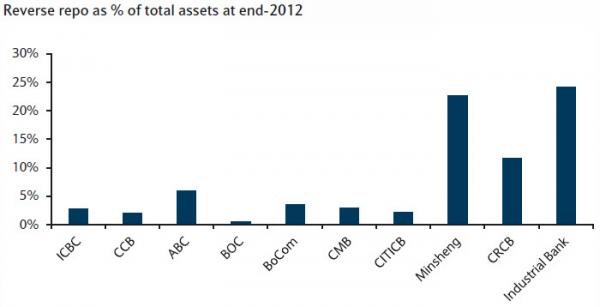
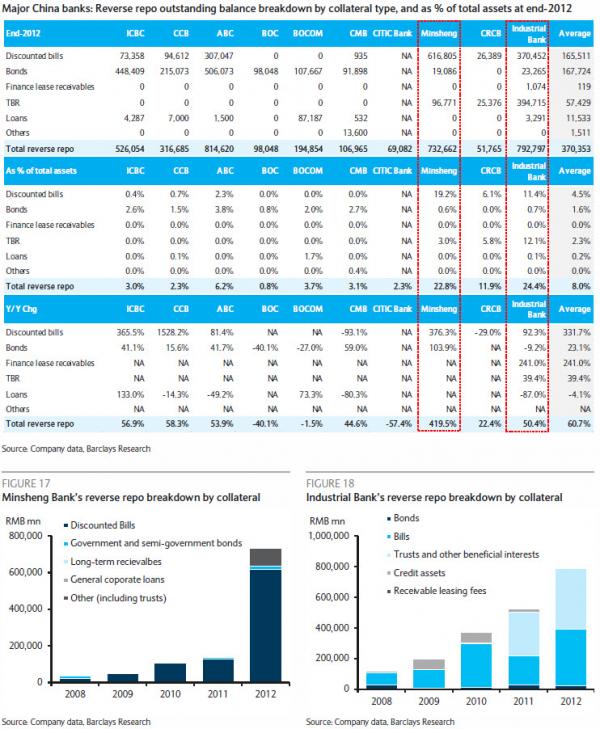
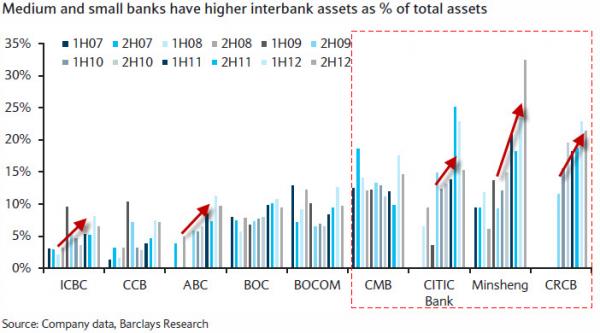
With China’s credit-to-GDP ratio over 200%, it appears, as Barclays notes, that the PBoC is acting in line with the government’s efforts to deleverage, rebalance and position the economy towards a path for sustainable growth. Though they expect that the PBoC is likely to stabilize the interbank market in the near term (perhaps by more of the same ‘isolated’ cash injections), short-term rates are likely to remain elevated, at least for a while, possibly leading to the failing of some smaller financial institutions. With the small- and medium-sized banks having grown considerably quicker than the larger banks, having been more aggressive on interbank business (i.e. alternative channels to get around lending constraints), thefollowing banks are at most risk of major disturbance of the funding markets remain stressed leaving the potential for retail bank runs or greater fragmentation in the commercial bank market. Read more of this post

Big Steel is a very big problem for China; Wisco is a large part of an ailing, inefficient industry that Beijing appears unable to discipline

June 19, 2013 5:07 pm

Big Steel has become a very big problem for China

By John Gapper

Wisco is a large part of an ailing, inefficient industry that Beijing appears unable to discipline

Even by China’s standards, Wuhan Iron & Steel is enormous. As we drive along the four-lane highway beside the 22 sq km site – with its eight blast furnaces, hot and cold rolling mills, port on the Yangtze River and Red Steel City workers’ town where 300,000 people live – the scale of Mao Zedong’s favourite steelworks is staggering.

It has its own Guggenheim-like museum, displaying photographs of every Chinese leader, from Mao through Deng Xiaoping to Xi Jinping, the president, and Li Keqiang, the premier, visiting the plant. It dominates the Qingshan district of Wuhan, a rapidly expanding city of 10m in Hubei province that is building a 12-line subway system – and eight satellite cities – to cope. Read more of this post

The Bronze Swan Redux; Is The End Of Copper Financing China’s “Lehman Event”?

Here Is What’s Going On In China: The Bronze Swan Redux

Tyler Durden on 06/20/2013 11:15 -0400

China 4_0 (1) China 3_0 (1) China 5_0 (1)

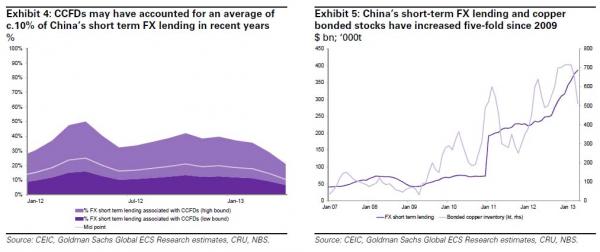
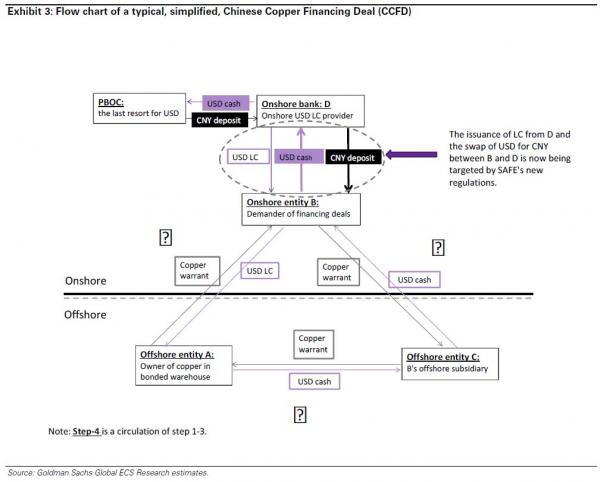
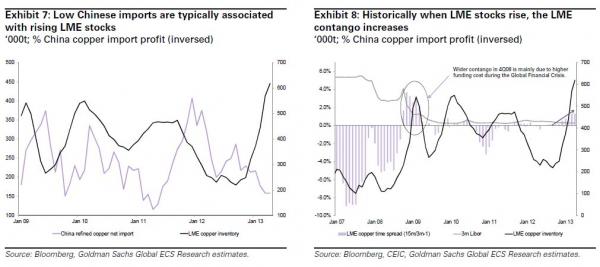
A month ago, when stock markets around the globe were hitting all time highs, we wrote “The Bronze Swan Arrives: Is The End Of Copper Financing China’s “Lehman Event”?” which as so often happens, many read, but few appreciated for what it truly was – the end of a major shadow leverage conduit (one involving unlimited rehypothecation at that),and the collapse of a core source of shadow liquidity. One month later, China’s “Lehman event” is on the verge of appearing, and with Overnight repo rates hitting 25% last night, coupled with rumors of bank bailouts rampant, it very well already may have but don’t expect the secretive Chinese politburo and PBOC to disclose it any time soon. So now that the market has finally once again caught up with reality, for the benefit of all those who missed it the first time, here is, once again, a look at the arrival of China’s Bronze Swan.

Read more of this post

Chinese Miners Suffer Hangover after Recent Binge Buying and many ran into problems with overseas deals

06.19.2013 16:48

Chinese Miners Suffer Hangover after Recent Binge Buying

Firms’ appetite for new purchases has dwindled after many ran into problems with overseas deals

By staff reporters Pu Jun and Zhang Boling

(Beijing) — The international mining industry saw mergers and acquisitions slow in 2012.

Accounting firm PricewaterhouseCoopers says a total of 1,803 M&As were reported in the international mining sector last year, down 30 percent from 2011 and the lowest level since 2005. The total transaction value was US$ 110 billion, down 26 percent from 2011. The slowdown has continued this year. Read more of this post

U.S. Icons Now Made of Chinese Steel; The Verrazano-Narrows Bridge was a feat of American engineering when it was built across New York’s harbor in the 1960s. Now, it’s being repaired with steel made in China

June 19, 2013, 9:02 p.m. ET

U.S. Icons Now Made of Chinese Steel

Imports Surge While U.S. Mills Idle; Lacking Bridge Expertise at Home

By JOHN W. MILLER and CHUIN-WEI YAP

MK-CE138_BRIDGE_G_20130619180604

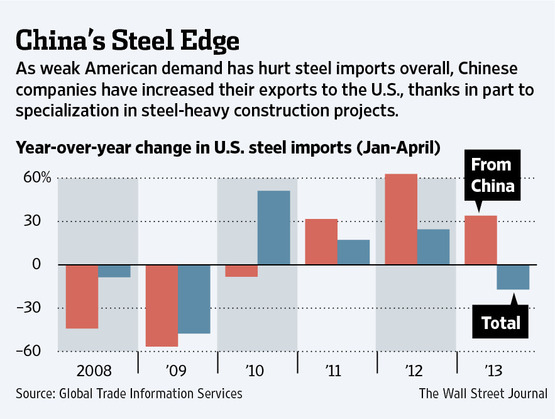
The Verrazano-Narrows Bridge was a feat of American engineering when it was built across New York’s harbor in the 1960s. Now, it’s being repaired with steel made in China. Chinese steel imports have surged so far this year, even as U.S. producers are awash with excess domestic capacity. Chinese steel was also recently used in the San Francisco-Oakland Bay Bridge. The reason is partly because Chinese-made steel is cheaper. In fact, U.S. steel companies argue its price is unfairly subsidized, and want the U.S. government to restrict imports as much as possible. China claims it is simply a more efficient producer.

Read more of this post

China Internet Security Stocks Rally on Snowden on speculation they will benefit from increased demand to protect domestic computer networks

China Internet Security Stocks Rally on Snowden: Shenzhen Mover

Surfilter Network Technology Co. jumped to a record as Chinese Internet security companies rallied on speculation they will benefit from increased demand to protect domestic computer networks.

Surfilter Network Technology, which provides website security products, jumped 6 percent to 25.49 yuan at the 11:30 a.m. local-time break in Shenzhen. Bluedon Information Safe Technology Co. (300297) added to yesterday’s 10 percent jump, rising 3 percent to 23.98 yuan. The Shenzhen Composite Index slid 1.1 percent, while the Shanghai Composite Index (SHCOMP) dropped 1.2 percent. Read more of this post

Capital of Chinese Province With Worst Smog Restricts Car Sales

Capital of Chinese Province With Worst Smog Restricts Car Sales

One of China’s most polluted cities will limit vehicle ownership through a lottery, becoming the latest locality to do so in the world’s largest auto market as air quality and traffic congestion worsen.

Shijiazhuang, the capital of steel-producing Hebei province surrounding Beijing, will restrict the number of new vehicles to 100,000 this year and limit households to owning two cars, according to a Shijiazhuang Daily report posted on the local government’s website today. That quota will be cut to 90,000 in 2015, with a lottery being used to determine who can buy cars, the report said. Read more of this post

L.A. Breaks Driving Addiction as Bike-Train Commutes Grow

L.A. Breaks Driving Addiction as Bike-Train Commutes Grow

Los Angeles embodied America’s love affair with the automobile in the last century. In this one it’s trying to kick the car to the curb.

The city that put drive-thru restaurants on the map has doubled its network of bike lanes to 292 miles (470 kilometers) and expanded light rail by 26 percent in the past eight years, with another 18 miles of track coming by 2015. Bus and train ridership is on the rise, while the total number of passenger cars registered has declined in Los Angeles County — evidence more commuters are breaking their dependence. Read more of this post

Student Debt Relief Industry Profits From Desperation

Student Debt Relief Industry Profits From Desperation

Polly Williams, a single mother who had recently lost her job, was desperate to lower the payments on her $23,000 in student loans. So, last June, she called one of the many companies advertising debt relief online.

For a $250 fee, the University of One, now known as Student Consulting Group Inc., offered to help. To come up with the money, Williams skipped an electric bill and lost power, forcing her to throw out $150 of food in her refrigerator, she said. Read more of this post

Jumping off the REIT bandwagon; Bond Investors Head for the Hills; As interest rates rise, banks face new stress tests

Jumping off the REIT bandwagon

Garry Marr | 13/06/18 | Last Updated: 13/06/18 6:32 PM ET

MI-BW642_BONDS_G_20130618183908

That pop you heard might have been the bubble finally bursting — at least for real estate investment trusts if not housing.

Reader wonders if his $100,000 should be invested in a private REIT. ‘That’s like going to the roulette table and putting all your money on red,’ says Jason Heath

Rising bond yields have brought down the publicly traded real estate sector since it hit an all-time high at the end of April. The iShares S&P/TSX Capped REIT Index Fund dropped about 12% before recovering about two percentage points off that fall in the past week or so. Read more of this post

To succeed in India, a company must meet these three criteria

To succeed in India, a company must meet these three criteria

By Ravi Venkatesan 5 hours ago

Ravi Venkatesan is the former chairman of Microsoft India and Cummins India.

Many multinational companies are quite pleased with their performance in India. That’s because they have set quite a low bar for success. To most, the fact that their business in India is meeting budget or growing at double-digit rates is significant. But that isn’t success. Companies can be growing at double-digit rates and meeting budgets, and still be irrelevant to their parent and in India. McKinsey & Company analysis shows that the 25 largest, publicly listed multinational companies in India contributed just 2% of their parent’s global revenues and profits in 2011. That’s telling, especially since many of them have been operating in India for a long time. The Indian operations of companies that have set up shop since 1991 as wholly owned subsidiaries contribute an even more anemic 1% of their parent’s revenues and profits. If all these operations grow at roughly the same pace as their industry, even after a decade their contribution will still be extremely modest. Real success in India, I would argue, means meeting three criteria:

Read more of this post

SEC Says It Will Seek Admission of Wrongdoing More Often

SEC Says It Will Seek Admission of Wrongdoing More Often

By Dave Michaels – Jun 19, 2013

The U.S. Securities and Exchange Commission will seek more admissions of wrongdoing from defendants as a condition of settling enforcement cases, the agency’s chairman said.

SEC Chairman Mary Jo White said the change in policy would probably apply to cases in which investors were significantly harmed and the alleged fraud was egregious. The former federal prosecutor said last month she was reviewing the practice of settling cases without requiring defendants to admit misconduct. Read more of this post

Global fish prices leap to all-time high

June 18, 2013 4:18 pm

Global fish prices leap to all-time high

By Emiko Terazono in London

Global fish prices have leapt to all-time highs as China’s growing appetite for high-end species – from tuna to oysters – runs up against lower catches.

The UN Food and Agriculture Organisation’s global fish price index, an industry benchmark that tracks the cost of wild and farmed seafood, hit a record high in May, up 15 per cent from a year ago and above the peak set in mid 2011. Read more of this post

Gems says it is the world’s largest private education provider with 130,000 students at 100 schools in 19 countries and $500m revenue this year

June 18, 2013 3:55 pm

School rooms for everyone

By Simeon Kerr

images (15)

Desk work: Sunny Varkey keeps in touch with the ‘front line’ by regularly dropping into schools unannounced and talking to parents

In the library of Wellington International School, Sunny Varkey is chatting with a group of 20 or so five-year-old pupils about the books they read. The parents of these boys and girls in white and navy uniforms rifling the low shelves pay about $12,000 a year for them to attend one of the academically best performing schools inDubai. Read more of this post

India: A bumpy, crowded road for carmakers

June 18, 2013 7:35 pm

India: A bumpy, crowded road for carmakers

By James Crabtree and Henry Foy

Global groups looking to cash in on a boom face a dilemma about how much more to invest as sales slide

Sanand seems an unlikely spot for a global automotive hub. A small, dusty backwater in the western Indian state of Gujarat, its population is barely 30,000. Yet over the past few years this sleepy town has undergone an improbable transformation and is now often hailed as a “new Detroit” in the making. Read more of this post

North American Millionaires Regain Top Spot, Report Finds

North American Millionaires Regain Top Spot, Report Finds

North America reclaimed the top spot with the most millionaires last year as the world’s ultra-rich led the way in raising global wealth to a record high, according to a report by Cap Gemini SA and Royal Bank of Canada. Read more of this post

Why Companies Shouldn’t Write Off India

Why Companies Shouldn’t Write Off India

Asked late last year about the market for Apple Inc. (APPL) products in India, Chief Executive Officer Tim Cook more or less wrote off the huge country.

He blamed a “multilayer distribution structure” for making it too hard to reach consumers beyond elites in cities such as Mumbai and Bangalore. Apple (AAPL) would look elsewhere for growth: “In the intermediate term there will be larger opportunities outside there,” Cook said. Today, India — with a middle class the size of the U.S. population — accounts for less than 1 percent of Apple’s global sales. Read more of this post

Chinese TV Spy Thriller Producer Fu Meicheng, chairman of Zhejiang Huace Film & TV, Becomes a Billionaire

Chinese TV Spy Thriller Producer Fu Becomes a Billionaire

b1d5dbb35d6e4f41_Fu_Meicheng

Fu Meicheng, chairman of Zhejiang Huace Film & TV Co. (300133), has become a billionaire as shares of the maker of Chinese TV shows climbed to a record after it boosted production of its historical dramas and spy thrillers.

Huace, based in Hangzhou, China, makes and distributes programming to TV channels and video-sharing websites. Its TV production increased 65 percent to 1,075 episodes in 2012, according to its annual report. Shares have more than doubled this year on the Shenzhen Stock Exchange. Read more of this post

Packaged-food companies are developing meals that aim to be quick and simple to prepare, but still feel like cooking from scratch. Kraft’s new line has two sauces. Testing showed people feel using two sauces feels more like real cook

Updated June 18, 2013, 9:22 p.m. ET

The Art of Almost Homemade

Companies Target Time-Crunched Home Cooks; Why Wednesday is the Worst

By SARAH NASSAUER

PJ-BO939A_JUSTE_G_20130618212602

What do people want for dinner? To feel like they cooked “just enough,” food companies say, and they are trying to come up with products that hit that sweet spot. Sarah Nassauer joins Lunch Break with a look at new products that walk the fine line between too much and not enough cooking. This moment may sound familiar: It’s 4 p.m. on Wednesday, and you realize the dinner you had been planning to make isn’t going to work out. It’s one of the most stressful points of weekday life, according to consumer research. Now in response, packaged-food companies and grocery stores are developing meals that aim to strike a delicate balance. They are quick and simple to prepare, but still feel like cooking a homemade meal.

Read more of this post

Toxic Toast Concerns Feed Food Enzyme Sales at Novozymes to DSM; food companies want to be able to document that all along they were using the best technology

Toxic Toast Concerns Feed Food Enzyme Sales at Novozymes to DSM

Food companies, facing increased scrutiny over the potential cancer risks of baked and fried products in the $80 billion crackers and cookies market, are bingeing on enzymes used to reduce the level of toxins.

The beneficiaries are Novozymes A/S (NZYMB) and Royal DSM NV (DSM), the two main suppliers of enzymes that cut levels of acrylamide, formed when starchy foods are browned and coffee beans roasted. While a link between human cancer and acrylamide hasn’t been established, food companies such as Oreo cookies maker Mondelez International Inc. (MDLZ) are turning to enzymes to cut levels, preempting any regulatory move to introduce warnings labels.“People want to use best-available technology and, if this proves to be a serious issue, food companies want to be able to document that all along they were using the best technology,” Novozymes Chief Executive Officer Peder Holk Nielsen said in an interview. Novozymes is supplying 70 companies globally and demand is “going very well.” Read more of this post

Missing the Target: Target-date funds have become one of the most important ways that Americans save for retirement. But for many investors, the funds are still wide of the mark

June 14, 2013, 6:05 p.m. ET

Missing the Target

By LIAM PLEVEN and JOE LIGHT

BF-AF142_15WIcv_G_20130614180602

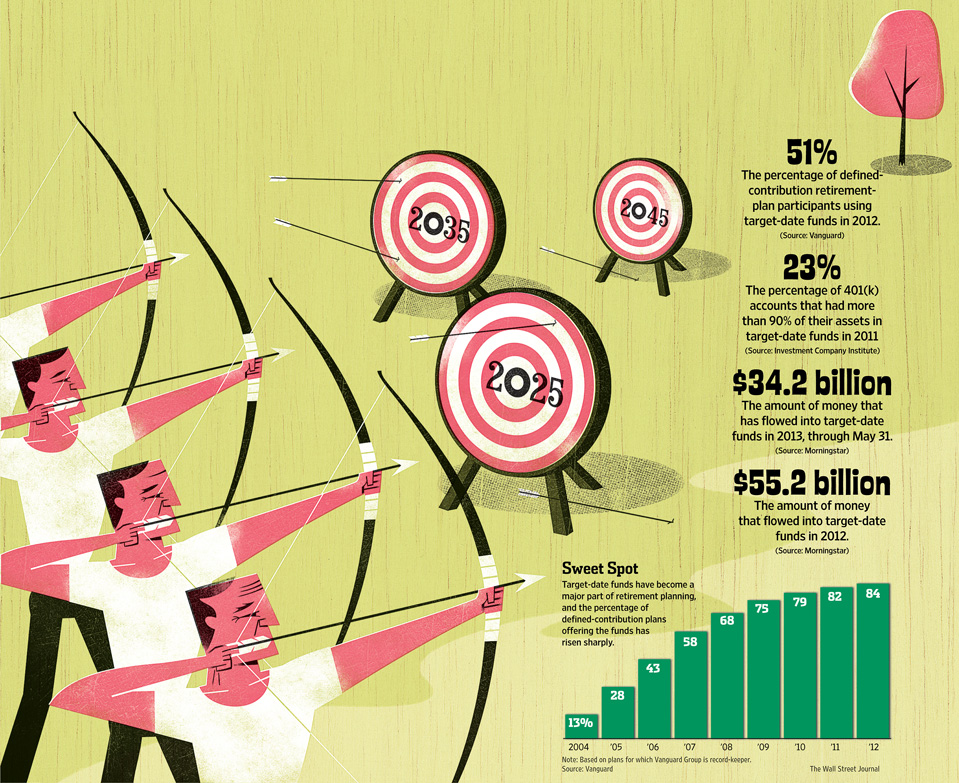
Target-date funds have become one of the most important ways that Americans save for retirement. But for many investors, the funds are still wide of the mark. The funds generally are set up so that investors can put their entire nest egg into a single one linked to the year they expect to retire, in effect putting a savings strategy on autopilot. The funds typically shrink their stock allocation and boost the bond allocation to become more conservative as the retirement date nears. Read more of this post

The slow boat to China is what gives FedEx executives nightmares

June 18, 2013, 5:58 p.m. ET

FedEx Down, Not Out, on Express Slump

By SPENCER JAKAB

MI-BW629_AOT_NS_20130618182703

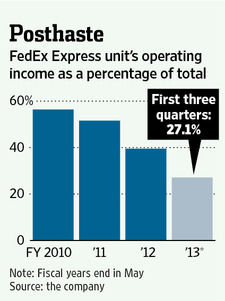
The slow boat to China is what gives FedEx Corp. executives nightmares.

Though it still dominates in express delivery, its customers are feeling less urgency these days—particularly those shipping packages internationally. The world’s largest air-freight company by volume is furiously cutting costs to accommodate those customers who don’t absolutely, positively have to get it there overnight. The slowdown in international trade and an even sharper one in time-sensitive deliveries loom over FedEx as it unveils results for fiscal 2013 Wednesday. Read more of this post

Niall Ferguson: The Regulated States of America; Tocqueville saw a nation of individuals who were defiant of authority. Today? Welcome to Planet Government

June 18, 2013, 6:43 p.m. ET

Niall Ferguson: The Regulated States of America

Tocqueville saw a nation of individuals who were defiant of authority. Today? Welcome to Planet Government.

By NIALL FERGUSON

In “Democracy in America,” published in 1833, Alexis de Tocqueville marveled at the way Americans preferred voluntary association to government regulation. “The inhabitant of the United States,” he wrote, “has only a defiant and restive regard for social authority and he appeals to it . . . only when he cannot do without it.” Read more of this post

Traders Try to Game Platts Oil-Price Benchmarks

Updated June 18, 2013, 10:38 p.m. ET

Traders Try to Game Platts Oil-Price Benchmarks

By JUSTIN SCHECK and JENNY GROSS

P1-BL953_OILTRA_NS_20130618190305 P1-BL955_OILTRA_G_20130618181507 P1-BL954_OILTRA_G_20130618181213

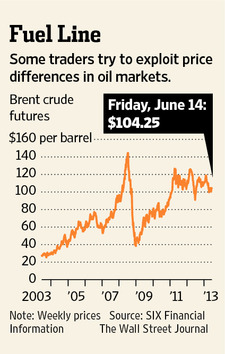
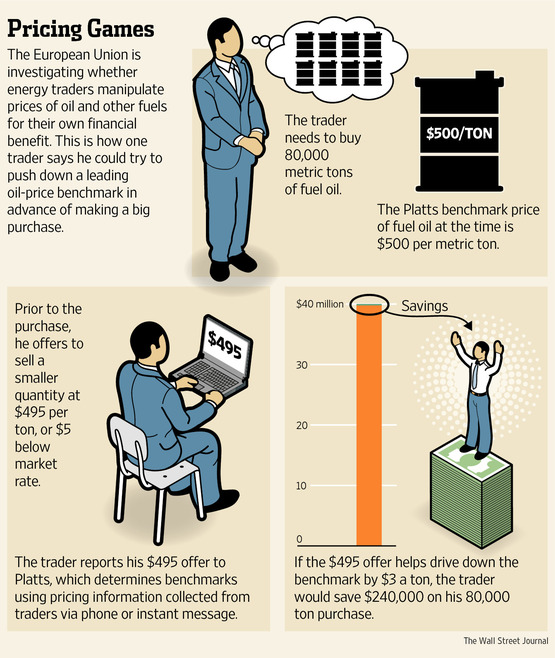
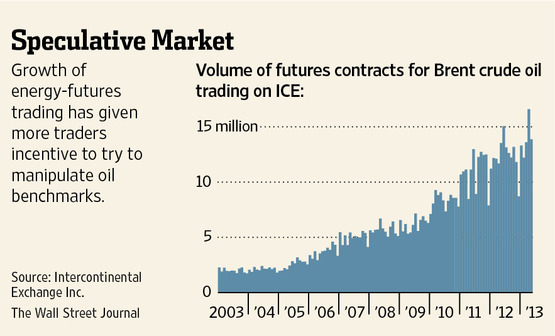
LONDON—The European Union says it is searching for evidence that oil traders manipulate prices. If oil trader Halis Bektas is correct, it shouldn’t be hard to find.

Mr. Bektas describes one strategy he has used himself: Offer to sell a small amount at a loss to drive down published oil prices, then snap up shiploads at the lower price.

The European Union is investigating whether oil traders manipulate the benchmarks posted daily by oil index publisher Platts in order to affect energy prices. WSJ’s Jenny Gross reports. Read more of this post

How China Fudges its Numbers

June 19, 2013, 12:42 PM

How China Fudges its Numbers

It’s typically advisable not to accept Chinese economic data at face value –as even the country’s own premier will tell you. Figures on everything from inflation and industrial output to energy consumption and international trade often don’t seem to gel with observation and sometimes struggle to stack up when compared with other indicators.

How the figures are massaged and by whom is as much a secret as the real data itself. But in an unusual move, the National Bureau of Statistics – clearly frustrated with the lies, damn lies – has recently outed a local government it says was involved in a particularly egregious case of number fudging, providing rare insight into just how just how we’re being deceived. Read more of this post