Chinese football super league becomes club for real estate firms

Chinese football super league becomes club for real estate firms

Staff Reporter

2014-02-17

Chinese financial group Ping An is rumored to have won the bid as the new sponsor of the Chinese Football Association Super League (CSL), a professional association mainly comprised of clubs backed by property companies, reports the Shanghai-based First Financial Daily. Read more of this post

China has the world’s biggest trade deficit-in services

China has the world’s biggest trade deficit—in services

Feb 15th 2014 | HONG KONG | From the print edition

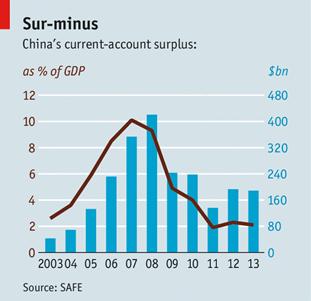
NOT long ago, China’s cheap currency and its large current-account surplus were the biggest controversies in global economics. American policymakers accused China of manipulating its currency for competitive gain and flew to Beijing to convey their displeasure. Some commentators blamed the global financial crisis on China’s surplus and its accumulation of safe American bonds, which encouraged America’s financial industry to invent lucrative, but toxic, substitutes. After the crisis, they then blamed China’s surplus for America’s failure to export its way out of trouble.

image001-14

The controversy has never entirely disappeared, but it has diminished. Having peaked at over 10% of GDP in 2007 (see chart), the surplus narrowed to just over 2% of GDP ($189 billion) last year, according to figures released last week. China’s exports of goods vastly exceeded its imports, as always. But this imbalance was partially offset by another component of trade: services. At $122 billion in 2013, China’s services deficit is by far the biggest in the world. Read more of this post

Global coffee chain Gloria Jean’s will close up to 25 of its 400 Australian outlets by the end of March as it quits corporate-run stores and becomes a franchise-only business

Michael Bleby Reporter

Gloria Jean’s to close 25 outlets in switch to franchise-only model

Published 17 February 2014 11:10, Updated 17 February 2014 11:58

Global coffee chain Gloria Jean’s will close up to 25 of its 400 Australian outlets by the end of March as it quits corporate-run stores and becomes a franchise-only business. Read more of this post

Manufacturers must specialise and customise: boss of Australia’s high-tech van company Byron Group

Manufacturers must specialise and customise: boss of high-tech van company Byron Group

Published 13 February 2014 11:22, Updated 14 February 2014 09:07

Simon Evans

image001-13

Byron Group CEO Bill Pike says there’s no future in mass manufacturing. Nic Walker

Bill Pike says there is “absolutely a future for manufacturing in Australia, but it’s not in mass manufacturing’’.

Mr Pike is chief executive of Byron Group, a thriving Sydney company with annual revenues of $50 million that supplies high-tech ambulances, ­correctional services vans and aged-care transport vehicles to domestic and export customers. Read more of this post

Why is Korea becoming less foreign biz-friendly?

2014-02-16 10:05

Why is Korea becoming less foreign biz-friendly?

By Lee Hyo-sik
President Park Geun-hye has been making the sales pitch that Korea is a good place for doing business, whenever she visits foreign countries. At home, the President holds meetings with CEOs of non-Korean companies operating here and visiting heads of multinational firms, asking them to expand investments and hire more workers in Asia’s fourth-largest economy.
However, her endeavors, while aimed at helping revive the sagging domestic economy, will not likely bear fruit unless Korea drastically improves its business environment for foreign corporations. Read more of this post

The end of cross-listings globally? BHP mulled leaving London and dropping dual listing

BHP mulled leaving London and dropping dual listing

February 17, 2014 – 3:42PM

James Chessell

BHP gained its London listing in June 2001. Some believe it is now looking to change its dual-listed structure. Photo: Reuters

Has BHP Billiton been reconsidering its dual listing on the Australian and London stock exchanges? The official line from the worlds largest diversified resources is that no serious work has been done on collapsing the dual-listed company structure. A BHP spokewoman said: “We think this structure has worked and continues to serve shareholders well”. Read more of this post

The affiliates of the 10 largest business groups accounted for around 54.66% of South Korea’s total stock market cap

2014-02-17 09:50

Top 10 conglomerates suffer 5.3 pct fall in market cap this year

South Korea’s top 10 conglomerates saw their stock market cap sink 5.32 percent this year, as most affiliated firms suffered a decline in their share prices amid a bearish run on the local stock market, data showed on Monday.
The combined market capitalization of affiliates under their wings stood at 693.86 trillion won ($653 billion) as of Wednesday, compared with 732.84 trillion won at the end of last year, according to the data compiled by the Korea Exchange. Read more of this post

‘It’s not what you do but how you do it’: Chaebol urged to build trust through tranparency and communication

2014-02-16 16:15

‘It’s not what you do but how you do it’

Chaebol urged to build trust through tranparency and communication
Kim Bo-eun

The troubled chaebol chiefs have recently come under the spotlight. Controversies arose as several received reduced sentences in the trials that took place earlier this month. Currently, a handful of conglomerate chairmen are either awaiting trial, on trial or have been sentenced for embezzlement, breach of trust and tax evasion.
This gives a stark picture of the levels of integrity at the nation’s most successful companies. While conglomerates such as Samsung and LG are world leaders in technology, they barely meet standards of integrity. Read more of this post

Bloated national debt; Korea’s total public sector debt was estimated at about 821 trillion won; Korean economy is also saddled in enormous household debt worth nearly 1,000 trillion won and 1,500 trillion won in corporate debt

2014-02-16 16:51

Bloated national debt

Korea’s total public sector debt was estimated at about 821 trillion won as of the end of last year under a new international standard recommended by the International Monetary Fund (IMF). The newly calculated debt, owed by both central and local governments and non-financial state companies and organizations, represents 64.5 percent of the country’s gross domestic product (GDP). Read more of this post

Gov’t to slash holding co’s required stake in 3rd-tier subsidiary from 100% to 20%

Gov’t to slash holding co’s required stake in 3rd-tier subsidiary from 100% to 20%

Shin Hyun-gyu, Kim Yoo-tae

2014.02.13 17:54:14

The South Korean government decided to implement a measure to induce conglomerates to invest their internal reserves to stimulate the creative economy and venture business industry.  Read more of this post

Forex in the spotlight: Banks are braced for multibillion-dollar fines and years of litigation from a global probe

February 16, 2014 6:15 pm

Forex in the spotlight

By FT reporters

Banks are braced for multibillion-dollar fines and years of litigation from a global probe

The annual Prime Finance get-together in The Hague is a rather arid affair, with a coterie of academics, lawyers and the odd banker gathering to discuss the finer points of jurisprudence in the international markets. Read more of this post

Tycoons quarrel over Italy’s young jobless; Two of Italy’s business heavyweights have gone to war over the country’s soaring levels of youth unemployment

Tycoons quarrel over Italy’s young jobless

Two of Italy’s business heavyweights have gone to war over the country’s soaring levels of youth unemployment

Italy’s youth unemployment reached a record 41.6pc in January

By Josephine McKenna, in Rome

11:04PM GMT 16 Feb 2014

Two of Italy’s business heavyweights have gone to war over the country’s soaring levels of youth unemployment. Read more of this post

Home prices could drop by up to 15 per cent: DBS chief

Home prices could drop by up to 15 per cent: DBS chief

Monday, Feb 17, 2014

Mok Fei Fei

The Straits Times

SINGAPORE – House prices could plunge by up to 15 per cent this year amid a softening property market, said DBS chief executive Piyush Gupta on Friday.

Mr Gupta also said that he expects property cooling measures to be wound back if prices start heading south. Read more of this post

Malaysia is 3rd cheapest place to buy a Big Mac

Malaysia is 3rd cheapest place to buy a Big Mac

Sunday, February 16, 2014 – 16:47

New Straits Times

KUALA LUMPUR – Malaysia has been ranked one of the cheapest places in the world to purchase a Big Mac, according to The Economist.

The British news magazine’s annual “Big Mac” Index, which gauges if global currencies are at their correct level, has ranked Malaysia third behind India and South Africa as the cheapest place in the world to purchase the McDonald’s signature burger. Read more of this post

World’s largest solar plant scorching birds in Nevada desert

World’s largest solar plant scorching birds in Nevada desert

Published February 15, 2014

FoxNews.com

A stretch of the Mojave Desert has been transformed by hundreds of thousands of mirrors into the largest solar power plant of its type in the world, but the milestone is being met with criticism from environmental groups concerned about the effect of solar energy on desert wildlife.  Read more of this post

The presence of China-based developers in Iskandar Malaysia could be a bitter-sweet experience for the property market in the state. Overhang likely to appear in secondary market

Updated: Saturday February 15, 2014 MYT 10:35:17 AM

Overhang likely to appear in secondary market

BY EUGENE MAHALINGAM

THE presence of China-based developers in Iskandar Malaysia could be a bitter-sweet experience for the property market in the state.

On one hand, their presence in Johor would lead to the “internationalisation” of the property sector in the state but others are worried about the overhang that awaits the secondary market when buyers decide to sell. Read more of this post

Hon Hai to give employees the chance to be bosses: chairman

Hon Hai to give employees the chance to be bosses: chairman

CNA

2014-02-16

Terry Gou, the chairperson of Hon Hai Precision Industry, the world’s largest contract electronics maker, said on Friday when asked about his successor that he may end up with more than one.

“I want Hon Hai employees to have a chance to be bosses,” Gou said Friday at Hon Hai’s New Taipei headquarters during a celebration held by the company to formally kick off work after the Lunar New Year holiday. Read more of this post

Why emerging market investors should avoid bandwagons; In more peaceful times, investors are modestly rewarded for taking emerging market risk, but to benefit fully they need a contrarian approach and to avoid jumping on bandwagons

Why emerging market investors should avoid bandwagons

In more peaceful times, investors are modestly rewarded for taking emerging market risk, but to benefit fully they need a contrarian approach and to avoid jumping on bandwagons

Emerging markets represent 13pc of the value of the world’s stock markets today and a third of global economic output. That compares with just 1pc of market capitalisation and 18pc of GDP 30 years ago.  Read more of this post

Start-Up America: Our Best Hope

Start-Up America: Our Best Hope

FEB. 15, 2014

Thomas L. Friedman

PALO ALTO, Calif. — THE most striking thing about visiting Silicon Valley these days is how many creative ideas you can hear in just 48 hours.

Jeff Weiner, the chief executive of LinkedIn, explains how his company aims to build an economic graph that will link together the whole global work force with every job being offered in the world, full-time and temporary, for-profit and volunteer, the skills needed for each job, and a presence for every higher education institution everywhere offering a way to acquire those skills. Read more of this post

The Untouchable Profits of Fannie Mae and Freddie Mac

The Untouchable Profits of Fannie Mae and Freddie Mac

FEB. 15, 2014

Fair Game

By GRETCHEN MORGENSON

Would you buy stock in a company that barred you from sharing in its future earnings? Of course not. Participating in the upside is what stock ownership is all about.

And yet, as of December 2010, holders of Fannie Mae and Freddie Maccommon stock were subject to such a restriction by the United States government. They didn’t know it at the time, though, because the policy was not disclosed.

This month, an internal United States Treasury memo that outlined this restriction came up at a forum in Washington.

The memo was addressed to Timothy F. Geithner, then the Treasury secretary, from Jeffrey A. Goldstein, then the under secretary for domestic finance. In discussing Fannie and Freddie, the beleaguered government-sponsored enterprises rescued by taxpayers in September 2008, the memo referred to “the administration’s commitment to ensure existing common equity holders will not have access to any positive earnings from the G.S.E.’s in the future.”

The memo, which was produced in a lawsuit filed by Fannie and Freddie shareholders, was dated Dec. 20, 2010. Securities laws require material information — that is, information that might affect an investor’s view of a company — to be disclosed. That the government would deny a company’s shareholders all its profits certainly seems material, but the existence of this policy cannot be found in the financial filings of Fannie Mae. Neither have the Treasury’s discussions about the future of the two finance giants mentioned the administration’s commitment to shut common stockholders out of future earnings. Freddie Mac’s filings do refer, albeit incompletely, to the administration’s stance, noting that the Treasury “has indicated that it remains committed to protecting taxpayers and ensuring that our future positive earnings are returned to taxpayers as compensation for their investment.” Note that this reference does not say all earnings.

Lewis D. Lowenfels, a securities law expert in New York, found this statement insufficient. “If there is disclosure regarding future Fannie and Freddie earnings and the administration has a commitment that existing Fannie and Freddie common equity holders will never receive any future positive earnings,” he said, “this commitment would be material to investors and should be disclosed.”

When the memo was written, plenty of people held these stocks. Regulatory filings show that 18,000 investors held 1.1 billion shares of Fannie Mae common stock, while just over 2,100 investors held 650 million Freddie Mac shares.

Back in 2010 and 2011, of course, common stockholders of Fannie and Freddie had little hope of making much money. During those days of rampant mortgage defaults and losses, investors were warned about the uncertainty of their companies’ prospects. Fannie and Freddie shareholders were repeatedly told that the preferred and common stock would have value only if anything remained after taxpayers were fully repaid for the rescue. With the amount of that rescue peaking at $189.5 billion, that was a very big “if.” On the day the Treasury memo was written, the price of Fannie Mae shares closed at 34 cents.

But the companies staged a turnaround; in mid-2012, they began earning billions. With interest rates low and banks not lending, Fannie and Freddie became the only mortgage game in town. By Sept. 30 of last year, the companies had returned $185 billion to the Treasury.

Failing to disclose the administration’s hard line on the companies’ shareholders is disturbing for another reason. In bailing out Fannie and Freddie, the Treasury received warrants — optionlike securities that rise in value when the shares underlying them do. When investors, hoping for a housing recovery, flocked to the shares and pushed them higher, the value of the warrants increased. Fannie’s common stock now trades at $3.06 a share.

Given Treasury’s interest in a rising stock price, depriving common equity holders of future earnings was especially important for investors to know, Mr. Lowenfels said.

A spokesman for the Treasury declined to comment. Mr. Geithner did not respond to an email, and Mr. Goldstein, now a managing director at Hellman & Friedman, a private equity firm, did not return a phone call. (After the deadline for publication of this column had passed, spokespeople for the Treasury Department and Mr. Geithner offered comments.)

All of this has come to a boil because Fannie and Freddie have become so profitable. Yet because of a change in the repayment process dictated by the Treasury in 2012, the $189.5 billion debt technically remains outstanding. The profits generated by Fannie and Freddie have instead gone to the general treasury.

I have been critical of these companies, but this change in the bailout terms seems punitive, especially when considering how other bailout recipients were treated. And it has led to lawsuits against the government from Fannie and Freddie shareholders, including insurance companies, a mutual fund and a hedge fund. The plaintiffs contend that the government’s 2012 decision to take all the companies’ profit — just as it was starting to balloon — was illegal under the 2008 law that rescued them.

After all, back in 2008, the companies were not put into receivership, the equivalent of bankruptcy. Rather, they were placed under the care of a conservator — the Federal Housing Finance Agency. That conservator was supposed to put the companies “in a sound and solvent condition” and “preserve and conserve the assets and property” of each entity.

Siphoning off the entities’ profits is the opposite of conserving their assets and property, the plaintiffs contend. And they point to a 2009 Treasury memo stating that the conservatorship of Fannie and Freddie “preserves the status and claims” of preferred and common shareholders. One of those claims is surely having access to future earnings.

A spokeswoman for the Federal Housing Finance Agency declined to comment, citing the litigation. A spokesmen for Fannie declined to comment as well. A Freddie Mac official did not elaborate beyond pointing to the language in its filings.

Perry Capital, a hedge fund, is one of the plaintiffs suing the government. Its lawsuit seeks no damages, but asks that the government follow the 2008 law. The 2010 memo was produced by the Treasury in response to this lawsuit.

Do the Treasury’s actions amount to a backdoor nationalization of the companies? A full-fledged takeover would have required Treasury to put all the companies’ obligations — $4.9 trillion at the time — on the government’s balance sheet. A nonstarter.

Furthermore, nationalization would have required the government to provide compensation to shareholders for what it took. Now the government gets the benefits of the companies’ profits while avoiding any compensation payments.

“People disagree about what should happen to the G.S.E.’s,” said Matthew D. McGill, a lawyer at Gibson, Dunn & Crutcher in Washington who represents Perry Capital. “But if the plan is to wind them down, Congress provided a means to do that in the 2008 law — it’s called receivership, and it provides a host of procedural protections to claimants. What the Treasury cannot do is abuse its conservatorship powers to nationalize the companies and then, when it deems convenient, wind them down without the protections enacted by Congress.”

 

The Case for Swapping Roles With China; A new book by Stephen Roach says it’s time for the United States to be more of a producer and for China to be more of a consumer

The Case for Swapping Roles With China

FEB. 15, 2014

By FRED ANDREWS

Stephen Roach proposes to remake the two largest economies on the globe, ours and China’s. For decades, he writes, the United States and China relied too much on a “marriage of convenience” that guaranteed China a huge market for its exports. In exchange, China gave American consumers a cornucopia of inexpensive products, while creating a willing buyer of the United States government’s swollen debt. But that marriage has played out, Mr. Roach says; it has warped the two economies, leaving them ill-equipped for further growth. Read more of this post

Accounting ‘Dumping Ground’ Headed For Clean Up; International accounting rulemakers may focus on cleaning up rules for “other comprehensive income,” a category that can obscure the true profit and loss picture

February 13, 2014, 5:36 PM ET

Accounting ‘Dumping Ground’ Headed For Clean Up

EMILY CHASAN

Senior Editor

International accounting rulemakers may focus on cleaning up rules for “other comprehensive income,” a category in a company’s earnings statement that can obscure the true profit and loss picture, the chairman of the International Accounting Standards Board said this week. Read more of this post

Canberra Goes Private: Selling off state-owned enterprises benefits Australians

Canberra Goes Private

Selling off state-owned enterprises benefits Australians.

Feb. 13, 2014 12:01 p.m. ET

Finance ministers from the G-20 converge on Australia next week, and they might learn something from their host government in Canberra. Prime Minister Tony Abbott’s government has set out to privatize public assets worth up to 130 billion Australian dollars ($117 billion). Read more of this post

As David Tepper Was Pitching A 20x P/E, He Was Selling (And Buying) These Stocks

As David Tepper Was Pitching A 20x P/E, He Was Selling (And Buying) These Stocks

Tyler Durden on 02/14/2014 18:00 -0500

On October 15, well into the fourth quarter, David Tepper appeared on CNBC for his semi-annual stock pumpfest, most memorable for his suggestion that a 20x P/E multiple on the S&P was perfectly acceptable. Which would suggest Tepper was very bullish on risk. Which would suggest buying more stocks, not selling. Yet selling is precisely what he did between September 30 and December 31 for the vast majority of his top holdings according to his just released 13F. So what did he sell or liquidate? Read more of this post

Felix Zulauf Warns Of “Another Deflationary Episode” As “The Mother Of All Bubbles” Pops

Felix Zulauf Warns Of “Another Deflationary Episode” As “The Mother Of All Bubbles” Pops

Tyler Durden on 02/15/2014 17:01 -0500

“There is a valuation problem with most global equity markets – the most with the US,” warns Felix Zulauf in the following brief clip, adding that sentiment “is extremely one-sided,” but the classic bear-market-inducing recession, he notes, is not on the immediate horizon. Instead, he warns, other problems may be the catalyst for a correction in the US – specifically China’s “mother of all bubbles”, fragility in Asian banks, and balance of payments crises continuing in emerging markets. Zulauf suggests “you have to be short stocks, own US treasury bonds, and also buy gold as panic and risks go up.” Read more of this post

Scott Hodge: Here’s What ‘Income Equality’ Would Look Like Take about $4 trillion from the top 40% of families and give it to the bottom 60%—voilà, no more inequality.

Scott Hodge: Here’s What ‘Income Equality’ Would Look Like

Take about $4 trillion from the top 40% of families and give it to the bottom 60%—voilà, no more inequality.

SCOTT A. HODGE

Feb. 13, 2014 6:16 p.m. ET

President Obama has talked a lot recently about reducing income inequality. Yet he neither acknowledges how much money the government is redistributing, nor how much more would be needed to close the income gap. Perhaps that’s because the project would require redistribution on a staggering scale. Read more of this post

German Thriftiness Vexes Banks; A Glut of Deposits Has Lenders Struggling to Invest It All

German Thriftiness Vexes Banks

A Glut of Deposits Has Lenders Struggling to Invest It All

CHRISTOPHER LAWTON and LAURA STEVENS

Feb. 13, 2014 4:16 p.m. ET

FRANKFURT—Hauke Hanke’s frugality is becoming a problem for Germany’s banks. Like many of his compatriots, the 30-year-old scientist from Berlin typically saves as much as 25% of his paycheck every month. Read more of this post

Luxury hotel brands swap keys in India’s economic slump

Luxury hotel brands swap keys in India’s economic slump

Thursday, February 13, 2014 – 12:50

Aditi Shah

Reuters

Mumbai – Less than nine months after opening the first hotel in Mumbai under its brand, Hong Kong luxury chain operator Shangri-La Asia (0069.HK) handed the keys back to the owner. Read more of this post

India’s aviation sector struggling to soar

India’s aviation sector struggling to soar

Friday, Feb 14, 2014

Nirmala Ganapathy

The Straits Times

NEW DELHI – India’s aviation sector is starting to shake off the doldrums with the launch of two new airlines, at least one this year, in a rapidly expanding market. Read more of this post

Wall Street’s grandfathers of commodities to survive Fed revamp better than others

Wall Street’s grandfathers of commodities to survive Fed revamp better than others

Wed, Feb 12 2014

By Anna Louie Sussman

NEW YORK (Reuters) – As the U.S. Federal Reserve considers new ways of reining in banks’ trading in what it sees as risky physical commodity markets, Wall Street‘s two oldest and biggest players may ultimately gain in stature. Read more of this post