Why China Can’t Innovate

Why China Can’t Innovate

by Regina M. Abrami, William C. Kirby, and F. Warren McFarlan

The Chinese invented gunpowder, the compass, the waterwheel, paper money, long-distance banking, the civil service, and merit promotion. Until the early 19th century, China’s economy was more open and market driven than the economies of Europe. Today, though, many believe that the West is home to creative business thinkers and innovators, and that China is largely a land of rule-bound rote learners—a place where R&D is diligently pursued but breakthroughs are rare. Read more of this post

The benefits of shale oil are bigger than many Americans realise. Policy has yet to catch up

Saudi America: The benefits of shale oil are bigger than many Americans realise. Policy has yet to catch up

Feb 15th 2014 | MIDLAND, TEXAS | From the print edition

DENNIS LITHGOW is an oil man, but sees himself as a manufacturer. His factory is a vast expanse of brushland in west Texas. His assembly line is hundreds of brightly painted oil pumps spaced out like a city grid, interspersed with identical clusters of tanks for storage and separation. Through the windscreen of his truck he points out two massive drilling rigs on the horizon and a third about to be erected. Less than 90 days after they punch through the earth, oil will start to flow. Read more of this post

The English empire: A growing number of firms worldwide are adopting English as their official language

The English empire: A growing number of firms worldwide are adopting English as their official language

Feb 15th 2014 | From the print edition

image001-3

YANG YUANQING, Lenovo’s boss, hardly spoke a word of English until he was about 40: he grew up in rural poverty and read engineering at university. But when Lenovo bought IBM’s personal-computer division in 2005 he decided to immerse himself in English: he moved his family to North Carolina, hired a language tutor and—the ultimate sacrifice—spent hours watching cable-TV news. This week he was in São Paulo, Brazil, for a board meeting and an earnings call: he conducted all his business in English except for a briefing for the Chinese press. Read more of this post

E-commerce in China: No profits, we promise; JD, an e-commerce firm billed as China’s Amazon, prepares an IPO

E-commerce in China: No profits, we promise; JD, an e-commerce firm billed as China’s Amazon, prepares an IPO

Feb 15th 2014 | SHANGHAI | From the print edition

IT IS a rare corporate boss who vows to make no profit for years. But that is precisely the strategy embraced by Richard Liu, the chief executive of JD. A year and a half ago, he declared that his Chinese e-commerce firm would earn no gross profits on electronic goods, which make up most of its sales, for three years. He was even reported to have threatened to sack any salesman making a margin. Read more of this post

Carmaking in Australia: Toyota’s move to the off-ramp signals the demise of a prized industry

Carmaking in Australia: Toyota’s move to the off-ramp signals the demise of a prized industry

Feb 15th 2014 | SYDNEY | From the print edition

WHEN Australia’s first locally made car, a Holden FX, rolled off the production line in 1948 it was greeted with an excitement that befitted a symbol of a youthful nation taking its place among advanced economies. Such was the enthusiasm for an indigenous car that around 18,000 punters paid deposits to buy one without even seeing it. Read more of this post

Manufacturing in Indonesia: On a wing and a prayer; A state aerospace firm risks forgetting the lessons of the Asian crisis

Manufacturing in Indonesia: On a wing and a prayer; A state aerospace firm risks forgetting the lessons of the Asian crisis

Feb 15th 2014 | BANDUNG | From the print edition

THEY do not look much, but they are largely responsible for saving Indonesia’s aviation industry. The ribs that fit into a section of the wings on the Airbus A380, the world’s largest passenger aircraft, are made in a corner of the sprawling factory of PT Dirgantara Indonesia (PTDI), in the Javanese city of Bandung. Along with another part, they are flown to a second factory, in Britain, where they are incorporated into the A380’s wings, which are then sent to France to be attached to the planes. Read more of this post

Corporate governance: Anything you can do, Icahn do better; The pressure on companies from activist shareholders continues to grow

Corporate governance: Anything you can do, Icahn do better; The pressure on companies from activist shareholders continues to grow

Feb 15th 2014 | NEW YORK | From the print edition

TIM COOK’S nightmare is over, but John Donahoe’s has just begun. On February 10th Carl Icahn, the godfather of activist shareholders, ended his campaign to get Mr Cook, the boss of Apple, to return some of its $160 billion cash mountain to shareholders through share buy-backs. Mr Icahn declared victory, although Apple is not handing back as much of its cash as he had wanted. His next target is eBay, which he is pressuring to spin off PayPal, its online-payments business. Mr Donahoe, eBay’s boss, has told Mr Icahn to get lost, but surely knows he cannot brush off the pugilistic investor so easily. Read more of this post

Malaysia’s Sarawak: Last of the rajahs; A powerful chief minister bows out—or does he?

Malaysia’s Sarawak: Last of the rajahs; A powerful chief minister bows out—or does he?

Feb 15th 2014 | KUALA LUMPUR | From the print edition

FEW of Asia’s elected leaders have enjoyed the power of Abdul Taib Mahmud, the chief minister of Sarawak. For 33 years he lorded it over this Malaysian state on the island of Borneo, once densely forested and still rich in oil. Mr Taib was an appropriate successor to generations of the British Brooke family, who ran the territory as their own monarchy for a century from 1841. They were known as the White Rajahs. Their 77-year-old, white-haired modern equivalent, Mr Taib, will officially retire on February 28th, passing the job to a hand-picked successor, Adenan Saten. Mr Taib, though, will probably get another comfortable job himself, retaining much influence. Read more of this post

Privatisation: The $9 trillion sale; Governments should launch a new wave of privatisations, this time centred on property

Privatisation: The $9 trillion sale; Governments should launch a new wave of privatisations, this time centred on property

Jan 11th 2014 | From the print edition

IMAGINE you were heavily in debt, owned a large portfolio of equities and under-used property and were having trouble cutting your spending—much like most Western governments. Wouldn’t you think of offloading some of your assets?

Politicians push privatisation at different times for different reasons. In Britain in the 1980s, Margaret Thatcher used it to curb the power of the unions. Eastern European countries employed it later to dismantle command economies. Today, with public indebtedness at its highest peacetime level in advanced economies, the main rationale is to raise cash. Read more of this post

South Korea’s housing market: Landlords are having to ditch a century-old rental system

South Korea’s housing market: Landlords are having to ditch a century-old rental system

Feb 15th 2014 | SEOUL | From the print edition

MOST South Korean urbanites would leap at the chance to part with $150,000 to rent a smallish flat for three years in Seoul, the capital. These days, however, most Korean landlords would spurn such a measly deposit. Read more of this post

Western Union: Finance in purgatory; The wonderful, awful business of international transfers

Western Union: Finance in purgatory; The wonderful, awful business of international transfers

Feb 15th 2014 | NEW YORK | From the print edition

ON FEBRUARY 11th Western Union’s executives glossed over a decline in earnings and revenues in an upbeat call. But a day earlier five law firms had cast light on some of its troubles when they petitioned a court to represent its shareholders in lawsuits related to dealings with financial regulators. Read more of this post

The Loch Ness consensus: Countries make macroeconomic policy by themselves for themselves. Should they?

The Loch Ness consensus: Countries make macroeconomic policy by themselves for themselves. Should they?

Feb 15th 2014 | From the print edition

image001-16

“INTERNATIONAL policy co-ordination is like the Loch Ness monster,” Olivier Blanchard and Jonathan Ostry of the IMF wrote recently. It is “much discussed but rarely seen”. The oddity was sighted in New York in 1985, when the big economies conspired to weaken the dollar. It resurfaced two years later in Paris, when they decided to stop the greenback’s fall. Some also claim to have witnessed it in Washington in 2008, when the G20 group of big economies agreed to fight the financial crisis with simultaneous fiscal stimulus. Read more of this post

The growth paradox: Past economic growth does not predict future stockmarket returns

The growth paradox: Past economic growth does not predict future stockmarket returns

Feb 15th 2014 | From the print edition

EMERGING stockmarkets go in and out of fashion. They were battered during the Asian and Russian crises of the late 1990s, but then recovered to offer double-digit annual returns in the first decade of the 21st century. Since 2010, however, they have reverted to underperforming their developed-country rivals. Read more of this post

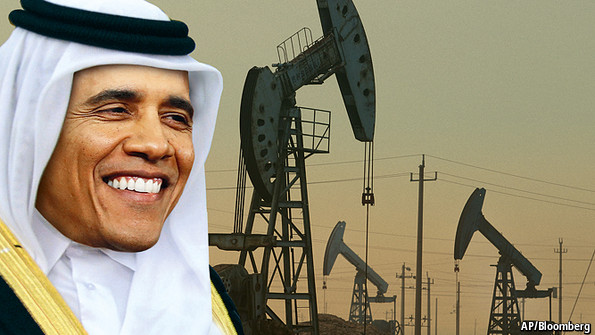
The petrostate of America: The energy boom is good for America and the world. It would be nice if Barack Obama helped a bit

The petrostate of America: The energy boom is good for America and the world. It would be nice if Barack Obama helped a bit

Feb 15th 2014 | From the print edition

image001-15

“RISE early, work hard, strike oil.” The late oil baron J. Paul Getty’s formula for success is working rather well for America, which may already have surpassed Russia as the world’s largest producer of oil and gas (see article). By 2020 it should have overtaken Saudi Arabia as the largest pumper of oil, the more valuable fuel. By then the “fracking” revolution—a clever way of extracting oil and gas from shale deposits—should have added 2-4% to American GDP and created twice as many jobs than carmaking provides today. Read more of this post

The parable of Argentina: There are lessons for many governments from one country’s 100 years of decline

The parable of Argentina: There are lessons for many governments from one country’s 100 years of decline

Feb 15th 2014 | From the print edition

A CENTURY ago, when Harrods decided to set up its first overseas emporium, it chose Buenos Aires. In 1914 Argentina stood out as the country of the future. Its economy had grown faster than America’s over the previous four decades. Its GDP per head was higher than Germany’s, France’s or Italy’s. It boasted wonderfully fertile agricultural land, a sunny climate, a new democracy (universal male suffrage was introduced in 1912), an educated population and the world’s most erotic dance. Immigrants tangoed in from everywhere. For the young and ambitious, the choice between Argentina and California was a hard one. Read more of this post

Unemployment in America: Closing the gap; America’s labour market has suffered permanent harm

Unemployment in America: Closing the gap; America’s labour market has suffered permanent harm

Feb 15th 2014 | From the print edition

IT TOOK barely a month for the bubble of optimism that formed over the American economy at the start of the year to deflate. Job growth slowed sharply in December, and stayed weak in January, suggesting more than bad weather was to blame. Read more of this post

Why America Has Such A High Rate Of Payment-Card Fraud

Why America Has Such A High Rate Of Payment-Card Fraud

THE ECONOMIST RETAIL  FEB. 15, 2014, 3:25 AM

AMERICA leads the world in many categories: shale-gas production, defence spending, incarceration rates and, alas, payment-card fraud. In December Target, an American retailer, said that hackers had breached its network and stolen payment-card details of about 40m of its customers. Read more of this post

With more than 7,600 pharmacies and the largest U.S. chain of retail health clinics, CVS is one of the country’s largest health-care companies

SATURDAY, FEBRUARY 15, 2014

Healthy Gains Ahead for CVS

By JACK HOUGH | MORE ARTICLES BY AUTHOR

With more than 7,600 pharmacies and the largest U.S. chain of retail health clinics, CVS is one of the country’s largest health-care companies.

Smokers who quit the habit can look forward not only to pinker lungs but also fatter wallets. CVS Caremark, which announced on Feb. 5 it will stop selling tobacco by October, may also win more profit than it loses from the move. Its profit comes increasingly from health plans, which aren’t keen on carcinogens. Consider: CVS’ tobacco decision is expected to subtract six to nine cents from its yearly earnings per share. But a prescription deal with the Federal Employee Health Program, which expires at year’s end, is worth 16 cents to 21 cents a share, estimates investment bank Mizuho Securities. For CVS (ticker: CVS), a good chance at renewal just became better, and there’s plenty more business to be won. Read more of this post

Lease-to-own instalment provider Singer Thailand has been stung by a rising number of non-performing loans, with most attributed to farmers who are suffering from long-delayed payments under the government’s rice-pledging scheme

Farmers’ plight driving up Singer Thailand’s NPLs

Sucheera Pinijparakarn
The Nation February 15, 2014 1:00 am

Lease-to-own instalment provider Singer Thailand has been stung by a rising number of non-performing loans, with most attributed to farmers who are suffering from long-delayed payments under the government’s rice-pledging scheme.

The company’s managing director, Boonyong Tansakul, said farmers accounted for 25 per cent of its portfolio. Read more of this post

Graduate glut: 12,000 new lawyers every year in Australia

Graduate glut: 12,000 new lawyers every year

February 14, 2014

Edmund Tadros

Law students are being urged to look beyond the legal field for career options, as a massive oversupply of graduates floods into a tough job market.

The number of law students has doubled in the past decade, with more than 12,000 graduates now entering a job market that comprises about 60,000 solicitors each year. Read more of this post

Why New Zealand is the new Ireland; New Zealand’s economy has been the subject of plenty of hype lately, but some say a reality check is coming, and it’s going to hurt

Why New Zealand is the new Ireland

February 14, 2014

New Zealand’s economy has been the subject of plenty of hype lately, but some say a reality check is coming, and it’s going to hurt.

New Zealand is “like Ireland in 2007” and it’s only a matter of time before its currency takes a hit according to one analyst. Read more of this post

The fumbles that led to Forge Group’s demise: CEO David Simpson, a former rugby player, was tripped by projects that cost him the game

The fumbles that led to Forge Group’s demise

February 15, 2014

Brian Robins

CEO David Simpson, a former rugby player, was tripped by projects that cost him the game.

For David Simpson, it was pretty much the dream job: his first gig as chief executive of his own public company.

After an extensive background in the construction sector, working for ABB and Leighton, he had most recently run UGL’s resources arm, a $1 billion business. So stepping up to run his own show was the opportunity of a lifetime. Read more of this post

Australia needs to smarten up its act with manufacturing exports; The decline of large-scale manufacturing leaves a gap for hungry small businesses to fill

Australia needs to smarten up its act with manufacturing exports

February 15, 2014

Georgia Wilkins, Ruth Williams.

The decline of large-scale manufacturing leaves a gap for hungry small businesses to fill

image001-6

Hybrid Electronics is the kind of business that has been touted as the future of local manufacturing.

The Melbourne-based company’s highly skilled workforce makes high-tech products for a niche market. Read more of this post

Deloitte Anjin faces credibility crisis; Accounting firm suspected of “deliberately” inflating Ssangyong Motor’s losses

2014-02-14 16:50

Deloitte Anjin faces credibility crisis

Accounting firm suspected of inflating Ssangyong’s losses

image003 Accounting firm suspected of inflating Ssangyong’s losses

By Na Jeong-ju
Deloitte Anjin is at risk of losing market trust because of allegations that it “deliberately” inflated potential losses of Ssangyong Motor to help it cut more than 2,600 jobs in 2009.
Last week, an appeals court ruled that the layoffs were invalid because it was based on the accounting firm’s “wrong” evaluation of Ssangyong’s value. If the ruling is upheld by the Supreme Court, the fired Ssangyong workers will get their jobs back. Read more of this post

The ‘Made in Canada’ brand: Does it even make any economic difference?

The ‘Made in Canada’ brand: Does it even make any economic difference?

Armina Ligaya | February 15, 2014 7:00 AM ET
image001-4

Canada enjoys an enviable reputation around the world for being a stable and friendly economic powerhouse with wide expanses, and, of course, a hockey-loving, maple-syrup churning, multicultural population. Read more of this post

China’s Risky Reforms

Ian Bremmer is President of Eurasia Group and the author of Every Nation for Itself: Winners and Losers in a G-Zero World.

David Gordon, a former director of policy planning in the US State Department, is Chairman and Head of Research at Eurasia Group.

FEB 14, 2014

China’s Risky Reforms

NEW YORK – When it comes to economic reform, China’s leaders no longer believe that time is on their side. With a new sense of urgency, President Xi Jinping and his inner circle are attempting one of the most ambitious economic and social-policy reform plans in history. Read more of this post

China $160 mln investment vehicle misses four scheduled payments, as fears grow that potential financial sector defaults could roil markets in the world’s second-biggest economy

Updated: Friday February 14, 2014 MYT 4:05:51 PM

China $160 mln investment vehicle misses payments

SHANGHAI: A US$160mil investment vehicle sold by China’s second-largest bank has missed four scheduled payments, state media reported, as fears grow that potential financial sector defaults could roil markets in the world’s second-biggest economy.

The “Songhuajiang River No.77” product, which raised a total of 972.7 million yuan (US$160mil) in six tranches, had failed to repay investors’ capital and interest four times by early February, the 21st Century Business Herald reported late Thursday.

Investors were also informed by Jilin Province Trust, which structured the product, that they will not receive the fifth payment due on February 19, according to the report.

China Construction Bank promoted the scheme, which funded a coal company, as a “risk-free and high-yield” investment, promising annual returns of 9.8 percent, investors told the paper.

The news comes after a possible default on a $500 million investment product, sold by the country’s largest bank ICBC and also backed by a loan to a debt-ridden coal firm, was averted in late January just three days ahead of deadline.

Analysts worry that China likely faces further problems in the trust sector.

A total 5.3 trillion yuan worth of trust products will mature this year, up 50 percent from 2013, state media have reported, citing research from Haitong Securities.

Default on such investment products would send a shockwave through China’s multi-trillion dollar “shadow banking” system – a massive network of lending outside formal channels – in the world’s second-largest economy, analysts said.

With the “Songhuajiang River No.77” product, the coal firm it was supposed to fund, Shanxi Liansheng Energy, filed for bankruptcy reorganisation in November last year after incurring around 30 billion yuan of debts.

“As far as we know, there’s no problem with the firm’s assets. The firm is negotiating with investors,” 21st Century Business Herald cited Jilin Province Trust as saying.

“We are all very anxious,” the official Shanghai Securities News on Wednesday quoted an investor as saying ahead of the February 19 maturation. Read more of this post

Hong Kong’s financial future hangs on getting the right mix

Published: Saturday February 15, 2014 MYT 12:00:00 AM
Hong Kong’s financial future hangs on getting the right mix

BY TAN SRI ANDREW SHENG

Hong Kong’s financial future hangs on getting the right mix

HONG Kong is currently engaging the public on its population policy. The policy paper is a very informative and educational document, full of useful statistics and asks what the citizens want for their own people, in terms of quantity and quality. Read more of this post

Johor chokes on property; The property market in Johor, particularly Iskandar Malaysia, might be a case of too much too soon.

Updated: Saturday February 15, 2014 MYT 10:34:05 AM

Johor chokes on property

BY WONG WEI-SHEN AND ZAZALI MUSA

The extra property supply would not pose an issue if foreign developers were attracting foreign buyers rather than targeting only domestic buyers.

THE property market in Johor, particularly Iskandar Malaysia, might be a case of too much too soon. Read more of this post

Lego Builds an Empire, Brick by Brick

Lego Builds an Empire, Brick by Brick

By GREGORY SCHMIDTFEB. 14, 2014

In this week’s top-grossing children’s movie, not only skyscrapers but actors built of tiny bricks inhabit a rather dystopian world known as “Lego-verse.”

That new realm, in “The Lego Movie,” which earned a near record-breaking $69.1 million when it debuted last weekend, represents the Lego Group’s first foray onto the big screen. Read more of this post