Top Anecdotal Signs of a Market Bubble

10 February 2014

Top Anecdotal Signs of a Market Bubble

By Jason Voss, CFA

At the risk of further inflating the bubble in discussion about whether or not global equity markets are in a bubble, I think it is worth discussing the topic from a qualitative point of view. Most of the talk of bubbles is data-driven analysis focusing on things like multiples, profit margins, revenue growth, historic equity market tops, equity risk premiums, and so forth. Read more of this post

A series of previously unthinkable fraud and information leaks have hit the Korean financial community hard, showing how vulnerable our financial system is

2014-02-10 17:44

Biggest financial scam

A series of previously unthinkable fraud and information leaks have hit the financial community hard, showing how vulnerable our financial system is.
The Financial Supervisory Service (FSS) last week revealed that the nation’s leading commercial and savings banks were unaware ― for more than five years ― of a massive loan fraud case in which an employee of KT ENS, a network operating subsidiary of KT Corp., embezzled nearly 300 billion won in loans allegedly in collusion with a number of subcontractors. The employee, surnamed Kim, is suspected of having issued fake bonds using an official stamp stolen from the company to the subcontractors, which were then used as collateral to take out loans from the banks.     Read more of this post

Starry-Eyed Budget Carriers in Southeast Asia Stare at Overcapacity

Starry-Eyed Budget Carriers in Southeast Asia Stare at Overcapacity

By Anshuman Daga on 2:08 pm February 10, 2014.
Singapore. Low-cost carriers are flying high in Southeast Asia on the back of sharp growth in air travel, but as hundreds of new jets swarm into the region concerns are rising about its ability to absorb the record numbers of planes on order. Read more of this post

Perils Mount As Debt Costs Swell in China; Dangers Include Slower Growth, Weaker Profits and Potential Defaults

Perils Mount As Debt Costs Swell in China

Dangers Include Slower Growth, Weaker Profits and Potential Defaults

SHEN HONG

Feb. 10, 2014 5:29 p.m. ET

image001-12

SHANGHAI—Borrowing costs for Chinese companies are rising strongly, a shift that could herald weaker corporate profits, slower economic growth and even the first defaults by indebted corporations on the mainland. Read more of this post

Singapore comes late to the stock regulation party

Singapore comes late to the stock regulation party

UNA GALANI

HONG KONG — Reuters Breakingviews

Published Monday, Feb. 10 2014, 8:00 PM EST

Last updated Monday, Feb. 10 2014, 8:00 PM EST

Singapore’s overhaul of its stock market is overdue. The city-state has proposed a raft of new trading rules in response to last year’s painful crash in penny stocks. Though welcome, the joint proposals from the Singapore Exchange (SGX) and the Monetary Authority of Singapore (MAS) look mostly like playing catch-up with Hong Kong. Read more of this post

Tacit agreement that SGX’s dual role is untenable

Tacit agreement that SGX’s dual role is untenable

Business Times

11 Feb 2014

Michelle Quah

SINGAPORE’S market regulators seem to finally be in agreement with a position that The Business Times has taken for years – that having a profit-driven market regulator, one with dual roles of revenue generation and market oversight, is simply not tenable. Read more of this post

If Nestlé Sells Its Stake in L’Oréal… Chain Reaction of Share Sales Could Occur With Expiration of Pact in April

If Nestlé Sells Its Stake in L’Oréal… Chain Reaction of Share Sales Could Occur With Expiration of Pact in April

CHRISTINA PASSARIELLO and NOÉMIE BISSERBE in Paris and JOHN REVILL in Zurich

Feb. 10, 2014 12:39 p.m. ET

A knot tying three of Europe’s biggest corporations together could soon be untangled with billions of euros in share buybacks.

In late April, Nestlé SA NESN.VX -0.07% will be free to unwind its 30% stake in L’Oréal SA, and, according to people familiar with the matter, that is one of the options the Swiss food giant is studying. If Nestlé’s stake is up for grabs, L’Oréal wants to buy at least part of it, one of the people said. That could trigger L’Oréal selling its 9% stake in French pharmaceutical company Sanofi SA, SAN.FR +1.78% according to the person. Read more of this post

Asian Group Tries to Stem Rubber’s Swoon; Bangkok-Based Group Urges Members Not to Sell After Commodity’s Prices Drop on Signs of Economic Slowdown in China

Asian Group Tries to Stem Rubber’s Swoon

Bangkok-Based Group Urges Members Not to Sell After Commodity’s Prices Drop on Signs of Economic Slowdown in China

HUILENG TAN

Feb. 10, 2014 7:13 a.m. ET

image001-11

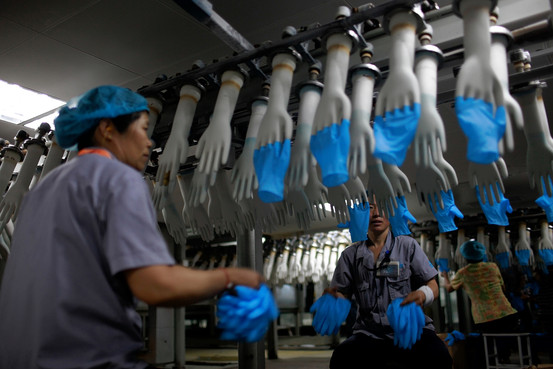
LOOKING FOR A BOUNCE: The Bangkok-based International Rubber Consortium told members not to sellthe commodity, an effort to stem a plunge in the price of rubber. Above, a glove assembly line in Zibo, ChinaReuters Read more of this post

South Korean Startup Support Gets Mixed Reception; Plan’s First Year Raises Efficacy Concerns; Government Says Project Continues to Improve

South Korean Startup Support Gets Mixed Reception

Plan’s First Year Raises Efficacy Concerns; Government Says Project Continues to Improve

JONATHAN CHENG

Updated Feb. 10, 2014 9:01 p.m. ET

SEOUL—Government officials here hope that a thriving local startup scene could soon put fresh Korean technology names on the global stage—and they are sparing no expense to make it happen. Read more of this post

Can Indonesia Really Weather the Looming Economic Crisis?

Can Indonesia Really Weather the Looming Economic Crisis?

By Alexander Ugut on 9:56 pm February 10, 2014.
Ask the above question to policy makers or supervisory authorities and the most likely answer you will get is an affirmative one. Yes indeed, our banking sectors are better capitalized now, leverage of public and private sector including households are low, foreign exchange reserves are adequate for roughly six months of imports. Our exposure to potentially toxic securitized transactions or shadow banking activities is negligible. Bank Indonesia, the central bank, has also made significant preparations for a much worse situation by signing option contracts with China, Japan and South Korea that give it the right to execute cross currency swap contracts in the total amount of $49 billion. In addition to that, another $5.5 billion is ready in the form of standby loans from multilateral financial institutions. Read more of this post

Book Review: ‘The Contest of the Century,’ by Geoff Dyer; China can’t change its history as a regional hegemon. It can’t change its size and population. And it can’t change its location.

Book Review: ‘The Contest of the Century,’ by Geoff Dyer

China can’t change its history as a regional hegemon. It can’t change its size and population. And it can’t change its location.

ALI WYNE

Feb. 10, 2014 7:24 p.m. ET

There is a tendency to view China‘s policies as part of a long-term strategic design, first for restoring its historic centrality in Asia and ultimately for displacing the U.S. as the world’s top power. But as Geoff Dyer observes in his stellar book, “The Contest of the Century,” the likelier explanation is more banal: Given its rapid economic growth, China is adopting a more expansive vision of its national interests and modernizing its military to match that vision. The challenge is to distinguish between those policies of Beijing that any other rising power would develop and those that could fundamentally alter the postwar global order.

Chinese leaders insist that they will avoid the mistakes that Germany and Japan made in the first half of the 20th century: As Communist Party foreign-policy adviser Zheng Bijian wrote in a 2005 Foreign Affairs magazine article, Beijing would achieve a “peaceful rise” by transcending “ideological differences to strive for peace, development, and cooperation with all countries of the world.” Today that optimism seems misplaced. The more China attempts to push the U.S. back into the Pacific Ocean and resolve its territorial disputes, the more it stimulates the formation of a countervailing coalition in the Asia-Pacific.

Mr. Dyer, a journalist for the Financial Times, cites three recent events that have shaped China’s current strategic predicament. In May 2009, the regime resurrected its “nine-dash line”—a self-declared maritime border that encompasses some 80% of the South China Sea—in a communiqué to United Nations Secretary-General Ban Ki-moon. Then, in 2010, China stood on the sidelines after North Korea torpedoed a South Korean warship, killing 46 sailors. And when in the same year Tokyo detained the captain of a Chinese trawler that had collided with two Japanese military vessels in Japanese-controlled waters, Beijing imposed an embargo on the export of rare earths to Japan.

As Mr. Dyer shows, China’s embattled position within the region also stems from immutable factors. It can’t change its history as a regional hegemon, which continues to alarm its neighbors. It can’t change its size—though former Foreign Minister Yang Jiechiwas remiss to declare at a 2010 regional forum that “China is a big country, and other countries are small countries, and that is just a fact.” And it can’t change its location: Mr. Dyer notes that it is encircled by “successful and ambitious states who also believe this is their time.”

Enlarge Image

image001-9

The Contest of the Century

By Geoff Dyer
(Knopf, 308 pages, $26.95)

Complicating matters is that numerous voices now shape China’s foreign policy. Its leaders confront “powerful vested interests within the party-state,” the author writes, as well as “an officer class that has its own hawkish take on global affairs” and the “nationalist views of a rising middle class.” There are marked divisions within these factions, and, because of the opaque nature of party decision-making, Beijing’s conduct can appear malign and conspiratorial even when it isn’t.

Momentum also undermines China’s regional charm offensives. After three and a half decades of torrid growth, it has the world’s second largest economy and is the largest trading country. Progress of such rapidity and scale is an invitation to scrutiny. China’s leaders are acutely aware, moreover, that their legitimacy depends in large part on continuing to improve their citizens’ livelihoods. The frenetic pace at which China is securing vital commodities around the world reflects this anxiety. As environmental degradation worsens, resource shortages grow and demographics deteriorate, China will become more dependent on outsiders to sustain its growth. Where its leaders discern vulnerability, however, many others see a Chinese dragon trying to buy the world.

But China’s myriad challenges don’t guarantee U.S. victory in the contest referred to by Mr. Dyer’s title. According to an “iron rule” that he says governs the region’s geopolitics, Washington will lose if it tries to enlist China’s neighbors in an effort to contain its rise. Instead, the U.S. must establish “a convincing long-term economic agenda” that binds theAmerican economy to that of the Far East. Thus stagnation in negotiations over the Trans-Pacific Partnership, he writes, “would be an enormous setback to the U.S.’s efforts to demonstrate that it has more to offer Asia than just its navy.” But demonstrating staying power carries a significant risk of its own: If China’s neighbors conclude that the U.S. will protect them no matter what contingency arises, they may opt to free-ride on U.S. security guarantees rather than develop their own capabilities.

Mr. Dyer is optimistic that the U.S. will “win”: that is, “retain its role at the center of international affairs.” But he doesn’t subscribe to unwarranted zero-sum logic. Given that China wasn’t too long ago an isolated, impoverished backwater, vulnerable to predation from without and collapse from within, becoming the second most important pillar of the international system would scarcely constitute a “loss.”

The real prize in U.S.-China competition would be the “new model of great-power relations” that President Obama and President Xi have proposed. One hopes that historians of a century hence will commend the two countries for inaugurating a new era of international relations, one in which a pre-eminent power and its principal challenger were able to both compete and collaborate in service of the global interest.

Mr. Wyne is an associate of the Belfer Center for Science and International Affairs at Harvard University’s Kennedy School of Government and a co-author of ” Lee Kuan Yew : The Grand Master’s Insights on China, the United States, and the World.”


Is Sweden Raising a Generation of Brats? Scandinavian country’s child-centric ways stir backlash

Is Sweden Raising a Generation of Brats?

Scandinavian country’s child-centric ways stir backlash

JENS HANSEGARD

Feb. 10, 2014 6:46 p.m. ET

Is Sweden raising a generation of brats?

The country has built a child-friendly reputation on its mandates for long parental leave and provision for state-funded day care from age 1. But a new book paints an ugly underbelly to Scandinavia’s child-centric ways. Youngsters here—deemed “competent individuals” by the state and legally protected from spanking—are becoming the chief decision makers in homes at very young ages in what some Swedes think is an alarming trend. Read more of this post

“It was very emotional, he hugged almost everyone”; Some of the beneficiaries of Sarawak Chief Minister Taib’s atypical show of affection looked surprised and a few even seemed uncomfortable.

Updated: Tuesday February 11, 2014 MYT 9:25:25 AM

So, who will be the next CM?

BY JOCELINE TAN

image003-2

Abang Johari (left) Adenan Satem

Tan Sri Taib Mahmud’s priority is to choose a successor who can lead the ruling coalition into the next state polls.

SARAWAK Chief Minister Tan Sri Taib Mahmud is not a touchy feely type of politician. As such, journalists were astonished to see the normally reserved leader throwing his arms around one person after another at the PBB supreme council meeting. Read more of this post

GMO’s James Montier: How do you select the subjects on which you do research? Are there particular publications or information sources that offer good insight or inspirations for the topics you choose?

James Montier – What Worries Me Right Now

By Robert Huebscher
February 4, 2014

James Montier is a member of Grantham Mayo van Otterloo’s (GMO’s) Asset Allocation team. Prior to joining GMO in 2009, he was co-head of Global Strategy at Société Générale. Mr. Montier is the author of several books including Behavioral Investing: A Practitioner’s Guide to Applying Behavioral Finance; Value Investing: Tools and Techniques for Intelligent Investment; and The Little Book of Behavioral Investing. Mr. Montier is a visiting fellow at the University of Durham and a fellow of the Royal Society of Arts. He holds a B.A. in Economics from Portsmouth University and an M.Sc. in Economics from Warwick University.

Advisors and retail investors can access GMO’s asset allocation by buying the Wells Fargo Advantage Absolute Return instead of the GMO Benchmark-Free Allocation Fund and the Wells Fargo Advantage Asset Allocation Fund instead of the GMO Global Asset Allocation Fund. The minimum investment for the GMO Funds is $10 million, while the minimum investment for the Wells Fargo Funds is $1,000.

I spoke with James on Jan. 28. Read more of this post

The top three Aussie franchises

The top three Aussie franchises

February 11, 2014

Adam Courtenay

If you’re researching franchises, you need to know why these are the best.

General manager of the Franchise Council of Australia Kym de Britt says franchises thrive on mutual benefit.

A company which has managed to wheel out 100 shops in 100 days was recently named the top franchisor in the country for 2013. Sounds like a simple business, easy to set up and quick to generate revenues? A passing fad perhaps? Not at all. Read more of this post

Banking on good sense and a prayer; As head of ICICI Bank, India’s biggest privately owned lender and the nation’s second largest by assets, 52-year-old Chanda Kochhar is a vastly influential figure in her native country.

Banking on good sense and a prayer

image001-10

Tuesday, Feb 11, 2014

Ravi Velloor

The Straits Times

The global leaders and the famous who flock to the Swiss resort of Davos for their annual conclave in January have often spotted a slim Indian woman, draped in the traditional sari, glad-handing key decision-makers and customers between meetings. Read more of this post

China firms head for U.S. IPOs, not fussed by accounting flap

China firms head for U.S. IPOs, not fussed by accounting flap

4:09pm EST

By Denny Thomas and Elzio Barreto

HONG KONG (Reuters) – Chinese companies are flocking to the U.S. IPO market in their biggest numbers since 2010, drawn by soaring valuations for tech start-ups and undeterred by a flare-up in an accounting row between Washington and Beijing. Read more of this post

“Breathtaking” Corruption In Europe

“Breathtaking” Corruption In Europe

Tyler Durden on 02/10/2014 12:12 -0500

Submitted by Pater Tenebrarum of Acting-Man blog,

recent article at the BBC discusses the findings of a report by EU Home Affairs commissioner Cecilia Malmstroem on corruption in the EU. According to the report, the cost of corruption in the EU amounts to €120 billion annually. We would submit that it is likely far more than that (in fact, even Ms. Malmstroem herself concurs with this assessment). This is of course what one gets when one installs vast, byzantine bureaucracies and issues a veritable flood of rules and regulations every year. More and more people are needed to administer this unwieldy nightmare of red tape, and naturally the quality of the hires declines over time due to the sheer numbers required. Read more of this post

A New World for Bonds: Time to sweep away an artificial distinction in the world of corporate debt issues

February 7, 2014

The Economist

A New World for Bonds: Time to sweep away an artificial distinction in the world of corporate debt issues.

Imagine that the stock market was divided into two. The big investment banks — Goldman Sachs, Morgan Stanley and Bank of America Merrill Lynch — would create lists of the shares that they liked. These approved shares would be classed as IB, for investment-bank-approved, and would trade on a higher valuation (i.e., lower yield) than equities they did not like, which would be lumped together in the BS, or bank-shunned, category. Some investors would be prevented from owning anything but the IB shares.

The idea sounds bizarre, but such an artificial distinction does exist in the bond markets, where the big ratings agencies class debt issues on a scale from AAA, the highest class, to D, for bonds in default. Bonds rated BBB- or higher are classified as investment grade (IG) whereas those rated BB+ or below are regarded as speculative, or more popularly, junk bonds. Some investors will not touch junk bonds at all; most bond funds focus on either IG bonds or junk.

But as Kevin Corrigan of Lombard Odier Investment Managers points out, this Manichean divide is rather odd. The difference between the BBB and BB categories is not that fundamental. Figures from Standard & Poor’s, one of the big ratings agencies, show that, of American corporate bonds rated BBB, 1.1 percent are in default three years later; for those rated BB, the figure is 4.8 percent. By contrast, 14.7 percent of bonds rated B have stopped paying within three years and 41.7 percent of those rated C or below. The figures for European bonds are similar (see chart).

image001-1A degentrification has been taking place in the bond market. The aristocrats of bonds — issuers of AAA-rated debt — have virtually disappeared. There is no longer much of an advantage in being rated AAA: shareholders instead want companies either to return the spare cash that might help earn them a high rating or to make their balance-sheets more “efficient” by borrowing more to take advantage of the tax deductibility of interest payments, thus jeopardizing an exalted status. Read more of this post

Some of the world’s largest banks are suffering from financial gangrene

Some of the world’s largest banks are suffering from financial gangrene

By Jason Karaian @jkaraian 5 hours ago

image001-8

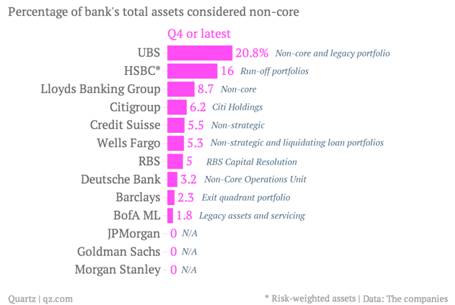
For critics of the financial industry, just about every big bank is a “bad bank.”

But a so-called bad bank is also a semi-technical term that describes a special division at a financial institution that happens to be packed with toxic assets, unwanted loans or entire business units hived off from a banking group’s “core” operations. Banks euphemistically dub these units “non-core,” “non-strategic” or a host of other names, steering investors away from considering them part of a bank’s future (and generating increasingly impenetrable earning reports in the process). This is how Lloyds Banking Group recently described its internal bad bank: Read more of this post

Henry Paulson: Why cities are the key to China’s success

Henry Paulson: Why cities are the key to China’s success

February 10, 2014: 5:00 AM ET

The world’s second-largest economy may have seen extraordinary growth, but that can’t continue without giving more of China’s rural workforce a stake.

By Henry M. Paulson

FORTUNE — China’s growth model is unsustainable. The costs of that growth are readily apparent in the country’s cities. Most pronounced are the stifling smog and serious water pollution. But vast energy consumption, health problems, density of population, and social stress are emerging problems exerting new pressures. Yet with a shrinking rural, agriculture sector — under 40% of the population — that’s now only about 10% of the Chinese economy, urbanization is both at the heart of China’s future growth and prosperity and posing a vexing challenge. If the country continues along the same path, the migration of another 300 million people into cities over the next couple of decades will impose a terrible price — not just on the Chinese people but on the rest of the world. Read more of this post

Controversial Malaysia state boss due to “retire”, but keep influence

Controversial Malaysia state boss due to “retire”, but keep influence

Monday, February 10, 2014 – 14:34

Reuters

KUALA LUMPUR – The chief minister of Malaysia’s Sarawak is expected to announce his resignation on Monday after 33 years in charge of the resource-rich state that have been key to keeping the national coalition in power but marred by corruption allegations and deforestation. Read more of this post

Toyota exit heralds end of Australia’s auto industry

Toyota exit heralds end of Australia’s auto industry

By Charles Riley  @CRrileyCNN February 10, 2014: 3:02 AM ET

HONG KONG (CNNMoney)

Toyota said Monday that it will close its factories in Australia by the end of 2017, a move that will cost thousands of jobs and leave the country without a major automobile manufacturer.

The decision to stop building Camry, Camry Hybrid and Aurion models in the country will result in approximately 2,500 lost jobs, the company said. Read more of this post

Turmoil in financial markets: Goldilocks and the bears; Investors have been forced to reassess their rosy view

Turmoil in financial markets: Goldilocks and the bears; Investors have been forced to reassess their rosy view

Feb 8th 2014 | From the print edition

image001-7

EQUITY markets started 2014 in a buoyant mood, after 30% gains for American shares in the previous year. Investors seemed to believe that the worst of thefinancial crisis was at last over and that the global economy was returning to “Goldilocks” mode, with growth neither so strong as to cause inflation nor so weak as to squeeze profits, but “just right”.

However, markets have been hit by a classic one-two punch in the opening weeks of the year. First, emerging-market currencies came under pressure, with the Argentine peso and Turkish lira, among others, falling sharply and several countries opting toincrease interest rates. To add to the concern, Chinese economic data showed signs of weakness, with the purchasing managers’ index for manufacturing dropping to 50.5 in January, its lowest level in six months.

The second sandbagging came from America, where the purchasing managers’ index for manufacturing slumped to 51.3 in January from 56.5 in the previous month. That was accompanied by a 3.1% decline in vehicle sales in January compared with a year earlier and followed a surprise 4.3% fall in durable-goods orders in December. The news prompted a 2.3% fall in the S&P 500 index on February 3rd. Most analysts had dismissed weak employment numbers for December as an aberration due to exceptionally cold winter weather, but the run of disappointing statistics seems to have stirred second thoughts. Payroll data for January, which were due to be released after The Economist had gone to press, may assuage or amplify these misgivings.

Underlying all this is a third potential worry. The Federal Reserve’s policy of “quantitative easing” (creating money to buy assets) is widely credited with propping up equity markets as well as depressing bond yields. Now that the Fed is “tapering”—that is, gradually reducing—its asset purchases, will the markets come under prolonged pressure?

As always, psychology plays a big role. The Fed is still buying $65 billion of assets a month, a significant level of support. The “forward guidance” it is giving suggests that an increase in short-term interest rates is far from imminent. Nevertheless, if investors expect the eventual withdrawal of monetary stimulus to prompt a decline in markets, it makes sense for them to sell in advance so as to reduce their potential losses. Indeed, the strong returns achieved from stockmarkets in 2013 may be reinforcing this process; investors are happy to lock in their profits.

The profit-taking trend seems well under way in Japan, even though the Bank of Japan is expected to maintain monetary easing (see article). The broadly based Topix index fell by 4.8% on February 4th, having risen by 51% last year.

image002

Profit-taking is not really the problem in emerging equity markets, since they have been underperforming stockmarkets in the rich world for the past three years (see chart). The worst-hit countries in recent weeks have been those with specific problems: political turmoil (Ukraine), a wide current-account deficit and high inflation (Turkey) or simply poor economic policy (Argentina).

But Raghuram Rajan, a prominent economist who is now governor of India’s central bank, has raised a broader issue. In the wake of the financial crisis of 2007-08, capital flooded into emerging markets, in part because their economies lacked many of the problems seen in the developed world and in part because central banks in rich countries had slashed rates so far that investors went abroad in search of juicier returns. As this money flows back again, emerging-market currencies (including the Indian rupee) are coming under pressure. That presents the countries concerned with a dilemma: let the exchange rate slide and risk inflation, or increase interest rates to defend the currency and risk a recession. “The US should worry about the effects of its policies on the rest of the world,” Mr Rajan says.

Judging by the behaviour of markets in recent weeks, many investors have been consumed by the opposite concern: will the difficulties in emerging markets infect the developed world? Analysts at Macquarie, an investment bank, point out that five of the countries that have seen their currencies fall the most (Argentina, Brazil, India, Russia and Turkey) comprise 12% of the global economy. Around 18% of European corporate revenues derive from emerging markets, according to Goldman Sachs, and that rises to 24% for Britain and 31% for Switzerland.

About 15% of the profits of S&P 500 companies come from emerging markets. As yet, there is no sign of problems in corporate results. Bank of America Merrill Lynch estimates that, as is the custom, most American companies have beaten earnings forecasts for the fourth quarter. With 70% of companies in the S&P 500 having reported, earnings per share have risen at an annual rate of 7%.

But Wall Street does not have much margin for error. Profits are close to a post-war high as a proportion of GDP. Meanwhile, equities look expensive by two of the best long-term valuation measures, which are calculated in quite different ways. Price-equity ratios, which relate share prices to a ten-year average of profits, are now around 25, far above their long-term average of 16. Shares look equally expensive when measured against the cost of replacing companies’ assets, a metric known as the q-ratio.

Bad news for equities has proved positive for government bonds, even though the Fed is buying fewer of them. The yield on ten-year Treasuries dropped from 3% at the start of the year to 2.59% on February 3rd, and yields on ten-year German bonds fell from 1.94% to 1.56% over the same period. Whereas sentiment on equities may have been overoptimistic at the end of 2013, it may have been too pessimistic about bonds; inflation is lower than it was a year ago in America, Britain and the euro area. The Economist’s commodities index has dropped by 13.9% over the past year and copper, often seen as especially sensitive to economic conditions, is down by almost 15%.

The wobbles in financial markets so far this year can be explained as a timely reassessment of what had been an excessively rosy investor outlook. For the sell-off to turn into something more serious, it will probably need clearer evidence of a new economic slowdown, in either China or the developed world, or a significant hit to corporate profits.

 

‘Purple ocean’ strategy works for big Korean retailers; Some develop private brands or introduce unique products.

‘Purple ocean’ strategy works for big retailers

Some develop private brands or introduce unique products.

BY MOON BYUNG-JOO [angie@joongang.co.kr]

Feb 10,2014

image002-4

Park Bo-kyung, a 39-year-old homemaker, sighed deeply when she recently received the family’s electricity bill for December. It was 15,500 won ($14.40) higher than the previous month’s 46,760 won bill. She was convinced the bigger bill was a result of the government’s electricity rate hike that came into effect on Nov. 21. Read more of this post

Tan Sri Andrew Sheng: China’s credit boom raises flags on risk levels

China’s credit boom raises flags on risk levels

BY ANDREW SHENG AND XIAO GENG

FEB 9, 2014

Credit in China is growing at a breakneck pace, having increased from 125 percent of GDP in 2008 to 215 percent in 2012. Local-government debt has soared by 70 percent since 2009, reaching almost $3 trillion last June. This is raising serious concerns about the level of risk in China’s financial system. Read more of this post

Half of bankrupt sole proprietors in S. Korea in the 50s

Half of bankrupt sole proprietors in S. Korea in the 50s

2014.02.10 16:13:59

Nearly one out of two self-employed in South Korea who went bankrupt last year was in their 50s, data showed.
This largely came as a growing number of baby boomers (born from 1955 to 1963) start their business after retirement, but most of them went bankruptcy due to lack of preparation. This means more people are leading a gloomy life over the remaining years after establishing a business.  Read more of this post

KT ENS may file for bankruptcy if it fails to settle damages from a large-scale loan fraud committed by one of its workers in collusion with its subcontractors

2014-02-09 16:26

Loan scam too big for KT affiliate

By Kim Rahn
KT ENS may file for bankruptcy if it fails to settle damages from a large-scale loan fraud committed by one of its workers in collusion with its subcontractors.
With loans from banks and savings banks being estimated at 300 billion won ($279 million), the company with 57 billion won paid-in capital may not be able to repay the money if courts find it wholly responsible for the fraud. Read more of this post

Massive open online forces: The rise of online instruction will upend the economics of higher education

Massive open online forces: The rise of online instruction will upend the economics of higher education

Feb 8th 2014 | From the print edition

image001-3

UNIVERSITIES have not changed much since students first gathered in Oxford and Bologna in the 11th century. Teaching has been constrained by technology. Until recently a student needed to be in a lecture hall to hear the professor or around a table to debate with fellow students. Innovation is eliminating those constraints, however, and bringing sweeping change to higher education. Read more of this post

Share options: The law of unintended consequences; When bosses take the short view

Share options: The law of unintended consequences; When bosses take the short view

Feb 8th 2014 | From the print edition

image001-2

EXECUTIVE share options were created in an attempt to align the interests ofmanagers and shareholders. In the 1970s and 1980s many investors had feared that executives were more interested in empire-building (in order to justify higher salaries and lavish expenses) than in generating returns for shareholders. Granting options was supposed to allow executives to benefit alongside investors from rises in the share price. Read more of this post