The Danger in Bespoke Funds: Many offer lots of leverage on the way up, but also on the way down

SATURDAY, JANUARY 25, 2014

The Danger in Bespoke Funds

By BRENDAN CONWAY | MORE ARTICLES BY AUTHOR

Many offer lots of leverage on the way up, but also on the way down.

Call it the rise of the bespoke exchange-traded fund. These days, in a shift from general-interest ETFs, a large institutional investor can identify a hole in its portfolio, and presto, the investing public gets a brand-new specialized fund. But while these custom-crafted strategies might be a perfect fit for one investor, they could be a lousy fit for you.

A single buyer showed up for the lion’s share of several of last year’s biggest ETF launches: Ken Fisher’s Fisher Asset Management owns 97% of two recently christened Barclays exchange-traded notes. Similarly, the Arizona State Retirement System invested $100 million in each of four iShares “factor” ETFs—funds focused on one factor, such as value or momentum. Big, professional investors are more comfortable than ever owning ETFs, and fund makers love this because it helps them rake in the money, notes S&P Capital IQ analyst Todd Rosenbluth.

Complexity is one hallmark of these funds. Take Barclays’ $1.4 billion ETN+FI Enhanced Global High Yield ETN (ticker: FIGY), majority-owned by Fisher. It uses a complex formula for leveraged returns on 24 countries’ stocks. But the leverage varies over time, and there’s a screen to remove undesired stocks. “Our size and scope allow us to do this,” says a Fisher spokesman, citing the firm’s thesis on growth stocks and benefits like strong liquidity. If investors chase the ETN’s recent returns–the three-month rise is ahead of the MSCI EAFE index’s—they risk getting crushed by leverage in a selloff. But what hurts you might not hurt Fisher nearly as badly. The ETN is less than 3% of the firm’s assets under management. Individuals’ bets would probably be bigger, because their portfolios get unwieldy when allocations are too small. A Fisher spokesman cautions against comparisons, but adds that “there are certainly economic benefits to size in this area.”

The best-known custom-ETF craze followed a revamp of an existing strategy: the yen-hedged Japan fund. In 2012, firms including RiverFront Investment Group hatched the idea of tweaking the WisdomTree Japan Hedged Equity ETF (DXJ) in favor of yen-sensitive stocks, on the theory that they’d fare best in a monetary-policy shift. The plan was well timed: Exporters were enviably positioned for Abenomics. The yen plunged, Japanese stocks soared, and the ETF surged 42% in 2013. Assets under management ballooned to $13 billion.

Were there suddenly so many investors with nuanced views of Japan—or were they just jumping on the bandwagon? “Make sure you’re doing your homework,” cautions Chris Konstantinos, a RiverFront manager. Any selloff would be a double whammy for the ETF because investors would sell stocks and crowd into yen.

Are you more eager on Japan than RiverFront? The firm’s most aggressive strategy, a global growth portfolio, has a 12% Japan weighting. A more conservative strategy has 5.5%. If your exposure is bigger, you’re outbulling the bulls. “Japan is my highest-conviction idea,” says Konstantinos, “but we’re not putting all our eggs in that basket.” Also, RiverFront’s aggressive strategy uses 32 ETFs; its annual portfolio turnover is 75%. Most individual investors can’t be so tactical.

You might win for a while chasing the big guys’ returns, but it’s more likely you’ll churn—and you may well get burned. Chances are these highly specialized ETFs are a better, safer fit for someone else’s portfolio.


Did it snow on the summit of Mount Kinabalu?

Did it snow on the summit of Mount Kinabalu?

image001-10

Saturday, January 25, 2014 – 09:59

The Star/Asia News Network

KOTA KINABALU – Did it snow at Mount Kinabalu just before dawn on Jan 17 when temperatures dipped to -3 deg C?

A report submitted to Sabah Parks by their head ranger Martin Mogurin indicated that there were signs of snow at the summit area of the 4,101m-high mountain along the Crocker Range around 4am.

Martin said guides at the mountain submitted a report but were unable to back it up with pictures as it was dark. Sabah Parks officials are trying to verify the report.

Sabah Parks chairman Tengku Zainal Adlin, who has climbed every face of Mount Kinabalu in the last five decades, is not surprised over the snow report.

Zainal said that ice on the mountain was common, especially in the early hours of the morning.

Sabah Parks director Paul Basintal said he was gathering information but he has his doubts about the snow.

Sabah meteorologists, however, are firm in dismissing any possibility of snow on Mount Kinabalu as it was too close to the Equator.

“Ice occurrence, yes, but snow? Not possible,” said Sabah Meteo­rological Department director Abdul Malik Tussin.

He said Sabah has been experiencing cold weather due to the annual Siberian winds coupled with high amount of rain due to the usually wet northeast monsoon season and a low atmospheric pressure over Sabah.

Indonesia must hold joint polls from 2019; Indonesia’s constitutional court ruled that holding separate polls for Parliament and president – as has been done in the past two elections – was against the spirit of the Constitution

Indonesia must hold joint polls from 2019

Sunday, January 26, 2014 – 09:00

Zakir Hussain

The Straits Times

INDONESIA’S constitutional court yesterday ruled that holding separate polls for Parliament and president – as has been done in the past two elections – was against the spirit of the Constitution.

But it said this year’s elections will carry on as scheduled to avoid disrupting a process that is already under way.

Simultaneous elections will start from 2019, the eight-man court ruled, in striking out sections of the presidential election law.

However, the court, led by Judge Hamdan Zoelva, stressed that this year’s elections will remain valid and constitutional.

The landmark decision reduces uncertainty over a possible delay to the April9 elections for Parliament, and drew support across the political spectrum as a middle way out that would prevent instability as some 190 million eligible voters head to the ballot box.

National Awakening Party (PKB) deputy secretary-general Abdul Malik Haramain told reporters: “I appreciate the ruling that weighed up the social and political aspects (to the matter), not just the judicial aspect.”

Changing the process this year, the court said, “could disrupt the conduct of the 2014 election and surface legal uncertainty, which is not desirable”.

The presidential election is scheduled for July, and set to be fiercely contested as President Susilo Bambang Yudhoyono is not allowed to stand for a third term.

National elections are held every five years.

Before 2004, there was one election for Parliament, and the president was then elected by Parliament.

The current arrangement, which saw voters elect MPs and a president three months apart in 2004 and 2009, came about as part of democratic reforms after the rule of strongman Suharto ended in 1998.

In its 92-page ruling, the court said the current practice fails to produce checks and balances that work, and does not strengthen the presidential system.

The court noted that presidential and vice-presidential candidates have to form tactical coalitions with political parties, which result in constant bargaining.

Having joint elections, it argued, would be more efficient, save costs and allow voters to vote more wisely.

But yesterday’s ruling drew criticism that it was politically motivated to safeguard the interests of major political parties.

“Why was it not read out much earlier? Why only now?” political communications academic Effendi Gazali, who filed the challenge to the presidential election law early last year, told reporters at the court.

Former constitutional court chief Mahfud MD said much of the deliberation on the case had been decided early last year.

Earlier this week, election commissioner Hadar Gumay also said whichever way the court ruled, the commission would have to work to ensure smooth elections.

The verdict comes two days after former law minister and state secretary Yusril Ihza Mahendra, who heads the Crescent Star Party (PBB), filed a separate challenge to the law.

Professor Yusril sought a decision on simultaneous elections, and also challenged the validity of the requirement for a presidential threshold which requires parties to have 25 per cent of the popular vote or 20 per cent of seats in Parliament before they can field a presidential candidate.

The court ruling yesterday did not address the issue of this requirement which, if struck out, could see a more crowded field of presidential contenders in July.

But Judge Maria Farida Indrati, in a dissenting opinion, said this criterion could still apply with simultaneous elections, but should be left to lawmakers to decide.


Hatred is not the only big worry in Thailand

Hatred is not the only big worry in Thailand

Saturday, January 25, 2014 – 15:23

The Nation/Asia News Network

THAILAND – The political crisis has become extremely dangerous not only because the hatred is feeding off itself, but also because law-enforcement officers are seen as biased in favour of the government.

Whether the police are intentionally partisan or are being pushed into a corner is debatable, but that doesn’t matter much now. The country is in serious trouble because, increasingly, anti-government protesters and the police are failing to see eye to eye.

In 2010 the police were accused of dragging their feet as the Democrat government struggled to contain the red shirts’ revolt. This time the police have been accused of being tools of the Pheu Thai government. The demonstrators have besieged key police headquarters several times, and outbreaks of violence have seen police firing tear gas and protesters hurling stones.

The situation is increasingly worrisome. The rift between a large section of society and the police is threatening to widen.

A demonstration by police recently confirmed their frustration, but they cannot blame it all on the anti-government protesters. Bangkok Police Chief Kamronwit Thoopkrajang showed off Thaksin Shinawatra’s photo in his office. His admiration of Thaksin is well publicised, not least because he wants it to be.

The anti-government campaign has targeted the police as the main pillar of the “Thaksin system”. Protest leader Suthep Thaugsuban has repeatedly said that, when he achieves victory, among the first items on the agenda would be a thorough reform of the police force. Suthep’s threat no doubt strikes fear into the police. All of a sudden, the force’s political stake in the crisis is firmly attached to who wins and who loses this showdown.

In fact, the stakes are getting higher and higher on both sides. The contrast with previous political crises is stark. This time, many more people have everything to gain from victory – and everything to lose from defeat. However, it is wrong for those who enforce the law to have any stake at all. Their duty demands that they remain completely neutral.

35-tonne truck rams into Taiwan President Ma Ying-jeou’s office

35-tonne truck rams into Taiwan President Ma Ying-jeou’s office

image001-9

Saturday, January 25, 2014 – 11:46

AFP

TAIPEI – Taiwan stepped up security measures Saturday after a driver rammed a huge truck through a bullet-proof screen and into the main gate of the presidential office, apparently intentionally, officials said.

A man identified only by his family name Chang drove the 35-ton truck through railings, the screen, and up a set of steps before coming stuck in the gate leading to the office’s main building, police said.

President Ma Ying-jeou was not in at the time as he is on a state visit to Sao Tome and Principe in Africa. He has been notified of the incident, his spokeswoman said.

She added that security measures had been beefed up at the Taipei site following the early morning incident and that police were investigating a cause and motive. She did not specify what the increased security measures were.

The impact from the crash knocked the driver unconscious and he was taken to a nearby hospital for treatment, police said. No one else was injured and the truck was towed from the scene.

“Chang has a criminal record and so far he has refused to answer any questions,” police spokesman Fang Yang-ning said, adding that they suspect he crashed “intentionally”.

Is the SEC Going Easy on General Electric? KPMG has been GE’s auditor for more than 100 years. GE is a systemically important financial institution, because of its GE Capital finance arm. GE has paid the firm more than $1.3bn since 2000

Is the SEC Going Easy on General Electric?

The Securities and Exchange Commission unveiled a curious settlement today with KPMG LLP over violations of auditor-independence rules. And it looks like the agency went out of its way to protect the Big Four accounting firm and its longtime audit client, General Electric Co.

The settlement papers came in two parts. The first was an administrative order, under which the firm will pay $8.2 million in fines and disgorgement. The SEC said KPMG provided bookkeeping and other prohibited services to three audit clients. The SEC said some KPMG partners also owned stock in one of the clients, which is a no-no.

The SEC didn’t name the clients, which is odd, because the agency has in other auditor-independence cases. One that comes to mind was a 2010 settlement with a former vice chairman at Deloitte & Touche LLP, Thomas Flanagan, who was caught trading shares of Berkshire Hathaway Inc. and other Deloitte audit clients. Another was a 2002 case against KPMG, which was the auditor for AIM Funds at the same time it had invested $25 million in one of the mutual funds that AIM ran.

The second part of today’s settlement offers more intrigue. The SEC issued a separate report about an investigation into KPMG’s practice of lending tax professionals from its own staff to certain audit clients. Once again, the SEC didn’t name any of the companies. But it’s a safe bet that one of them was GE.

Francine McKenna, who writes about accounting and auditing for her website re: The Auditors, broke the story in March 2011 that KPMG was doing this at GE. Some of the KPMG employees working at GE even were given GE e-mail addresses, she reported.

The SEC spent much of its report explaining what sorts of staff-lending arrangements it had uncovered at KPMG and why they are prohibited. Audit firms’ employees aren’t allowed to act as employees of an audit client. “The legal consequence of an auditor lacking independence is that it violates, and causes its audit clients to violate, various provisions of the federal securities laws,” the report said. The commission said it issued the report “in order to address uncertainty regarding the commission’s interpretation” of its rules on the subject.

The report also said “the commission has determined not to pursue an enforcement action with regard to these loaned staff engagements.” However, it didn’t explain why. And given all of the secrecy, I can’t help but wonder.

KPMG has been GE’s auditor for more than 100 years. GE is a systemically important financial institution, because of its GE Capital finance arm. The company paid KPMG almost $100 million in fees for 2012. It has paid the firm more than $1.3 billion since 2000. Former SEC Chairman Mary Schapiro, who left the agency in December 2012, joined GE’s board last year. And you never know what a fresh pair of eyes might find on GE’s books if the SEC ever ordered it to get a new accounting firm.

Could any of those things have been an issue when the SEC decided not to name any audit clients? Or penalize KPMG for lending them its tax staff? Or disqualify KPMG as GE’s outside auditor? An SEC spokesman, John Nester, declined to comment.

(Jonathan Weil is a Bloomberg View columnist. Follow him on Twitter.)

To contact the writer of this column:
jweil6@bloomberg.net.

Gold Mint Runs Overtime in Race to Meet World Coin Demand; “People who bought coins have lost value, but they are not looking at short-term gains, and hope springs eternal.”

Gold Mint Runs Overtime in Race to Meet World Coin Demand

Austria’s mint is running 24 hours a day to meet orders for gold coins, joining counterparts from the U.S. to the U.K. to Australia in reporting accelerating demand boosted by the bear market in bullion.

Austria’s Muenze Oesterreich AG mint hired extra employees and added a third eight-hour shift to the day in a bid to keep up with demand. Purchases of bullion coins at Australia’s Perth Mint rose 20 percent this year through Jan. 20 from a year earlier. Sales by the U.S. Mint are set for the best month since April, when the metal plunged into a bear market.

Global mints are manufacturing as fast as they can after a 28 percent drop in gold prices last year, the biggest slump since 1981, attracted buyers of physical metal. The demand gains helped bullion rally for five straight weeks, the longest streak since September 2012. That won’t be enough to stem the metal’s slump according to Morgan Stanley, while Goldman Sachs Group Inc. predicts bullion will “grind lower” over 2014.

“The long-term physical buyers see these price drops as opportunities to accumulate more assets,” said Michael Haynes, the chief executive officer of American Precious Metals Exchange, an online bullion dealer. “We have witnessed some top selling days in the past few weeks.”

Gold futures in New York climbed 5.2 percent this month to $1,264.50 an ounce, heading for the first gain since August. The Standard & Poor’s GSCI Spot Index of 24 raw materials slid 1.2 percent, while the MSCI All-Country World index of equities dropped 2.9 percent. The Bloomberg Dollar Spot Index, a gauge against 10 major trading partners, advanced 0.7 percent.

Prices Rebound

Prices rebounded 7.2 percent since reaching a 34-month low in June as physical buying rose. The Shanghai Gold Exchange, China’s largest bullion bourse, delivered 2,197 metric tons to customers in 2013, compared with 1,139 tons in 2012, it said Jan. 15. The Asian country topped India as the world’s top buyer last year as demand probably reached a record, the World Gold Council estimates.

The U.K.’s Royal Mint, which traces its history back more than 1,000 years, ran out of 2014 Sovereign gold coins because of “exceptional demand,” it said in a statement on Jan. 8. Coins weren’t available to customers until six days later when inventories were replenished. Sales by the Perth Mint, which also has workers producing coins in three shifts a day, will probably beat last year’s record, Ron Currie, the marketing director, said Jan. 20.

Goldman, Morgan

Bullion tumbled in 2013 after some investors lost faith in the metal as a store of value, snapping 12 straight years of gains. Holdings through exchange-traded products fell 33 percent in the past 12 months, erasing $69.1 billion from the value of the funds, data compiled by Bloomberg show. Prices also fell as U.S. equities rallied and inflation remained low.

Goldman expects bullion to fall to $1,050 in the next 12 months as the Federal Reserve reduces monetary stimulus, analysts led by Jeffrey Currie, the bank’s head of commodities research, said in a report Jan. 12. Precious metals are Morgan Stanley’s “least preferred” commodities, and physical demand won’t be enough to buoy prices, analysts Adam Longson, Bennett Meier and Peter Richardson said in a Jan. 17 report. The bank cut its 2014 target 12 percent to $1,160 on Jan. 22.

“Prices are likely to drop further as global economic conditions are stabilizing and tapering worries continue,” said Rob Haworth, a senior investment strategist in Seattle at U.S. Bank Wealth Management, which oversees about $110 billion of assets. “There is no doubt that physical demand has improved, but it will not be enough to support prices.”

Coin Sales

The U.S. Mint, the world’s largest, sold 89,500 ounces so far this month. The Austrian mint that makes Philharmonic coins, saw sales jump 36 percent last year and expects “good business” for the next couple of months, Andrea Lang, the marketing and sales director of Austria’s Muenze Oesterreich AG, said in an e-mail.

“The market is very busy,” Lang said. “We can’t meet the demand, even if we work overtime.”

The price for the Austrian mint’s 1-ounce Philharmonic gold coin slumped 27 percent last year, according to data from the Certified Coin Exchange.

“It’s been a very bad year for gold,” said Frank McGhee, the head dealer at Integrated Brokerage Services LLC in Chicago. “People who bought coins have lost value, but they are not looking at short-term gains, and hope springs eternal.”

To contact the reporter on this story: Debarati Roy in New York at droy5@bloomberg.net

BlackRock’s Fink Warns of ‘Too Much Optimism’ in Markets

BlackRock’s Fink Warns of ‘Too Much Optimism’ in Markets

BlackRock Inc. (BLK) Chief Executive Officer Laurence D. Fink warned there is “way too much optimism” in financial markets as he predicted repeats of the market turmoil that roiled investors this week.

“The experience of the marketplace this past week is going to be indicative of this entire year,” Fink, 61, told a panel at the World Economic Forum in Davos, Switzerland today. “We’re going to be in a world of much greater volatility.”

Fink, who runs the world’s largest asset manager, spoke after a selloff in emerging markets that was triggered by concern about China’s economic growth and the Federal Reserve’s tapering of its monetary stimulus later this year. The MSCI World Index slid the most this week in five months.

As Davos delegates fretted about the robustness of economies from Turkey to Argentina, central bankers from the euro area, the U.K. and Japan used the stage to signal that monetary stimulus will remain in place.

“Interest rates will stay at the present or lower level for an extended period of time,” European Central Bank President Mario Draghi said. Bank of England Governor Mark Carney added “there’s no immediate need” to raise rates.

Global Outlook

Fink’s outlook challenged the relatively upbeat tone struck by others during the four-day gathering in the Swiss Alps, which began after the International Monetary Fund predicted the strongest world economic expansion since 2011. The meetings of the past seven years were clouded by jitters about financial crisis in the U.S. and Europe.

‘We can be cautiously optimistic about the global outlook,’’ Bank of Japan Governor Haruhiko Kuroda told the panel.

While Fink agreed “the overall trend is going to be fine,” he predicted “quite a bit of disruption” and said the onus was now on governments to work to improve economies.

“That troubles me, as there has been great consistency of dragging their feet by politicians,” he said. “The marketplace has been rather encouraged by good, consistent monetary policy across the world.”

Fink spoke a day after Goldman Sachs Group Inc. CEO Lloyd Blankfein told Bloomberg Television that the week’s fall in markets wasn’t surprising because asset values had risen sharply.

‘Very Abnormal’

“It would be very abnormal if we didn’t have consolidating moves in the assets that have gone up so much,” he said.

Fink predicted the U.S. economy will grow more than 3 percent this year and said the world’s economy had benefited from a soft dollar. By contrast, Europe needs a weaker currency and the euro at $1.36 is “unsustainable,” he said.

Appearing on the same panel, IMF Managing Director Christine Lagarde said central banks should continue to keep monetary policy loose until growth becomes well-anchored and then communicate their exit strategies clearly. She warned the risk of global deflation may be between 15 and 20 percent.

Draghi rebuffed speculation the European economy faces the threat of a prolonged decline in consumer prices. He noted that inflation excluding energy and food prices had been as low now as in the wake of past financial strains and that much of its decrease the result of downward pressure on prices in crisis-hit Greece, Ireland, Spain and Portugal that may reverse.

“Our accommodative monetary policy will remain so,” Draghi said. If the economy or markets deteriorate “we are ready and willing to use all the instruments our treaty allows.”

As for the U.K., which has recently displayed signs of economic strength, Carney said “exceptional stimulus remains very relevant.” He cited headwinds including spare capacity, sluggish European demand and tighter monetary conditions, including a strengthened pound. Even when the Bank of England does raise rates “any such increase would be gradual,” he said.

To contact the reporters on this story: Catherine Bosley in Davos, Switzerland at cbosley1@bloomberg.net; Jana Randow in Davos, Switzerland at jrandow@bloomberg.net

Emerging markets: The perils of denial

Emerging markets: The perils of denial

Jan 24th 2014, 16:11 by Buttonwood

THE big sell-off in emerging market currencies yesterday is an odd example of “remembrance of things past”; one’s mind is drawn back to 1998, or even 1982 and the crises of old. Not that long ago, it was the developed economies that were causing all the problems and the emerging markets that seemed to offer hope; now the news out of the rich world is a lot more positive whereas the weaknesses of some developing countries are showing again.

Margaret Thatcher is not a popular heroine in Argentina but it is tempting to recall her aphorism that “you can’t buck the markets”. The country was running with an exchange rate that was (and still is) out of whack with the black market rate; its government was also quoting an inflation rate that was well below independent estimates of 23.4%. Defending the exchange rate required official intervention that was eating away at the country’s reserves. Yesterday, the authorities stopped intervening; today, they relaxed capital controls. While there was brave talk that a rate of 8 pesos to the dollar was fair value, the black market rate is more like 13. The scope for the official rate to fall dramatically is clear. The big question concerns the economic consequences of the devaluation; will this lead to a big rise in the cost of imported goods (pushing inflation up further and putting more downward pressure on the peso) or does the cost of private sector goods already reflect the black market rate?

The other case of denial was in Turkey, where it seems clear the central bank would have liked to raise rates this week, but was discouraged from doing so by the government. Turkey has a current account deficit of 7.5% of GDP and inflation of 7.5%; monetary tightening looks appropriate. (The central bank indicated that it may allow interbank rates to hit 9% on some days, but they are normally 7.75%, ie, barely positive in real terms). Again, a big fall in the lira will boost Turkish exporters but creates the peril of a further surge in the inflation rate. The Turks have intervened to support the lira but how long can they do that; at $33 billion, their reserves are only a little larger than Argentina’s.

The broader question is whether these sell-offs are just “little local difficulties” or are a herald of a 1997/1998-style collapse? It is worth remembering that most emerging economies are sounder than they were 16-17 years ago, in the sense that they tend to have smaller current account deficits and are less dependent on inflows of hot money. But they are not homogenous. The countries that are suffering now are those with the worst policies or the most obvious weaknesses. For the sector as a whole, China is the giant panda in the room; there are worries about an investment product that may default at the end of this month. By itself, this seems unlikely to provoke panic; its travails are down to a specific investment, rather than hinting at a more broad malaise, along the lines of subprime loans. The Economist’s man in HK is not too worried.

But the stories have certainly created a risk-off mood in the stockmarkets; they did enter 2014 in remarkably optimistic mood.


China loses its allure: Life is getting tougher for foreign companies. Those that want to stay will have to adjust

China loses its allure: Life is getting tougher for foreign companies. Those that want to stay will have to adjust

Jan 25th 2014 | From the print edition

image001-8

ACCORDING to the late Roberto Goizueta, a former boss of The Coca-Cola Company, April 15th 1981 was “one of the most important days…in the history of the world.” That date marked the opening of the first Coke bottling plant to be built in China since the Communist revolution.

The claim was over the top, but not absurd. Mao Zedong’s disastrous policies had left the economy in tatters. The height of popular aspiration was the “four things that go round”: bicycles, sewing machines, fans and watches. The welcome that Deng Xiaoping, China’s then leader, gave to foreign firms was part of a series of changes that turned China into one of the biggest and fastest-growing markets in the world.

For the past three decades, multinationals have poured in. After the financial crisis, many companies looked to China for salvation. Now it looks as though the gold rush may be over.

More pain, less gain

In some ways, China’s market is still the world’s most enticing. Although it accounts for only around 8% of private consumption in the world, it contributed more than any other country to the growth of consumption in 2011-13. Firms like GM and Apple have made fat profits there.

But for many foreign companies, things are getting harder. That is partly because growth is flagging (seearticle), while costs are rising. Talented young workers are getting harder to find, and pay is soaring.

China’s government has always made life difficult for firms in some sectors—it has restricted market access for foreign banks and brokerage houses and blocked internet firms, including Facebook and Twitter—but the tough treatment seems to be spreading. Hardware firms such as Cisco, IBM and Qualcomm are facing a post-Snowden backlash; GlaxoSmithKline, a drugmaker, is ensnared in a corruption probe; Apple was forced into a humiliating apology last year for offering inadequate warranties; and Starbucks has been accused by state media of price-gouging. A sweeping consumer-protection law will come into force in March, possibly providing a fresh line of attack on multinationals. And the government’s crackdown on extravagant spending by officials is hitting the foreign firms that peddle luxuries (seearticle).

Competition is heating up. China was already the world’s fiercest battleground for global brands but local firms, long laggards in quality, are joining the fray. Many now have overseas experience, and some are developing inventive products. Xiaomi and Huawei have come up with world-class smartphones, and Sany’s excellent diggers are taking on costlier ones made by Hitachi and Caterpillar. Consumers will no longer pay a hefty premium just because a brand is foreign. Their internet savvy and lack of brand loyalty makes them the world’s most demanding customers (see article).

Some companies are leaving. Revlon said in December that it was pulling out altogether. L’Oréal, the world’s largest cosmetics firm, said soon afterwards that it would stop selling one of its main brands, Garnier. Best Buy, an American electronics retailer, and Media Markt, a German rival, have already left, as has Yahoo, an internet giant. Tesco, a British food retailer, last year gave up trying to go it alone, and entered a joint venture with a state-owned firm.

Some of those who are staying are struggling. IBM this week said that revenues in China fell by 23% during the last quarter of 2013. Rémy Cointreau, a French drinks group, reported that sales of its Rémy Martin cognac fell by more than 30% during the first three quarters of last year because of a plunge in China. Yum Brands, an American fast-food firm, said in September last year that same-store sales in China had fallen by 16% in the year to date. Its problems were partly the result of a government investigation into alleged illegal antibiotic use by its chicken suppliers.

Investors no longer celebrate firms with big investments in China. Our Sinodependency Index weights American multinationals by their China revenues. Sino-dependent firms used to outperform their peers, but in the past two years their share prices have done worse than others’.

As Jeffrey Immelt, the boss of GE, puts it, “China is big, but it is hard…[other] places are equally big, but they are not quite as hard.” Companies that want to stay in China will have to put in even more effort. Many will have to change strategy.

One China is over

First, rising costs mean that bosses must shift from going for growth to enhancing productivity. This sounds obvious, but in China the mentality has long been “just throw more men at the problem”. One way to get a grip on costs is to invest in labour-substituting technology, not only in manufacturing but also in services. Also, multinationals are falling behind local firms like Alibaba and Tencent in exploiting a surge of big data coming from e-commerce and smartphones.

Second, tighter control is another must. GSK’s bosses in London admitted that its problems in China were partly the result of executives acting “outside of our processes and control”. Managers in headquarters must ensure that executives’ behaviour and safety standards are as high as anywhere else in the world. Chinese consumers are even more active on social media than those in the West, so any scandal is instantly broadcast nationally.

image002-5

Our interactive Sinodependency index gauges China’s influence on the fortunes of American multinationals

Lastly, a One China policy no longer makes sense. Most firms set up their local offices when China’s economy was smaller than $2 trillion. Although it will soon be five times that size, many still try to run their operations from Shanghai. That makes little sense when tastes in food, fashion and much else vary between provinces and mega-cities that have populations as big as European countries. Some 400m Chinese do not speak Mandarin. So even as CEOs need to keep a closer eye on standards and behaviour, they should localise marketing and perhaps product development.

China is still a rich prize. Firms that can boost productivity, improve governance and respond to local tastes can still prosper. But the golden years are over.


A tippler’s guide: What SABMiller’s lager sales say about the state of African economies

A tippler’s guide: What SABMiller’s lager sales say about the state of African economies

Jan 25th 2014 | JOHANNESBURG | From the print edition

FOR most people the letters BBC denote the British Broadcasting Corporation. For fans of Real Madrid, the world’s richest football club, they stand for Bale, Benzema and Cristiano (Ronaldo), the team’s goal-guzzling forward line. For investors in Africa’s stockmarkets, BBC means banks, breweries and cement. The biggest companies listed on African exchanges are typically BBC firms. And in places where official statistics are scarce or unreliable, their trading figures are often a good guide to how much lending, spending and building is taking place in African economies.

image001-3

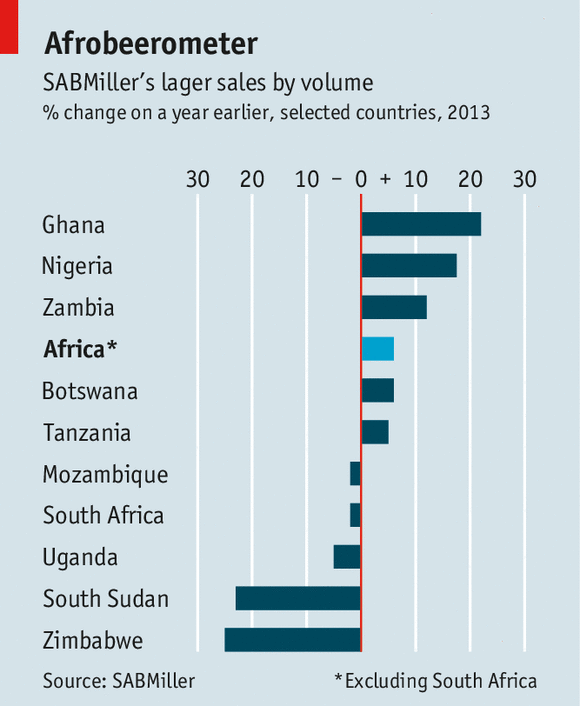
SABMiller is a BBC behemoth. It is one of the world’s leading brewers, with chunky operations in 15 African countries and a presence in a further 20 markets on the continent through its alliance with Castel, a French company. Africa is now SAB’s fastest-growing market. Lager sales by volume rose by 6% in the year to the fourth quarter of 2013 compared with growth of just 1% in its operations worldwide. So its latest trading statement of January 21st is a useful barometer to the state of Africa’s economies.

In this section

Can he manipulate the West?

Deepening rifts

Too optimistic?

No proper end

Heads off

A tippler’s guide

Reprints

Related topics

Beverage manufacturing

Consumer non-cyclicals

Breweries

Alcoholic drinks

Food and drink companies

Some of the numbers are startling. A slowdown in the flow of dollars into Zimbabwe last year has squeezed the economy much harder than is generally understood. Lager sales there fell by a quarter (see chart), as big a slump as in South Sudan, where factions are fighting for control of the country. Mozambique has been one of the world’s fastest-growing economies, but its beer sales are weak. This suggests that sporadic attacks along the country’s north-south highway by the militia of Renamo, the main opposition party, now seem to be harming the economy.

Other African markets look healthier. Though lager sales fell in South Africa, SAB’s home market, revenue nonetheless rose, as consumers switched to pricier brews. Sales volumes rose by 12% in Zambia, though the figure is flattered by purchases by traders in advance of January’s increase in excise duties. Nigeria is a newish market for SABMiller in which it faces competition from Guinness and Nigerian Breweries. Yet the firm was still able to report volume growth approaching 20%. Ghana appears to be growing even faster.


Political crisis in Thailand: You go your way, I’ll go mine; Thailand’s very unity is now under threat

Political crisis in Thailand: You go your way, I’ll go mine; Thailand’s very unity is now under threat

Jan 25th 2014 | CHIANG MAI | From the print edition

STOUT and loquacious, Khamsi Audomsi runs a roasted-banana stall in the covered market of San Kamphaeng, a small town just outside Chiang Mai, the main city of northern Thailand. In front of where she fries up, a greasy wall is festooned with posters and calendars devoted solely to the Shinawatra clan: Thaksin Shinawatra, the former prime minister deposed in a coup in 2006 and now in self-imposed exile, and Yingluck Shinawatra, the current prime minister, who takes orders from her older brother in Dubai.

Thanks to Mr Thaksin’s policies, Ms Khamsi says, her family’s prospects were transformed. A student-loan scheme allowed both her son and daughter to go to university, a family first. Now their relatively well-paid jobs help to pay for her health care. And for this, Ms Khamsi repays Mr Thaksin and his sister with her undying loyalty. She was a founder of the “red shirts”, Mr Thaksin’s grassroots political movement.

image001

It is the sort of story you hear time and again in northern and north-eastern Thailand: how Mr Thaksin’s social policies, dismissed as mere populism by his opponents, helped people to escape poverty. Chiang Mai and the 16 provinces around it are almost solid red-shirt territory; the 20 provinces of Thailand’s poor north-east, a region known as Isan, are even redder (see map). The flames of devotion burn brightest in San Kamphaeng, for this is where the Shinawatras come from and where they return to be buried.

Ms Khamsi and her fellow red shirts are looking forward to the general election on February 2nd. (Ms Yingluck called it in an attempt to break the political deadlock that has gripped the capital, Bangkok, since November.) They can renew their vows and demonstrate once again the strength of the red shirts and the supporters of the ruling Pheu Thai party. Parties run by Mr Thaksin have won every election since 2001, precisely by dominating the rural north and north-east.

For that very reason the anti-Thaksin forces are boycotting the election altogether. Led by a former MP, Suthep Thaugsuban, they have staged mass protests in Bangkok in hopes of ousting Ms Yingluck. Mr Suthep and the Democrat Party, the main opposition, argue that Mr Thaksin’s money has poisoned the electoral process and say they will only participate after the system has been cleaned up. Their disruptive tactics may yet cause the election to be postponed or even cancelled.

Mr Suthep launched his crusade three months ago, at the time of the government’s cack-handed attempt to force through a bill granting Mr Thaksin amnesty for convictions for corruption and abuse of power. In reality, Mr Suthep’s protests are just the latest round in an increasingly bitter struggle for the political soul of the country, between the northern red shirts and an ultraroyalist establishment that controls much of the capital and the southern provinces. The struggle is turning ugly again, and risks splitting the country in two. At least nine have died as men of violence creep on to the stage with sniper rifles and bombs. Each side blames the other for these shadowy provocateurs. On January 21st Ms Yingluck declared a state of emergency in Bangkok and its surrounding districts.

Although the red shirts will dutifully vote on February 2nd, they are mostly focused on how they might protect their government, and Ms Yingluck, from the coup that they are all expecting. A coup might be a military one, under the pretext of stopping violence escalating in Bangkok. Or it might be a judicial one, with the courts barring Pheu Thai politicians from taking office because of alleged offences against the constitution. Both have happened before, and the red shirts see both the army and the courts as tools of the Bangkok political establishment.

If Ms Yingluck, who was elected in a landslide in 2011, is forced out of Bangkok, she will be welcomed in Chiang Mai, where she will be encouraged to keep on governing as the legitimate rival to whoever takes over in the capital. That might trigger the split between north and south.

Indeed, many red shirts say Bangkok is already lost. Mr Suthep has nearly free rein there, closing down most government offices. The police have charged him with insurrection and seizing state property, but no attempt has been made to arrest him. The imposition of a state of emergency for 60 days may not make much difference.

Thus most red shirts in the north and north-east now contemplate—indeed they seem to be preparing for—a political separation from Bangkok and the south. Some can barely wait. In Chiang Mai a former classmate of Mr Thaksin’s says that in the event of a coup “the prime minister can come here and we will look after her. If…we have to fight, we will. We want our separate state and the majority of red shirts would welcome the division.” Be afraid for Thailand as the political system breaks down.


The Taiwan Stock Exchange (TWSE) said that its TWSE RA Taiwan Employment Creation 99 Index beat the weighted index on the main board in terms of total investment returns

TWSE’s employment index beats main board in returns

CNA
January 24, 2014, 12:06 am TWN

TAIPEI — The Taiwan Stock Exchange (TWSE) said Thursday that its TWSE RA Taiwan Employment Creation 99 Index beat the weighted index on the main board in terms of total investment returns last year.

The TWSE said the employment index garnered 22.3 percent in total returns in 2013, compared with 15.1 percent in returns generated by the Taiwan Stock Exchange Capitalization Weighted Stock Index.

According to the TWSE, the employment index in returns closed at 5,670.82 points at the end of 2013, up from 4,637.07 at the end of the previous year.

The exchange said the employment index also beat 11.9 percent in returns posted by the FTSE TWSE Taiwan 50 Index, which is comprised of the top 50 stocks in Taiwan in terms of market capitalization.

The employment index, which was co-compiled by the TWSE and U.S.-based investment management firm Research Affiliates, was launched in December 2010 and includes the top 99 employers in Taiwan as its constituents.

The employment index covers companies in the high-tech sector, the old economy sector and the financial sector. It uses Research Affiliates methodology that determines the constituents and their weightings based on the number of employees, to show how corporations are fulfilling their social responsibilities.

The employment index is also able to reflect how local enterprises are pursuing long term development through their efforts to cultivate talent for future growth, the exchange said.

The TWSE said the Research Affiliate’s innovative methodology is highly regarded in the major equity markets around the world as it can generate satisfactory returns in line with the fundamentals of its constituents.

The exchange said other corporate responsibility-related stock indexes largely focus on issues such as social justice, corporate earnings and environmental protection efforts, which can take too much time to evaluate.

As the assessment process for these indexes can also be expensive, the exchange said, it is not easy for these corporate responsibility-related indexes to generate stable investment returns.

Taiwan’s first budget airline named ‘V air’

Taiwan’s first budget airline named ‘V air’

AFP
January 24, 2014, 12:06 am TWN

TAIPEI–Taiwan’s TransAsia Airways said Thursday a low-cost carrier it aims to launch later this year will be called “V air” as it seeks to tap the growing budget travel market.

TransAsia said it picked “V air” out of nearly 8,000 entries in a public naming contest while the new carrier’s Chinese name will be “Wei Hang,” which means “mighty airline” in English.

“V can stand for voyage, vision, vivid, or victory which symbolizes the positive energy a new company requires and can help boost the public’s preference and acceptance of the new company,” it said in a statement.

Two winners of the naming contest are entitled to unlimited free flights on the budget airline for 10 years, it said.

The company, Taiwan’s first private airline, said in November last year it would spend around NT$3 billion (US$100 million) to launch Taiwan’s first low-cost airline catering to the needs of Taiwanese travelers.

TransAsia plans initially to lease two to three brand-new Airbus A320/A321 planes and hopes to start flying by year’s end.

TransAsia — which flies to Japan, Singapore, South Korea and Vietnam — has been expanding as it benefits from increased revenues from new China routes that have opened up in recent years as relations between Beijing and Taipei have improved.

Demand for discount flights has been rising in Asia. Twelve foreign budget airlines, including Malaysia-based AirAsia and Japan’s Peach Aviation, offer services to and from Taiwan.

Taiwan’s leading carrier China Airlines announced in December that it would set up a new no-frills airline in a joint venture with Singapore’s budget carrier Tigerair, expected to become operational in 2014 with three A-320s.


[TechNode 2013 Year in Review]: A Year Not So Good, Not So Bad

[TechNode 2013 Year in Review]: A Year Not So Good, Not So Bad

By Ben Jiang on January 24, 2014

After a year that saw the burgeoning entrepreneurship cutting across China in 2011 and a following year that tasted the backlash in 2012 — painfully leads to the termination of venture capital spree in addition to the shutdown of innumerable failures, we are now at the end of 2013 and looking back at a year which is neither so good nor so bad for Chinese TMT industry.

IPO Window Reopens

I’ll start with the not so bad part. Just so you know, 2012 was a dud for both the startup and venture capital world with only two startups made it to the public market — YY(NASDAQ:YY) and VIPShop(NYSE:VIPS). The gloomy picture was mostly painted by the sustained worldwide economic downturn and worries over accounting fraud that dogged and derailed several China concept stocks over the past two years. Now in 2013 that picture – which apparently was put upside down — turned around and turned out to be a masterpiece. We have six companies, including 58(NYSE:WUBA), 500Wan(NYSE:WBAI), AutoHome(NYSE:ATHM), Lightinthebox(NYSE:LITB), SUNGYMobile(NASDAQ:GOMO) and Qunar(NASDAQ:QUNR), successfully pulled off long-awaited IPO.

image001-2


Breakthroughs that set for changes 

As IPO is just one of the many facets of a vivid and persuasive evidence to testify that 2013 isn’t a bad year, We also outlined below some breakthroughs that someday in the near future would have more material influence on Chinese economy with the power of Internet, new technology as well as political reform.

I think there is little argument that the groundbreaking set-up of China (Shanghai) Free Trade Zone topped the first place of the breakthrough candidates. Despite the fact that some optimists pointed out a parallel between this and the reform and open-up policy that leads China to what it’s achieved today, we are neither too optimistic nor will we play down its significance. While the trade zone indeed was created by aggressive (sort-of) reformers to spur changes in China, how’d it pan out remain to be seen. And, economic and political significance aside, at least hard-core Chinese gamers will applaud for the FTZ as the decade long ban on the sales of game consoles are lifted within this zone. High five? Ok never mind.

3G never really took off in China. In an effort to balance the inequities among Chinese carriers, MIIT did a little gimmick to issue WCDMA – advance technology, widely adopted by manufacturers, carriers worldwide – license to China Unicom the weakest one of the Chinese carrier trilogy while China Mobile the world’s largest carrier were obligated to build up the home-grown TD-SCDMA technology.The result is palpable, a small chunk of China Mobile users fled to either China Unicom or China Telecom (operates CDMA2000) for faster mobile Internet access, while the others stick around. Out of China’s 1.1 billion or so subscribers, 3G subscribers stand at a mere 234 million.

To solve the dilemma, MIIT finally granted 4G licenses to the carriers after a whole year of speculation and wait, hoping that the new standard could get people out of the 2G camp, while all the carriers are supposed to use the Beijing-backed TD-LTE technology, China Unicom and China Telecom were also seeking to apply for FDD-LTE license “as soon as practicable”.

China Mobile, which was muted by poorly-received TD-SCDMA, has already launched commercial 4G services with enthusiasm and wall-to-wall campaign in many cities with wider and more aggressive rollout in the coming years. Personally, some of my friends who sticked around already flipped the LTE switch on by getting an iPhone 5s. Speed? Bloody fast. Disadvantage? Poor coverage.

But it’s only getting better.

Interestingly, MIIT the bureaucratic slow mover and telecoms regulator of China caught everyone off guard by announcing a flurry of announcements in the final weeks of 2013. Well, good news always comes when least expected. MIIT also issued the highly speculated virtual network operator licenses to 11 Chinese companies (including Alibaba and JingDong) on December 26. Currently Chinese telecom market is dominated by the big three carriers, the introduction of virtual network operator is expected to bring some competition and efficiency to the market.
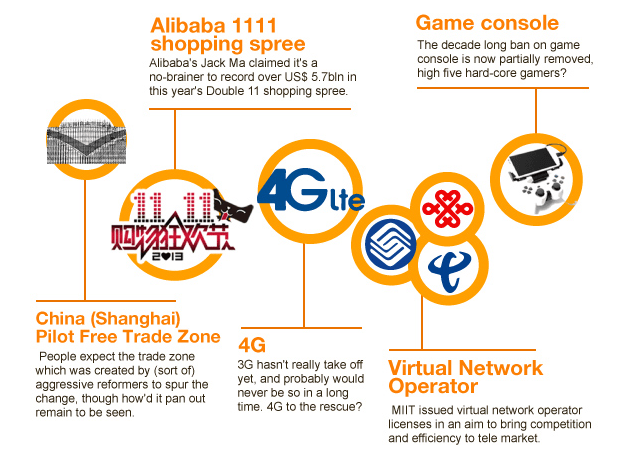
image002-1

Our readers would certainly be sure that mobile internet is now a mega trend in China: entrepreneurs are doing it, investors are checking on it, journalists are bragging about it. And a faster and more ubiquitous 4G services is expected to boost it to the next level and change Chinese people’s daily life in many ways.

Speaking of changing daily life, I guess the vigorous ecommerce empire pumped up by Alibaba deserves a vote. The company recored north of RMB 35 billion yuan (USD 5.7bln) in this year’s Double 11 shopping spree, breaking its own recored from last year. In comparison, America’s CyberMonday hit 2.29bln. Jack Ma, the legendary founder and chairman of the group later on divulged that the transaction volume was just a no-brainer, the company could easily crank it up to 100bln in the years to follow. Ambitious!

Numbers aside, we Chinese people who live here did felt the gradual and accelerated replacement of brick-and-mortar stores by virtual storefronts. What people used to say of anyone of Chna’s small commodity markets, where you could get almost anything, now they say of Taobao. The Chinese e-tailing platform provides everything ranging from clothing, food, electronics, cars, home decors to even improper items such as aircraft/island/human body parts, you name it, you find it.


2013 goes down as the most active for Internet M&A

As aforementioned are the breakthroughs emerged in the past year that’d be shaping up China towards a better direction, we also noted a maybe less profound but more practical change on the market that overrides the stereotype of Chinese Internet conglomerates. They DO know what M&A is.

Baidu grabbed 91 Wireless the largest Chinese app distribution platform from NetDragon, the whopping 1.9bln dowry made the deal the largest acquisition in Chinese Internet industry. It also gave Baidu access to a fast-growing and lucrative mobile Internet market. 91 Wireless manages 91 Assistant and HiMarket, tow of the leading app distribution service in China through which over 10 billion apps have been downloaded.

As Baidu is catching up on mobile front, Tencent and Sogou are coveting Baidu’s search business when they forged an alliance that saw Tencent bought 36.5% of Sogou with US& 448mln and packed Soso into Sogou.The new company would operate under the Sogou brand. Actually, from appearance nothing seems to have changed after the merger, Baidu 360 and Sogou ranked top 3 in terms of market share. Same old same old. But please be sure that the new Sogou is determined to take down 360 to become the second largest player.

And right after the merger, Sogou CEO Wang Xiaochuan said that some users of its Sogou Internet Browser running 360 Safe Guard complained about having the browser removed without their consent. The finger-pointing suggested that Qihoo was compromising Sogou on purpose, which came as no surprise given the company’s failed attempt in bidding for Sogou and its past repeated involvements in this kind of practice to rival against competitors.

A new acronym BAT was coined this year to represent Baidu/Alibaba and Tencent, three of the largest Chinese Internet companies with across-the-board services, as Baidu and Tencent both made fruitful deals in many areas this year, the one who is at a genuine spree should be Alibaba.

image003-1

The ecommerce giant treated itself with a little bit of something in almost every sectors: from Xiami (online music),  Zhong An (internet finance), Weibo (social media), AutoNavi (mobile map), Meituan (O2O, daily deal)UMeng (data analysis), Kanbox (cloud storage), LBE (mobile security), DDMap (O2O, e-coupon), Kuaidi (O2O, taxi hail app), Quiexy (overseas investment, app search service), ShopRunner (ditto, ecommerce) and Fanatics (ditto, sports retailer). Looks like Alibaba was trying to dip its toes into everywhere.

To wrap up, 2013 is a year that destined to go down as the most active for Internet M&A wave with Baidu, Alibaba and Tencent as the major drivers.


Xiaomi becomes a cult

Now let’s move on to the company of the Year. I personally haven’t tried anyone of those sensational popular Xiaomi phones, but my stubborn and ignorance did nothing to diminish Xiaomi’s status as a new cult here. According to Lei Jun, founder and CEO of the Chinese handset manufacturer founded three years ago, the company sold 18.7mln Xiaomi phones in 2013, up 160% from last year, while its revenue reached US$ 5.22 billion. The company was valued at over US$ 10bln in its latest round of financing compared to Nokia’s US$ 7.17bln sale to Microsoft. Besides, Xiaomi managed to nab Hugo Barra, a highly regarded Android team exec from Google, right in the middle of last year to steer its global expansion effort.

Good sales, wide prevalence, upbeat valuation and international effort all propelled the up-and-coming mobile vendor into our Company of the Year category.


Lei Jun, starts a business at 40

Since Xiaomi made it to the Company of the Year, the man behind it naturally emerged on top of our choices for People of the Year, and we thought Lei Jun, the founder and CEO of Xiaomi, well deserves it for a threefold reason:firstly, he made Xiaomi a huge success; secondly, he made Xiaomi a huge success; thirdly, he made Xiaomi a huge success.

In his late 30s, Mr. Lei already made his name for being a successful Jack of all trades and quite a figure in China Internet industry: as a professional manager, at him helm Kingsoft the Chinese software slash online game developer launched initial public offering; as an angel investor, his portfolios scattered around everywhere with YY landed an IPO last year; as a tech billionaire and happily married father of two, he basically had way more than what the world would expect from a middle-aged man.

Yet he didn’t feel completely fulfilled. He yearned to create a world-class company, a dream planted deeply in his heart in his early years.

The day he turned 40, he invited some friends over to a teahouse, and blew their mind by telling them he’d start a new business to make smartphone, he believed there was huge untapped potential in this area. Regardless of concerns over funding difficulty, failure among other things, he got started anyway. Now three years after, Mr. Lei’s Xiaomi not only took firm grip on its home turf, but also would expand its geographic footprints to overseas market such as Singapore soon.

Given Mr. Lei’s diligence, audaciousness and vision, we tapped him as this year’s People of the Year.

Now after all the sweet talks, it’s time to shed light on some tough realities. Just like the two sides of a coin, the past year wasn’t so bad, nor was it that good.

2013 is a lost year in terms of creativity and innovation. While people are applauding that BATs didn’t follow through on their copy-and-kill startups practice this year and generously offer them with big check instead, the unspoken fact is that M&A has replaced innovations. Now the big names couldn’t care less about curating mind-blowing new ideas that being challenged by big chances of failure despite a slight hope of becoming successful and transforming people’s life in some ways. They just went out with _strategic_ shopping and then arranged the acquiree like they’re the pieces in a chess match. All that matters is to gain the upper hand of your rivals and for that matter some pieces are doomed to be given up, the ultimate goal is to deliver checkmate.

While we couldn’t bank on the top-down innovation initiative, the bottom-up one also failed to work. The more popular Xiaomi became, the more sales-sensitive the company was. Xiaomi shipped its latest update to its handset with the launch of Xiaomi 3 and received mixed comments. Albeit a larger screen, battery that last longer, faster CPU and better camera,there’s no significant raise in price. This is one of the characteristics that made it successful – to offer high performance smartphone at relatively low price. However, some did find the iteration cycle of stacking up hardwares become more dull and less fun.

In all fairness, Xiaomi certainly isn’t the epitome of lack for creativity, the big guys are doing much much worse. Take Baidu the Chinese counterpart of Google for instance, at the company’s annual conference, it unveiled a new solution dubbed Light App to tap into mobile area. Since Light app basically is the rebranding of the web app solution once highly promoted by the search giant, what are we expecting for next year? Lighter App or Super Light App? Its pricey but worthwhile acquisition of 91 would do better to give it a quicker and easier access to mobile world.

Some might argue mentioning the smartwatch or smart router wave, aren’t those innovative enough? Listen, let’s don’t jump to conclusion so fast before you lay your hands on a smart watch, as for router, you mean a router with built-in features to block the pre-roll from online video sites? Not so much. There might be something coming out from them in the years to come, but not interesting enough for the time being.

For better or worse, 2013 is now a bygone and just like what Alfred Tennyson said, it’s not wiser to weep a lost, we might as well “trim our sails and let old bygones be” and to create a brave new tech world in 2014.


HK property agents were warned they face stiff punishment if they use their own money to pay developers in the hope of being allotted a chance to buy homes at popular projects

Agents warned on paying for shot at homes
Friday, January 24, 2014
Property agents were warned yesterday they face stiff punishment if they use their own money to pay developers in the hope of being allotted a chance to buy homes at popular projects.

Fines of up to HK$300,000 and licenses suspended or revoked were cited by Vivien Chan, chairwoman of the watchdog Estate Agents Authority.

“The authority is highly concerned about agents offering financing for homebuyers,” she said, noting there are clear guidelines that ban such action.

Agents are said to be drawn into such dealings when developers announce oversubscription figures at projects, hoping to boost sales.

Potential buyers have to register and provide cashiers’ cheques to a developer, which is how developers can gauge responses to a project.

Chan said the worry about this becoming a problem means more undercover checkers are being sent to watch agents, though only three violations of the money rule are suspected at this time.

The warnings on payments came as the authority revealed it had received a total of 494 complaints last year, with 44 of them from the primary market.

But that compared with 547 received in 2012.

It is also a fact that the number of agent licenses has been falling – it lately stood at 35,900 – since April last year.

The trend has reflected a lackluster market for homes, indicated clearly yesterday when a 1,600-square-foot unit at Harbourfront Landmark in Hung Hom sold for HK$32 million after the asking price had been reduced by HK$3 million.

And a survey by online property platform GoHome, which had 2,575 respondents, showed around one-third of local people interested in buying a home in the first half this year are being tempted by developers’ discounts and rebates.

Still, 86 percent of respondents also said that homes were still too expensive, while 38 percent believed prices will fall.

It was also noted that more than half of the respondents claimed they would consider buying property in Singapore, Malaysia or Thailand.


HK hospitals suffering from bad debts, with more than half the culprits being non-residents

Hospitals suffering from bad debts
Hilary Wong
Friday, January 24, 2014
The Hospital Authority says it has incurred bad debts totaling HK$49 million, with more than half the culprits being non-residents.

It said in its annual report that absconding pregnant woman from the mainland alone were responsible for HK$10 million of this amount.

Secretary for Health Ko Wing-man said he is greatly concerned as the number of bad debts has increased sharply from the previous year.

“We took stringent measures to prevent bad debts, including deposits by non-local patients,” he said.

Ko admitted it will be hard to recover the money if the patients had left Hong Kong as this will require additional resources.

“The deposit system is used when patients are referred to a hospital,” he said.

“But if a pregnant women arrives at the accident and emergency ward we have to provide medical services on humanitarian grounds and charge the patient later.”

He said the government and the authority will work together on prevention measures and he asked the public to understand the difficulties encountered on this issue.

Meanwhile, Ko said there are two peak periods of seasonal influenza, at the end of a calendar year and again in spring.

He said the Centre for Health Protection has been monitoring the incidence rate of influenza by examining samples from clinics or hospitals and collecting information about the patients who had upper respiratory infection symptoms similar to influenza.

Ko said the number of influenza cases this year is higher than the previous two years. He said since the outbreak of H1N1 in 2009, it had became one of the main viruses found in seasonal flu, accounting for 40 percent of all tested samples.

“With the flu season peaking in March and April we need to prepare to face any pressure to the medical system.”

Ko said despite the low death rate, flu can cause complications. “We still need to carefully monitor the situation so no conclusion can be made now.”

Charles Lee Yeh-kwong, the first chairman of Hong Kong Exchanges and Clearing (0388) became the chairman the Academy of Chinese Studies after stepping down from the top of the financial pyramid

Pivotal pioneer
Ling Wang
Monday, January 20, 2014

image001
Charles Lee Yeh-kwong, the first chairman of Hong Kong Exchanges and Clearing (0388) became the chairman the Academy of Chinese Studies after stepping down from the top of the financial pyramid.

Lee now endeavors to promote Chinese culture.

Last year marked the 20th anniversary of the first mainland enterprise listing in Hong Kong, and indeed, it was Lee, 77, who had pioneered the watershed event.

Mainland firms now account for more than half of Hong Kong’s total HK$24 trillion market capitalization.

In addition to bringing H shares to Hong Kong, Lee has been credited with being a prime mover in pushing through the merger of the city’s stock and futures exchange.

He also encouraged many of the territory’s biggest companies, including major developers to go public, as chairman of the Mandatory Provident Fund Schemes Authority.

Born in Shanghai in 1936 during the Sino-Japanese war, Lee moved to Hong Kong with his family in 1949, attended Wah Yan College, then studied accounting before going Britain to qualify as a lawyer.

Returning from London, he took various roles, including politician, solicitor, administrator, reformer, academic and charity worker. Now, he prefers people to call him a “messenger of culture”.

Mr Lee told Sing Tao Daily, The Standard’s sister paper, he likes the saying from The Analects of Confucius: “While wealth is covetable for a gentleman as well, he takes it in its natural course.”

Recalling the global financial crisis in 2008, He added: “So long as it comes to humans, things are not easy to control because humans are greedy by nature.” Therefore, edification brought by culture education was important.he lays blame on greed of Wall Street elites. “That was a grave lesson. But with days gone, people seem to forget the pain as Wall Street’s greed comes back again,” Lee said. “Governments want to correct the situation, but how?”

He paraphrased a story circulated in Pingyao, Shanxi Province, from where he has just returned.

The city was the financial center during the Ming and Qing dynasties. In the transition period between dynasties, the currency of the former dynasty depreciated sharply.

An owner of a private bank took pity on civilians who lost almost half of their life savings through currency depreciation, and deciding to exchange their currency with real gold prices.

“He suffered a great loss, of course, but it is a good example of doing business with morality,” Lee said.

He believes such good Chinese history is a treasure that deserves deeper exploration. The Academy of Chinese Studies is a non-profit organization established by renowned scholars in 1998. Lee is dedicated to promoting the website “Splendid Chinese civilization” (http://hk.chiculture.net).

The website has been running for more than 15 years, but has never had a high profile.

However, it has attracted a lot of overseas visitors, and the academy is translating the content into English. “You will be completely wrong if you think it’s an easy job,” Lee said.

“An article tens of thousand of words long needs more than one translator, but too many hands might spoil the coherence.” Despite the challenges, he would never give up. He believes that people should persist with meaningful things.

“It is a pity when you are capable, yet do nothing. When you are capable, then turn impossible into possible.”

In the past three decades, he has had numerous public roles. He feels sorry for the younger generation who show little enthusiasm for public service.

“The older generation felt they wanted to give something back to society when they tasted success. But the younger generation seems to think in a different way. They lack enthusiasm.”

There were lots of reasons for this, and politics was only one of them .

Asked if he would go back into public service, Lee said: “Opportunities should be left to the younger generation.”

But his public gowns have not disappeared for good.

He now heads the Hong Kong- Taiwan Economic and Cultural Cooperation and Promotion Council, and has been appointed as pro-chancellor. He has also been busy fund-raising for the Journalism Education Foundation to help it build a museum in Central.

As it gets harder for the government to find talent, Lee quoted a metaphor as food for thought.

“Man always complains it is hard to look for a girlfriend. For sure, it will be difficult when you require both beauty and brains. Sometimes you should lower the standards.”

He disagrees with those who criticize the young, saying: “Years ago, only one percent of people were admitted to university. Now over 60 percent attend colleges and universities, and one percent are as excellent as their predecessors.”

Although he was born in Shanghai and raised in Hong Kong, Lee’s family originated from Chiu Chow. He and another Chiu Chow tycoon, chairman of Cheung Kong (Holdings) Li Ka-shing have a close friendship.

He helped Cheung Kong to list in 1972 and held a role of director in all Cheung Kong-related companies. Last year, he became independent non- executive director of Cheung Kong and Hutchison Whampoa on a promise made 16 years ago.

“I joined the Executive Council in 1997, so I had to quit all the positions in listed companies. He [Li Ka-shing] said it was good to serve society, but when you finish the job in Exco, please come back to help me,” he said.

Li Ka-shing commented on current affairs and business issues in an interview conducted by mainland media last November. Asked how he sees his old friend’s remarks, Lee laughed and said, “Of course I cannot tell you.”

At 77, Lee still has lots of energy. He walks quickly, and still visits the office of Woo Kwan Lee & Lo law firm, which he co-founded in 1973. He is also a regular at a coffee shop in The Landmark..

Asked his opinion on Occupy Central, he said: “It’s OK to express ideas, but you have to adhere to the law.”

He likes scuba diving. His endurance of staying under the water would put many young divers to shame.

“People say diving is dangerous, but actually its the safest to stay under water. If I am under water when a tsunami hits, I would not feel it.”

Company chiefs in Hong Kong are earning as much as HK$31 million a year – but the city’s top and senior executives are still getting far less than their counterparts in Singapore and Japan

HK, Singapore CEOs tell a tale of two salary scales
Eddie Luk
Friday, January 24, 2014
Company chiefs in Hong Kong are earning as much as HK$31 million a year – but the city’s top and senior executives are still getting far less than their counterparts in Singapore and Japan.

The Hay Group found that salaries and year-end bonuses of CEOs in large listed companies in Hong Kong ranged from HK$13.63 million to HK$31.3 million a year.

But this is 34 percent less than that pulled in by top executives in Singapore.

And another survey showed that even senior executives in Hong Kong get 14 percent less than their counterparts in Singapore.

That’s according to Towers Watson, a professional services firm, which compared the salaries of senior executives in business corporations in Asian economies that also included Vietnam, Indonesia and others.

Based on the Hay Group survey, CEOs in banking, finance, telecoms and “consumer discretionary” industries are generally highly paid, taking home as much as HK$31.3 million a year.

Those in the financial/ banking and communication/ telecom sectors are paid HK$28.03 million and HK$20.68 million, respectively.

CEOs in the industrial sector are paid around HK$13.63 million a year.

On average, the salary of CEOs in the top 25 percent was HK$22.17 million a year.

The middle 50 percent took home HK$10.62 million and the bottom 25 percent got HK$4.82 million. Hay Group Hong Kong general manager Thomas Higgins said: “Changes in total CEO remuneration value is not always obviously linked to performance.”

Chinese University economics professor Terence Chong Tai-leung said: “As the retail industry is booming, particularly for firms selling watches, handbags and cosmetic products, they are willing to pay high salaries for the best CEOs.”

“In Singapore, firms are willing to offer extremely high salaries to lure talented people.”

Centaline Human Resources Consultants managing director Alexa Chow Yee-Ping agreed with Chong, saying that in recent years Singapore’s economic development has been stronger than Hong Kong’s.

India’s Decade of Decay; Manmohan Singh’s decade of disastrous leadership has been characterized by weakness and decay. India will suffer the consequences for years to come

India’s Decade of Decay

01-24 18:01 Caijing

Manmohan Singh’s decade of disastrous leadership has been characterized by weakness and decay. India will suffer the consequences for years to come.

By Jaswant Singh

NEW DELHI – Indian Prime Minister Manmohan Singh, who has been in office since 2004, recently held what was only the second press conference of his current five-year term, which is rapidly approaching an inglorious end. Betraying his yearning for approval, Singh told the assembled journalists that he hoped that history would judge his tenure more kindly than his political adversaries do.

That outcome seems unlikely, at best. On the contrary, Singh’s once-great Congress party is now at a political impasse, from which it can escape only if it frees itself from its destructive dynastic leadership. After more than a half-century in government – much of India’s modern life as an independent country – the era of Congress dominance appears to be over.

Perhaps the clearest indication of the party’s decline occurred in December, when it suffered crushing defeats in four key state-assembly elections. In Rajasthan, Congress won only 21 seats, while India’s second-largest political force, the Bharatiya Janata Party (BJP), won 162. This represents a massive shift from the 2008 election, when Congress gained 96 seats, compared to the BJP’s 78.

Likewise, in Delhi, Congress was reduced to just eight of 70 seats after 15 years in power, with even Sheila Dikshit, Delhi’s longest-serving Chief Minister, losing her seat to a political newcomer. Only in the small northeastern state of Mizoram did Congress retain its majority.

This was an unprecedented rout – and does not bode well for Congress in the upcoming national elections. To see why – and to determine whether the party can stem its own decay – requires understanding what has happened since Congress regained national leadership from the BJP-led National Democratic Alliance in 2004.

As the largest party, Congress became the hub of the newly established United Progressive Alliance (UPA). But, in a surprise move, the party’s leader, Sonia Gandhi, declined to become Prime Minister, naming Singh – an academic and civil servant, with no electoral experience – as the UPA’s choice. After nearly 40 days of melodrama, Singh was finally sworn in, though he had not won voter support directly in any constituency.

This unnatural arrangement instantly earned acid comments. As one observer astutely remarked, “Where there is authority, there is no ability; but where there is some ability, there is no authority.” Despite Singh’s academic abilities, his potential as India’s top politician was severely limited. Over time, it became apparent that Singh’s government was worse than ineffective; it was doomed to fail, because Singh’s strengths lie in serving as an obedient and capable subordinate, not as an agenda-setting leader who acts decisively.

Consider his role in managing India’s economic transformation when he was the country’s finance minister in the early 1990’s – an effort that his supporters have often cited as an example of his vision and ability. Last year, former External Affairs Minister Natwar Singh disclosed that it was actually then-Prime Minister Narasimha Rao, a shrewd and experienced Congress veteran, who pushed India’s economic reform and restructuring. Singh, reluctant to do what was needed, would have achieved very little had Rao not provided a platform – and the needed political support – to pursue the government’s agenda. Early on, there were intimations that Singh should neither be underestimated as a political manipulator, nor overestimated as an effective economic manager.

But Singh’s ineptitude as a leader was already apparent before the revelation of Rao’s role. Not only has economic reform come to a virtual standstill since he took office, but he has also acquiesced to all of Gandhi’s demands, legitimate or otherwise.

As a result, governance, and thus the economy, has been deteriorating. India has been taken hostage by an extra-constitutional body composed of NGOs, brought together under the National Advisory Council, which is chaired by Gandhi. With the cabinet having become superfluous, the NAC’s decrees – including half-baked ideas inspired by the European welfare state – became policy.

As a result, Singh has presided over a sharp economic slowdown and soaring prices, especially for food. Meanwhile, political scandals, financial scams, and other criminal activities have proliferated under Congress rule since 2004. The UPA regime has effectively looted the country, and rampant corruption and a lack of accountability have decimated its leading party’s credibility.

Through all of this, the supposedly economically literate Singh was little more than a silent spectator, offering only denials of responsibility or trite remarks from the perspective of a political outsider. And, while the damage that he has caused to Congress is for the party to solve, the damage that his aloofness has caused to the institution of Prime Minister is a problem for all Indians.

Manmohan Singh’s decade of disastrous leadership has been characterized by weakness and decay. India will suffer the consequences for years to come. Far from vindicating him, historians will know exactly whom to blame.

Jaswant Singh, a former Indian finance minister, foreign minister, and defense minister, is the author of Jinnah: India – Partition – Independence and India at Risk: Mistakes, Misconceptions and Misadventures of Security Policy.

Tesla makes electric debut in China market despite hurdles

Tesla makes electric debut in China market despite hurdles

Xinhua

2014-01-25

US electric vehicle maker Tesla made its debut in China this week amid applause over its lower-than-expected price tag, but consumers are still concerned about issues such as battery charging.

The company plans to have showrooms and maintenance centers open in more major cities in east China this year as part of its outreach to consumers in the world’s largest auto market, Veronica Wu, Tesla’s vice president, told Xinhua on Friday.

She also said CEO Elon Musk wants to double Tesla’s auto production this year and sees China as a key driver of its global auto sales growth.

Despite these ambitions, its efforts to build a strong presence in China face many hurdles.

Wu said pre-orders of its Model S in China have been dynamic in the past few months, but prospective car buyers in China are still resistant to the idea of driving a purely electric vehicle, mostly out of concern that it is hard to find places to recharge the car.

At Tesla’s Beijing showroom — the first and so far only one in mainland China — Xinhua reporters found customers gathering around the company’s popular Model S, with some venturing inside to try driving an electric vehicle.

A sales representative at the showroom said people who check out the Model S come with a broad range of questions, but the most frequently asked is where to charge the car, especially when running long-distance trips.

Tesla has said it will build free-to-use charging stations along expressways linking Beijing and Shanghai. The Model S can run up to 500 km after an hour of charging at one of these stations.

The insufficient infrastructure will likely hold back Tesla’s sales and expansion in China. But Wu expressed confidence in the Chinese government’s commitment to advancing its green initiatives. “Based on our contacts with officials in central and local governments, we find that authorities are very open to discussions about sustainable solutions to problems posed by growing automobile ownership,” she said.

Wu labels Tesla’s commitment to the Chinese market “unprecedented” compared with many multinational firms such as Apple and Motorola that she has previously worked for.

Tesla marked its entry to the highly competitive Chinese auto market with an online announcement on Thursday that the price of its Model S constitutes only its original price in the United States and unavoidable taxes and shipping costs.

Yet competitive pricing alone does not promise strong sales in China. A host of big Chinese cities have moved to cap the growth of automobile ownership to alleviate traffic congestion and air pollution.

Authorities have been encouraging purchases of hybrid and electric cars by granting more quotas and subsidies for buyers, but Tesla has yet to make the official list of cars eligible for such preferential policies.

Wu said Tesla is in talks with relevant government departments over this issue, recognizing that Tesla’s inclusion on the list would make its cars much more attractive to Chinese consumers.

She said the company has grand vision for its China business, even though its current China-based team of less than 30 people is building from scratch.

Wu also said she felt encouragement from the fact that China has seen “leapfrog development across many industries in the past” as an unsatisfactory status quo in many sectors has led to faster adoption of the latest technologies.

Kingston Chang, Tesla’s general manager in China, also added, “Though we sell cars, we are more of a tech company and we are in a business consistent with China’s goal of developing more sustainably. This means huge opportunities for us going forward.”


Taiwan topped the global rankings in patent activity and was ranked as the 10th most innovative nation in the world and the fourth most innovative in Asia

Taiwan tops global patent rankings

CNA

2014-01-25

Taiwan topped the global rankings in patent activity and was ranked as the 10th most innovative nation in the world and the fourth most innovative in Asia, according to the Global Innovation Rankings released by Bloomberg on Thursday.

According to Bloomberg, the patent activity category looked at resident patent filings per million residents and per US$1 million of research and development spent, as well as patents granted as a share of the world’s total.

In addition to patent activity, Taiwan finished second in high-tech density and tertiary efficiency in the Bloomberg innovation rankings.

The high-tech density category calculated the number of hi-tech publicly listed companies as a percentage of all listed companies. The United States came in first.

The tertiary efficiency category, measuring the number of secondary graduates enrolled in post-secondary institutions and the percentage of the labor force with tertiary degrees, in which Canada was ranked first, also looked at the annual number of science and engineering graduates as a share of the labor force and as a percentage of all tertiary graduates.

In addition to the three categories, the Bloomberg global innovation rankings weighed four other factors: R&D density, productivity, researcher concentration, and manufacturing capability.

The rankings evaluated more than 200 countries and regions based on the seven factors.

South Korea came in first in the overall innovation rankings but did not lead in any of the seven categories, according to Bloomberg.

Sweden was ranked the second most innovative nation in the world ahead of the United States, Japan, Germany, Denmark, Singapore, Switzerland, Finland and Taiwan.

China finished 25th in the overall innovation ranking but placed first in manufacturing capability, which measured manufacturing value as a percentage of a country’s gross domestic product and as a share of the world’s total value-added manufacturing.

South Korea came in second in the manufacturing capability category, according to the rankings.

Pharmas face closure if they fail to meet Beijing’s new regulations; Most drug makers who passed the new regulation are now facing idle capacity because their capacity had been enhanced to meet standards

Pharmas face closure if they fail to meet Beijing’s new regulations

Staff Reporter

2014-01-23

Drug manufacturers in China that have not passed new regulations under the Good Manufacturing Practice for Pharmaceutical Products (GMP) will face closure until they pass the verification process devised by the new GMP regulations, according to the China Food and Drug Administration.

Chinese pharmaceuticals can be divided into two categories — sterile medical products and non-sterile medical products.

The administration stated that all the sterile drugs manufactured by existing drug manufacturers had to meet the requirements of the new version of GMP before the end of 2013.

As of Dec. 31, 2013, the number of sterile drug producers was pegged at 1,319, with 796 passing the new GMP regulation and 523 trying to meet the new requirements or waiting to be merged with other companies.

The administration stated that those who have not met the requirements of the new GMP regulation could continue operating after they pass, but those who fail to pass the exam would be closed or merged, according to the Shanghai-based Economic Observer.

Most drug makers who passed the new regulation are now facing idle capacity because their capacity had been enhanced to meet standards, said a worker at China Shineway Pharmaceutical Group.

For drug producers, trying to meet the new GMP regulation is exerting mounting pressure as a result of idle capacity, bank loans, development for new drugs and capital flow.

Non-sterile medical products, on the other hand, have to meet the requirements of the new GMP by the end of 2015, said the report.

As of Oct. 2013, only 778 out of the total 3,839 non-sterile drug manufacturers passed the verification process.

An official at the China Association of Pharmaceutical Commerce said that at least 1,000 non-sterile medical producers have to be shut down or merged with other firms after the deadline passes in 2015.

Market observers are of the view that China’s pharmaceutical industry should be controlled by large pharmaceutical firms, which could help enhance quality, improve competitiveness and internationalization.

266 SMEs debut on China’s New Third Board

266 SMEs debut on China’s New Third Board

Xinhua

2014-01-25

A total of 266 small and medium enterprises (SMEs) started to be traded on the New Third Board on Friday, marking a considerable expansion for China’s over-the-counter (OTC) market after the board was officially established one year ago.

The move, bringing the number of companies listed on the New Third Board to 621, represents China’s efforts to encourage the development of SMEs against the current economic downward pressure.

The New Third Board, or National Equities Exchange and Quotation (NEEQ) system, serves as a national share transfer system for SMEs to transfer shares and raise funds.

Of all the debuting companies, which come from 28 provinces across the country, over 75% are engaged in innovative hi-tech sectors, covering high-end manufacturing, information transmission, software, research and development, technological solutions and cultural services.

23% of the companies have capital stock between 5 million yuan and 10 million yuan (US$820,000-$1.65 million), while enterprises with 10 million to 20 million yuan (US$1.65 million-$3.3 million) take up 24%.

Companies with capital stock of 20 million yuan to 50 million yuan (US$3.3 million-$8.26 million) and of above 50 million yuan account for 34% and 19%, respectively, of the total.

Half of the enterprises posted revenue of over 50 million yuan (US$8.26 million) in 2013 and a quarter reported 100-million-yuan (US$16.5 million) revenue with net profits surpassing 10 million yuan (US$1.65 million).

Confronted with a potential slowdown in economic growth, widespread industrial overcapacity and weakening investment increases, China’s economy is increasingly reliant on SMEs to generate growth.

Currently, such enterprises contribute 50% of national tax revenue, 60% of GDP, 80% of employment and 74% of technological innovation, the China Securities Journal reported on Friday.

However, SMEs in China still struggle with financing, regardless of whether they are trying direct or indirect ways of raising money, and are encumbered by intrinsic factors such as high risks for start-ups, lack of information and an opaque financial condition.

Prompted by the situation, the New Third Board was initiated in 2006 as an experimental platform to facilitate financing for China’s non-listed small and promising high-tech enterprises in Beijing’s Zhongguancun Science Park. Companies nationwide are now allowed to file applications.

The present system was officially established on Jan. 16, 2013 after years of trials in cities including Shanghai, Wuhan and Tianjin.

It complements the existing main board, the SME board and the ChiNext board, being seen as an easier financing channel with low costs, simple listing procedures and a short application period for start-up firms unqualified to be listed on major exchanges.

The State Council, China’s Cabinet, released policy measures in June 2013 to support adjustment and upgrading of the country’s economic structure, putting great emphasis on the OTC market in a bid to set up a multi-layered capital market.

Data from Straight Flush, a securities information service provider, showed that 355 enterprises listed on the New Third Board completed 60 issuance projects in 2013, raising over 1 billion yuan (US$165 million) and with aggregate market value surging 64.55% year on year.

Xie Geng, general manager of the NEEQ, revealed that the new transaction platform for the board is scheduled to begin operating in May while a system for market makers could also be expected in August.

Yang Xiaojia, chairman of the board of the NEEQ, promised to expand cooperation with commercial banks and other financial institutes and build a connecting mechanism for the Third Board and other exchanges markets as well as regional markets.

A guideline for supervision over mergers and acquisitions of non-listed companies is being drafted and will be released as soon as perfected, said the China Securities Regulatory Commission on Thursday via its account with Sina Weibo, the Twitter-like microblogging service.

China overtakes Japan for highest rate of death from overwork

China overtakes Japan for highest rate of death from overwork

Liang Shih-huang and Staff Reporter

2014-01-25

China has surpassed Japan to become the country that posts the highest rate of deaths caused by excessive work, with one Chinese website noting that the problem is acutest in the manufacturing sector.

According to some media reports, around 600,000 people or over 1,600 persons a day die as a result of overwork in China every year.

The manufacturing sector has seen the highest number of such deaths, reported iheima, a website offering consulting services to entrepreneurs, followed by PR, media, e-commerce, start-ups, finance, communication, internet, gaming and courier services.

“The invincible Chinese workers produce cheap, quality goods for the world, but pay the high price of health and lives,” iheima said, citing the example of Taiwan-based contract manufacturer Foxconn Group, which produces consumer electronics at its plants in China.

The website also cited the example of a 24-year-old employee at advertising agency Ogilvy & Mather’s Beijing office, who died suddenly in May last year after working overtime for a month.

However, such sudden deaths are excluded from accident insurance policies in China and have resulted in several disputes, the Chinese-language Beijing Business Today reported.

As a result, CIGNA and CMC Life Insurance Co recently launched the country’s first insurance policy that covers sudden death, although industry insiders pointed out certain existing life insurance policies also covered such deaths.

35% of top brands’ toxic childrenswear made in China

35% of top brands’ toxic childrenswear made in China

Staff Reporter

2014-01-25

A report released recently by Greenpeace claiming that the childrenswear lines of renowned international brands contain toxic chemical residues has caused a stir among Chinese consumers.

The clothes of twelve brands, including Burberry, Adidas, Nike, H&M, Primark, Puma, Li Ning, Disney, American Apparel, C&A, GAP, and Uniqlo, were found to have contained toxic ingredients, such as nonylphenol ethoxylates (NPEs) and phthalates, according to the report. The finding is based on samples of 82 items of childrens’ clothing purchased by the organization in 25 countries and areas during May-June of 2013, with production sites including China, Bangladesh, India, Indonesia, Italy, Mexico, the Philippines, Thailand, Tunisia, Turkey, Vietnam, and the US. “The problem may lie in the lining and the dyeing process,” remarked Xiao Danlai, vice secretary general of the Hubei Textile Industry Association.

Twenty nine, 35%, of the toxic samples came from China, which is the world’s largest textile producer, consuming 42% of textile chemicals worldwide.

The report points out that 50 of the 82 samples contain NPE ranging from 1.1-17,000 micrograms per 1.000 grams, higher than the allowed maximum of 1 microgram per 1,000 grams. Three samples had NPE residues exceeding 1,000 micrograms per 1,000 grams, including a Disney skirt, with 3,900 micrograms per 1,000 grams, C&A footwear, with 2,000 micrograms per 1,000 grams, and an American Apparel babywear garment, with 2,000 micrograms per 1,000 grams. A Burberry T shirt also contains 780 micrograms per 1,000 grams.

NPE is a chemical widely used in the textile production. When NPE is discharged into the environment, it can turn into nonylphenol (NP), an even more toxic environmental pollutant, which can disrupt the endocrine system of animals.

The report urges governments and enterprises to manage chemical ingredients throughout their life cycle, starting from the sources, by formulating complete policies and regulations.

Investors Offer Hospitals a Market Injection; Public hospitals in China’s cities are attracting investors willing to confront ‘Himalayan’ challenges

01.23.2014 17:24

Investors Offer Hospitals a Market Injection

Public hospitals in China’s cities are attracting investors willing to confront ‘Himalayan’ challenges

By staff reporters Yu Ning, He Chunmei, Li Xuena, Zhou Qun, Li Yan, Luo Jieqi and Ren Bo

(Beijing) — Sick patients waiting in long lines at China’s public hospitals have at least one advantage over the local government officials who run these overcrowded facilities.

Seeing a doctor, eventually, is pretty much assured for patients with patience. But for all their hard work a public hospital’s government managers may never see a profit: Simply breaking even after paying the bills is usually as good as it gets.

Which is one reason why local governments and the nation’s health care industry players have been carefully reviewing guidelines issued in October by the State Council, China’s cabinet, designed to encourage fresh investment in the nation’s more than 10,000 public hospitals.

The guidelines complement previous policy directives introduced by Beijing in recent years that encouraged a more market-oriented approach to managing the big, mainly urban hospital networks at the heart of the nation’s health care system.

“This policy is very attractive,” said Wei Xin, CEO of Sinocapistar Investment Holding Group Co. Ltd., a privately owned investment firm. “Private investors will soon carve up the public hospitals pie that’s being offered.”

Indeed, Wei said his firm is launching a special fund for investors interested in putting money into public hospital takeover projects. Others potential hospital investors include pharmaceutical companies, venture capital firms and even foreign investors.

The central government’s initiative has already spurred success stories as well as failures. Both outcomes have been experienced by the state-owned drug company China Resources Pharmaceutical Group Ltd. (CRP), for example, which first set its investment sights on hospitals in Yunnan, a province in the southwest, and Guangdong, in the south, in 2010. CRP is a subsidiary of the state conglomerate China Resources Group.

In the Yunnan capital of Kunming, CRP paid the city government 700 million yuan for a 66 percent stake in Kunming Children’s Hospital, the city’s main pediatrics facility and one of eight public hospitals in town.

On the failure side, the company in 2013 was forced to abandon a year-long effort to buy Gaozhou City Hospital, a public facility in the Guangdong city of the same name. The deal fell through because of what officials called resistance from special interests at the hospital.

A subtext to CRP’s tale of two city hospitals is that local governments, the traditional owner-operators of these bustling health centers, have the power to make or break an investor’s plan. Indeed, some say local governments stand as the biggest barriers to the kind of public hospital reform advocated by the central government.

Powerful city governments are particularly formidable. For that reason, the health sector does not expect outside investors to try vying for big public hospitals in big cities, such as Beijing and Shanghai, anytime soon.

However, smaller cities and communities with hospitals that are struggling financially are expected to welcome new investors. Some already have: In addition to Kunming Children’s, hospitals have gotten new owners in the cities of Wuhan, in the central province of Hubei, and Xuzhou, in coastal Jiangsu.

Willing investors can be found because buying a major or a controlling stake in a public hospital, which can include valuable medical staffers and urban real estate, is seen as a cost-effective way to break into the business. Public hospitals, although rarely profitable, are usually well-equipped and staffed by skilled doctors. Thus, buying a hospital is considered more investment-effective than trying to build a new hospital from scratch.

Himalayan Challenge

How did CRP successfully scale the local government barrier in Kunming? By winning support from the highest echelons, said company CEO Zhang Haipeng.

“It was only possible because the mayor led and the (Communist) Party secretary advocated the project,” Zhang said. “Investing in public hospitals is like climbing the Himalayas.”

CRP, whose parent started out as a trade mediator between Hong Kong and the mainland, has close ties with government agencies nationwide. This political network gave it a head start in its bid for the Kunming hospital.

In the course of negotiations with CRP, Zhang explained, Kunming’s then- arty secretary, Qiu He, agreed to let outside investors buy shares in up to three public hospitals, including Kunming Children’s.

For a local government official, Zhang said, Qiu’s outlook was especially progressive because he was willing to let CRP, as a new investor, acquire a majority stake and manage the hospital.

A CRP investment team had been looking for exactly that kind of opportunity. But while researching potential investment targets across the country, Zhang said, the team generally found government officials reluctant to allow private management of a local hospital.


Magnum, a Hong Kong nightclub launching its IPO, explains how a nightclub works, the popularity of the Jagerbomb and that, sometimes, people drink while dancing

With This Initial Public Offering, There’s a Lot to Drink In

Hong Kong Stock Pitch Explains Scene: Jagerbombs Sell Big; Club Hopping Poses a Risk

ISABELLA STEGER

Updated Jan. 21, 2014 10:58 p.m. ET

image001

Gold toilet at Magnum Club in Hong Kong Isabella Steger/The Wall Street Journal

When a company is going public, it is important that prospective investors understand its business.

Magnum, a Hong Kong nightclub, is launching an initial public offering on Thursday, and its prospectus explains the following: how a nightclub works, the popularity of the Jagerbomb and that, sometimes, people drink while dancing.

“Clubbing is a popular night time activity which has evolved from the discotheques of the 1970s into a modern form of social gathering with lively music, elaborate lighting and a dance floor, supplemented by both alcoholic and non-alcoholic beverages,” the IPO-prospectus overview begins.

And it describes the scene: “The aura and atmosphere of the modern clubbing scene is filled with images of people moving in unison to the beat of synthesised remixed dance and electronic music spun out by a DJ perched upon an elevated stage.”

Late on a Saturday night, the line to get into the Magnum Club can sometimes stretch down the block. As busy as Magnum gets, far more people want to buy into the company’s IPO than to dance amid its flashing walls and use its diamanté-encrusted toilets.

Investors placed orders for over 3,000 times the number of shares available in the HK$126 million ($16 million) IPO, making it one of the hottest stock offerings in the city’s history. The prospective buyers are betting that the stock of the nightclub chain will skyrocket when it starts trading on Thursday.

As with any coveted IPO, brokers give their best customers the first crack at the shares so they can earn quick profits if the stock pops when trading starts. In Hong Kong, that would include an army of mom and pop stock traders, many of whom spend their days hanging around brokerage offices and some who have likely gone to bed before Magnum gets hopping.

“Lots of my clients want to get their hands on Magnum’s shares,” said Arthur Lui, senior sales manager at Prudential Brokerage.

Peter Wong, 38 years old, works at a brokerage and visits the Magnum club twice a week. “I would actually be interested in the IPO, but it’s very hard to get into,” he said as he poured from a HK$5000 ($645) bottle of Belvedere vodka Saturday night at Magnum.

But he wouldn’t stay for the long haul. “I would dump the shares quickly,” Mr. Wong said. One reason: “People are fickle and will just move on to whatever the hottest new club is.”

The prospectus acknowledges that patrons might not hang around all night. “There has been a trend of ‘club-hopping’ developing in Hong Kong in recent years which means customers have the tendency to visit multiple clubs in one night,” the document continues. “Customers may choose a Club based on their mood on a particular evening.”

The IPO is tiny by most standards. The club’s owner, Magnum Entertainment Group Holdings Ltd., runs three nightclubs within blocks of one another in Lan Kwai Fong, a densely packed, occasionally rowdy neighborhood of bars and restaurants just up the hill from Central, Hong Kong’s main business district.

Magnum tries to differentiate its three clubs: Magnum, Beijing Club and Billion Club. The Billion Club boasts life-size bronze bulls on its outdoor terrace and Magnum has a crystal-studded DJ booth. Billion and Magnum have diamanté-decorated toilets. Proceeds raised from the IPO will go to opening another club, Zentral, this year.

The nightclub company and its bankers and lawyers wouldn’t talk ahead of the IPO.

Magnum topped the record set by Milan Station Holdings Ltd. 1150.HK +2.17% ‘s IPO in 2011, when investors placed orders for more than 2,000 times the number of shares available. Milan Station occupies a unique niche in brand-obsessed Hong Kong, selling secondhand designer handbags for prices ranging from a few hundred to a few thousand dollars. Hong Kong’s individual investors typically flock to small IPOs like these, looking to make a quick buck by selling the shares once the company starts trading.

Magnum makes most of its money selling drinks, “generally known as alcoholic beverage served by glass and prepared by bartenders mixing different alcohol and ingredients,” according to the prospectus.

The drinking habits of Magnum’s patrons have changed recently. According to the IPO prospectus, Magnum’s clients have widely divergent and rapidly changing tastes. The club’s highest-grossing drink is Moët & Chandon Magnum Champagne.

But the most popular is the Jagerbomb, typically defined as a shot of Jagermeister—a German liqueur made from 56 herbs, roots and spices that tastes heavily of anise—dropped into a glass of beer or energy drink. The Jagerbomb overtook a Smirnoff vodka that was the most popular drink for the previous three fiscal years, according to the prospectus.

Magnum’s IPO is getting an unlikely boost. While Hong Kong residents aren’t known to be big drinkers, the prospectus gives credit for the company’s growth to a 50% surge in expatriate professionals in Hong Kong after the financial crisis.

“It is believed that this leads the Hong Kong alcohol consumption and night entertainment scene closer to the consumption patterns observed in western countries,” the document says.


Smiggle kids stationery retailer expands to UK; large shopping centre landlords are keen to have Smiggle as a tenant because there is little risk of sales leaking away to the internet

Smiggle kids stationery retailer expands to UK

Published 22 January 2014 12:00, Updated 23 January 2014 11:48

Simon Evans

The Smiggle chain’s bright colours and cheap and cheerful stationery have proven a hit with Australia’s nine-year-old girls and boys. Now Mark McInnes is hoping youngsters in Britain will have the same appetite for Smiggle’s rucksacks, pencil cases, lunch boxes, drink bottles and erasers.

The former boss of department store chain David Jones, who has been chief executive for almost three years at ­Premier Retail (the retail business owned by billionaire and BRW rich lister Solomon Lew’s listed Premier Investments ­vehicle), believes Smiggle can be a ­global champion.

He’s about to find out if Smiggle, which has 124 stores in Australia, can become a serious player in the $2.4 billion British market. The first Smiggle store is set to open on February 20 in Britain in Westfield Stratford City, the giant shopping centre which opened in 2011 and is adjacent to London’s Olympic Village.

McInnes, Smiggle group general manager John Cheston and the Premier Investments board are aiming to have 200 Smiggle stores operating in Britain within five years. This will make the British Smiggle business much larger than the Australian operations, which are rapidly approaching saturation point with 124 stores.

Smiggle also has 17 stores in Singapore after first entering that market two and a half years ago, and that business is tracking solidly. Mr McInnes thinks Smiggle has the right stuff to become a highly pro­fitable global brand as it attempts to muscle in on Britain.

“We’re not competing with the Zaras of the world. There aren’t many global companies that can talk about their ­target market being nine-year-old girls and boys.”

Smiggle’s biggest competitor is the private equity-owned Paperchase, which has about 100 stores in Britain and much larger store footprints of about 200 to 250 square metres. Paperchase has 70 per cent of its range focused on adult stationery. Another competitor is WH Smith, a newsagent, bookseller and stationery group.

Cheston says large shopping centre landlords are keen to have Smiggle as a tenant because there is little risk of sales leaking away to the internet. The average transaction size of Smiggle customers is about $20 each visit, as children shop with a parent and younger teenagers make purchases of fashionable stationery with their pocket money. Smiggle has a small internet presence but makes most of its sales in stores.

The former Just Group paid $29 million for Smiggle in 2008 when it was just 20 stores and sales revenue has risen from $19 million to more than $90 million. Premier Investments bought Just Group for $800 million in late 2008.


Will the 2nd Great Machine Age be a frightening jobless dystopia?

Will the 2nd Great Machine Age be a frightening jobless dystopia?

Machines have been displacing jobs for years and the rate is accelerating

By Ambrose Evans-Pritchard

12:11PM GMT 25 Jan 2014

Thanks to lightning-speed advances in hi-tech, humanity (or part of it) is close to achieving its dream of prosperity without toil. We are already starting glimpse the awful consequences. As Voltaire said, work is the triple tonic for needs, vice, and boredom.

A Davos vote split 51:49 on whether “technological innovation” will keep displacing jobs – and at an accelerating rate – leaving us with a deformed world where hundreds of millions are left on the unemployment scrap-heap (205m so far).

The waters have been so muddied by the global financial crisis – and the 1930s response to it in some quarters – that it is hard to separate the chronic job wastage caused by “robots” (to use a metaphor) from the temporary effects of scarce global demand.

Phillip Jennings, head of the UNI global labour federation, said it would be a “miscarriage of justice” to blame the 32 million job losses since the Lehman-EMU crisis on the iPad or the driverless car.

“You can’t put technology in the dock for 50pc youth unemployment in Greece or Spain. I blame the EU Troika. It was the economic and political decisions taken that have led to the collapse of jobs. In Greece it has gone beyond depression into a humanitarian crisis,” he said at theWorld Economic Forum.

He said some $2 trillion of corporate cash is on the sidelines in the US, $700bn in the UK, and another $2 trillion in the rest of the world. “There is an investors strike. This is a problem of demand in our economies, they are comatose,” he said.

This has a kernel of truth. The current policy settings are pushing the global savings rate to a record 25.5pc of GDP, creating a chronic surfeit of capital over labour. It is a Marxian world.

You can blame this on the “savings glut” in Asia and Northern Europe, or Chinese industrial policy, or regressive tax systems, or labour arbitrage that lets multinationals play off cheap labour in the East against the West, or growing inequality on the GINI index (all linked). As Mr Jennings says, “the social contract has been ruptured.” I would go further. We risk losing social/liberal democracy altogether.

And yet, there is a deeper story. Larry Summers, the former US Treasury Secretary, told the same panel that the post-Lehman jobless spike is of course due to a failure to take “economics seriously” – though he mercifully spared us the names of his “avatars of austerity”, the guilty men. We know who they are. It is a crisis caused by lack of global aggregate demand.

But he also said machines have been displacing jobs for almost half a century. The proportion of those aged 25-54 (the relevant cohort) that is not working in the US has tripled since 1965. This cannot be blamed on globalisation alone. “It predates meaningful trade with China. It is a long-term trend and it is accelerating.”

For those tempted by cry Luddism, hold your thought. This is nothing like the switch from agricultural revolution to the first machine age. The new displaced cannot migrate into textiles mills and great manufacturing hubs on the 19th Century. Labour-saving technology is now sweeping all sectors, including services. “The challenge is that much more immense now,” he said.

A single professor can teach 150,000 students the same academic course through digital lessons. While it still takes the irreplaceable creativity of human beings to play a Haydn Quartet, the same disc can be sold to millions, he said.

This is not a counsel of utter despair. Governments can rewrite the rule book, though that is a tall order in our global race to the bottom, with footloose capital. As Mr Summers says, the abuses did not self-correct even in the late 19th Century and early 20th Century. “It required a Gladstone, a Bismarck, a Roosevelt to make it work,” he said.

Prof Erik Brynjolfsson, a tech guru at MIT, said tax policies can change the game. Some 80pc of US taxation is now on labour. But how do you shift this burden to wealth taxes in a world of open capital flows and competing national tax jurisdictions? (Protectionism perhaps, but I wash my mouth out with soap for even muttering it)

Nor will the emerging economies escape this curse. Indeed, they are in the “bulls eye”, said Prof Brynjolfsson.

Apple’s new Mac Pro will be made in Austin, Texas. Robots have rendered the labour cost irrelevant. The BRICS and mini-BRICS can longer under cut on price.

“Wages don’t matter any longer. Off-shoring was just a way station.” We are back to reshoring, but without jobs. Welcome to our brave new world