Institutional Imperative and Differentiating Between the Tech Innovators, the Imitators and the Swarming Incompetents in Asia. Bamboo Innovator is featured in BeyondProxy.com, where value investing lives

Bamboo Innovator is featured in BeyondProxy.com, where value investing lives:

  • Institutional Imperative and Differentiating Between the Tech Innovators, the Imitators and the Swarming Incompetents in Asia, June 27, 2013 (BeyondProxy)

Institutional Imperative

China’s Alibaba, Tencent, Baidu Team Up to Fight Online Fraud

June 26, 2013, 9:59 a.m. ET

China’s Alibaba, Tencent, Baidu Team Up to Fight Online Fraud

PAUL MOZUR

BEIJING—China’s largest Internet companies vowed to share information and cooperate to fight online fraud, highlighting a developmental difficulty facing China’s fast-growing e-commerce market.

The companies—including Alibaba Group Holding Ltd., Tencent Holdings Ltd.,0700.HK +2.47% and Baidu Inc. BIDU +1.55% and 18 others—established an e-commerce protection framework under the guidance of China’s Ministry of Public Security, according to a statement posted by Alibaba. Read more of this post

If Cable Is Dying, Why Is It Still Making So Much Money?

If Cable Is Dying, Why Is It Still Making So Much Money?

By Derek Thompson

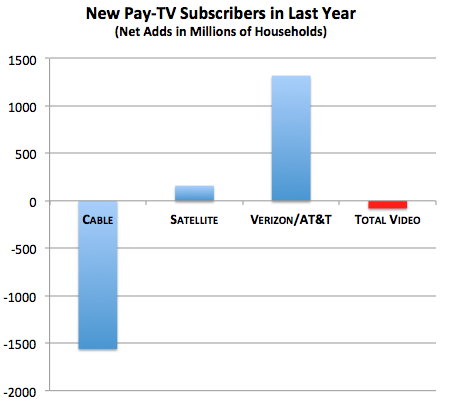
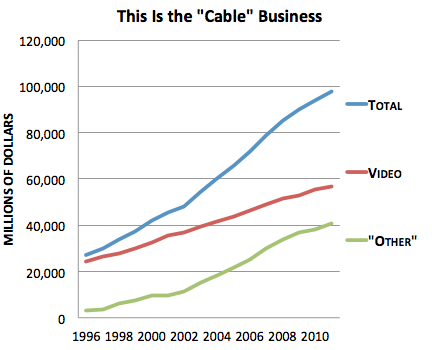
Every few weeks, some tech writer holds up a media analyst report allegedly showing, once and for all, that the cable guys have finally lost, and the cord-cutters have finally won. One week, that report might come. It will really be something. This is not that week. Let’s start with news that might appear to be the death throes of cable. Cable companies’ TV subscribers collapsed by more than 1.5 million in the last year, according to Leichtman Research Group. (The Big Two, Comcast and Time Warner Cable, have declined by more than 900,000, alone.) In fact, the trend has been underway for a while. Cable TV customers peaked in the late 1990s and have since fallen to early Clinton-era levels (SNL Kagan data) But the cable companies aren’t exclusively in the business of selling TV. They’re really in the business ofcommunications infrastructure, which is TV, phone, and Internet. The Internet business in particular has done very well for them. Since cable video subs peaked in the late 1990s, the industry has added 45 million high-speed Internet customers (SNL Kagan data, again). The two most important reasons why cable is still making more and more money every year, despite a structural decline in cable TV subs, is that they’ve successfully gleaned more money per customer: both by charging more for television and by getting households to buy more than just TV. For example, 40 percent of Comcast customers take three products (e.g.: video, phone, and Internet) and 70 percent take two products (e.g.: video and Internet). Cable ≠ video, and nothing says it more clearly than the latest earnings reports from the Big Two:Comcast, the largest provider of pay-TV in the country; and Time Warner Cable, the second largest cable provider (but behind DirecTV and Dish in total video subs). Comcast’s total revenue is almost twice TWC’s, but their businesses are remarkably similar. Upshot: If you equate “cable” with TV, you are literally getting only half the story. Cable providers are in the business of communications transport. They’re still in business because selling communications access is still a pretty good business, with high barriers to entry and voracious demand.

Screen Shot 2013-05-21 at 8.59.50 AM Screen Shot 2013-05-21 at 8.42.50 AM Screen Shot 2013-05-22 at 11.11.07 AM-thumb-570x189-122250

Four reasons why Apple’s Passbook is growing on retailers

Four reasons why Apple’s Passbook is growing on retailers

By Erica Ogg | GigaOM.com, Published: June 27 | Updated: Wednesday, June 26, 11:50 PM

We still have no leader in mobile payments, but when it comes to digital gift cards Apple’s Passbook is doing a decent job of making its case with big-name retailers — many of whom were somewhat skeptical of its utility when Passbook was first went live in fall 2012. CashStar, which makes digital gift cards for several dozen big name brand retailers including Starbucks, Dunkin  Donuts, Sephora, Williams-Sonoma, Gap, Best Buy and others, has good insight into how some of the biggest retail brands are faring with Apple’s digital wallet. And today, nearly 10 months since Passbook’s launch, CashStar released data claiming that about one-third of all digital gift cards that are sent to someone are opened on a smartphone, two-thirds of which are iOS 6 devices. About 30 percent of those are actually added to the Passbook app. Read more of this post

The Internet of Things and the future of manufacturing; Executives at Robert Bosch and McKinsey experts discuss the technology-driven changes that promise to trigger a new industrial revolution

The Internet of Things and the future of manufacturing

Executives at Robert Bosch and McKinsey experts discuss the technology-driven changes that promise to trigger a new industrial revolution.

June 2013 | byMarkus Löffler and Andreas Tschiesner

In what’s called the Internet of Things,1 the physical world is becoming a type of information system—through sensors and actuators embedded in physical objects and linked through wired and wireless networks via the Internet Protocol. In manufacturing, the potential for cyber-physical systems to improve productivity in the production process and the supply chain is vast. Consider processes that govern themselves, where smart products can take corrective action to avoid damages and where individual parts are automatically replenished. Such technologies already exist and could drive what some German industry leaders call the fourth industrial revolution—following the steam engine, the conveyor belt, and the first phase of IT and automation technology. What opportunities and challenges lie ahead for manufacturers—and what will it take to win? To discuss the future of manufacturing, McKinsey’s Markus Löffler and Andreas Tschiesner recently sat down for a conversation with Siegfried Dais, deputy chairman of the board of management at German engineering company Robert Bosch GmbH, and Heinz Derenbach, CEO of Bosch Software Innovations GmbH. Read more of this post

Guru Networks Sell Social Investing to Copycat Traders

Guru Networks Sell Social Investing to Copycat Traders

Internet social networks that let users follow investments the way they track status updates on Facebook are attracting record interest, turning top performers into market stars for individual investors.

Accounts at Tel Aviv-based EToro, the largest social-investment network, have climbed to 2.85 million from 1.75 million in 2011. ZuluTrade in New York says users have more than tripled since 2011. About 17 percent of brokerages serving individuals offer the ability to copy other users’ trades, according to a survey of 254 firms compiled by Aite Group LLC between October 2012 and April 2013. Read more of this post

In Asia, Ancient Writing Collides With the Digital Age

In Asia, Ancient Writing Collides With the Digital Age

By Miwa Suzuki on 11:53 am June 26, 2013.
Tokyo, Japan. As a schoolboy, Akihiro Matsumura spent hundreds of hours learning the intricate Chinese characters that make up a part of written Japanese. Now, the graduate student can rely on his smartphone, tablet and laptop to remember them for him.

“Sometimes I don’t even bother to take notes in seminars. I just take out my tablet to shoot pictures of what instructors write on blackboards,” he told AFP. Read more of this post

Wine producers go hi-tech to outsmart fraudsters

Wine producers go hi-tech to outsmart fraudsters

BY SUZANNE MUSTACICH

AFP-JIJI

JUN 26, 2013

PARIS – Making sure a glass of wine is everything it promises on the label was once a relatively simple process: hold against the light, tilt and observe the shade, swirl a little and give it a good sniff.

But with the ever-increasing global consumption of wine now attracting the attention of fraudsters, wine drinkers are soon just as likely to be advised to whip out their smartphones. Read more of this post

Google Ventures Stresses Science of Deal, Not Art of the Deal

June 23, 2013

Google Ventures Stresses Science of Deal, Not Art of the Deal

By CLAIRE CAIN MILLER

SAN FRANCISCO — Here is how the venture capital game used to be played around here:

A friend calls a friend who knows a guy. A meeting is taken. Wine is drunk (at, say, Madera lounge in Menlo Park). A business plan? Sure, whatever. But how does it feel?

This is decidedly not how Google, that apotheosis of our data-driven economy, wants to approach the high-stakes business of investing in the next, well, Google. Unlike venture capitalists of old, the company’s rising V.C. arm focuses not on the art of the deal, but on the science of the deal. First, data is collected, collated, analyzed. Only then does the money start to flow. Read more of this post

Voice software provider iFLYTEK announced to acquire MstChina, a test solution provider, for US$78 million

iFLYTEK to Acquire Test Solution Provider MstChina for RMB 480 million

By Tracey Xiang on June 25, 2013

Voice software provider iFLYTEK (SZ: 002230) announced to acquire MstChina, a test solution provider, for RMB 480 million (USD78 million).

MstChina’s offerings include English speaking and listening test software which must be the synergy between the two companies. iFLYTEK, having been focused on speech recognition technologies, now has a variety of voice-related services including Mandarin speaking test software, and an English speaking and listening test solution for middle schools. Read more of this post

Bitter rivals Oracle, Salesforce team up on cloud

Bitter rivals Oracle, Salesforce team up on cloud

12:02pm EDT

By Jim Finkle

BOSTON (Reuters) – Oracle Corp, the technology giant losing market share to younger firms that sell software via the Web, has signed a long-term partnership with archrival and cloud computing pioneer Salesforce.com Inc. The two companies said on Tuesday that Oracle will integrate some of its cloud-based software programs with Salesforce products. The companies gave few details on the unprecedented partnership, which also calls for Salesforce to expand its own use of Oracle products. Oracle, which unveiled a separate cloud partnership with longtime rival Microsoft Corp on Monday, is looking to accelerate growth by expanding sales of cloud-computing products, one of the few fast-growing areas in the technology sector. Oracle shares have grown 35 percent over the past five years, while Salesforce stock has soared more than 100 percent. The alliance marks a dramatic shift by Oracle co-founder and Chief Executive Larry Ellison toward Salesforce and its CEO Marc Benioff, who Ellison has derided for more than a decade. A bitter rivalry traces back to 2000, when Benioff fired Ellison from the Salesforce board of directors after Oracle started selling competitive software. Spokeswomen for both companies declined to elaborate beyond the announcement in a press release. That contrasted sharply with Monday’s unveiling of the new Oracle-Microsoft partnership, heralded in a press conference featuring Microsoft CEO Steve Ballmer and Oracle President Mark Hurd. The products that Salesforce plans to purchase from Oracle include one that manages human resources, known as human capital management software. That may signal that Salesforce has canceled ambitious plans to develop similar software that would compete with Oracle software. Benioff disclosed those plans to Reuters in December 2011. (reut.rs/sjtfcM) Benioff could not be reached for comment.

Cisco China Sales Vulnerable as Media Urge Domestic Shift

Cisco China Sales Vulnerable as Media Urge Domestic Shift

Cisco Systems Inc. (CSCO) faces a backlash in China, where it generates about $2 billion in annual sales, after state-run media said the company poses a security threat and urged a shift toward domestic suppliers.

While Cisco has said it didn’t participate in U.S. surveillance programs revealed earlier this month by former government contractor Edward Snowden, state-owned Chinese media outlets are calling for the company to face restrictions there. Read more of this post

Stratasys Plans Purchases for 3-D Printing Using Metals

Stratasys Plans Purchases for 3-D Printing Using Metals

Stratasys Ltd. (SSYS), a New York-listed maker of printers that create three-dimensional objects, plans acquisitions to expand into devices that use metals.

The company, with headquarters in Minneapolis and Israel, can maintain annual sales growth of about 20 percent without including the effect of purchases, Stratasys Chairman Scott Crump said in an interview in Beijing today. Read more of this post

Twitter Bites Back Brazil’s Batista in 82% Share Plunge

Twitter Bites Back Brazil’s Batista in 82% Share Plunge

Eike Batista became the most popular Latin American billionaire on Twitter by sharing his formula for success. Now the Brazilian entrepreneur is being assailed online by investors blaming him for wealth destruction.

People with shares in Batista’s OGX Petroleo & Gas Participacoes SA (OGXP3) are using the social media to criticize him after missed oil targets spurred an 82 percent share-price plunge this year. The billionaire has posted about 21,700 Twitter messages since 2010 and has more than 1.3 million followers, almost six times more than Mexican magnate Carlos Slim, the world’s second-richest person. Bill Gates, the richest person on the planet, has 11.8 million followers. Read more of this post

Ad tech firms face tough Wall Street audience with IPO pitches; in a sector characterized by hundreds of different companies, it is often difficult for outsiders to distinguish how one ad tech co’s algorithms are better than the next

Ad tech firms face tough Wall Street audience with IPO pitches

5:11pm EDT

By Olivia Oran and Alistair Barr

(Reuters) – A slew of advertising technology businesses are preparing for their toughest pitch yet: persuading investors to buy their stock in initial public offerings later this year.

Trouble is, some investors are dubious because it is hard to tell whether any company has a real technological edge. Ad tech companies that have gone public in the past do not inspire confidence either, with stocks of several down sharply since their debuts. Read more of this post

Nintendo Bets on App Store Model Amid New Game Drought

Nintendo Bets on App Store Model Amid New Game Drought

At the Electronic Entertainment Expo in Los Angeles this month, Sony Corp. (6758) and Microsoft Corp. (MSFT) made headlines when they unveiled new generation consoles to reach stores by Christmas. Nintendo Co. (7974)’s news at the world’s biggest gaming show: its fifth software delay since October.

That’s a problem because games sell consoles, and Nintendo’s new $300-$350 Wii U hasn’t exactly been flying off shelves. Between its November introduction and the end of March, Nintendo sold 3.45 million Wii Us. That’s far below the company’s initial estimate of 5.5 million and about 40 percent behind the original Wii in the same time after its 2006 release, according to Citigroup Inc. Read more of this post

GTT, the world’s No. 1 maker of cryogenic hull linings for LNG tankers, valued at up to $2.4 billion; GTT and Norwegian competitor Moss Maritime have a virtual duopoly on the lucrative niche market despite Korean shipbuilders – which have a near monopoly on LNG tankers – have tried for years to develop their own cryogenic technology

French LNG cryogenics specialist GTT for sale

1:03pm EDT

By Geert De Clercq

PARIS (Reuters) – Total (TOTF.PA: QuoteProfileResearchStock Buzz) and private equity firm Hellman & Friedman plan to sell their 30 percent stakes in GTT, the world’s No. 1 maker of cryogenic hull linings for LNG tankers, in an IPO that could value GTT at up to $2.4 billion, sources close to the companies said.

Gaztransport & Technigaz (GTT), also 40 percent owned by GDF Suez (GSZ.PA), has 70 percent of the market for the high-tech alloy membranes that line the hulls of the world’s liquefied natural gas (LNG) carriers. Read more of this post

Why basic 3D printers are crazy cheap now; Starting at $200: A smaller footprint, standardization, and growing interest helps

Why basic 3D printers are crazy cheap now

Starting at $200: A smaller footprint, standardization, and growing interest helps.

by Cyrus Farivar – June 21 2013, 9:00pm MPST

Last fall, Ars reported on the opening of a Southern California shop that was selling a $600 3D printer. The brick-and-mortar store seemed to bring the total number of 3D printer retail stores in America (and possibly the world) to two. Since then, there’s been a steadily rising interest in 3D printing—particularly in 3D-printed firearms, which, of course, has drawn the ire of legislators. For these printers to truly come into the mainstream, however, manufacturers need to first make it easy for consumers to buy them. That goal came one step closer to realization in early May 2013, when office supply retailer Staples announced that it would be selling a $1,300 printer from 3D Systems, making it the first major retailer to do so. Read more of this post

How eBay Uses Data and Analytics to Get Closer to Its (Massive) Customer Base

How eBay Uses Data and Analytics to Get Closer to Its (Massive) Customer Base

Big Idea: Data & AnalyticsInterview June 25, 2013  Reading Time: 11 min

Neel Sundaresan (eBay), Interviewed by Renee Boucher Ferguson

Online auction site eBay uses data about the behavior of its millions of customers to drive analytics at every level of the organization, and get closer to its customers.

You can find just about anything on eBay: A vintage BMW, a Lear jet, a half-million-dollar yacht. Or perhaps a domain name, industrial equipment, software and services from the likes of IBM, a food safari in San Francisco. Or even a previously undiscovered species, such as Coelopleurus exquisitus, a heretofore-unknown sea urchin sold on eBay. Read more of this post

TSMC signs up Apple for three-year deal; A deal whereby TSMC replaces or supplements Samsung, the incumbent supplier of Apple processors, has rumored for several years, but it appears that TSMC’s supplier status is about to begin

TSMC signs up Apple for three-year FinFET deal

Peter Clarke

6/24/2013 6:48 AM EDT

LONDON – Taiwan Semiconductor Manufacturing Co. Ltd. is set to supply Apple with processors using its FinFET process at the 16- and 10-nm nodes, after beginning with 20-nm planar CMOS, according to a report from Digitimes that referenced unnamed sources. TSMC’s IC design service partner Global UniChip, which works with customers to help prepare chips for the foundry, is also involved in the three-year deal, Digitimes report said. A deal whereby TSMC replaces or supplements Samsung, the incumbent supplier of Apple processors, has rumored for several years, but it appears that TSMC’s supplier status is about to begin. TSMC is expected to begin supplying a processor called A8 in July 2013 made on 20-nm CMOS and ramp up production “after December,” Digitimes said. TSMC is then scheduled to produce A9 and A9x processors in the second half of 2014. The timing indicates that A9/A9x processors are destined to be produced in TSMC’s 16-nm FinFET process. Both TSMC and Global Unichip said they do not comment on customer orders, Digitimes said. Read more of this post

How a freelance web developer made $490,000 in just 18 months posting lectures online on Udemy, which keep 30% of the revenue while the instructor takes 70%

June 25, 2013 – 12:41PM

Will Oremus

How a freelance web developer made $490,000 in just 18 months posting lectures online.

Victor Bastos has made close to half a million US dollars teaching classes on Udemy, an online learning start-up. Photo: Courtesy of Victor Bastos

Victor Bastos was making $US20,000 ($21,600) a year as a freelance web developer in Lisbon, Portugal, when he started posting videos to YouTube. Already fluent in several programming languages and looking to branch into new ones, he thought making instructional videos would help him keep track of what he’d learned. “It was like an online notebook for myself,” Bastos, 33, said. “But then I started getting a lot of subscriptions. People told me, ‘Your tutorials are great — why don’t you make a full course?’”

Within a few months, Bastos got an email inviting him to do just that. The proposal came from an online-learning start-up he had never heard of called Udemy. The offer: host his course on Udemy’s web-based platform, and he could charge students to take it and keep 70 per cent of the revenues. Udemy would keep the other 30 per cent. Read more of this post

China Mobile Called A Halt to Jego, its One-month-old Skype/WeChat Competitor

China Mobile Called A Halt to its One-month-old Skype/WeChat Competitor, Jego

By Annie Wang on June 24, 2013

China Mobile called a halt to Jego, a Skype-like appreleased early this month, by disabling new user registration and stopping voice and video calling service in mainland China, according to a statement issued by China Mobile International (in Chinese). This has added some more spice to the talking of messaging lovers. This app, at first, aimed to provide users from home and abroad, with free messaging services like text/voice chats, pic sharing, video calls etc. Why was Jego a flash in the pan? Many wondered. Some of the insiders said the mainly cause was the disputes between different departments of China Mobile, as Jego was released and promoted by the Hong Kong-headquartered China Mobile International (in Chinese). Another speculation is the app may cannibalize two of its revenue generators, text message and calling services. China Mobile acknowledged that they were suffering the consequences of the rise free messaging apps, and even wanted to charge WeChat, one of the most popular of the likes. Jego actually was revamped from the push-to-talk software designed for volunteers during 2008 Olympic Games, as disclosed by employees from China Mobile.

Connecting People, Data and Machines: The next great leap in technology will see the Internet play a huge role in production, former China Mobile chairman Wang Jianzhou says

06.24.2013 17:14

Connecting People, Data and Machines

The next great leap in technology will see the Internet play a huge role in production, former China Mobile chairman Wang Jianzhou says

By staff reporter Qin Min

(Beijing) — Many company leaders have seen that the development of the Internet is bringing about a new revolution in the means of production. As General Electric chairman and CEO Jeffrey Immelt has said: “[It is] an open, global network that connects people, data and machines. The Industrial Internet is aimed at advancing the critical industries that power, move and treat the world.” Read more of this post

Uber Continues Asia Expansion With Seoul Test Runs

Uber Continues Asia Expansion With Seoul Test Runs

CATHERINE SHU

posted 2 hours ago

Uber has begun testing its taxi calling app in Seoul, the startup’s second stop in Asia.

Uber has been promoting its app and premium car service in South Korea since the beginning of May, right after it started looking for a community manager and operations manager in Seoul. The San Francisco-based company kicked off its Asia expansion with the start of its Singapore trials in January.

Uber launched its testing phase in trendy Gangnam district with its first celebrity passenger, footballer and Olympic medalist Koo Ja-cheol. The company will spend the next few weeks testing out its operations in South Korea’s capital with a limited fleet of cars. Read more of this post

What is behind Snapchat’s $800 million valuation?

What is behind Snapchat’s massive valuation?

By Dan Primack June 24, 2013: 1:25 PM ET

Venture capitalists have valued Snapchat at more than $800 million. Why?

FORTUNE — Snapchat is one of the world’s fastest-growing mobile apps, with users sharing more than 200 million “snaps” per day. For the uninitiated (or those over 30), “snaps” are instant messages/photos that self-destruct ten seconds or less after being viewed.

It also has one of the mobile world’s fastest-growing valuations, with multiple reports out today that the company has raised $60 million in new VC funding at an $800 million pre-money valuation (the company confirmed the deal, sans financial specifics).

What Snapchat doesn’t have yet, however, is revenue. Nor does it have easily identifiable paths to revenue. Read more of this post

Oracle’s Power of Prophecy Fades; corporate customers are struggling to organize data that aren’t so easily structured but Oracle databases are suited best to information that is easily categorized in rows and columns

June 24, 2013, 5:33 p.m. ET

Oracle’s Power of Prophecy Fades

By ROLFE WINKLER

MI-BW752_ORACLE_G_20130624174206

Larry Ellison says his products aren’t the problem. Except that they are. What’s worse for investors, Oracle may be making imprudent investments as a result.

Explaining why his company missed its own fiscal fourth-quarter targets, Oracle’s chief executive pointed to “weakness” across each of the company’s core offerings. “So it was clearly an economic issue,” he said, “not a product competitive issue.” Read more of this post

Hulu Faces a Nebulous Future as It Seeks a New Owner

June 23, 2013

Hulu Faces a Nebulous Future as It Seeks a New Owner

By AMY CHOZICK and BRIAN STELTER

This year Hulu reached a milestone: viewers streamed more than one billion videos on the site in a single three-month period.

But the valedictory lap did not last long. Even as the number of views were adding up, so were concerns within the company about the site’s future. Read more of this post

Fab.com’s Ascent to $1 Billion Valuation Brings Missteps

Fab.com’s Ascent to $1 Billion Valuation Brings Missteps

Fab.com Inc., valued at more than $1 billion dollars after just two years in existence, is suffering growing pains from its rapid expansion as it applies a culture of meticulous control to a global business.

The online retailer — a darling of the New York startup scene for its uniquely designed home goods, art and jewelry — has made five acquisitions, expanded its staff to 650 people and spent tens of millions of dollars on marketing. It’s also lost or fired at least 11 of its executives in the past year and missed its targets for revenue by almost 20 percent. Read more of this post

Microsoft Web-based computing service will start offering Oracle database as an option as the companies cast aside a longstanding rivalry to attract businesses moving their software online

Microsoft Joins Oracle in Cloud-Computing, Rivalry Thaws

Microsoft Corp. (MSFT)’s Web-based computing service will start offering Oracle Corp. (ORCL)’s database as an option as the companies cast aside a longstanding rivalry to attract businesses moving their software online.

Microsoft will offer businesses using its Windows Azure cloud-computing service the ability to run Oracle’s widely used database software, application-connecting middleware and Java programming tools, Microsoft Chief Executive Officer Steve Ballmer and Oracle co-President Mark Hurd said in a statement. Read more of this post

Apple Falls Below $400 Amid IPhone Slump, low morale causing employee departures.

Apple Falls Below $400 Amid IPhone Slump, Worker Exits

Apple Inc (AAPL). dipped below $400 for the first time since April as a glut of unsold iPhones prompted Jefferies & Co. to lower its target price, and Global Equities Research said low morale is causing employee departures.

Apple, the world’s most valuable technology company, fell 2.7 percent to $402.54 at the close in New York, after earlier dropping as low as $398.05. The shares have declined 24 percent this year, compared with a 10 percent gain in the Standard & Poor’s 500 Index. Read more of this post