Amazon’s Growth Story Keeps Selling

Amazon’s Growth Story Keeps Selling

SPENCER JAKAB

Jan. 29, 2014 4:03 p.m. ET

“The bottom line” has earned a place of distinction, if you can call it that, on lists of hackneyed clichés. So it seems appropriate investors in one of today’s evolving media and retail powerhouses pay it little heed. Read more of this post

Apple Pushes Deeper Into Mobile Payments Tech Giant Lays Groundwork to Expand Service for Physical Goods

Apple Pushes Deeper Into Mobile Payments

Tech Giant Lays Groundwork to Expand Service for Physical Goods

DOUGLAS MACMILLAN And DAISUKE WAKABAYASHI

Jan. 24, 2014 7:43 p.m. ET

Apple Inc. AAPL -1.14% is laying the groundwork for an expanded mobile-payments service, leveraging its growing base of iPhone and iPad users and the hundreds of millions of credit cards on file through its iTunes stores. Read more of this post

WeChat overtakes Facebook in Indonesian market

WeChat overtakes Facebook in Indonesian market

Staff Reporter

2014-01-29

Chinese smartphone messaging app WeChat has become one of the four major instant messaging tools widely used in Indonesia, reports Shanghai’s China Business News, citing Andi Ardiansyah, an Indonesian representative based in Guangzhou. Read more of this post

Tech giants scramble to tap internet solutions for cars

Tech giants scramble to tap internet solutions for cars

Staff Reporter 

2014-01-29

In line with a global trend among international auto multinationals, Chinese enterprises are scrambling to invest in car-related internet technology, attracted by the emerging market’s huge potential. Read more of this post

In China, the Coolpad Is Hotter Than Apple’s iPhone

In China, the Coolpad Is Hotter Than Apple’s iPhone

LORRAINE LUK and JURO OSAWA

Jan. 28, 2014 11:46 a.m. ET

image001-12

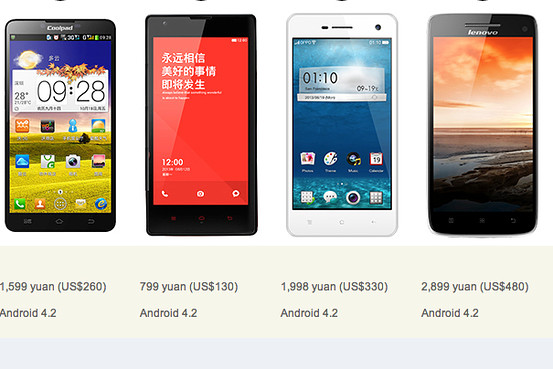
HONG KONG— Apple Inc. AAPL -7.99% and Samsung Electronics Co.005930.SE -0.23% are the dominant smartphone brands in the U.S. and in many other parts of the world. But in China, the world’s biggest smartphone market, there isn’t a clear winner yet.

Virtually unheard of outside China, several homegrown brands are gaining ground and seeking to challenge the technology giants’ duopoly. Working in their favor: advanced hardware at lower prices, strong relationship with Chinese carriers, as well as creative ways to build a fan base through social media and online forums. Read more of this post

Acer founder open to son heading the company in future

Acer founder open to son heading the company in future

CNA
January 28, 2014, 12:10 am TWN

image003-5

Acer founder and chairman Stan Shih, right, and his eldest son Maverick Shih in Taipei, Jan. 27, 2007. (Photo/CNA)

TAIPEI — Acer Inc. (宏碁) founder Stan Shih (施振榮), who is trying to get the computer vendor back on track after three years of poor results, said on Monday that he is open to the possibility of having his eldest son, Maverick Shih (施宣輝), take over the company in the future.

Maverick Shih came to public attention on Jan. 23 when he was named president of Acer’s BYOC (Build Your Own Cloud) and Tablet Business Group as part of the company’s management reshuffle.

“I hope people will not put too much pressure on him. He needs to take more responsibility and learn as much as possible,” Stan Shih said at the Acer Digital Innovation awards ceremony when asked by reporters to comment on his eldest son’s promotion.

“It is a matter of corporate governance and something the future management team will need to decide. I’ll leave it as it is and expect him to contribute to the organization in his position,” said the 69-year-old founder, who returned to the struggling PC maker as chairman in November last year.

Maverick Shih, 40, joined Acer two years ago and gained sufficient experience in the cloud computing and software sectors relative to other Acer executives, making it natural to appoint him as the head of Acer’s cloud business group, Stan Shih said.

In a bid to revive the company’s waning fortunes, Acer announced organizational changes on Jan. 23 that included the establishment of a Notebook Business Group, a Stationary Computing and Display Business Group, and a Corporate Business Planning and Operations Group.

The Taipei-based manufacturer also renamed its cloud technology department the BYOC and Tablet Business Group and its e-enabling services as the e-Business Group.

The changes were triggered by Acer’s after-tax loss of NT$7.63 billion (US$252.6 million), or a loss of NT$2.8 per share, in the fourth quarter of 2013, including an unexpected NT$1.3 billion write-off of raw materials inventory.

That followed a loss of NT$13.12 billion, or NT$4.82 per share, in the third quarter, driven largely by the write-down in value of intangible assets. That loss resulted in the resignations of former CEO J.T. Wang and Corporate President Jim Wong on Nov. 21 last year.

Shares in Acer edged down 0.83 percent to NT$17.95 in trading in Taipei on Monday. The market’s benchmark index fell 1.58 percent on the last trading day before the Lunar New Year holiday.


Acer founder open to Maverick son taking over reins

CNA

2014-01-28

Acer founder Stan Shih, who is trying to get the Taiwanese computer vendor back on track after three years of poor results, said on Monday that he is open to the possibility of having his eldest son Maverick Shih take over the company in the future.

Maverick Shih came to public attention on Jan. 23 when he was named president of Acer’s BYOC (Build Your Own Cloud) and Tablet Business Group as part of the company’s management reshuffle.

“I hope people will not put too much pressure on him. He needs to take more responsibility and learn as much as possible,” Stan Shih said at the Acer Digital Innovation awards ceremony when asked by reporters to comment on his eldest son’s promotion.

“It is a matter of corporate governance and something the future management team will need to decide. I’ll leave it as it is and expect him to contribute to the organization in his position,” said the 69-year-old founder, who returned to the struggling PC maker as chairman in November last year.

Maverick Shih, 40, joined Acer two years ago and gained sufficient experience in the cloud computing and software sectors relative to other Acer executives, making it natural to appoint him as the head of Acer’s cloud business group, the elder Shih said.

In a bid to revive the company’s waning fortunes, Acer announced organizational changes on Jan. 23 that included the establishment of a Notebook Business Group, a Stationary Computing and Display Business Group, and a Corporate Business Planning and Operations Group.

The Taipei-based manufacturer also renamed its cloud technology department the BYOC and Tablet Business Group and its e-enabling services as the e-Business Group.

The changes were triggered by Acer’s after-tax loss of NT$7.6 billion (US$252.6 million), or a loss of NT$2.80 (US$0.09) per share, in the fourth quarter of 2013, including an unexpected NT$1.3 billion (US$42.8 million) write-off of raw materials inventory.

That followed a loss of NT$13.1 billion (US$431 million), or NT$4.82 (US$0.16) per share, in the third quarter, driven largely by the write-down in value of intangible assets. That loss resulted in the resignations of former CEO J T Wang and corporate president Jim Wong on Nov. 21 last year.

Shares in Acer edged down 0.83% to NT$17.95 (US$0.59) in trading in Taipei on Monday. The market’s benchmark index fell 1.58% on the last trading day before the Lunar New Year holiday.


Google Is Making A Land Grab For The Internet Of Things

Google Is Making A Land Grab For The Internet Of Things

Posted 12 hours ago by Pankaj Mishra (@pankajontech)

Before this past December, when Google acquired seven robotics companies back-to-back, the company’s ambitions in the “Internet of Things” space looked as detailed as a freshly started jigsaw puzzle.

But with its last three acquisitions — Boston Dynamics, Nest and DeepMind — it seems like Google is rapidly collecting the individual pieces to put together a “real life Internet,” a network of AI-driven robots and objects that could improve transportation, manufacturing and even day-to-day consumer life.

Google’s “real life Internet,” a business that reaches far beyond web search and online advertising, may look like a General Electric on the Internet of Things side, and an IBM on the software side — where artificial intelligence is at the core of products like Watson.

At least that’s what it looks like right now, as the search giant is gobbling up almost every company that could fit into the puzzle, combining hardware, software, analytics, robotics and artificial intelligence into, well, something.

Google X, the company’s skunkworks unit that’s been developing driverless cars among several other sci-fi-esque projects, now seems to be leading Google’s hefty meatspace ambitions.

One obvious extrapolation from all these acquisitions is that Google will be in the business of data for a long time. Covering computers, tablets and now phones with Android and building applications like Maps to harvest information about its hundreds of millions of users, Google is now looking far beyond traditional computing devices. Acquiring Nest, which builds smart home devices, was one swift lunge in that direction.

How many more of these diversity acquisitions will we see before 2014 closes out?

Since last Christmas, Google has dropped well over $4 billion on buying seven roboticscompanies and Big Dog maker Boston Dynamicsenlisting Android guru Andy Rubin to figure out what do with them.  Internet of Things darling Nest, and AI company DeepMind will operate outside of the robotics division, according to Liz Gannes.

Google is betting its future on the fact that one day our cars, refrigerators, mobile phones, computers and home devices will communicate with each other, generating insights that can be converted into data. And that these newer channels will result in a massive advertising opportunity.

But what can Google accomplish that IBM and GE cannot?

IBM has invested $1 billion in its AI-driven Watson project, which is expected to bring $10 billion in revenue over the next few years. Facebook too, has set up an artificial intelligence team to understand emotions, and according to The Information and a tipster, was even in the race to acquire DeepMind (our tipster held the Facebook bid at $450 million).

And good old GE is putting all its might behind building software platforms that bridge the physical world of industrial machines with the Internet — a strategy and aim similar to Google’s but for the machine world.

So far, IBM has depended heavily (perhaps doggedly) on Watson for making its artificial intelligence push work. Since its launch around three years ago, IBM has been pushing aggressively to turn its “Jeopardy”-winning computer into a business where healthcare and telecom companies pay to use Watson in real life. But as a WSJ piece earlier this month pointed out, IBM has been struggling to make it work.

On the enterprise side, both IBM and GE are still far away from making any big impact in terms of revenues, despite having the experience of working with Fortune 500 companies for decades.

Watson’s biggest challenge today is solving real-life problems and living up to the “intelligence” part of the artificial intelligence equation.

When asked by the New York Times what he wanted to build at Google, Andy Rubin brought up the example of a windshield wiper that turned itself on when it rains.

As humble as that sounds, Google ostensibly has a head start in terms of AI-practicality, with Google Now making strides in the proactive computing field. It also has a tremendous advantage in its treasure chest of user data, allowing it to predict and analyze patterns in behavior and needs more robustly than any competitor.

With one of the largest server architectures on the Internet, Google has the big computing power necessary for AI processing at its fingertips. It also has ancillary Google X efforts likeProject Loon

that could blanket areas in connectivity needed to power robotics.

A “real life Internet” may be closer than we think.

Shop Direct, the group behind catalogue retailer Littlewoods and very.co.uk, in line to post £50m profits after an accounting switch to IFRS standards mean it would no longer be hit by amortization charges

January 26, 2014 11:18 pm

Shop Direct in line to post £50m profits

By Duncan Robinson

Shop Direct, the group behind catalogue retailer Littlewoods and very.co.uk, is set to make a pre-tax profit of nearly £50m this year putting the retailer in the same league as fast-growing rival Asos.

The retailer, which is owned by the Barclay family, posted pre-tax profits of £6.6m –its first in a decade – for the year to June 30.

But rapid growth from brands such as Very and Isme, where revenues jumped by a fifth last year, could push operating profits at the group to between £25m and £30m next year.

An accounting switch to IFRS standards would mean that Shop Direct would no longer be hit by amortisation charges of about £20m related to the group’s buyout of the catalogue division of former FTSE 100 retailer GUS in 2003. This would feed through to the group’s bottom line, pushing it to nearly £50m, if the company goes ahead with the switch, estimate analysts.

Such a performance would put Shop Direct on a par with rivals such as Asos, which had pre-tax profits of £55m last year off revenues of £770m, and top off a remarkable 10-year turnround at the group.

The potential jump in profits comes after a decade of losses at Shop Direct, as the business shifted from its core catalogue business to an online model. The business lost nearly £60m in 2012 alone.

Now about 85 per cent of transactions from the group are online, with 36 per centtaking place on mobile devices

. Alex Baldock, chief executive, predicted that “every transaction” will involve a mobile device at some point from next year.

“We have been taken by surprise at how fast this is growing,” said Mr Baldock.

The group derives just over half its £1.7bn revenues from its “heritage” businesses, which include Littlewoods, where sales are declining by about 5 per cent per year. The remainder of the business comes from newer brands, such as Very and Isme, which should account for the majority of revenues from 2016.

Yodel, the Barclay family’s sometimes maligned delivery service, is also set to become profitable in the next year or so. Yodel has had a rough life since it was spun out of Shop Direct, with heavy losses and regularly hitting the headlines due to tales of poor customer service. Losses halved from £125m before tax in 2011 to just under £60m in 2012 and the delivery group made a profit over the busy Christmas period.

Why millions are gung-ho for this gaming company; With Puzzle & Dragons, GungHo Online Entertainment has a monster Japanese hit

Why millions are gung-ho for this gaming company

By JP Mangalindan, Writer January 27, 2014: 5:00 AM ET

With Puzzle & Dragons, GungHo Online Entertainment has a monster Japanese hit.

FORTUNE — Few know about it stateside, but in Japan, you’d be hard-pressed to find someone who hasn’t heard of Puzzle & Dragons.

Part puzzler, part dungeon crawler, part monster-collecting adventure, GungHo Online Entertainment launched the mobile game in 2012, and it now claims over 20 million users — roughly 1/6 of the Japanese population — who have downloaded the free-to-play game and bought into its ecosystem of virtual goods. Puzzle & Dragons‘ success has, in turn, sent GungHo’s own fortunes soaring: The company has generated $700 million-plus in profit on revenues of over $1.2 billion so far during its fiscal year, ending this month. Its stock spiked a whopping 775% in 2013.

Gamers have CEO Kazuki Morishita largely to thank. Before GungHo, Morishita worked as a manzai artist, a comedian specializing in a traditional style of Japanese stand-up comedy, for little over two years. “I genuinely enjoy entertaining people — I get a thrill out of it,” explains Morishita, who argues being a comedian actually bears some commonalities with developing games. “Game companies should entertain their fans and users. It can never just be about the business-to-business aspects of the industry.”

When he joined GungHo in 2002, it was still an Internet auction software developer. But Morishita, who grew up pouring hours into traditional console games like Super Mario Bros., saw more business potential in online gaming even then, before contemporary broadband speeds were common in his country. He helped draft a 10-year company plan, which included developing games like Ragnarok Online. The Norse mythology-inspired multiplayer role-playing game, released for the PC in 2002, has 80 million registered users in 70 countries, and spawned several successful sequels.

Still, it’s Puzzle & Dragons’ virtual overnight success that has made GungHo the veritable Rovio of Japan. Puzzle & Dragons Z, a spin-off for Nintendo’s 3DS handheld, topped Japanese software sales charts during its first two weeks on sale after it launched in December, selling 800,000-plus copies. According to Morishita, GungHo has at least 10 more games in development, although he declined to give specifics. Says Morishita simply: “Whatever they [gamers] experience the first time they pick up a GungHo game will leave a lasting impression.”


Enough is enough, Silicon Valley must end its elitism and arrogance

Enough is enough, Silicon Valley must end its elitism and arrogance

By Vivek Wadhwa, Updated: January 27 at 10:59 am

When computers were just for nerds and large corporations, Silicon Valley’s elite could get away with arrogance, insularity and sexism. They were building products for people that looked just like them.  The child geniuses inspired so much awe that their frat-boy behavior was a topic of amusement.

Now technology is everywhere.  It is being used by everyone. Grandma downloads apps and communicates with junior over Facebook. Women are dominating social media and African Americans are becoming Twitter’s fastest-growing demographic group.

The public is investing billions of dollars in tech companies and expects professionalism, maturity, and corporate social responsibility.  It is losing its tolerance for elitism and arrogance.

Note what just happened when Silicon Valley luminary Tom Perkins wrote to the Wall Street Journal to complain of public criticism of the Bay Area elite and his ex-wife Danielle Steel. He said “Writing from the epicenter of progressive thought, San Francisco, I would call attention to the parallels of fascist Nazi Germany to its war on its ‘one percent,’ namely its Jews, to the progressive war on the American one percent, namely the ‘rich.’”

There was such an outpouring of anger on social media over the comparison to the Nazi genocide that the venture capital firm Perkins founded, Kleiner Perkins Caufield & Byersdisavowed its association with him. Tech blogs and newspapers lashed out. Silicon Valley heavyweights such as Marc Andreessen and Marc Benioff expressed their disapproval. It is a rare thing in Silicon Valley for any venture capitalist or CEO to speak up against a tech luminary — no matter how much out of line he may be. So this was a surprise.

The Perkins controversy is the tip of the iceberg. Kleiner Perkins is itself embroiled in a sexual-harassment scandal that it chose to litigate rather than settle. When Twitter filed for an IPO with an all-male board, the New York Times slammed it for being an old boys’ club. Rather than admitting that his company may have erred, Twitter CEO Dick Costolo chose to lash out publicly against a critic—me—for expressing outrage in the article. A few weeks later, Twitter gave in to the growing backlash and announced a woman director. There was no apology or humility, however.

In most industries, discriminating on the basis of gender, race, or age would be considered illegal. Yet in the tech industry, venture capitalists routinely show off about their “pattern recognition” capabilities. They say they can recognize a successful entrepreneur, engineer, or business executive when they see one. The pattern always resembles Mark Zuckerberg, Bill Gates, Jeff Bezos, or them: a nerdy male. Women, blacks, and Latinos are at a disadvantage as are older entrepreneurs. VCs openly admit that they only fund young entrepreneurs and claim that older people can’t innovate.

It isn’t just venture capitalists who are insensitive to federal employment-discrimination laws. Most tech companies refuse to release gender, race, or age data. They claim this information is a trade secret. Whatever data are available reveal a strong bias towards young males.

In his letter to Wall Street Journal, Tom Perkins complained of the outraged public reaction to Google buses carrying technology workers and to rising real-estate prices. But these are genuine grievances. Long-time residents of San Francisco are being displaced because of skyrocketing rents. Bus stops are being clogged with fleets of luxury buses. The tech industry is taking advantage of the investment that taxpayers made in public infrastructure, the Internet, and education—without giving much back or even acknowledging its debts to society.

Silicon Valley’s tech companies are also disconnected from the communities in which they live. They remain aloof about the problems that the poor face. Very few help set up soup kitchens, build houses for the homeless, or provide scholarships for disadvantaged children. Tech moguls such as Peter Thiel go as far as admonishing the value of higher education itself—and paying children $100,000 to drop out of college. Most startups focus on building senseless social media-type apps or solving the problems of the rich—and that is what venture capitalists typically fund.

Silicon Valley has an important role to play in solving the world’s problems.  It is the epicenter of innovation. Most technologists I know have a social conscience and want to do whatever they can to make the world a better place. Yet the power brokers—most venture capitalists, super-rich angel investors, and CEOs consistently show a disregard for social causes. They display a high level of arrogance, demand tax cuts for themselves, and have a don’t-care attitude. As demonstrated by the Perkins letter, this sends the wrong message to the world and holds Silicon Valley back.

It is time for the Silicon Valley elite to smell the coffee and realize that the world has changed—and that they must too. It is time for tech entrepreneurs to focus on solving big problems and giving back to the world.


Tesla Completes L.A.-to-New York Electric Model S Drive Chargers

Tesla Completes L.A.-to-New York Electric Model S Drive Chargers

Tesla Motors Inc. (TSLA)’s Elon Musk said the electric-car maker has expanded its U.S. network of rapid chargers to let owners of battery-powered Model S sedans drive their cars from coast to coast for the first time.

Musk, Tesla’s chief executive officer and co-founder, said last year the company would set up “Superchargers” in most major U.S. and Canadian cities to permit long-distance trips solely on electricity provided at no charge. The carmaker has more than 70 stations in North America, according to Tesla’s website.

“Tesla Supercharger network now energized from New York to LA, both coast + Texas!” Musk said in a Twitter post today. “Approx 80% of US population covered.”

Tesla, seeking to be the world’s leading maker of all-electric autos, needs the broader network of charging stations to address the limited driving range and long charge times of battery cars. Without the stations, Tesla drivers are limited by the estimated 265-mile (426-kilometer) range of a Model S battery, which can take as long as 9 hours to repower.

Musk has said the chargers, which the company says are the fastest available, are installed near major highway interchanges on properties close to restaurants, cafés or shopping to allow drivers to take breaks while their vehicle are repowered.

The Superchargers, currently compatible only with the Model S, provide 170 miles of range in a 30-minute charge, according to the company. The cheapest version of the Fremont, California-built car enabled to work with the Superchargers costs $73,070, according to Tesla’s website.

Two teams of Tesla drivers will try to set U.S. cross-country electric vehicle speed records using the chargers, departing Jan. 31 from Los Angeles and arriving in New York by Feb. 2, said Musk, 42. He also plans a “LA-NY family road trip over Spring Break,” using the system, he said on Twitter.

The company named for inventor Nikola Tesla more than quadrupled in value in 2013. Tesla fell 3.8 percent to $174.60 at the close Jan. 24 in New York.

To contact the reporter on this story: Alan Ohnsman in Los Angeles at aohnsman@bloomberg.net

11 Rules for Critical Thinking

11 Rules for Critical Thinking

January 24, 2014 by Shane Parrish

A fantastic list of 11 rules from some of history’s greatest minds. These are Prospero’s Precepts and they are found in AKA Shakespeare: A Scientific Approach to the Authorship Question:

All beliefs in whatever realm are theories at some level. (Stephen Schneider)

Do not condemn the judgment of another because it differs from your own. You may both be wrong. (Dandemis)

Read not to contradict and confute; nor to believe and take for granted; nor to find talk and discourse; but to weigh and consider. (Francis Bacon)

Never fall in love with your hypothesis. (Peter Medawar)

It is a capital mistake to theorize before one has data. Insensibly one begins to twist facts to suit theories instead of theories to suit facts. (Arthur Conan Doyle)

A theory should not attempt to explain all the facts, because some of the facts are wrong. (Francis Crick)

The thing that doesn’t fit is the thing that is most interesting. (Richard Feynman)

To kill an error is as good a service as, and sometimes even better than, the establishing of a new truth or fact. (Charles Darwin)

It ain’t what you don’t know that gets you into trouble. It’s what you know for sure that just ain’t so. (Mark Twain)

Ignorance is preferable to error; and he is less remote from the truth who believes nothing, than he who believes what is wrong. (Thomas Jefferson)

All truth passes through three stages. First, it is ridiculed, second, it is violently opposed, and third, it is accepted as self-evident. (Arthur Schopenhauer)


The Surface and the Chromebook Offer Lessons on Innovation

January 24, 2014, 5:04 PM ET

The Surface and the Chromebook Offer Lessons on Innovation

By Steve Rosenbush

Deputy Editor

Well after their initial release, two devices—the Surface tablet and the Chromebook laptop—finally are gaining some traction in the market. Microsoft Corp.MSFT +2.08%’s Surface was a bright spot in the company’s latest earnings report, the WSJ’s Shira Ovide says. The Chromebook—a stripped-down laptop that is designed to be used over the Internet with Google Inc.GOOG -3.13%’s Chrome operating system and its cloud-based apps–is increasingly popular among schools, the WSJ’s Rolfe Winklerreports.

Neither product was an instant sensation, but that is exactly what makes them interesting. Conversations about innovation focus all too often on the iPads and iPhones of the world, the outliers that redefine markets and the way that people go about lives and their business. It’s great to understand the stories behind their success, but given that few successful products can match that arc—and that the ones that do tend to come about in a unique and unpredictable way—the Surface and the Chromebook may have more to teach us.  As Gartner Inc. analyst Tuong Nguyen says, “the process of progress in technology is often more evolutionary than revolutionary.”

As readers of CIO Journal are well aware, the Surface failed to live up to initial expectations in 2012. But as Ms. Ovide writes, “fresh versions of Surface went on sale in October, and Microsoft sharply discounted the first-generation Surface models. It looks like the one-two punch of new Surface models and cheap, older Surface models helped drive a surprisingly good showing from Microsoft’s hardware business.” Reviews of early Chromebooks, launched in 2011, determined that the devices suffered from basic flaws—they were under-powered and had poor screens, even given the price range of about $300. But prices have come down even more, and the quality steadily has improved.  “A Chromebook could soon become a truly viable notebook,” the Verge’s David Pierce wrote last year in a review of the Hewlett-Packard Co. Chromebook 14.

“We’re always listening to what our customers may need, and Chromebooks are always gaining new features based on that feedback,” a Google spokeswoman told the WSJ. That may seem obvious, but the fact is that businesses often don’t listen to their customers, and even if they do, then what? What do they do with all of that feedback and how do they use those insights to improve their products and bring them to market?

CIO Journal has focused on those questions for nearly two years now. As PwC principal Chris Curran wrote in a guest column back in 2012, many companies have the ability to generate or capture innovative ideas, but “a rare few have instilled the systemic organizational processes to harness those ideas and to repeat the process over and over again to sustain successful innovation.”

Innovation draws together a broad range of people and skills and flows organically from a company, from its culture, leadership and structure. As Mr. Curran notes, technology and IT leadership is a major factor in that success, which depends upon the collection, dissemination and analysis of data.

***

The innovation process should be segmented into phases and talent should be managed accordingly. Creativity fuels the idea generation phase of innovation and is necessary to identify potential breakthrough products and services. The second phase, idea exploration, employs more left-brained talent that is capable of sorting, prioritizing, and prototyping and testing ideas. Discriminating scrutiny is required to boost the odds that the innovation is aligned with business goals and has a chance of generating a return on investment. At the final stage, idea scaling, the art of innovation takes a back seat to the engineering. Corporations need to marshal the necessary resources along the innovation conveyor belt to mobilize, scrutinize, enhance, scale and implement inspired ideas.***

While it’s unlikely that this sort of prosaic work will yield the next iPhone or iPad, it may play a key role in helping save the next promising, but flawed , idea from failure. In the aggregate, those relatively minor successes are greater than the sum of their parts.

In Music, the Money Is Made Around the Edges; In Pre-Grammy Tradition, Executives Seek Ways to Boost Profits With Freebies, Interactive Videos

In Music, the Money Is Made Around the Edges

In Pre-Grammy Tradition, Executives Seek Ways to Boost Profits With Freebies, Interactive Videos

HANNAH KARP

Jan. 26, 2014 7:22 p.m. ET

LOS ANGELES—While much of the music industry was busy last week feting Grammy nominees, several dozen artist managers, technologists and record-label executives met for breakfast at a private club on the Sunset Strip to discuss a more urgent matter: how to make more money.

A pre-Grammy tradition that started several years ago known as the Big Bang Forum, the tech-focused discussion highlighted an uncomfortable reality: While Grammy wins and performances still boost record sales and exposure, the glory is increasingly muted as record sales make up a shrinking piece of most artists’ income.

The speakers included Tim Quirk, GoogleInc. GOOG -3.13% ‘s head of programming for music and digital-media store Google Play. Mr. Quirk talked candidly about Google’s long-term strategy to make a “profit center” by charging different consumers different prices for the same songs.

Yoni Bloch, founder of Israeli technology startup Interlude, showed why low-cost interactive music videos—such as recently released clips for Bob Dylan’s “Like a Rolling Stone” and Pharrell Williams’s “Happy”—garner far more advertising dollars than the traditional videos. Helping drive interest, fans can click on the videos to customize everything from the song lyrics to the instruments band members play.

SFX Entertainment Inc. SFXE +2.72% plans to make more money from social media than from selling tickets to the dozens of electronic-dance-music festival’s the promotion company has snapped up in recent years, said Chris Stephenson, SFX’s chief marketing officer.

“There’s a 5% to 10% margin on these events—that’s not what the business is. People are reliving that moment 365 days a year,” said Mr. Stephenson, noting that one of SFX’s festivals, Tomorrowland, was streamed live by 16.9 million people last year, and has been viewed 100 million times. The company plans to capitalize on that ongoing interest by corralling social-media followers onto a central platform where brands can advertise.

Google’s Mr. Quirk said his vision to make money in music involved catering to three different groups: fans looking for free tunes; fans willing to pay a small amount to rent or stream music from its subscription service, All Access; and superfans who will pay almost any price for a memento associated with their favorite act. As an example, he cited devotees of the rock band Kiss who want to be buried in a “Kiss coffin.”

The trick, Mr. Quirk said, is to market to all three groups at once. Albums, for example, should be presented as free apps, including access to some content but requiring eventual purchase for certain songs, features, or merchandise, he said.

Google Play’s early experiments have yielded mixed results, he said. A global promotion for the now defunct British punk pioneers The Clash in September—for which Google paid “a significant amount” to produce documentary interviews with the band’s four surviving members—did “not necessarily recoup” the video investment, he said, and only sold several hundred downloads in Belgium, for example. But the promotion, which also featured free Clash cover songs and $175 box sets, helped to significantly increase Google’s share of the music market, he said. Google doesn’t disclose its music sales.

“We have to get people used to buying stuff on Google,” Mr. Quirk said.

Among the other lessons Google has learned: It’s far easier to funnel fans from free to paid content on genre-specific sites than it is on a general-music home page. While the company struggled to get country-music fans to connect with general Google Play promotions, its country page has become its most lucrative.

Google also started eking out more revenue from its emerging artists page, “Antenna,” when it began offering a multi-artist sampler free of charge instead of focusing on one artist at a time.

“When it was single [artists] we could not get people to download these tracks—now the site has the best conversion rate,” he said. “Free is where you have to start, but free is not enough.”

Google is also gathering data on which types of fans are most likely to make purchases if given freebies. While track and album giveaways generally pay for themselves within a week, Mr. Quirk said, some generate far more sales than others.

A decade ago, as a member of the alternative rock band Wonderlick, Mr. Quirk said that to fund the completion of an album, the band ran a presale letting fans name their price and promising fans who paid more than the average that their names would be published in the CD liner notes. Fans paid an average of $32 an album, he said, with no one paying less than $5.

“So this [stuff] works, basically,” he said.


Why Samsung quietly cheers when Apple sells an iPhone

Why Samsung quietly cheers when Apple sells an iPhone

Eric Pfanner,New York Times | Jan 25, 2014, 02.12 PM IST

TOKYO: In the marketplace, Samsung Electronics and Apple battle for customers. In the courts, they fight over patents. Yet every time Apple sells an iPhone, Samsung quietly cheers, too.
In addition to being one of Apple’s main competitors, Samsung is one of its top suppliers. Samsung provides the application processor in the iPhone 5S – the brains of Apple’s flagship handset, and one of its most expensive components.
Because Samsung is not only the biggest maker of smartphones, but also a leading provider of parts to Apple and other gadget makers, company executives say they are confident that the electronics giant can work its way through a difficult period. On Friday, Samsung confirmed that it had sustained a sharp slowdown in sales growth and earnings in the fourth quarter of 2013 and warned that business conditions would remain challenging in the first half of this year. Apple’s sales have risen, and those gains have shored up Samsung by lifting the performance of its chipmaking business.
Samsung said that one-time factors were largely responsible for the fourth-quarter weakness. These included a special bonus totaling 800 billion won, or $740 million, that Samsung paid out to employees on the 20th anniversary of a management initiative to improve quality, as well as the effects of a surge in the strength of the South Korean currency, which Samsung pegged at 700 billion won.
“This kind of adjustment is normal for a high-growth industry,” said CW Chung, an analyst at Nomura, though he added that Samsung’s earnings could be “flattish” for the next two years.
Sales in the company’s mobile division fell 9% in the fourth quarter compared with the third quarter, it said, acknowledging that sales of high-endsmartphones had been weaker than expected. The premium segment, in which Samsung offers handsets like the Galaxy S4 and the Note 3, is the most lucrative part of the business, but analysts say it is increasingly saturated.
Samsung faces a renewed challenge from Apple, which introduced two new handsets – the iPhone 5S and a less expensive model, the 5C – in the second half of last year. Apple also recently reached agreements to distribute its phones via the largest mobile carriers in Japan and China.
While analysts said iPhone sales grew strongly after the latest models were introduced, with Apple regaining market share, Samsung’s chipmaking business shared the spoils. That unit posted a 7% quarter-on-quarter increase in sales, helped by “increased AP shipments for a competitor’s new product,” said Jee-Ho Baek, Samsung’s vice president of memory marketing, in a conference call with analysts. He was referring to application processors, and while he did not mention Apple by name, the allusion was clear.
Samsung’s mobile division provides about two-thirds of the company’s operating profit, but analysts expect that portion to decline in the coming years as the smartphone business matures. The chipmaking unit is expected to pick up some of the slack. That trend was already apparent in the fourth quarter, when the semiconductor division provided 24% of operating profit, up from 16% a year earlier.
Overall, Samsung posted net income of 7.3 trillion won, or $6.7 billion, up from 7.04 trillion won a year earlier but down from 8.24 trillion in the third quarter of 2013. Fourth-quarter sales of 59.28 trillion won were up from 56.06 trillion won a year earlier but flat compared with the third quarter of 2013. Operating profit, at 8.31 trillion won, was in line with a forecast issued two weeks ago.
The company said it expected weakness to persist in the first half of 2014, though it insisted that this was because of the “seasonality” of the technologyindustry, in which purchases are often deferred until later in the year.
While Samsung makes a wide range of consumer products other than phones, including televisions and home appliances, many of these have sluggish sales and low profit margins. Sales and earnings fell sharply in the display panel business.
Tablet computers are one area of promise, with sales and market share growing. Samsung executives said in the conference call that they were optimistic that new devices with larger screens would expand the tablet business further. The company also sees so-called wearable technology as a promising trend, though an early example, the Galaxy Gear smart watch, has gotten off to a slow start.
For now, that has left Samsung’s chipmaking arm to pick up most of the slack from the new softness in smartphones. Memory chips, which are recovering from a long price slump, are outperforming more complicated semiconductor devices like application processors. Samsung said memory chip sales had been bolstered in the fourth quarter by the introduction of new video game consoles like Sony’s PS4 and Microsoft’s Xbox One.
While Apple once bought other components, including screens, from Samsung, it has been moving to reduce its dependence on its South Korean rival. Still, Apple pays about $20 to $30 per phone for the iPhone application processors it buys from Samsung, estimated Sundeep Bajikar, an analyst at the brokerage firm Jefferies. That, he said, was about one-fifth of the overall parts bill for an iPhone.
Apple did not respond to a request for comment on reports that it planned to move production of application processors for its next generation of iPhones to the Taiwan Semiconductor Manufacturing Co. But Chung, the Nomura analyst, said he expected Apple to alternate contracts for application processors between Samsung and TSMC from now on.
There is a lot of business to go around. In 2013, Apple was the biggest buyer of semiconductors globally, spending $30.3 billion, according to IHS, a research firm. Samsung, which sources some of its chips internally, was in second place, spending $22.2 billion on outside semiconductor purchases, IHS said.
As chip technology improves more incrementally, Samsung is one of the few companies left with the financial wherewithal to make the investments needed for new generations of semiconductor equipment, analysts say. As a result, it could be in a strong position to gain business from other mobile phone makers, Bajikar said.
“Then Samsung will have greater control over the whole ecosystem,” he said. “The benefits of that could be enormous.”

Battle of the Box: Dropbox Vs Box

BATTLE OF THE BOX

Ben Thompson

Monday, January 20, 2014 — Tweet this article

The problem with the old thin client model was the assumption that processing power was scarce. In fact, Moore’s Law and the rise of ARM has made the exact opposite the case – processing is abundant.

Data, on the other hand, is scarce – indeed, it is the scarcest resource in technology.

To be precise, I’m referring to personal data – my data, if you will – the opposite of “big data.” Were I to no longer have access to my various documents, pictures, emails, etc., I couldn’t simply walk into the store and pick up some more, and you couldn’t loan me yours. It’s precious, and it’s worthless, all at the same time.

Thus, over the last few years as the number of fat clients has multiplied – phones, tablets, along with traditional computers – the idea of a thin client with processing on the server seems positively quaint; however, in the context of our data, that is the exact model more and more of us are using: centralized data easily accessible to multiple “fat” devices distinguished by their user experience:

This is the niche Dropbox, which just raised $250 million at a $10 billion valuation, seeks to fill. In The Dropbox Opportunity, I argued that Dropbox’s business model gave them a key advantage vis–à–vis device/platform vendors like Apple:

Dropbox’s approach to my most important data is much more in line with the value I ascribe to that data: it’s available everywhere.

Not so for iCloud: data is available only on Apple devices, and it’s not exactly clear how to get it out…The only coherent strategy for Apple is a walled-garden of sorts that protects their vertical business model. A services-centric company like Dropbox, on the other hand, ought to pursue a horizontal strategy predicated on maximizing the number of interconnects with the layers above and below.

Today, though, I’m not so sure; Dropbox’s model makes sense theoretically, but it ignores the messy reality of actually making money. After all, notably absent from my piece on Business Models for 2014 was consumersoftware-as-a-service. I’m increasingly convinced that, outside of in-app game purchases, consumers are unwilling to spend money on intangible software. That is likely why Dropbox has spent much of the last year pivoting away from consumers to the enterprise.

There are multiple reasons why the latter is a more attractive target for all software-as-a-service companies, especially those focused on data:

Consumers need to be convinced of the value of their data – Despite the fact that data is precious and unique to each consumer, the vast majority of consumers don’t know or don’t care. Backblaze, the online storage company, found that only 10 percent of people backup regularly; I would imagine anyone reading this who has tried to convince friends and family to buy a $70 drive for Time Machine or similar is nodding wearily. While backup is not the primary use case for Dropbox, the broader point remains: before Dropbox can get a consumer to pay for their data service, said consumer needs to value data in the first place.

The situation is the exact opposite in the enterprise; data is what ties the entire operation together, and it’s difficult to imagine any company anywhere that is not intently concerned with its data even before you consider the various regulations around data safekeeping. It is much easier to sell something to someone who already knows they need what you have on offer.

Consumers have multiple free options – As I noted above, Dropbox’s horizontal orientation aligns their incentives with my need to have my data available anywhere. Most consumers, though, are much less likely to consider such intricacies when deciding where to put their data. Instead, convenience usually wins, and it’s more convenient to use iCloud, SkyDrive, or Google Drive on Apple devices, Microsoft devices, and Google devices respectively.

Enterprises, on the other hand, will never choose one of the free services offered by platform providers: the licensing terms are usually unacceptable, there is no guarantee of uptime, security is a significant concern, there is no top-down control, and there is no customization. Thus, while there may be competition on price within the enterprise space, that price will not be zero. It should be obvious that this makes monetization easier.

Consumers are hard to market to – Reaching the sort of scale to profit from consumers requires converting millions; if you consider how few consumers even know their data is important, and the fewer still that are willing to pay, that means the top of your consumer marketing funnel must be exponentially larger. This then requires a huge amount of money for advertising as well as an advertising message that is sufficiently broad and non-specific to appeal to your addressable market.

This is another stark difference with the enterprise, where most marketing is still done to a small group of individuals in the senior leadership of the company, particularly the CIO. Influencing just one person can result in many thousands of users; more importantly, the ability to actually sit down and have a conversation lets you more effectively tailor your message and sell your product.

For consumers, collaboration is an edge case – Most of the data that matters to consumers is for use by them alone; that’s part of what makes the data so valuable on an individual basis, but it also means collaboration and general sharing of files is only necessary every now and then. This reduces the perceived utility of Dropbox, making it even more difficult to monetize (particularly with the freemium option sufficing for any collaboration needs that do come up).

In contrast, what is an enterprise if not a collection of people and the data they jointly create and consume? Data belongs to the corporation, and by definition requires collaboration. Collaboration features, then, are a necessity, and the quality and ease-of-use of them is of primary importance. Any service that excels in this area is meeting a real need (and, as I just noted, the direct contact entailed with enterprise sales lets you explain these features clearly).

Building a platform for consumers is incredibly difficult – The natural evolution of a service like Dropbox – and one that justifies such a high valuation – is to be a platform on which other apps and services depend. The trouble with building consumer platforms is twofold:

The vast number of consumers necessitates a broad-based general-use platform, even as different consumers have specific use cases. The only way to overcome this is with massive developer support and mindshare

Many potential partners are not incentivized to support your platform. For example, the device makers may have a competing service; other partners, like say Gmail (for contacts), have different business models; still other partners may have your business-model but view the consumers dollar as a zero sum game given their general unwillingness to pay anything at all

While building platforms for the enterprise is no walk in the park, both of these challenges are reduced:

Because you are making specific sells to specific customers, you have more latitude to build custom solutions that directly meet consumer needs, which may only entail a few specific partners for a payoff of many thousands of licenses

Potential partners are, just like your competitors, paid offerings as well. This better aligns incentives. This is particular the case of other SaaS companies, which often still see a benefit in promoting SaaS in general, leading to win-win offerings that expand the pie for all. For example, Salesforce has made cloud promotion a central part of their pitch; this makes them more amenable to partnering with a storage cloud solution (as opposed to, say Gmail contacts)

Again, platforms are hard, but the incentives and obstacles in the enterprise are reduced; thus, the likelihood of seizing the potential upside is increased.

This is what is driving Dropbox’s pivot. Well, this plus the reality that Dropbox, according to the WSJ, only had revenues of ~$200 million last year, hardly enough to justify their 2011 Series B valuation of $4 billion, much less this weekend’s Series C valuation of $10 billion. To wit, over the last several months Dropbox has:

Poached execs from Salesforce, VMWare, and Google to lead enterprise sales

Hired an enterprise sales team en masse (take a look at Dropbox’s LinkedIn profiles; it’s hard to find a sales exec with tenure greater than six months)

Relaunched Dropbox for Teams, which offered basic group management options, as Dropbox for Business which allowed dual business and personal accounts and slightly more fine-grained administrator control

Waiting in the wings, though, is the company most often compared to Dropbox: Box. Aaron Levie figured out a full seven years ago that enterprise was a far more attractive market than consumer. From a profile in theMIT Technology Review:1

By 2007, Box’s user base had doubled 20 times over and annual revenue was around $1 million. But Levie felt uneasy. The price of hard disks was falling 50 percent every 12 to 18 months. As online storage became a commodity, what would stop Apple, Google, or Microsoft from giving it to customers free? He noticed that the customers who stuck around longest weren’t storing MP3s or JPEGs but Word, Excel, and PDF files. In other words, business customers. Moreover, their colleagues would follow their lead, generating a steady stream of new sign-ups. Levie decided to ditch the fickle consumer market and focus on serving enterprises, companies with thousands of employees, which would be willing to pay for a storage service tailored to their needs. He set about adding the capabilities required by large businesses: search, security, and the ability to create and delete accounts, manage file access, and grant permission to view, edit, or delete.

In other words, what we have here is one of the more interesting business experiments we’ve ever seen: is it better to have established a firm foundation in the top-down enterprise market that actually matters – i.e. Box – or to have built tremendous goodwill and customer loyalty with actual users – i.e. Dropbox?

Looking back at the five factors I identified above:

Box has focused on enterprises – who value data – a full six years longer than Dropbox. This means they have a much more full-fledged offering when it comes to features like user permissions, centralized control, etc.

Box has long been focused on paid accounts, not freemium

Box has an experienced sales team that has been an integral part of the company for years; Dropbox is catching up in sheer numbers, but not in cultural or product competency

Box has only ever been concerned with competing with paid options; Dropbox has a legacy freemium business to be concerned with

Box has spent years building up its platform capabilities; Dropbox has a nice hold on small scale developers but little else

On the other hand, Dropbox has a significant lead in registered users: 200 million (at last report) versus 20 million for Box, and many of those users are intensely loyal.

Box itself raised a new round of financing late last year – $100 million at a $2 billion valuation. The question, then, is if I had $10 million, would I prefer to invest in Dropbox or Box?

The decision is a close one:

At the most recent valuations, $10 million will get me 0.1% of DropBox, or 0.5% of Box.

Dropbox has a lot of retrofitting to do; in the consumer space, security and downtime concerns are of relatively less importance. You may lose customers, but they’re not very valuable on an individual basis. In enterprise, though, your uptime is usually guaranteed contractually, and data integrity is a precondition. I am very curious what this means for Dropbox’s reliance on Amazon S3 and shared files

I’ve previously argued that The Consumerization of IT is Overstated; consumer and enterprise products are increasingly similar, but business models aren’t – and business models matter

Thus, if I had the $10 million, I’d invest in Box. Unfortunately, I don’t, which gives me the luxury of sitting back and observing which matters more: consumer headway in a market where enterprise pays, or enterprise capability – and business model – with a smaller base.

May the battle begin.
 

EBay to Alibaba Hurt by Russia New Rules on Express Parcels Delivered From Abroad as Local Rivals Gain

EBay to Alibaba Hurt by Russia Rules as Local Rivals Gain

Russia’s new rules on express parcels delivered from abroad are benefiting local online stores at the expense of global companies such as EBay Inc. (EBAY) and Alibaba Group Holding Ltd., Renaissance Capital said.

Strengthened document checks were introduced this month on imported goods intended for personal use, regardless of their value, Kommersant reported. Express-delivery operators including Deutsche Post AG (DPW)’s DHL unit and FedEx Corp. (FDX) reacted by stopping shipments to private individuals in the country, while others such as United Parcel Service Inc. said deliveries would suffer delays.

“The losers in this situation are global online stores including EBay and Alibaba, which have been increasing shipments to Russia,” David Ferguson, an analyst at Moscow-based investment bank Renaissance Capital, said by phone. “Local Internet stores including Ozon.ru and Lamoda may benefit in the short term.”

Cross-border e-commerce shipments in Russia probably doubled last year to almost $3 billion, while the domestic online retail market rose 26 percent to the equivalent of $15 billion, according to researcher Data Insight.

“A lot of those Russians who made online purchases in global online stores aren’t eager to switch to the local ones,” said Boris Ovchinnikov, co-founder of Data Insight. “They would rather make more purchases while traveling abroad.”

Tax Initiative

President Vladimir Putin said last month that e-commerce should be put “in order” with more tax collected from it. Subsequently, Russia’s Finance Ministry proposed to lower the threshold for tax-exempt online purchases to 150 euros ($206) from 1,000 euros. Meanwhile, Russia has introduced the additional paperwork for deliveries for personal use.

The decision by DHL and FedEx to stop shipments to private individuals in Russia won’t affect EBay as the share of parcels shipped through these operators is insignificant, EBay’s press office said by e-mail. Pamela Munoz, a spokeswoman for Alibaba in Hong Kong, declined to comment.

Maria Nazamutdinova, a spokeswoman for Ozon, and Yana Basaranovich, a spokeswoman for Lamoda, declined to comment.

The effect of Russia’s new rules for the delivery companies will be limited because more than 90 percent of international package and document shipping is business-to-business, said Satish Jindel, president of SJ Consulting Group, a logistics advisory company in Sewickley, Pennsylvania.

To contact the reporter on this story: Ilya Khrennikov in Moscow at ikhrennikov@bloomberg.net

A critical comment on The Economist’s special report on tech startups by Daniel Isenberg, who created the entrepreneurship ecosystem project at Babson Executive Education

A critical comment on The Economist’s special report on tech startups

Jan 23rd 2014, 14:20 by Daniel Isenberg

Daniel Isenberg, who created the entrepreneurship ecosystem project at Babson Executive Education, thinks that our special report on tech startups, “A Cambrian moment”, promulgates the misimpression that entrepreneurship is exclusively, or even largely, about small, accelerated, lean social media startups. We invited him to write a reply.

THE distinction between tech and non-tech entrepreneurship is false. Today, every business venture, entrepreneurial or otherwise, requires technology to be competitive, whether it is diamond trading, transportation, construction, or energy. There is nothing intrinsically more technological about Twitter and Facebook, say, than about Harley-Davidson or American Express. In fact, medical devices and alternative energy are arguably more technology-intensive, generically, than any of the report’s wide-eyed examples. Furthermore, for any business, anywhere, ignoring the opportunities and necessities presented by technology is backing light speed into oblivion, and no different than ignoring the existence of electricity or cars. And research is showing that as many, if not more, social and economic benefits of entrepreneurship accrue from non-tech entrepreneurship and that the new public policy focus on startups may be badly misplaced.

Entrepreneurship and startups are not one and the same. Many startups are not entrepreneurial and much entrepreneurship is not about startups. In 1999 Icelander Robert Wessman came home from Germany, took over a badly teetering generic pharmaceuticals company with one product in the market, poured his life savings and house into it (and a lot of outside cash) and within eight years grew it 100 times into a global leader with 11,000 employees, 650 products, operations in 40 countries, over $2 billion in sales, and fifth in the world (ACT, now number 3, market capitalisation of $30 billion, not too far from Facebook’s about a year ago). In 2001 Ron Zwanziger founded Inverness Medical (now Alere) out of the leftover assets from the $1.3 billion sale of his glucose-monitoring business (OneTouch) to Johnson & Johnson: today Alere is worth $3 billion.

There is a startup traffic jam. What seems to be clear is that there has been a sharp increase in the ranks of tech starts, a trend that may continue. What is less clear is whether this is generally beneficial to entrepreneurs or society, contrary to what the report strongly implies. Leaving aside whether iPhone-based lute-tuning is a market-maker (we’ll let the market sort that out), it is very likely that the on-ramp of startups has been jam packed, while the actual speed on the highway has not been impacted at all. In fact, the entire highway just may move more slowly as a result of the startup glut—that is, firms that have the wherewithal to scale into socially and economically valuable ventures, may just be slowed down by the on-ramp traffic build up, the hype, and the valuable resources startups tie up.

Scaling up is vastly harder than starting up. What is much more certain is that, as anyone who has tried, as I have, can tell you, starting up a venture is just the first baby step on a long hard trudge to scale up. But without the ability to scale way beyond start, all the blood, sweat and tears (and money) will be flushed right down the drain. The Economist does warn us that starting up a venture is back breaking, but that start is such a short leg of the journey: back-breaking during your first months is nothing compared to running the entire marathon with your startup-broken back. It typically takes a decade or longer, not months or a couple years, to build a venture of value, with any semblance of robustness and return. The few that pop through in a few years are by far the aberration. For that matter, Silicon Valley may be the aberration.

There is little fundamentally new in entrepreneurship just because some of it happens faster. Everything happens faster, all the time, and almost always has. Entrepreneurs, as long as there has been human society, have always raced to take advantage of inefficiencies and overlooked opportunities to do something that in prospect looks startlingly wonderful and in hindsight kind of obvious. Three millennia ago Phoenician entrepreneurs set sail to build global businesses base on innovations in stellar navigation, silver ore extraction, and marvellously fast Tyrian purple dye extracted from shellfish bile. Entrepreneurship is always surprising: in fact, if it’s predictable, it probably isn’t entrepreneurship.

There is nothing new about starting lean. That is how my grandfather and generations before and after launched their businesses—know your customer, take small incremental risks, adjust your products as you go, and be capital efficient. That’s what I learned in Israel in the early 1980s from Stef Wertheimer, who sold his wholly-owned Iscar to Warren Buffett in 2006 for $6 billion in cash: work hard to get one fantastic customer by knocking his socks off with your product, and don’t monkey around with fancy finances until you do. It is uncalled for to “discover” a “new” form of entrepreneurship just because of the venture capital excesses (known only with 20/20 hindsight) of the late 1990s. And most ventures that scale big fast need substantial capital in some form, anyway (bank debt as much as risky equity capital). Maybe in a few years someone will write a book about fat scale ups.

Platforms are all around us. Every city planner knows that one of the biggest economic development platforms is the metro system around which blossom huge ecosystems of work, life and play. Walmart is a platform for thousands of suppliers, as are the movie industry in Hollywood and fresh water in Wisconsin. Malls are platforms. Just because the platforms are digital doesn’t make the phenomenon fundamentally new.

Finally, entrepreneurship is extraordinary value creation and capture, which almost always entails a few people taking a scary personal risk on some assets (ideas, reputation, cash, or whatever) which the market undervalues. The entrepreneur is almost always swimming against the current. There is no explosion suddenly pushing him or her along, Cambrian or otherwise. The Silicon Valley “model” has been around for about a century, 541.999 million years after the Cambrian “explosion” that took 50 million years, give or take 30 million. If indeed it did happen at all.


Spam in the fridge: When the internet of things misbehaves

Spam in the fridge: When the internet of things misbehaves

Jan 25th 2014 | From the print edition

“THE internet of things” is one of the buzziest bits of jargon around in consumer electronics. The idea is to put computers in all kinds of products—televisions, washing machines, thermostats, refrigerators—that have not, traditionally, been computerised, and then connect those products to the internet.

If you are in marketing, this is a great idea. Being able to browse the internet from your television, switch on your washing machine from the office or have your fridge e-mail you to say that you are running out of orange juice is a good way to sell more televisions, washing machines and fridges. If you are a computer-security researcher, though, it is a little worrying. For, as owners of desktop computers are all too aware, the internet is a two-way street. Once a device is online, people other than its owners may be able to connect to it and persuade it to do their bidding.

On January 16th a computer-security company called Proofpoint said it had seen exactly that happening. It reported the existence of a group of compromised computers which was at least partly comprised of smart devices, including home routers, burglar alarms, webcams and a refrigerator. The devices were being used to send spam and “phishing” e-mails, which contain malware that tries to steal useful information such as passwords.

The network is not particularly big, as these things go. It contains around 100,000 devices and has sent about 750,000 e-mails. But it is a proof of concept, and may be a harbinger of worse to come—for the computers in smart devices make tempting targets for writers of malware. Security is often lax, or non-existent. Many of the computers identified by Proofpoint seem to have been hacked by trying the factory-set usernames and passwords that buyers are supposed to change. (Most never bother.) The computers in smart devices are based on a small selection of cheap off-the-shelf hardware and usually run standard software. This means that compromising one is likely to compromise many others at the same time. And smart devices lack many of the protections available to desktop computers, which can run antivirus programs and which receive regular security updates from software-makers.

Ross Anderson, a computer-security researcher at Cambridge University, has been worrying about the risks of smart devices for years. Spam e-mails are bad enough, but worse is possible. Smart devices are full-fledged computers. That means there is no reason why they could not do everything a compromised desktop can be persuaded to do—host child pornography, say, or hold websites hostage by flooding them with useless data. And it is possible to dream up even more serious security threats. “What happens if someone writes some malware that takes over air conditioners, and then turns them on and off remotely?” says Dr Anderson. “You could bring down a power grid if you wanted to.”

That may sound paranoid, but in computer security today’s paranoia is often tomorrow’s reality. For now, says Dr Anderson, the economics of the smart-device business mean that few sellers are taking security seriously. Proper security costs money, after all, and makes it harder to get products promptly to market. He would like legislation compelling sellers to ensure that any device which can be connected to the internet is secure. That would place liability for hacks squarely on the sellers’ shoulders. For now, he has had no luck. But Proofpoint’s discovery seems unlikely to be a one-off.


Failure Modes; Every creative field – music, movies, books, art – follows a power law, and startups are no exception

Failure Modes

Posted 2 hours ago by Jon Evans, Columnist

This was a rich month for the deadpool.Prim shut down. So did CarWoo. And much-hyped Outbox. And even moot’sCanvas/DrawQuest, which had 1.4 million app downloads and 400,000 monthly users. All part of the game, right? The circle of startup life, or something.

It’s a truism that most startups fail. But in fact most startups don’t even get to fail, in the way the word is most commonly used in Silicon Valley. The “failures” listed above were, by any reasonable standard, astonishing successes; like athletes who almost-but-not-quite qualified for the Olympics. Most startups never get anywhere near as far as that. Most startups disappear without a trace.

I saw Inside Llewyn Davis last week, and it has haunted me since, mostly, I think, because it’s a brilliantly told tale of abject, anonymous failure, and you don’t encounter that much nowadays, especially in the Valley. Not that we ignore failure. No, the relationship is much more awkward than that. Instead we make a point of celebrating it…as long as it’s part of narrative of struggle which ultimately ends in success.

But the cold hard truth is that most people who fail don’t succeed in the end.

Every creative field — music, movies, books, art — follows a power law, and startups are no exception. (Of course startups are a creative field. They bring into the world richly valued things which did not exist before. That’s why they’ve become so culturally compelling; they’re perceived as combining the coolness of the arts with the filthy lucre of business.) And like every creative field, the startup ecosystem is hit-driven; a few massive successes balance out the vast teeming majority that nobody but a handful of people, or maybe, a few thousand, ever heard of.

For almost every artist/entrepreneur who succeeds — within or beyond their wildest dreams — there are 10 more who were just as smart and talented and worked just as hard but who got hit by bad luck, or were the victims of bad timing, or simply dug where there was no gold. What’s more, the super successes almost invariably got very lucky several times over. (Page and Brin would have sold Google for $750,000 back in the day. Drew Houston had higher ambitions; he would have taken $1 million after tax for Dropbox. They were lucky nobody took them up on that.)

The Valley says, “It’s OK to fail, you learn from it.” But what they really mean is, “it’s OK to fail once or twice, maybe thrice, after you’ve had your big break. But don’t push your luck much further than that.” (There are exceptions, of course, but by definition, they’re exceptional.) Again, just like any other hit-driven industry. Your big break is your first movie, your first book deal, your notice that you’ve been accepted to Y Combinator. After that you’re an insider, you’re part of the industry, looking out from within the walled garden, and you’re afforded two or three more kicks at the can before people start forgetting to return your emails.

The thing is, this is all totally fair.

Because the walled garden is too small for everyone; and if you fail repeatedly, while you learn from those failures, others are learning from their success. How to handle growth, how to cut deals, how to use media attention, how to hire good employees, how to acquire and be acquired, how to ride the fabled hockey stick, how to use each success as a springboard for the next. All lessons that you are not learning while doing your best to overcome the collapse of your latest dream.

Failure teaches you a whole lot of important stuff once, yes — never trust someone who’s never failed at anything, you don’t know if they’ll collapse or explode — but the second time? The third? You just keep falling further behind, while those who were lucky enough (and smart enough, and dogged enough) to succeed are avidly learning how to run faster.

Personally, I’ve always been horribly fascinated by failure; at the same time, I’ve had a weird knack of avoiding it. In the midst of the dot-com boom I quit a software consultancy heading for an IPO to go write novels, and it was universally understood that I was choosing failure over success — until that consultancy went from 110 employees on three continents to four evicted co-founders in the space of eight months, while I sold the book I wrote and spent six years as a full-time novelist. Now I write software for another (far more secure) development shop, effectively selling picks and shovels to would-be miners of this new gold rush.

Some of them have been quite successful. Some have not. Sometimes our clients drive me crazy, but I understand why. I always wanted to be a writer, to the extent that it used to be almost physically painful to walk into a bookstore. In the same way, today’s founders hunger for success. They’re starving for it. And they’re terrified of the prospect of failure.

But just like all other creative fields, most of the hungry hangers-on on the fringes of the tech-entrepreneur industry will never, ever have a real hit. The difference is that this industry is so big, so lucrative, and so fast-growing that they can stay semi-gainfully employed in it indefinitely. Is it better to always be hungry, and always be frustrated, or accept that failure was your lot, and move on? I’d say the former, but then I would, wouldn’t I?

I do believe, though, that those who have tried and failed to build their own dream make for the finest startup employees, the best sergeants and lieutenants, as long as you can make them feel that the enterprise they are joining can in some small way become their own. I would always choose someone who has failed repeatedly over someone who has never really tried to achieve anything. If nothing else, failing again and again teaches you how to keep fighting; and while helping to build someone else’s dream isn’t anywhere near as rewarding as bringing life to your own, it’s miles better than not dreaming at all.

[TechNode 2013 Year in Review]: A Year Not So Good, Not So Bad

[TechNode 2013 Year in Review]: A Year Not So Good, Not So Bad

By Ben Jiang on January 24, 2014

After a year that saw the burgeoning entrepreneurship cutting across China in 2011 and a following year that tasted the backlash in 2012 — painfully leads to the termination of venture capital spree in addition to the shutdown of innumerable failures, we are now at the end of 2013 and looking back at a year which is neither so good nor so bad for Chinese TMT industry.

IPO Window Reopens

I’ll start with the not so bad part. Just so you know, 2012 was a dud for both the startup and venture capital world with only two startups made it to the public market — YY(NASDAQ:YY) and VIPShop(NYSE:VIPS). The gloomy picture was mostly painted by the sustained worldwide economic downturn and worries over accounting fraud that dogged and derailed several China concept stocks over the past two years. Now in 2013 that picture – which apparently was put upside down — turned around and turned out to be a masterpiece. We have six companies, including 58(NYSE:WUBA), 500Wan(NYSE:WBAI), AutoHome(NYSE:ATHM), Lightinthebox(NYSE:LITB), SUNGYMobile(NASDAQ:GOMO) and Qunar(NASDAQ:QUNR), successfully pulled off long-awaited IPO.

image001-2


Breakthroughs that set for changes 

As IPO is just one of the many facets of a vivid and persuasive evidence to testify that 2013 isn’t a bad year, We also outlined below some breakthroughs that someday in the near future would have more material influence on Chinese economy with the power of Internet, new technology as well as political reform.

I think there is little argument that the groundbreaking set-up of China (Shanghai) Free Trade Zone topped the first place of the breakthrough candidates. Despite the fact that some optimists pointed out a parallel between this and the reform and open-up policy that leads China to what it’s achieved today, we are neither too optimistic nor will we play down its significance. While the trade zone indeed was created by aggressive (sort-of) reformers to spur changes in China, how’d it pan out remain to be seen. And, economic and political significance aside, at least hard-core Chinese gamers will applaud for the FTZ as the decade long ban on the sales of game consoles are lifted within this zone. High five? Ok never mind.

3G never really took off in China. In an effort to balance the inequities among Chinese carriers, MIIT did a little gimmick to issue WCDMA – advance technology, widely adopted by manufacturers, carriers worldwide – license to China Unicom the weakest one of the Chinese carrier trilogy while China Mobile the world’s largest carrier were obligated to build up the home-grown TD-SCDMA technology.The result is palpable, a small chunk of China Mobile users fled to either China Unicom or China Telecom (operates CDMA2000) for faster mobile Internet access, while the others stick around. Out of China’s 1.1 billion or so subscribers, 3G subscribers stand at a mere 234 million.

To solve the dilemma, MIIT finally granted 4G licenses to the carriers after a whole year of speculation and wait, hoping that the new standard could get people out of the 2G camp, while all the carriers are supposed to use the Beijing-backed TD-LTE technology, China Unicom and China Telecom were also seeking to apply for FDD-LTE license “as soon as practicable”.

China Mobile, which was muted by poorly-received TD-SCDMA, has already launched commercial 4G services with enthusiasm and wall-to-wall campaign in many cities with wider and more aggressive rollout in the coming years. Personally, some of my friends who sticked around already flipped the LTE switch on by getting an iPhone 5s. Speed? Bloody fast. Disadvantage? Poor coverage.

But it’s only getting better.

Interestingly, MIIT the bureaucratic slow mover and telecoms regulator of China caught everyone off guard by announcing a flurry of announcements in the final weeks of 2013. Well, good news always comes when least expected. MIIT also issued the highly speculated virtual network operator licenses to 11 Chinese companies (including Alibaba and JingDong) on December 26. Currently Chinese telecom market is dominated by the big three carriers, the introduction of virtual network operator is expected to bring some competition and efficiency to the market.

image002-1

Our readers would certainly be sure that mobile internet is now a mega trend in China: entrepreneurs are doing it, investors are checking on it, journalists are bragging about it. And a faster and more ubiquitous 4G services is expected to boost it to the next level and change Chinese people’s daily life in many ways.

Speaking of changing daily life, I guess the vigorous ecommerce empire pumped up by Alibaba deserves a vote. The company recored north of RMB 35 billion yuan (USD 5.7bln) in this year’s Double 11 shopping spree, breaking its own recored from last year. In comparison, America’s CyberMonday hit 2.29bln. Jack Ma, the legendary founder and chairman of the group later on divulged that the transaction volume was just a no-brainer, the company could easily crank it up to 100bln in the years to follow. Ambitious!

Numbers aside, we Chinese people who live here did felt the gradual and accelerated replacement of brick-and-mortar stores by virtual storefronts. What people used to say of anyone of Chna’s small commodity markets, where you could get almost anything, now they say of Taobao. The Chinese e-tailing platform provides everything ranging from clothing, food, electronics, cars, home decors to even improper items such as aircraft/island/human body parts, you name it, you find it.


2013 goes down as the most active for Internet M&A

As aforementioned are the breakthroughs emerged in the past year that’d be shaping up China towards a better direction, we also noted a maybe less profound but more practical change on the market that overrides the stereotype of Chinese Internet conglomerates. They DO know what M&A is.

Baidu grabbed 91 Wireless the largest Chinese app distribution platform from NetDragon, the whopping 1.9bln dowry made the deal the largest acquisition in Chinese Internet industry. It also gave Baidu access to a fast-growing and lucrative mobile Internet market. 91 Wireless manages 91 Assistant and HiMarket, tow of the leading app distribution service in China through which over 10 billion apps have been downloaded.

As Baidu is catching up on mobile front, Tencent and Sogou are coveting Baidu’s search business when they forged an alliance that saw Tencent bought 36.5% of Sogou with US& 448mln and packed Soso into Sogou.The new company would operate under the Sogou brand. Actually, from appearance nothing seems to have changed after the merger, Baidu 360 and Sogou ranked top 3 in terms of market share. Same old same old. But please be sure that the new Sogou is determined to take down 360 to become the second largest player.

And right after the merger, Sogou CEO Wang Xiaochuan said that some users of its Sogou Internet Browser running 360 Safe Guard complained about having the browser removed without their consent. The finger-pointing suggested that Qihoo was compromising Sogou on purpose, which came as no surprise given the company’s failed attempt in bidding for Sogou and its past repeated involvements in this kind of practice to rival against competitors.

A new acronym BAT was coined this year to represent Baidu/Alibaba and Tencent, three of the largest Chinese Internet companies with across-the-board services, as Baidu and Tencent both made fruitful deals in many areas this year, the one who is at a genuine spree should be Alibaba.

image003-1

The ecommerce giant treated itself with a little bit of something in almost every sectors: from Xiami (online music),  Zhong An (internet finance), Weibo (social media), AutoNavi (mobile map), Meituan (O2O, daily deal)UMeng (data analysis), Kanbox (cloud storage), LBE (mobile security), DDMap (O2O, e-coupon), Kuaidi (O2O, taxi hail app), Quiexy (overseas investment, app search service), ShopRunner (ditto, ecommerce) and Fanatics (ditto, sports retailer). Looks like Alibaba was trying to dip its toes into everywhere.

To wrap up, 2013 is a year that destined to go down as the most active for Internet M&A wave with Baidu, Alibaba and Tencent as the major drivers.


Xiaomi becomes a cult

Now let’s move on to the company of the Year. I personally haven’t tried anyone of those sensational popular Xiaomi phones, but my stubborn and ignorance did nothing to diminish Xiaomi’s status as a new cult here. According to Lei Jun, founder and CEO of the Chinese handset manufacturer founded three years ago, the company sold 18.7mln Xiaomi phones in 2013, up 160% from last year, while its revenue reached US$ 5.22 billion. The company was valued at over US$ 10bln in its latest round of financing compared to Nokia’s US$ 7.17bln sale to Microsoft. Besides, Xiaomi managed to nab Hugo Barra, a highly regarded Android team exec from Google, right in the middle of last year to steer its global expansion effort.

Good sales, wide prevalence, upbeat valuation and international effort all propelled the up-and-coming mobile vendor into our Company of the Year category.


Lei Jun, starts a business at 40

Since Xiaomi made it to the Company of the Year, the man behind it naturally emerged on top of our choices for People of the Year, and we thought Lei Jun, the founder and CEO of Xiaomi, well deserves it for a threefold reason:firstly, he made Xiaomi a huge success; secondly, he made Xiaomi a huge success; thirdly, he made Xiaomi a huge success.

In his late 30s, Mr. Lei already made his name for being a successful Jack of all trades and quite a figure in China Internet industry: as a professional manager, at him helm Kingsoft the Chinese software slash online game developer launched initial public offering; as an angel investor, his portfolios scattered around everywhere with YY landed an IPO last year; as a tech billionaire and happily married father of two, he basically had way more than what the world would expect from a middle-aged man.

Yet he didn’t feel completely fulfilled. He yearned to create a world-class company, a dream planted deeply in his heart in his early years.

The day he turned 40, he invited some friends over to a teahouse, and blew their mind by telling them he’d start a new business to make smartphone, he believed there was huge untapped potential in this area. Regardless of concerns over funding difficulty, failure among other things, he got started anyway. Now three years after, Mr. Lei’s Xiaomi not only took firm grip on its home turf, but also would expand its geographic footprints to overseas market such as Singapore soon.

Given Mr. Lei’s diligence, audaciousness and vision, we tapped him as this year’s People of the Year.

Now after all the sweet talks, it’s time to shed light on some tough realities. Just like the two sides of a coin, the past year wasn’t so bad, nor was it that good.

2013 is a lost year in terms of creativity and innovation. While people are applauding that BATs didn’t follow through on their copy-and-kill startups practice this year and generously offer them with big check instead, the unspoken fact is that M&A has replaced innovations. Now the big names couldn’t care less about curating mind-blowing new ideas that being challenged by big chances of failure despite a slight hope of becoming successful and transforming people’s life in some ways. They just went out with _strategic_ shopping and then arranged the acquiree like they’re the pieces in a chess match. All that matters is to gain the upper hand of your rivals and for that matter some pieces are doomed to be given up, the ultimate goal is to deliver checkmate.

While we couldn’t bank on the top-down innovation initiative, the bottom-up one also failed to work. The more popular Xiaomi became, the more sales-sensitive the company was. Xiaomi shipped its latest update to its handset with the launch of Xiaomi 3 and received mixed comments. Albeit a larger screen, battery that last longer, faster CPU and better camera,there’s no significant raise in price. This is one of the characteristics that made it successful – to offer high performance smartphone at relatively low price. However, some did find the iteration cycle of stacking up hardwares become more dull and less fun.

In all fairness, Xiaomi certainly isn’t the epitome of lack for creativity, the big guys are doing much much worse. Take Baidu the Chinese counterpart of Google for instance, at the company’s annual conference, it unveiled a new solution dubbed Light App to tap into mobile area. Since Light app basically is the rebranding of the web app solution once highly promoted by the search giant, what are we expecting for next year? Lighter App or Super Light App? Its pricey but worthwhile acquisition of 91 would do better to give it a quicker and easier access to mobile world.

Some might argue mentioning the smartwatch or smart router wave, aren’t those innovative enough? Listen, let’s don’t jump to conclusion so fast before you lay your hands on a smart watch, as for router, you mean a router with built-in features to block the pre-roll from online video sites? Not so much. There might be something coming out from them in the years to come, but not interesting enough for the time being.

For better or worse, 2013 is now a bygone and just like what Alfred Tennyson said, it’s not wiser to weep a lost, we might as well “trim our sails and let old bygones be” and to create a brave new tech world in 2014.


Craig Winkler’s Xero shares now worth $745m as stock breaks $40 barrier

Caitlin Fitzsimmons Online editor

Craig Winkler’s Xero shares now worth $745m as stock breaks $40 barrier

Published 16 January 2014 12:33, Updated 16 January 2014 12:35

image001

Craig Winkler returned to the BRW Rich 200 in 2013 thanks to his Xero investment. James Davies

The extraordinary rise of shares in accounting software start-up Xero has already made hundreds of millions of dollars for early investor Craig Winkler and it shows no signs of slowing down.

The New Zealand-based company opened on the Australian Securities Exchange at $40.30 on Thursday morning, after rising nearly 8 per cent the previous day.

This is an 18 per cent rise since 6 November last year when it closed at $34.20. The stock listed on the ASX just a year before, on 8 November 2012, at an opening price of $4.50. It was already listed on the New Zealand Stock Exchange and maintains a dual listing.

The share price gives it a market capitalisation greater than many other businesses, including SEEK and Qantas, and is despite the fact that the company is not yet profitable.

Xero reported a net loss of $16 million for the six months ended 30 September but revenue is growing strongly and is now more than $30 million. The company, described by Credit Suisse as the “Apple of accounting”, offers a cloud-based accounting solution to the small business market and its customer base is global.

Winkler paid $15 million for his initial stake in Xero in 2009 after selling out of rival accounting software company MYOB, which he founded.

He sold some shares early on but remains the second largest shareholder in Xero behind the Kiwi chief executive Rod Drury.

Winkler returned to the BRWRich 200 in 2013 in 178th place, with a fortune estimated at $275 million, $200 million of that from the value of Xero shares.

Based on the Thursday opening price of $40.30, his stake is now worth a staggering $745 million.

On Wednesday Xero appointed Victoria Crone, who previously worked at Telecom New Zealand and Chorus, as managing director in New Zealand, effective April.

The statement to the ASX also revealed the company had recruited 90 staff in the past three months and now had headcount over 600 but is still looking to hire more software developers.

Meet the Cabal That Wants to Terminate Your Cable Box

Meet the Cabal That Wants to Terminate Your Cable Box

By Victor Luckerson @VLuckJan. 24, 20142 Comments

Intel’s grand aspirations to launch a disruptive pay-TV service are dead, but the dream of a modern, more competitive television experience lives on. A cadre of big-name tech companies (and at least one startup) are quietly trying to broker deals with television networks in order to launch cable-like TV subscription packages that are delivered via the Internet. Such services could upend the $100 billion industry with improved user interfaces, tighter integration with digital services like Netflix and increased competition in local markets. Though all these companies have had their pay-TV plans reported on in the past, 2014 could finally be the year a newcomer breaks through. Here’s a breakdown of the primary contenders:

Aereo

The Plan: With Aereo customers can live-stream broadcast networks to their televisions, phones or tablets via the Internet and utilize a cloud-based DVR  to save at least 20 hours of content for later viewing. The $8-per-month service works by storing a farm of dime-sized antennas that are each assigned to individual customers, who can then tune them to the appropriate channel and stream content. The service is mostly for channels that send over-the-air broadcast signals that the antennae can pick up, but Aereo also carries Bloomberg TV and could make deals with other cable channels in the future.

Will it Work? That’s for the Supreme Court to decide. The court will hear an appeal brought by CBS, NBC and other major broadcast networks against Aereo that claims that the startup is essentially stealing their content by selling it to consumers without paying them retransmission fees. The lower courts have sided with Aereo, and a definite victory for the startup in the Supreme Court case would fundamentally change the relationship between broadcast networks and pay-TV operators.

Sony

The Plan: At this year’s Consumer Electronics Show Sony announced that it was launching a cloud-based TV service that would include live programming, on-demand viewing and DVR capabilities. Individual user profiles and a recommendation engine are also planned. Last year Sony reportedly reached a deal with Viacom to carry popular channels like MTV and Comedy Central on the service.

Will It Work? Sony hopes to appeal to its built-in fanbase by selling the service to people who own PlayStation game consoles and other Sony devices. Negotiating a deal with a huge player like Viacom also bodes well. However, the company just posted its first annual profit in five years in 2013, so it’s not exactly flush with cash to cut aggressive deals with TV networks. If a Sony service does launch, its channel bundles may look very similar to those currently offered by cable and satellite operators.

Verizon

The Plan: This week Verizon announced plans to purchase OnCue, the Intel-developed pay-TV service that the chipmaker abandoned after a new CEO threw cold water on the project. OnCue automatically saves three days’ worth of live content for easy viewing later, and utilizes a camera to recognize who’s watching television and serve them up personalized content. Verizon, which already has a small pay-TV service called FiOS, will likely use OnCue to more seamlessly stream content to mobile devices and expand FiOS’s footprint into more markets.

Will It Work? Verizon reportedly paid about $200 million for OnCue, so they’re definitely looking to put the technology to good use. The company also has more than 100 million wireless subscribers to whom they can offer bundles of television and cell service. And they already have relationships with the TV networks thanks to FiOS. But as an already active player in the pay-TV space, they’re unlikely to have the same disruptive tendencies as a startup like Aereo.

Amazon

The Plan: The online retail giant is reportedly in talks with television studios to license their content for a new pay-TV service that would stream live content, according to The Wall Street Journal. The service would be an extension of the Netflix-like streaming service and digital video rental store that Amazon already operates. It would likely integrate with the set-top-box that Amazon is reportedly prepping also.

Will it Work? Amazon has denied that they are planning a pay-TV service. But the company has shown itself willing to lose large amounts of money to elbow its way into other sectors (it spent an estimated $1 billion on its streaming service alone in 2013). The company might offer cheaper TV packages in hopes of enticing customers to buy more products from Amazon’s retail store.

Apple

The Plan: Apple has been trying to finagle its way into the TV industry since Steve Jobs was the CEO but hasn’t yet hit upon a winning formula. Reports last year indicated that the company was in talks with television studios to license content, but with a unique twist: Apple Apple would allow viewers to skip commercials, then compensate media companies for the lost ad revenue.

Will it Work? Apple has never commented much directly on its TV plans (beyond the Roku-like Apple TV device). However, the company is facing increasing pressure from Wall Street to launch another disruptive device like the iPhone or the iPad, despite continuing to rake in massive profits each quarter. A bold push into television might be just the thing to jumpstart the company’s stock price.

Google

The PlanGoogle has reportedly been mulling a pay-TV service for years. The company has plenty of experience broadcasting video content through YouTube, where it is currently experimenting with premium channels and live streams of sporting events.

Will It Work? Google has deep pockets, and the company is already edging its way into the living with Chromecast, a $35 device that allows users to stream content from computers and mobile devices to television screens. If the company couples Chromecast with a pay-TV service that people can easily control with their smartphones or tablets, they may hit on a formula that entices people to switch from clunky set-top-boxes and remote controls.

Apple’s Mythical TV Could Add $40 Billion In Revenue Says Hedge Fund Manager

Apple’s Mythical TV Could Add $40 Billion In Revenue Says Hedge Fund Manager

Carl Icahn has some interesting thoughts on how big of a seller Apple’s currently nonexistent TV can be.posted on January 23, 2014 at 5:04pm EST

Matthew LynleyBuzzFeed Staff

Carl Icahn, the activist hedge fund manager who now holds $3.6 billion worth of Apple shares, thinks the company can sell 25 million new ultra high-definition televisions at a price of $1,600 each.

Only problem is, despite persistent rumors of its imminent release, an Apple TV does not yet exist.

But if it did, Icahn — not to mention at least one Wall Street analyst — thinks it will be a huge seller.

“With 238 million TVs sold globally in 2012, it would not surprise us if Apple could sell 25 million new Apple ultra high definition televisions at $1,600 per unit, especially when considering both its track record of introducing best in class products and its market share in smartphones and tablets,” Icahn said in a new letter to Apple’s shareholder that once again argued his case that the company isn’t doing enough with its money. “At a gross margin of 37.7%, which would be consistent with that of the overall company, such a debut would add $40 billion of revenues and $15 billion to operating income annually.”

Icahn released his latest letter this afternoon after disclosing yesterday on Twitterthat he bought another $500 million worth of Apple shares. The recently announced purchase brings his stake in the company to more than $3 billion — though that is still less than 1% of total ownership of the company. He is currently pushing Apple to increase its buyback program by an additional $50 billion, saying the company isn’t doing enough with its cash. Apple currently has more than $140 billion in its bank, and is in the middle of a $100 billion dividend and buyback program.

In the seven-page letter, Icahn spells out a few possible growth areas for Apple to illustrate why he believes it is currently undervalued. In particular, he says Apple could basically add $15 billion in annual operating income if it started selling a high-definition television set. And while Icahn did agree that Apple has shown interest in returning some capitol to investors, he essentially considers it a token gesture than a real buyback program:

“In this letter, we have summarized why we believe Apple is undervalued in order to express how ridiculous it seems to us for Apple to horde so much cash rather than repurchase stock (and thereby use that cash to make a larger investment in itself for the benefit of all of the company’s shareholders). In its statement in opposition to our proposal, the company claims that “the Board and management team have demonstrated a strong commitment to returning capital to shareholders” and we believe that is true, but we also believe that commitment is not strong enough given the unique degree to which the company is both undervalued and overcapitalized.”


Amazon and EBay Inch Into India’s E-Commerce Market

Amazon and EBay Inch Into India’s E-Commerce Market

By Mahesh Sharma January 23, 2014

For U.S. e-commerce companies, some of the most tantalizing expansion opportunities lie in India. Hong Kong-based investment bank CLSA forecasts that the country’s e-commerce market, now at $3.1 billion, will grow to $22 billion in the next five years. The problem for the likes of Amazon.com (AMZN) and EBay (EBAY) has been the Indian government’s strict rules barring companies backed by foreign money from warehousing their inventory on Indian soil—or selling it directly to the nation’s billion-plus consumers.

After several years of disappointing economic growth, the government is looking for ways to boost foreign investment. India’s Department of Industrial Policy and Promotion published a report earlier in January weighing whether it should relax regulations for online retailing and has asked e-commerce companies to register their opinions by Jan. 30. U.S.-owned companies are pushing hard to change the rules, says Amit Agarwal, Amazon India’s vice president and country manager.

U.S. companies have found a way to do business while they await the Indian government’s decision. They’re allowed to deliver and store goods on behalf of Indian merchants and are building local delivery and storage businesses and investing in e-commerce startups.

Amazon established an Indian online marketplace in June where merchants can hawk their wares and pay the company fees to store and deliver their goods. More than 2,300 sellers have signed up, listing 440,000 products including books, electronics, diapers, and jewelry, says Agarwal. That’s more than Indian e-commerce pioneer Flipkart but far shy of market leader Snapdeal.com, which lists some 20,000 sellers and 4 million products. EBay led a $50 million round of funding for Snapdeal last year. “Ninety percent of the assortment we have is not comparable to any other e-commerce company in India,” says Snapdeal Chief Executive Officer Kunal Bahl. “That’s where we’ve driven growth.” Snapdeal says it expects to hit $1 billion in sales conducted on its website this year; Flipkart says it will do the same in 2015.

Amazon said on Jan. 20 that it plans to open a 150,000-square-foot warehouse in Bangalore, matching a facility it maintains in Mumbai, to speed deliveries. On Jan. 15, EBay India announced a nine-hour delivery guarantee for customers in Mumbai. EBay India executive Vidmay Naini said in a statement that the service will expand to other cities over the next few months.

To appeal to local merchants, foreign companies will have to keep improving delivery range and speed, says analyst Rajiv Prakash, the founder of NextIn Advisory Partners, which advises Indian startups. In November, Amazon teamed up with India’s postal service to deliver packages to remote locations, a project Snapdeal says it has tested but hasn’t adopted. A month later, Amazon launched a guaranteed next-day delivery service for certain products in six major Indian cities; Flipkart and Snapdeal both followed, though the latter’s guarantee applies only to the municipality of Delhi. (Flipkart said it would undercut prices on Amazon’s Indian marketplace by 10 percent.)

Even with fervent lobbying, there are no guarantees that foreign companies will be able to expand into direct sales. India’s industrial policy department said in its report that easing rules could help cut prices and make supply chains more efficient but expressed concern that India’s small and midsize businesses would be hard-pressed to compete with the buying power and technology of an Amazon or EBay. “The market is not yet ready for opening up e-retail space to foreign investors,” the report read.

The bottom line: U.S. e-commerce companies are delivering goods for Indian merchants as they lobby to sell directly to customers.


Evernote Market: App Maker’s Retail Strategy Pays Off

Evernote Market: App Maker’s Retail Strategy Pays Off

By John Tozzi January 23, 2014

image021

Cloud software company Evernote lets people store musings, links, photos, and other files with its popular personal management app. It has built a user base of about 85 million by pitching itself as a cooler, more effective organizer for creative minds than business-focused data management services such as Dropbox and Box. The problem for Evernote is that most users don’t pay for the basic service, which allows them 60 megabytes of uploads per month. It’s been relying largely on about 10,000 businesses to cough up $10 per user per month for subscriptions that come with “business notebooks” and other collaboration tools. The company says it has a total of 4.5 million paid users, including those business customers, trial subscriptions, and individuals who pay a $45 annual premium for such features as more capacity (about 1 gigabyte per month) and a better search engine.

Now the privately held company, based in Redwood City, Calif., has hit on a new revenue stream with its four-month-old online store, Evernote Market. The store sells branded merchandise from scanners to Moleskine notebooks to socks, and Vice President Jeff Zwerner says it has delivered more than $4 million in revenue since its late September debut on Evernote’s website and apps. “This is about diversifying the revenue streams for the business and allowing us to transform into a larger lifestyle brand,” says Zwerner, who runs Market. At an Internet conference in Paris in December, Chief Executive Officer Phil Libin said the new venture was responsible for 30 percent of the company’s sales. It’s also helping the company broaden its paying audience, says Zwerner. Roughly half of Market customers don’t pay for the premium app, and 1 in 9 haven’t used Evernote before.

Market customers pay high prices for sleek-looking goods, often bearing Evernote’s elephant logo. A 16-inch-long gray triangular bag made of nylon, polyester, and leather sells for $199. A package of five pairs of “business socks” costs $85. The retail strategy dovetails with Evernote’s cooler-than-thou image, says Doug Weltman, a senior analyst at researcher PrivCo. “These are people who want to be organized and don’t mind spending a fair amount of money doing it,” he says.

The surge of revenue comes as Evernote, which has raised $305 million since its 2007 founding, has struggled to convince longtime users and business customers that its software is stable and secure. In March, Evernote revealed that hackers had gained access to users’ e-mail addresses and encrypted passwords. The latest version of its iPhone app, released the week before Market’s launch, drew user complaints about technical problems and a cluttered design. Libin, in a Jan. 4 mea culpa blog post, noted the “frustrating roll-out” and said he’d begun “a company-wide effort to improve quality.” On Jan. 21, Evernote announced a deal with European wireless carrierDeutsche Telekom (DTE:GR) to give DT customers six months’ worth of the premium app.

Chris McConnell, a premium Evernote subscriber who writes a technology blog called DailyTekk, says he worries that Evernote Market is distracting the company from app development. “Some of this stuff has nothing to do with anything Evernote,” he says, adding that he was disappointed with a stylus he bought from Market to review. “Let the bagmakers make the accessories, and you focus on your core product.”

The Market development team, formed in 2012, comprises just six of Evernote’s 300 employees, says Zwerner. Still, he and Libin have made clear that the company’s retail interests are growing. Evernote has leased warehouse space in Los Angeles, Lancaster, Pa., and near Tokyo. Its headquarters prominently features a retail store packed with Market products, and Libin said at the Paris conference that he expects a “complete blending together of physical and digital products” within five years. Its new business gives Evernote an opportunity to expand beyond technology, says Ronda Scott, the company’s director of communications, who is pitching Market gear to Vogue. “Vogue would not have taken a meeting for an app,” she says.

The bottom line: Boutique cloud app company Evernote has sold more than $4 million worth of branded merchandise in less than four months.


Knowing your customer too well has risks for Bezos; Amazon’s venture into ‘anticipatory shipping’ is pushing the concept of service too far

January 24, 2014 7:08 pm

Knowing your customer too well has risks for Bezos

By Christopher Caldwell

Amazon’s venture into ‘anticipatory shipping’ is pushing the concept of service too far

Like a rollercoaster, the information economy can thrill you and make you queasy at the same time. US retailer Target’s discovery that women often buy unscented lotion and then mineral supplements early in their pregnancies is a masterpiece of marketing analytics. It is also intrusive and creepy. The news that Amazon obtained a USpatent for “anticipatory shipping” last month has evoked the usual mixed feelings about companies that try to know what we want before we ourselves do. Imagine some garrulous delivery worker waving a just-released blue movie at you and announcing to the neighbourhood that, since you liked all the others in the series, you are bound to like this one.

Anticipatory shipping has been overhyped. It is a breakthrough not so much in customer psychology as in inventory and warehousing. But it still tells us a lot about the ratio of thrills to queasiness that will determine Amazon’s future.

The vaguely worded patent describes shipments to a “destination geographical area” and a computer system for filling out detailed addresses en route. Amazon does not assume that, having just read the essays of WH Auden, you will pay for the radio plays of Louis MacNeice when they show up unordered on your doorstep. But the process could streamline a traditional distribution strategy – the idea that, say, given the historic demand for Ian Rankin novels around Belsize Park, it would save time and money to have a couple of hundred copies circulating around north London on publication day.

Amazon has such vast amounts of data from its customer base that whatever computer system results from this patent will probably be powerful. But the general concept is scarcely more sophisticated than “anticipating” that the 85,000 people who attend the Super Bowl at MetLife Stadium in New Jersey next weekend will probably want a certain amount of beer. Although people still associate Amazon primarily with books and music, it delivers everything from appliances to (in Seattle and Los Angeles) groceries. It also has a “Subscribe and Save” feature that allows people to place standing orders for household staples.

The positioning of inventory has always been an obsession of Jeff Bezos, Amazon founder and chief executive. The company has big warehouses throughout the world. But what is special about online retail is the way the line blurs between warehouse and shop, wholesale and retail, storing and selling. Now there seems to be a blurring of the line between storage and transit. It is as if Amazon has stopped thinking of inventory in terms of physical plants and begun thinking of it as a set of geolocational co-ordinates. On the public roads of some cities, the company’s trucks will be like little orbiting entrepots.

Amazon has a reputation for extraordinary efficiency and customer-friendliness – at a steep price to its rivals. It was long exempt from charging sales tax in most US states, giving it an outrageous pricing advantage over far smaller competitors. Courts have lately ruled against that exemption in a number of high-profile US cases. Amazon faces labour unrest in Germany and elsewhere. Yet the company is viewed ever more fondly by consumers. Last year the annual Harris poll’s “Reputation Quotient” ranked it the most trusted US company. Maybe Amazon has dispelled people’s misgivings. Or maybe it has simply crushed their resistance. In his recent biography of Mr Bezos, The Everything Store , tech writer Brad Stone summed up America’s ambivalence about Amazon: “We want things cheap, but we don’t really want anyone undercutting the mom-and-pop store down the street.” In many US towns, there is no longer any mom-and-pop store down the street, and retail options have shrunk to two: a well-functioning Amazon versus a malfunctioning Amazon. The prospect that people will avoid the internet giant in order to save beloved retail institutions has probably passed, along with the institutions themselves.

Longer-term problems may come from what is best about Amazon’s business model. The more efficient a service, the better. But predictability is just as important. People will sacrifice a little in average quality of service to avoid volatility. If Amazon could, through an “anticipatory” message to a truck already on the road, fill a customer’s next-day order in two hours, would it be wise to? Not necessarily. The next time that customer made a next-day order, he might consider a mere on-time delivery a disappointment. Marriages, not love affairs, are the model for most good retail relationships. A retailer ought to care about customers but without ever importuning or disorienting them. That may sometimes be hard to remember in a company where the adjective “disruptive” is thought a high compliment.


Microsoft earnings illustrate move to devices and services from software; A picture of the new Microsoft – one transformed from a software factory into a maker of devices and online services – has come into sharper focus

Microsoft earnings illustrate move to devices and services from software

SEATTLE — A picture of the new Microsoft — one transformed from a software factory into a maker of devices and online services — has come into sharper focus.

BY –

6 HOURS 31 MIN AGO

SEATTLE — A picture of the new Microsoft — one transformed from a software factory into a maker of devices and online services — has come into sharper focus.

The old Microsoft had an almost unmatched ability to chug out profits by selling software on discs to customers. The new Microsoft has an expanding portfolio of hardware products with decidedly lower margins.

That was clear on Thursday, when the company reported a 14 per cent increase in quarterly revenue — in large part from brisk holiday sales of its new Xbox game console and Surface tablets — and a 3 per cent rise in profit.

Microsoft management has been coaching Wall Street for some time to expect major changes in its business as it refashions itself to what it calls a devices and services company.

The person driving that change at Microsoft has been Mr Steve Ballmer, its Chief Executive. But if the vision is going to be seen through to the end, it will be by someone other than Mr Ballmer, who is stepping down in the coming months. His successor was not named on Thursday, as the search for a new leader dragged on.

The holidays are an especially strong time for hardware sales and they offered a good test of the company’s evolving focus. The new Xbox One turned out to be one of the most sought-after gifts this year and Microsoft’s new versions of the Surface tablet received better reviews than its first tablet offerings.

Those sentiments translated into sales. Microsoft sold 7.4 million Xbox consoles, including the Xbox One and the older Xbox 360, up from 5.9 million a year ago. And revenue from the Surface tablet more than doubled to US$893 million (S$1.14 billion) from the previous quarter.

In the last quarter ended Dec 31, revenue from devices and consumer hardware rose 68 per cent to US$4.73 billion, growing faster than any other part of the company.

“The real growth you see is hardware,” said Mr Brendan Barnicle, an analyst at Pacific Crest Securities. “It was the devices and consumer business driving everything in the quarter.”

And Microsoft’s hardware ambitions are only getting bigger, too, with the company nearing the completion of its US$7.2-billion deal to acquire Nokia’s handset business.

THE NEW YORK TIMES


EBay reliance on PayPal for growth lowers chances of spinoff

EBay reliance on PayPal for growth lowers chances of spinoff

12:54pm EST

By Phil Wahba and Nadia Damouni

NEW YORK (Reuters) – EBay Inc is fighting the proposal by activist investor Carl Icahn to spin off PayPal because it views the payments service as crucial to long-term growth prospects of the e-commerce company.

The marketplaces business, eBay’s biggest, is growing at a slower rate than both PayPal and eBay rival Amazon.com Inc. PayPal, estimated to be worth as much as $40 billion on its own, helps bolster eBay’s share price.

And it is key to future growth opportunities. PayPal is considered a leader in U.S. mobile payments, which Forrester Research projects will triple in volume to $90 billion by 2017.

Icahn, who has roiled the tech industry by agitating for change at companies from Apple Inc and Dell Inc to Netflix, took a 0.82 percent stake in eBay this month and made a proposal for it to spin off PayPal, eBay disclosed on Wednesday. On Thursday, a source close to the matter said Icahn’s stake stood closer to 2 percent.

Many Wall Street analysts do not expect Icahn’s proposal to succeed. They say hiving off PayPal would weaken the parent company and compromise prospects of its marketplace business and its business services division, which handles ecommerce for major retailers.

EBay’s CEO and board dismissed Icahn’s proposal. Their refusal to part with PayPal may also stem from an uneasiness over whether PayPal can thrive independently.

Hot startups like Square and Stripe have raised hundreds of millions of dollars and are beginning to challenge PayPal in mobile payments.

“Marketplaces is battling Amazon in the midst of a massive eCommerce channel shift and PayPal is the clear early leader in payments,” Wells Fargo analyst Matt Nemer wrote on Thursday.

“But they play in a field of well-funded innovators.”

Even with a small bump following Icahn’s proposal, eBay’s shares are down 5.2 percent from a 52-week high last April. Since then, eBay’s results have disappointed, and on Wednesday the company lowered its 2015 revenue forecast and gave a disappointing profit forecast for the current quarter.

One top Silicon Valley banker said Icahn’s idea had some merit, that eBay could find ready buyers for PayPal, for instance one of the major credit card companies.

An independent PayPal also might find it easier to sign up retailers wary of entrusting payments to an eBay division.

“They would get a nice premium from it in a couple years time. It is not a stupid idea,” the banker said.

CLOSING RANKS

EBay Chief Executive Officer John Donahoe, with the backing of founder and top shareholder Pierre Omidyar, who owns an 8.5 percent stake, on Wednesday forcefully dismissed Icahn’s suggestion. Donahoe said eBay’s three units all need one another to thrive. On Thursday, director Marc Andreessen, a Silicon Valley investor, took to Twitter to oppose the spinoff idea.

While Donahoe has the support of his board, he will need to rally shareholders. Icahn’s activism has boosted share prices at other big companies.

One prominent investor reached by Reuters voiced support for eBay, and said Donahoe has successfully blended the marketplace and payment services.

EBay shares, which surged 12 percent after hours on Wednesday immediately following news of Icahn’s proposal, gave back most of those gains on Thursday and closed just 1 percent higher.

PayPal was founded in the late 1990s, and acquired by eBay in 2002 for $1.5 billion, shortly after PayPal went public.

It is now eBay’s fastest growing business, with 143 million active users at the end of 2013, up 16 percent from a year earlier. Paypal revenue rose 19 percent during the holiday quarter, beating a 12 percent rise at the marketplaces unit.

R.W. Baird analyst Colin Sebastian estimates PayPal is worth $30 per eBay share, contributing more than half of its parent’s value even though it contributes only 41 percent of revenues.

One industry expert expressed concern PayPal on its own would struggle to innovate as much, or have access to as much funding to continue developing its technological edge.

“I doubt the same level of investment would be available to PayPal if it were a standalone company,” said Denee Carrington, a senior analyst with Forrester Research. “One of the things PayPal has to do is demonstrate their ability to have success in mobile payments that’s not dependent on eBay.”

Dassault Systemes: Capturing a Beating Heart in 3D Simulation

Dassault Systemes: Capturing a Beating Heart in 3D Simulation

by Joann Muller | Jan 24, 2014

Designers have used computers for years to build elaborate machines. But what about modelling complex experiences? Dassault Systèmes is leading the charge

Dr Julius Guccione, a 50-year-old cardiac researcher at the University of California, San Francisco, was mesmerised the first time he saw a virtual image of a beating heart. He’d been using math models to research the heart his entire career, but now Dassault Systèmes, a French design and simulation software company, had created a complete, three-dimensional view of the electrical impulses and muscle-fibre contractions that enable the human heart to perform its magic.
If it were a model of his own heart, Guccione would have seen it racing. “This is something doctors have been trying to get to since before the 1900s,” he said. The advent of technologies like magnetic resonance imaging and echocardiography, he said, have been a “dream come true” for measuring abnormal motion in a patient’s heart. But by modelling a beating heart in 3D, the hope is that one day doctors will be able to diagnose and treat patients based on the unique forces at work within each patient and even rehearse open-heart surgery on an individual before opening up his chest.
“The heart isn’t just made of tissue; it also has an electrical current. I compare it to a machine,” says Dassault Systèmes Chief Executive Bernard Charlès, whose company has been creating digital mock-ups of machines like airplanes and automobiles for more than 30 years. With $2.8 billion in revenue and 11,000 employees (3,000 in North America), it’s the leader in the $16 billion market for product life-cycle management (PLM) software, which engineers at companies such as Boeing and Gap use to manage the development of everything from jumbo jets to jeans, saving both time and money.
As the Living Heart project suggests, Charlès, 56, is steering the company in new directions as part of a plan to double its revenue in five years. Instead of just peddling software for designers and manufacturers, Dassault Systèmes is recasting itself as a ‘3D experience company’ whose simulation technology can be applied to just about anything.
Last year it combined its nine software brands, including Catia, Simulia and Enovia, into one 3D Experience Platform, which clients can use to model and simulate not only the way a product is designed or manufactured but even how it is bought, feels or is used. Charlès’s favourite example: A woman with an armful of groceries who swings her leg under the bumper of her Ford SUV, causing the lift gate to open automatically. Catia software helped realise that “experience”.
Dassault Systèmes has already branched out beyond aerospace and automotive design to a total of 12 sectors, including life sciences, architecture and construction, energy and consumer packaged goods. Even some fashion designers are using Dassault Systèmes’s 3D tools to design their collections (though they don’t like to admit it, Charlès says).
SHoP Architects and its virtual construction arm, SHoP Construction, are known for pushing the limits of technology on projects like the new Barclays Center in Brooklyn, which features an undulating latticework ‘wrapper’ made of 12,000 unique prefabricated, pre-weathered steel panels.
SHoP used Dassault Systèmes’s 3D Experience software to transform the way designers and engineers worked together on the project, streamlining the process by creating a single model that all teams could work from, including plumbers, electricians and carpenters. The 3D model logged changes made by any of the construction teams in real time, so every team, regardless of trade, was always working from the most current information. That helped reduce material costs by 25 percent.
SHoP is now testing a cloud-based version of Dassault Systèmes’s technology to manage its next project—modular, prefabricated houses to replace homes lost in Hurricane Sandy. By sharing 3D design data directly with the Long Island factory that will build the housing modules, SHoP says it will be able to erect a fnished home in just 48 hours, instead of the customary four to six months.
At the Museum of Fine Arts in Boston, Harvard professor Peter Der Manuelian is converting its impressive collection of photos, diaries, drawings and documents from Egypt’s Giza pyramids into 3D models so he can take students inside the tombs for a realistic view of the Fourth Dynasty. Armed with that rich data and a 3D printer, he’s even recreating ancient Egyptian artefacts that had long since vanished.
“If you can imagine it, you can simulate it,” says Steve Levine, chief strategy officer of Dassault Systèmes’s Simulia, who heads up the Living Heart project. He admits there’s a chicken-and-egg problem: You need to start with good data in order to produce an accurate simulation.
In the case of the Living Heart project, Dassault Systèmes lifted geometric data about the electrical and mechanical properties of the heart from about a dozen different sources—academic researchers, cardiologists, medical device companies and regulators—then combined it into one massive database. “People had been working on different pieces of this in great detail, but no one has attempted to work it together,” Levine said.
Matching up data about the heart’s electrical impulses with its mechanical ones—called coupled multiphysics—was a meticulous job. Using a standard 48-processor workstation, Dassault Systèmes’s scientists needed about four hours to calculate the precise biomechanical forces of a single heartbeat, tracking how electricity is conducted through every strand of muscle fibre to replicate the true motion of a human heart. Once they accurately described the physics, the model operated on its own. “We do nothing more than pulse it the way nature does,” said Levine.
The next step is personalised 3D heart models. Doctors would start with the Dassault Systèmes model of a normal heartbeat, then modify it to reflect the behaviour of the patient’s own heart as detected by an MRI or echocardiogram. If a portion of the heart was damaged after a heart attack, for instance, they would observe how the physics had changed and simulate various treatment options to ensure proper blood flow.
Dassault Systèmes was established in 1981 as a spinoff from France’s Dassault Aviation, the privately held manufacturer of Falconjets founded in 1929 by Marcel Dassault.
At the time it was working on software for wind-tunnel testing, which naturally led to similar work for the auto industry. It sold its software under the Catia brand, through a distribution agreement with IBM.
Over the years Dassault Systèmes added to its PLM software portfolio through a series of acquisitions, including Enovia and SolidWorks. The company went public in 1996, though 41.5 percent is still privately held by Dassault Group. In 2010, it acquired IBM’s PLM sales force, taking responsibility for its own growth. Revenue has been growing 10 percent a year, outpacing competitors like Siemens PLM, Autodesk and PTC. And Dassault Systèmes’s stock, like its rivals’, has been on a tear, up 175 percent since 2009, as investors look to jump on the 3D printing bandwagon. Dassault Systèmes is ideally positioned. As Charlès says, “If you want to print a letter, you have to write it first.”
Today almost 70 percent of Dassault Systèmes’ $2.8 billion in revenue is recurring from software licences and maintenance, providing a cushion to explore new markets. Despite a third-quarter slowdown attributed to a weak economy, Charlès is expecting sales to bounce back in the fourth quarter and in 2014. The launch of its cloud-based software, Lighthouse, early next year should open new markets and spur companies to speed up their 3D modelling efforts, he believes.
Years ago manufacturers and their vendors were all located in the same village because they needed to be, says Charlès. But in an age of virtual design and cloud collaboration, “the world of the making” is changing rapidly, he says. “Innovation will still come from scientific breakthroughs, yes, but also from social trends and virtualisation, which have opened us to ideas we never thought were possible before. The frontiers of industry are changing because the nature of collaboration is changing.”