5 Startups Google Might Acquire Next

5 Startups Google Might Acquire Next
MARC BARROS, INC.
JAN. 22, 2014, 9:15 PM 4,863 1
Google’s acquisition of Nest was monumental for the hardware community. Not only did it represent a major company seeing value in a startup, it cemented that startup’s place in Google’s ecosystem, which is no small feat.
Hardware is one of the most exciting startup frontiers, but at the same time is notorious for causing investors to lose hundreds of millions of dollars. Considered the double black diamond of startups, hardware is just plain hard business for entrepreneurs.
One of the things that makes it so challenging is a lack of consistent acquisitions. Hardware startups are often forced to become standalone businesses, winning capital from a handful of investors just to compete against multi-billion dollar conglomerates. Makerbot and Nest now have the opportunity to change this, but it won’t come without a fight. Here are a few startups who could turn things around for hardware makers–and why Google might have an eye on them.
Fitbit
With a simple wristband, this startup made tracking health fun. And by targeting users outside the tech scene, Fitbit found a way to connect with people like suburban moms, thanks to its suite of products that provide actionable results all day. From sleeping to exercising, Fitbit has built an experienced team that Google might find rather useful.
DropCam
DropCam makes networked video look easy, even though it’s anything but. A software company, it just happen to make a connected video camera that can serve a variety of applications, including watching your house, pets, and/or children. Dropcam could help Google improve its video products, especially as it tries to make Hangouts a staple at work.
Electric Imp
Tony Fadell knows Electric Imp’s team well, as it was founded by some of the best Apple engineers. Its focus on making Wi-Fi more accessible could also be valuable to Google as the latter moves further into the wearable tech space.
3D Robotics
If drones are the future, then 3D Robotics is the next Makerbot. Its drones are ubiquitous, while its rich developer community is helping them become the Android OS of drones. If the startup succeeds as the clear market leader, it could help Google build up its momentum in robotics innovation.
Thalmic Labs
Gesture technology is the future and this team is leading the way. Without personally knowing how deep its engineering and design teams are, Google may want a team to re-imagine gesture technology for all of the hardware products it is building.
GoPro
This startup owns action video/image capture, which has turned out to be a huge market. Its demographic is also technical and boasts a devoted user base that Google probably can’t get enough of. GoPro’s marketing prowess could also help Google sell people on the idea of Google Glass as a gadget that’s cool, not incredibly dorky.

Intel’s Cough Gives Industry Flu

Intel’s Cough Gives Industry Flu
Jim McGregor, Principal, Tirias Research
1/21/2014 03:25 PM EST
As Intel struggles with declining PC sales, soft mobile demand, and increasing competition in servers, it may need to cut costs in many areas — even investment in future process technology. The company is an industry leader in semiconductor manufacturing, and other companies rely on its leadership and investments, so this could impact the rest of the industry.
Semiconductor fabrication is a complex manufacturing process that relies on materials technology, lithography technology, and transistor design. Intel has been a leader in bringing advancements in all three areas to market, and it is continually increasing transistor density and performance. It typically leads other companies by one to two generations in the manufacturing of logic devices, and this leadership has afforded the company a competitive advantage in x86 processors and related products. It is looking to leverage this advantage for foundry services.
However, this competitive advantage is based on the ability to continue to invest in fab capacity and new process technologies, which it spends billions on every year. What happens if Intel’s revenue and margins drop?
The typical remedy is to cut costs. Intel recently said it will delay equipping one of its newest fabs, Fab 42 in Arizona. Another typical remedy is downsizing. Intel said last week that it willreduce its headcount by 5,000. If that’s not enough, other things will need to be cut.
Intel has excess fab capacity, which positions it well for the future, but each new process generation still requires an increased R&D investment. The industry is already struggling to bring EUV lithography technology to market. An investment cutback could further exacerbate problems with that technology.
Similarly, the transition to 450mm wafers has been pushed out past 2020 as some development partners struggle with the economics of the move to a new wafer size. Intel appears unwilling to pay for it all up front. This does not appear to be linked to Intel’s current cost-cutting efforts, but similar moves could be in the future.
As a result, other semiconductor vendors and foundries might be required to pony up more to make up the difference, or semiconductor process advancements might slow down. Changes in financial and market position due to market dynamics are inevitable, but the entire industry must continue to invest if the industry’s economics are to remain the same. So far, it is unclear if Intel will be forced to cut process R&D. If it does, who will make up the difference?

The Promise – and Challenge – of Integrating IT into the Auto Industry

The Promise – and Challenge – of Integrating IT into the Auto Industry
Jan 22, 2014 Asia-Pacific Europe North America
If Nissan Motors has its way, there will be no auto accidents involving the Japanese company’s vehicles by the year 2050. At Toyota Motors, a similar initiative has the eventual goal of achieving “zero casualties from traffic accidents.” In the years ahead, those companies – along with other major automakers in Asia, North America and Europe — will be rolling out more and more vehicles that promise to do no harm to the environment – because they are battery-powered – or little or no harm to their occupants and pedestrians because they are loaded with safety features developed in the disruptive world of digital high-technology.
What are some of these technologies, and how are they being introduced into the tightly integrated systems of the automotive sector? What fundamental challenges are involved in achieving a smooth process of integration? These questions, critical for the future of the automotive sector, were discussed recently at the Mack Institute Fall Conference 2013, whose theme was: “When Disruptive Technologies Meet Integrated Systems: Who Captures the Value?”
‘Less Integrated, More Modular”
The automobile is about to undergo its first fundamental change in dominant design since the late 1920s, according to John Paul MacDuffie, director of the Mack Institute’s Program on Vehicle and Mobility Innovation (PVMI) and a Wharton management professor, as he led off the conference. While the automotive sector is “quite tightly” integrated, more and more technologies are arriving from the high-tech sector, which is structured in a different way.
The automobile is about to undergo its first fundamental change in dominant design since the late 1920s.
Automotive product architecture, industry structure, and supplier and dealer relationships are all still highly integrated, he noted, despite increased “deverticalization” in product design and assembly (i.e., greater reliance on partnerships involving the outsourcing of design and assembly.) But IT and digital industries are “less integrated, more modular, more disaggregated” and “less dependent on one overarching system integrator,” added MacDuffie, noting that with the introduction of disruptive digital innovations, “the auto industry will have ever more in common with emerging industries” such as information and communications technologies.
Each disruptive change in technology faces the challenge of dealing with the automotive sector’s tightly integrated systems, said MacDuffie. Thus, electric motors and batteries need to be integrated into vehicle steering, braking, suspension, safety and HVAC (heating, ventilation and air conditioning) systems in order to meet regulatory requirements and customer expectations. When it comes to marketing, Internet sales made directly from manufacturers are illegal in all 50 states due to franchise laws, so vehicle dealers will remain central in the sales process. But the infrastructure for fueling vehicles is quite distinctive and varied: While well established for such fuels as gasoline and diesel, the infrastructure is quite limited for other fuels such as ethanol and biodiesel, and “virtually non-existent” for the newest energy sources – such as the recharging of lithium ion batteries and compressed natural gas (CNG), noted MacDuffie.
Exactly what kinds of IT-based innovations are automotive companies integrating into their latest product lines? In a panel discussion entitled, “When Clockspeeds Collide: Integrating IT into New Vehicles,” Takeshi Yamaguchi, vice-president, Nissan Technical Center North America, said that Nissan has directed its innovation efforts toward two sorts of products: first, environmentally focused innovations that will lower – or totally eliminate – vehicle emissions; and second, innovations aimed at improving the safety of passengers as well as pedestrians and others who are at risk. Looking beyond the battery powered Nissan Leaf, powered entirely by electricity, Yamaguchi surveyed the line-up of Nissan’s “safety shield” innovations, including sensor rear end; lane departure prevention; direct adoptive steering; active engine brake and zero-gravity seats.
In recent years, such innovations have been gradually rolled out in such vehicles as the Infiniti Q50 and the Altima, which are not electric vehicles. For example, Nissan rolled out lane departure prevention in 2007; blind spot prevention in 2009; back-up collision intervention in 2012, and forward collision avoidance assist in 2013. (At Toyota, similar recent roll-outs include such innovations as rear-end collision; pedestrian accident avoidance assist; night view detection system with pedestrian detection function, and lane departure prevention. At VW, safety innovations include park assist, remote control parking, trailer assist, construction site assistant, blind spot monitor and the pre-crash occupant protection system.)
Takeshi Mitamura, general manager, mobility and service laboratory, Nissan Research Center, added that Nissan researchers are focusing on three distinct aspects of “intelligence” in each of these products. First, recognition – by electronic tools of other vehicles, drivers and obstacles along the road; second, judgment – automated analysis of the data collected by these electronic instruments; and, third, action – automated, rapid-fire responses that minimize or eliminate the risks identified by those electronic tools.
The logical, ultimate upshot of these efforts is the autonomous, driver-less vehicle. Last August, Nissan demonstrated prototypes of such a vehicle in a closed environment in central Tokyo alongside similar battery-driven prototypes developed by Toyota and Honda. The demonstrations attracted a great deal of attention, in part because of the presence of Japanese Prime Minister Shinzo Abe.
How much will consumers be willing to pay for trouble-free, hands-off vehicles, or for safer vehicles that still require someone to sit in the driver’s seat?
A major component of such vehicles is a high-speed camera that can process images at speeds up to 100 times faster than the brain of any human driver. “Everything can be seen in slow motion,” Mitamura said. The “action” functions involved in these prototypes are known at Nissan as “autonomous lane change; autonomous highway exit; autonomous stop at stop sign; autonomous car parking; autonomous remote parking” and so forth. The key goal, said Mitamura, is “how we can replace the human driver” by integrating each of these separate innovations into the vehicle seamlessly.
In this brave new world of driverless cars, information collected by such cameras, laser scanners and other electronic devices will “identify multiple objects in a complex, rapidly changing environment” and take action “to avoid accidents faster than a driver could,” Mitamura said. These vehicle prototypes not only incorporated advanced microchips throughout each chassis, but integrated such data-gathering tools with cloud-based data that reflected “collective intelligence about customer data, design data and manufacturing data,” Mitamura noted, without providing additional details.
For all that, Mitamura cautioned against getting overly excited about the prototypes revealed at that public demonstration. The Nissan vehicle “is still a very initial prototype,” he said, adding that there exists a substantial “mismatch” between the clock speeds of automotive assembly firms, “which have long development times,” and the clock speeds of information technology firms, which can test and approve new ideas and products much more quickly.
“IT clock speeds change fast, but the IT in a vehicle stays on the market for 10 years after it is launched,” said Mitamura. While advances in computer simulation tools have reduced the time it takes for auto designers to develop new models, it can still take years for a new vehicle to move from the drawing board to showroom, far longer than it takes to develop a new info-tech product or upgrade an old PC with new software. “The complex integration of multi-domain components” in the production of such vehicles, he added, has created a new challenge, or new vehicles would likely be brought to market even more quickly than they are currently.
Another thorny issue concerns how to measure the value that these innovations add to new vehicles. How much will consumers be willing to pay for the promise of trouble-free, hands-off vehicles, or for safer vehicles that, nevertheless, still require someone to sit in the driver’s seat? Mitamura noted that there are two ways to measure value: Objective value is something that can be measured by technology and performance specifications. “It can be measured precisely,” such as in the case of acceleration rate or fuel economy. Subjective value, however, cannot be measured; for example, “driving pleasure or ride comfort are subjective values…. How can we supply these different values at the same time?”
Various kinds of drivers are likely to have different perceptions about how much value they derive from autonomous (self-driven) vehicles – or from more conventional drive-yourself vehicles that are nevertheless laden with electronic safety features. Are male drivers more – or less – likely than female drivers to purchase a self-driving vehicle or one with all sorts of electronic safety gadgets? In response to this question, Yamaguchi said that “almost every male driver thinks that an autonomous car would be good for his wife,” but not necessarily for himself.
There are also legal issues to be considered. In the event that a self-driven vehicle malfunctions as a result of the failure of an innovative electronic component, will the human being who sits in its driver seat be held responsible for the damage that results – despite the fact that he or she did not actually drive the vehicle? Or will the liability fall on the manufacturer who claimed that the vehicle could safely drive itself? Yamaguchi noted that “we will still design the car based on the concept of human liability.”
The Road to Zero Accidents
In 1995, Nissan set a target of reducing the number of fatalities and serious injuries involving Nissan vehicles to half of the 1995 level by 2015, not just in Japan, but also in the United States and the United Kingdom. This target has already been reached ahead of schedule. By 2020, said Yamaguchi, the firm hopes to reduce these fatality and injury numbers by an additional 50%, and to “virtually zero” sometime later in this century.
Nevertheless, Yamaguchi identifies four kinds of challenges for the long-term sustainability of Nissan’s new technologies: continued road congestion; the danger of traffic accidents; energy prices and global warming. Nissan’s approach, he noted, is to focus on electrification, on the one hand, and on building electronic intelligence into all of its vehicles — not just those that are battery powered.

Nokia Investors Nearing Reward as Microsoft Proceeds Loom

Nokia Investors Nearing Reward as Microsoft Proceeds Loom

As Nokia Oyj (NOK1V) nears the completion of the $7.4 billion sale of its handset unit to Microsoft Corp. (MSFT), investors may find out as early as this week how much of the proceeds — if any — will be theirs.

The Finnish company may return as much as 3 billion euros ($4.1 billion) to shareholders, pledging some of it as soon as tomorrow in the form a regular annual dividend, Deutsche Bank AG predicts. Nordea Bank AB estimates the payout could reach 3.7 billion euros, with Nokia probably announcing it in the second quarter. Nokia hasn’t guaranteed any payment.

Chairman Risto Siilasmaa, evaluating candidates to succeed Stephen Elop as chief executive officer, needs to balance shareholder demand for cash rewards with the company’s growth ambitions. Too generous a payout would risk leaving Nokia with insufficient funds for investments and takeovers as it builds a future without the mobile-phone business that made it famous.

“What’s required to run the business should be left in, and the excess must be distributed to shareholders,” said Markus Larsson, who helps manage about 800 million euros, including Nokia shares, at Fondita Fund Management Co. in Helsinki. “It’s reasonable that the balance sheet wouldn’t be left overflowing with cash.”

The Espoo, Finland-based manufacturer is set to gain 5.44 billion euros of cash from the divestment of the money-losing phone division it expects to complete this quarter. That would boost the company’s net cash to 6.4 billion euros, Deutsche Bank analyst Kai Korschelt estimates.

Straining Cash

Nokia is scheduled to report earnings tomorrow. The company has said it will give any cash it doesn’t need to investors, without being more specific. James Etheridge, a Nokia spokesman, declined to comment before tomorrow’s release.

Even as analysts estimate Nokia lost 465 million euros in 2013, Korschelt predicts that it will reinstate a regular annual dividend of 20 cents a share. That would cost the company about 750 million euros. Nokia scrapped the regular payout last year, leaving investors with no dividend for the first time in at least 143 years. Fondita’s Larsson also predicts a regular dividend of 20 cents. DNB Markets projects 30 cents and Swedbank AB 10 cents.

Shares of Nokia rose 0.9 percent to 5.84 euros at 11:19 a.m. in Helsinki.

By reinstating a regular dividend, Nokia would risk straining its cash should something go awry with the Microsoft deal. The company, whose debt is ranked junk by the the three main rating companies, had net cash of 2.4 billion euros at the end of September. It has 2.55 billion euros of debt due this year, according to data compiled by Bloomberg.

Stability Needed

Microsoft and Nokia announced the handset deal in September and have won approval from the European Union. They are still waiting for clearance from countries including China.

Dividend payments could also hurt Nokia’s target to bring its credit rating back to investment grade, something a robust cash balance would help with.

Moody’s Investors Service cut Nokia’s debt to B1, four levels below investment grade, in August. After the Microsoft deal, Moody’s said it could lift the rating “if Nokia’s strategic review leads to a stable business profile, and the group extends its track record of positive operating performance” and manages a conservative capital structure.

To minimize risks, Nokia may delay any payouts to shareholders until after the Microsoft deal is completed, said Sami Sarkamies, an analyst at Nordea in Helsinki. That would mean no regular dividend, he said. Instead, Nokia could pay a special dividend of as much as 1 euro a share, or 3.7 billion euros in total, most likely in the second quarter, he said.

Loeb’s Stake

Mika Heikkilae, who helps manage about 2.7 billion euros at Helsinki-based Taaleritehdas Oyj, said investors would probably settle for less.

“I’d see 50 cents in total,” he said. “This would probably satisfy shareholders.”

Fondita’s Larsson and Deutsche’s Korschelt also predict more payouts to investors, in addition to a regular dividend, once the handset-unit sale is done. Nokia may want to keep 2 billion euros on hand and earmark 2 billion euros to 3 billion euros for acquisitions, allowing it to give a total 2 billion euros to 3 billion euros to investors, Korschelt estimates.

In October, activist Daniel Loeb’s Third Point LLC disclosed a stake in Nokia and predicted the company is likely to pay a special dividend or do a stock buyback after the Microsoft deal. Loeb also expressed confidence in Nokia’s remaining businesses.

Next CEO

When the Microsoft deal closes, Nokia will mainly become a manufacturer vying with Ericsson AB (ERICB) and Huawei Technologies Co. in selling network gear such as base stations and antennas to carriers. It also has a digital-maps business and an advanced-technologies unit that licenses Nokia patents.

A robust balance sheet would help Nokia’s next CEO engineer a revival for those businesses. Revenue at the network-equipment unit fell 26 percent in the third quarter, in part because of pulling out of less-profitable service contracts. Sales at the maps business slumped 20 percent and Nokia’s income from licensing patents had an annual run rate of about 500 million euros in the third quarter.

Rajeev Suri, head of Nokia’s network-equipment unit, is among applicants for the CEO job, people familiar with the matter told Bloomberg News this month. Chief Financial Officer Timo Ihamuotila has also been considered, said one of the people.

“A new CEO and strategy doesn’t guarantee success,” said Louis Landeman, an analyst at Danske Bank A/S in Stockholm. “We’ll see how they take on rivals and manage their cash level. Whoever the new boss is, the person will have a full plate.”

To contact the reporters on this story: Adam Ewing in Stockholm at aewing5@bloomberg.net; Kasper Viita in Helsinki at kviita1@bloomberg.net

Can Apple and Amazon Make TV Better?

Can Apple and Amazon Make TV Better?

It’s hardly a surprise that many people are excited by the prospect of Apple Inc. and Amazon.com Inc. selling television programming over the Web. But these tech aces may not do much better than the hated cable companies.

In the popular mind, the folks who make and sell the pipes that let us watch TV and surf the Internet are evil monopolists that gouge consumers. Service would improve if only there were more competition.

Investors see something else: mounting costs, high capital expenditures and low profit margins. Cable companies must pay the networks if they want to carry live events and popular programs, even if the networks already broadcast their content freely over government-owned airwaves. Hit shows and sports ensure that the networks always have leverage to extract higher rates. They — not the owners of the cable lines — look more like the real monopolists.

Just consider how CBS Corp. held Time Warner Cable Inc. over a barrel a few months ago. This power imbalance explains why Time Warner Inc. spun off Time Warner Cable, with its lower profit margins, back in 2009. It also explains why Comcast Corp. was so keen on buying NBC Universal, a content producer, from General Electric Co.

There’s no good reason to think Apple and Amazon would do any better. Consider Netflix Inc., the current leader in streaming television and films over the Internet. Whenever its contracts with the networks and Hollywood studios come up for renewal, it has to choose between paying much higher fees and ditching a significant chunk of its content. Netflix has responded by spending hundreds of millions of dollars on original television series and movies. It’s more attractive for it to invest in new material rather than pay for content produced by others. Amazon, which also has a streaming service, has also decided to invest in original content. Hulu, another streaming service, doesn’t have these problems because it is owned by the big networks.

Perhaps the company with the best chance of making money on Internet television is Verizon Communications Inc., which is already in the telecommunication business. Over the past few months, it has bought companies that give it the technology to stream existing content directly into your television through a Web connection. These may well be defensive acquisitions to remove a challenge to its cable business. A likelier explanation is that it wants to distribute programs to parts of the country where its FiOS cable service isn’t available.

According to data compiled by Bloomberg Industries, Verizon had only about one-seventh as many paying cable television subscribers as Comcast and Time Warner put together. Verizon would love to sell more subscriptions to cable television content without having to actually install more physical cable. If the prices were right, customers might choose to get Web access from one of Verizon’s competitors while paying Verizon to stream television content over the Internet. The benefit to consumers would come from increased competition among existing cable businesses, not glitzy tech companies.

Of course, Verizon’s strategy won’t be successful if it can’t win customers with lower prices. That, in turn, depends on the fees for programming charged by the networks. No wonder Bloomberg News reports that Verizon “has been asking media companies if a streaming service would require new contracts for shows.”

Whatever the answer, Verizon’s recent acquisitions were probably wise. The cost was only a few hundred million dollars, a fraction of a percent of Verizon’s $135 billion market value. It’s best to think of them as cheap options that pay off if Verizon can get a good deal on the fees it pays to carry content.

(Matthew C. Klein is a writer for Bloomberg View. Follow him on Twitter.)

Alibaba: The First Real Test for Amazon’s Business Model

Alibaba: The First Real Test for Amazon’s Business Model

by Juan Pablo Vazquez Sampere  |   12:00 PM January 21, 2014

Generating over $80 billion in sales in 2013, Amazon’s business model, with its ability to capture growth through disruption of retail stores, has proven to be very successful. It seems that at this point both the company and its legendary CEO, Jeff Bezos, can do no wrong. Read more of this post

Alibaba’s Ma: Company Faces Unprecedented Challenges

Jan 21, 2014

Alibaba’s Ma: Company Faces Unprecedented Challenges

PAUL MOZUR

As Wall Street looks forward to big windfalls from Alibaba Group Holding’s anticipated initial public offering this year, the Chinese e-commerce company’s founder and chairman Jack Ma told employees the company is facing “unprecedented challenges.” Read more of this post

Inside the world of one-click grocery delivery; Shipping boxes? Easy. Shipping perishable food? Different story. A look at what it’s like to live on the edge in the logistics business

Inside the world of one-click grocery delivery

January 21, 2014: 3:20 PM ET

Shipping boxes? Easy. Shipping perishable food? Different story. A look at what it’s like to live on the edge in the logistics business.

By Jennifer Alsever

FORTUNE — It all seems so simple: Hit the “place order” button online and get a head of lettuce, a dozen eggs, or a gallon of milk delivered to your doorstep within 24 hours. But behind the scenes, the burgeoning market of online grocery delivery involves a surprisingly delicate dance to ensure that perishable food gets from producer to consumer in just enough time to avoid (quite literally) a spoiled delivery. Read more of this post

IBM Asian Revenues Crash, Adjusted Earnings Beat On Tax Rate Fudge; Debt Rises 20% To Fund Stock Buybacks

IBM Asian Revenues Crash, Adjusted Earnings Beat On Tax Rate Fudge; Debt Rises 20% To Fund Stock Buybacks

Tyler Durden on 01/21/2014 16:40 -0500

IBM just released results which only a mother could love.

The bottom line beat. At least on the surface that is. The company’s Non-GAAP EPS were $6.13, higher than the expected $6.00. Hurray, right? Wrong. Read more of this post

Netflix’s Share Price Looks Like ‘Risky Business’

Netflix’s Share Price Looks Like ‘Risky Business’

SPENCER JAKAB

Updated Jan. 21, 2014 4:51 p.m. ET

MI-CA851_AOT_NS_20140121183303

One can’t help but frame Netflix Inc. NFLX -0.40% ‘s recent fortunes in cinematic terms. “Raging Bull” or “Some Like It Hot” could describe the video-streaming stock’s 227% gain in the past year. Recall its mid-2011 meltdown, though, and a double feature of “For a Few Dollars More” followed by “The Comeback Kid” seems fitting. Netflix’s split that summer of video streaming from DVD rentals—a 60% price hike—left some customers feeling like “The Expendables.” Read more of this post

Mounting cash piles an embarrassment of riches for tech companies

January 21, 2014 7:03 pm

Mounting cash piles an embarrassment of riches for tech companies

By Richard Waters in San Francisco

A growing number of big US technology companies are heeding the call from Wall Street to hand more of their excess cash back to shareholders. But that does not look likely to stop a huge build-up of liquid reserves that has already left the sector with a cash mountain of historic proportions. Read more of this post

IBM Sales Slump Prompts Top Executives to Forgo Bonuses

IBM Sales Slump Prompts Top Executives to Forgo Bonuses

International Business Machines Corp. (IBM), the world’s biggest computer-services provider, reported a seventh straight quarterly sales decline amid plunging demand for servers, prompting top executives to forgo annual bonuses. Read more of this post

How SaaS helped one Canadian company discover an extra workday

How SaaS helped one Canadian company discover an extra workday

Rebecca Walberg | January 21, 2014 9:00 AM ET
By switching over to on-demand software from purchased software, on Canadian company managed to squeeze an additional workday into the average workweek of its employees.

Sort of.

According to Jack Newton, president and chief executive of Clio, which provides online legal practice management software, by adopting a software as a service (SaaS) consumption model, employee efficiency has drastically increased at the Vancouver-based company. Read more of this post

Harvard, MIT Online Courses Dropped by 95% of Registrants; “The data are demanding that we think of new metrics beyond certification rates to capture the diverse goals of users”

Harvard, MIT Online Courses Dropped by 95% of Registrants

About 95 percent of students enrolled in free, online courses from Harvard University and the Massachusetts Institute of Technology dropped them before getting a completion certificate. Read more of this post

Does IBM Love or Hate Itself? Stock Buybacks Make Firms Look Attractive, but Also Deprive Them of Capital for Real Investment

Does IBM Love or Hate Itself?

Stock Buybacks Make Firms Look Attractive, but Also Deprive Them of Capital for Real Investment

DENNIS K. BERMAN

Updated Jan. 21, 2014 4:27 p.m. ET

MK-CJ467A_THEGA_NS_20140121180907

There is a rare type of organism that eats itself alive. One of them is International Business Machines Corp. IBM -0.87%

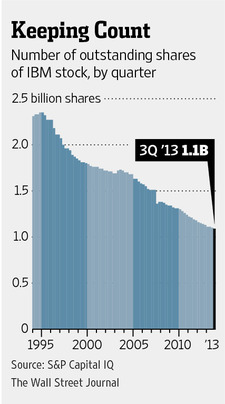
For the past 20 years, IBM has been an avid, methodical buyer of its own stock. In 1993, it had 2.3 billion shares outstanding. Today it has 1.1 billion, shrinking at more than 1% per quarter over the past few years. At that pace, there will be no more publicly traded IBM shares left by 2034. Read more of this post

Card-Theft Software Grew in Internet’s Dark Alleys

Card-Theft Software Grew in Internet’s Dark Alleys

Version of Malware Used Against Target Was for Sale for $2,000 a Year Ago

CHARLES LEVINSON and DANNY YADRON

Jan. 21, 2014 8:12 p.m. ET

The malicious software that infected Target Corp. TGT -1.73% popped up in January 2013 with a price tag of $2,000 and spent nearly a year evolving in the Internet’s black markets before an unknown attacker slipped it into the retailer’s computer systems. Read more of this post

Candy Crush Saga maker King trademarks word ‘candy’

Candy Crush Saga maker King trademarks word ‘candy’

11:17am EST

STOCKHOLM (Reuters) – Videogame maker King, creator of the Candy Crush Saga, a game that has millions of fans around the world, said on Tuesday it had trademarked the word “candy” to protect the game from persistent intellectual property infringements. Read more of this post

Can IBM Keep Cutting Its Way to Profits?

Can IBM Keep Cutting Its Way to Profits?

Businesses have a few ways to boost profits: sell more stuff, shift to selling more profitable stuff or cut costs. International Business Machines Corp. has done fine with the latter two, but for half a decade has gone nowhere with the first. This is the context for IBM’s plan to sell its low-end server business to Lenovo Group Ltd. for between $2.5 billion and $4.5 billion: It’s another entry in the cost-cutting ledger that does little to promote growth. Read more of this post

Amazon Considering Online Pay-TV Service; Live TV Channels Would Compete With Cable, Satellite

Amazon Considering Online Pay-TV Service

Live TV Channels Would Compete With Cable, Satellite

AMOL SHARMA, SHALINI RAMACHANDRAN and DON CLARK

Updated Jan. 21, 2014 8:29 p.m. ET

Amazon.com Inc. AMZN +1.86% has approached big entertainment companies about licensing their television channels for a possible new online pay-TV service, in what would be a significant expansion of the company’s online video efforts. Read more of this post

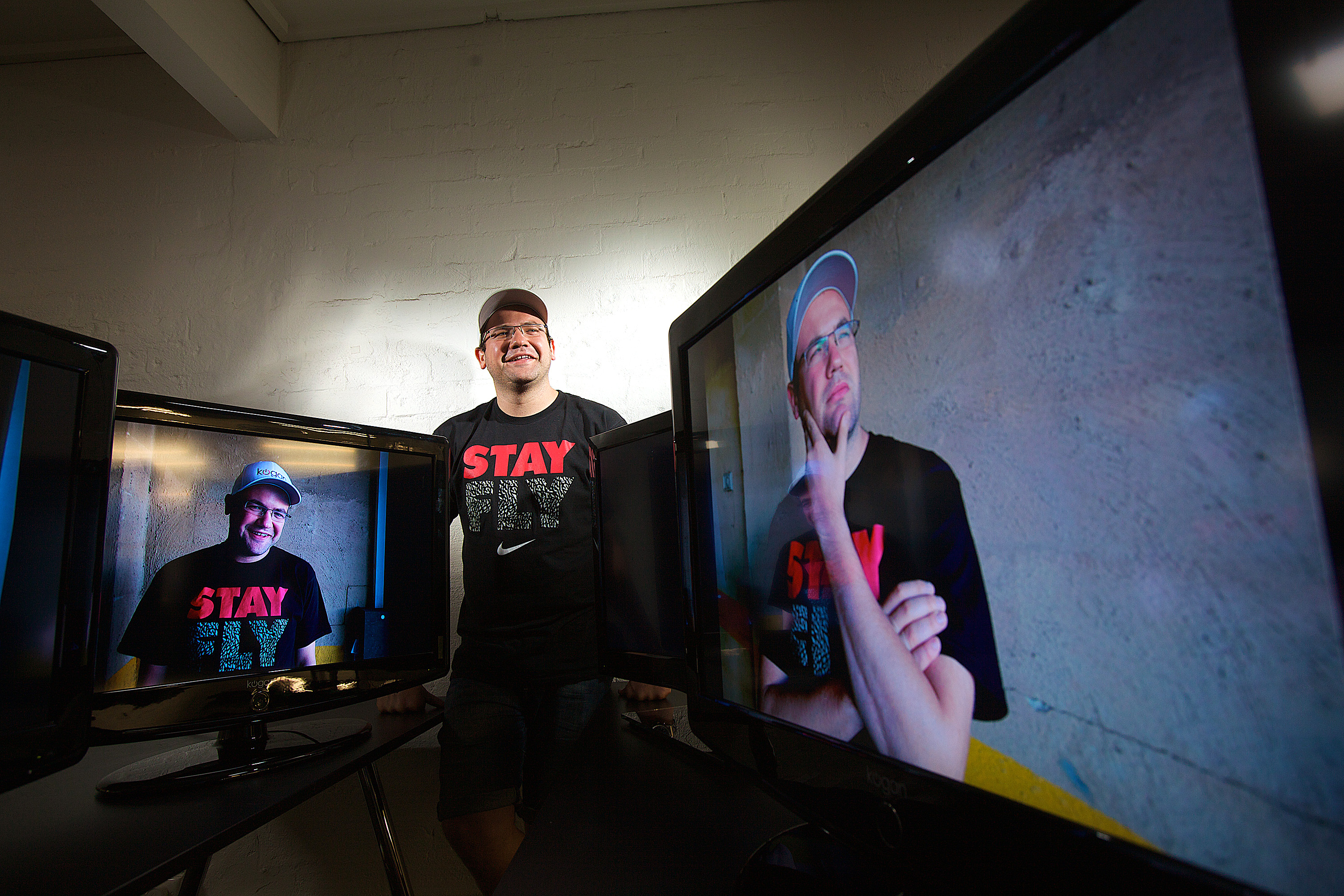
‘Nobody’s bitch’: why growing up poor shaped Ruslan Kogan as an entrepreneur

Caitlin Fitzsimmons Online editor

‘Nobody’s bitch’: why growing up poor shaped Ruslan Kogan as an entrepreneur

Published 20 January 2014 13:09, Updated 21 January 2014 09:05

bc210f26-8172-11e3-a8fd-bd9802970ec5_618135077

In 2013 maverick retailer Ruslan Kogan was ranked fourth on the BRWYoung Rich list, with an estimated fortune of $315 million, aged just 30. He still works 70 to 100 hours a week and says he isn’t much interested in spending his money, though he does own a BMW M6 and a nice apartment on St Kilda Road in Melbourne overlooking Albert Park Lake. Read more of this post

A Globe-Trotting Serial Entrepreneur Finds Roots in China’s Start-Up Scene

JANUARY 20, 2014, 7:44 PM  Comment

A Globe-Trotting Serial Entrepreneur Finds Roots in China’s Start-Up Scene

By RON GLUCKMAN

Richard Robinson tended bar in the Virgin Islands, taught English in Prague, picked grapes in France, painted houses in Norway and toiled at a BMWfactory in Munich. But little prepared him for the adventure that awaited him in Hong Kong. Read more of this post

A Popular Chinese Social Networking App Blazes Its Own Path

A Popular Chinese Social Networking App Blazes Its Own Path

By DAVID BARBOZAJAN. 20, 2014

Allen Zhang organized the team in Guangzhou that began in 2010 to develop the Weixin app for the Internet company Tencent. Qilai Shen for The New York Times

SHANGHAI — Every half-hour or so, Jenny Zhao, young and wired, unlocks her iPhone 5 to connect with friends using Weixin, China’s wildly popular social messaging app. “I’m probably on Weixin six hours a day,” says Ms. Zhao, 24, a cosmetics marketer in Shanghai. “A lot of what I do revolves around it.” Read more of this post

Failed Chinese Startups 2013

Failed Chinese Startups 2013

By Tracey Xiang on January 21, 2014

Like always and anywhere, a number startups in China failed in 2013. ITjuzi, a China-based starup data base, shared with us this list of worth-mentioning Chinese startups that died in the year. Read more of this post

Q&A: How to Build a Smartphone Fan Base in China

Jan 20, 2014

Q&A: How to Build a Smartphone Fan Base in China

JURO OSAWA

Now that the iPhone is available through China Mobile, AppleAAPL -2.45%’s sales may get a boost in China. But Chinese smartphone makers are trying to fight back by ramping up grassroots marketing on domestic social networks such as Sina’s Twitter-like Weibo microblog and Tencent Holdings’  WeChat mobile messaging service. One example of such efforts is Nubia, a smartphone brand launched by major Chinese handset maker ZTE in 2012. Nubia, a wholly owned unit of ZTE, sells its phones through online channels such as Chinese e-commerce site JD.com. In December, ZTE said that Nubia had received 2.5 million orders on JD.com for its Z5S and Z5S Mini smartphones, after their November launch. ZTE says the Nubia business is profitable, but it doesn’t disclose the unit’s earnings figures. Read more of this post

Struggling Best Buy Is Trapped Between Wal-Mart and Amazon

Struggling Best Buy Is Trapped Between Wal-Mart and Amazon

It’s the Best Thing That Ever Happened to Its Competitors

AL LEWIS

Jan. 18, 2014 8:51 p.m. ET

Best Buy BBY -8.95% still markets itself online as “the ultimate showroom.” The electronics retailer’s critics have been calling this a deadly idea for years: Customers go to its giant stores to play with its toys, then they buy them somewhere else, sometimes using a smartphone before they even leave the floor. Read more of this post

Intel Formally Shuts Off Its Web TV Plans, with Sale to Verizon

Intel Formally Shuts Off Its Web TV Plans, with Sale to Verizon

January 21, 2014, 2:08 AM PST

By Peter Kafka

Intel is now officially out of the Web TV business: The company has formally announced the sale of its Intel Media unit to Verizon, a deal we first told you about back in October. Read more of this post

How To Manipulate The Entire IPO Market With Just $250 Million

How To Manipulate The Entire IPO Market With Just $250 Million

WOLF RICHTERTESTOSTERONE PIT
JAN. 20, 2014, 2:29 PM 2,775 3

Tech isn’t exactly booming, as we’ve seen from numerous revenue and earnings debacles. Most recently, Intel’s: revenues were down 1% from 2012 and 2.4% from 2011. Net income was down 13% from 2012 and 25% from 2011. Looking forward, they’d be flat, CEO Brian Krzanich warned. In 2013, the PC industry just saw its worst decline in shipments ever. Read more of this post

Hardware Mashups Inspire Frugal Tech

January 20, 2014, 11:49 AM

Hardware Mashups Inspire Frugal Tech

SAPTARISHI DUTTA

In 2009, Vinay Venkatraman was strolling the streets of Mumbai with two colleagues when he saw a group of people tinkering with old computer monitors and turning them into televisions. Read more of this post

Building Toward the Home of Tomorrow

Building Toward the Home of Tomorrow

By JENNA WORTHAMJAN. 19, 2014

The home of the future — complete with helper bots and automated appliances — has long been the stuff of science fiction. The tech world is determined to make it a reality. Read more of this post

A Tiny Antenna Threatens the TV Networks’ Airspace; Chet Kanojia and Aereo Seek to Shake Up Television Industry

A Tiny Antenna Threatens the TV Networks’ Airspace

Chet Kanojia and Aereo Seek to Shake Up Television Industry

By LESLIE KAUFMANJAN. 19, 2014

AEREO-master675

Chet Kanojia, chief executive of Aereo, at the company’s Manhattan office. James Estrin/The New York Times

When the case of American Broadcasting Companies v. Aereo comes before the Supreme Court in April, it will feature two American archetypes in a battle that could upend the television industry. Read more of this post