Apps bring lock and key into the digital age

Apps bring lock and key into the digital age

Tue, Sep 3 2013

By Natasha Baker

TORONTO (Reuters) – The lock and key has been a mainstay of security for thousands of years, but companies developing new apps are bringing them into the digital age, allowing people to share keys digitally and gain keyless access to homes. KeyMe, an app for the iPhone, aims to modernize the way spare keys are stored, and how copies are shared with family and friends. With KeyMe, home owners can photograph their keys, which the app converts into instructions that a locksmith can follow to replicate the key. Read more of this post


5 reasons 3-D printing isn’t quite ready for prime time

5 reasons 3-D printing isn’t quite ready for prime time

September 3, 2013: 3:02 PM ET

The 3-D printing market could triple by 2018, but don’t confuse that with a 3-D printing revolution.

By Clay Dillow

FORTUNE — If there was any doubt Wall Street is warming up to 3-D printing it was extinguished last week when Citi analyst Kenneth Wong initiated coverage of 3-D printer manufacturers Stratasys (SSYS) and 3D Systems (DDD), at the same time expressing in a client note that he believes the market for 3-D printing equipment and services will triple by 2018. The market “is on the cusp of seeing much broader adoption across more upstream production applications and the consumer end market,” Wong wrote. Shares of Stratasys and 3-D Systems — as well as others in the space — spiked. Read more of this post

Health.com.au’s Andy Sheats eyes health insurance shake-up

Health.com.au’s Andy Sheats eyes health insurance shake-up

PUBLISHED: 03 SEP 2013 00:05:00 | UPDATED: 03 SEP 2013 12:39:45

fc4d22e0-1135-11e3-a019-ae7c4c5b1189__MG_0332--646x363

‘Health insurance is a massive industry and there is plenty of room for everybody,’ says Andy Sheats. Photo: Michel O’Sullivan

MERCEDES RUEHL

Former REA Group executive Andy Sheats wants to shake up the $16 billion private health insurance sector, the way realestate.com.au transformed buying and selling houses. The last new substantial health insurance company to open its doors was Medibank Private in 1997, according Mr Sheats. Even though the industry has moved online, he feels there is room for a new, more modern player. Launched in April 2012, his online health insurance company, health.com.au already generates sales of $45 million and employs 23 people. It has grown to cover 40,000 Australians. “Health insurance is a massive industry and there is plenty of room for everybody,” Mr Sheats said. “We are only doing $45 million out of a possible $16 billion so we are not really concerned about new entrants.” Read more of this post

Chinese Courier SFExpress Testing Parcel Delivery with Robotic Drones; China could become the first country to legalize parcel delivery by drone

Chinese Courier SFExpress Testing Parcel Delivery with Robotic Drones

By Tracey Xiang on September 3, 2013

SFdrone3 SFdrone1

S.F. Express, one of the largest couriers in China, is testing delivering parcels with robotic drones. It is reported that it is developed in house (in Chinese). The drone can fly as high as one hundred meters. With built-in navigation system, a drone carrying a parcel can arrive at a place by a route pre-set by S.F.Express staff. The company claims the maximum distance error is only two meters. The maximum weight a drone can carry is not disclosed. Currently several major Chinese couriers like S.F.Express have expanded to counties or even villages. But there are still areas that are more remote or with poor transport infrastructure. It is expected the drones will be useful for delivering online shopping goods to those places. Read more of this post

Baidu’s IQiyi to Sell TCL Smart TVs to Compete With Alibaba

Baidu’s IQiyi to Sell TCL Smart TVs to Compete With Alibaba

Baidu Inc. (BIDU), the owner of China’s most-popular Internet search engine, will start selling smart TVs with TCL Multimedia Technology Holdings Ltd. (1070) to compete with Alibaba Group Holding Ltd. in the growing online video business. Baidu and TCL’s 48-inch TV will go on sale online tomorrow at 4,567 yuan ($746), the companies said in a joint statement ahead of a news conference in Beijing today. A second model priced at 2,999 yuan will go on sale in November. Read more of this post

Samsung to Install Antivirus Software from Lookout in Android Phones

Updated September 4, 2013, 12:09 a.m. ET

Samsung to Install Antivirus Software in Android Phones

DANNY YADRON

MK-CG011_ANTIVI_NS_20130903183312

Now even telephones come with antivirus software. Programs that flag viruses and keep out intruders have been fixtures for decades on desktop computers. On Wednesday, Samsung Electronics Co., 005930.SE +1.20%the world’s largest smartphone maker by sales, is expected to announce that it will install security software from Lookout Inc. on all new phones running Android software from Google Inc. GOOG +1.59%. Behind the move, say Samsung and some firms in the security industry, is a reality that phones have become a lot more like always-online computers, and now face thousands of their own viruses. Hackers have found ways to steal corporate data off of mobile devices, and Eastern European organized-crime rings scam users by charging them for premium text messages.

Read more of this post

A Kinder, Gentler South China Morning Post

A Kinder, Gentler South China Morning Post

Written by Our Correspondent

TUESDAY, 03 SEPTEMBER 2013

New Chinese language Web site won’t make any waves

William Zheng Wei, a former Singapore Press Holdings business editor, has been named the chief editor of the South China Morning Post’s new Chinese-language Web site. His mandate? Don’t carry anything controversial.
Zheng’s appointment was announced Monday in an internal company release by Robin Hu, the 55-year-old chief executive officer of the SCMP Group, himself a former Singapore Press Holdings executive. Hu replaced Kuok Hui Kwong last July after serving for six years as regional director in China for the Singapore Economic Development Board, a government agency, and as a senior vice president for an Internet startup. Read more of this post

One insight from Jeff Bezos’s Washington Post interview that bodes well for the future of media; “The key thing about a book is that you lose yourself in the author’s world. Great writers create an alternative world.”

One insight from Jeff Bezos’s Washington Post interview that bodes well for the future of media

BY HAMISH MCKENZIE 
ON SEPTEMBER 3, 2013

Amazon founder Jeff Bezos finally granted an interview to the newspaper he just bought. He evidently didn’t spend much time on the phone with the Washington Post reporters, but he provided enough fodder to keep the “Is Bezos going to save newspapers?” meme in the headlines for another couple of weeks. (Case in point: This post.) I just wanted to zero in on one of his comments, which I believe signals why the media industry has a brighter future than its current state would seem to imply. To me, the most important thing is not that Bezos has lots of money to fund business model experiments – it’s his recognition of the power of the story. Bezos made that point inadvertently while discussing why printing on paper is not crucial to a newspaper’s future, a realization driven by his experience with ebooks and the Kindle.

“The key thing about a book is that you lose yourself in the author’s world,” Bezos told the Post. “Great writers create an alternative world.” It doesn’t matter if you find your way into that world through print or digital, Bezos added. Read more of this post

Hollywood’s Tanking Business Model; After a series of big-budget bombs at the box office, Hollywood could learn a thing or two from economists?

September 3, 2013

Hollywood’s Tanking Business Model

By CATHERINE RAMPELL

Nearly 40 years ago, a great white dorsal fin sliced through American cinemas with its ominous, minor-second-interval leitmotif, and a new business model was born. “Jaws,” which cost $7 million to make, was deemed a good fit for a June release in 1975 partly because it took place at a beach around Independence Day. But its extraordinary success — the movie went on to earn $471 million at box offices worldwide — subsequently helped spawn Hollywood’s now-conventional wisdom that if you’re going to make a blockbuster, then summer, when kids are out of school and people are in search of industrial-strength air-conditioning, is the best time to release it. After “Star Wars” became a huge hit two summers later, all the big studios seemed to take notice. Read more of this post

Publishing Hears Echoes of Netflix Business Model; Digital Startups Prepare to Offer E-Book Subscription Services

September 2, 2013, 6:59 p.m. ET

Publishing Hears Echoes of Netflix Business Model

Digital Startups Prepare to Offer E-Book Subscription Services

JEFFREY A. TRACHTENBERG

Offering unlimited television shows and music for a flat monthly fee has worked forNetflix Inc. NFLX +1.06% and Spotify AB. Will it work in the book industry? It is a question of intensifying debate in the publishing industry right now, as two digital startups plan launches of rival e-book subscription services this fall. If successful, the new services could pose fresh challenges for brick-and-mortar bookstores already struggling to cope with the growth of e-book sales and low prices of physical books offered online. Read more of this post

It’s all in the wrist – Who has vision to crack the “smartwatch”?

It’s all in the wrist – Who has vision to crack the “smartwatch”?

7:08am EDT

By Jeremy Wagstaff

SINGAPORE (Reuters) – The smartwatch could be as revolutionary as the smartphone – an intelligent device on our wrist that connects our bodies to data and us to the world – but only a handful of companies have the heft and vision to be able to pull it off. It’s not through lack of trying. Watchmakers and others have been adding calculators, calendars and wireless data connections to wrist-straps for at least 30 years. Read more of this post

What’s Left of Nokia? Microsoft Deal Changes Nokia’s Focus; Remaining Business Largely Focused on Network Equipment; Nokia handsets sale reveals revamped networks value

September 3, 2013, 10:15 a.m. ET

Deal Changes Nokia’s Focus

Remaining Business Largely Focused on Network Equipment

SAM SCHECHNER

What’s left of Nokia NOK1V.HE +33.94% Corp.? The Finnish company’s proposed $7 billion deal to sell its unprofitable cellphone business to Microsoft Corp MSFT -5.48% . will leave behind 56,000 employees and a collection of businesses focused mainly on making network equipment for cellphone operators. But it will also hold on to a lucrative patent portfolio and a mobile-mapping business that competes with Google Inc. GOOG +1.11% and Apple Inc. If a deal is sealed, Nokia will emerge about half the size it is today, by revenue, but profitable. Read more of this post

Nokia’s Stephen Elop: Next Microsoft CEO? Having Left the Software Giant After Running the Company’s Profitable Business Division, Elop Returns a Bit of a Hero

Updated September 3, 2013, 10:37 a.m. ET

Nokia’s Stephen Elop: Next Microsoft CEO?

Having Left the Software Giant After Running the Company’s Profitable Business Division, Elop Returns a Bit of a Hero

JOHN D. STOLL

After three years of trying to repair businesses that proved to be unfixable, Nokia Corp.NOK1V.HE +33.94% Chief Executive Stephen Elop is back at Microsoft Corp.MSFT -5.60% to help shape the legacy of the software giant’s longtime boss, and potentially take his job. Nokia on Tuesday announced the $7 billion sale of an ailing handset business to Microsoft, ending several months of discussions between Mr. Elop and Microsoft Chief Executive Steve Ballmer. The negotiations were the subject of dozens of boardroom deliberations on both sides of the Atlantic. Read more of this post

Analysts: Microsoft Bought Nokia Because Nokia Was Going To Stop Making Windows Phones

Analysts: Microsoft Bought Nokia Because Nokia Was Going To Stop Making Windows Phones

NICHOLAS CARLSON SEP. 3, 2013, 7:25 AM 9,018 8

Last night Microsoft bought the smartphone division of Nokia for ~$7 billion. Nokia will present the deal to is shareholders in November, and both companies expect the transaction to close in the first quarter of 2014. So, why did Microsoft do this deal? Two analysts, Ben Thompson of Stratechary and Benedict Evans, assume that Microsoft had to buy Nokia because Nokia was going to stop making Windows Phones very soon.

Read more of this post

Purchasing Chinese goods online booming in Vietnam

Purchasing Chinese goods online booming in Vietnam

By Nguyen Thi Thuy Anh, Zhang Jianhua (Xinhua)    14:22, August 31, 2013

Like anywhere else in the world, the use of the Internet and e-commerce has flourished inVietnam, especially in the capital Hanoi.
In fact, for the past few years, the Vietnamese people have been purchasing goods online,including products from abroad.
With rapid development of commodity production with various designs and the growth ofonline websites, more and more Vietnamese people choose to buy Chinese commoditiesonline. Read more of this post

Subscription commerce companies are struggling. Here’s how to fix them

Subscription commerce companies are struggling. Here’s how to fix them

BY TOM CAPORASO 
ON SEPTEMBER 2, 2013

You’d think the way the media has covered subscription commerce that it’s some brand-new innovative idea that ShoeDazzle, BirchBox, or Dollar Shave Club just invented. But subscription services have been around a long time. Think of your grandmother getting milk delivered to her front porch, the paperboy tossing the daily newspaper somewhere in the vicinity of your porch, or my favorite: the weekly Charles Chips delivery. Read more of this post

Microsoft in $7 Billion Deal for Nokia Cellphone Business

September 2, 2013, 11:51 p.m. ET

Microsoft in $7 Billion Deal for Nokia Cellphone Business

SHIRA OVIDE

Microsoft Corp. MSFT -0.45% struck a $7 billion deal to acquire Nokia Corp.’sNOK1V.HE +1.30% core cellphone business, a bold move to try to catch up in a fast-growing mobile business that is now dominated by Samsung 005930.SE -0.44% andApple AAPL -0.91% . The deal comes on the heels of announcing the planned retirement of Microsoft Chief Executive Steve Ballmer. As part of the deal for the devices-and-services business, Microsoft will bring aboard several executives who could be contenders for Mr. Ballmer’s job. Read more of this post

How Velti, One Of The Largest Mobile Ad Companies On The Planet, Lost $130 Million

How Velti, One Of The Largest Mobile Ad Companies On The Planet, Lost $130 Million

JIM EDWARDS SEP. 2, 2013, 3:34 PM 2,493 2

Until recently, Velti was one of the world’s huge mobile adtech success stories. It staged a big, early IPO in 2011, raising $150 million in cash. It had more than 1,000 employees around the world. It had an eye-popping, spaceship-like new headquarters in San Francisco. And it signed some of the biggest mobile ad deals ever seen — one client pledged a $27 million budget to the company in 2012. Business Insider even lauded CEO Alex Moukas as one of the most important people in mobile advertising. Today, the company is a disaster area. Read more of this post

Digital Technology Lets Dentists Make a Crown While a Patient Waits; The one-day crown systems are sold by Sirona Dental Systems

September 2, 2013, 4:44 p.m. ET

Are One-Day Crowns Worth the No Wait?

Digital Technology Lets Dentists Make a Crown While a Patient Waits

LAURA JOHANNES

PJ-BQ247_ACHES_DV_20130902215649

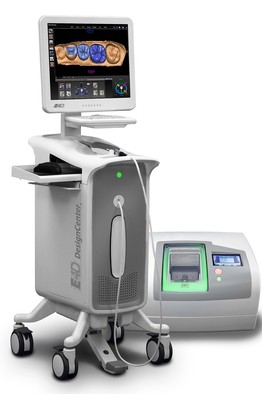
The E4D system includes machines for digital impressions and milling.

The Ache: Getting a crown for a weak or damaged tooth can be a big pain—and not just in the tooth. The process usually requires at least two dentist visits and a one-to-three-week wait for the crown to be made.

The Claim: Dentists say, with digital technology, they can make a crown in the office while a patient waits. The process takes only an hour or two.

The Verdict: One-day crown technology is convenient and produces durable ceramic crowns, dentists say. But there are “aesthetic limitations” to the one-day crown procedure making it a less appealing option for front teeth, says Jacinthe M. Paquette, a Newport Beach, Calif., prosthodontist.

A crown is a cap made to cover a damaged tooth. To prepare for the crown, dentists drill to remove the decayed portion and shape the tooth for the crown. Depending on the dentist and location, a traditional crown can cost $800 to $2,000 or more, and take at least two visits and a wait in between while a lab makes the crown. Read more of this post

As violence linked to the crisis in neighbouring Syria increasingly slips over the border, the Lebanese have come up with a novel way of coping: advance-warning apps

September 2, 2013 7:23 pm

Lebanon turns to apps to avoid growing violence linked to Syria

By Abigail Fielding-Smith in Beirut

As violence linked to the crisis in neighbouring Syria increasingly slips over the border, the Lebanese have come up with a novel way of coping: advance-warning apps. Smartphone applications that map gun battles and differentiate between fireworks and gunfire, offer paths around roadblocks and even contact the army in the event of kidnap are becoming a must-have for Lebanese commuters. “In other places in the world, the only thing that might obstruct your path is traffic,” said Mohammad Taha, an entrepreneur behind one of the products. “In Lebanonthere are many things that can happen.” Read more of this post

Andreessen Horowitz’s Scott Weiss On Why There Will Be 30 New Franchises In The Enterprise

Andreessen Horowitz’s Scott Weiss On Why There Will Be 30 New Franchises In The Enterprise

LEENA RAO

posted 9 hours ago

The future of enterprise software is anything but boring. Andreessen Horowitz partner Scott Weiss aptly predicted his guest post titled “30 New Franchises” a few weeks ago, there a massive opportunity to create new multi-billion-dollar enterprise franchises despite incumbents throwing massive amounts of money to acquire these franchises. These companies, such as Box and many others, are choosing to stay independent. Weiss himself should now–he sold his enterprise company IronPort Systems to one of the most well known incumbents in the space, Cisco, back in 2007. And we decided to create an enterprise panel at Disrupt SF around Weiss’ predictions, with the CEO’s of Box, Zendesk and Nebula (you can still buy tickets here). We sat down with Weiss to hear more about his theories behind “30 Franchises.” You can read the entirety of our conversation below. Read more of this post

For Samsung, Smartwatch’s Timing Counts

September 2, 2013, 7:06 p.m. ET

For Samsung, Smartwatch’s Timing Counts

MIN-JEONG LEE and JONATHAN CHENG

SEOUL—After months of buzz,Samsung Electronics Co.005930.SE -0.59% will take center stage in Berlin to showcase its new smartwatch, a device that will bring some of the functions of a smartphone to your wrist. All eyes will be on the “Galaxy Gear” as a test of whether the South Korean company can innovate in the mobile industry. The company has been locking horns with Apple Inc. AAPL -0.91% in courts around the globe since 2011, after Apple accused Samsung of copying the design and feel of its smartphone and tablet. This time, Samsung is beating its rival to the punch in the realm of so-called wearable devices, considered by many to be a promising new frontier in consumer electronics. Read more of this post

Japan’s E-Reader Industry Struggles to Keep Up as Amazon Takes the Lead; Even though Rakuten’s Kobo had beaten Kindle to market by nearly five months, it grabbed only 33 percent of Japan’s e-reader sales

September 1, 2013

Japan’s E-Reader Industry Struggles to Keep Up as Amazon Takes the Lead

By JOSHUA HUNT

KOBO-01-articleLarge

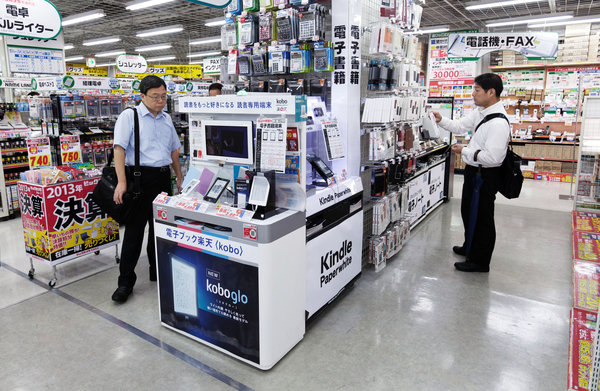
Tokyo shoppers consider e-reader options: Rakuten’s Kobo and Amazon’s Kindle.

TOKYO — When Rakuten, Japan’s leading e-commerce company, introduced its Kobo e-reader in Japan in July 2012, the company’s chief executive, Hiroshi Mikitani, presented a gift to Yoshinobu Noma, the president of Kodansha, Japan’s largest publisher. It was a T-shirt emblazoned with “Beat Amazon.” Mr. Mikitani wanted to signal that the two companies had no intention of slugging it out in a print-versus-digital fight in Japan. The alliance did little to help them defend against Amazon. Four months later, Amazon brought its Kindle e-reader to Japan. It quickly became Japan’s top-selling e-reader, gaining 38.3 percent of the market, according to the MM Research Institute, a data firm in Tokyo. Even though Rakuten’s Kobo had beaten Kindle to market by nearly five months, it grabbed only 33 percent of Japan’s e-reader sales during the same 12-month period. Sony, which had stated its goal of selling half of all e-readers by 2012, managed to hold only 25.5 percent with its devices. Read more of this post

TV Market Tough to Crack for OLED Makers

Sep 2, 2013

TV Market Tough to Crack for OLED Makers

By  Juro Osawa and Min-Jeong Lee

Long touted as the next-generation display technology, organic light-emitting diode or OLED screens have made it to the mainstream in the world of smartphones, with market leaderSamsung Electronics Co.005930.SE -1.24% using them in popular models like the Galaxy S4 and Galaxy Note II. But when it comes to larger screens for televisions, OLED is still far from taking off. Technology for producing TV-size OLED screens hasn’t yet matured, and it’s also difficult for electronics makers to make a lot of capital investment in that area, given low expected returns in the thin-margin TV market. Read more of this post

Airport Wait Times Set to Drop With New Technology, Rockwell Collin’s Arinc Says

Airport Wait Times Set to Drop With New Technology, Arinc Says

Passengers will spend less time at airports in coming years as more efficient operators deploy advanced technology to reduce waiting, aviation services company Arinc Inc. said. Arinc’s products targeted at improving the screening of passenger information and travel documents to improve the flow through terminals will help make travel “much less stressful,” said Michael DiGeorge, a Singapore-based managing director of the Asia-Pacific division for the Annapolis, Maryland-based company, which Rockwell Collins Inc. (COL) agreed last month to buy for $1.39 billion. Read more of this post

Malone as ‘Happy’ Owner of Liberty Says He’d Look at M&A Offers

Malone as ‘Happy’ Owner of Liberty Says He’d Look at M&A Offers

John Malone, the U.S. cable magnate who built Europe’s largest cable-television operator through acquisitions, said while he would consider offers for Liberty Global Plc, he’s “happy” with the company as is. As Vodafone Group Plc (VOD) nears closing a $130 billion sale of its stake in U.S. venture Verizon Wireless, the question of how the second-biggest mobile phone company could spend the windfall has focused on its recent efforts to expand in cable. Since Vodafone agreed to buy Kabel Deutschland Holding AG (KD8) in June, speculation has shifted to whether Liberty Global will be among its next targets. Read more of this post

In an era when digital effects have made the use of small models and suited actors look quaint, tokusatsu, or “special filming,” is on the way out

September 1, 2013

Rubber-Suit Monsters Fade. Tiny Tokyos Relax.

By MARTIN FACKLER

sub-japan-articleLarge

“Ultraman Ginga” is a rarity, made without digital graphics.

CHOFU, Japan — Daisuke Terai plays one of the best-known characters in the history of science fiction, but few fans have ever seen the actor’s face. That is because Mr. Terai puts on a bright silver and red rubber suit before stepping onto a set made of miniature trees and buildings to do battle as the cosmic superhero Ultraman. On a recent afternoon, Mr. Terai’s character was locked in mortal combat to defend the Earth from a giant extraterrestrial dinosaur with glowing eyes and forked spikes called Grand King. When the cameras paused, a sweating Mr. Terai, 36, peeled off the top of his Ultraman suit, while stagehands removed Grand King’s foam spikes to reveal a zipper down the back of the 65-pound costume. Read more of this post

Opinion monitoring services doing brisk business in China as online media reduced the time it takes to form public opinion from 24 hours to just one to four hours

Opinion monitoring services doing brisk business in China

Staff Reporter

2013-09-02

With online media having reduced the time it takes to form public opinion from 24 hours to just one to four hours, the business of public opinion monitoring is booming in China, the Guangzhou-based Southern Weekly newspaper reports. The monitoring of online opinions caught attention in 2007, owing to the rise of social media, which has allowed people to actively express their thoughts on political and social issues, said Shan Xuegang, deputy head of the Public Opinion Monitoring Office at the People’s Daily. Former Chinese president Hu Jintao’s taking part in an online discussion in June 2008, the first time a Chinese leader had done so with internet users, led to the Chinese media marking that year as the beginning of online political participation in the country. Read more of this post

Twitter is wrecking Twitter to make Twitter more popular

Twitter is wrecking Twitter to make Twitter more popular

By Dan Mitchell, contributor August 29, 2013: 2:56 PM ET

By making conversations easier to follow, Twitter is encouraging people to use the service for something other than its essential function. It’s probably a good idea for the company, but not for people who use Twitter to follow the news.

FORTUNE — Twitter is working to attract many more new users and keep the ones it has. To that end, the site is risking doing all it can to wreck Twitter. Wreck it, that is, for those of us who appreciate Twitter’s unmatched utility as a constantly updated, crowdsourced flow of real-time news and information. The people who use it that way might be part of a shrinking minority, however, with more and more people using the service to yammer and argue. “Twitter fights” no doubt bring many more eyeballs to Twitter than do, say, links to stories about Syria or climate change. But for people who use Twitter as an information resource rather than as a platform for inherently inarticulate “conversation,” the cacophony wastes time and ruins the experience. Read more of this post

Why Internet Companies Don’t Buy From The Enterprise Kings

Why Internet Companies Don’t Buy From The Enterprise Kings

ALEX WILLIAMS

posted 3 hours ago

Internet companies represent the world’s fastest-growing markets and they cover the global economy. Every market imaginable is affected by Internet companies. They are cloud-centric by nature and come in various forms. They are SaaS companies but also have emerged as departments in big companies that derive their primary value as Internet providers. And these companies are not on the enterprise sales radar screen. Instead, enterprise companies are trying to soak every dollar possible out of IT. That’s their domain. But what the enterprise is selling is not the kind of technology an Internet company is likely to buy. Internet companies  are in the market to shave latency and deliver services faster. They are built to be as lean as possible. Capital spending makes little sense. And without capital spending, the enterprise vendors have nothing really to sell to a cloud-centric company. Read more of this post