Charlie Munger: The Complete Investor – Bamboo Innovator Daily: 12 Jul (Sun)

Life

  • The CEO of one of the fastest growing business apps ever used an ingeniously simple analogy to explain why companies succeed; Stewart Butterfield of Slack: Is Empathy on Your Résumé?: BI, NYT
  • Successful Startups Don’t Make Money Their Primary Mission: HBR
  • Communicating a Corporate Vision to Your Team: HBR
  • What If Everything You Knew About Disciplining Kids Was Wrong? Negative consequences, timeouts, and punishment just make bad behavior worse. But a new approach really works.: MJ
  • Meet the ‘Sherlock Holmes’ of the art world: AsiaOne
  • D.I.Y. Education Before YouTube: NYT

Books

  • Charlie Munger: The Complete Investor: Amazon
  • Never Be Lied to Again: How to Get the Truth In 5 Minutes Or Less In Any Conversation Or Situation: Amazon

Read more of this post

Empathy Is Actually a Choice; What Would Buddha Say?: 1,501 Right-Speech Teachings for Communicating Mindfully; How Would Buddha Act?: 801 Right-Action Teachings for Living with Awareness and Intention – Bamboo Innovator Daily: 11 Jul (Sat)

Life

  • Empathy Is Actually a Choice: NYT
  • Why Sherlock Holmes endures; Holmes put it best: “Education never ends, Watson.”: WaPo
  • The importance of diversity of thought for solving wicked problems: Forbes
  • The Great Gift of Reading Aloud; To curl up with children and a good book has long been one of the great civilizing practices of domestic life, an almost magical entry point to the larger world of literature. WSJ
  • Thoughts on corporate governance: Forbes
  • Zappos CEO Tony Hsieh believes rave culture holds a key to business strategy: qz
  • Career advice for millennials (and really, anyone) from Margaret Heffernan; In her career, Margaret Heffernan has been the CEO of five businesses. What advice does she have for people just starting their careers? TED
  • Warren Buffett revealed this ‘great philosophy of life’ in a letter to a hedge fund manager: “I follow the dictum praise by name, criticize by category.”: BI
  • With over 37 million YouTube subscribers and a reported $7.4 million earned last year, Felix “PewDiePie” Kjellberg is among the top YouTubers in the world : BI
  • The CEO of A&E Networks shares the 3 types of people you need on every team: “You’re either a thinker, a doer, or a feeler.” : BI, NYT
  • The world’s most popular TED speaker explains why schools should be more like farms, not factories: BI

Books

  • What Would Buddha Say?: 1,501 Right-Speech Teachings for Communicating Mindfully: Amazon
  • How Would Buddha Act?: 801 Right-Action Teachings for Living with Awareness and Intention: Amazon
  • Taking Smart Risks: How Sharp Leaders Win When Stakes are High: Amazon
  • The Great Detective: The Amazing Rise and Immortal Life of Sherlock Holmes : Amazon
  • Straight to Hell: True Tales of Deviance, Debauchery, and Billion-Dollar Deals, Amazon, BI

Read more of this post

29 incredibly successful people who failed at first – Bamboo Innovator Daily: 10 Jul (Fri)

Life

  • 29 incredibly successful people who failed at first: BI
  • The founder of Sam Adams created a unique ‘speed coaching’ method for entrepreneurs: BI
  • What we can all learn from the gutsy way 13-year-old Steve Jobs landed a job at HP: BI

Read more of this post

The Key to Making Smarter Long-term Decisions; Instead of following your passion, find a career that changes people’s lives; Flannery O’Connor on Art, Integrity, and the Writer’s Responsibility to His or Her Talent – Bamboo Innovator Daily: 9 Jul (Thurs)

Life

  • The Key to Making Smarter Long-term Decisions: K@W
  • Instead of following your passion, find a career that changes people’s lives: qz
  • Flannery O’Connor on Art, Integrity, and the Writer’s Responsibility to His or Her Talent: BP
  • Ten Pairs of Opposite Traits That Creative People Exhibit: Farnam
  • Leadership Is a Contact Sport: The “Follow-up Factor” in Management Development: Strategu&
  • Researchers discovered a psychological trick that will help you stop procrastinating: BI
  • Who’s In Charge Of Asia’s Family Businesses? Forbes
  • Are Marshall Goldsmith’s Triggers the Only Way to Change?: Strategy&

Read more of this post

A former Apple employee reveals the most memorable piece of advice he ever heard from Steve Jobs; Entrepreneurs need to think like scouts, not tourists: Look for the “software,” not the “hardware.” Pay more attention to scale-up and growth, than to startup. Look beyond what people tell you. Try to identify and meet the hidden heroes – Bamboo Innovator Daily: 8 Jul (Wed)

Life

  • A former Apple employee reveals the most memorable piece of advice he ever heard from Steve Jobs: BI
  • Entrepreneurs need to think like scouts, not tourists. Look for the “software,” not the “hardware.” Pay more attention to scale-up and growth, than to startup. Look beyond what people tell you. Try to identify and meet the hidden heroes: HBR
  • 9 super-successful people share their biggest leadership secrets: BI
  • What every employee can teach their boss: Be caring; Believe; Give more; Maintaining a solid team requires honesty, openness, and a willingness to listen. Fortune
  • Professional qualifications convey a message but they foster potentially misleading generalisations: FT

Books

  • Gomorrah: A Personal Journey into the Violent International Empire of Naples’ Organized Crime System : Amazon
  • ZeroZeroZero; From the author of the #1 international bestseller Gomorrah comes an electrifying investigation of the international cocaine trade, as vicious as it is powerful, and its hidden role in the global economy: Amazon

Read more of this post

Simple Rules: How to Thrive in a Complex World; Emotions organize — rather than disrupt — rational thinking – Bamboo Innovator Daily: 7 Jul (Tues)

Life

  • Simple Rules: How to Thrive in a Complex World: Farnam
  • Turning Towards Failure: Farnam
  • The scientists behind ‘Inside Out’ explain one big thing the movie gets right that most people get wrong: Emotions organize — rather than disrupt — rational thinking: BI
  • Six reasons why innovations require errors: BT
  • How accepting and managing errors can raise a firm’s performance: BT
  • Organizations are ready for a step toward self-management, wholeness, and a new sense of purpose. Companies are developing a new form of organization — a soulful workplace where talents are nurtured and the deepest aspiration: Strategy&
  • Burt’s Bees cofounder Burt Shavitz died at age 80 — here’s his crazy success story: BI
  • Strengthening Your Cultural Fortress: Strategy&
  • Physicists brought low by thinking big; Science is a messy affair peopled by characters ready to risk everything to seal their reputations: FT
  • Does it pay to train people to set up their own business? There are start-up courses all over the world but nobody knows if they work: FT
  • How Zappos Converts New Hires to Its Bizarre Office Culture: Bloomberg

Read more of this post

Buffett’s Machines and the Rise of Asia’s Wide-Moat Machine Innovators – Bamboo Innovator Weekly Insight

 “Bamboo Innovators bend, not break, even in the most terrifying storm that would snap the mighty resisting oak tree. It survives, therefore it conquers.”
BAMBOO LETTER UPDATE | July 6, 2015
Bamboo Innovator Insight (Issue 90)

  • The weekly insight is a teaser into the opportunities – and pitfalls! – in the Asian capital jungles.
  • Get The Moat Report Asia – a monthly in-depth presentation report of around 30-40 pages covering the business model of the company, why it has a wide moat and why the moat may continue to widen, a special section on “Inside the Leader’s Mind” to understand their thinking process in building up the business, the context – why now (certain corporate or industry events or groundbreaking news), valuations (why it can compound 2-3x in the next 5 years), potential risks and how it is part of the systematic process in the Bamboo Innovator Index of 200+ companies out of 15,000+ in the Asia ex-Japan universe.
  • Our paid Members from North America, Europe, the Oceania and Asia include professional value investors with over $20 billion in asset under management in equities, some of the world’s biggest secretive global hedge fund giants, and savvy private individual investors who are lifelong learners in the art of value investing.
Dear Friends,

Buffett’s Machines and the Rise of Asia’s Wide-Moat Machine Innovators

“CTB, which operates worldwide in the agriculture equipment field.. since we purchased it in 2002.. again set an earnings record. Vic Mancinelli, its CEO, followed Berkshire-like operating principles long before our arrival. He focuses on blocking and tackling, day by day doing the little things right and never getting off course. We purchased CTB in 2002 for $139 million. It has subsequently distributed $180 million to Berkshire, last year earned $124 million pre-tax and has $109 million in cash.”

– Buffett in Berkshire Hathaway 2011 Annual Letter to Shareholders

“I checked with Howie; he told me CTB was an absolute first-class company and he’d heard good things about Vic. Howie would rather spend an evening on a tractor in the field than a date with Angelina Jolie, which is not true of all members of the family, but that’s true of Howie.. I spent a little time talking to Vic and I knew that he was the right guy and CTB was the right company, and, boy, was that a lucky day for Berkshire. Ever since then, the operational results, the acquisitions that you’ve made, everything has exceeded my expectations.. Vic is a manager that could run any company in the Fortune 500. He’s done a wonderful job for us.. CTB has been moving ahead every year since we bought it. We’ll hit a bump in the road every now and then but we’re looking at a superhighway out there in front of us.. You know, this may be a tougher year economically than some we’ve had in the past, but we’re going to own CTB forever. So over the next 100 years we’re going to have some bad farm years, we’re going to have some bad years in the economy, but just look at the progress you’ve made over time, and I hope you keep doing more of the same.”

– Buffett address to CTB employees in a video posted on CTB’s website that he refused an initial proposal to bid for CTB, reversing his decision only after Mancinelli made a trip to Omaha, that his son Howard had recommended CTB and that CTB may produce profits beyond the year 2200.

Warren Buffett learnt about the power and business model of “machines” very early on. There is plenty for value investors to learn from Buffett’s wisdom about the business of “machines” to identify Asian wide-moat machines innovators.

In his senior year of high school, Buffett bought a broken pinball machine that had an original price of $300 for $25, and went to his friend Don Danly to fix it. Together they started Wilson’s Coin-Operated Machine Company, named after a fictitious Mr. Wilson to give the teens an air of credibility and authority. They asked a local barber if they could put the machine in the back of his shop, in exchange for half the money they raised. In just a single day, enough customers at the barbershop played pinball to make four dollars. Within a week Warren had enough money to reinvest to buy more pinball machines, which he negotiated into other barber shops, get it delivered and installed, handle maintenance and repairs, and he had to collect the coins from the machine. In terms of customer service, the boys always told the barbers that they would blamed Mr. Wilson for any unpopular decisions they had to make, such as why they were not able to replace older machines with newer ones. Buffett later sold the business to a War Veteran for $1,200.

As Buffett becomes the world’s most successful value investor, he added more powerful machines into his own acquisitive mega machine Berkshire Hathaway. One of these machines is CTB Inc., a worldwide leader in equipment systems for the poultry, pig, egg production and grain industries which was acquired for $139 million on its 50th anniversary in 2002. Buffett revealed in his 2011 annual letter to shareholders that CTB had performed very well and praised its CEO Victor Mancinelli. The business has – in a decade – distributed well over 100 percent of its purchase price in cash to Berkshire and its pre-tax earnings are roughly the acquisition price.

What accounts for the growing success of CTB?

Outfitting a farm can be a multi-year commitment. Knowing that the company you are buying from has a global network to provide outstanding customer service provides peace of mind to the purchaser. CTB operates from multiple locations in various countries around the world and serves its customers through a worldwide network of independent dealers and distributors. The depth of offering from CTB meant they are able to equip the entire farm to provide a one-stop solution, saving the farmer the trouble of attempting to get disparate systems to operate together. Once a CTB system is installed, switching to another is a highly costly transaction. CTB also undertook at least eight bolt-on acquisitions to expand its product offerings and integrate them into a total solution at a competitive price to outfit the entire farm, enhancing the farmer’s user experience.

Buffett also recently disclosed in March 2015 a 5% ownership in Deere & Company (NYSE: DE, MV $32.2bn), the largest farm equipment manufacturer in the world known for its high quality tractors, construction equipment, mowers, and other farm machinery. Buffett used a special confidentiality rule to delay disclosing the increased position he was building in 2014 in Deere, which has paid steady or increasing dividends since 1987, giving it a streak of 28 consecutive years without a dividend reduction.

Buffett’s experiences from the pinball business to CTB highlight several important axioms for value investors seeking to invest in machines or capital equipment companies. Value investors tend to overly focus on the observable, including the price-to-book valuation ratio, the order book to bill ratio, and the cyclical price-earnings ratio given that capital equipment sales tend to cyclical according to the industry’s business cycle, and overlook the wide-moat business model underlying the generation of the numbers. From the customer’s perspective in their purchase decision of machines, even if a company offers excellent products, they won’t buy from it if it doesn’t offer excellent and speedy repair services, given that breakdown in machines are inevitable which will be disruptive and costly to operations.

Thus, this is the major problem and constraint – and wide-moat opportunity if the problem is solved – in the business model: One Buffett cannot service 100 barber shops customers and “Mr Wilson” cannot be put to blame forever, which limits the scalability of the pinball machine business. In the case of CTB, some of the most important steps that Victor Mancinelli had undertaken since Berkshire acquired it, besides the successful bolt-on acquisitions, was the restructuring into Business Units and introducing the Rapid Customer Response (RCR) to bring “people closer to the customer” so that they have a “better sense of customer challenges” and are “more responsive to changing customer needs” to “continue to provide innovative solutions”. By valuing its employees, enabling their growth through training in lean manufacturing principles and techniques and getting everyone to understand department and business operations in detail, CTB creates employee engagement and ongoing commitment that improves productivity. These actions resulted in winning Buffett’s praise in his 2010 annual letter that sales per employee had more than doubled from $189,365 when they purchased CTB in 2002 to $405,878 in 2010. Thus, understanding the dynamics of this stall point can illuminate important lessons for both the Asian entrepreneur trying to scale his or her enterprise to a greater height and the diligent value investor wanting to generate sustainable compounding returns in machine or capital equipment stock.

With this Buffett wisdom in our pocket, value investors can travel to Asia with greater confidence to identify wide-moat companies beyond the quant screens and checklists. Let’s make the first stop at Mount Fuji in Japan to witness the breath-taking poetry in motion scene of robots making robots at the world’s largest – and most secretive – robot manufacturer. Then we travel to Kyushu, the third largest island of Japan and most southwesterly of its four main islands, to visit its rival who had developed a katana-wielding robot as an example of its capabilities and know-how with robots. Finally we will go back to Tokyo to visit another world-class wide-moat machine innovator that is arguably even better managed than the earlier two global champions and understand its management strategy called Lanchester Strategy that is named after the British aeronautical engineer F.W. Lanchester (1868-1946) who had researched attrition in land, sea and air combat, and developed the “3:1 rule” of Lanchester Laws.

Machines

Interestingly, despite the US producing the first industrial robot in the early 1960s and also having a robust auto sector, there are no US companies that are dominant in industrial robot manufacturing globally. We think one of the reasons why Japan has a robust industrial robot industry is because during the 1980s, Japanese auto manufacturers were early in recognizing the benefits of using robots in their assembly processes, which in turn facilitate the development of the Japanese robot industry.

<ARTICLE SNIPPED>

Read more at the Moat Report Asia: http://www.moatreport.com/updates/

PS: We are grateful to be presenting for the third time as one of the instructors in the 3rd Wide Moat Investing Summit on July 7-8. Instructors include: Thomas A. Russo, Managing Member, Gardner Russo & Gardner LLC, Paul Lountzis, President of Lountzis Asset Management; Todd Sullivan, Managing Partner, Rand Strategic Partners; Robert Deaton, Managing Partner of Fat Pitch Capital; and many more. Do join the global community of ValueConferences attendees, including professionals from Artisan, Baillie Gifford, Baupost, Bestinver, Chieftain, Citadel, Citigroup, Diamond Hill, GAM, Gardner Russo, GMO, GoldenTree, Goldman Sachs, IVA, Invesco, Merrill Lynch, J.P. Morgan, Raymond James, Rothschild, Ruane Cunniff, Schroders, Third Avenue, Tiger Global, Tweedy Browne, and many smaller funds, advisors, analysts, and individuals, to gain access to the best wide-moat investments.

Warm regards,

KB

The Moat Report Asia

www.moatreport.com

A new monthly issue of The Moat Report Asia is now available!

Access the in-depth idea presentation:

http://www.moatreport.com/members/

This month of July, we highlight Asia ex-Japan’s largest maker of a mission-critical automotive electronics part that is dubbed the “nervous system” in cars whose electronic content is rising due to the Green, Connected, and Autonomous automotive trends. Without this “nervous system”, the various auto parts cannot start and work. While it is considered a Tier-2 auto parts supplier, [Company’s name] directly participates in the design process of Tier-1 suppliers for most of its [Flagship product’s name] to be “designed-in” and as a result, enjoys sole supplier rights during the first 2-3 years following a new model launch. In addition, [Company’s name] has changed its sales model in China from a distributor model to direct selling, forging Tier-1 relationship with the major Chinese automakers, including accounting for over 50% of [Flagship product’s name] used in emerging electric vehicle maker BYD (1211 HK). Its top ten customers account for around 44-50% of sales. [Company’s name] has pursued the strategy of a diversified customer base to lower operating risk so that “no one “no one customer can seal the life and death of [Company’s name]”, and the rest of sales are contributed by hundreds of customers.

In the ruthless cut-throat automotive industry, the fact that [Company’s name]’s EBITDA margin at 33% is twice that of world-class Bosch India (BOS IN), arguably the best auto parts company listed in Asia, and [Company’s name]’s ROE of 20.5% is also higher than Bosch’s 14.5% speaks volume about [Company’s name]’s wide-moat advantage in securing long-term pricing power and earnings sustainability with the major OEM carmakers by winning their trust to strike long-term partnership. Bosch India trades at an expensive valuation premium of EV/EBITDA 42.9x compared to 12.2x for [Company’s name]. [Company’s name], with its technical superiority in developing low-cost innovative solutions and in generating higher profitability and growth, deserves to command comparable a higher valuation. Short-term downside is protected by a decent cash dividend yield of 4% and supported by a healthy net-cash balance sheet generated from internal free cashflow as opposed to external equity or debt funding.

Led by the highly inspiring Mr. C, [Company’s name] has toiled for more than 10 years since it entered China before bearing some of the fruits. [Company name]’s sales has climbed nearly 31% since FY11 while EBITDA growth is stronger at 78% with the impressive improvement in gross margin from 34.2% to 42.1% due to greater sales weight of higher value-add products that include [Flagship product’s name] for electric vehicles (EVs). Now the growth momentum has hit the tipping point for [Company’s name] to accelerate its profitability significantly in its visible long runway to supply the mission-critical automotive electronics part that is dubbed the “nervous system” in cars whose electronic content is rising due to the Green, Connected, Autonomous automotive trends. Net profit and EBITDA could potentially double in the next 5 years by FY2020, pointing towards a doubling in market value.

5 books that inspired billionaire CEO Elizabeth Holmes; The trick to overcoming stress could be embracing it – Bamboo Innovator Daily: 6 Jul (Mon)

Life

  • The trick to overcoming stress could be embracing it: qz
  • 5 books that inspired billionaire CEO Elizabeth Holmes:BI
  • The Wisdom of Crowds and The Expert Squeeze; As networks harness the wisdom of crowds, the ability of experts to add value in their predictions is steadily declining. This is the expert squeeze.: Farnam
  • Letters from a Self-Made Merchant to His Son: Farnam
  • The urge to embrace failure reaches its final frontier; Elon Musk is unlikely to be seduced by the flawed idea that setbacks are to be celebrated: FT
  • The Science of ‘Inside Out’; “Inside Out” offers a new approach to sadness. Its central insight: Embrace sadness, let it unfold, engage patiently with emotional struggles. : NYT
  • Billion-Dollar Bloodlines: America’s Richest Families 2015: Forbes

Read more of this post

Beyond Measure: The Big Impact of Small Changes; How did the CIA revolutionize their intelligence gathering with one simple question? How did one organization increase their revenue by $15 million by instituting a short coffee break? Bamboo Innovator Daily: 5 Jul (Sun)

Life

  • The Chef That Ate The World: How Gordon Ramsay Earned $60 Million Last Year: Forbes
  • 11 brilliant quotes from Evan Spiegel, the controversial 25-year-old Snapchat founder: BI
  • The father-son feud that built an empire of food: For decades, a son’s wayward wanderings clashed with his father’s vision for the family business, but when they finally see eye to eye, one of San Francisco’s great culinary institutions is born.: Narrative

Books

  • Beyond Measure: The Big Impact of Small Changes; How did the CIA revolutionize their intelligence gathering with one simple question? How did one organization increase their revenue by $15 million by instituting a short coffee break?  Amazon

Read more of this post

From working as a parking lot attendant to taming lions, here are the summer jobs 19 super successful people had before they were famous; How the microwave was invented by a radar engineer who accidentally cooked a candy bar in his pocket – Bamboo Innovator Daily: 4 Jul (Sat)

Life

  • Behold Ontario’s truck stop king: Ken Tanenbaum’s empire sprawls over 1,000 kilometres and never closes: FP
  • From working as a parking lot attendant to taming lions, here are the summer jobs 19 super successful people had before they were famous: BI
  • How the microwave was invented by a radar engineer who accidentally cooked a candy bar in his pocket: BI
  • The ultimate lesson of being an astronaut: Trust your team: qz
  • 78 years ago, a journalist studied 500 rich men and boiled down their success into 13 steps: BI
  • Karl Lagerfeld: King of couture; The fashion designer on 50 years at Fendi and the power of ‘fantasy fur’: FT
  • Lunch with the FT: Pavel Durov, the tech entrepreneur talks about founding Russia’s biggest social networking app VKontakte which revolutionised the Russian internet, falling out with Putin and life as an international nomad: FT
  • What Jackie Chan Taught Will Smith And Jay Z: Forbes
  • What Did Lincoln Really Think of Jefferson?: NYT

Read more of this post

In Search of Sir Thomas Browne: The Life and Afterlife of the Seventeenth Century’s Most Inquiring Mind; An inside look the historic career of ‘unlikely ballerina’ Misty Copeland, who went from ‘pretty much homeless’ to dance superstar – Bamboo Innovator Daily: 3 Jul (Fri)

Life

  • An inside look the historic career of ‘unlikely ballerina’ Misty Copeland, who went from ‘pretty much homeless’ to dance superstar: BI
  • The skills that make entrepreneurs extraordinary: Forbes
  • Contrarian strategy helps build Hiday Hidaka ramen empire: AsiaOne
  • 7 skills all successful communicators have mastered: BI
  • 11 timeless lessons from a book that changed billionaire CEO Elizabeth Holmes’ life: BI
  • Why one Silicon Valley exec says every CEO should be part Moses, and part Galileo: BI
  • Judge identifies 12 huge lies about justice in America: BI

Books

  • In Search of Sir Thomas Browne: The Life and Afterlife of the Seventeenth Century’s Most Inquiring Mind: AmazonEconomist

Read more of this post

How To Raise A Billionaire: An Interview With Elon Musk’s Father, Errol Musk; Winifred Gallagher On Living a Focused Life – Bamboo Innovator Daily: 2 Jul (Thurs)

Life

  • How To Raise A Billionaire: An Interview With Elon Musk’s Father, Errol Musk: Forbes
  • Winifred Gallagher On Living a Focused Life: Farnam
  • After studying 500 millionaires, a journalist noticed one characteristic they all had in common: decisiveness: BI
  • The Secret To Walt Disney’s Corporate Strategy: FastCo
  • Persuasion Depends Mostly on the Audience: HBR
  •  Ten tips for writing a book without making your head explode: JasonZweig
  • There’s a dark side to startups, and it haunts 30% of the world’s most brilliant people: BI

Read more of this post

Here’s the inspiring fan letter Steven Spielberg sent The Rock; Why Our Relationship With Ourself is the Most Important of The Three Marriages – Bamboo Innovator Daily: 1 Jul (Wed)

Life

  • Here’s the inspiring fan letter Steven Spielberg sent The Rock: BI
  • Why Our Relationship With Ourself is the Most Important of The Three Marriages: Brainpickings
  • Breathing Is the Key to Persuasive Public Speaking: HBR
  • When CEO Star Power Backfires: Strategy&
  • How David Allen increased Drew Carey’s Productivity: Farnam

Read more of this post

Building Asia ex-Japan’s largest maker of the “nervous system” in smart cars with Responsibility – Bamboo Innovator Monthly Riddle

 “Bamboo Innovators bend, not break, even in the most terrifying storm that would snap the mighty resisting oak tree. It survives, therefore it conquers.”
BAMBOO LETTER UPDATE | June 30, 2015
Bamboo Innovator Insight (Issue 89)

  • The weekly insight is a teaser into the opportunities – and pitfalls! – in the Asian capital jungles.
  • Get The Moat Report Asia – a monthly in-depth presentation report of around 30-40 pages covering the business model of the company, why it has a wide moat and why the moat may continue to widen, a special section on “Inside the Leader’s Mind” to understand their thinking process in building up the business, the context – why now (certain corporate or industry events or groundbreaking news), valuations (why it can compound 2-3x in the next 5 years), potential risks and how it is part of the systematic process in the Bamboo Innovator Index of 200+ companies out of 15,000+ in the Asia ex-Japan universe.
  • Our paid Members from North America, Europe, the Oceania and Asia include professional value investors with over $20 billion in asset under management in equities, some of the world’s biggest secretive global hedge fund giants, and savvy private individual investors who are lifelong learners in the art of value investing.
Dear Friends,

Can You Guess This Asian Wide-Moat Company?

Building Asia ex-Japan’s largest maker of the “nervous system” in smart cars with Responsibility

How would you respond when you lose your finger in a workplace accident? We will be depressed, the inevitable and natural response which paralyzes and robs us of the ability to respond to our troubles and setbacks.

For Leonardo Del Vecchio who severed part of his finger in a mold-making factory while working as an apprentice to put himself through design school, he went on to build Luxottica (LUX), the world’s largest eyewear company with a market cap of $32.7 billion and became Italy’s second richest man. Luxottica is one of the world’s most respected companies that is responsible for revolutionizing and dominating the entire eyewear industry, creating a fashion concept out of a functional item and putting luxury glasses on the world.

For Mr. C who lost two of his fingers while manually operating a stamping machine, he went on to build Asia ex-Japan’s largest maker of [Flagship product’s name] in automobiles and motorcycles, a mission-critical auto part that is dubbed the “nervous system” of cars whose electronic content is rising due to the Green, Connected, Autonomous automotive trends. The painful accident made Mr. C “swear that I will change such a dangerous production method one day and I resolve to focus on the full automation of the production line.” Because of this resolve and determination, [Company’s name] is willing to commit to heavy investments in automated production lines. “As a result, our products are of a far higher quality and lower cost, by at least 20%, than other companies.” Mr. C also set his mind to build a sustainable, scalable, wide-moat business model with an “organizational-wide competitive ability and an organizational-wide management information system”.

This month of July, we highlight this Asian wide-moat innovator behind “the soul and connecting nervous system of the vehicle in transmitting signals to coordinate the various auto parts.” Without this “nervous system”, the auto parts cannot start and work. While it is considered a Tier-2 auto parts supplier, [Company’s name] directly participates in the design process of Tier-1 suppliers for most of its [Flagship product’s name] to be “designed-in” and as a result, enjoys sole supplier rights during the first 2-3 years following a new model launch. In addition, [Company’s name] has changed its sales model in China from a distributor model to direct selling, forging Tier-1 relationship with the major Chinese automakers, including accounting for over 50% of [Flagship product’s name] used in emerging electric vehicle maker BYD (1211 HK). Its top ten customers account for around 44-50% of sales. [Company’s name] has pursued the strategy of a diversified customer base to lower operating risk so that “no one “no one customer can seal the life and death of [Company’s name]”, and the rest of sales are contributed by hundreds of customers.

Our earlier highlight for the month of May about Asia’s #1 maker of a patented automotive electronics part that is part of the fast-growing multi-billion Advanced Driver Assistance System (ADAS) market and the race towards the autonomous car is up >25% in <2 months.

Read the story of Mr. C below and be inspired about the values of Responsibility – the ability to respond in times of hardship and adversity..

Q: “Chairman C, [Company’s name] has an illustrious business history since its establishment more than 38 years ago in 1977. Can you share with us how it all started, the philosophy and thought process underlying the evolution of the business model, the lessons learnt, and the ups and downs in your personal journey building [Company’s name]?”

Mr. C: “My personal journey in building [Company’s name]? I was poor when I was young and I always wanted to venture into business to give a better life to my family. After my middle school, I wanted to go straight to work but my father insisted that I must continue to study in the night school. So I work in the daytime in the metal stamping division of lighting company.

At that time, metal stamping is still operated manually by hand, with the operator using one hand to hold the metal, another hand to step on the machine’s pedal, stamping the metal piece by piece. However, an incorrect rhythm or a slight neglect will result in a workplace accident. An accident happened to me and I lost two of my fingers as a result. As a result, I swear that I will change such a dangerous production method one day and I resolve to focus on the full automation of the production line. Because of this resolve and determination, [Company’s name] is willing to commit to heavy investments in automated production lines. As a result, our products are of a far higher quality and lower cost, by at least 20%, than other companies.”

Q: “Thank you for sharing such a moving and inspiring personal story behind the impressive production automation commitment at [Company’s name]. Our curiosity is piqued, can you share with us what is so difficult about making these [Flagship product’s name] beyond having more capital and money?”

Mr. C: “Computer and smartphones can malfunction, but can cars afford to malfunction? When consumer electronics products break down, they will cause inconvenience, but they will not cause our lives. When a car is moving and it suddenly malfunctions, what would be the consequences? In terms of safety standards, automakers have far higher requirements for components and parts than those for consumer electronics products. Safety is of paramount importance. When there is an incident of a car engine on fire, a big reason is because of the breakdown of the [Flagship product’s name]. [Flagship product’s name] are first used during the World War II in fighter planes. The [Flagship product’s name] is small and not eye-catching, but it is the soul and connecting nervous system of the vehicle in transmitting signals to coordinate the various auto parts. Without them, the auto parts cannot start and work. Now, [Flagship product’s name] need to be even smaller and precise than ever before and the supplier has to produce customized parts according to the customer’s diverse requirements. Each car requires around 600 to 3,000 to 6,000 [Flagship product’s name], depending on the ‘smartness’ or electronic content of the model. So the demand is rather sizable in terms of volume and value.

Yet in the early days, no one is interested in this business. The reason is simple. Besides the high barriers to entry and extremely high standards set by the customer, the supplier would have to produce small-lots and multi-items, and this does not make any economic sense from a cost perspective. The time period of investment is long and the payback even longer and uncertain. [Company’s name] has grasped the technical complexity of the functioning of the various auto parts and foresee the change in the shifting profits in the value chain towards high value-add electronic parts.

Hence [Company’s name] focuses on mission-critical [Flagship product’s name] in the safety area. The technical expertise required is much higher and the design and development of the molds requires deep know-how, but the margins are also much higher. There are other auto parts companies who also tried to break into this business but they started in producing the products that will not affect the safety and engine of the car, thinking that it will be a starting point to win more business. However, these companies underestimated the barriers to entry and they have all exited.

Thus, not anyone can enter this business. Because of the extremely high standards for safety and reliability, car makers are very strict in selecting their suppliers. Once the supplier is connected to the automakers’ supply chain, that’s ten-year worth of business at least. With mutual trust as the foundation, this relationship is not easily changed. However, this also means it is very difficult to break into the supply chain of an automaker.”

Q: “We understand the high barriers to entry and stringent quality standards required by the car makers. Still, we are curious – are there any specific production technique or know-how or secret to success that [Company’s name] has mastered over the 38 years that gives it a sustainable wide-moat competitive advantage to generate a relatively high ROE of 20.5% and to keep growing?”

Mr. C: “…. <SNIPPED>”

Q: “Do you have any words of advice for entrepreneurs? What is the best advice you have received that has guided your thinking?”

Mr. C: “I always remember what my parents have taught me since young, ‘Be kind to others’. My mother would also remind me, ‘If you manage to make money, you must treat your workers better.’ Our principles of management include: ‘Co-sharing of fruits reaped through teamwork’, ‘Human-friendly management’, ‘Whole-hearted trust and support’..

In the ruthless cut-throat automotive industry, the fact that [Company’s name]’s EBITDA margin at 33% is twice that of world-class Bosch India (BOS IN), arguably the best auto parts company listed in Asia, and [Company’s name]’s ROE of 20.5% is also higher than Bosch’s 14.5% speaks volume about [Company’s name]’s wide-moat advantage in securing long-term pricing power and earnings sustainability with the major OEM carmakers by winning their trust to strike long-term partnership. Bosch India trades at an expensive valuation premium of EV/EBITDA 42.9x compared to 12.2x for [Company’s name]. [Company’s name], with its technical superiority in developing low-cost innovative solutions and in generating higher profitability and growth, deserves to command comparable a higher valuation. Short-term downside is protected by a decent cash dividend yield of 4% and supported by a healthy net-cash balance sheet generated from internal free cashflow as opposed to external equity or debt funding.

Led by the highly inspiring Mr. C, [Company’s name] has toiled for more than 10 years since it entered China before bearing some of the fruits. [Company name]’s sales has climbed nearly 31% since FY11 while EBITDA growth is stronger at 78% with the impressive improvement in gross margin from 34.2% to 42.1% due to greater sales weight of higher value-add products that include [Flagship product’s name] for electric vehicles (EVs). Now the growth momentum has hit the tipping point for [Company’s name] to accelerate its profitability significantly in its visible long runway to supply the mission-critical auto part that is dubbed the “nervous system” of cars whose electronic content is rising due to the Green, Connected, Autonomous automotive trends. Net profit and EBITDA could potentially double in the next 5 years by FY2020, pointing towards a doubling in market value.

Who is Mr. C and this wide-moat Bamboo Innovator?

Warm regards,

KB

The Moat Report Asia

www.moatreport.com

A new monthly issue of The Moat Report Asia is now available!

Access the in-depth idea presentation:

http://www.moatreport.com/members/


How an Airbnb renter’s horror story taught the company’s CEO his greatest leadership lesson: “A consensus decision in a moment of crisis is very often going to be the middle of the road, and they’re usually the worst decisions. Usually in a crisis you have to go left or right” – Bamboo Innovator Daily: 30 Jun (Tues)

Life

  • How an Airbnb renter’s horror story taught the company’s CEO his greatest leadership lesson; “Usually in a crisis you have to go left or right.”: BI
  • Who Will Succeed Warren Buffett as CEO of Berkshire Hathaway?: Bloomberg
  • How Martha Stewart lost her $2 billion empire: WaPo
  • Where does the money go? Auditor-General to investigate private school funds: TheAge
  • Turning Envy into a Positive Force: Insead
  • How To Negotiate With Chinese Companies, Part 3: Forbes
  • How Katy Perry Became America’s Top Pop Export: The Forbes Cover Story: Forbes
  • A mathematical formula reveals the secret to lasting relationships: BI
  • Grow big without growing dumb: BT
  •  To pick a know-all chief executive is just plain dumb: FT
  • A boot camp for billionaires anxious to stay ahead: FT

Read more of this post

The inspiring rags to riches career of Shark Tank judge and internet security guru, Robert Herjavec; Eight powerful ways to mold your children into leaders – Bamboo Innovator Daily: 28-29 Jun (Sun-Mon)

Life

  • The inspiring rags to riches career of Shark Tank judge and internet security guru, Robert Herjavec: BI
  • Eight powerful ways to mold your children into leaders: Quartz
  • How Bayes’ Rule Can Make You A Better Thinker: io9
  • The Benefits of Mind-Wandering; Robert M. Sapolsky on recent brain research about letting your mind wander-and why it’s good for you: WSJ
  • Corporate social responsibility: The halo effect; Do-gooding policies help firms when they get prosecuted: Economist
  • The father of “getting things done”: you’re getting me all wrong: FastCo
  • The Mouth Is Mightier Than the Pen: NYT
  • Jurassic World: 7 reminders for investors: Fortune
  • Danfoss among big winners at campdenfb european families in business awards 2015: Campdenfb
  • Wu Hai, founder, Crystal Orange hotel group: Rebel with a cause; The entrepreneur met party officials after his online rant against Chinese corruption went viral: FT

Read more of this post

How Fanuc quietly took over the world; Why Scientists and Poets Seek New Frontiers; From Galileo and Kepler to the space probe Philae, curiosity about new worlds has long been part of human nature – Bamboo Innovator Daily: 27 Jun (Sat)

Life

  • Why Scientists and Poets Seek New Frontiers; From Galileo and Kepler to the space probe Philae, curiosity about new worlds has long been part of human nature: WSJ
  • The education of Airbnb’s Brian Chesky: Fortune
  • How to Own Your Story: Vivian Gornick on the Art of Personal Narrative and the Power of Textured Storytelling: Brainpickings
  • The Three Essential Properties of the Engineering Mind-Set: Farnam
  • Artificial Intelligence Machine Gets Testy With Its Programmer: WSJ
  • How Not to Be Misled by Data: Numbers can deceive just as surely as words—so here’s a guide to avoid being led astray.: WSJ
  • A Cure for ‘Conflict of Interest’ Mania; A crusading physician says medical progress is hampered by a holier-than-thou ‘moralistic bullying.’: WSJ
  • CampdenFB European Families Business Award 2015 Shortlist: Campden
  • Towers Watson CEO John Haley, a mathematician at the core, sums up the HR and risk management firm’s story. BT
  • Lunch with the FT: Thomas Piketty; France’s ‘rock-star’ economist talks about his fears of eurozone ‘catastrophe’, what spurred his interest in inequality : FT
  • Stephen Ross, property billionaire; Having sold soccer to the US, the Miami Dolphins’ owner aims to do the same with F1 motorsport: FT
  • The practice legendary tycoon Andrew Carnegie credits for his riches can be used by anyone: BI
  • Why Airbnb’s CEO asked for management advice from the former head of the CIA: BI

Books

  • Filters Against Folly: How To Survive Despite Economists, Ecologists, and the Merely Eloquent : Amazon, Farnam

Read more of this post

How to break through mediocrity and become exceptional in your field; The day multimillionaire life coach Tony Robbins became a wealthy man, he was down to his last $2 – Bamboo Innovator Daily: 26 Jun (Fri)

Life

  • How to break through mediocrity and become exceptional in your field: BI
  • The day multimillionaire life coach Tony Robbins became a wealthy man, he was down to his last $20: BI
  • Vaccination: The lifesaver; How one man became involved in two of the 20th century’s most important medical breakthroughs: Economist
  • KFC founder Colonel Sanders didn’t achieve his remarkable rise to success until his 60s: BI
  • 3 things extremely lucky people do differently: BI
  • 9 fears everyone should get over before turning 30: BI
  • 24 ways to stop making horrible decisions (and start making better ones): BI
  • 8 pieces of entrepreneurial wisdom from my father: e27
  • The buzzy new term at Microsoft is ‘growth mindset’ — here’s what it means: BI
  • Innovating fast or slow? Gates vs Wolf edition: FT
  • Bill Gates answers questions on a range of issues: FT
  • The silent anxiety of the sharing economy; Fear of failure and existential panic stalk the self-employed: FT
  • Want to write a piece for the Financial Times op-ed page?: FT
  • Living With Cancer: Being Mortal: NYT
  • The Rise of ‘Speed-Listening’: Books can be places for intellectual wandering. They can also be mined of precious information with ruthless efficiency.: Atlantic

Read more of this post

Sam Adams founder explains how 2 books helped him build a billion-dollar company – Bamboo Innovator Daily: 25 Jun (Thurs)

Life

  • Sam Adams founder explains how 2 books helped him build a billion-dollar company: BI
  • One trick introverts use to become influential public leaders; “If you have that conviction, it’s going to shine through.”: BI
  • Better Lucky than Smart: Strategy&
  • Interpublic CEO Says Creativity Is Still Advertising’s ‘Secret Sauce,’ Despite Endless Digital Talk at Cannes: WSJ
  • Whatever Happened to Knowledge Management?: WSJ
  • Mind-reading program translates thoughts into text: BI
  • Startup CEOs need creativity more than managerial ability: Nikkei

Books

  • Animal Madness: How Anxious Dogs, Compulsive Parrots, and Elephants in Recovery Help Us Understand Ourselves: Amazon

Read more of this post

Train The Brave: 7 Steps To Building Your Courage Muscles; If you want to understand people and be understood in life, speak from your heart – Bamboo Innovator Daily: 24 Jun (Wed)

Life

  • Train The Brave: 7 Steps To Building Your Courage Muscles: Forbes
  • If you want to understand people and be understood in life, speak from your heart: Quartz
  • Jack Ma a lover of magic, philosophy and salt, says assistant: WCT
  • 24 people who became highly successful after age 40: BI
  • What 11 extremely successful people were doing as teenagers: Bill Gates was falling in love with computers.: BI
  • Here’s everything that Pixar’s ‘Inside Out’ gets right and wrong about human psychology: BI
  • Mother Nature is still the greatest innovator; Owl feathers, the secret to quiet airplanes and even quieter fans.  WaPo
  • Big question: Why do I yawn when I’m nervous or stressed?: Wired
  • Why this tech CEO and his employees work just 32 hours each week; Treehouse, an online learning platform that offers skill-based courses for a small price, has over 100,000 enrolled users nearly 100% employee retention, and brought in $10m sales: BI
  • The 6 Most Common Innovation Mistakes Companies Make: HBR
  • Surviving flops: lessons for start-ups from a theatrical empire; Ambassador Theatre Group’s Rosemary Squire on the art of balancing creativity and pragmatism: FT
  • The mystery of the universe’s lucky numbers: TheAge
  • Why some people can get away with so little sleep: Quartz

Read more of this post

Billionaire Sam Adams founder explains why ‘getting rich is life’s biggest booby trap’ – Bamboo Innovator Daily: 23 Jun (Tues)

Life

  • Billionaire Sam Adams founder explains why ‘getting rich is life’s biggest booby trap’: BI
  • Restless spirit paid off for Gain City founder: AsiaOne
  • This tech CEO doesn’t just want to interview you – he also wants to meet your family; When you join a startup, everybody in your family has to be willing to “see past the ambiguity” that’s inherent to the process: BI
  • The Benefits of Fidgeting for Students With ADHD; The children perform better on cognitive tasks when allowed to move freely: WSJ
  • 7 psychological steps to getting people to trust you: BI
  • Pixar’s imaginative ‘Inside Out’ was so powerful that it changed the way I understand my own emotions: BI
  • Well-managed factories should have nothing to hide; Opening up encourages producers to clean up and improve the way they work: FT
  • Education startups find profit in re-examining the way we teach children: FP
  • Brand Britain must broaden its horizons; The world loves to buy British, so let’s focus on our manufacturing; Dyson and Cath Kidston are among them. All are successfully exporting a British definition of quality, reliability and taste. Telegraph
  • Why Culture Matters For Startups – Q&A With Culture Influencer Cosmin Gheorghe: Forbes
  • Family Ties Help When Firms Go Bust: Insead
  • Tricks to prolong the family trade’s success: BT

Read more of this post

Brand It Like Buffett in Asian Wide-Moat Consumer-Brand Innovators – Bamboo Innovator Weekly Insight (Issue 88)

 “Bamboo Innovators bend, not break, even in the most terrifying storm that would snap the mighty resisting oak tree. It survives, therefore it conquers.”
BAMBOO LETTER UPDATE | June 22, 2015
Bamboo Innovator Insight (Issue 88)

  • The weekly insight is a teaser into the opportunities – and pitfalls! – in the Asian capital jungles.
  • Get The Moat Report Asia – a monthly in-depth presentation report of around 30-40 pages covering the business model of the company, why it has a wide moat and why the moat may continue to widen, a special section on “Inside the Leader’s Mind” to understand their thinking process in building up the business, the context – why now (certain corporate or industry events or groundbreaking news), valuations (why it can compound 2-3x in the next 5 years), potential risks and how it is part of the systematic process in the Bamboo Innovator Index of 200+ companies out of 15,000+ in the Asia ex-Japan universe.
  • Our paid Members from North America, Europe, the Oceania and Asia include professional value investors with over $20 billion in asset under management in equities, some of the world’s biggest secretive global hedge fund giants, and savvy private individual investors who are lifelong learners in the art of value investing.
Dear Friends,Brand It Like Buffett in Asian Wide-Moat Consumer-Brand Innovators

Warren Buffett: “When you were a 16-year-old, you took a box of candy on your first date with a girl and gave it either to her parents or to her. In California the girls slap you when you bring Russell Stover, and kiss you when you bring See’s. You cannot destroy the brand of See’s candy. Only See’s can do that. You have to look at the brand as a promise to the customer that we are going to offer the quality and service that is expected. We link the product with happiness… there’s something in the mind about a brand. I mean, you have something in your mind about Coca-Cola – but you don’t have anything in your mind about RC Cola because they’ve never been, you know.”

Charlie Munger: “We didn’t know the power of a good brand until we bought See’s Candies. Over time we just discovered that we could raise prices 10% a year and no one cared. Learning this changed Berkshire. It was really important… How would you try to create a brand that competes with Disney? Coke is a brand associated with people being happy around the world. That is what you want to have in a business. That is the moat. You want that moat to widen.” 

Last week, we discussed the Achilles heel of Buffett and Munger in retail stocks in the article “Buying Furniture with Warren Buffett and Mrs. B at Asia’s Wide-Moat Furniture Innovators” and how value investors can overcome this tough investment hurdle to identify compounders before their wide moats become obvious by the investment community. This week, we examine their greatest investment strength – picking consumer brands – and the case of an unusual wide-moat consumer-brand innovator in Asia.

Imagine if Warren Buffett-Charlie Munger’s See’s Candies, Coca-Cola, Gillette/Pampers (P&G), Heinz and a host of iconic consumer-branded products that they had successfully invested in are stripped of their trademarked name, logo and nice emblazoned packaging design. Would consumers – and Buffett and Munger! – consider them as “brands” and still buy them?

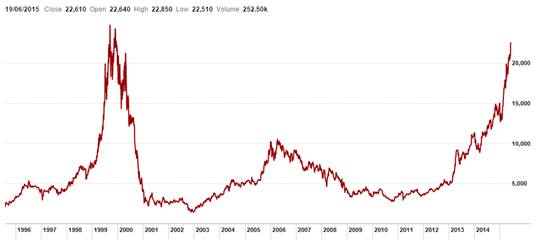
How would Buffett-Munger evaluate Ryohin Keikaku (7453 JP, MV $5.2bn), owner of MUJI? MUJI stands for Mujirushi Ryohin (無印良品), which translates to “No Brand Quality Goods” and “All Value No Frills”. None of MUJI’s 7,500 “minimalist” products, including household products (36.9% of sales, including linen & interior goods, furniture, household appliances, houseware, stationary, cosmetics), apparel (53.5% of sales, including underwear, socks, bags and shoes), and food products (8.2% of sales) have a logo or are wrapped in fancy, distinctive packaging. Plain but not generic, MUJI’s products have a simple aesthetic that appeals to certain customers. In fact, it is the lack of a name brand that many find enticing. With more than 700 stores worldwide (284 directly-managed and 117 licensed stores in Japan), including 301 stores overseas (130 in China), the Japanese retailer has a cult-like following. MUJI seems like a Japanese nazonazo (riddle): one of the most beloved Japanese brands that isn’t a brand.

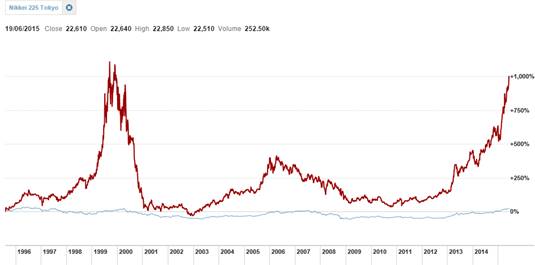
Ryohin Keikaku (TSE: 7453) Stock Price Performance 1995-2015 Vs Nikkei 225 Index
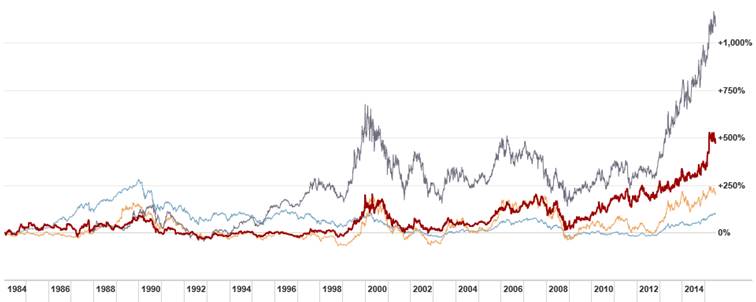
MUJI1 MUJI2

So what is it about MUJI that accounts for its rising success? Often hidden in the seemingly simple designs are functions that make MUJI’s products stand out. Its toilet brush, for example, has a small cover to protect water from splashing while cleaning. Their summer sheets are made of special linen that absorbs moisture better than cotton. But you might argue that many other companies can copy MUJI’s minimalist product concept. After all, wouldn’t MUJI lose its competitive edge in terms of pricing to the fast-fashion outlets such as apparel giant Uniqlo/Fast Retailing (9983 JP), low-priced furniture giant Nitori (9843 JP), and the myriad 100-yen stores that were features of every new mini-mall? And MUJI’s rising success is all the more amazing when we revisit one of Munger’s fascinating insights about brand-based moats. Munger imparted his wisdom that “informational advantage” enables brands to leverage into advantages of scale:

Munger: “The informational advantage of brands is hard to beat. And your advantage of scale can be an informational advantage. If I go to some remote place, I may see Wrigley chewing gum alongside Glotz’s chewing gum. Well, I know Wrigley is a satisfactory product, whereas I don’t know anything about Glotz’s. So if one is 40 cents and the other is 30 cents, am I going to take something I don’t know and put it in my mouth—which is a pretty personal place, after all, for a lousy dime? So, in effect, Wrigley simply by being so well known, has advantages of scale—which you might call an informational advantage. Everyone is influenced by what others do and approve. Another advantage of scale comes from psychology. The psychologists use the term, ‘social proof’. We are all influenced—subconsciously and to some extent consciously—by what we see others do and approve. Therefore, if everybody’s buying something, we think it is better. We don’t like to be the one guy who is out of step. Again, some of this is at a subconscious level and some if it isn’t. Sometimes we consciously and rationally think, ‘I don’t know much about this. They know more than I do. Therefore, why shouldn’t I follow them?’ The social proof phenomenon which comes right out of psychology gives the huge advantages to scale—for example, with very wide distributions, which of course is hard to get. One advantage of Coca-Cola is that it is available almost everywhere in the world. Well, suppose you have a little soft drink. Exactly how do you make it available all over the Earth? The worldwide distribution setup—which is slowly won by a big enterprise—gets to be a huge advantage….And, if you think about it, once you get enough advantages of that type, it can become very hard for anybody to dislodge you. All told, your advantages can add up to one tough moat.”

Thus, the “no-name” MUJI products apparently do not emit the “informational advantage” that Munger described – carrying or using a MUJI product is not observable by others and the “social proof” effect seemingly breaks down.

While the MUJI products have no brand logo to elicit the psychology-based “social proof”, MUJI is actually perceived as a great brand with thoughtful, innovative products. The design and stories around how these new innovative products came to be developed show the seriousness of MUJI to develop a new unique product – continuously. These designs have also come to MUJI winning more than 100 top-tier design and innovation prizes.

Amongst the design “stories” is a pair of “right-angled 90-degree socks” (Chokkaku Kutsuhsita) – the way your foot extends form your leg, rather than a conventional sock at a 120-degree angle. The angle between the heel and sole on the socks is 90 degrees, after research showed that the shape reduced shrinkage and damage. One of the global associates of MUJI sent information that a sock knitted by a grandmother in Czech for her grandchildren has a right angle. MUJI thought it was very MUJI and invited the grandmother to come to Japan. Her knitting was video-recorded and MUJI asked a manufacturer whether it can mass-produce the socks. An immediate response from the manufacturer was, “Please do not joke. We cannot produce such a pair of socks.” The reason dates back to as long as during the Industrial Revolution in England when machines mass-produce socks at 120-degrees, an angle which allows the well-balanced mass-production of socks. MUJI persisted and they found a way to make machines to mass-produce the right-angled sock which was introduced in 2006 and improved in 2011 in partnership with a research center in Nara Prefecture. MUJI also used a more breathable and elastic material in the redesign. MUJI created a hit product selling over 7 million pairs annually.

The wide-moat strength of the MUJI brand is the mission, values and unique philosophy the company founders have identified and carefully cultivated:

  • Affordable, simple,  sleek, durable minimalist products designed well for a specific task and made of natural materials
  • An antithesis to the consumption society and designs created simply for profit-making
  • We leave room for the individuality of the customers to use products as users wish by eliminating commercialism and waste
  • No name, anonymous, not inducing consumers to purchase due to the names of brands and designers
  • We try to take the viewpoint of the purchasers, consumers

Its growing cult-like customers come to identify and associate with the MUJI values, much in the same way Buffett-Munger described the power of association in See’s and Coca-Cola, brands associated with people being happy around the world. MUJI customer is more about the lifestyle of the MUJI brand promise and values. Its core, core customer is really core. They don’t think about which furniture or stationary or household product store they should visit. MUJI is more about regular shopping, lifestyle shopping.

MUJI has also improved its excellent customer service with a revamped store environment offering detailed lifestyle suggestions and the experience of discovery, in which product advisors and specialty sale staff (styling advisors, interior advisors, tasting advisors) help tailor choices for customers, offering suggestions for living, and customers can also see, touch and feel to discover their own original style at the Fragrance Studio, Stamp and Gifts Corner, Wood Environment Play Area. MUJI’s online sales has also been growing steadily and now accounts for around 6.5% of sales.

MUJI was launched in 1980 by the late Seiji Tsutsumi (photo, left), the chairman of the Saison retail group, as an inexpensive house brand and line of merchandise for his Seiyu chain of supermarkets under the slogan “Cheap for a reason” (Wake Atte Yasui). Tsutsumi was the son of Yasujirō Tsutsumi, founder of the Seibu Railway. Following the death of his father in 1964, he led the spin-off of its logistics business to form the Saison Group, which eventually included the Seibu department stores, Seiyu supermarkets, Wave (a music shop), Parco (shopping complex), and the Muji and Loft variety store chains. MUJI no-name products soon garnered a following thanks to its iconoclastic simplicity designed by Ikko Tanaka (photo, right), a leading graphic designer, Kazuko Koike, who was MUJI’s creative director, and three other founding members. Tsutsumi-san and Tanaka-san observed that companies sell their products using highly manipulative marketing techniques and engage in meaningless branding. Tanaka had deep thoughts on how a man should be and live, and found it necessary to concretize his thoughts into products, expressing his antithesis to consumptive society. Thus, MUJI was born with a goal to produce products really valuable to consumers, instead of inducing them to purchase those with valueless brand names.

To concretize these values and concepts into products is not easy, which is why many imitators of MUJI did not go far. MUJI operationalize three processes: (1)…

 <ARTICLE SNIPPED>

The systematic use of external designers and the crowdsourcing projects is an exemplification of the “open innovation” business model that characterized the “Bamboo Innovator”, as explained in earlier articles in how we systematically identify overlooked, underappreciated and misunderstood innovators.

MUJI’s information system also ensures the escalation of management reform. The sophisticated IT system can track with precise accuracy the movement of even a single pen throughout the country. MUJI also introduced an innovative business process support system for better decision-making in relation to customer information, automatic ordering to enable more accurate long-term demand forecasts and product planning. The logistics system was designed to coordinate every aspect of distribution from merchandise procurement to retail outlet supply (to ensure stable support of products), reduction of physical distribution costs, aggregation and transmission of product distribution information, and improvement of stores’ efficiency.

The evolution of MUJI also bears instructive lessons for value investors in looking beyond numbers to assess the erosion or widening of the economic moat. MUJI was very successful in the 1990s and they grew complacent. MUJI started to…

 <ARTICLE SNIPPED>

The rise and fall and rise again of MUJI remind us of what the late American writer Carl Sandburg once said:

“When an institution goes down or a society perishes, one condition may always be found. It forgot where it came from. They lost sight of what had brought them along”

We observe the Sandburg effect in different companies. For instance, whenever McDonald’s was embroiled in controversies that were the result of its neglect of the core values, such as the usage of low-quality or unhealthy ingredients, it flounders. When the Golden Arches went back to rediscover the core values, it rises back up, like it did when it created a healthier and higher-quality image since 2003, although McDonald’s had neglected its core values to stumble again. Without the workable intangible culture and core values, the tangible assets, such as its vast retail property assets, would amount to a dark-cloud-like ominous liability, particularly when leverage is involved.

At MUJI, the innovative designer spirit of the founders that include Tsutsumi-san and Tanaka-san has lived on and endured. Through MUJI, value investors get to experience the role of design and designers in brand-based moats. A designer always approaches his or her work from the viewpoint of the consumer. Designers characteristically begin with the necessities in the life of the typical consumer. Design has the power to show consumers the future in a very tangible way. We believe that companies can use this power to communicate corporate vision, as well as to create new businesses and services that let consumers dream about future lifestyles while creating demand by society. Today, companies need to create new products and services over a shorter lifecycle and we live in a time where companies have to move beyond the question of process efficiency and “branding” through marketing, creating something to sell that is something more to do with commercialism rather than the essential nature of the product itself. The creativity of design can help companies make enormous leaps forward in developing new ideas.

Today, there aren’t many business leaders in the world today who have embraced design as a way to create business. MUJI has embraced and exemplified this idea from its earliest days. The MUJI approach takes design beyond an approach to management, incorporating it into every business and product as an inseparable part of the whole. MUJI was essentially founded by designers, not businessmen with retailing backgrounds. Tsutsumi-san brought Ikko Tanaka and a number of other designers and creators to create MUJI in a single generation.

Ikko Tanaka was the first MUJI art director, and he was famous for saying that they created MUJI as a way to find the best consumers in Japan. Normally, a business says that they want to offer the best products to the consumer. MUJI’s approach was the opposite, which is very refreshing. Retail companies will normally sell anything that the consumer will buy. But, MUJI refuses to sell anything that won’t lead to better living on the part of the consumer. MUJI is looking for the best consumers to offer them a more fulfilled, conscientious lifestyle.

Ikko Tanaka and the other designers-creators believed that design would be able to elevate the lifestyles of Japan’s regular citizens, rather than be something just for Japan’s noble or feudal class. They refused to accept the form and ornamentation of Japan’s traditional authoritarianism.

MUJI communicated the message that living well and enjoying a quality lifestyle didn’t mean buying the expensive brands and luxury items that were so popular. MUJI chose to pioneer a completely new path during a time when the markets were controlled by short-term popular trends. MUJI concept remains valid even as they expand globally. There’s a Japanese culture, spirit, and way of thinking that are inseparably connected with the MUJI philosophy. MUJI’s values meant that they didn’t have to focus on going out and selling products. The instant you focus on selling, you start to resort to flattery. The moment you focus on complex financing engineering schemes to generate short-term profits, you start to neglect the core business of serving customers and value investors can find this salient information in the footnotes on segmental performance that inevitably report the profit erosion in the core business. MUJI is a resilient Bamboo Innovator with a scalable open innovation business model that is embraced by employees, designers and consumers who share the same values and recognize not only the outward design, but also the underlying philosophies.

Above all, MUJI believe that corporate longevity depends on two principles: Flexibility and Conscience. Flexibility to respond to the fast environmental changes. Responding to these changes by asking two questions: “What brings happiness?” and “What will a fulfilled lifestyle look like for people in the future?” The second is the degree to which Japan values the principles of gratitude and service. MUJI does not believe in enriching ourselves at the expense of others. MUJI calls this value their “conscience.”

Flexibility and Conscience. This is the ultimate success factor behind Buffett-Munger when investing in consumer brands, viewing companies beyond the screens, checklist and numbers to assess both supply-side economics (network effect of distribution and IT system to scale up) and demand-side economics (psychology advantage in association with consumer happiness to sustain the competitive advantage period runway) in brand-based moats.

Have you shopped at MUJI to fully appreciate Buffett-Munger’s wisdom of brand-based moat to identify the next consumer-brand compounder? Brand it like Buffett-Munger at MUJI and other Asian innovators with Flexibility and Conscience!

Warm regards,

KB

The Moat Report Asia

www.moatreport.com

PS: The Weekly will be back on 30 June with the Monthly Riddle to the monthly Moat Report Asia for the month of July.

A new monthly issue of The Moat Report Asia is now available!

Access the in-depth idea presentation:

http://www.moatreport.com/members/

In the month of June, we investigate the #1 ice cream and pasta maker in its domestic market in an Asian country. It is also the main supplier of buns to McDonald’s in its home market. Its high-speed bun production business has expanded to serve other quick-serve restaurants, including Wendy’s and KFC. The firm has nurtured a corporate culture and deep know-how in branding to establish an impressive track record in acquiring and turning small heritage brands into market leaders in different food and beverage categories. Its share price is down 37+% in the past year. This is despite resilient results announced in May. The company was incorporated in 1957 by a group of entrepreneurial families and is now led by an outstanding down-to-earth third-generation business leader.

“Life has its ups and downs but you can only look forward,” says Frank Lowy, Australia’s fast-footed tycoon; The head of Westfield on boldness, demergers and the World Cup – Bamboo Innovator Daily: 22 Jun (Mon)

Life

  • Frank Lowy: Australia’s fast-footed tycoon; The head of Westfield on boldness, demergers and the World Cup: FT
  • The founder of an award-winning tequila brand shares the 2 most powerful lessons his father ever taught him: BI
  • Five Elements of Effective Thinking: Farnam
  •  ‘Inside Out’ Is Something Truly Special, Even For Pixar: Forbes
  • 14 successful people share the best advice they ever got from their dads: BI
  • The ridiculous myth that ego can ever be left at the door: FT

Read more of this post

How Ada Lovelace and Charles Babbage Invented the World’s First Computer: An Illustrated Adventure in Footnotes and Friendship – Bamboo Innovator Daily: 21 Jun (Sun)

Life

  • How Ada Lovelace and Charles Babbage Invented the World’s First Computer: An Illustrated Adventure in Footnotes and Friendship: Brainpickings
  • Adam Smith’s Underappreciated Wisdom on Benevolence, Happiness, and Kindness; “Man naturally desires, not only to be loved, but to be lovely; or to be that thing which is the natural and proper object of love.”: Brainpickings
  • How to Be Extraordinary: William James on the Psychology of the Second Wind and How to Release Our Untapped Human Potential: Brainpickings
  • Blaise Pascal on the Intuitive vs. the Logical Mind and How We Come to Know Truth: Brainpickings
  • Howard Marks: The ‘Uncomfortably Idiosyncratic’ Billionaire; The Zen capitalist has made a fortune fishing in less-fished waters: Observer

Read more of this post

The Misfit Economy: Lessons in Creativity from Pirates, Hackers, Gangsters and Other Informal Entrepreneur; This is the personality combo that Steve Jobs and Richard Branson shared: They’re a special breed of innovator: they’re misfit entrepreneurs – Bamboo Innovator Daily: 20 Jun (Sat)

Life

  • This is the personality combo that Steve Jobs and Richard Branson shared: They’re a special breed of innovator: they’re misfit entrepreneurs. BI
  • Lessons From Dave Goldberg: An Open Letter To Aspiring CEOs And Young Entrepreneurs: Techcrunch
  • Toddlers Have Sense of Justice, Puppet Study Shows; Children as young as age 3 will intervene on behalf of a victim, reacting as if victimized themselves, scientists have found. NYT
  • Neil Gaiman on How Stories Last: BP
  • Oliver Sacks on Storytelling, the Curious Psychology of Writing, and What His Friendship with the Poet Thom Gunn Taught Him About Creativity and Originality: BP
  •  A 24-year-old entrepreneur spent 4 days with Richard Branson — here’s what she learned from him: BI
  • Comcast Founder Ralph Roberts Dies at 95; Cable-TV pioneer and tenacious deal maker built family business into a media empire. Ralph Roberts, Comcast founder, 1920-2015: WSJ, FT, NYT
  • Use Everyday Life to Teach Kids About Money: WSJ
  • Lessons on family business succession from Rupert Murdoch: Campden
  • A father’s dark legacy: The fate of Bernie Madoff’s sons should be a lesson for all dads on the importance of integrity: Star
  • Disney has been hiding a secret message in its movies for years: BI
  • The brilliantly revealing interview question one tech CEO asks every job candidate: “If you worked in a restaurant, what role would you want?”: BI
  • Lunch with the FT: Takashi Murakami:  ‘Japan’s Andy Warhol’ has blurred the lines between art and commerce. Over two burgers in Tokyo, he talks about fantasy beating reality and his quest to be understood: FT
  • Believe It Or Not, Most Published Research Findings Are Probably False: Bigthink
  • How Richard Baker engineered Hudson’s Bay Co.’s stunning turnaround with a ‘leap of faith’ in real estate: FP
  • Dishonesty in business most likely to occur as window of opportunity closes: SCMP
  • 13 Practical Ideas That Have Helped Me Make Better Decisions: Farnam
  • Why it’s easier to describe “what makes us happy” than answer the question “what is happiness?”: Farnam

Books

  • The Misfit Economy: Lessons in Creativity from Pirates, Hackers, Gangsters and Other Informal Entrepreneurs: Amazon
  • How to Measure Anything: Finding the Value of Intangibles in Business : Amazon

Read more of this post

The most ridiculous ideas that eventually became successful startups; How to move through the four stages of life: Stage One: The mimicry; Stage Two: Self-discovery; Stage Three: Committment; Stage Four: Legacy; How a 32-year-old who never expected to make any money now earns up to $75,000 a month – Bamboo Innovator Daily: 19 Jun (Fri)

Life

  • The most ridiculous ideas that eventually became successful startups: e27
  • How to move through the four stages of life: Stage One: The mimicry; Stage Two: Self-discovery; Stage Three: Committment; Stage Four: Legacy: Quartz
  • How a 32-year-old who never expected to make any money now earns up to $75,000 a month: BI
  • Avoid a culture of clock-watchers: 5 ways to keep your staff motivated: BRW
  • Vote: Which woman should be shown on the new $10 bill?: Fortune
  • 11 European billionaires who never went to university: BI
  • One of comedy’s most powerful people was brutally rejected by his childhood hero – and it changed his career: BI
  • Girl Who Asked Obama to Put Women on Bills ‘Really Excited’ About a Woman on the $10: Time
  • Read a 9-Year-Old’s Letter to Obama About Putting a Woman on U.S. Currency – and His Response: Time
  • ‘Inside Out’ Review: Pixar’s Brilliant Life of the Mind; Pixar racks up another masterpiece with a psycho-comical take on the feelings that swirl inside a young heroine’s head: WSJ
  • 5 surprising lessons a psychologist learned from interviewing killers for 20 years: BI
  • How the lessons of Waterloo still echo through today’s economy; Free trade, balanced budgets and insider trading appear high on the agenda in both 1815 and 2015: telegraph

Read more of this post

Read a 9-Year-Old’s Letter to Obama About Putting a Woman on U.S. Currency — and His Response

http://time.com/3765227/woman-us-currency-obama-letter/

Read a 9-Year-Old’s Letter to Obama About Putting a Woman on U.S. Currency — and His Response

“Why don’t women have coins or dollar bills with their faces on it?”

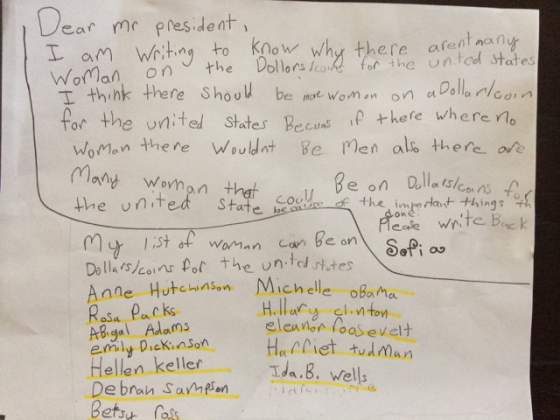
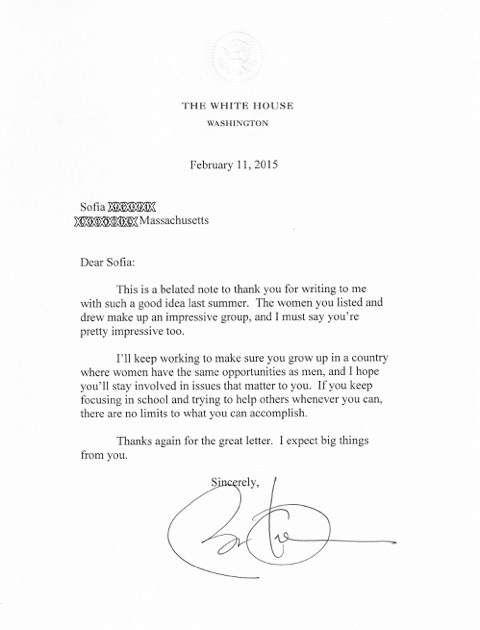
The little girl who asked Obama last year why there aren’t any women on U.S. bills has finally gotten a letter back from the President — and she’s invited to the annual White House Easter Egg Roll. President Obama made waves last year when he mentioned he had received a letter from a little girl asking him to put some women on U.S. currency, which he called a “pretty good idea.” That letter was from Sofia, a Massachusetts girl who was just finishing third grade at the time. “I was studying Ann Hutchinson, who stood up for women’s rights,” she says. “Almost everyone who chose a boy, on their poster they had pictures of different dollar bills or coins with their person on it. So I noticed, why don’t women have coins or dollar bills with their faces on it?” Sofia, now 9, knew immediately what she had to do. “I just came home from school and said, ‘I need to write to the president.’” Sofia’s mother provided her letter exclusively to TIME:

SofiaImage courtesy of Kim B., Sofia’s mother

For a while, Sofia didn’t hear anything back from the President. She says she “sort of forgot about it” until her dad showed her the President had mentioned her letter in a speech. “I was really excited about it, because I thought that maybe it would actually happen,” she says. In the months since Sofia wrote to Obama, a campaign to put a woman on the $20 bill has gone viral. The W20 movement is hosting an online poll so the public can vote on which woman should replace Andrew Jackson. The group plans to petition Obama and the Treasury Secretary to make it happen. Almost 220,000 people have voted in the online poll so far. And Sofia, who is now in fourth grade, is a junior ambassador for the campaign. Even though she’s a longtime fan of Ann Hutchinson, Sofia wants to see Rosa Parks on the $20. “What she did was really important,” she says. “If it wasn’t for her, we’d still be segregated today.” She got her whole class to vote in the online poll, and her third grade teacher got her class to vote as well. Last month, Sofia finally got a personalized letter back from the President, along with an invitation to attend this year’s White House Easter Egg Roll. Here’s what President Obama wrote to her:

Obama

Image courtesy of Kim B., Sofia’s mother Read more of this post

The Rise: Creativity, the Gift of Failure, and the Search for Mastery Paperback; How toy trains inspired Charles Correa to become India’s greatest contemporary architect; How Ford CEO Alan Mullaly turned a broken company into the industry’s comeback kid; A crucial part of values-based leadership, however, is becoming a “best citizen.” This recognizes the responsibility to make a difference in the world – Bamboo Innovator Daily: 18 Jun (Thurs)

Life

  •  How toy trains inspired Charles Correa to become India’s greatest contemporary architect: Quartz
  • How Ford CEO Alan Mullaly turned a broken company into the industry’s comeback kid;  A crucial part of values-based leadership, however, is becoming a “best citizen.” This recognizes the responsibility to make a difference in the world. Quartz
  • The real secret to a more productive brain: Find the Motivation. Invest in the tools. Learn with others. BRW
  • 3 powerful lessons from a classic book that Tony Robbins always recommends: BI
  • Food Network star Ina Garten on the power of saying ‘no’: BI
  • Winston Churchill famously said, “Democracy is the worst form of government, except all the others that have been tried.” Until recently, the same could be said for the factory model of education: Techcrunch
  • On the 200th anniversary of the Battle of Waterloo, remember the dark side of history: Quartz
  • How to word an invoice so it gets paid on time, and other hacks from ‘nudge’ economics: BRW
  • The Last Mover Advantage: techcrunch
  • Managers in the Digital Age Need to Stay Human: HBR
  • Conquering Digital Distraction: HBR
  • Solving Complex Social Problems Through Collaboration: HBR
  • Remembering the legendary Kirk Kerkorian: ‘He paved the way for the modern activist’: FP
  • Should Managers Read Academic Articles?: Forbes
  • Mind the 100-Year Gap in Education; It will take another 100 years for developing countries to reach the levels of developed nations unless drastic measures are taken: Bloomberg
  • The Myth of Perfect Information: SamMcNerney
  • How Maria Sharapova Became the World’s Wealthiest Female Athlete: Bloomberg

Books

  • The Rise: Creativity, the Gift of Failure, and the Search for Mastery: Amazon
  • The Four Things That Matter Most – 10th Anniversary Edition: A Book About Living: Amazon
  • As a Man Thinketh: Amazon
  • Your summer reading list: 70+ book picks from TED speakers and attendees: TED

Read more of this post

13 brilliant ideas that turned these people into self-made billionaires; Nine Career Lessons I Learned From Comic Books: Don’t stop trying until the job is done. Focus on the needs of others more than your own needs – Bamboo Innovator Daily: 17 Jun (Wed)

Life

  • 13 brilliant ideas that turned these people into self-made billionaires: BI
  • Nine Career Lessons I Learned From Comic Books: Forbes
  • The Wit And Wisdom Of Warren Buffett and Charlie Munger: Forbes
  • From obscurity to an unlikely comeback: how one leader turned a failing business around: FastCo
  • Kirk Kerkorian, investor, 1917-2015; Elusive billionaire who bought and sold his way to wealth via the airline, hotel, film and car businesses: FT
  • How science itself is coming under scrutiny: TheAge
  •  Are Companies Any Good at Picking Stars? Despite new assessment tools, the hunt for high-potential employees is more art than science: WSJ
  • ‘Makers’ are worth £18bn to the UK economy; Britain’s DIY disruptors, also known as makers, are revolutionising technology in the UK – boosting GDP and creating jobs while they’re at it: Telegraph
  • Three Essential Elements Of A Winning Mindset: Forbes
  • How Adobe keeps key employees from quitting; Ditching annual performance reviews has paid unexpected dividends. Fortune
  • A tech CEO explains the deceptively simple concept all leaders must understand: BI

Books

  • We Need To Talk: Your Guide to Challenging Business Conversations : Amazon

Read more of this post

Steve Jobs’ lessons from 1980 that are pure gold for entrepreneurs of today; Food Network star Ina Garten shares the career advice she’d give her younger self – Bamboo Innovator Daily: 16 Jun (Tues)

Life

  • Steve Jobs’ lessons from 1980 that are pure gold for entrepreneurs of today: e27, Youtube
  • How to Give the Most Motivating Pep Talk; Listen to a friend’s needs, emphasize resilience and strength. Don’t minimize concerns.; ‘I want to be here for you. What can I do?’; stay away from cliches like ‘Time heals’: WSJ
  • Food Network star Ina Garten shares the career advice she’d give her younger self: BI
  • 70% VCs reduce the potential of a startup: Silicon Valley VC Vinod Khosla: e27
  • Focus On the Customers You Want, Not the Ones You Have: HBR
  • Scientists just created the coldest substance on Earth, and it has some really weird properties: BI
  • This personality trait predicts your tendency to lie and cheat: BI
  • 6 reasons why family-owned businesses are smoking the competition: BI
  • This one big problem is why we can’t control computers with our brains yet: BI
  • How To Negotiate With Chinese Companies: Forbes
  • Getting organizational redesign right; Companies will better integrate their people, processes, and structures by following nine golden rules. Mckinsey
  • What Mountain Climbing Can Teach You About Business: NYT

Read more of this post