Malaysian Westport Billionaire May Let Shipping Lines Invest in Malaysian Terminals

Billionaire May Let Shipping Lines Invest in Malaysian Terminals

Malaysian billionaire G. Gnanalingam said he is open to shipping-line clients investing in Westports (WPRTS) Holdings Bhd.’s terminals to help retain their business as it expands port capacity. “We won’t sell equity in the port but will welcome joint-venture terminals,” Westports founder and Chairman Gnanalingam, 69, said in an interview in Kuala Lumpur yesterday. “The advantage is that the customer will stay.” Read more of this post


Learning from Malaysian listings of Chinese companies

Learning from Malaysian listings

Friday, November 29, 2013 – 14:43

Elaine Tan

China Daily/Asia News Network

Chinese companies struggle to raise their profiles as investors are wary of unfamiliar names

When Xingquan International Sports Holdings sought a listing on Bursa Malaysia, the Malaysian stock exchange, it was welcomed with open arms. The 2009 initial public offering (IPO) of China’s fifth largest outdoor sportswear manufacturer marked the first by a foreign-owned company after a concerted 16-month effort by the Securities Commission and the stock exchange to internationalize the Malaysian capital market. Read more of this post

Cinema economics: Bigger on the inside; Now showing at your local cinema: operas, circuses and television shows

Cinema economics: Bigger on the inside; Now showing at your local cinema: operas, circuses and television shows

Nov 30th 2013 | NEW YORK | From the print edition

“WHOVIANS” habitually sit on the sofa—or hide behind it—to watch their favourite time-traveller battle Daleks, Cybermen, Zygons and other monsters. But on November 23rd thousands of them, all around the world, settled into cinema seats to see “Doctor Who” in 3D. The 50th-anniversary episode of the British television show was screened on 800 big screens in 20 countries at the same time as being broadcast on the BBC’s channels. Read more of this post

What a Higher Minimum Wage Does for Workers and the Economy

What a Higher Minimum Wage Does for Workers and the Economy

By Peter Coy and Susan Berfield November 27, 2013

Tom Wolfe himself couldn’t have imagined a better New York juxtaposition. Pizza, Pepsi, and hot chicken wings were out on the table one November evening at Strive New York, an agency in East Harlem that helps ex-convicts and other chronically unemployed people get and keep jobs. Luz Droz, 32, who has a 10-month-old son, explained that she was trying to turn things around after “a little situation in my life,” which turned out to be two prison sentences totaling eight years for dealing drugs and passing bad checks. She detests being on welfare but was turned down recently for a minimum-wage job at Burlington Coat Factory (BURL). “I thought I was going to get it,” she said. “Once I get a job, I’m off to the races.” Read more of this post

UBS shrinks corporate advisory team for rich in emerging markets

UBS shrinks corporate advisory team for rich in emerging markets

5:50am EST

By Katharina Bart and Dinesh Nair

ZURICH/DUBAI (Reuters) – Swiss lender UBS is scaling back corporate advisory and investment banking services for ultra-rich clients in some key emerging market countries to reduce overlaps with other departments, three sources familiar with the plan said. The bank’s Corporate Advisory Group (CAG) offers services such as advice on mergers and acquisitions (M&A) and initial public offerings (IPOs), financing options and structured equity products to ultra-high-net-worth individuals and entrepreneurs who were the bank’s wealth management customers. Read more of this post

There Are 199,235 “Ultra High Net Worth” People In The World With Over $30 Million In Assets

There Are 199,235 “Ultra High Net Worth” People In The World With Over $30 Million In Assets

Tyler Durden on 11/29/2013 10:39 -0500

Wealth X breakdown

It is no secret that the bulk of “very rich people” in recent years has been created in Asia (where some $15 trillion in liquidity has entered broad circulation in just the past five years). As the FT reports, “Asia is producing more new wealth than any other part of the world at any point in history. Over the past five years, the assets of rich individuals have grown at triple the rate of the wealthy elsewhere, while the number of rich people has increased by twice that of other regions. Their number grew by almost 10 per cent to reach 3.7m last year, according to the survey, while their wealth expanded by 12 per cent to $12tn.” However, to find the truly ultra-high-net-worthy (UHNW), those with over $30 million in net assets, one has to go to the US and Europe – the places where Ben’s print baby print policy has most aggressively inflated the latest asset bubble, making the richest richester. “More people from the US and Europe entered this club in the past year than from anywhere else – the population in China and Brazil actually declined slightly.” So how many ultra-high-net-worth individuals are there? The answer: 199,235. Read more of this post

The struggle of low-income workers, many in retailing, is adding momentum to efforts to increase the federal minimum wage

November 28, 2013

On Register’s Other Side, Little to Spend

By STEVEN GREENHOUSE

In many stores around the country, the workers stocking the shelves and ringing up the gifts are at the very heart of this season’s retail lament —many Americans are so financially strapped that projections for holiday sales have grown bleaker by the week. And more so than in years past, the focus is on retail workers as more stores open on Thanksgiving Day, requiring many more to work on the holiday. Even if they have the option of staying home, those still stuck at the bottom economic rung long after the recession’s end have little choice but to take on extra shifts. Read more of this post

The founder of one of the earliest virtual currencies has re-emerged with a rival toBitcoin, more than five years after his first venture, e-gold, was shut down by the US Department of Justice

November 28, 2013 2:44 pm

E-gold founder backs new Bitcoin rival

By Stephen Foley in New York

The founder of one of the earliest virtual currencies has re-emerged with a rival toBitcoin, more than five years after his first venture, e-gold, was shut down by the US Department of Justice. Douglas Jackson is consulting for a membership organisation called Coeptis that hopes to launch a new version of his gold-backed currency, which attracted millions of users at its height. Read more of this post

Regulators want banks and asset managers that arrange deals for collateralized loan obligations to have some skin in the game

Loan Rules Raise Squawks

Lenders, Managers Say Keeping Skin in the Game Could Hamper CLO Market

STEPHANIE ARMOUR

Nov. 28, 2013 8:46 p.m. ET

WASHINGTON—An attempt by regulators to prevent the kind of lax underwriting that exacerbated the financial crisis is running into resistance from corporations, investors and asset managers who said new rules will cripple a $300 billion market for loans to U.S. companies. Regulators want those who manage or arrange collateralized loan obligations, or CLOs, to retain some of the loans’ risk on their books. Policy makers said requiring such skin in the game will ensure loans sliced, packaged and sold to investors are of high quality and help protect against default. Read more of this post

No quick exit from West’s economic malaise

No quick exit from West’s economic malaise

2:16am EST

By Alan Wheatley, Global Economics Correspondent

LONDON (Reuters) – Ending the Great Stagnation that is taxing Western policy makers may depend as much on the Chinese Communist Party as it does on the world’s leading central banks. Six years after the global financial crisis erupted, there is any number of explanations why Europe cannot shake off a Japan-style balance-sheet recession and why the United States is experiencing sub-par growth and high unemployment. Read more of this post

Mexico’s Surprising Engineering Strength

Mexico’s Surprising Engineering Strength

By Brendan Case November 27, 2013

econ_mexico49__01__630x420

As global automakers pour billions of dollars into their Mexican factories, Marcos Perez is trying to make sure the nation’s future goes beyond assembly lines. The head of product development at Ford Motor’s (F) Mexico unit, Perez has helped the company almost triple its local engineering staff, to nearly 1,000, since 2010. His engineers have filed for 40 U.S. patents in the last three years, including one for a low-cost crash protection system that boosts safety ratings without adding much weight or cost. “It’s an inflection point,” Perez says. “We used to be a simple-assembly kind of country, and we moved to a truly core manufacturing country, where most of our assembly plants are hitting record numbers on productivity, on quality, on cost. Now we are transitioning from Made in Mexico to Designed in Mexico.” Read more of this post

In Bogle Family, It’s Either Passive or Aggressive; While Vanguard Group’s Founder May Be the Father of Passive Investing, His Fund-Manager Son Sides With Active Stock-Picking

In Bogle Family, It’s Either Passive or Aggressive

While Vanguard Group’s Founder May Be the Father of Passive Investing, His Fund-Manager Son Sides With Active Stock-Picking

LIAM PLEVEN

Updated Nov. 28, 2013 5:59 p.m. ET

On their regular Friday morning phone calls, Jack Bogle and his son, John, catch up on family news. Sometimes they will compare notes on a particularly gnarly crossword. But the conversation often turns to a big topic among the Bogle clan: the best strategy for investing in stocks. For them, it is more than just shooting the breeze. Read more of this post

How Canada’s pension funds changed their conservative ways to become global buyout kings

How Canada’s pension funds changed their conservative ways to become global buyout kings

Katia Dmitrieva and Matthew Campbell, Bloomberg News | 28/11/13 | Last Updated:28/11/13 7:32 AM ET

Mark Wiseman, the chief executive of Canada Pension Plan Investment Board, walked into the high-end New York department store Bergdorf Goodman in the mid-1990s looking for a suit. He left empty-handed. “I couldn’t afford anything there — I probably still can’t,” said Wiseman, sitting in the $192.8 billion fund’s headquarters in Toronto last month. “Is that where I shop? No, thanks. But there are a lot of people who do.” Read more of this post

Howard Marks: “Markets Are Riskier Than At Any Time Since The Depths Of The 2008/9 Crisis”

Howard Marks: “Markets Are Riskier Than At Any Time Since The Depths Of The 2008/9 Crisis”

Tyler Durden on 11/27/2013 20:43 -0500

In Feb 2007, Oaktree Capital’s Howard Marks wrote ‘The Race to the Bottom’, providing a timely warning about the capital market behavior that ultimately led to the mortgage meltdown of 2007 and the crisis of 2008 as he worried about “carelessness-induced behavior.” In the pre-crisis years, as described in his 2007 memo, the race to the bottom manifested itself in a number of ways, and as Marks notes, “now we’re seeing another upswing in risky behavior.” Simply put, Marks warns, “when people start to posit that fundamentals don’t matter and momentum will carry the day, it’s an omen we must heed,” adding that “the riskiest thing in the investment world is the belief that there’s no risk.” Read more of this post

How Poland Became Europe’s Most Dynamic Economy

How Poland Became Europe’s Most Dynamic Economy

By Stephan Faris November 27, 2013

The oldest coffee shop in Warsaw has been in operation nearly without interruption since the end of the 18th century. In the upstairs room, a young Frédéric Chopin played one of his last concerts before emigrating to Paris. During the Nazi occupation from 1939 to 1945, the cafe was strictly for Germans. When the city rose up at the end of the war, the building, like much of the old city around it, was completely destroyed—then reconstructed from photographs in the years following. The cafe was state-owned under communism and privatized in 1989 after the fall of the Iron Curtain, sold to a journalist and a jazz musician. “And now,” says Polish businessman Adam Ringer, sitting in the cafe in early October, “it’s been bought by an international company.” Read more of this post

Flirting With Money-Market Madness; SEC proposals that would increase instability are worse than no reform at all

Flirting With Money-Market Madness

SEC proposals that would increase instability are worse than no reform at all.

ERIC S. ROSENGREN

Nov. 28, 2013 4:44 p.m. ET

Five years after the financial crisis, we know what caused much of the chaos. Many aspects of the financial system have been strengthened, reducing the likelihood of future problems. And yet for money-market mutual funds, fundamental reform has not been enacted. Unfortunately, some reforms proposed by the Securities and Exchange Commission might actually work against financial stability, instead of enhancing it. Read more of this post

European Banks Could Take Their Hits Early; Banks Face Up to Next Year’s Asset Review by ECB

European Banks Could Take Their Hits Early

Banks Face Up to Next Year’s Asset Review by ECB

ANDREW PEAPLE

Nov. 28, 2013 1:05 p.m. ET

European banks could be in for a painful end to 2013. European banks are already facing up to a huge potential capital shortfall next year, thanks to several regulatory pressures. The European Central Bank will carry out an asset quality review aimed at ensuring banks’ balance sheets conform to uniform rules in areas like bad loans; stress tests will examine how robust banks might be in a downturn. Read more of this post

Central bankers’ diverging paths could create damaging disharmony

November 28, 2013 12:01 pm

Central bankers’ diverging paths could create damaging disharmony

By Claire Jones and Ralph Atkins

For the past six years, the world’s main central banks have sung largely from the same hymn sheet – shoring up financial systems and printing money to support economies. Now, they are doing their own thing. Weak eurozone inflation data on Friday could fuel expectations of further stimulus measures from the European Central Bank. The Bank of Japan, meanwhile,has dropped heavy hints that if its aggressive asset purchase, or “quantitative easing” programmes do not drag the country out of deflation, it will step up action. Read more of this post

Cheap money feeds QE addiction and inequality

Cheap money feeds QE addiction and inequality
Friday, November 29, 2013
By Mike Dolan, Reuters

LONDON–The message is sinking in — economies of the rich world face super-easy money far into the future and central banks are now convinced it’s the least of all policy evils. Despite rumblings of dissent about the financial bubbles and iniquities associated with zero interest rates and money printing, 2013 is ending with a remarkable certainty among global investors that cheap money is around for the long haul. Read more of this post

Bitcoin under pressure: Virtual currency: It is mathematically elegant, increasingly popular and highly controversial. Bitcoin’s success is putting it under growing strain

Bitcoin under pressure: Virtual currency: It is mathematically elegant, increasingly popular and highly controversial. Bitcoin’s success is putting it under growing strain

Nov 30th 2013 | From the print edition

ALL currencies involve some measure of consensual hallucination, but Bitcoin, a virtual monetary system, involves more than most. It is a peer-to-peer currency with no central bank, based on digital tokens with no intrinsic value. Rather than relying on confidence in a central authority, it depends instead on a distributed system of trust, based on a transaction ledger which is cryptographically verified and jointly maintained by the currency’s users. Read more of this post

Bitcoin needs to learn from past e-currency failures

November 28, 2013 8:45 am

Bitcoin needs to learn from past e-currency failures

By Stephen Foley

Before Bitcoin, there was e-gold. In 1999, the Financial Times called it “the only electronic currency that has achieved critical mass on the web”. As it kept growing through the next decade, users ultimately opened more than 4m accounts, with more than $60m in deposits, backed by almost 4 metric tonnes of precious metal, and millions of dollars of transactions on a typical day. And then it all stopped. The founder of e-gold, an oncologist and economic history buff in Florida called Douglas Jackson, had hoped his gold-backed electronic currency would become a new base money to rival flawed fiat currencies. Read more of this post

Bank of England cuts mortgage support to avoid housing bubble

Bank of England cuts mortgage support to avoid housing bubble

8:10am EST

By David Milliken and Huw Jones

LONDON (Reuters) – The Bank of England moved to head off the risk of a bubble in house prices on Thursday, making a surprise announcement that it would put the brakes on a scheme launched last year to boost mortgage lending. Shares in British construction firms tumbled after the central bank said it would refocus the Funding for Lending Scheme (FLS) on helping small firms that find it hard to borrow. Read more of this post

Asset managers told to ‘be more visible’; Backlash feared unless industry presents a more human face

November 28, 2013 11:32 am

Asset managers told to come out of the shadows

By Gillian Tett

Backlash feared unless industry presents a more human face

In recent years Helena Morrissey, head of Newton, the asset management group, has attracted much attention. She is something of a rarity, being a truly senior woman in British finance, and she has used that platform to speak out on many issues including the 30 per cent campaign, which aims to get more women on British boards. But Ms Morrissey is currently promoting another cause: the profile of the British asset management industry. Earlier this month she delivered a speech to the CFA Institute in London, in which she urged fund managers to become far more vocal and visible. Read more of this post

“Quant” hedge funds: Computer says no; Hedge funds looking to spot and ride market trends are hoping for a fresh start

“Quant” hedge funds: Computer says no; Hedge funds looking to spot and ride market trends are hoping for a fresh start

Nov 30th 2013 | From the print edition

20131130_fnd001 20131130_FNC878

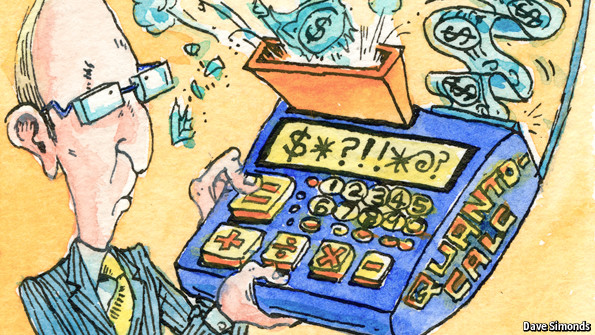
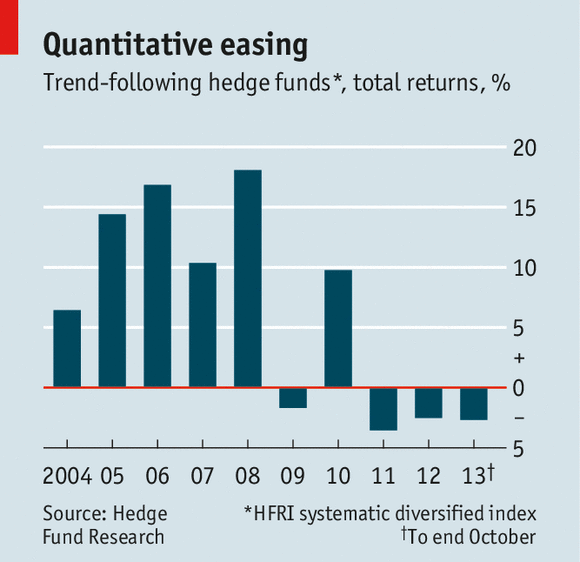
IF SOMETHING has not worked for five years, most people would conclude that it was broken. Tell that to the geeks managing “quant” hedge funds, who craft elaborate algorithms to profit from market movements. Once money-spinners, their prized formulae have misfired since 2009, losing money in four of the past five years. Unless their results improve markedly, the giant funds will finish this year as the worst-performing of the most common hedge-fund strategies. Read more of this post

On Thanksgiving, understanding what gratitude requires

On Thanksgiving, understanding what gratitude requires

By E.J. Dionne Jr., Thursday, November 28, 7:37 AM

Thanksgiving Day is awash in sentiment, but gratitude is not a sentiment. It’s a virtue. It’s certainly nice, but it is more than a feeling or an emotion. Properly understood, gratitude is hard because it entails both an admission and a demand. A genuine sense of gratitude is rooted in the realization that when I think about all that I am, all that I have and all that I might have achieved, I cannot claim to have done any of this by myself. None of us is really “self-made.” We must all acknowledge the importance of the help, advice, comfort and loyalty that came from others. Read more of this post

Gratitude is more than simple sentiment; it is the motivation that can save the world

Gratitude is more than simple sentiment; it is the motivation that can save the world

By Miles Kimball 30 minutes ago

Miles Kimball is an economics professor at the University of Michigan. He blogs about economics, politics and religion.

As my regular academic work slows down in the days leading up to Thanksgiving, my thoughts have turned toward gratitude. In a visceral way, I feel thankful for my family, for my work, for the exhilarating November air on a brisk walk around my neighborhood, for my friends both here in Ann Arbor and online, and for being alive in this very interesting era—in what I believe is still close to the dawn of human history, yet a time of great abundance compared to what has gone before in past centuries. Read more of this post

Where Is the Love? It’s easy to scorn the poor from a position of privilege. But, on Thanksgiving, maybe we need a conversation about empathy for fellow humans in distress

November 27, 2013

Where Is the Love?

By NICHOLAS D. KRISTOF

When I’ve written recently about food stamp recipientsthe uninsured and prison inmates, I’ve had plenty of pushback from readers. A reader named Keith reflected a coruscating chorus when he protested: “If kids are going hungry, it is because of the parents not upholding their responsibilities.” A reader in Washington bluntly suggested taking children from parents and putting them in orphanages. Jim asked: “Why should I have to subsidize someone else’s child? How about personal responsibility? If you procreate, you provide.” Read more of this post

Giving Thanks: I fear that far too many people have no familiarity – or even empathy – with what it means to be poor.

November 27, 2013

Giving Thanks

By CHARLES M. BLOW

Tuesday morning, I got a call about a girl — now a woman — whom I had gone to grade school with. She was gravely ill. Cancer. It had spread to her brain, I was told. From where, it wasn’t clear. She was on life support. By early afternoon her childhood friend and next-door neighbor had posted on Facebook: “This isn’t good bye, it’s just see u later. God saw ur suffering n decided u should suffer no more.” Read more of this post

The Solution Revolution: How business, government and social enterprises are teaming up to solve society’s toughest problems

November 27, 2013 4:15 pm

‘The Solution Revolution’, by William Eggers and Paul Macmillan

Review by Tanjil Rashid

The Solution Revolution: How business, government and social enterprises are teaming up tosolvesociety’stoughestproblems, by William Eggers and Paul Macmillan, Harvard Business Review Press $26/£17.99

Like many revolutionary manifestos, The Solution Revolution seeks the overthrow of government as we know it. But for authors William Eggers and Paul Macmillan – both of whom work for the public sector practice at Deloitte – this is a revolution very much in the interests of business, not against it. Read more of this post

Lessons on breaking into a new market: it takes time

Michael Bleby Reporter

Lessons on breaking into a new market: it takes time

Published 27 November 2013 12:02, Updated 28 November 2013 07:56

It takes time to break into a new market. Whether that market is for large infrastructure projects or business in China, establishing relationships with local potential clients and building up a local track record is crucial, businesses say. Of course, foreigners’ access to the local market can be impeded. Italian construction company Salini says in a submission to the Productivity Commission that access to Australia’s infrastructure market is hindered by a Leighton-Lend Lease duopoly and infrastructure funder Hastings supports that view. Read more of this post