For half of Taiwan, overtime just a fact of life

For half of Taiwan, overtime just a fact of life

Wednesday, Nov 27, 2013

John Liu

The China Post/Asia News Network

TAIPEI – The Council of Labor Affairs (CLA) said yesterday that 51.2 per cent of the nation’s workforce had the experience of working overtime in 2013, and 28 per cent of those cases were unlawful. Both percentages have increased over the past two years, the CLA said. According to the regulations, working for 12 hours or more per day is considered unlawful. Read more of this post

Acer’s Stan Shih asserts capacity to innovate, hits back at his critics

Acer’s Stan Shih asserts capacity to innovate, hits back at his critics

Wednesday, Nov 27, 2013

Ted Chen

The China Post/Asia News Network

TAIPEI – Stan Shih (施振榮) yesterday responded to critics of his return to the helm of beleaguered Acer Inc. by stating that he is still capable of facilitating innovation. At a public engagement yesterday, Shih asserted that he is capable of leading Acer out of its current woes, citing numerous innovative achievements during his previous tenure as company chairman. A committee designed to oversee sweeping reforms at the company has been set up, said Shih. Read more of this post

SingPost said it is the first postal service provider in the world to offer remittance services to Myanmar.

SingPost launches remittance services to Myanmar

POSTED: 27 Nov 2013 11:50
Singapore Post (SingPost) has launched remittance services to Myanmar at all its post offices. In its statement on Wednesday, SingPost said it is the first postal service provider in the world to offer remittance services to Myanmar. SINGAPORE: Singapore Post (SingPost) has launched remittance services to Myanmar at all its post offices. In its statement on Wednesday, SingPost said it is the first postal service provider in the world to offer remittance services to Myanmar. SingPost is partnering four commercial banks in Myanmar in the effort. They are Asia Green Development Bank, Cooperative Bank, Kanbawza Bank and Tun Foundation Bank. SingPost said apart from remitting money to their families in Myanmar, senders can also remit their salaries home as savings, which will accrue interest paid out by the banks in Myanmar. The statement said there are some 150,000 to 200,000 Myanmar nationals in Singapore.

Treasury correlation puts Malaysia at higher taper risk

Treasury correlation puts Malaysia at higher taper risk

4:38am EST

By Jongwoo Cheon

SINGAPORE (Reuters) – Record-high correlations between U.S. Treasury yields and the Malaysian and Thai currencies and high levels of foreign investment in their bond markets mean they could be hit hard when the U.S. Federal Reserve tapers quantitative easing. This focus on Malaysia and Thailand is in clear contrast from the May to September sell-off in Asian markets, when fear of the Fed tapering its stimulus drive hit the Indian rupee and Indonesian rupiah hardest because of their wide current account deficits. Read more of this post

The proposed assessment rate hike for properties in Kuala Lumpur by the KL City Hall might have a negative impact on REITs with the highest exposure to KL-based properties

Updated: Wednesday November 27, 2013 MYT 7:15:30 AM

Rate hike may hurt REITs

BY EUGENE MAHALINGAM

PETALING JAYA: The proposed assessment rate hike for properties in Kuala Lumpur by the Kuala Lumpur City Hall might have a negative impact on real estate investment trusts (REITs) with the highest exposure to KL-based properties, according to analysts. “We do expect some impact (from the assessment hike) on the earnings of REIT players with properties in KL,” said an analyst from a local bank-backed brokerage. Read more of this post

S&P Cuts Outlook on Malaysian Banks on Household Debt Concerns

S&P Cuts Outlook on Malaysian Banks on Household Debt Concerns

Standard & Poor’s cut its credit outlook for four Malaysian lenders on concern that rising home prices and household debt are contributing to economic imbalances in the country. The credit ratings company revised its outlook to negative from stable for CIMB Group Holdings Bhd. (CIMB), AmBank (M) Bhd., RHB Bank Bhd. and sister company RHB Investment Bank Bhd. It also lowered its long-term Asean regional scale rating on CIMB to axBBB+ from axA-, S&P said in an e-mailed statement today. Read more of this post

Volatile Loan Securities Are Luring Fund Managers Again

Volatile Loan Securities Are Luring Fund Managers Again

Collateralized Loan Obligations Offer High Returns—And Risk

MATT WIRZ

Updated Nov. 26, 2013 7:30 p.m. ET

MI-BZ917_CLO_PR_NS_20131126175103

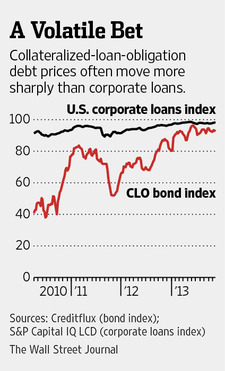
Investment funds aimed at individual investors are barreling into collateralized loan obligations, a complex and volatile type of security that was shaken by the financial crisis. Lured by annual returns of as high as 20%, some mutual-fund managers are buying CLOs through investment funds that purchase stakes in loans to companies with low credit ratings. Another type of loan investment fund, business-development companies, also have begun buying CLOs, according to securities filings. Read more of this post

Surfing central banks in a benign ‘QE trap’

Surfing central banks in a benign ‘QE trap’

1:55am EST

By Mike Dolan

LONDON (Reuters) – The message is sinking in – economies of the rich world face super-easy money far into the future and central banks are now convinced it’s the least of all policy evils. Despite rumblings of dissent about the financial bubbles and iniquities associated with zero interest rates and money printing, 2013 is ending with a remarkable certainty among global investors that cheap money is around for the long haul. Read more of this post

Private equity keeps $789bn of powder dry

November 26, 2013 7:06 pm

Private equity keeps $789bn of powder dry

By Anne-Sylvaine Chassany, Private Equity Correspondent

Private equity groups are holding more cash for acquisitions than they had at the height of the leveraged buyout boom, in spite of a fall in the volume of deals being done – raising concerns about overcapacity in the industry. Data compiled by Preqin, the research group, show that the value of unspent commitments to private equity funds, known as “dry powder”, has surged to $789bn this year – an increase of 12 per cent since December 2012, after four years of decline. Read more of this post

Norway Debates $800 Billion Wealth Fund’s Investment Options

Norway Debates $800 Billion Wealth Fund’s Investment Options

Norway’s central bank Governor Oeystein Olsen said it would be natural for the nation’s $800 billion sovereign wealth fund to expand the asset classes it invests in as the new government considers how best to deal with the fund’s growth. Olsen signaled support for a 2010 recommendation, which was rejected the following year, for the fund to invest in infrastructure and private equity as the new administration of Prime Minister Erna Solberg reviews its investment mandate. Read more of this post

Middle East: Cracking up; The ferocious battle between Sunni and Shia is shattering the imperial borders drawn up a century ago

November 26, 2013 7:29 pm

Middle East: Cracking up

By David Gardner

The ferocious battle between Sunni and Shia is shattering the imperial borders drawn up a century ago

When Arabs started pouring on to the streets to challenge dynastic despots almost three years ago, a wave of euphoria swept over their world as its citizens dared to dream they were finally on their way into the 21st century. Now, it looks as if they have been pitched back almost a century, to the period after the first world war when the Arab territories of the Ottoman Empire were dismembered. Then, it was the imperial machinations of Britain and France that carved up their lands and future. Now, a raging civil war in Syria that is spilling over into neighbouring countries threatens to bulldoze post-Ottoman borders. Read more of this post

Canada’s Pensions Now Buyout Kings Taking On U.S. Firms

Canada’s Pensions Now Buyout Kings Taking On U.S. Firms

Mark Wiseman, the chief executive officer of Canada Pension Plan Investment Board, walked into the high-end New York department store Bergdorf Goodman in the mid-1990s looking for a suit. He left empty-handed. “I couldn’t afford anything there — I probably still can’t,” said Wiseman, sitting in the C$192.8 billion ($183 billion) fund’s headquarters in Toronto last month. “Is that where I shop? No, thanks. But there are a lot of people who do.” Read more of this post

Bitcoin Is Moving Just Like South Sea Stock Before The Bubble Popped [CHARTS]

Bitcoin Is Moving Just Like South Sea Stock Before The Bubble Popped [CHARTS]

MEBANE FABERMEBANE FABER RESEARCH NOV. 26, 2013, 6:48 PM 9,708 22

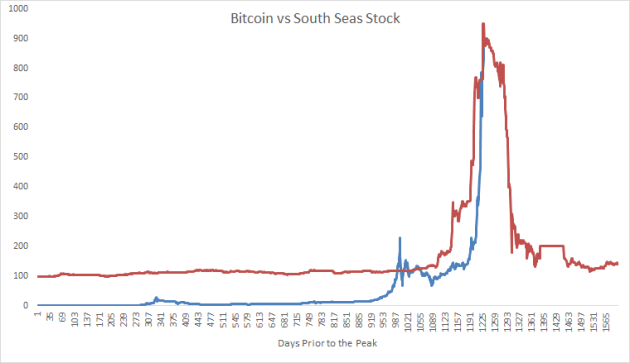
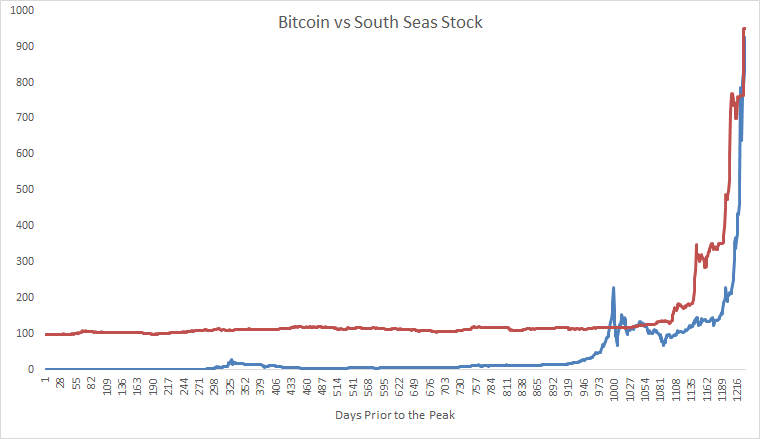
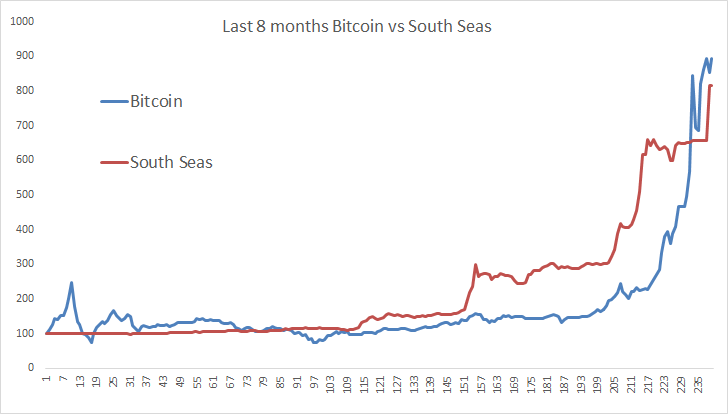
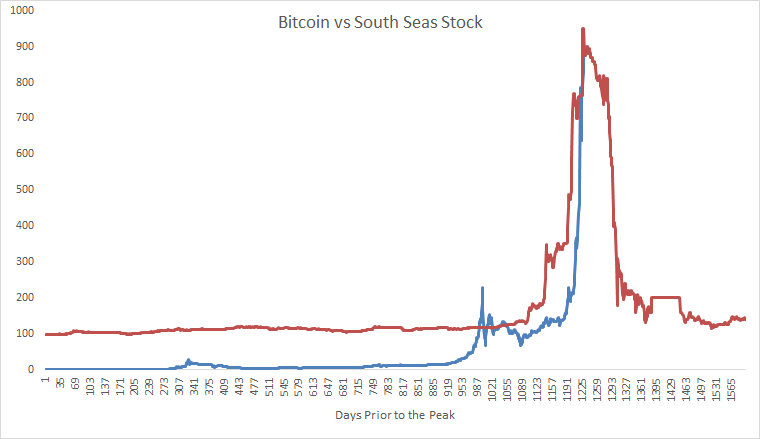
This is just for fun, I have no idea if or when the bitcoin train will ever get derailed.  You could compare this to any speculation that has gone parabolic, I just like ones that are over 200 years old. Chart 1 is actual bitcoin and South Sea Stock values plotted with SS peak lined up with current BC data. Chart 2 takes the last 8 months and lines them up with similar starting points. Granted I’m violating my #1 rule of charting but these are more fun to look at on a non log basis… Chart 3 is the most important, and it shows what happens after a bubble pops.  Namely, a 90% loss for those who bought at the top.  Now, I know many of you believe bitcoin will go to $1,000,000, but as a speculation (and to be clear this IS a speculation) you have to be at least be prepared for this to happen.  Do you have an exit plan?  Will you stick with it?  Or will you be like so many before you that ride a speculation all the way down? At least think about it. (Last note – one very common characteristic of bubbles is no talk of downside.  And that is all I am hearing with bitcoin today, rarely do you hear of anyone talking about the possibility of it going back to 100 or less.) I will will you with a little Kurt Vonnegut, from Galapagos, circa 1985: The thing was, though: When James Wait got there, a worldwide financial crisis, a sudden revision of human opinions as to the value of money and stocks and bonds and mortgages and so on, bits of paper, had ruined the tourist business not only in Ecuador, but practically everywhere…Ecuador, after all, like the Galapagos Islands, was mostly lava and ash, and so could not begin to feed its nine million people. It was bankrupt, and so could no longer buy food from countries with plenty of topsoil, so the seaport of Guayaquil was idle, and the people were beginning to starve to death…Neighboring Peru and Columbia were bankrupt, too…Mexico and Chile and Brazil and Argentina were likewise bankrupt – and Indonesia and the Philippines and Pakistan and India and Thailand and and Italy and Ireland and Belgium and Turkey. Whole nations were suddenly in the same situation as the San Mateo, unable to buy with their paper money and coins, or their written promises to pay later, even the barest essentials. ..They were suddenly saying to people with nothing but paper representations of wealth, “Wake up, you idiots! Whatever made you think paper was so valuable?” The financial crisis, was simply the latest in a series of murderous twentieth century catastrophes which had originated entirely in human brains. From the violence people were doing to themselves and each other, and to all other living things, for that matter, a visitor from another planet might have assumed that the environment had gone haywire, and that people were in such a frenzy because Nature was about to kill them all. But the planet a million years ago was as moist and nourishing as it is today – and unique, in that respect, in the entire Milky Way. All that had changed was people’s opinion of the place.”
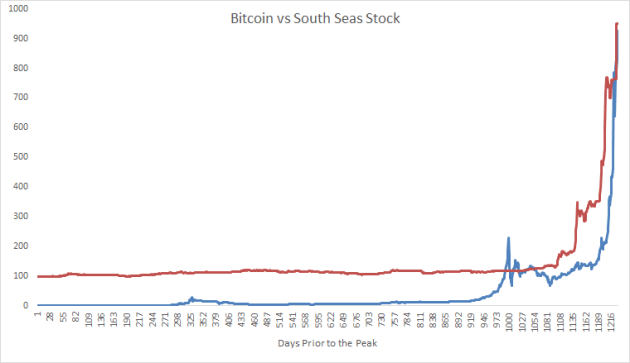
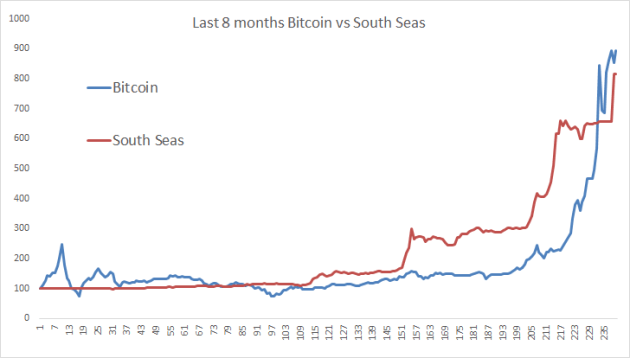
chart1-7 chart2-6 3-81

Among American workers, poll finds unprecedented anxiety about jobs, economy

Among American workers, poll finds unprecedented anxiety about jobs, economy

By Jim Tankersley and Scott Clement, Tuesday, November 26, 8:03 AM

CHESTER, Pa. — The alarm rang on John Stewart’s phone at 1:10 a.m. Up at 1:30, he caught one bus north into Philadelphia a little after 2 and another bus, south toward the airport, half an hour after that. He made it into work around 3:25 for a shift that started at 4, for a job that pays $5.25 an hour, which he cannot afford to lose. Read more of this post

Struggling pawnbroker resorts to melting down retail gold jewellery stocks to stay within bank borrowing agreements as profits slump

Albemarle & Bond smelts its own gold jewellery to stave off bankruptcy

Struggling pawnbroker resorts to melting down retail jewellery stocks to stay within bank borrowing agreements as profits slump

By John Ficenec

2:19PM GMT 27 Nov 2013

The beleaguered pawn broker Albemarle & Bond is smelting down its own gold jewellery to stave off bankruptcy. The company said on Wednesday it was carrying out a programme of exceptional smelting of retail jewellery stocks in order to stay within constrained banking facilities. The company said it now expects to make a trading loss in the first five months of the year, and that the pledge book of pawned items had declined by 12pc on the same stage last year. Read more of this post

Return of bundled debt deals raises crisis re-run fears

November 27, 2013 9:06 am

Return of bundled debt deals raises crisis re-run fears

By Tracy Alloway in New York

The Adams Express Building in lower Manhattan has a colourful history that includes a first world war explosion and the discovery of basement-dwelling goldfish. Perhaps of greater relevance to its Wall Street neighbours, the loan used to build the near century-old skyscraper was also one of the first to be bundled and securitised into a commercial real estate bond. Read more of this post

Fears Rise as China’s Yields Soar

Fears Rise as China’s Yields Soar

SHEN HONG

Nov. 25, 2013 1:31 p.m. ET

MI-BZ892_CYIELD_G_20131125180907

SHANGHAI—Yields on Chinese government debt have soared to their highest levels in nearly nine years amid Beijing’s relentless drive to tighten the monetary spigots in the world’s second-largest economy. The higher yields on government debt have pushed up borrowing costs broadly, creating obstacles for companies and government agencies looking to tap bond markets. Several Chinese development banks, which have mandates to encourage growth through targeted investments, have had to either scale back borrowing plans or postpone bond sales. Read more of this post

Why You Should Embrace The Tao Of The Jedi

Why You Should Embrace The Tao Of The Jedi

JAMES ALTUCHERTHE ALTUCHER CONFIDENTIAL NOV. 25, 2013, 4:42 PM 2,220 1

In 2005 I was going to go out of business (again). My biggest investor had lost all his money. He had a nervous twitch and whenever I ran into him he was constantly twitching. “I need my money back,” he told me. But I didn’t have it. I had invested it. It would be a year before I could legally give it to him. So I didn’t know what to do. He once threw a chair at me he was so angry. So I did what any normal 37-year-old man in the hedge funds business would do: I bought the book, “The Tao of Star Wars.” Because I knew deep down if I just surrendered to The Force then my business would be ok.  Read more of this post

The Warren Buffett Wannabe Index

November 25, 2013, 5:04 P.M. ET

The Warren Buffett Wannabe Index

By Robert Milburn

Want to invest like Warren Buffett? That’s the premise of a recently launched new app, callediBillionaire, which allows you to dig through the holdings of the nation’s top financial gurus and create your own portfolio based on where the smart money has parked cash. These guys (no females on the list yet) include Warren Buffett, Carl Icahn, and David Einhorn, investors famous for beating the broader market. So you can understand the logic of this investment gimmick, but when we tested the app, we found it had a few bugs still to work out. Read more of this post

How to become a morning person

How to become a morning person

November 26, 2013

Even night owls can learn to be an early bird. Small business owner Jill Chivers has never been a morning person. But that all changed three months ago after a visit to her GP. Chivers was told she would have to exercise regularly or go on medication to lower her cholesterol levels. It was an easy decision. “It was a wake-up call,” she said. “I didn’t want to go on medication, so I now have a morning routine.” Chivers was a night owl who used to watch TV and read until midnight or 1am before rising at 8am. She now gets up at 6am every day to exercise – rain, hail or shine. Read more of this post

The Hunger Games: Catching Fire taps the zeitgeist with its them-and-us society and the feeling that when money is in the hands of so few, the odds are never in our favour.

Review: The Hunger Games: Catching Fire

11-26 13:54 Caijing

The second film in the franchise raises the already-high bar set by The Hunger Games

What are the odds? Like Katniss Everdeen ducking a poison-tip arrow, the keepers of Suzanne Collins’s trilogy of fantasy novels have dodged the perils of the sloppy second franchise film. The Hunger Games: Catching Fire is leaner, gutsier and smarter. In hand-to-hand combat, it would have the first film on the floor, trapped in a headlock, whimpering for mercy. Over two-and-a-half heart-pounding hours, it doesn’t drag for a second. Read more of this post

Eve Taylor – the 81-year-old company founder who won’t retire

Eve Taylor – the 81-year-old company founder who won’t retire

Great-grandmother Eve Taylor founded her family-run cosmetics company in 1968 and has been working for the British brand ever since. She talks to Radhika Sanghani about 7.30am starts and the Asian export market. Eve Taylor, founder of Eve Taylor cosmetics company specialising in aromatherapy oils Photo: MARTIN POPE

By Radhika Sanghani

12:46PM GMT 25 Nov 2013

evetaylor_2744950b

It was the moment one Christmas when Eve Taylor had just ironed two dozen grey school shirts for her five sons that she realised something had to change. She was in her early thirties; feeling trapped in a man’s world. She put down the iron, signed up for beauty classes, and went on to found an aromatherapy and skincare company. Read more of this post

Hit the high notes: Lessons on business innovation from soprano singer Tania de Jong

Caitlin Fitzsimmons Online editor

Hit the high notes: Lessons on business innovation from soprano singer Tania de Jong

Published 26 November 2013 11:28, Updated 26 November 2013 16:02

In this world of rapid change and cut-throat competition, all businesses need to innovate. The problem is that it is easier said than done. Soprano singer Tania de Jong is both executive producer and keynote speaker at this week’s Creative Innovation conference in Melbourne. She is also founder of Creative Universe and social enterprise Creativity Australia. Tania de Jong believes creativity and the arts don’t always go together. Here are de Jong’s tips for how business can foster creativity and innovation. Read more of this post

TV sports broadcasts as a language-learning tool

TV sports broadcasts as a language-learning tool

BY MARK SCHREIBER

SPECIAL TO THE JAPAN TIMES

NOV 24, 2013

Another exciting grand sumo tournament ended yesterday, and brought back memories of my first encounter with sumo, in Okinawa back in September 1965. Within a couple of weeks after my arrival there, I was enrolled in Basic Japanese classes at the University of Maryland’s Far East Division and making my first awkward efforts to learn the language. In addition to my beginner’s textbook and a newly purchased 和英辞典 (waei jiten, Japanese-English dictionary), I had two supplementary learning materials: The Okinawa Morning Star, the local daily English newspaper; and our old monochrome TV set. Read more of this post

When Superstition Works; Some superstitions increase the illusion of control—and can even boost performance. In one recent study, golfers sank 35% more putts when playing with a ball they were told was ‘lucky.’

When Superstition Works

Some boost the illusion of control and can even boost performance

ANGELA CHEN

Nov. 25, 2013 7:16 p.m. ET

Even if you scoff at Friday the 13th and aren’t wary of black cats, you’re probably still superstitious. Angela Chen takes a look at the research to prove people are superstitious, and whether superstitions can actually be beneficial. Photo: Getty Images. It starts when people try something different—Pepsi instead of Coca-ColaKO -0.15% a blue tie instead of the old red one—and find that something good happens. Read more of this post

Global airlines brought in $27 billion in nonticket revenue last year, an 11-fold increase over 2007

Thriftiest Fliers Outwit Fee-Hungry Airlines

Travelers Pack Special-Sized Bags, Use Other Tricks to Avoid Extra Charges

JACK NICAS

Updated Nov. 25, 2013 5:28 p.m. ET

The airline industry’s increasing reliance on extra fees is spawning a sort of arms race between discount carriers and their thriftiest customers to outsmart each other. Global airlines brought in $27 billion in nonticket revenue last year, an 11-fold increase over 2007, according to airline-consulting firm IdeaWorks Co. Nonticket revenue includes fees for extras, as well as sales of frequent-flier points, hotel rooms and rental cars, among other things. Read more of this post

The Next Frontier in Heart Care; Research Aims to Personalize Treatment With Genetics

The Next Frontier in Heart Care

Research Aims to Personalize Treatment With Genetics

RON WINSLOW

Nov. 25, 2013 7:18 p.m. ET

2013_11_26_cmyk_NA_02

Two influential heart studies are joining forces to bring the power of genetics and other 21st century tools to battle against heart disease and stroke. Ron Winslow and study co-director Dr. Vasan Ramachandran explain. Photo: Shubhangi Ganeshrao Kene/Corbis.

Scientists from two landmark heart-disease studies are joining forces to wield the power of genetics in battling the leading cause of death in the U.S. Cardiologists have struggled in recent years to score major advances against heart disease and stroke. Although death rates have been dropping steadily since the 1960s, progress combating the twin diseases has plateaued by other measures. Read more of this post

Hospitals Take On Post-ICU Syndrome, Helping Patients Recover

Hospitals Take On Post-ICU Syndrome, Helping Patients Recover

Especially at Risk Are Those Who Treated for Sepsis and Who Experience ‘ICU Delirium’

LAURA LANDRO

Nov. 25, 2013 7:00 p.m. ET

Hospitals are doing more to help the growing number of patients who receive treatment for serious illness in the intensive-care unit—only to find their release is the start of a whole new set of problems. With medical advances, even the sickest patients now often survive potentially life-threatening conditions after a stay in intensive care. Many experience aftereffects, not only of the illness but also of the very medical care that may have saved their lives. Read more of this post

ADHD Fakers Hankering for Pills Thwarted by Lie Detectors

ADHD Fakers Hankering for Pills Thwarted by Lie Detectors

College students faking symptoms of attention-deficit hyperactivity disorder to get hold of pills may have met their match in an ADHD lie detector device. People are acting fidgety and inattentive to try to dupe doctors into writing prescriptions for ADHD drugs, which can be used to get high, stay awake or concentrate while studying. The growing illicit use of the drugs on college campuses and a tripling in emergency-room visits linked to the pills have helped spur efforts to improve diagnosis. Read more of this post

Do Firms Issue More Equity When Markets Are More Liquid?

Do Firms Issue More Equity When Markets Are More Liquid?

Rene M. Stulz Ohio State University (OSU) – Department of Finance; National Bureau of Economic Research (NBER); European Corporate Governance Institute (ECGI)

Dimitrios Vagias Erasmus University Rotterdam (EUR) – Rotterdam School of Management (RSM)

Mathijs A. Van Dijk Erasmus University – Rotterdam School of Management; Erasmus Research Institute of Management (ERIM)

July 9, 2013
Fisher College of Business Working Paper No. 2013-03-10
Charles A. Dice Center Working Paper No. 2013-10

Abstract: 
This paper investigates how public equity issuance is related to stock market liquidity. Using quarterly data on IPOs and SEOs in 36 countries over the period 1995-2008, we show that equity issuance is significantly and positively related to contemporaneous and lagged innovations in aggregate local market liquidity. This relation survives the inclusion of proxies for market timing, capital market conditions, growth prospects, asymmetric information, and investor sentiment. Liquidity considerations are as important in explaining equity issuance as market timing considerations. The relation between liquidity and issuance is driven by the quarters with the greatest deterioration in liquidity and is stronger for IPOs than for SEOs. Firms are more likely to carry out private instead of public equity issues and to postpone public equity issues when market liquidity worsens. Overall, we interpret our findings as supportive of the view that market liquidity is an important determinant of equity issuance that is distinct from other determinants examined to date.