URA acts to curb use of ‘SoHo’ by developers

PUBLISHED NOVEMBER 26, 2013

URA acts to curb use of ‘SoHo’ by developers

It says they should clarify approved use of a development

MINDY TAN TANMINDY@SPH.COM.SG

The Urban Redevelopment Authority (URA) is clamping down on the use of the term “small office home office” (SoHo) for commercial and residential units, as the man on the street may be led to think that such units can be used as homes and offices – whether concurrently or interchangeably – PHOTO: FAR EAST ORGANIZATION

[SINGAPORE] The Urban Redevelopment Authority (URA) is clamping down on the use of the term “small office home office” (SoHo) for commercial and residential units, as the man on the street may be led to think that such units can be used as homes and offices – whether concurrently or interchangeably. Read more of this post

Tokyo Beating Paris Property Lifts REIT Bond Sales: Japan Credit

Tokyo Beating Paris Property Lifts REIT Bond Sales: Japan Credit

The strongest bond sales in three years by real estate investment trusts are showing confidence in the property revival sparked by Prime Minister Shinzo Abe. REIT sales jumped 33 percent this year to 95.8 billion yen ($944 million), outpacing the 5.9 percent increase in Japanese corporate issuance and the 2.2 percent climb for that in the U.S., according to data compiled by Bloomberg. Japan Excellent Inc. (8987), whose properties house units of Toshiba Corp. and Fujitsu Ltd., raised 5 billion yen of 0.46 percent debt last week due 2018 at a 5 basis point yield premium over the yen swap rate, down from the 48 it paid in 2011. Read more of this post

Prologis to Boost Japan Rents, Buy Warehouses on Abenomics Bonus

Prologis to Boost Japan Rents, Buy Warehouses on Abenomics Bonus

Prologis Inc. (PLD), the world’s biggest warehouse owner, plans to increase rents and spend as much as $600 million a year to develop warehouses in Japan as Prime Minister Shinzo Abe’s policies boost corporate confidence. The company expects rents to rise about 3 percent annually “for a while” and will invest $500 million to $600 million a year in warehouses, said Hamid Moghadam, chairman and chief executive officer of San Francisco-based Prologis. That compares with the the average annual investment of $400 million to $600 million historically, he said. Read more of this post

52 South Koreans in their 30s and 40s owned over 100 billion won ($94.2 million) in equity, and only nine of them were self-made entrepreneurs

52 S. Koreans in 30s, 40s own over $94mn in equity

2013.11.25 15:04:50

52 South Koreans in their 30s and 40s owned over 100 billion won ($94.2 million) in equity, and only nine of them were self-made entrepreneurs, according to an analysis. Hyundai Motor vice chairman Chung Eui-sun, who owns 3.5 trillion won worth of equity, was ranked as the richest among those in their 30s and 40s in terms of equity holdings.  Read more of this post

Anti-chaebol regulations backfire

2013-11-25 18:03

Anti-chaebol regulations backfire

Brioche Doree, Dufry allowed ‘unintedned’ way into Korean market
By Yi Whan-woo
A growing number of foreign companies are entering the Korean market by taking advantage of loopholes in regulations introduced to prevent sprawling expansion of large firms and to nurture small- and medium-sized enterprises (SMEs) The National Commission for Corporate Partnerships, a presidential committee, has restricted family-owned conglomerates and companies with more than 300 employees from expanding into several industries in which the government intends to foster SMEs.
These industries include bakeries, restaurants, coffee shop franchises, duty free shops, catering, stationeries, car rentals and IT services. Read more of this post

Dongsuh Food, Korea’s largest instant coffee product manufacturer, recently upgraded its products by using better coffee beans and adopting advanced manufacturing methods to meet increasingly sophisticated consumer tastes

2013-11-25 15:32

Dongsuh upgrades instant coffee products

By Lee Hyo-sik
Dongsuh Food, Korea’s largest instant coffee product manufacturer, recently upgraded its products by using better coffee beans and adopting advanced manufacturing methods to meet increasingly sophisticated consumer tastes. Under the slogan of the ”Better Beans, Better Taste,’’ the company has been updating a wide range of its products every four to five years since 1996. In October, Dongsuh introduced ”restaged Maxim” and other items for the fifth time, drawing a great deal of attention from coffee drinkers. Read more of this post

Home alone: Growth of single households in Korea

Home alone: Growth of single households in Korea

Sunday, November 24, 2013 – 18:00

Chun Sung-woo

Jeong Hunny

The Korea Herald/Asia News Network

The Roman emperor Augustus prohibited unmarried women between the ages of 20 and 50 from inheriting property because dying without legitimate children left properties heirless. Living alone in Ancient Rome was frowned upon by both state and citizenry. After 2,000 years, prospects for those living alone have changed, although of course, not entirely for the better. Read more of this post

Korea’s Top-Performing Fund Goes Global as Locals Shun Kospi

Korea’s Top-Performing Fund Goes Global as Locals Shun Kospi

South Korea’s top-performing mutual fund more than doubled its assets in 2013 by betting on global consumer shares, luring inflows from domestic investors who have sold Kospi (KOSPI) index stocks for five straight years. The $610 million Mirae Asset Global Great Consumer Securities Master Investment Trust 1 (1A38171) returned 33 percent this year for the biggest gain among Korea-domiciled equity funds with at least $500 million of assets. The fund has grown from about $283 million at the start of the year, even as individual investors withdrew a net $4 billion from Kospi shares. The benchmark index has climbed 1 percent this year, trailing the 18 percent gain in the MSCI All-Country World Index. Read more of this post

Samsung Preferreds Jump as Kospi Cash Pot Fattens: Korea Markets

Samsung Preferreds Jump as Kospi Cash Pot Fattens: Korea Markets

South Korean preferred shares are beating common stocks by the most on record as surging cash holdings boost the outlook for dividend payouts by Samsung Electronics Co. and Hyundai Motor Co. (005380) The nation’s five-largest preferred shares jumped an average 36 percent in Seoul this year, while the same companies’ common stock dropped 5.8 percent as investors said voting rights are becoming less important. Preferreds, which give holders higher payouts without influence over how the business is run, still trade at an average discount of 51 percent to common shares and have dividend yields about twice as large. Read more of this post

Shilla Duty Free, Korea’s major player in duty free shopping, has been expanding its presence in Southeast Asia over the past few years to capitalize on the rapidly growth of the sector there

2013-11-25 15:28

Shilla opens more shops in Asia

By Lee Hyo-sik
Shilla Duty Free, Korea’s major player in duty free shopping, has been expanding its presence in Southeast Asia over the past few years to capitalize on the rapidly growth of the sector there. It is scheduled to open two new duty free shops handling  top brand watches at Singapore’s Changi International Airport, one of the world’s busiest aviation hubs, in January next year. Read more of this post

Singers and actresses sprinkle stardust on Korean cosmetics

November 25, 2013 7:23 am

Singers and actresses sprinkle stardust on Korean cosmetics

By Song Jung-a in Seoul

Thirtysomething tourist Patchalin Vongratanakunton is a big fan of Korean cosmetics. On her first trip to Seoul, she is spending $120 – more than a week’s average salary in Thailand, her home country – on Laneige creams by AmorePacific, South Korea’s biggest cosmetics group. “I love skincare products made in Korea,” she says at a crowded duty-free shop in central Seoul. “They fit Asian skin well, while European brands are for Europeans.” Read more of this post

Top10 chaebol hit by $716m FX losses

2013-11-25 17:12

Top10 chaebol hit by FX losses

By Na Jeong-ju
The country’s top 10 business groups suffered some 760 billion won ($716 million) in losses so far this year due to the won’s gain against the dollar and the yen, according to data released Monday. The damage from volatility in the currency market is expected to grow further amid forecasts that the won may continue to gain ground until early next year. Read more of this post

Condom Maker TTK Seeks Rebound After Durex Loss: Corporate India

Condom Maker TTK Seeks Rebound After Durex Loss: Corporate India

TTK Group, the Indian company that lost rights to make Durex condoms after a dispute triggered the exit of partner Reckitt Benckiser Group Plc (RB/) a year ago, plans to triple exports of its own brand as it seeks to revive sales. TTK Healthcare Ltd. (TTKP), which started selling the Skore brand of prophylactics in November 2012, aims to increase overseas shipments to 1 billion units in two years from 300 million, Chairman T.T. Jagannathan said in an interview. The company’s market share in the world’s second-most populous nation has shrunk to as little as 7 percent from as high as 47 percent when it made Reckitt’s Durex and Kohinoor brands, he said. Read more of this post

India Growth Seen Stuck Below 5% for Longest Stretch Since 2005

India Growth Seen Stuck Below 5% for Longest Stretch Since 2005

India’s economic growth probably held below 5 percent for a fourth straight quarter, the longest stretch in data going back to 2005, as Prime Minister Manmohan Singh struggles to boost investment and tame elevated inflation. Gross domestic product rose 4.6 percent in July through September from a year earlier, compared with 4.4 percent in the prior quarter, according to the median of 25 estimates in a Bloomberg News survey ahead of a report due on Nov. 29. Read more of this post

The role of dark inventory in the commodities bull run of 2008

The role of dark inventory in the commodities bull run of 2008

Izabella Kaminska

| Nov 25 17:41 | 7 comments | Share

We’ve argued before that the 2005-2007 commodity bull-run could have been the product of an unwitting self-manufactured squeeze, as the industry rushed to monetise as much inventory as possible to benefit from higher than usual interest rates and as inventory levels dropped. (All pretty much unwittingly, of course.) As prices increased, the economy choked. Read more of this post

From snacks to houses, consumers lead Kenya’s growth story

November 25, 2013 9:01 pm

From snacks to houses, consumers lead Kenya’s growth story

By Katrina Manson

There may be no better indication of the effort to snare Kenya’s wallet-conscious middle-class spenders than popcorn prices in the country’s leading supermarket chain. While imported popcorn, with glitzy photographs on cardboard packaging, costs 370 shillings ($4.24) for 300g, a simple “Blue Label” plastic package on the shelf beside it is 85 shillings ($0.98) for 500g. Read more of this post

India Office Boom Turns Glut With Vacancies: Real Estate

India Office Boom Turns Glut With Vacancies: Real Estate

India’s slowing economy has left its big cities with a glut of office space, pushing up vacancy rates, freezing development and prompting some builders to convert commercial projects into housing. Vacancy rates in the financial center of Mumbai and capital New Delhi topped 20 percent in the third quarter, the highest in Asia after Chengdu, China, where 32 percent of offices are empty, according to broker Cushman & Wakefield Inc. Six Indian cities are among the 10 office markets with the worst vacancies in the region, according to Cushman. Read more of this post

Toil for oil means industry sums do not add up

Last updated: November 25, 2013 5:29 pm

Toil for oil means industry sums do not add up

By Mark Lewis

Rising costs are being met only by ever smaller increases in supply

The most interesting message in this year’s World Energy Outlook from theInternational Energy Agency is also its most disturbing. Over the past decade, the oil and gas industry’s upstream investments have registered an astronomical increase, but these ever higher levels of capital expenditure have yielded ever smaller increases in the global oil supply. Even these have only been made possible by record high oil prices. This should be a reality check for those now hyping a new age of global oil abundance. Read more of this post

China investors give cash-hungry Asian hedge funds shot in the arm

China investors give cash-hungry Asian hedge funds shot in the arm

4:13pm EST

By Nishant Kumar

HONG KONG (Reuters) – Capital-starved Asian hedge funds may have got the lifeline they’ve been waiting years for – investors from China, some of whom are willing to risk very large sums of money. This new source of capital is a potential game changer for an industry that has been dependent on the whims of U.S. and European fund flows. It may also represent a key turning point in the movement of Chinese wealth offshore as the world’s second-biggest economy becomes more flexible about inbound and outbound investments. Read more of this post

A son of billionaire philanthropist Eric Hotung is suing an accounting giant and the surveying firm that HK Chief Executive Leung Chun-ying used to head, for fraud

Tycoon’s son names CY firm in fraud suit
Mary Ann Benitez
Tuesday, November 26, 2013
A son of billionaire philanthropist Eric Hotung is suing an accounting giant and various other entities, including the surveying firm that Chief Executive Leung Chun-ying used to head, for fraud. CY Leung & Co, which merged with property consultant DTZ in 2000, is named as one of 10 defendants in a writ filed yesterday in the High Court by Sean Eric Mclean Hotung. Read more of this post

Chinese real estate developers hit back at claims of unpaid RMB3.8 trillion ($623 billion) tax

Nov 25, 2013

CCTV Real Estate Exposé Triggers Business Backlash

A critical report by China’s official television broadcaster over the weekend has set off a rare public dispute between the powerful propaganda organ and business leaders. China Central Television reported on Sunday that property developers neglected to pay more than 3.8 trillion yuan ($623 billion) in land appreciation taxes from 2005 to 2012 (in Chinese). The report said 45 listed developers – including major well-known developers such as Soho China and China Vanke Co.000002.SZ +0.12%, owe land appreciation taxes. The one with the highest bill was Guangzhou-based Agile Property Holdings3383.HK +0.23%, with  8.3 billion yuan at stake, the report said. Read more of this post

China Said to Plan Crackdown on Banks’ Evasion of Lending Limits

China Said to Plan Crackdown on Banks’ Evasion of Lending Limits

China has drafted rules banning banks from evading lending limits by structuring loans to other financial institutions so that they can be recorded as asset sales, two people with knowledge of the matter said. The rules drafted by the China Banking Regulatory Commission ban borrowers from using resale or repurchase agreements to move assets off their balance sheets, said the people, who asked not to be identified because they aren’t authorized to discuss the rules publicly. Read more of this post

More than a million seek China government jobs

More than a million seek China government jobs

Monday, November 25, 2013 – 18:45

AFP

BEIJING – More than one million people took China’s national civil service exam at the weekend in a modern version of an age-old rite, but faced huge odds against clinching one of the few government jobs available. A total of 1.12 million took the National Public Servant Exam, according to figures from the State Administration of Civil Service figures. Read more of this post

Qualcomm’s China Growth Plans Threatened by Anti-Monopoly Probe

Qualcomm’s China Growth Plans Threatened by Anti-Monopoly Probe

Qualcomm Inc. (QCOM)’s growth prospects in the world’s largest mobile-phone market may be under threat after China’s National Development and Reform Commission began an investigation related to an anti-monopoly law. Qualcomm disclosed the probe yesterday, saying the NDRC advised that specific details are confidential. The San Diego-based company said it knows of no charge by the agency that it violated the law. Qualcomm gets revenue from sales of smartphone chips and collects license fees from wireless providers for the shipment of most Internet-capable handsets. Read more of this post

Cinda IPO unveils secrets of a Chinese bad debt factory

Updated: Tuesday November 26, 2013 MYT 7:54:26 AM

Cinda IPO unveils secrets of a Chinese bad debt factory

HONG KONG: China Cinda Asset Management Co Ltd lifted the lid on how Beijing turns bad loans from its banks into profits, issuing a prospectus for an initial public offering that has reeled in some of the world’s biggest investors. The IPO, seeking up to US$2.5bil, is set to be the largest in Hong Kong this year as sovereign wealth funds join hedge funds in betting that soured loans will be a growth business in China’s slowing economy. Cinda plans to list shares on Dec 12. Read more of this post

Brokers Beat Banks as China Revamps Economy: Chart of the Day

Brokers Beat Banks as China Revamps Economy: Chart of the Day

Investors are betting China’s brokerages will gain more than commercial banks and other companies from a plan unveiled this month to make market forces the “decisive factor” in the world’s second-largest economy. The CHART OF THE DAY shows the average price-to-book ratio for the three Chinese brokerages whose shares are traded in Hong Kong — China Galaxy Securities Co., Citic Securities Co. and Haitong Securities Co. — compared with a similar measure for the five largest banks and the Hang Seng China Enterprises Index, which tracks 40 mainland companies. Since the Communist Party announced a package of 60 reforms on Nov. 15, the brokers’ ratio surged to 1.76, while banks lagged behind at 1.08. Read more of this post

M&A Mystery: Why Are Takeover Prices Plummeting?

M&A Mystery: Why Are Takeover Prices Plummeting?

VIPAL MONGA

Nov. 25, 2013 8:26 p.m. ET

MK-CI131_PREMIU_NS_20131125180916MK-CI135A_PREMI_G_20131125183012

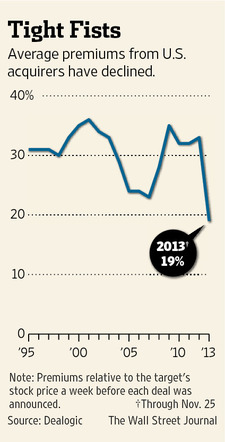
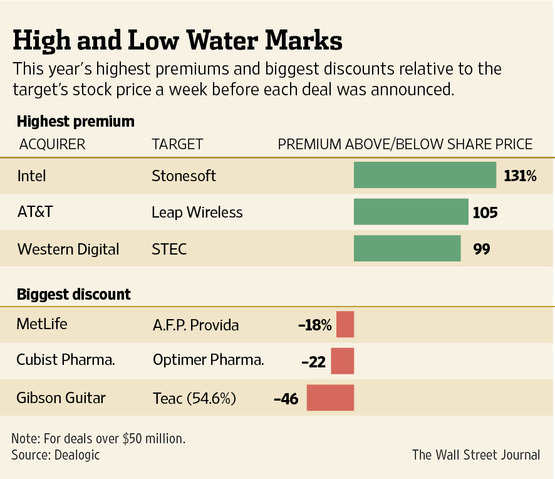
Mergers and acquisitions have been dominated by cheapskates this year. U.S. companies are paying just 19% more, on average, than their acquisition target’s trading price one week before the deal was announced.  That’s the lowest takeover premium since at least 1995, as far back as records go at Dealogic, which analyzed the data for The Wall Street Journal. Historically, the premiums have averaged 30%. Read more of this post

Turn on the tap, F&N – show what’s brewing in Myanmar

Turn on the tap, F&N – show what’s brewing in Myanmar

Monday, Nov 25, 2013

Kenneth Lim

The Business Times/MyPaper

Looking at Fraser and Neave’s (F&N’s) latest results announcement, one would think that all is fine and dandy at its Myanmar Brewery business. But there is more than just beer brewing in that business, and F&N needs to shed more light on the ongoing dispute with its Myanmar partner that threatens a significant part of its beverage business. In its full-year results announcement earlier this month, F&N appeared to paint a fairly robust picture of its Myanmar beer business. Read more of this post

China at a crossroads

China at a crossroads

By Robert J. Samuelson, Monday, November 25, 8:52 AM

It has been only a few years since China was widely regarded as an unstoppable economic colossus. For three decades, its economy grew about 10 percent annually; China seemed to be gliding through the global economic storm. Well, maybe not. Many economists — Chinese and foreign — think China’s economic model is unworkable. Without a new model, they say, China will someday face a collapse of growth or worse. The outcome has huge implications for China’s internal stability and its global economic footprint. The precedent of Japan, a highflier laid low, suggests that rapid growth can’t be taken for granted. Read more of this post

Mockingjay and IFRS 10/FRS 110 in Asia 2014: Changing Balance Sheet and The Rebellion Year for Accounting Frauds?

The following article is extracted from the Bamboo Innovator Insight weekly column blog related to the context and thought leadership behind the stock idea generation process of Asian wide-moat businesses that are featured in the monthly entitled The Moat Report Asia. Fellow value investors get to go behind the scene to learn thought-provoking timely insights on key macro and industry trends in Asia, as well as benefit from the occasional discussion of potential red flags, misgovernance or fraud-detection trails ahead of time to enhance the critical-thinking skill about the myriad pitfalls of investing in Asia at the microstructure- and firm-level.

The weekly Bamboo Innovator Insight series brings to you:

  • Mockingjay and IFRS 10/FRS 110 in Asia 2014: Changing Balance Sheet and The Rebellion Year for Accounting Frauds? Nov 25, 2013 (Moat Report Asia, BeyondProxy)

Rebellion

Dear Friends and All,

Mockingjay and IFRS 10/FRS 110 in Asia 2014: Changing Balance Sheet and The Rebellion Year for Accounting Frauds? 

“Fire is catching! And if we burn, you burn with us!” 
― Katniss Everdeen in Mockingjay, series #3 of The Hunger Games

When you’re in the arena … you just remember who the enemy is.”

– Haymitch in Catching Fire, series #2 of The Hunger Games

Audit firms that show up year after year to express their “true and fair” opinion on the financial statements to be free of material misstatements run the risk of getting complacent and, worse still, in cahoots with their clients in their chemical dependence on the comfortable audit fees, like the victors of previous Hunger Games who show up annually at the event and spend the rest of their time in the relative comfort of the Victor’s Village in each district. Last week on Nov 19, an arrow struck into the client-auditor nexus that perpetuates frauds in Asia: The Seoul Central District Court ordered Samil-PwC, the largest auditor in Korea, to pay a $13 million fine to a group of 137 shareholders for failing to conduct its audit in Kosdaq-delisted software firm Forhuman with due care. The shareholders filed the lawsuit to claim compensation for their losses after the company was delisted from the Kosdaq exchange over embezzlement and accounting fraud scandals. Lee Yong-hee, the company’s CEO, was ordered to pay more than $23 million on charges of embezzling $9.4 million. Forhuman was listed on the Kosdaq market in 2002. From 2008 to 2010 it recorded $15.5 million of net losses. However, the software developer forged its accounting records, recording $39 million of net profit instead. During that period, Samil-PwC consistently gave Forhuman high evaluation scores.

This is the first time that a court has ruled to hold big accounting firms such as Samil-PwC responsible for poor auditing, whether in Korea or in Asia. And this ruling came despite the financial regulator defending Samil-PwC, arguing that it would be wrong if an auditor should assume responsibility for what was perpetrated by a client company. Both retail and institutional investors in Asia have frequently fallen prey to the negligence of auditors in terms of their duties or collusion with companies, as has been seen in the savings banks and Tongyang Group scandals which prompted the unprecedented ruling in Korea. Over the last three years in Korea, accounting firms had to pay a total of only $3.2 million for partial responsibility and settlements in accounting scandal cases. Incorporated accounting companies also came up with clever ways to escape responsibility over charged of negligence. The ruling against Samil PricewaterhouseCoopers was the second decision made by the same court in the same month that an accounting firm is responsible for negligence. The Seoul Central District Court ruled on Nov 9 that BDO-Daejoo is partially responsible for compensating investors of the failed Samhwa Mutual Savings Bank.

Accounting fraud has long been a prevalent and deep-seated problem. There had been various measures to tackle it, but fraudulent practices continue. In Hunger Games, the mockingjay bird becomes a symbol of rebellion in the second series Catching Fire. Hopefully, the Forhuman is the “mockingjay” symbol that can spread throughout Asia to unravel more accounting frauds with the various colluders from auditors to financial advisors/dealmakers with the company’s insiders. The S-chip (or Singapore-listed Chinese companies) scandals have also cases of auditor partners directly or indirectly involved, such as Ziwo in which the Deloitte Singapore audit partner was advertised to have invested in the company as one of the largest shareholders. As explained in our series on Detecting Accounting Frauds (Part 1 and Part 2), Ziwo is a typical case in employing the capex inflation (“Grand Capex”) and consolidation trick in accounting by using balance-sheet items in the “Subsidiary”, “Amount Due from Subsidiary” and “Prepayment/Advances” accounts (“Roll-Away Loans or Advances”) to generate artificial sales and mask possible acts of tunneling and expropriation of cash and assets. Since the media blitz which includes the audit partner’s investment, the all-expense-paid IR trip and bullish sell-side research piece, share price of Ziwo is down nearly 90% from S$0.42 to S$0.05.

Like Ziwo, the fraudulent accounts of Korea’s Forhuman are detected via their affiliate overseas business partners in Japan. These are all part of the related-party transactions atypical of Asian firms. Noteworthy for Forhuman, Ziwo and Prince Frog is that if their hidden “related-party” entities (subsidiaries, associates, SPEs/VIEs (special purpose entities/ variable interest entities), JVs, pool arrangements, financial assets/instruments) are consolidated into the balance sheet as they ought to be, a far clearer picture on the financial health, particularly the hidden liabilities and debt, of the group (of companies) can be analyzed and evaluated. Value investors would be able to observe the explosion in the hidden debt and liabilities for Korea’s Forhuman at the group level once the Japanese affiliated entities are consolidated into their balance sheet and not be misled by the nice quant numbers of just the listed vehicle at the company level.
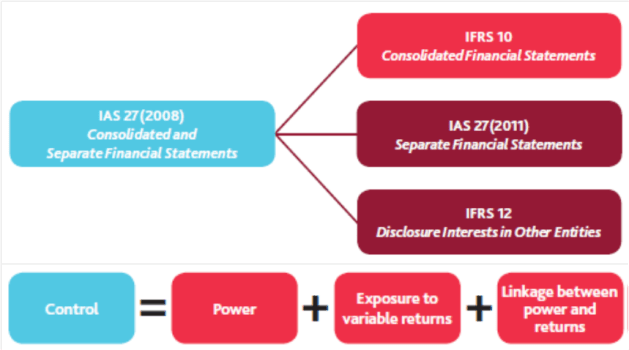
IFRS10

What are the implications of the new IFRS 10 Consolidated Financial Statements (the outgoing IAS 27), effective for annual periods beginning on or after Jan 1, 2013 but delayed in Singapore to allow more time for implementation. In Singapore, the FRS 110 will be effective for annual periods beginning on or after Jan 1, 2014. The power of control is one of the most difficult questions to answer in accounting since it involves subjective judgment, leading to diversity in practice related to consolidation. What is the impact on family business groups such as Jindal, Jaypee/Jaiprakash, Essar, Adani, JSW, GMR, Lanco, Videocon, and GVK? Or the chaebols in Korea such as Doosan, Dongbu, Hanjin and Kolon? Or to the REIT/real estate/construction industry and shipping industry? Yet, all these accounting standard changes are not impactful if the auditors are not held accountable for any material misstatements and fraud revelation. Hence the importance of the mockingjay symbolized by the court ruling case for delisted Kosdaq tech firm Forhuman last week. The auditors are now in the fire. What are the 4 key Bamboo Innovator takeaways?