After years in shadows, online gambling in US picks up speed

After years in shadows, online gambling in US picks up speed

By Rob Lever, AFP
November 18, 2013, 12:08 am TWN

WASHINGTON–Internet gambling is on a roll in the U.S. market after years lurking in the shadows. New Jersey kicks off its online wagering Nov. 26, becoming the most populous state to do so after Nevada and Delaware. Other states have become active since 2011, when the federal government signaled it would not block most forms of Internet wagering. California, Illinois and Pennsylvania are considering such moves. Read more of this post

Yeo’s Lures Suitors Seeing to Win Over Owners: Real M&A

Yeo’s Lures Suitors Seeing to Win Over Owners: Real M&A

Yeo Hiap Seng Ltd. (YHS) would be among the most alluring targets in Asia’s booming drinks market if it weren’t for the Singaporean company’s controlling family. With a factory in China and sites planned for Cambodia and Indonesia, Yeo’s offers acquirers a ready-made distribution network, said CMC Markets. The $1.18 billion seller of soy milk and chilled melon tea has more than doubled its profit in two years, and rivals such as Suntory Beverage & Food Ltd. (2587) are seeking food and drinks assets in emerging markets. Read more of this post

The isotonic drink 100Plus was the first to be formulated and launched in Malaysia as a sports drink under the F&N Group in 1983

Updated: Saturday November 16, 2013 MYT 1:42:46 PM

F&N, already famous brand not resting on its laurels

BY JOY LEE
PHOTOS BY BRIAN MOH

The isotonic drink 100Plus is a brand not unknown to many. The drink was the first to be formulated and launched in Malaysia as a sports drink under the F&N Group in 1983. And Khalid Alvi, managing director of F&N Beverages Marketing Sdn Bhd believes that 100Plus continues to enjoy a loyal and significant following among Malaysians. Read more of this post

Increase transparency in property prices; Companies factor in sales gimmick freebies into the cost of the property

Updated: Saturday November 16, 2013 MYT 9:00:04 AM

Increase transparency in prices

BY CHANG KIM L OONG

Companies factor in freebies into the cost of the property

DEVELOPERS often offer sales gimmicks and marketing ploys like free legal fees, rebates, air-conditioners and furniture. Budget 2014, however, seems to make it a requirement that developers be transparent about their property prices. Read more of this post

London Lures Billionaires as Mansions Seen as Safe Haven

London Lures Billionaires as Mansions Seen as Safe Haven

“We’ve had offers of around 25 million pounds, but they aren’t quite high enough,” says Noel de Keyzer, a veteran broker for Savills Plc (SVS), a London-based real estate agency. We are standing in a surprisingly sunlit subterranean family room beneath the garden of 29 Brompton Square in Knightsbridge, on the market for 27.5 million pounds ($44.3 million). Damien Hirst butterfly prints hang on the earth-tone walls of the recently renovated, fully furnished 1820s house. Read more of this post

Young and Educated in Europe, but Desperate for Jobs; “But that doesn’t stop the feelings of guilt. On the bad days, it’s really hard to get out of bed. I ask myself, ‘What did I do wrong?’”

November 15, 2013

Young and Educated in Europe, but Desperate for Jobs

By LIZ ALDERMAN

MADRID — Alba Méndez, a 24-year-old with a master’s degree in sociology, sprang out of bed nervously one recent morning, carefully put on makeup and styled her hair. Her thin hands trembled as she clutched her résumé on her way out of the tiny room where a friend allows her to stay rent free. She had an interview that day for a job at a supermarket. It was nothing like the kind of professional career she thought she would have after finishing her education. But it was a rare flicker of opportunity after a series of temporary positions, applications that went nowhere and employers who increasingly demanded that young people work long, unpaid stretches just to be considered for something permanent. Read more of this post

Why should Britain build new towns when it already has great cities? Awarding prizes for the urbanisation of the countryside makes no sense while existing cities are given Cinderella status

Why should Britain build new towns when it already has great cities?

Awarding prizes for the urbanisation of the countryside makes no sense while existing cities are given Cinderella status

Simon Jenkins

The Guardian, Thursday 14 November 2013 20.31 GMT

I still wake at night sweating over the time at school when I came bottom in art. The teacher felt he should embrace town planning and told the class to design a city. We were each given a large sheet of paper with a wavy line across it for a river. We were issued with rulers, compasses and set squares. I was nonplussed. Others were beavering away with grids and circles while I gazed at the paper in despair. I saw no city. At last I doodled some roads wandering away from the river. I drew bridges and spattered the page with random lanes, streets, squares and factories. The teacher looked over my shoulder and was appalled. “You have simply drawn London,” he said. He tore up my masterpiece and put me bottom of the class. He apparently expected me to design Brasília, or at least Crawleynew town. I was mortified. Read more of this post

What Yellen Didn’t Tell Congress And Why It Matters

What Yellen Didn’t Tell Congress And Why It Matters

ALISTER BULL, REUTERS NOV. 17, 2013, 8:05 AM 1,195 3

WASHINGTON (Reuters) – The most revealing thing about Janet Yellen’s widely praised Senate confirmation hearing performance last week might not have been what she said, but what she didn’t say – and how she didn’t say it. President Barack Obama’s nominee to be the next chair of the Federal Reserve smiled and nodded her way through a two-hour hearing on Thursday without giving the Senate Banking Committee any real clues as to how she views near-term monetary policy choices. Read more of this post

What the financial media don’t want you to know: the myth of the merger scoop

What the financial media don’t want you to know: the myth of the merger scoop

By John McDuling @jmcduling November 15, 2013

screen-shot-2013-11-14-at-5-58-53-pm

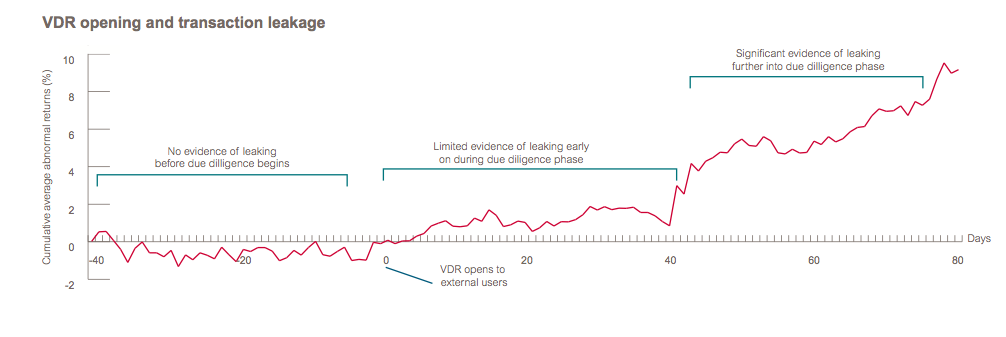
The “merger scoop” has been a staple of financial journalism for decades. Careers, and even entire business models, have been built around being the first to report that Company Y is buying Company Z. But there is an alternate view that deals scoops are far from the pieces of hard-hitting, journalistic brilliance they are often portrayed to be: In fact they are almost always the result of strategically calibrated leaks in the endgame of a given deal. Read more of this post

Rate rise set to put stake through heart of zombie companies

November 14, 2013 6:10 pm

Rate rise set to put stake through heart of zombie companies

By Brian Groom, Business and Employment Editor

Stores Unlimited, not its real name, looked a classic “zombie company” – a topic back in the news as the prospect of higher interest rates means more struggling businesses face insolvency. Four years ago, the southeast England retailer, with a turnover of £30m, was losing £2m a year and barely generating enough cash to pay the interest on its £10m debt. In previous recessions “it would have been curtains”, said the turnround professional sent in to rescue it. Read more of this post

Markets are betting QE cannot last much longer

November 15, 2013 11:29 am

Markets are betting QE cannot last much longer

John Authers

Cracking the code of the new Federal Reserve chief will be key

Ultimately, the Federal Reserve will remove its extreme policies of monetary stimulus, because ultimately the US economy will stage a recovery. And ultimately, the remarkable onward march of the US stock market will be thwarted and go into reverse. The problem is to work out what “ultimately” means, and exactly when these things will happen. Read more of this post

Italy’s luxury property sector proves beacon of hope in recession

November 15, 2013 1:39 pm

Italy’s luxury property sector proves beacon of hope in recession

By Guy Dinmore and Giulia Segreti in Rome

An imposing bronze statue of a gladiator armed with trident and net overlooks the lobby paved with delicate yellow Siena marble illuminated by Murano crystal chandeliers from Venice. There is no mistaking the Italian character of the Regina Baglioni in Rome’s renowned Via Veneto, but its new owner is the ruling family of Qatar, which bought the five-star hotel through its Mayhoola for Investments fund after acquiring Italian designer Valentino last year for a reported $850m. Read more of this post

It’s Fed Versus Moody’s for ‘Most Wrong’ Crown

It’s Fed Versus Moody’s for ‘Most Wrong’ Crown

Who was more wrong in the run-up to the financial crisis of 2008: the Federal Reserve or Moody’s Investors Service? This isn’t an academic question; both organizations are still hugely relevant to shaping the way we see our financial system and the risks it contains. And both are now apparently underestimating the dangers again. To be fair, the thinking at both places has shifted, but not anywhere close to enough. The reason for this is simple: The incentives that encouraged their misperceptions before 2008 remain in place today. Read more of this post

El-Erian: Have we overestimated the power of the central banks?

Have we overestimated the power of the central banks?

Governments that once resented central banks’ power are now happy to have them compensate for their own economic-governance shortfalls

Mohamed El-Erian

theguardian.com, Wednesday 13 November 2013 15.29 GMT

History is full of people and institutions that rose to positions of supremacy only to come crashing down. In most cases, hubris – a sense of invincibility fed by uncontested power – was their undoing. In other cases, however, both the rise and the fall stemmed more from the unwarranted expectations of those around them. Read more of this post

Forget data and rhetoric, Fed liquidity’s the only show in town

Forget data and rhetoric, Fed liquidity’s the only show in town

8:27am EST

By Jamie McGeever

LONDON (Reuters) – For all the fevered speculation about when the Federal Reserve will begin scaling back its monetary stimulus, market volatility has been taking a leisurely nap, suggesting investors see no major shocks on the horizon to derail their bets. Low market volatility is a sign markets expect no “taper” any time soon, or that they are steeled for a reduction in the pace of the Fed’s bond-buying if it comes. Read more of this post

Fair value lessons from ‘London whale’; Regulators determined to safeguard investors’ interests as valuation models vary

November 15, 2013 11:24 am

Comment: Fair value lessons from ‘London whale’

By Mark Hepsworth

Regulators determined to safeguard investors’ interests as valuation models vary

The US justice department’s civil and criminal charges against two traders at JPMorgan in connection with the so-called “London whale” trading losses have kept the methods employed by banks and investors for valuing complex securities in the spotlight. Valuing a bond or a derivative can be challenging for a variety of reasons. Foremost among them is that a large portion of these instruments do not trade frequently, if at all, in over-the-counter markets. Read more of this post

Dubai Expat Rents Exceed Pay Hitting Competitiveness

Dubai Expat Rents Exceed Pay Hitting Competitiveness

Sarah El-Said is relocating for the fourth time since coming to Dubai from New Jersey in 2008. The mother of two and her husband will pay 43 percent more for a similar-sized apartment, moving their children away from friends after disagreeing with their landlord over terms of a new lease. “This is insane,” said El-Said, who pays 8,750 dirhams ($2,400) per month for an apartment on the Palm Jumeirah manmade island. “It’s like you have to move house every two years. You feel no stability in where you live and you’re always at the mercy of landlords whose sole interest is making more money.” Read more of this post

Caught in Unemployment’s Revolving Door; Some economists fear that the long-term unemployment crisis affecting millions of Americans might be a permanent change, with far-reaching and damaging consequences

November 16, 2013

Caught in Unemployment’s Revolving Door

By ANNIE LOWREY

On a cold October morning, just after the federal government shutdown came to an end, Jenner Barrington-Ward headed into court in Boston to declare bankruptcy. It took weeks to put the paperwork together, given that her papers and belongings were scattered across the country — there was a broken-down car and boxes of paperwork in Virginia Beach, clothes in Colorado and personal possessions at a friend’s house in Somerville, Mass. She managed to estimate her income — maybe $5,000 last year, but maybe half that this year — from odd jobs. Soon, she would officially have nothing. Read more of this post

Buying Low Thwarted by Narrowest Stock Valuation Gap Ever

Buying Low Thwarted by Narrowest Stock Valuation Gap Ever

Cheap is converging with expensive in the American equity market, narrowing options for investors looking for bargains after the broadest rally on record lifted almost 90 percent of the Standard & Poor’s 500 Index this year. The difference in valuations shrank to the smallest since at least 1990 after companies such as Hormel Foods Corp. and CenterPoint Energy Inc. rose to levels that match Ralph Lauren Corp. and Citrix Systems Inc., whose five-year average profit growth rate is twice as big. A measure of the dispersion of price-earnings ratios in the S&P 500 compiled by Goldman Sachs Group Inc. narrowed to 41 percent in June, the lowest on record, and held around that level since. Read more of this post

Bond Investors Should Brace for Higher Rates

Bond Investors Should Brace for Higher Rates

Rise Will Likely Be More Gradual Than Last Summer’s

TOM LAURICELLA

Nov. 16, 2013 8:32 p.m. ET

SJ-AG911_LEDE_G_20131115154804

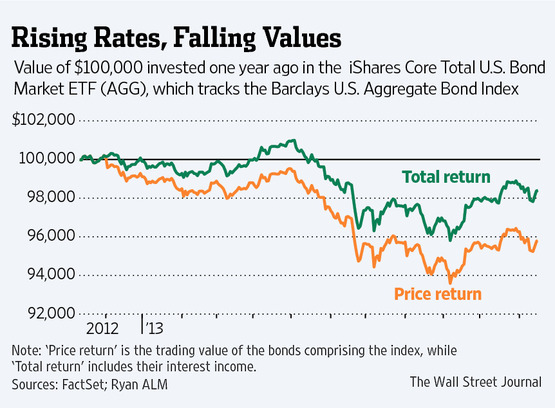
After a sharp selloff hit the bond market earlier this year, investors have gotten a reprieve: The Barclays BARC.LN -0.22% Capital U.S. Aggregate Bond Index, a widely watched benchmark tracking total returns on government and corporate bonds, was down as much as 3.9% for the year at the start of September. As of last week, it was down only 1.8%. But bond-fund managers warn that investors should brace for a resumed rise in interest rates—and the potential for more losses—over the coming year. Read more of this post

Andy Kessler: Private Startups, Where Investor Dollars Often Go to Die; Now anyone can join the crowd to fund startups—but most are crapshoots. Trust me, I know

Andy Kessler: Private Startups, Where Investor Dollars Often Go to Die

Now anyone can join the crowd to fund startups—but most are crapshoots. Trust me, I know.

ANDY KESSLER

Updated Nov. 15, 2013 6:57 p.m. ET

When President Obama signed the Jumpstart Our Business Startups Act in April 2012, he hailed it as “exactly the kind of bipartisan action we should be taking in Washington to help our economy.” Well, maybe. Some JOBS Act provisions kicked in right away. “Emerging growth companies”—those with under $1 billion in revenues—are exempt from many reporting provisions of Sarbannes-Oxley. And so Twitter, TWTR -1.59% for example, only had to show two years of audited results (instead of three) in its IPO filing. And private companies can now have 2,000 investors, up from 500, before they have to file annual reports with the Securities and Exchange Commission. Less information is never better. Read more of this post

Aluminium traders accused over Bahrain fraud

Last updated: November 15, 2013 9:42 pm

Aluminium traders accused over Bahrain fraud

By Caroline Binham, Legal Correspondent

Aluminium traders from Glencore, Mitsui and Sojitz made payments to one of Bahrain’s most senior royals who is at the centre of a high-profile corruption trial, a London court heard. Sheikh Isa bin Ali al-Khalifa, the former chairman of Alba, Bahrain’s state-run aluminium producer, and who was also the minister of finance and close to the Gulf state’s influential prime minister, ordered the system as a way “to control the flow of money” to and from Alba, a jury heard on Friday amid the trial of Victor Dahdaleh, a “power broker” accused of creaming 10 per cent off contracts that he negotiated. Read more of this post

Collaboration, Stars, and the Changing Organization of Science: Evidence from Evolutionary Biology

Collaboration, Stars, and the Changing Organization of Science: Evidence from Evolutionary Biology

Ajay Agrawal, John McHale, Alexander Oettl

NBER Working Paper No. 19653
Issued in November 2013

We report a puzzling pair of facts concerning the organization of science. The concentration of research output is declining at the department level but increasing at the individual level. For example, in evolutionary biology, over the period 1980 to 2000, the fraction of citation-weighted publications produced by the top 20% of departments falls from approximately 75% to 60% but over the same period rises for the top 20% of individual scientists from 70% to 80%. We speculate that this may be due to changing patterns of collaboration, perhaps caused by the rising burden of knowledge and the falling cost of communication, both of which increase the returns to collaboration. Indeed, we report evidence that the propensity to collaborate is rising over time. Furthermore, the nature of collaboration is also changing. For example, the geographic distance as well as the difference in institution rank between collaborators is increasing over time. Moreover, the relative size of the pool of potential distant collaborators for star versus non-star scientists is rising over time. We develop a simple model based on star advantage in terms of the opportunities for collaboration that provides a unified explanation for these facts. Finally, considering the effect of individual location decisions of stars on the overall distribution of human capital, we speculate on the efficiency of the emerging distribution of scientific activity, given the localized externalities generated by stars on the one hand and the increasing returns to distant collaboration on the other.

The Economics of China: Successes and Challenges

The Economics of China: Successes and Challenges

Shenggen Fan, Ravi Kanbur, Shang-Jin Wei, Xiaobo Zhang

NBER Working Paper No. 19648
Issued in November 2013

This paper is the first chapter in the Oxford Companion to the Economics of China (Oxford University Press, forthcoming). Rather than trying to summarize other contributors’ views, we provide our own perspectives on the Economics of China—the past experience and the future prospects. Our reading of China’s economic development over the past 35 years raises two major sets of issues, one of which is inward looking, and the other of which is outward looking. While Chinese aggregate development is impressive, it has raised the question of whether the growth is sustainable, and has led to a set of distributional issues and well-being concerns. We argue that these internal issues combine with those raised by China’s rapid integration and ever growing presence in the international arena, to jointly frame the challenges faced by China in the next 35 years, as it approaches the 100th anniversary of the People’s Republic in 2049.

Don’t ignore Myanmar politics, Suu Kyi tells EU investors as it heads towards crucial 2015 elections

Don’t ignore Myanmar politics, Suu Kyi tells EU investors

Thursday, November 14, 2013 – 21:43

AFP

YANGON – Myanmar opposition leader Aung San Suu Kyi told investors at a European Union forum Thursday that business leaders should not ignore the country’s political challenges as it heads towards crucial 2015 elections. The veteran activist, who rejected suggestions that her party would slow economic progress if it came to power, said constitutional change was imperative for the economic development of the nation, seen as a key regional developing market. “Anybody who encourages business or investment or any other activity in Burma while at the same time totally ignoring the need to amend the constitution is not being pragmatic,” she said, using the country’s former name. Read more of this post

Is This a Bubble? As stocks Hit Records, Some Analysts and Economists Are Getting Worried. Here’s What to Do Now

Is This a Bubble?

As stocks Hit Records, Some Analysts and Economists Are Getting Worried. Here’s What to Do Now.

JOE LIGHT

Nov. 15, 2013 5:59 p.m. ET

BF-AG189D_16WIc_G_20131115192321 BF-AG207_BUBBLE_G_20131115154504 BF-AG208A_BUBBL_G_20131115154203

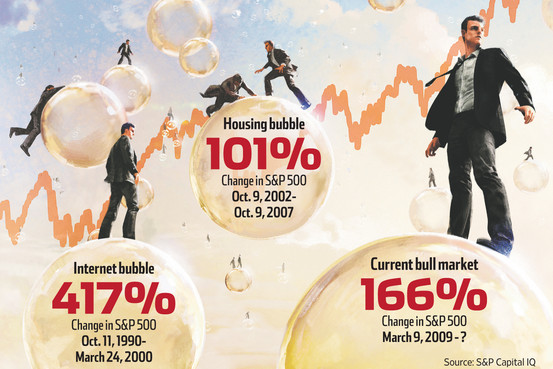
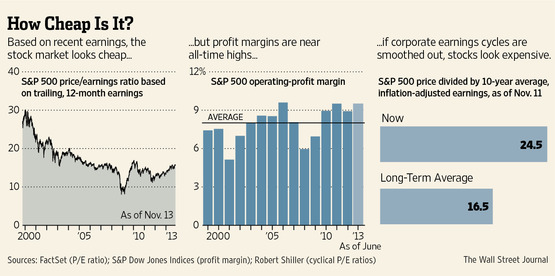
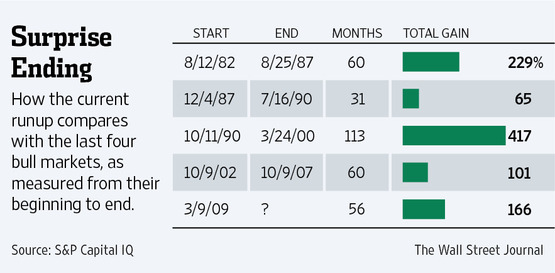
At first, it sure looks like a bubble. Some hot stocks have more than doubled in price so far this year. The initial-public-offering market has been torrid. Small investors are buying stocks again. The “bubble talk” flared up even more afterTwitter TWTR -1.59% started trading on Nov. 7, when the social-media company’s shares surged 73%. They still are up 69%. Electric-car company Tesla MotorsTSLA -1.56% has rocketed 300% higher in 2013, and online retailing giant Amazon.comAMZN +0.48% has jumped 47%. There are so many superlatives in the stock market that it is easy to forget the S&P 500 has set 36 records this year on the way to its 26% gain—or that the federal debt-ceiling crisis threatened to disrupt the economy just a month ago. During the U.S. Senate confirmation hearing Thursday for Janet Yellen, the nominee to replace Ben Bernanke as head of the Federal Reserve, Sen. Mike Johanns (R., Neb.) said he thinks the Fed’s loose monetary policy is pumping up the stock and real-estate markets. “What am I missing here?” he said. “I see asset bubbles.” Ms. Yellen responded, “We have to watch this very carefully, but I don’t see this as an asset bubble.” Read more of this post

Tuition madness, Gangnam style

Tuition madness, Gangnam style

Last month, TODAY reported that the Ministry of Education was reviewing its policy of allowing teachers to give private tuition, as calls grew for the policy to be tightened or scrapped completely. Over the years, there have been perennial calls among the public for the authorities to do more to regulate the tuition sector, which some feared had got out of hand.

BY NG JING YNG –

4 HOURS 49 MIN AGO

16733176

Last month, TODAY reported that the Ministry of Education was reviewing its policy of allowing teachers to give private tuition, as calls grew for the policy to be tightened or scrapped completely. Over the years, there have been perennial calls among the public for the authorities to do more to regulate the tuition sector, which some feared had got out of hand. In South Korea, where the tuition craze has reached fever pitch, the government has tried to regulate the industry — to mixed success — such as introducing a curfew on the operating hours of tuition centres and considering a ban against tutors teaching students what they have yet to learn in school. In the first instalment of a two-part special report, TODAY examines the situation in South Korea’s capital Seoul, including in the affluent Gangnam district, and the factors driving the high demand for tuition. The second part on Monday will look at how the government and some groups in South Korean society, including school leaders, parents and a former “star” tutor, are trying to do more to fight against the tide and wean children off tuition.

SEOUL — On a Thursday evening last month, this reporter was at one of the popular tuition-centre zones, Daechi-dong, in Gangnam district. With just weeks to go before the high-stakes college-entrance exams, which are held every November, the streets were quiet, in contrast to the intense activity taking place behind closed doors. Read more of this post
The World of English Freedoms; It’s no accident that the English-speaking nations are the ones most devoted to law and individual rights

The World of English Freedoms

It’s no accident that the English-speaking nations are the ones most devoted to law and individual rights, writes Daniel Hannan

DANIEL HANNAN

Nov. 15, 2013 6:17 p.m. ET

Asked, early in his presidency, whether he believed in American exceptionalism, Barack Obama gave a telling reply. “I believe in American exceptionalism, just as I suspect the Brits believe in British exceptionalism and the Greeks believe in Greek exceptionalism.” The first part of that answer is fascinating (we’ll come back to the Greeks in a bit). Most Brits do indeed believe in British exceptionalism. But here’s the thing: They define it in almost exactly the same way that Americans do. British exceptionalism, like its American cousin, has traditionally been held to reside in a series of values and institutions: personal liberty, free contract, jury trials, uncensored newspapers, regular elections, habeas corpus, open competition, secure property, religious pluralism. Read more of this post

Hong Kong Property Still in Danger of Overheating, HKMA Says, and a rise in interest rates would “indisputably” affect the city

Hong Kong Property Still in Danger of Overheating, HKMA Says

Hong Kong’s property market is still in danger of overheating and a rise in interest rates would “indisputably” affect the city, Norman Chan, chief executive of the Hong Kong Monetary Authority said today. The outlook for Hong Kong’s property market was uncertain and it wasn’t clear whether it had entered a downward cycle, Chan said at a legislative briefing. Emerging markets would face the risk of capital outflow, currency depreciation and a decline of asset prices once the U.S. Federal Reserve starts tapering stimulus, he said. Read more of this post

Playing China’s Investing Frontier; The move by China to open its local stock markets is triggering a new wave of ETFs

Playing China’s Investing Frontier

The move by China to open its local stock markets is triggering a new wave of ETFs.

MURRAY COLEMAN

Nov. 15, 2013 6:28 p.m. ET

The $1.2 trillion stock market in mainland China—home to the world’s second-largest economy—is opening up even more to foreign investors, but hazards still abound. The Deutsche Bank‘s DBK.XE -0.35% db X-trackers Harvest CSI 300 Index ETF,ASHR +4.36% the first U.S.-listed exchange-traded fund to invest directly in China’s A-shares, began trading on the New York Stock Exchange on Nov. 6. A-shares, which trade on the Shanghai and Shenzhen exchanges, have been largely closed off to foreign investors. Read more of this post