Filming Oshin made me think of mom

Filming Oshin made me think of mom

oshin-goldenvillage

Wednesday, October 23, 2013 – 08:54

My Paper

Child actress Kokone Hamada was selected from among 2,500 hopefuls who auditioned for the role of Oshin Tanimura in Oshin, a film remake of a popular Japanese drama from the 1980s. In an interview with Encore Films, the nine-year-old reveals how it was like to be separated from her family for 52 days of filming.

What were the most difficult moments during filming?

It was during the scene where I had to run and fall in the snow, with strong wind blowing. I was covered in snow and it was freezing to the extent that I couldn’t feel my body. It was so cold and painful that I cried. (But) the separation scene (between Oshin and her family) was definitely the most difficult scene to shoot.

Did filming the scenes with Oshin’s mother, Fuji (Aya Ueto), make you think of your own mother?

There were a lot of times it happened. The scene where Oshin was on a raft, being separated from her parents, and when her mother visited Kagaya Mansion (where Oshin worked). Also, the scene where her mother entered the river reminded me of the time when I had to say goodbye to my own mother at Haneda airport. I was really sad. Read more of this post
The fraud detective: Jim Chanos saw through Enron, Tyco, and the subprime mortgage mess. And made money on them

The fraud detective

Jim Chanos saw through Enron, Tyco, and the subprime mortgage mess. And made money on them.

By Richard Conniff | Sep/Oct 2013

On a muggy Thursday in the dog days of August 2011, the news broke that the American technology giant Hewlett-Packard was about to acquire British software maker Autonomy Corp. The offer price represented a 64 percent premium on the previous day’s close. At his office in mid-Manhattan, hedge fund manager Jim Chanos ’80 did not rejoice. Only a few weeks earlier, his firm, Kynikos Associates, had put together a report on Autonomy, calling its chief operating officer unqualified, its customers unenthusiastic, its market share and growth numbers questionable, its financial disclosures “very poor,” and its margin profile “suspiciously high.” Read more of this post

World’s greatest GIF-maker works 100 hours a week in job that goes on and on and on

World’s greatest GIF-maker works 100 hours a week in job that goes on and on and on

October 23, 2013 – 1:14PM

Sarah Lyall

art-gif2-620x349

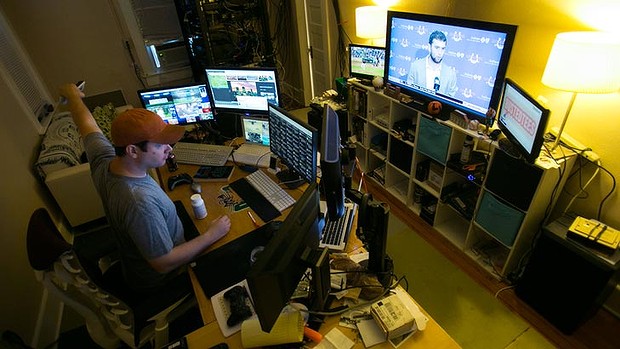
“I’m very committed to this, but also I’m always in the house … I am not able to do many other things”: Tim Burke can record from 28 sources at once. Photo: Will Vragovic/The New York Times

At 2:44 pm on a recent Sunday, Tim Burke took a moment from monitoring several NFL games for the sports website Deadspin to post something that had nothing to do with football: a smidgen of a clip from an English rugby match he also happened to be following. He stitched together still-frame images captured from the broadcast into a short, continuous loop that showed a player built like a cement mixer strong-arming an opponent to the ground by the unfortunate man’s throat. The GIF, or Graphics Interchange Format, showed a vivid moment, the kind that has become standard currency for online sports journalism. That Burke had time to produce a GIF reflects the vacuum-cleaner-like way he approaches his job. The sports editor over at the website Buzzfeed, Ben Mathis-Lilley, could only observe in awe. Read more of this post

China Tries to Clean Up Toxic Legacy of Its Rare Earth Riches

October 22, 2013

China Tries to Clean Up Toxic Legacy of Its Rare Earth Riches

By KEITH BRADSHER

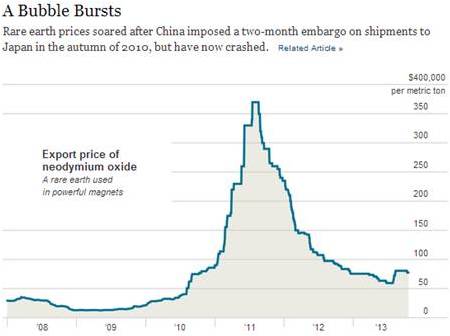
Rare earth bubble

TIANJIN, China — In northern China, near the Mongolian border, radioactively contaminated leaks from two decades of rare earth refining have been slowly trickling underground toward the Yellow River, a crucial water source for 150 million people. In Jiangxi province in south-central China, the national government has seized control of rare earth mining districts from provincial officials after finding widespread illegal strip-mining of rare earth metals. And in Guangdong province in southeastern China, regulators are struggling to repair rice fields and streams destroyed by powerful acids and other runoff from open-pit rare earth mines that are often run by violent organized crime syndicates. Read more of this post

The Shanghai Secret: How these schools in China made it to No. 1 in the world

October 22, 2013

The Shanghai Secret

By THOMAS L. FRIEDMAN

SHANGHAI — Whenever I visit China, I am struck by the sharply divergent predictions of its future one hears. Lately, a number of global investors have been “shorting” China, betting that someday soon its powerful economic engine will sputter, as the real estate boom here turns to a bust. Frankly, if I were shorting China today, it would not be because of the real estate bubble, but because of the pollution bubble that is increasingly enveloping some of its biggest cities. Optimists take another view: that, buckle in, China is just getting started, and that what we’re now about to see is the payoff from China’s 30 years of investment in infrastructure and education. I’m not a gambler, so I’ll just watch this from the sidelines. But if you’re looking for evidence as to why the optimistic bet isn’t totally crazy, you might want to visit a Shanghai elementary school. Read more of this post

Breaking up the bamboo ceiling: Making Asian-background Australians less invisible in business

Fiona Smith Columnist

Breaking up the bamboo ceiling: Making Asian-background Australians less invisible in business

Published 23 October 2013 07:15, Updated 23 October 2013 08:39

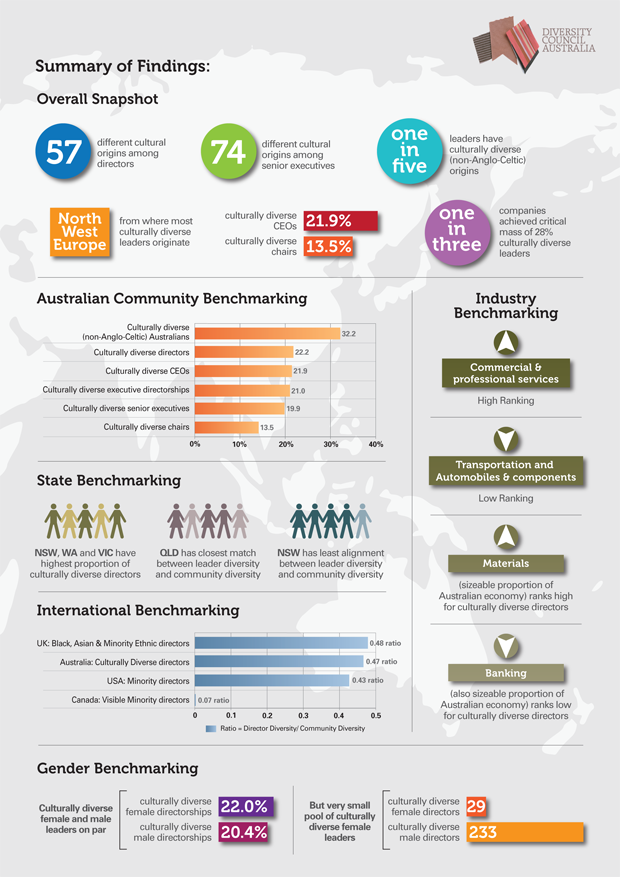
The director of a household-name company was pleased with himself as he expanded on the promotion of business leaders with an Asian background. “We’ve got one banana and three eggs on our board,” he informed BRW. What he meant was that there is one director with Asian heritage, who has spent much of their career working for Western organisations, and three Anglo-Australians accustomed to dealing with Asian businesses and state-owned enterprises. Despite the lack of political correctness in the delivery, at least this director was conscious of the benefits of capitalising on the talents and experience of Asian-Australians. The CEO of Diversity Council Australia (DCA), Nareen Young, says employers are starting to have conversations about the “bamboo ceiling” – the Asian equivalent of the invisible glass ceiling that has kept women out of positions of power for so long.

6da1435a-3b56-11e3-85ad-f423b978d243_DCA Capitalising on Culture Summary HR Read more of this post

China Intensifies Crackdown on Bond Market

China Intensifies Crackdown on Bond Market

10-22 14:32 Caijing

The long-term solution will be to reduce regulatory arbitrage by ending market segmentation and the current three-rail regulatory system.

By staff reporter Wang Xiaolu

A crackdown on bond market irregularities, triggered by a case involving a high-level Finance Ministry official in 2010, has been intensifying as of late. Heads of fixed income departments in several banks, brokerages, and fund companies have been investigated since March. As part of the latest development, Guosen Securities stated Oct. 11 that Sun Mingxia, head of the company’s fixed income unit, and other two executives at the unit were being investigated by the public security authorities. Read more of this post

Will history repeat itself at KT? Prosecutors raided KT’s head office and its chief Nam Joong-soo’s residence as part of an investigation into bribery allegations involving the telecom operator

2013-10-22 18:26

Will history repeat itself at KT?

Kim Tae-gyu
On Oct. 16, 2008, prosecutors raided KT’s head office in Bundang, Gyeonggi Province and its chief Nam Joong-soo’s residence as part of an investigation into bribery allegations involving the telecom operator and its affiliates. It took less than a month for Nam to resign ― he stepped down on Nov. 5 after a court issued an arrest warrant for him on charges of accepting 300 million won ($260,000) in bribes from subsidiaries and contractors. New CEO Lee Suk-chae filled the vacancy on Jan. 14, 2009, igniting controversy that all prior moves were politically motivated after the launch of the Lee Myung-bak administration in February 2008. Read more of this post

Edison’s revenge: The humble USB cable is part of an electrical revolution. It will make power supplies greener and cheaper

Edison’s revenge: The humble USB cable is part of an electrical revolution. It will make power supplies greener and cheaper

Oct 19th 2013 |From the print edition

FIDDLY cables, incompatible plugs and sockets, and the many adaptors needed to fit them all together used to be the travellers’ bane. But the USB (Universal Serial Bus) has simplified their life. Most phones and other small gadgets can charge from a simple USB cable plugged into a computer or an adaptor. Some 10 billion of them are already in use. Hotel rooms, aircraft seats, cars and new buildings increasingly come with USB sockets as a standard electrical fitting. Read more of this post

The Value Of Apple Weirdly Mirrors The Market For Smartphones As A Whole

The Value Of Apple Weirdly Mirrors The Market For Smartphones As A Whole

JIM EDWARDS OCT. 22, 2013, 4:24 PM 1,469 2

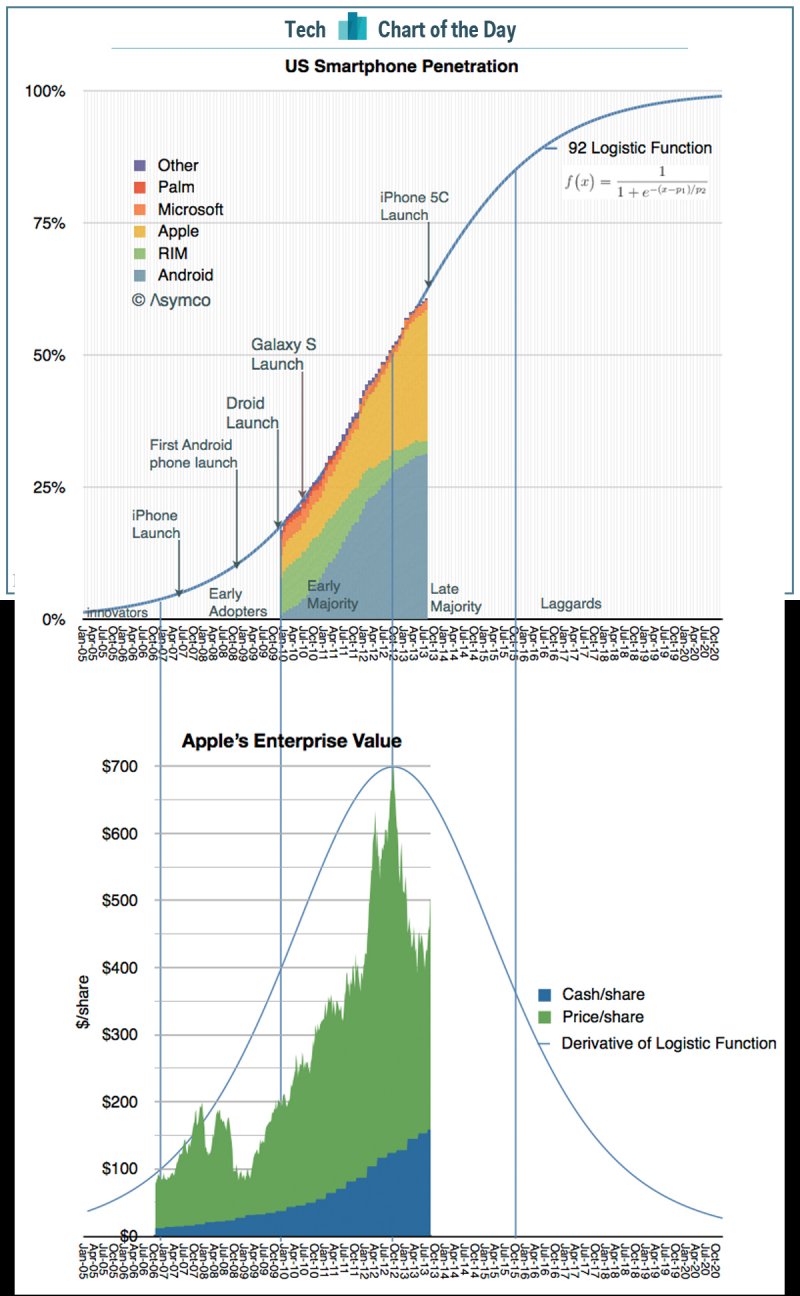
The enterprise value of Apple over the years mirrors the market for smartphones generally, according to an analysis on the Asymco blog. (Enterprise value is a way of measuring the total value of a company based on its market cap, debt and cash.) The Asymco folks suggest that, somehow, Apple is a proxy for the smartphone market as a whole, even though it doesn’t dominate market share. Here’s the chart:

tech_cotd-chart of the day

Apple Targets Microsoft Office With Free Apps; Apple Exploits Microsoft Hesitation on Office

October 22, 2013

Apple Targets Microsoft Office With Free Apps

By BRIAN X. CHEN

SAN FRANCISCO — At an event meant to feature its latest iPad tablet computing devices, Apple on Tuesday took aim at one of the biggest and seemingly unassailable businesses of its rival Microsoft, its Office software for tasks like word processing and spreadsheets. Apple said iWork, a set of applications for Macs, iPads and iPhones that essentially duplicates what Microsoft’s Office offers customers, would be free to anyone who bought a new Macintosh computer or mobile device from Apple. Each Apple app used to cost $10 apiece.  The latest version of the Macintosh operating system, Mavericks, will also be free. Read more of this post

China’s betting big on HTML5 mobile apps. Will the US be next?

China’s betting big on HTML5 mobile apps. Will the US be next?

BY HAMISH MCKENZIE 
ON OCTOBER 22, 2013

400 million users. More than 10 percent market share in 10 countries. Market leading positions in India and China. And UC Web, the leading mobile browser in China, is betting it all on HTML5. Today, UC Web announced that Amazon is launching an app on its brower’s open platform, which acts like a de facto operating system. In UC Browser, users will be able to open the Amazon “light app” and shop on the site just as they would if they were using a native app, or visiting the website itself. While the retail giant is one of the first global brands to add an app to the platform, UC Web already has more than 1,800 app partners. Read more of this post

A recent rally in Korean stocks is prompting a number of after-hours block trades of shares

Oct 23, 2013

South Korean Share Rally Prompts Stake Sales

By Kanga Kong

A recent rally in Korean stocks is prompting a number of after-hours block trades of shares. Just a day after France’s BNP Paribas SAraised $192.4 million by selling 1% of Seoul-based Shinhan Financial Group055550.SE -2.96% in block trades, Korea Exchange Bank sold a 2.9% holding in its parent Hana Financial Group086790.SE -2.78% to raise $321 million, while Industrial Bank of Korea024110.SE -0.40% offloaded all of its 3.4% stake in Shinsegae Co.004170.SE -3.16%for $82 million, both late Tuesday, according to people familiar with the companies’ plans. Read more of this post

FSS to conduct special probe into Hyosung Group; family of chairman Cho Seok-rae borrowed money from Hyosung Capital, a financial arm of the group, under borrowed names

FSS to conduct special probe into Hyosung Group

2013.10.23 14:47:24

Hyosung Group, which was investigated by the Financial Supervisory Service (FSS) earlier this year, will be under another special probe on allegations that the family of chairman Cho Seok-rae borrowed money from Hyosung Capital, a financial arm of the group, under borrowed names. The FSS will launch a probe next month into Hyosung Capital on suspicions that chairman Cho Seok-rae’s family received several billion won loans from Hyosung Capital using borrowed names of corporate executives, according to a local news agency, Yonhap News Wednesday. Extending loans to the family of the owner did not infringe the relevant law, but FSS has apparently found some irregularities in Hyosung Capital`s loan approval procedure to the owners through its board and is considering restrictions against the group, according to the FSS’s probe on the financial unit of the group from April to May. Back then, the FSS did not investigate into whether the loans under the borrowed names were extended to the family, but this time, appointed a special prosecutor for the probe with rising suspicions. Meanwhile, Seoul Regional Tax Office filed a charge on September 30 against the conglomerate with the prosecution on allegations that the group raised slush funds by evading corporate tax through an accounting fraud worth one trillion won from 1997 and it did not pay taxes through management of borrowed-name assets.

James Packer’s Sri Lanka casino faces delay

James Packer’s Sri Lanka casino faces delay

October 23, 2013 – 4:21PM

Colin Kruger

James Packer’s plans to build a $400 million casino resort in Sri Lanka face further delays after opposition by religious leaders and politicians in Sri Lanka forced the government to alter tax concessions granted to Crown Resort’s consortium. The changes will delay the passage of legislation granting tax concessions to the project. The legislation was originally scheduled to go before parliament this week. Read more of this post

One of South Korea’s biggest gaming firms Paradise Co is building a $1.7 billion casino resort in the coastal city of Incheon to lure the rising number of Chinese gamblers flocking to the country

Paradise seeks Chinese punters with $1.7 bln Korea resort

7:01am EDT

* Paradise Co teams up with Sega Sammy for $1.7 bln South Korea casino resort

* Resort will be one of biggest in South Korea

* South Korea attracting interest of major casino operators

* Chinese tourist numbers on the rise; casino operators attract punters

HONG KONG/SEOUL, Oct 22 (Reuters) – One of South Korea’s biggest gaming firms Paradise Co Ltd is building a $1.7 billion casino resort in the coastal city of Incheon to lure the rising number of Chinese gamblers flocking to the country. Paradise, one of two companies that dominate Korea’s foreigner-only casino market, said on Tuesday it was teaming up with Japanese gaming firm Sega Sammy Holdings Inc for the project, which is scheduled to be completed in 2017 and will be located minutes away from Seoul’s international airport. Read more of this post

Rift between India’s business leaders and its government widens

October 22, 2013 2:08 pm

Rift between India’s business leaders and its government widens

By James Crabtree

Targeting of billionaire Kumar Birla in coal rights probe provokes angry reaction

Pity the titans of corporate India. Just a few years ago, the country’s leading industrialists were lauded at home and admired abroad as custodians of one of the emerging world’s most impressive growth stories. Now they stand becalmed by an economic slowdown and beset by anti-corruption investigations. Their frustration with India’s lacklustre government is clear. Many wait quietly for the saviour they hope will arrive after next year’s elections: opposition leader Narendra Modi. Read more of this post

Chinese consumers favour overseas brands in many sectors, eroding Beijing’s attempts to boost domestic profits

October 22, 2013 8:41 pm

China: Foreign values

By Paul J Davies

Consumers favour overseas brands in many sectors, eroding Beijing’s attempts to boost domestic profits

The menswear floor of the New World Department Store in central Chengdu, a city of 14m in western China, offers the kind of fast fashion you might expect to see in any second-tier city in the US or Europe. The signage on the concessions is in English but it displays unfamiliar brand names. “I’m David” sells urban casual wear, “Scofield” is meant to have a British feel, while “Mind Bridge” and “Gather Jewels” are both preppy Ivy League style. They may look the part, but these clothes struggle to compete with Uniqlo, Zara and H&M, all of which have their own stores nearby. Brands such as these illustrate the problems and opportunities facing China as it attempts to jump-start the consumer spending that will rebalance its economy away from heavy investment in factories and property. Read more of this post

A new financial reporting standard (FRS) affecting the consolidation of financial statements will become effective for annual periods beginning on or after Jan 1, 2014, the Singapore Exchange (SGX) reminded investors

PUBLISHED OCTOBER 23, 2013

SGX reminds investors of new consolidation rule

MICHELLE QUAH MICHQUAH@SPH.COM.SG

A NEW financial reporting standard (FRS) affecting the consolidation of financial statements will become effective for annual periods beginning on or after Jan 1, 2014, the Singapore Exchange (SGX) reminded investors yesterday. The new standard, FRS 110, issued by the Accounting Standards Council, could change the entities that consolidated into the group’s consolidated financial statements. “FRS 110 . . . makes control the basis for determining the entities to be included in consolidated financial statements. More entities will be included in the consolidated financial statements if the issuer is able to establish control over them,” SGX said in a mailer, sent via its investor education portal My Gateway, yesterday. “This means the assets, liabilities, income, and expenses of these ‘investees’, or subsidiaries, will be reflected in the consolidated financial statements as if they were part of the issuer group, likely affecting the final figures,” SGX’s report added. Read more of this post

Proposed changes in auditor reporting are expected to dramatically change the way external auditors reflect their opinions on companies’ financial statements

PUBLISHED OCTOBER 23, 2013

Changes ‘to add colour and insight to audit reports’

ISCA event discusses today how proposals will apply in S’pore context

MICHELLE QUAH MICHQUAH@SPH.COM.SG

Changing auditor reporting

[SINGAPORE] Proposed changes in auditor reporting are expected to dramatically change the way external auditors reflect their opinions on companies’ financial statements. Among the key proposals are the provision of more information on how audits are performed – a new section will highlight the key audit matters that came up during the audit – and the audit opinion will be placed right at the beginning of the audit report to increase its prominence. The aim is to provide greater transparency on what goes into an audit and to increase the usefulness of the audit report to users, building on the standard one-page document most audit reports are these days. Read more of this post

Brazil must embrace change to flourish; 74% of GDP growth over the past decade was due to the increase in the number of people working and only about 26% was attributable to productivity gains

October 22, 2013 10:03 pm

Brazil must embrace change to flourish

By Joseph Leahy

The Technological Park of the Federal University of Rio de Janeiro could hardly be better located, given its purpose. Set on an island in Guanabara Bay, the giant natural harbour that forms the setting for Brazil’s second-largest city, the centre has a prime vantage point looking out over the ocean and the country’s huge oil discoveries that lie beneath. These deepwater fields, called pre-salt because they are buried under a layer of sodium chloride that is up to 2km thick, are helping drive a wave of innovation in the energy sector. Read more of this post

Indonesia’s mining industry will collapse if the government moves ahead with a planned ban on the export of raw minerals, the country’s chamber of commerce has warned

October 22, 2013 5:53 pm

Indonesia mining at risk over export ban

By Ben Bland in Jakarta

Indonesia’s mining industry will collapse if the government moves ahead with a planned ban on the export of raw minerals, the country’s chamber of commerce has warned. The southeast Asian nation, which is facing strong economic headwinds, is the biggest exporter of coal for power stations, nickel ore and tin, and a leading shipper of bauxite and copper. But on January 1 it is set to implement a law prohibiting the export of unprocessed metals as part of a drive to refine the ores and potentially generate higher margins. Read more of this post

Struggling Newspapers Sell Off Old Headquarters

October 22, 2013

Struggling Newspapers Sell Off Old Headquarters

By TERRY PRISTIN

They were once major symbols of civic pride and influence, often situated in the heart of the city, and nearly equal in stature to nearby city halls, courthouses and other major public buildings. But increasingly, many of the buildings that served as newspaper headquarters in cities around the country are being put on the market, as a struggling industry searches desperately for ways to increase revenue. Read more of this post

Top China Banks Triple Debt Write-Offs as Defaults Loom

Top China Banks Triple Debt Write-Offs as Defaults Loom

China’s biggest banks tripled the amount of bad loans written off in the first half, cleaning up their books ahead of what may be a fresh wave of defaults. Industrial & Commercial Bank of China Ltd., the world’s most profitable lender, and its four largest rivals expunged in the first six months 22.1 billion yuan ($3.65 billion) of debt that couldn’t be collected, up from 7.65 billion yuan a year earlier, filings showed. That didn’t pare first-half profits, which climbed to a record $76 billion, as provisions were set aside in earlier periods when the loans began souring. Read more of this post

China’s Banks Must Compete to Survive; The explosion of debt and shadow banking may threaten the stability of China’s banking system, if it stays as is

China’s Banks Must Compete to Survive

The explosion of debt and shadow banking may threaten the stability of China’s banking system, if it stays as is.

YUKON HUANG AND CANYON BOSLERYukon Huang

Oct. 22, 2013 1:27 p.m. ET

The news leading up to China’s Third Plenum next month seems to suggest that the country is heading toward a financial cliff. The common perception is that China’s mismanaged banks are saddled with unprecedented credit driven by irresponsible local borrowing and incomprehensible shadow banking products. Over-capacity in manufacturing suggests that high investment rates cannot produce the returns needed to service these new debts. Read more of this post

Buffett Sees Zero Chance of Gates Returning as Microsoft CEO

Buffett Sees Zero Chance of Gates Returning as Microsoft CEO

Warren Buffett, the billionaire chairman of Berkshire Hathaway Inc., said Bill Gates’s focus on philanthropy makes it impossible that the Microsoft Corp. co-founder will return to the company as chief executive officer. “The chances of that are zero,” Buffett told Bloomberg Television’s Betty Liu in an interview today. “He is doing exactly what he wants to do in life, and he’s doing it well and it takes his full-time energy.” Microsoft is searching for a new CEO after Steve Ballmer said he would step down from the world’s largest software maker. Gates, 57, is chairman of Microsoft and serves on the board of Berkshire. In 2006, Buffett committed a majority of his wealth to the foundation run by Gates and his wife, Melinda. Gates is “flying around the world a very significant percentage of the time, and he is engaging governments in his efforts,” said Buffett, 83. “He has got more than a full-time job at the Gates Foundation, and obviously cares about Microsoft, but he’s not going back.” Buffett appeared today alongside his son and grandson, both named Howard, to promote a new book, “40 Chances: Finding Hope in a Hungry World.” The text describes lessons the billionaire’s son learned from his years working to improve food security around the world. The elder Buffett has also given funds to foundations overseen by his three children.

To contact the reporters on this story: Noah Buhayar in New York at nbuhayar@bloomberg.net; Zachary Tracer in New York at ztracer1@bloomberg.net

Howard Buffett Finds 40 Chances to Get Philanthropy Right

Howard Buffett Finds 40 Chances to Get Philanthropy Right

Howard G. Buffett has photographed an African warlord at close range and witnessed 50 children bound in shackles in Senegal. In Barranquilla, Colombia, he sat next to the pop star Shakira in an SUV as kids banged on the windows until their idol emerged to sign autographs. Buffett, son of the second-richest person in the U.S., could have written a vanity book to chronicle his philanthropic work battling world hunger. Instead, he offers insight, self-deprecation, solutions and heart in “Forty Chances: Finding Hope in a Hungry World.” Warren Buffett and his late first wife, Susan, gave and pledged billions to each of their three children to fund charitable foundations. Howard, an Illinois farmer, picked global hunger as his target. In the book’s foreword, the elder Buffett describes “Forty Chances” as a “guidebook for intelligent philanthropy.” It’s more than that. Howard Buffett has figured out a way to tell 40 stories about hunger, farming, poverty and war, while delivering a readable account of a formidable challenge. Philanthropists will take much from “Forty Chances,” and the layperson will benefit, too, coming away wiser about the powerful forces that keep poverty and hunger alive — and ways to fight those forces. Read more of this post

How a Radical New Teaching Method Could Unleash a Generation of Geniuses

How a Radical New Teaching Method Could Unleash a Generation of Geniuses

BY JOSHUA DAVIS

10.15.13

José Urbina López Primary School sits next to a dump just across the US border in Mexico. The school serves residents of Matamoros, a dusty, sunbaked city of 489,000 that is a flash point in the war on drugs. There are regular shoot-outs, and it’s not uncommon for locals to find bodies scattered in the street in the morning. To get to the school, students walk along a white dirt road that parallels a fetid canal. On a recent morning there was a 1940s-era tractor, a decaying boat in a ditch, and a herd of goats nibbling gray strands of grass. A cinder-block barrier separates the school from a wasteland—the far end of which is a mound of trash that grew so big, it was finally closed down. On most days, a rotten smell drifts through the cement-walled classrooms. Some people here call the school un lugar de castigo—“a place of punishment.” Read more of this post

How Our Brains Betray Us

How Our Brains Betray Us

In the wake of the financial crisis, parents, educators and even students have argued for more financial literacy courses in schools. Problem is, many studies show that financial education doesn’t make a difference because people don’t change their behavior – even if they know better. David Laibson, an economics professor at Harvard University, says understanding this anomaly could help us take charge of our financial lives.

Most Americans know they should save for retirement and pay off their debts. Yet they often don’t do those things. Why?

Our brains are responsible for good intentions not being translated into action. There’s a little tug-of-war going on in our minds. One region of the brain tells us that the right thing to do is to execute. Another brain region says to go for instant gratification. The presence of the dopamine reward system make us biased to do things we can do now. To make things that are not pleasant happen, we have to learn how to exert self-control. Read more of this post

Starbucks vs Starbung in Bangkok

Starbucks vs Starbung

starbungcks2

Tuesday, October 22, 2013 – 09:20

The New Paper

BANGKOK – On one side is a billion-dollar global coffee chain. On the other is a Bangkok street vendor, selling coffee from his cart. Starbucks, which had an annual net profit of US$1.38 billion (S$1.7 billion) last year, is suing Mr Damrong Maslae for 300,000 baht (S$12,000) for copying its famous green logo on his Starbung cart, the Bangkok Post reported. Mr Damrong sells coffee for 20-30 baht each in the Thai capital. Starbucks is also demanding a monthly payment of 30,000 baht plus legal fees, according to its Trademark Act violation complaint. Read more of this post