Uneasy Investors Sell Billions in Treasurys; Nervousness Over U.S. Debt Has Investors Unloading U.S. Bonds

Uneasy Investors Sell Billions in Treasurys

Nervousness Over U.S. Debt Has Investors Unloading U.S. Bonds

MIN ZENG

Oct. 14, 2013 8:30 p.m. ET

While leaders in Washington have been chasing a deal to avert a U.S. default, investors and banks have dumped billions of dollars in government debt. In the past two weeks, investors have sold mountains of short-term debt issued by the government. Banks have also reduced their holdings, trimming such debt by more than 50% over that period, according to data from the Federal Reserve Bank of New York. Amid anxiety about near-term finances, yields on U.S. debt that comes due in one month have risen to levels higher than for similar securities that don’t mature for six months. Typically, issuers pay more to borrow for longer periods of time. Read more of this post

Japanese Stocks Lure More Long-Term Investors

Japanese Stocks Lure More Long-Term Investors

Buying by Mutual Funds Suggests Nikkei May Have More Upside

KANA INAGAKI

Updated Oct. 14, 2013 9:46 p.m. ET

TOKYO—At the start of the year, high-profile hedge funds were piling into Japan’s stock market in search of quick, profitable bets. Now, there are growing signs that mutual funds are jumping in for the long haul. Institutional money managers, which tend to trade less actively than hedge funds, started to ramp up purchases of Japanese stocks in midsummer, after a decisive parliamentary election in July bolstered hopes that Prime Minister Shinzo Abe would be able stay in power long enough to carry out difficult structural changes to the economy, many market experts say. Read more of this post

Treasury Bill Supply at Eisenhower-Era Low Seen Bolstering Bonds

Treasury Bill Supply at Eisenhower-Era Low Seen Bolstering Bonds

Lost amid concern that the U.S. is headed toward a default is a fact that bulls say may help underpin American debt prices: supply of the shortest-term securities is shrinking. Treasury bills make up 13.2 percent of the $11.6 trillion in marketable debt outstanding, the smallest share since Dwight Eisenhower was president in the 1950s and down from 34.4 percent in 2008, according to Barclays Plc. The drop reflects efforts by the government to take advantage of record-low interest rates by selling more longer-term debt after the financial crisis, pushing the average maturity of the Treasury’s debt to 5.4 years from 4.1 years in early 2009. Read more of this post

U.S. debt ceiling crisis would start quiet, go downhill fast

U.S. debt ceiling crisis would start quiet, go downhill fast

Mon, Oct 14 2013

By Jason Lange

WASHINGTON (Reuters) – If Washington doesn’t reach a deal soon to keep paying its bills, an economic crisis could start unfolding so quietly on Thursday it will give little hint of its potential to throw millions of Americans out of work. Many people would not notice right away if the government hits a $16.7 trillion cap on its debt, which could come on Thursday. Checks would likely go out on time that day for everyone from bondholders to workers who are owed unemployment benefits, according to analysts in government and the private sector. Read more of this post

Draghi Had to Expect Calls for New Long-Term Refinancing Operation; The crisis shows that no central bank can easily escape from its unconventional monetary policies

Updated October 14, 2013, 7:45 p.m. ET

Draghi Had to Expect Calls for New Long-Term Refinancing Operation

The crisis shows that no central bank can easily escape from its unconventional monetary policies.

SIMON NIXON

Until recently, the European Central Bank could be forgiven for feeling a little smug. All of the major central banks have massively expanded their balance sheets since the start of the crisis. But while the U.S. Federal Reserve continues to accumulate assets to the tune of $85 billion a month—too nervous about the market’s reaction even to scale down its money-printing—the ECB balance sheet has been steadily shrinking. Read more of this post

Nobel Prize U.S. winner warns of ‘bubbly’ global home prices

Nobel Prize U.S. winner warns of ‘bubbly’ global home prices

Mon, Oct 14 2013

By Alister Bull and Johan Ahlander

WASHINGTON/STOCKHOLM (Reuters) – One of three American economists who won the 2013 economics Nobel prize on Monday for research into market prices and asset bubbles expressed alarm at the rapid rise in global housing prices. Robert Shiller, who shared the 8 million Swedish crown ($1.25 million) prize with fellow laureates Eugene Fama and Lars Peter Hansen, said the U.S. Federal Reserve’s economic stimulus and growing market speculation were creating a “bubbly” property boom. Read more of this post

Philippines infrastructure: taking the slow train to nowhere

Philippines infrastructure: taking the slow train to nowhere

Mon, Oct 14 2013

By Rosemarie Francisco

MANILA (Reuters) – Images of a portion of the Philippines’ oldest light rail transit line ablaze in the middle of the night were exactly what private sector bidders for a $1.4 billion rehabilitation of the country’s rail system had feared. The fire last week, caused by a short circuit that ignited power cables lining the tracks, was the second on Manila’s elevated rail system in two months and one of many mishaps in its 29-year life – telltale signs that Southeast Asia’s first light rail transit (LRT) network is in dire need of an upgrade. Read more of this post

Malaysia’s Securities Commission (SC) rules on updated list of syariah-compliant stocks may impact property stocks due to their relatively higher leverage

Updated: Tuesday October 15, 2013 MYT 9:38:40 AM

New SC rules may hit property, benefit O&G

BY INTAN FARHANA ZAINUL

slimmersyariah countersb1

PETALING JAYA: Certain stocks are expected to face more price volatility than others when the Securities Commission (SC) releases on Nov 29 the updated list of syariah-compliant stocks. Analysts believed that property counters, due to their relatively higher leverage, might take a hit from the more stringent financial rules while others such as plantation as well as oil and gas stocks would have less impact and might even benefit from the move. Read more of this post

The Long, Slow Process of IKEA Design: Company’s Commitment to Shaving Costs Makes Designing a Kitchen a Five-Year Task

The Long, Slow Process of IKEA Design

Company’s Commitment to Shaving Costs Makes Designing a Kitchen a Five-Year Task

JENS HANSEGARD

Updated Oct. 14, 2013 11:57 a.m. ET

While some car companies can design a new sedan in about three years and smartphone makers can churn out a new handset in six months, it takes IKEA half a decade to create a new kitchen. Ellen Jervell finds out why.

ÄLMHULT, Sweden—It takes car companies about three years to design a sedan, and handset makers can churn out a new smartphone in six months. But an IKEA kitchen takes half a decade to create. The Swedish company uses a painstaking development process to produce cheap and sensible home-design items, all of which have quirky names and many of which must be assembled at home from kits. IKEA’s dogged pursuit of engineering products to bring down the price is helping fuel growth in emerging markets such as China and Russia. Read more of this post

China-to-India Price Jump Risks Growth as World Outlook Dims

China-to-India Price Jump Threatens Growth as World Outlook Dims

Higher food costs from China to India are raising prices for a third of the world’s people, adding to the challenge of sustaining the global economic recovery as the growth outlook dims. Consumer prices in China rose 3.1 percent last month as food costs advanced the most since May 2012, statistics bureau figures showed today in Beijing, while India’s Commerce Ministry said inflation unexpectedly accelerated to a seven-month high. Both gauges increased more than economists had estimated. Read more of this post

Huawei Innovates With Rotating CEO System

Oct 14, 2013

Huawei Innovates With Rotating CEO System

JURO OSAWA

China’s Huawei Technologies Co. has a unique management structure that has sometimes raised questions about who makes decisions at the company. At Huawei, three senior executives — Guo Ping, Ken Hu and Eric Xu — take turns and rotate through the chief executive position, with each term for the acting CEO role six months long. The Shenzhen-based company, the world’s second-largest supplier of telecommunications network equipment, adopted the rotating CEO system in 2011. Read more of this post

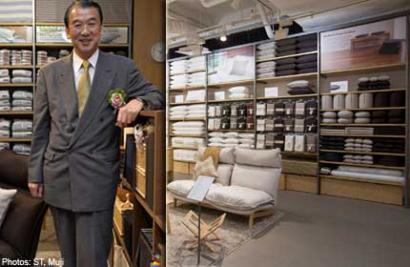
Tadamitsu Matsui, the man behind Muji’s turnaround; Employees can raise any problems they encounter, come up with solutions and tweak their copy of Mujigram. These updates are synced across all stores.

Simply Muji

st_muji_0

Sunday, Oct 13, 2013

Natasha Ann Zachariah

The Straits Times

Lifestyle brand Muji might not put its name or logo on any of its products, but it is happy to shout about their quality. During an interview with Life!, Mr Tadamitsu Matsui, chairman of Japanese retail company Ryohin Keikaku, Muji’s parent company, emphasises no fewer than 10 times that Muji is synonymous not just with minimalist design, but also well-made products. The 64-year-old, who was in town last week for the opening of the seventh Muji store here in 313@Somerset, is not just paying lip service. When he took over as president and representative director of Ryohin Keikaku in 2001, Muji was in a steep decline. It had chalked up a deficit of 3.8 billion yen the year before and was closing stores worldwide. Its stock price plunged to just one-sixth of its original price. Read more of this post

Buffett Turns to Deputies to Help Find Successors for Unit CEOs

Buffett Turns to Deputies to Help Find Successors for Unit CEOs

Warren Buffett isn’t the only chief executive officer that Berkshire Hathaway Inc. (BRK/A) shareholders have to worry about replacing. Managing CEO turnover has become more demanding with the company’s expansion. Last week the Benjamin Moore paint unit named its third chief in two years, bringing in an executive who worked before with Ted Weschler, 52, one of Buffett’s investing deputies. Read more of this post

From salaried workers to business legends to failed tycoons: Were they too arrogant or is Korea no place for self-made entrepreneurs?

2013-10-13 14:01

From salaried workers to business legends to failed tycoons

Were they too arrogant or is Korea no place for self-made entrepreneurs?

131013_a01_from01
By Kim Da-ye
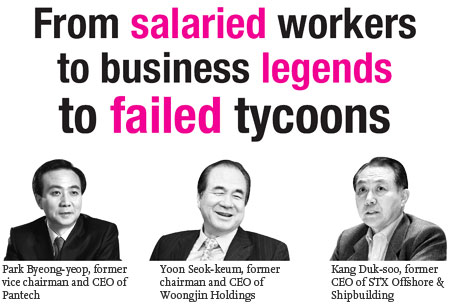
The chief executive officers who recently stepped down from the large conglomerates or corporations they had built on their own share a common background — they started their careers as salaried employees. These failed tycoons include Yoon Seok-keum of Woongjin Group, Kang Duk-soo of the shipbuilding-focused STX Group and Park Byeong-yeop of handset maker Pantech. Yoon was formerly an ace salesman at Encyclopedia Britannica. Kang’s first job was at SsangYong Cement, whose key affiliate he later acquired. Park spent his mid-late 20s at Maxon Electronics as a salesman. Read more of this post

Ray Kelvin, the founder and chief executive of Ted Baker, on how a Glasgow shirt shop has been transformed into a global fashion brand over the last 25 years

Ted Baker chief Ray Kelvin is as unique as his brand

Ray Kelvin, the founder and chief executive of Ted Baker, on how a Glasgow shirt shop has been transformed into a global fashion brand over the last 25 years.

bloomted_2226898bray-kelvin_2701232c

Ray Kelvin never shows his face in public – “I’m an ugly bugger,” he says. Ray Kelvin’s quirkiness, passion and rebellious style runs through everything that Ted Baker does Photo: Martin Pope

By Graham Ruddick

6:00AM BST 14 Oct 2013

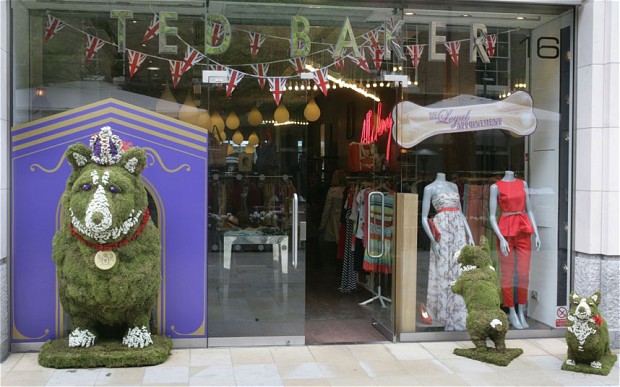
Before you meet Ray Kelvin, the founder and chief executive of Ted Baker, you already know that he is not your average FTSE boss. A bit of reading on the history of the company tells you that he never shows his face in public, he makes people who are late to meeting do press-ups, and he loves to hug people. A lot.  But after a couple of hours in his company, here are a few more things that stand out about Kelvin – he beat Andy Murray at table tennis three days after the sportsman won Wimbledon, he spends his evenings “in front of the TV farting”, and he constantly plays matchmaker in the office. Read more of this post

Asian tycoons look to spin off underperforming businesses

October 14, 2013 9:42 am

Asian tycoons look to spin off underperforming businesses

By Paul J Davies

One is a tall, suave francophone African living in London; the other a small, Octogenarian multi-billionaire from Hong Kong. They look to have little in common, but Tidjane Thiam, who runs UK-based life insurer Prudential, and Li Ka-shing, the patriarch of the Cheung Kong and Hutchison Whampoa empire, are both acting under the influence of the same number – the price to book multiple that answers the question of whether, or not, they should spin off sections of their companies. Read more of this post

Entrepreneurship and sacrifice go hand in hand

Entrepreneurship and sacrifice go hand in hand

Published: 2013/10/14

THE closing ceremony of the Global Entrepreneurship Summit 2013 (GES 2013) in Kuala Lumpur literally finished with a big bang! We hosted 4,700 delegates, we showcased exemplary young entrepreneurs, we deliberated on the many challenges faced by entrepreneurs worldwide and we announced a new initiative named “MaGIC”! The audience also witnessed the passing of the baton from Malaysia to Morocco, who will host GES 2014. As I reflect on the achievements of Malaysia as the host this year, I can’t help but try to understand the true intention of President Barack Obama when he first conceptualised the GES four years ago in Cairo. He did so because he understood that freedom of opportunity is humanity’s most powerful motivator.  Read more of this post

15,000 foreclosed properties in Wenzhou pummeling guarantee companies

15,000 foreclosed properties in Wenzhou pummeling guarantee companies

Staff Reporter

2013-10-13

Wenzhou’s banking authorities confirmed rumors of 15,000 houses in Wenzhou nearing foreclosure after surveying 42 financial institutions. It has assured the public that “the situation is under control,” though shaking guarantee companies might not second the opinion, the Shanghai-based Jiefang Daily reports. Wenzhou banks, as of the end of July, reported only 580 cases of foreclosed houses, and 2,584 houses with non-performing loans (NPLs). Of the 580 cases, 183 involved mortgages, and 397 involved mortgages with “collateral plus guarantees,” said the report. Read more of this post

Liam Casey has never read a book on China and does not speak Chinese. But the Irish entrepreneur has earned the nickname “Mr China” by creating a 5,000-employee company in Shenzhen whose customers include Apple and Beats Electronics. “There is no such thing as a ‘Mr China’ because nobody knows China,” says Mr Casey.

October 13, 2013 4:48 pm

Liam Casey: From County Cork to ‘Mr China’

By Demetri Sevastopulo

©Berton Chang

Express delivery: Liam Casey says his group can ship a Chinese product to ‘anywhere in the world in a couple of days’

Liam Casey has never read a book on China and does not speak Chinese. But the Irish entrepreneur has earned the nickname “Mr China” by creating a 5,000-employee company in Shenzhen whose customers include Apple and Beats Electronics. Sitting in his glass-walled office, the chief executive of PCH International laughs off the sobriquet given to him by the journalist James Fallows in The Atlantic magazine. “There is no such thing as a ‘Mr China’ because nobody knows China,” says Mr Casey. Read more of this post

Monkeying Around with the Nobel Prize: Wu Chen’en’s “Journey to the West”; On Wu Cheng’en’s “Journey to the West,” one of the masterworks of classical Chinese writing

Monkeying Around with the Nobel Prize: Wu Chen’en’s “Journey to the West” by Julia Lovell

On Wu Cheng’en’s “Journey to the West,” one of the masterworks of classical Chinese writing.

October 13th, 2013RESET–+

Wu-Cheng’en--243x366

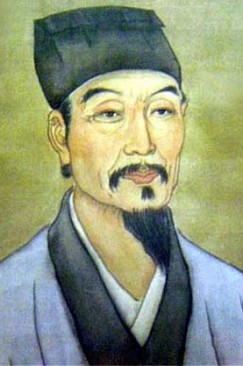
SAY WHAT YOU LIKE about the Nobel Prize, it does achieve one thing: through its strong media presence, it draws attention to “serious” literature for at least one day a year. This international spotlight has at times been particularly welcome for writers outside the Anglophone and Western European publishing centers that still dominate our understanding of world literature. And given how little-known many of the masterpieces of the Imperial Chinese literary canon are to Western readers, the Los Angeles Review of Books asked me to nominate one pre-20th-century work or writer deserving of the Nobel publicity boost. I’ve settled upon Journey to the West,which may or may not have been authored by a failed official–turned–hermit poet called Wu Cheng’en (c. 1500-1582). I’ve chosen it for its dazzling combination of slapstick effervescence and thought-provoking meditations on existential conundrums: the tragedy of mortality, the obstacles to self-perfection, the violence and chaos of the human and animal worlds. Read more of this post

Taleb reveals unsettling truths; Western economy is overcentralised, creating extra risk

October 13, 2013 2:25 pm

Commonsense ideas behind Taleb’s rhetorical flourishes

By John Authers

Western economy is overcentralised, creating extra risk

How fragile we are. Five years on from the Lehman Brothers collapse, political and regulatory errors have made the world’s financial system even more fragile. This alarming line of thought comes from Nassim Nicholas Taleb, best known for The Black Swan, which explained markets’ difficulties in pricing extreme events for which they had no precedent. Mr Taleb, who spoke to me in London last week, divides opinion. For some he is a genius, for others a charlatan. What seems clear, however, is that his gloriously charismatic act and polymath choice of imagery, drawn from philosophy, mathematics and the Classics, can get in the way of underlying ideas which are not in fact far-fetched. Indeed they contain a hard kernel of commonsense truth. Read more of this post

Secrets of great second bananas: Rather than be CEO someplace else, three tough executives each chose to operate as No. 2 at winning corporations. The masters of hands-on tell why — and how — they do it.

Secrets of great second bananas (FORTUNE, 1991)

October 13, 2013: 10:22 AM ET

Editor’s note: Every Sunday Fortune publishes a favorite story from its magazine archives. This week, FORTUNE displayed Facebook’s COO Sheryl Sandberg on the cover as one of the Most Powerful Women in business. In this week’s Sunday throwback, we take a look at a story from 1991 highlighting a few other powerful no. 2 executives. 

Rather than be CEO someplace else, three tough executives each chose to operate as No. 2 at winning corporations. The masters of hands-on tell why — and how — they do it.

By John Huey REPORTER ASSOCIATE Andrew Erdman
101113_classic-1 101113_classic-3 101113_classic-2

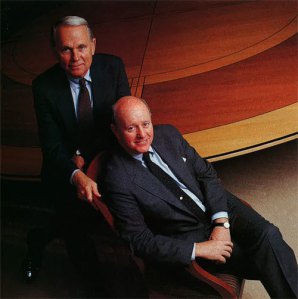
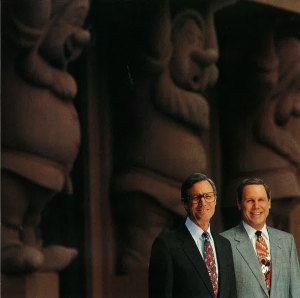
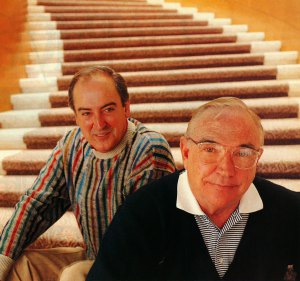
Keough (right) with Goizueta at a Palm Springs resort. In 30 years, Burke (left) and Murphy of Capital Cities/ ABC have “never disappointed each other,” Burke says. Wells (left) and Eisner in front of the 20-foot versions of the Seven Dwarfs that hold up Disney headquarters.

ROBERTO GOIZUETA, now celebrating his tenth anniversary as chairman and CEO of Coca-Cola Co., still recalls the evening of February 14, 1980, as a crucial moment in his career — and in the history of the company. Edgar M. Bronfman threw a birthday party for then Coke chairman J. Paul Austin at Manhattan’s Four Seasons restaurant, and afterward the Goizuetas and their friends the Donald Keoughs repaired to the King Cole Bar at the St. Regis hotel. ”Our wives were talking in one corner,” Goizueta says, ”and Don and I began talking about who was going to succeed Paul.” Unbeknownst to either of them, the imperious, isolated Austin was suffering from both Alzheimer’s and Parkinson’s diseases, personal tragedies that largely explained Coke’s paralysis. As Keough remembers the conversation, ”Roberto and I said, ‘Look, nobody knows how this is going to work out. The two of us are quite compatible, and we have different skills. So let’s sleep at night. Whoever comes out on top, let’s put the other one to work immediately.’ ” Read more of this post

Six things leaders can learn from orchestra conductors

Fiona Smith Columnist

Six things leaders can learn from orchestra conductors

Published 14 October 2013 11:28, Updated 14 October 2013 14:23

Every organisation wants to hire the best, the most talented, the most dynamic people. But what happens when you throw them all together and start telling them what to do? Each employee is highly skilled and has their own vision of what they want to achieve – and each vision is valid. As a leader, how do you keep these people engaged and prevent the onset of anarchy? Sometimes, it can help to look at dilemmas through a different lens – and an orchestra can present a situation that many business leaders (particularly those with a creative workforce) can learn from. Three orchestra conductors were recently interviewed on ABC Classic FM, talking about how they managed to get the best from their musicians, without crushing their creativity. British conductor Christopher Seaman warns that conductors (which could be read as business leaders) have to be careful not to get in the way. Read more of this post

10 Ways Today’s Purpose-Driven Brands Can Bring Their Core Values To Life

10 Ways Today’s Purpose-Driven Brands Can Bring Their Core Values To Life

How businesses can take their beliefs and make them real for consumers.

Today’s brand must live and breathe through its core values in order to survive. Purpose is king, and there’s no turning back. When 87% of global consumers believe business should place equal weight on societal issues and business issues, the better a brand brings its societal purpose to life in everyday operations, the more successful both business and social impact will be. Emotional impact on your customers will be in direct proportion to the social impact of your purpose. Read more of this post

Celebrations costing $300 million to mark the birth date of late Chinese leader Mao Zedong, including mass singing and a noodle feast, have sparked popular anger amid a crackdown by authorities on extravagance

Mass singing honoring Mao in anniversary bash sparks outrage

7:26am EDT

BEIJING (Reuters) – Celebrations costing $300 million to mark the birth date of late Chinese leader Mao Zedong, including mass singing and a noodle feast, have sparked popular anger amid a crackdown by authorities on extravagance. The local government of Mao’s birthplace said on Monday that the events on December 26 marking the 120th anniversary of his birth will include 10,000 people singing a song comparing the revolutionary leader to the rising sun. Another 10,000 will eat “auspicious” birthday noodles at various locations. Read more of this post

Fama, Hansen, Shiller Share Nobel Economics Prize, Academy Says

Fama, Hansen, Shiller Share Nobel Economics Prize, Academy Says

Eugene F. Fama, Lars Peter Hansen and Robert J. Shiller shared the 2013 Nobel Prize in Economic Sciences for their work toward deepening an understanding of how asset prices move. The prize was awarded for “their empirical analysis of asset prices,” the Royal Swedish Academy of Sciences, which selects the winner, said in a statement today in Stockholm. Read more of this post

China’s spelling bees aim to punctuate written word; If you think digital devices and predictive text are hurting Americans’ writing skills, consider the Chinese, who must master 4,000 complex calligraphy-style characters to be considered functionally literate

China’s spelling bees aim to punctuate written word

Calum MacLeod, USA TODAY12:46 p.m. EDT October 12, 2013

If you think digital devices and predictive text are hurting Americans’ writing skills, consider the Chinese, who must master 4,000 complex calligraphy-style characters to be considered functionally literate.

STORY HIGHLIGHTS

Two hit TV shows test ability to write Chinese characters

Smartphones, computers have left many Chinese forgetting how to write common words

Chinese tripped up by characters for sneeze, chin, lizard, toad

BEIJING — China is feeling embarrassed — but just can’t spell it. In one episode of China’s latest hit TV show, a handwriting version of America’s Scripps National Spelling Bee, only one-third of the studio audience correctly wrote the Chinese characters for “gan ga,” meaning embarrassed, the Beijing Review magazine reported. Almost 99% admitted to forgetting how to write words in a survey reported by the China Youth Dailynewspaper in August. For many Chinese, proud of their ancient and complex writing system, such amnesia spells crisis. Read more of this post

Family concerns come second to cult of the entrepreneur

October 13, 2013 11:30 pm

Family concerns come second to cult of the entrepreneur

By Emma Boyde

In the US the family-owned enterprise seems to be the poor relation of the business world. Entrepreneurs such as Jeff Bezos, the founder of Amazon, and Mark Zuckerberg, who founded Facebook, are household names. Becoming an entrepreneur is the fashionable route that many want to travel. As a result, business schools are geared up to teach students how to launch their own companies. The ethos is that entrepreneurs, not families, create jobs. Read more of this post

Annual Kusu pilgrimage season losing Singapore devotees

Annual Kusu pilgrimage season losing devotees

Published on Oct 13, 2013

2013Kusu01Pic1310e

A man prays to the Guan Yin (Goddess of Mercy) at Kusu Island’s Da Bo Gong Temple on Oct 13, 2013. The annual Kusu pilgrimage season, which coincides with the ninth lunar month and is ongoing from Oct 5 to Nov 2, appears to be losing its lustre. — ST PHOTO: MARK CHEON

By Walter Sim

The annual Kusu pilgrimage season, which coincides with the ninth lunar month and is ongoing from Oct 5 to Nov 2, appears to be losing its lustre. Last year, some 47,000 devotees made the 15-minute ferry trip to Kusu Island, according to the Sentosa Leisure Group, which manages the island located 5.6km away from Singapore. This year, about 14,000 people have made the pilgrimage so far, said Mr Ryden Fang, general manager of Singapore Island Cruise & Ferry Services, which exclusively runs scheduled ferry trips to Kusu. He added there has been a drop in visitorship of about 5,000 people each year since 2007.


Patients Mired in Costly Credit From Doctors

October 13, 2013

Patients Mired in Costly Credit From Doctors

By JESSICA SILVER-GREENBERG

The dentist set to work, tapping and probing, then put down his tools and delivered the news. His patient, Patricia Gannon, needed a partial denture. The cost: more than $5,700. Ms. Gannon, 78, was staggered. She said she could not afford it. And her insurance would pay only a small portion. But she was barely out of the chair, her mouth still sore, when her dentist’s office held out a solution: a special line of credit to help cover her bill. Before she knew it, Ms. Gannon recalled, the office manager was taking down her financial details. Read more of this post