Singapore Circuit Breakers Sought After Losses: Southeast Asia

Singapore Circuit Breakers Sought After Losses: Southeast Asia

Singapore Exchange Ltd. (SGX), Southeast Asia’s biggest bourse, faces calls from investors to add circuit breakers after a plunge in shares of three commodity companies erased $6.9 billion in value over three days. The bourse operator imposed unprecedented trading restrictions on Blumont Group Ltd. (BLUM), Asiasons Capital Ltd. and LionGold (LIGO) Corp. after their stock prices plunged. Trading caps to prevent sharp gains or losses will give investors time to assess their holdings, according to Liquidnet Holdings Inc. and the Securities Investors Association of Singapore. Read more of this post

Sri Lanka Targets Wealthy Asians in Singapore-Style Casino Push

Sri Lanka Targets Wealthy Asians in Singapore-Style Casino Push

Louise Fernandez has visited Sri Lanka about five times in the past decade, drawn by its white sandy beaches, tea plantations and historic temples. The South Asian island is about to give her more reasons to return. The Sri Lankan parliament is due to approve today a tax amnesty for the island’s first foreign casino venture, a $350 million investment backed by Australian James Packer’s Crown Ltd. The 400-room waterfront project will join a growing lineup of luxury Colombo hotels, including a $400 million beachfront Shangri-La, the Taj group’s upgraded five-star Samudra Colombo, and a John Keells Holdings Plc. gaming resort. Read more of this post

Aussie start-up brings ‘try before you buy’ to apps

Aussie start-up brings ‘try before you buy’ to apps

October 8, 2013 – 9:49PM

Ben Grubb

Ever wanted to try a mobile app before you buy it but only had screenshots and a couple of reviews to look at before making a decision? Worse still, ever forked out cash for an app that doesn’t do what you thought it would do? An Australian technology start-up is working to fix that problem, and has caught the eye and the backing of American investors. In the same way that movies have trailers, App.io gives smartphone users the ability to try an app to get a taste of what it looks and feels like before buying it. Demos can be placed on blogs, websites, Facebook or Twitter and work on all platforms and do not require a plugin – all that is needed is a web browser. So far the start-up has raised $US1.2 million ($1.27m) from investors and more than 8500 app developers have signed up to use the service. Read more of this post

Default risk a ‘giant Taser’, says Alcoa chief

October 8, 2013 11:14 pm

Default risk a ‘giant Taser’, says Alcoa chief

By Ed Crooks in New York

The threat that the US might refuse to raise the debt ceiling is a “giant Taser” freezing confidence in the world economy, Klaus Kleinfeld, chief executive of Alcoa,the US aluminium group, has warned. Speaking as Alcoa reported strong growth in earnings for the third quarter, Mr Kleinfeld said the disputes in Washington were hurting confidence not just in the US but globally. Read more of this post

Buyout debt returns to pre-crisis levels in US

October 8, 2013 6:38 pm

Buyout debt returns to pre-crisis levels in US

By Anne-Sylvaine Chassany, Private Equity Correspondent

The amount of debt in US leveraged buyouts has increased to levels reminiscent of the boom years before the financial crisis, as private equity groups tap buoyant credit markets. Private equity investors aim to boost their returns by using more bank debt or bonds than their own cash to fund takeovers. By the end of September, the debt component in US deals, which is serviced by the profits of the purchased companies, equalled 5.3 times the companies’ earnings before interest, taxes, depreciation and amortisation (ebitda), according to S&P Capital IQ. This is the highest ratio since 2007, when the average debt portion reached a peak of 6 times ebitda, and surpasses the 2006 level of 5.1 times. Read more of this post

While Norway’s election handed power to a coalition led by women, Scandinavia’s richest economy is reserving its top corporate jobs and biggest pay checks for men

Sex Gap Alive and Kicking in Norway as Women Rule in Politics

While Norway’s election handed power to a coalition led by women, Scandinavia’s richest economy is reserving its top corporate jobs and biggest pay checks for men. Norway is set to get its first female prime minister in 17 years as Conservative Party leader Erna Solberg, 52, takes over on Oct 18. Her coalition partner, the Progress Party, is led by 44-year-old Siv Jensen. Women also head Norway’s largest labor union and its biggest employers group. Read more of this post

Chengdu mall has everything but crowds

Chengdu mall has everything but crowds

20131007_escalators_chengdu_st

Tuesday, October 8, 2013 – 03:00

Esther Teo

The Sunday Times

CHINA – With its undulating silhouette and hulking size, the New Century Global Centre – the world’s biggest building – is impossible to miss among the tall skyscrapers of Chengdu. The massive glass and steel structure sits snugly like a heavy metal box placed on the earth by the gods in this south-western Chinese city of 14 million. The centre officially opened on Sept 1 in Tianfu New District in Chengdu’s south – a new business area that aims to accelerate the city’s development. It is 100m tall, 500m long and 400m wide, offering 1.7 million sq m of floor space – or 12 times that of Singapore’s largest mall, VivoCity. Put another way, it could fit 20 Sydney Opera Houses. If that does not begin to hint at its massive scale, consider what’s inside: a university campus, two hotels, a shopping mall, an Imax cinema, offices, a convention centre and a seaside resort with water lapping on a fake beach, an Olympic- size ice rink and Mediterranean- themed shopping village. Clearly, if anyone needs a definition of excess, this is it. When I stepped through the revolving doors of the all-in-one shopping mall, vast khaki-toned marbled halls lined with palm trees greeted me. The cavernous central atrium compelled me to gaze upwards to figure out just how high the glass ceiling went. Natural sunlight filtered in through the wave-like roof structure as winding escalators – some golden in colour and with bright blue LED panels on the sides – criss-crossed one another, giving a sense of opulence. Read more of this post

Does 6,000 Percent Interest Make You a Loan Shark? The recession in the U.K. has produced an explosion of payday lenders, with much of the action online. Britons now take out more than 8 million short-term loans worth more than 2 billion pounds a year

Does 6,000 Percent Interest Make You a Loan Shark?

The recession in the U.K. has produced an explosion of payday lenders, with much of the action online. Britons now take out more than 8 million short-term loans worth more than 2 billion pounds a year, at least double the amount in 2008, at theoretical annualized interest rates of 5,853 percent or more. These “legal loan sharks” have become a big issue. According to the U.K. consumer group Which?, 38 percent of those who take out short-term loans use them to pay for essentials, such as food and fuel; a quarter repay other loans. Read more of this post

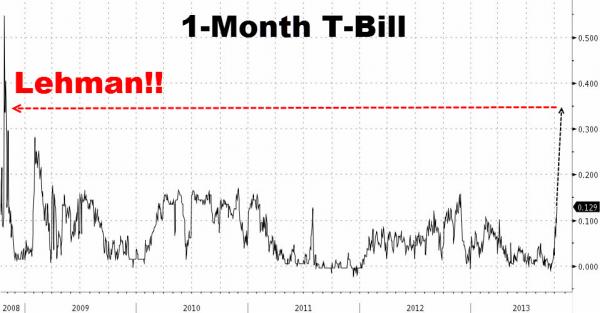
Panic: 1 Month Bill Yield Explodes, Prices At 0.35% Highest Since Lehman

Panic: 1 Month Bill Yield Explodes, Prices At 0.35% Highest Since Lehman

Tyler Durden on 10/08/2013 11:39 -0400

Moments ago, the just concluded 4 week Bill, with a Cusip which appropriately enough was BK, priced at a stunning 0.35%, blowing through the 0.295% When Issued, the highest yield since October 2009, the lowest Bid to Cover since March 2009, and the largest tail since March 25, 2008. The bond market panic is palpable, and just as we predicted would happen in a market gripped by sheer “Bernanke will kiss and make it all better” complacency.
20131008_1m_0

Updated October 8, 2013, 12:42 p.m. ET

Default Worry Hammers Short-Term U.S. Debt

T-bill Yields Climb to Highest Since October 2008

CAROLYN CUI And KATY BURNE

Short-term U.S. debt prices tumbled again Tuesday amid rising investor concern about the prospect of a government-debt default, sending the yield on one-month U.S. Treasury bills to its highest level since the financial crisis.

With little sign that Republicans and Democrats will hammer out a compromise on the partial government shutdown, many in the financial markets are starting to worry about the prospect of a default.

Treasury bills maturing on Oct. 31—a date many market participants predict for the Treasury to run out of cash to pay its bills—sold off sharply Tuesday, driving their yields up to 0.35%, the highest level since October 2008.

Concern about the stalemate in Washington was also evident in Tuesday’s auction of new bills. The Treasury Department sold $30 billion worth of four-week bills maturing on Nov. 7 at a rate of 0.350%, the highest rate the government paid on such short-dated debt in five years.

Money-market funds and banks are typically the biggest buyers of Treasury bills, where they park their idle cash for a short time. But they shied away from the auction Tuesday. The bid-to-cover ratio, a gauge of investor demand, was 2.76, the lowest since July 2009 for four-week bills, according to Nomura Securities.

“It was an awful auction,” said Priya Misra, head of U.S. rates strategy research at Bank of America Merrill Lynch.

In another sign of weak demand, the “tail,” or the difference between the highest yield on the securities during the auction and the expected high yield when the auction starts, was as wide as 0.05 percentage points, the largest since March 25, 2008, according to Bank of America.

In the market for derivatives known as credit-default swaps, which some traders use to bet that a debt issuer will default, investors now are pricing in a 3% probability the U.S. won’t pay its obligations in timely fashion. Traders were asking Tuesday for €58,800 ($79,856) to insure €10 million of U.S. debt for a year, up 9.7% from Monday and up tenfold from Sept. 20 levels. U.S. credit-default swaps trade in euros to help users hedge the risk of a depreciating dollar in the event of a default.

The U.S. Treasury has said it will run out of emergency borrowing capacity around Oct. 17. By Oct. 31, the government could deplete all its available funds and face the risk of a default on bills or bonds that are due around month’s end, according to J.P. Morgan Securities LLC. Prices for bills maturing between mid-October and early November fell the most.

Some money managers said they sold these maturities to avoid potential losses or the operational difficulties of dealing with defaulted securities.

For now, investor concerns appear to be limited to these short-term securities. The yields of longer-term bills, those maturing in three, six and 12 months, remain near zero, and the yield on the 10-year note has been holding steady, settling at 2.634%.

U.S.-listed money-market funds saw a small outflow of $3.679 billion in the week ended Oct. 2, according to EPFR Global, a fund data provider.

“We’re still not seeing a great deal of concern among retail investors of the probability of a debt-ceiling incidence,” said Jake Lowery, portfolio manager with ING U.S. Investment Management. “While managers are trying to minimize their exposure to Treasury bills that are most likely to be impacted by any default, investors still believe T-bills are a safe-haven asset.”

The repurchase market, known as repo, where banks and other financial institutions get billions of dollars of short-term funding by borrowing and lending securities—often short-term Treasury debt—is beginning to show some stress.

It cost 0.09% to borrow cash overnight against short-term Treasury debt Tuesday, up from 0.05% in late September, according to the Depository Trust & Clearing Corporation.

Traders and banks are concerned that a Treasury default on its debt could mean they are pushed to pay a much higher rate to borrow against short-term Treasury securities, or they may simply refuse to lend cash against such securities, analysts say. U.S. government securities amount to about one-third of all the securities used to back up loans obtained in the repo market.

In 2008, concerns about borrowers’ ability to repay their debts froze the repo market as investors shied away from trading with certain financial institutions. This time around, the repo market is dealing with a more fundamental question: What’s the credit quality of the Treasury securities backing the loans?

Declines in the value of T-bills, considered one of the most risk-free assets in the world, will have a knock-on effect on other assets used to back loans in the repo market, Ms. Misra said.

“In the run-up to a default or following a default, there could be significant changes in pricing of equities, corporate bond and other securities,” said Alex Roever, head of U.S. rates strategy at J.P. Morgan Chase.

South Korea’s Celltrion CEO to Be Probed in Stocks Trading Case

South Korea’s Celltrion CEO to Be Probed in Stocks Trading Case

South Korea’s financial regulator plans to ask prosecutors to investigate the chief executive officer of Celltrion Inc. over alleged stock price manipulation, the drug manufacturer said today. The Financial Services Commission is asking prosecutors to probe the actions of Celltrion’s largest shareholder, the company said in an e-mailed statement. Celltrion disagrees with the FSC’s decision and plans to cooperate with prosecutors, the company said. Celltrion’s largest shareholder is CEO Seo Jung Jin, spokesman Kim Joon Seok confirmed by phone. Read more of this post

How Investors Lose 89 Percent of Gains from Futures Funds

How Investors Lose 89 Percent of Gains from Futures Funds

The pitch was enticing. At a time when the Standard & Poor’s 500 Index had suffered a decline of 41 percent in the previous three years, Morgan Stanley (MS) was offering its clients the possibility of some relief. In a prospectus, the New York securities firm invited its customers to put their money into a little-known area of alternative investing called managed futures. “If you’ve never diversified your portfolio beyond stocks and bonds, you should know about the powerful argument for managed futures,” the bank wrote. “Managed futures may potentially profit at times when traditional markets are experiencing losses.” Read more of this post

Six Other Jerks Whose Stocks Julian Robertson Wouldn’t Buy

Six Other Jerks Whose Stocks Julian Robertson Wouldn’t Buy

Julian Robertson, the hedge fund billionaire, told CNBC that he sold all of his Apple holdings after discovering that Steve Jobs was a “really awful” person through Walter Isaacson’s biography. According to Robertson, this is because mean people can’t build enduringly successful companies. Here are some other business founders whose companies Robertson probably wouldn’t want to own:

1. Henry Clay Frick, United States Steel Corp.

Frick was called one of the “worst American CEOs of all time” by Portfolio magazine. One reason was that his vigorous response to the Homestead Strike of 1892 led to the deaths of 16 people. On the other hand, the company he helped found — U.S. Steel — remains the country’s largest producer, as well as the namesake of the Pittsburgh Steelers, despite the contraction of the American steel industry over the past 30 years. Read more of this post

Singapore: Parents upset over PSLE book-burning ‘celebration’

Parents upset over PSLE book-burning ‘celebration’

burnbooks_int

Tuesday, October 8, 2013 – 12:37

Edvantage

SINGAPORE – A photo showing parents and their kids celebrating the end of the Primary School Leaving Examinations (PSLE) by burning their textbooks has triggered an intense debate online. A reader notified the Shin Min Daily News to the photo circulating on Facebook. According to the reader, the book-burning celebration happened after the exams ended last Wednesday. The photo shows a group of 10 adults and children gathered around a raging fire contained in a metal bin. Torn pages and pieces of paper could be seen strewn around the area. Read more of this post

Robot Surgery Damaging Patients Rises With Marketing

Robot Surgery Damaging Patients Rises With Marketing

Porter Adventist Hospital in Denver announced last year that Warren Kortz, a general surgeon on the medical staff, was the first in the Rocky Mountain region to use a technique known as robotic surgery to remove gall bladders through one incision in the belly button. The operation, performed while the doctor sits at a video-game-like console, was “taking advantage of another breakthrough in robotic surgery” and is “easier on the patient,” the hospital said in a press release. Read more of this post

Flash sale pioneer Vente-Privee eyes smartphone-driven boom

Flash sale pioneer Vente-Privee eyes smartphone-driven boom

9:09am EDT

By Dominique Vidalon and Pascale Denis

PARIS (Reuters) – Vente-Privee, the French firm that pioneered online sales events, expects the bulk of its sales in coming years to be carried out on smartphones and tablet computers, its founder and chief executive said on Tuesday. Vente-Privee, which sells luxury fashion, wine and music at steep discounts to its 19 million European members in “flash sales” that last three to five days, also expects revenue to continue to grow at a double-digit rate over the next 10 years. Read more of this post

Packed China Tourist Sites May Spur Paid-Leave Reform, CCTV Says

Packed China Tourist Sites May Spur Paid-Leave Reform, CCTV Says

China’s overcrowded trains, roads and tourist sites during the week-long National Day holiday may spur the country of more than 1.3 billion people to speed up reforms that ensure paid leave for workers, state television reported. Chinese companies rarely grant requests for vacation time, which combined with growing tourism demand in the world’s second-largest economy, has led to surges in travel during the so-called “Golden Week” holiday Oct. 1-7, China Central Television reported. That’s added impetus to more quickly implement rules that guarantee paid leave, the broadcaster reported yesterday, citing “experts” it didn’t identify. Read more of this post

Casanovas on Foot Baffle Toyota CEO as Japan Sales Shrink: Cars

Casanovas on Foot Baffle Toyota CEO as Japan Sales Shrink: Cars

While Toyota Motor Corp. (7203) President Akio Toyoda is on the cusp of a record year for profit, kids nowadays make him nervous. They’re so clueless that boys without cars have the nerve to ask girls out. “In the past, if you wanted to date someone, you couldn’t ask her out if you didn’t have a car,” Toyoda, 57, told a packed auditorium of about 900 Meiji University students in Tokyo on Sept. 26. “It’s all changed now. Money goes on monthly phone bills. Also, parking’s expensive and it’s easy to get around Tokyo on public transport.” Read more of this post

A Lonely Housing Bear Predicts a Big Tumble

A Lonely Housing Bear Predicts a Big Tumble

Talk to Mark Hanson about the housing market for five minutes and you may find yourself wanting to sell your home and park the cash in a suitcase. The Menlo Park, California, real estate analyst, blogger and founder of consultancy Hanson Advisers predicts a decline of 20 percent in housing prices in the next 12 months. Half the gains since the latest housing bottom in 2011 could be erased in the hot areas — Florida, California, Nevada, Arizona and Georgia — by rising interest rates and a thinner herd of speculative private-equity buyers, he says. Read more of this post

Emerging storm reveals ebbing central bank autonomy

Emerging storm reveals ebbing central bank autonomy

9:25am EDT

By Sujata Rao

LONDON (Reuters) – After a stormy year for global emerging markets, one long-term casualty may be the decade-long push for central banking free from politics and the inflation-busting kudos that earned. Investors see governments once more intent on pumping up economic growth via low interest rates even at the risk of inflation and currency volatility. The trend is effectively rolling back more than 10 years of growing consensus on the benefits of inflation targeting and greater rate-setting autonomy across emerging markets. Read more of this post

Can you trust Facebook with your genetic code?

Can you trust Facebook with your genetic code?

By Christina Farr | VentureBeat.com, Published: October 7

We share everything on Facebook: our family photos, intimate thoughts, relationship woes. Some of us even post our DNA. Thousands of Americans are sharing results of genealogy tests on social media sites like Facebook, even posting their entire genome on GitHub and GenomesUnzipped. But is it safe for patients to share DNA with a private company and then post test results on the Internet? That’s not so clear. Genealogy companies like 23andMe that analyze your genetic data encourage this kind of sharing, and they say that it is safe. For just $99, you can send 23andMe a sample of your DNA, and it will send you a full report, replete with information about your health and ancestry, and give you options to share the data online and connect with people you might be distantly related to. It can also be used by prospective parents to determine the risk that their future offspring will inherit a genetic condition. Read more of this post

Retailers see ‘click and mortar’ as way to beat Amazon

Retailers see ‘click and mortar’ as way to beat Amazon

9:39am EDT

By Emma Thomasson and Dominique Vidalon

PARIS (Reuters) – Traditional stores can take on e-commerce and keep their major role by reinventing themselves faster to best combine shopping in stores and online, top retailers said on Tuesday. Despite the challenge from players like Amazon, 68 percent of retailers say stores remain the most important channel for shoppers and one in three plan to expand their footprint, according to a survey by the Australian Centre of Retail Studies released at a conference in the French capital. Read more of this post

British Invading Again as U.S. TVs Tune In for Sherlock Holmes

British Invading Again as U.S. TVs Tune In for Sherlock Holmes

In the 1960s, the British Invasion brought bowl haircuts and rock-n-roll to U.S. shores with The Beatles and The Rolling Stones. Fifty years on, a new assault is coming, led by iconic U.K. characters featured on TV shows. Time Warner Inc. (TWX)’s HBO, CBS Corp. (CBS)’s Showtime, Netflix Inc. (NFLX) and Hulu LLC are among the cable networks and streaming sites commissioning, co-producing and buying rights to expensive new British dramas, meaning Americans will soon be watching U.K.- made shows featuring everyone from Dracula to Sherlock Holmes. Read more of this post

Are curved, flexible smartphones the next frontier in smartphone innovation?

Are curved, flexible smartphones the next frontier in smartphone innovation?

By VentureBeat.com, Published: October 7

Are curved, flexible smartphones the next frontier in smartphone innovation? LG and Samsung really want to make it so. Both companies are weeks away from announcing smartphones with curved displays, whose plastic substrate should make them more durable and cheaper to produce. LG said today that it’s already started production of its flexible displays, which could appear in a phone called the “LG Flex” as soon as November. Read more of this post

Steak No More in Yeats Country Depicting Scant Recovery: Economy

Steak No More in Yeats Country Depicting Scant Recovery: Economy

On Ireland’s emptiest major shopping street, butcher Keith Clarke is mourning a loss of business. “The fillet steak died a death,” said Clarke, 57, who runs a store on Grattan Street in the town of Sligo on the country’s west coast. His sales have dropped 40 percent since the economy imploded in 2008 and have further to fall, he said. “They’re buying the cheapest cuts now.” Read more of this post

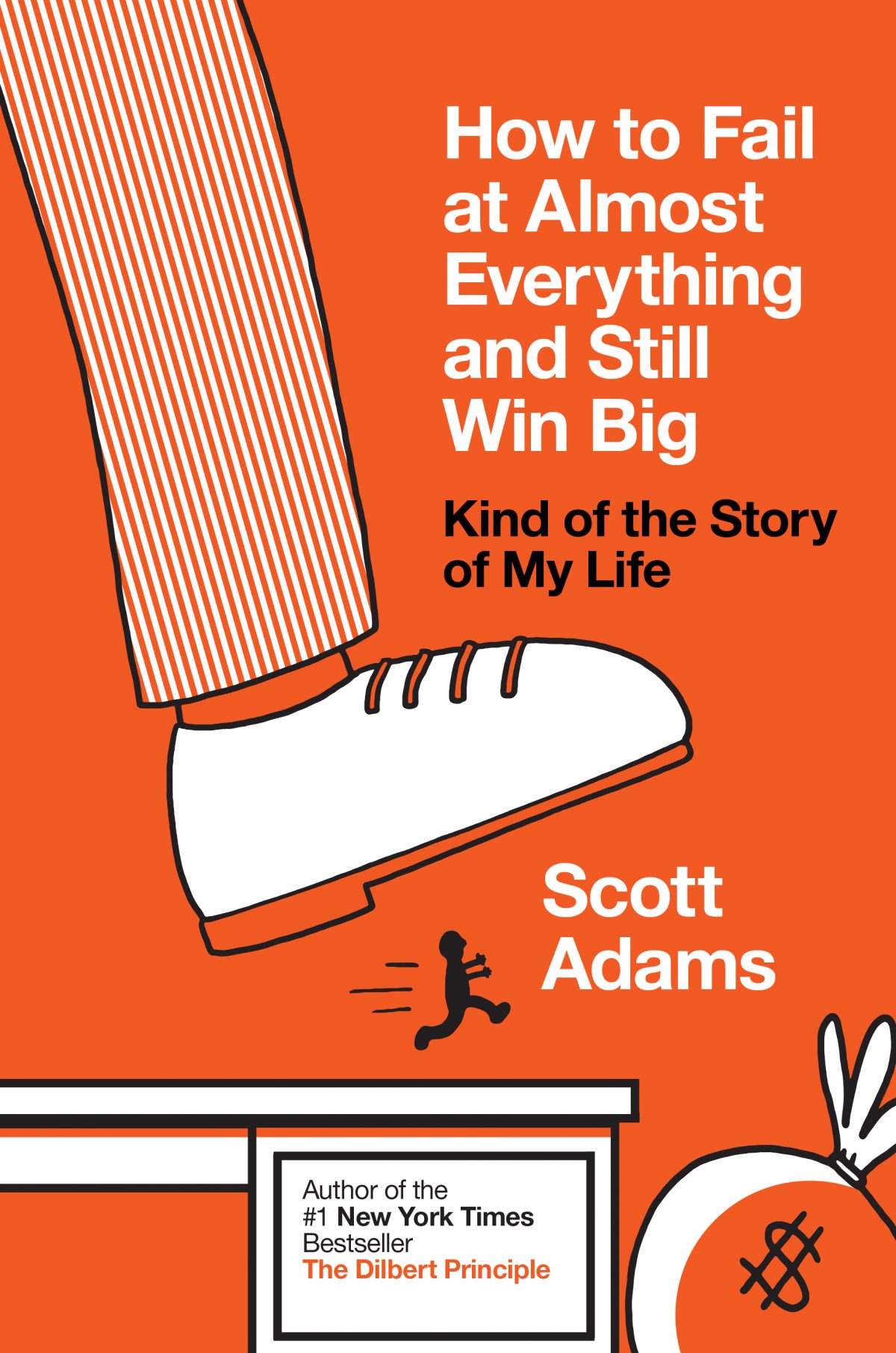
Dilbert’s creator Scott Adams: How to Fail at Almost Everything and Still Win Big: Kind of the Story of My Life; Everything you want out of life is in that bubbling vat of failure. The trick is to get the good stuff out.

How to Fail at Almost Everything and Still Win Big: Kind of the Story of My Life Hardcover

by Scott Adams  (Author)

how to fail... jacket

Everything you want out of life is in that bubbling vat of failure. The trick is to get the good stuff out.
Scott Adams has likely failed at more things than anyone you’ve ever met or anyone you’ve even heard of. So how did he go from hapless office worker and serial failure to the creator of Dilbert, one of the world’s most famous syndicated comic strips, in just a few years? In How to Fail at Almost Everything and Still Win Big, Adams shares the strategy he has used since he was a teen to invite failure in, embrace it, then pick its pocket. No career guide can offer advice that works for everyone. As Adams explains, your best bet is to study the ways of others who made it big and try to glean some tricks and strategies that make sense for you. Adams pulls back the covers on his own unusual life and shares how he turned one failure after another into something good and lasting. Adams reveals that he’s failed at just about everything he’s tried, including his corporate career, his inventions, his investments, and his two restaurants. But there’s a lot to learn from his personal story, and a lot of humor along the way. Adams discovered some unlikely truths that helped to propel him forward. For instance:

• Goals are for losers. Systems are for winners.

• “Passion” is bull. What you need is personal energy.

• A combination of mediocre skills can make you surprisingly valuable.

• You can manage your odds in a way that makes you look lucky to others.

Adams hopes you can laugh at his failures while discovering some unique and helpful ideas on your own path to personal victory. As he writes:

“This is a story of one person’s unlikely success within the context of scores of embarrassing failures. Was my eventual success primarily a result of talent, luck, hard work, or an accidental just-right balance of each? All I know for sure is that I pursued a conscious strategy of managing my opportunities in a way that would make it easier for luck to find me.” Read more of this post

‘Passion Is BS’ And Other Life Advice From Dilbert Creator Scott Adams

‘Passion Is BS’ And Other Life Advice From Dilbert Creator Scott Adams

JENNA GOUDREAU OCT. 7, 2013, 2:27 PM 3,959 3

Despite being a world-famous cartoonist and best-selling author, Scott Adams maintains that he’s failed at just about everything he’s ever tried. But the trick is, only one thing has to work. The creator of Dilbert, the first syndicated comic that focused on the workplace, details his unlikely path to success in an upcoming book “How to Fail at Almost Everything and Still Win Big.” In it, he describes his stalled corporate career, a string of failed business ventures, and his first rejections as a cartoonist. But through those failures, he discovered what it takes to eventually find success. (Hint: It isnot passion.) Adams sat down with Business Insider to discuss his new book and the best advice he ever got. The following has been edited for length and clarity.

Business Insider: You seem to think it’s possible to fail your way to success. How does that work?

Scott Adams: You can’t control luck directly, but you can move from a game with bad odds to a game with good odds. The world is like a reverse casino. In a casino, if you gamble long enough, you’re certainly going to lose. But in the real world, where the only thing you’re gambling is, say, your time or your embarrassment, then the more stuff you do, the more you give luck a chance to find you. If you do one thing and stop, you didn’t give luck a chance to find you. You only need one thing to work. Read more of this post

The world’s first malaria vaccine could be available in as little as three years after British drugmaker GlaxoSmithKline’s candidate treatment passed a major testing milestone

GSK malaria vaccine could be available in three years

The world’s first malaria vaccine could be available in as little as three years after British drugmaker GlaxoSmithKline’s candidate treatment passed a major testing milestone.

By Denise Roland

12:01AM BST 08 Oct 2013

GSK is ready to take the first step in getting the vaccine to market after promising trial results showing it was effective in protecting children and babies from malaria for up to 18 months. The pharmaceuticals giant plans to submit the vaccine to EU regulators next year, which means, if approved, it could be widely available by 2016. The World Health Organisation has already indicated that a policy recommendation for the vaccine, the most advanced treatment anywhere in the world by at least 10 years, could be made by 2015 if it clears regulatory hurdles. Read more of this post

Common nonsense: Commoditised best practice and why we’re getting ‘the basics’ of business wrong

James Thomson Editor

Common nonsense: Commoditised best practice and why we’re getting ‘the basics’ of business wrong

Published 08 October 2013 07:48, Updated 08 October 2013 13:24

12caeb32-2f91-11e3-b690-9cc324ec45e6_Dr Jules Goddard--646x363

Dr Jules Goddard says many of the practices of “managerialism” date back to 19th-century efforts to get farm workers producing in factories. How many times have you heard a leader – of a business or a sporting team – talk about doing “the basics” right. But what if the way we define “the basics” is all wrong? That’s the question raised by Dr Jules Goddard, a fellow of London Business School who recently visited the Australian Graduate School of Management as its Unilever Distinguished Scholar. Goddard is the co-author of a book calledUncommon Sense, Common Nonsense, which questions whether some of the tenets of Business 101 – such as cost-efficiency, operational excellence and competitive benchmarking – promote a sort of herd thinking that does not make for great leaders or great businesses. He provides the example of the idea of “best practice” which can be heard in boardrooms of all shapes and sizes. As he points out, the idea itself is a little silly. “Every firm in an industry defines best practice in an industry in the same way. But markets do not reward commodities.” Read more of this post

Uncommon Sense, Common Nonsense: Why some organisations consistently outperform others

Uncommon Sense, Common Nonsense: Why some organisations consistently outperform others [Kindle Edition]

Jules Goddard (Author), Tony Eccles (Author)

419f33c2-2f15-11e3-814b-138ad8fa7301_Jules Goddard Uncommon Sense, Common Nonsense

Publication Date: May 3, 2012

This is a book for managers who know that their organisations are stuck in a mindset that thrives on fashionable business theories that are no more than folk wisdom, and whose so-called strategies that are little more than banal wish lists.It puts forward the notion that the application of uncommon sense – thinking or acting differently from other organisations in a way that makes unusual sense – is the secret to competitive success. For those who want to succeed and stand out from the herd this book is a beacon of uncommon sense and a timely antidote to managerial humbug. Read more of this post

Fund managers find responsible investing comes with big risks

October 7, 2013 11:57 am

Fund managers find responsible investing comes with big risks

By Pauline Skypala

Long-term investments to support a low-carbon economy are out of fashion

There is a lot you can do with $34tn, for good or ill. In theory, the $34tn of assets backing the UN’s Principles for Responsible Investment should be invested to take account of environmental, social and governance factors. In practice, it is hard to see what difference the UNPRI is making to the world. On environmental grounds alone, the report from the Intergovernmental Panel on Climate Change suggests investors are either unwilling or unable to push companies they invest in to reduce carbon emissions. Concentrations of greenhouse gases in the atmosphere have risen to levels not seen in “at least the last 800,000 years”, the report says. Read more of this post