Space Burials at $1,990 Give Aging Japan Cheaper Funeral Option

Space Burials at $1,990 Give Aging Japan Cheaper Funeral Option

Burial options in Japan are expanding beyond the traditional Buddhist ceremony. You can now send a loved one’s ashes into space. Closely held Elysium Space Inc. is offering a service in Japan to send a portion of a person’s cremated remains in a capsule that will circle the earth for several months for $1,990. Relatives and friends can track the spacecraft’s trajectory on a mobile phone app. Like a meteorite, the remains disintegrate upon entering the earth’s atmosphere, “blazing as a shooting star,” according to a company statement. About one gram of a person’s remains are placed into an individual “space-grade” aluminum capsule, Benjamin Joffe, a spokesman for the company said in an e-mail. Missions will carry between 100 to 400 individual capsules, he said. The service will give a new option for Japanese looking to reduce the size and expense of funerals as relatives become fewer and traditional ties weaken in one of the world’s fastest aging societies. The cost of a renting a burial plot and buying a tomb stone in Tokyo is about 2.7 million yen ($27,400), according to Japan Institute of Life Insurance. The market for funeral services in Japan rose 0.7 percent to 1.3 trillion yen in the year ended March 2010 from a year earlier as the number of aged Japanese increased, according to the marketing and credit research firm Teikoku Databank Ltd. based in Tokyo. Elysium Space began taking U.S. space burial reservations in the U.S. in August. The San Francisco company’s first launch is scheduled for next summer.

To contact the reporter on this story: Kanoko Matsuyama in Tokyo at kmatsuyama2@bloomberg.net

In historic step, Japan PM hikes tax; will cushion blow to economy

In historic step, Japan PM hikes tax; will cushion blow to economy

1:42am EDT

By Tetsushi Kajimoto and Stanley White

TOKYO (Reuters) – Japan’s Prime Minister Shinzo Abe took a step on Tuesday that none of his predecessors had managed in more than 15 years – making a dent in the government’s runaway debt. Abe, riding a wave of popularity with economic policies that have begun to stir the world’s third-biggest economy out of years of lethargy, said the government will raise the national sales tax to 8 percent in April from 5 percent. Read more of this post

JGB Bubble Seen Growing by Bank of America on BOJ: Japan Credit

JGB Bubble Seen Growing by Bank of America on BOJ: Japan Credit

A bubble forming in the Japanese government bond market risks further expansion as central bank purchases shield the notes from a global rout, according to Bank of America Merrill Lynch and Mizuho Securities Co. The Bloomberg Japan Sovereign Bond Index (BJPN) climbed 1.45 percent in the quarter ended Sept. 30, the biggest gain among Group of 10 countries after the 1.54 percent increase in Italy’s debt. Benchmark 10-year JGB yields were the lowest in the world at 0.67 percent today and compared with 2.65 percent for similar-maturity U.S. Treasuries. Read more of this post

Politics in Malaysia: Bumi, not booming; The ruling party returns to its old habits of race-based handouts

Politics in Malaysia: Bumi, not booming; The ruling party returns to its old habits of race-based handouts

Sep 28th 2013 | KUALA LUMPUR |From the print edition

THE United Malays National Organisation (UMNO) is the dominant party in the coalition that has ruled Malaysia since independence in 1957. Only now, however, is it parading its democratic credentials, so far as its internal appointments go. Nominations have just closed for elections to a broad range of party posts, to be decided in the middle of October by 146,000-odd party delegates at local level. Previously, a mere 2,600 members, those who attended the party’s convention, had a say. UMNO’s boosters claim that these new elections will restore vim to an ageing organisation. They say it will make it the most genuinely democratic party in the country. Not bad for an outfit with a past reputation as a ruthless political machine. Read more of this post

India’s informal economy: Hidden value; Activities out in the sticks may add more to GDP than was thought

India’s informal economy: Hidden value; Activities out in the sticks may add more to GDP than was thought

Sep 28th 2013 | MUMBAI |From the print edition

THE chief architect of India’s constitution, B.R. Ambedkar, once said its villages were “a den of ignorance, narrow-mindedness and communalism”. Now some think they are the strongest bit of the economy. Neelkanth Mishra, an analyst at Credit Suisse, reckons that, if activity in informal industries and rural areas were properly measured, India’s GDP would look bigger and more stable and the present slump less severe. This is a source of comfort at a time when India is fighting a financial panic. Read more of this post

The Economist explains: Why is Brazil so expensive?

The Economist explains: Why is Brazil so expensive?

Sep 30th 2013, 23:50 by H.J. | SÃO PAULO

TRAVELLERS have long known that the richer a country, the more likely a visit is to burn a hole in their wallets. A recent survey by Tripadvisor, a travel website, put Oslo, the capital of super-rich Norway, as the world’s priciest destination, with a one-night stay in a four-star hotel with dinner and drinks for two costing more than $600. But near the top of the sticker-shock rankings is a surprise entry: upper-middle-income Brazil. Hotels in São Paulo, the business capital, or beachside Rio de Janeiro, cost more than in London or Zurich. Visitors who go window-shopping will find the high prices hit locals too. Clothes, cosmetics, electronics and cars are all more expensive, sometimes much more, than in most other places. The Economist’sBig Mac Index finds Brazilian burgers are dearer than everywhere else except in three much richer countries, (Norway, Sweden, Switzerland) and one dysfunctional one (Venezuela). So why is Brazil so pricey? Read more of this post

David, Goliath and the appeal of the underdog: A Q&A with Malcolm Gladwell on this often-misunderstood story

David, Goliath and the appeal of the underdog: A Q&A with Malcolm Gladwell on this often-misunderstood story

Posted by: Kate Torgovnick
September 30, 2013 at 12:22 pm EDT

For 3000 years, the story of David and Goliath has seeped into our cultural consciousness. This is generally how the tale is told: a young shepherd does battle with a giant warrior and, using nothing but a slingshot, comes out victorious. But is this really what the Bible describes? In today’s talk, Malcolm Gladwell — whose new book is titled David and Goliath: Underdogs, Misfits and the Art of Battling Giants — takes a closer look at this classic story, digging into the details which are easily lost on a modern audience. Overall, he asks: was David really the underdog in this fight? It all begins with a closer look at that sling (which is not the toy slingshot we might picture), and at the five rocks David picked up to use in it. “The term ‘David and Goliath’ has entered our language as a metaphor for improbable victories by some weak party over someone far stronger,” says Gladwell in this talk. “Everything I thought I knew about that story turned out to be wrong.” Fascinated to hear more, the TED Blog called Gladwell to unravel why the underdog story has such resonance and why rethinking David and Goliath is important now. (As a bonus, we also asked him what pasta sauce he prefers.) An edited transcript of the conversation follows. Read more of this post

Toyoda’s legacy goes well beyond the lean: The innovator who led Toyota insisted that people were as important as the production system

September 30, 2013 5:17 pm

Toyoda’s legacy goes well beyond the lean

By Andrew Hill

The innovator who led Toyota insisted that people were as important as the production system

Eiji Toyoda was the man who taught the world’s production workers Japanese. If you know kaizen means continuous improvement, and use kanban inventory tags to eliminate muda, or waste, then Toyoda, who died recently, was your sensei. The Toyota Production System he championed as head of the carmaker in the 1970s and 1980s, traces its roots to a fail-safe device devised by Toyoda’s uncle to cope with thread breaks on mechanical looms. Multinationals have since turned its efficiency methods – “lean” production, just-in-time supply chains and outsourcing – into a habit that is woven through the fabric of global production. However, in future, Toyoda’s insights into the power of human initiative will be more relevant. Read more of this post

Amanco Brazil identified unmet needs; The Latin American pipe manufacturer challenged a market-leading brand

September 30, 2013 5:00 pm

Amanco Brazil identified unmet needs

By Paulo Rocha e Oliveira

The story. In early 2006, Amanco was Latin America’s leading manufacturer of pipes and fittings for water management systems. But in Brazil, despite a decade or so of operating there, Amanco was losing money. Grupo Nueva, Amanco’s Swiss owner, was preparing the company for an initial public offering and needed the balance sheet to be spotless. Roberto Salas, Amanco’s chief executive, had to decide on a strategy to turn things round. Should he propose selling the Brazilian subsidiary or present a plan for how to increase its 16 per cent market share? Staying in Brazil meant either competing on price (and lowering shareholder expectations), or developing a branded strategy to take on Tigre Tubos e Conexoes, which accounted for 61 per cent of sales in Brazil and had proved resilient to challengers. Read more of this post

Warren Buffett’s Fourth Tweet Ever Was About ‘Breaking Bad’: “Not even the Oracle knows what will happen tonight”

Warren Buffett’s Fourth Tweet Ever Was About ‘Breaking Bad’

SAM RO SEP. 30, 2013, 7:48 AM 10,613 4

Billionaire investing legend Warren Buffett is a fan of AMC’s “Breaking Bad.” In fact, his fourth Tweet ever came two minutes into Sunday night’s series finale. “Not even the Oracle knows what will happen tonight,” he said. He even dressed up for the part.

download (20)

Caveman cuisine at the office: Stressed executives are resorting to the diet of their ancestors to deal with the modern world

September 30, 2013 5:59 pm

Caveman cuisine at the office

By Charles Wallace

Dan Benjamin is an entrepreneur whose business is at the cutting edge of the US’s technology and online media industries. Yet when he began experiencing a host of unexplained allergies, high cholesterol and hypoglycaemia, he ignored his doctor’s advice and put his family on a diet likely to have been eaten by his hunter-gatherer ancestors 100,000 years ago.

Read more of this post

The Intriguing Health Benefits of Qigong; The ancient Chinese practice shows promise in helping ease hypertension and depression

September 30, 2013, 6:52 p.m. ET

The Intriguing Health Benefits of Qigong

The ancient Chinese practice shows promise in helping ease hypertension and depression

LAURA JOHANNES

The Claim: Qigong, a Chinese health practice based on gentle movements, meditation and breathing, has wide-ranging benefits, including improving balance, lowering blood pressure and even easing depression.

The Verdict: Increasingly popular in the U.S., qigong (pronounced chee-gong) has been found in recent studies to improve quality of life in cancer patients and fight depression. Other studies have found improvements in balance and blood pressure. But so far, there aren’t enough large, well-designed studies to constitute solid proof of any benefits, scientists say. Read more of this post

Science of Healing the Heart; In a Surprise, a Temporary Device Provides a Long-Term Cure

September 30, 2013, 7:26 p.m. ET

Science of Healing the Heart

In a Surprise, a Temporary Device Provides a Long-Term Cure

RON WINSLOW

PJ-BQ801A_HEART_G_20130930185408 OB-ZC430_Hearts_G_20130930205209

Doctors have discovered that a heart pump designed to help keep patients alive until a transplant becomes available may actually help the heart heal itself. WSJ’s Larry Greenberg explains how it could bring new hope to seriously ill patients. (Photo: Getty)

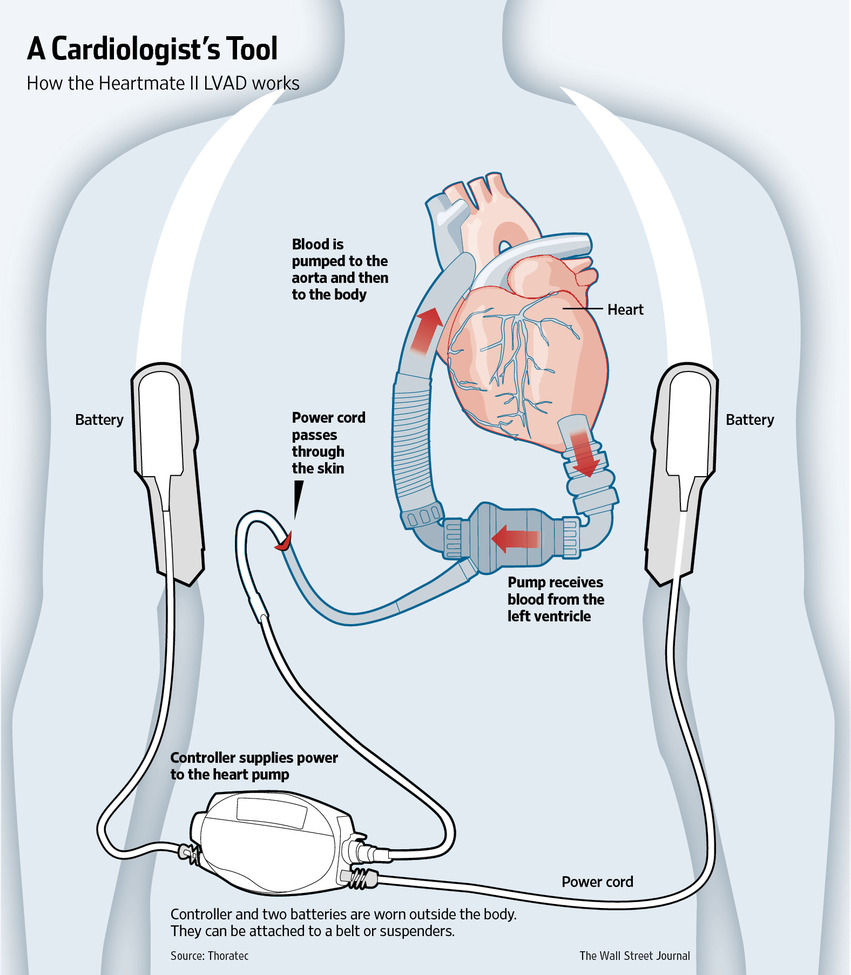
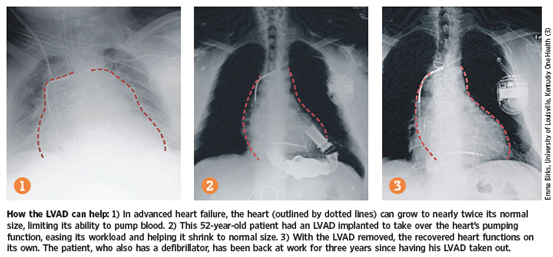
A mechanical pump that was invented as a temporary life support for patients with advanced heart failure is emerging as a potential tool to help hearts heal and function for the long term on their own. The device, called an LVAD, takes over most of the heart’s main pumping function and was designed initially to enable patients to survive until a donor heart became available for transplant. But doctors have discovered to their surprise that the heart can get better on the pump. When they remove it later to perform a transplant, the heart is sometimes dramatically improved. Read more of this post

Stress in Midlife Linked to Higher Risk of Alzheimer’s Disease

Stress in Midlife Linked to Higher Risk of Alzheimer’s Disease

Stress in middle age may contribute to development of Alzheimer’s disease later in life, according to a Swedish study spanning almost 40 years. Psychological stress was associated with a 21 percent greater risk of developing Alzheimer’s disease, according to a study of 800 Swedish women born between 1914 and 1930 who underwent neuropsychiatric tests periodically between 1968 and 2005. The research, led by Lena Johansson at the Sahlgrenska Academy at the University of Gothenburg was published today in the journal BMJ Open. Read more of this post

Japan’s luxury fruit masters grow money on trees

Japan’s luxury fruit masters grow money on trees

grapes_afp2

Monday, September 30, 2013 – 12:03

AFP

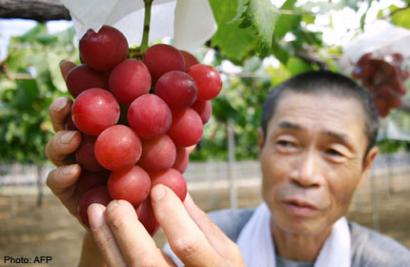
TOKYO – With melons that sell for the price of a new car and grapes that go for more than US$100 (S$125) a pop, Japan is a country where perfectly-formed fruit can fetch a fortune. An industry of fruit boutiques has defied Japan’s sluggish economy to consistently offer luscious and lavishly tended produce for hefty prices – and it is always in demand. In July, a single bunch of “Ruby Roman” grapes reportedly sold for 400,000 yen (S$5,100), making the plump, crimson berries worth a staggering 11,000 yen each. Every May, a pair of canteloupe melons grown in the north of Hokkaido is auctioned off. They regularly fetch the price of a modest new car. The hammer fell on this year’s pair at a cool 1.6 million yen. Read more of this post

What Does it Cost to Make an iPhone?

September 30, 2013, 11:52 AM

What Does it Cost to Make an iPhone?

BEN ROONEY

A 16GB iPhone 5S costs Apple Inc. $213 in materials, while a 16GB 5C comes in at $156, according to a report published Monday byUBS AGUBSN.VX -1.33%. The tear-down shows the big saving that the “unashamedly plastic” case of the 5C represents, coming in at $42 less than the aluminum body of the 5S. The other big saving is the $7 fingerprint sensor. Apple lists an unlocked 16GB iPhone 5S on its site at $649 and an iPhone 5C at $549. In a report of exacting detail, UBS estimates gross margins of around 50% for both devices. The report notes: Adding box contents, manufacturing, and non-BoM [Bills of Material] related costs, we estimate gross margins could ramp to 45-55% for the iPhone 5S and 48-54% for the iPhone 5C overtime as production scales and matures. In our view, non-component costs are likely to reach to approximately 33-40% of total device costs, largely driven by deprecation and software amortization expense. We estimate Apple’s depreciation expense is roughly $25 per device, accounting for the company’s sizable investments in non-leading edge production equipment. We assume Apple’s warranty accrual rate is 1.8% and manufacturing, including freight, to equal $18-20 per unit. The display, which UBS source to Samsung Display Co., LG Display034220.SE +0.39% Co and Sharp Corp.6753.TO -0.56% is the biggest cost (20% of 5S material costs, 27% for the 5C). UBS estimates it comes in at $42.11. The tear-down reveals is how intertwined suppliers and makers are. While Apple andSamsung Electronics Co.005930.SE +0.95%, Ltd. have been locked in a series of legal battles conducted around the world and fight each other for consumers, Samsung is a key part of Apple’s success in making its “retina display” screen. Apple also uses Sony Corp.’s6758.TO +0.14% sensor in its camera. Sony is fighting to be the number three handset maker by value in the world, behind Apple and Samsung.

Ngiam Tong Dow: On healthcare, F1 and politicians

On healthcare, F1 and politicians

What’s the challenge for Singapore as a medical hub? Is the F1 a “frivolous” use of taxpayers’ money? What do today’s younger politicians lack?

BY –

3 HOURS 28 MIN AGO

What’s the challenge for Singapore as a medical hub? Is the F1 a “frivolous” use of taxpayers’ money? What do today’s younger politicians lack? Outspoken former top civil servant Ngiam Tong Dow served as Permanent Secretary in the Prime Minister’s Office under Mr Lee Kuan Yew, as well as in various other ministries. As Chairman, concurrently, of the Economic Development Board, he had, in the 1980s, championed the idea of developing Singapore as an international medical centre to tap the region’s growing middle-class market. In line with that vision, medical school enrolment was increased. These are edited excerpts of a wide-ranging interview with Dr Toh Han Chong, Editor of SMA News, published in the September issue of the Singapore Medical Association’s newsletter. Read more of this post

Lessons from fallen financial idols

Lessons from fallen financial idols

Tuesday, Oct 01, 2013

Goh Eng Yeow

The Straits Times

As a financial writer who tries to help readers to understand the intricacies of the stock market, I have often turned to the folksy quotes of investment guru Warren Buffett to make my point. But let’s face it, most of us are not likely to have the patience to buy a stock and then hold it for decades like Mr Buffett. The likelihood is that if we make a decent profit on our investment, we will take the windfall and use the money to reinvest somewhere else. Read more of this post

Only Finland’s best become teachers

Only Finland’s best become teachers

Monday, September 30, 2013 – 17:09

Sandra Davie

The Straits Times

Some top scholars in Singapore would find it an unconventional career path but Finnish high-scorers Aurora Ojamaki, 21, and Aleksi Lindberg, 23, chose teaching over law. They graduated among the top 10 per cent of their cohort in high school, and could have easily gone on to law school. Instead, both applied several times before landing a place in a teacher-education degree course at Helsinki University, one of eight universities in Finland offering such a course of study. Ms Ojamaki said: “The first year I applied for a place in law, I got it but I turned it down as in my heart I wanted to become a teacher.” Read more of this post

The Vatican bank will publish a detailed annual report for the first time in its history today as it seeks to improve financial transparency after several corruption scandals

Vatican Bank to Publish 2012 Annual Report in Transparency Drive

The Vatican bank will publish a detailed annual report for the first time in its history today as it seeks to improve financial transparency after several corruption scandals. The bank, formally called the Institute for Works of Religion, or IOR, will release its 2012 full report at about 8 a.m. Rome time, giving a breakdown of its balance sheet and income statement. The Vatican bank earlier this year reported 2012 profit more than quadrupled to 86.6 million euros ($117 million), according to its website. Read more of this post

Vinamilk Sees Revenue Doubling in Overseas Expansion Push

Vinamilk Sees Revenue Doubling in Overseas Expansion Push

Vietnam Dairy Products Joint-Stock Co., the nation’s largest dairy producer, is building a milk factory in Cambodia as it plans a global expansion to more than double annual revenue to $3 billion by 2017. The company known as Vinamilk is opening a plant in the capital of Phnom Penh and will expand into other overseas markets over the next five years, Chairwoman and General Director Mai Kieu Lien said in an e-mailed statement yesterday. Read more of this post

Facebook, Google Live in Pinteresting Times

September 29, 2013, 7:33 p.m. ET

HEARD ON THE STREET: Facebook, Google Live in Pinteresting Times

ROLFE WINKLER

What do you get when you cross the advertising potential of Facebook FB -1.97%and Google GOOG -0.05% ? A social network, and likely revenue machine, called Pinterest. Facebook and Twitter for that matter have fast-expanding ad revenues not because users like to see ads, but because advertisers can’t ignore their large reach. Meantime, Google search results are an ideal spot to grab customers who already know what they are looking to buy. Pinterest, which is almost the social-networking equivalent of window shopping, sits somewhere in between. Read more of this post

Phony Web Traffic Tricks Digital Ads; As Online Marketing Budgets Soar, Fraudsters Skim Millions with ‘Botnets”

September 30, 2013, 7:30 p.m. ET

Phony Web Traffic Tricks Digital Ads

As Online Marketing Budgets Soar, Fraudsters Skim Millions with ‘Botnets”

CHRISTOPHER S. STEWART and SUZANNE VRANICA

OB-ZC436_Botwar_G_20130930212725

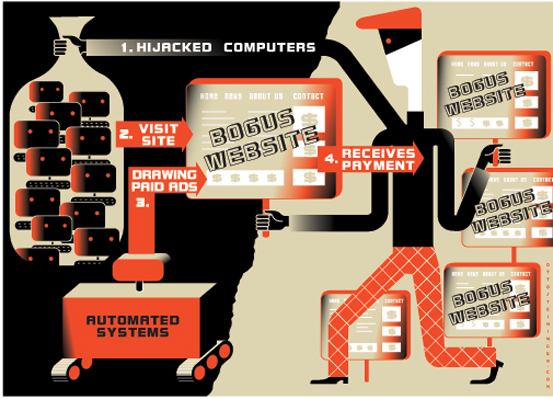
The website Songsrpeople.com looks a lot like other amateur-video sites. It is wallpapered with clips featuring “the most insane amusement park ever” and “your girlfriend’s six friends.” The site draws tens of thousands of visitors a month, according to audience measurement firms. It also has ads for national brands, including Target Corp.,TGT +0.06% Amazon.com Inc. AMZN -1.07% and State Farm. Read more of this post

Interrupting TV’s M&A Broadcast; Proposed Rule Change on How Broadcast Stations Are Treated Could Stymie the Recent Uptick in TV Consolidation

September 30, 2013, 5:11 p.m. ET

Interrupting TV’s M&A Broadcast

Proposed Rule Change on How Broadcast Stations Are Treated Could Stymie the Recent Uptick in TV Consolidation

MIRIAM GOTTFRIED

Broadcast stations may soon be sending a different signal. The Federal Communications Commission has opened a public comment period on a proposal that could make broadcast stations equal for the purpose of determining ownership caps. If adopted, it could put the brakes on the recent round of consolidation among station owners. A single company is currently prohibited from owning stations that, in aggregate, reach more than 39% of total TV households nationwide. But owners have been allowed to count only 50% of the TV households in their market areas toward the cap for stations broadcasting via ultrahigh frequency, or UHF, signals. Read more of this post

Time For a Samsung US Market Listing?

October 1, 2013, 9:29 AM

Time For a Samsung US Market Listing?

JONATHAN CHENG

For a few hundred dollars, a U.S. consumer can visit a local telecoms dealer and pick up a device manufactured bySamsung Electronics Co.005930.SE +0.88% But buying shares of the Korea-listed technology giant? Not so easy. That’s because Samsung, virtually alone among Asian tech giants with a global brand presence, doesn’t make its shares tradeable through American depositary receipts — instruments that allow stock in a non-U.S. company to trade, in greenbacks, on a U.S. exchange. Read more of this post

A New Challenge for Multinationals in China: Mao-era Politics

September 30, 2013, 1:53 p.m. ET

A New Challenge for Multinationals in China: Mao-era Politics

The ambitions of some of the world’s largest consumer brands in China are colliding with an unexpected new reality: hardball Mao-era politics.

ANDREW BROWNE

The ambitions of some of the world’s largest consumer brands in China are colliding with an unexpected new reality: hardball Mao-era politics. Increasingly, say China-based Western business executives, lawyers and consultants, a drive against alleged corporate price-fixing and corruption that has ensnared some of the biggest names in the global dairy and pharmaceutical industries has taken on a harsh political—and antiforeign—edge. Read more of this post

KKR to buy a 10 percent stake in appliance maker Qingdao Haier for 3.38 billion yuan ($552 million)

KKR Buys Stake in China Appliance Maker for $552 Million

KKR & Co. (KKR) agreed to buy a 10 percent stake in appliance maker Qingdao Haier Co. for 3.38 billion yuan ($552 million), the New York-based private-equity firm’s biggest investment in China. The Shanghai-listed unit of China’s largest appliance maker is selling 299.5 million shares at 11.29 yuan each to KKR in a private placement, the company said in a statement posted to the Shanghai Stock Exchange yesterday. That’s a 15 percent discount to the price on Sept. 12, the last day before Qingdao Haier suspended share trading pending an announcement. Read more of this post

Germans Think Small in China; Audi, BMW and Mercedes Are Speeding Up Plans to Offer Small Cars to Expand Sales

September 30, 2013, 4:17 p.m. ET

Germans Think Small in China

Audi, BMW and Mercedes Are Speeding Up Plans to Offer Small Cars to Expand Sales

COLUM MURPHY

MK-CG583_CSMALL_NS_20130930130307

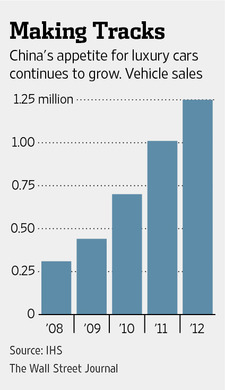
SHANGHAI—German luxury auto makers are speeding up plans to offer a wider selection of small cars and sport-utility vehicles in China, hoping to lure Chinese consumers unable to afford a larger luxury car, or affluent buyers who want a less-expensive second car. Small luxury cars are still an oxymoron to many wealthy Chinese, but industry executives say the risks—including lower profit margins—are worth it because of the growth expected in compact, premium-brand vehicles. Read more of this post

Asian smartphone makers seek to cut costs; Samsung now produces nearly 80 per cent of its handsets in Vietnam and China – roughly 40 per cent in each

October 1, 2013 1:41 am

Asian smartphone makers seek to cut costs

By Song Jung-a in Seoul

Leading Asian smartphone makers such as Samsung Electronics are racking their brains to come up with effective ways to protect market share and profit margins in the increasingly saturated global smartphone market. With three-quarters of people in the developed world owning a smartphone compared to only a fifth of those in more populous emerging markets, companies are expanding lower-priced product ranges to make their smartphones more affordable, while expanding production and procurement in lower-cost countries to save costs.

Read more of this post

Asia Losing $89 Billion a Year Failing to Recognize Women: Jobs

Asia Losing $89 Billion a Year Failing to Recognize Women: Jobs

At a booth in one of Manila’s biggest malls, 22-year-old Vanessa Tinitigan sells butter lip gloss from the U.S. and hair extensions from South Korea, part of a business she began at 16 that has made her the family’s main breadwinner. The self-taught entrepreneur, who also wholesales and exports fashion products, started her company, Purpektion Shop, as a schoolgirl with no formal financial education or access to funds. She now hires part-time workers to run stalls at bazaars and events. Read more of this post