Charlie Munger: Investment Practices of Leading Charitable Foundations

From the Vault: Charlie Munger on Institutional Funds Management

by VW StaffJune 02, 2014, 4:55 pm

Speech of Charlie Munger, Vice Chair, Berkshire Hathaway, at Miramar Sheraton Hotel, Santa Monica, CA, on October 14, 1998, to a meeting of the Foundation Financial Officers Group sponsored by The Conrad Hilton Foundation, The Amateur Athletic Foundation, The J. Paul Getty Trust, and Rio Hondo Memorial Foundation. Read more of this post

From Patent Thickets to Patent Networks: The Legal Infrastructure of the Digital Economy

From Patent Thickets to Patent Networks: The Legal Infrastructure of the Digital Economy

Jonathan Barnett 

USC Gould School of Law
May 1, 2014
Jurimetrics, 2014
USC CLASS Research Paper No. CLASS14-22
USC Law Legal Studies Paper No. 14-23

Abstract: 
Scholarly and popular commentary often assert that markets characterized by intensive patent issuance and enforcement suffer from “patent thickets” that suppress innovation. This assertion is difficult to reconcile with continuous robust levels of R&D investment, coupled with declining prices, in technology markets that have operated under intensive patent issuance and enforcement for several decades. Using network visualization software, I show that information and communication technology markets rely on patent pools and other cross-licensing structures to mitigate or avoid patent thickets and associated inefficiencies. Based on the composition, structure, terms and pricing of selected leading patent pools in the ICT market, I argue that those pools are best understood as mechanisms by which vertically integrated firms mitigate transactional frictions and reduce the cost of accessing technology inputs. Appropriately structured patent pools can yield cost savings for intermediate users, which may translate into reduced prices for end-users, but at the risk of undercompensating R&D suppliers.

 

The Effect of Forced Refocusing on the Value of Diversified Firms

The Effect of Forced Refocusing on the Value of Diversified Firms

John G. Matsusaka 

University of Southern California – Marshall School of Business; USC Gould School of Law

Yongxiang Wang 

University of Southern California – Marshall School of Business
April 25, 2014
USC Law Legal Studies Paper No. 14-20
USC CLASS Research Paper No. CLASS14-19

Abstract: 
This paper studies how investors responded when Chinese regulators required a group of large, publicly traded companies to divest their non-core hotel and real estate assets in 2010. The quasi-experiment allows direct estimates of the effect of diversification on value that are free from common selection problems in the literature. On average, stock prices rose 1 to 2 percent in response to forced refocusing, suggesting that corporate diversification was a value-destroying strategy for those firms. The implied “excess value/diversification discount” has at best a weak connection to the announcement return. The abnormal return was most positive for companies in which the ultimate controller had small cash flow rights, suggesting that investors were concerned with the possibility of tunneling.

Shadow Banking: Why Modern Money Markets are Less Stable than 19th c. Money Markets but Shouldn’t Be Stabilized by a ‘Dealer of Last Resort’

Shadow Banking: Why Modern Money Markets are Less Stable than 19th c. Money Markets but Shouldn’t Be Stabilized by a ‘Dealer of Last Resort’

Carolyn Sissoko 

USC Center for Law and Social Science
April 25, 2014
USC Law Legal Studies Paper No. 14-21
USC CLASS Research Paper No. CLASS14-20

Abstract: 
An important policy question that is currently being discussed by central bankers and academics is whether the “shadow” banking system should have a permanent backstop from the central bank akin to the extraordinary support that was provided by the Federal Reserve to the shadow banking system in 2008. I answer this question by (i) using a macroeconomic analysis of banking (ii) to explain the role played by the first lender of last resort in 19th c. Britain and (iii) applying this analysis to the modern shadow banking system. I conclude that because of its heavy reliance on collateralization, the shadow banking is a poor substitute for the traditional banking system and does not merit the support of a “dealer” of last resort.  Read more of this post

Taiwan urges China to face up to history of Tiananmen

Taiwan urges China to face up to history of Tiananmen

Tuesday, June 3, 2014 – 21:43

AFP

TAIPEI – Taiwan on Tuesday urged China to face up to history and protect the rights of dissidents on the eve of the 25th anniversary of the Tiananmen Square crackdown.

“The unfortunate history of the ‘June 4 incident’ cannot be forgotten and only by facing history can (China) heal the wounds, transform and move forward,” said the Mainland Affairs Council, Taiwan’s top policy-making body on China. Read more of this post

China defends Tiananmen crackdown on eve of 25th anniversary

China defends Tiananmen crackdown on eve of 25th anniversary

6:19am EDT

By Ben Blanchard

BEIJING (Reuters) – China defended the bloody 1989 crackdown on pro-democracy demonstrators around Beijing’s Tiananmen Square on Tuesday, the eve of the 25th anniversary, saying it had chosen the correct path for the sake of the people.

For the ruling Communist Party, the 1989 demonstrations that clogged Tiananmen Square in Beijing and spread to other cities remain taboo after the government termed the protests “counter-revolutionary”. Read more of this post

Nervous about borrowing, U.S. states and cities alter municipal bond landscape

Nervous about borrowing, U.S. states and cities alter municipal bond landscape

Mon, Jun 2 2014

By Lisa Lambert

WASHINGTON (Reuters) – U.S. cities and states are leery of borrowing more money despite near-record low interest rates, forcing bond funds to scour for investments and boosting returns on existing debt. Read more of this post

Samsung Everland IPO Signals Revamp of Largest Korea Chaebol

Samsung Everland IPO Signals Revamp of Largest Korea Chaebol

Samsung Everland Inc. said it will seek an initial public offering, adding to evidence that the founding family of South Korea’s largest conglomerate will restructure the group to retain control.

Everland, a theme park and zoo operator that’s also the de facto center of Samsung Group’s business empire due to a network of cross shareholdings, will seek an IPO by the first quarter of next year, spokesman Kim In Cherl said by phone today. Samsung SDS Co. said last month it plans to list shares while Samsung SDI Co., a supplier of batteries to Apple Inc., earlier this year agreed to buy affiliate Cheil Industries Inc.

Read more of this post

Misadventures of Alibaba, JD.com; Their US listing should lay to rest any argument that America champions good corporate governance

Misadventures of Alibaba, JD.com

by Mak Yuen Teen

Their US listing should lay to rest any argument that America champions good corporate governance

First published in Business Times, June 4, 2014

Mak Yuen Teen

WHEN the corporate governance of News Corp came under scrutiny after the phone hacking scandal in 2011, Nell Minow of GovernanceMetrics International (GMI), which rates the corporate governance of companies, was quoted (Financial Times, July 12, 2011) as saying: “We’ve consistently given News Corp an F, only because there is no lower grade.” Read more of this post

Start with a Theory, Not a Strategy; a theory about strategy: a mental model about how company could create value

Start with a Theory, Not a Strategy

by Todd Zenger  |   10:00 AM June 3, 2014

Well-crafted strategies are road maps to places that yield competitive advantage and generate value for the firm. But once you’ve arrived, they don’t take you anyplace else. That’s a problem for companies under continual pressure from investors to find new sources of competitive advantage.

I recently had lunch with the CEO of a large privately held corporation that illustrated this dilemma. After two decades of strong growth, he recognized that that his strategy had run its course. In the minds of his investors, his success was baked into his company’s current value and they wanted to know where he was going to find more. Read more of this post

Nestle wraps up unsuccessful tea venture in China

Nestle wraps up unsuccessful tea venture in China

Staff Reporter

2014-06-03

Nestle’s recent pullout from the tea market in China showed that even the world’s largest food company has difficulty operating in the country, reports the Chinese-language Innovative Finance Observation. Read more of this post

Why Do China’s Reforms All Fail? Throughout history, Chinese reformers have fallen short and met grisly ends. Why did they always fail?

Why Do China’s Reforms All Fail?

Throughout history, Chinese reformers have fallen short and met grisly ends. Why did they always fail?

By Yang Hengjun

May 30, 2014

Compared with the “revolutions” (peasant uprisings, armed rebellions, palace coups, etc.) that toppled dynasties in Chinese history, the goal of “reform” has been the exact opposite: to perpetuate the dynasty. Ordinary people have roughly the same impression of “revolution” and “reform” as instruments of “change.” But actually, in the 2000-year history of China, there has been one purpose for reform: avoiding change. Reform is used to keep the existing system in place. In Chinese history, “reform” and “revolution” alternated over time. Revolutions often succeeded, and so China became the country with the most peasant uprisings and dynastic changes in the world. But few reforms were successful. Read more of this post

Arresting China’s slowdown: the search for sustainable growth

Yukon Huang

June 3, 2014

Arresting China’s slowdown: the search for sustainable growth

There are no signs that China’s slowdown has bottomed out. A turnround would require some combination of a pickup in investment, exports or consumption in the midst of current efforts to deleverage and this is unlikely to happen soon. More than a decade ago during the Asian financial crisis, China was able to revive growth despite a similarly severe debt problem by tapping buoyant global markets facilitated by its accession to the World Trade Organisation. Read more of this post

Why Chinese Booze Costs More Than Fine Wine at Auction

Jun 3, 2014

Why Chinese Booze Costs More Than Fine Wine at Auction

With its strong flavor and fiery aftertaste, Kweichow Moutai isn’t for everyone. With prices for vintage bottles of the liquor spiraling upwards, it’s now for even fewer people.

On Sunday, at an auction hosted by Chinese auction house Beijing Googut Auction Co., 540 milliliter bottles of Moutai produced in the 1980s sold for between 60,000 yuan ($9,700) and 70,000 yuan ($11,300). That was up from between 50,000 and 60,000 yuan last year, and around 30,000 yuan at the end of 2012. Read more of this post

China’s economic boom leaves a trail of ghost cities

China’s economic boom leaves a trail of ghost cities

by Rob Schmitz

Monday, June 2, 2014 – 16:09

Nearly a year ago, I visited a replica of New York City under construction outside the Northern Chinese city of Tianjin. Workers were constructing dozens of skyscrapers on a piece of swampland inside a bend in the river, giving it an uncanny resemblance to the island of Manhattan. There were plans for a Lincoln Center, a Rockefeller center, and much more. Read more of this post

Chinese port stops metal shipments due to probe – trade sources

Chinese port stops metal shipments due to probe – trade sources

Mon, Jun 2 2014

By Melanie Burton

SYDNEY, June 2 (Reuters) – China’s northeastern port of Qingdao has halted shipments of aluminium and copper due to an investigation by authorities, causing concern among bankers and trade houses financing the metals, trading and warehousing sources said on Monday. Read more of this post

The Lives and Times of the CEO: From 100 years back to a quarter century ahead, the evolution of the chief executive officer

May 30, 2014 / Summer 2014 / Issue 75

Strategy & Leadership

The Lives and Times of the CEO

From 100 years back to a quarter century ahead, the evolution of the chief executive officer.

by Ken FavaroPer-Ola Karlsson and Gary L. Neilson

Imagine a chilly mid-November afternoon in 1914, shortly following the outbreak of World War I. The place: a sumptuous fifth-floor salon in the new Beaux Arts Renaissance Hotel in Chicago. The salon’s electric lamps have just been turned on. The room is decorated with red velvet couches, a long mahogany table, and deep Persian carpets. A fire crackles in the marble fireplace. Read more of this post

100-year-old beggar celebrated as living saint in Bulgaria

100-year-old beggar celebrated as living saint in Bulgaria

Monday, June 2, 2014 – 14:52

image001-5

AFP

SOFIA – A 100-year-old beggar in a threadbare coat, “Grandpa” Dobri, is already celebrated as a saint in Bulgaria – a symbol of goodness in a country ravaged by poverty and corruption.

For over 20 years, Dobri Dobrev has been begging on the streets of Sofia, collecting alms worth tens of thousands of euros. And he has given it all to the Bulgarian Orthodox Church. Read more of this post

Election fever hits Indonesia as candidates polarize netizens

Election fever hits Indonesia as candidates polarize netizens

Tuesday, June 3, 2014 – 10:08

The Jakarta Post/Asia News Network

INDONESIA – For those Indonesians uninterested in politics, logging in to Facebook or Twitter is a frustrating experience these days.

“I’ve limited my newsfeed to close friends,” Ira Hairida, a blogger from Palembang, South Sumatra, wrote on her Facebook wall. She said she was tired of people posting political statuses and verbally attacking the presidential contenders. Read more of this post

Gratitude begins at home; Why go to say, Cambodia, to assuage middle-class guilt? Students parachuting in will not have the time nor capacity to comprehend complex issues there

Gratitude begins at home

Monday, June 2, 2014 – 08:04

Melvin Singh

The New Paper

SINGAPORE – Why go to say, Cambodia, to assuage middle-class guilt? Students parachuting in will not have the time nor capacity to comprehend complex issues there. Surely ‘poor’ is not measured by the lack of air conditioning. Read more of this post

SEC not to recommend action against IBM on cloud revenue

SEC not to recommend action against IBM on cloud revenue

Mon, Jun 2 2014

(Reuters) – The U.S. Securities and Exchange Commission has completed its probe on how International Business Machines Corp reports revenue from its cloud computing business and does not intend to recommend any enforcement action, the company said.

The company did not provide details or reasons for the investigation.

The company said last July that it was facing an investigation from the Division of Enforcement of the SEC as to how it reported its cloud computing business revenue.

IBM reported $4.4 billion in revenue from its cloud computing business in 2013.

IBM shares closed at $185.69 on the New York Stock Exchange on Monday.

The fear factor: Why Asian firms need to take on the world

The fear factor: Why Asian firms need to take on the world

May 31st 2014 | From the print edition

image001-4 image002-4


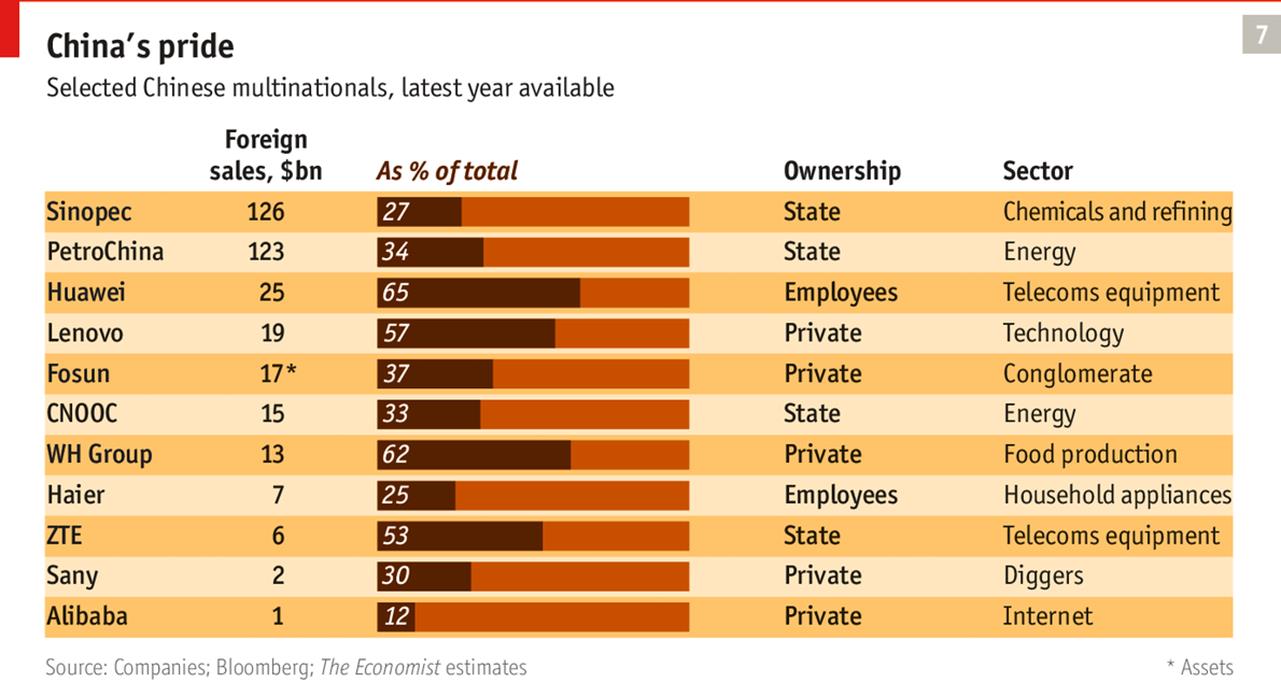
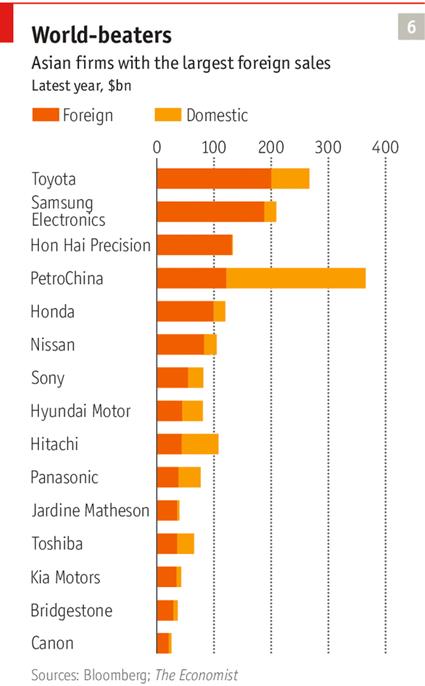
FUJIO MITARAI KNOWS more than most people about building a multinational. He is the 78-year-old boss of Canon, one of Japan’s biggest firms. Worth $43 billion, it makes everything from scanners to lenses for Hollywood. It first opened a New York office back in 1955, but breaking into America took 20 years of hard slog and an Apple-style innovation. In 1976 the company launched a cheap, automatic single-lens-reflex camera on the back of a massive advertising campaign. Mr Mitarai was in charge and the memory still makes him smile. “Our competitors thought I’d gone crazy.” Canon became America’s biggest camera firm. Today it faces competition from smartphones and low-cost rivals. Mr Mitarai insists innovation will keep the firm ahead of the pack. It is developing a raft of new products, from surveillance cameras to virtual-reality design studios and 3D printing materials. Read more of this post

Hutchison Whampoa: Now for the fat-cow years; Lessons in survival from an Asian corporate legend

Hutchison Whampoa: Now for the fat-cow years; Lessons in survival from an Asian corporate legend

May 31st 2014 | From the print edition

IF YOU WANT to hear some plain talk on the relative merits of family-controlled conglomerates, listen to Canning Fok, managing director of Hutchison Whampoa, one of the region’s biggest specimens with a value of $60 billion and a worldwide empire of ports, energy, property, telecoms and retail. “There’s a school of thought in America that widely held companies have better governance,” he says. “But if you look over the last ten years that has not happened. Just look at the big banks and all the chief executives going crazy.” Read more of this post

Get up and dance: China Mobile, a state-owned giant, is having to reinvent itself

Get up and dance: China Mobile, a state-owned giant, is having to reinvent itself

May 31st 2014 | From the print edition

THROUGH THE SMOG in Beijing’s Financial Street you can see the glass-and-steel headquarters of many of China’s giant state-owned-enterprises (SOEs). The flash buildings are a statement of might, but inside them the mood is more of anxious self-reinvention. Most SOEs are in fast-changing industries, and since last year China’s government has made clear that it wants them to become more market-orientated and more competitive. As a result, some of these organisations now face the largest transformation in corporate history. Read more of this post

Governance: Avoiding the dinosaur trap; State firms and family conglomerates are Asia’s favourite kinds of companies. Both must change

Governance: Avoiding the dinosaur trap; State firms and family conglomerates are Asia’s favourite kinds of companies. Both must change

May 31st 2014 | From the print edition

ASIA IS A land never conquered by institutional shareholders. Only 28% of the region’s stockmarket consists of firms with diverse owners (see chart 4). Most of these are in Japan, where businesses are controlled by managers and employees who by long-established protocol politely listen to and then ignore what fund managers say. State-run firms make up 40% of Asia’s total and family-run firms, often conglomerates or “business houses”, account for 27%. The proportions vary from country to country (see chart 5). In China state-run firms dominate, whereas in South Korea and India business houses are prominent. All this has been true for a long time and it is tempting to think it will never change. That would be a mistake.

image001-2 image002-2 Read more of this post

How to keep roaring: Over the past two decades Asia’s companies have enjoyed huge success. But now they need to reform to become brainier, nimbler and more global

How to keep roaring: Over the past two decades Asia’s companies have enjoyed huge success. But now they need to reform to become brainier, nimbler and more global, says Patrick Foulis

May 31st 2014 | From the print edition

image001 Read more of this post

Convergence: Asian and Western business will become more alike

Convergence: Asian and Western business will become more alike

May 31st 2014 | From the print edition

ASIA PROSPERED OVER the past two decades by following a different economic model from the West’s. But if it wants to continue to do well over the next 20 years, it will have to reform. What that involves will vary from place to place. Myanmar, a big country with a difficult past, is beginning to pull itself out of the mire. India and Indonesia, two chaotic democracies, have to create enough order to attract factories and industrial jobs. In China the government needs to ease its grip on the economy. Japan is embarking on the world’s biggest experiment to see whether a society can shrink and still remain prosperous. Read more of this post

Megatrends Q & Asia: A handful of Asian conundrums the world’s boardrooms should chew over

Megatrends Q & Asia: A handful of Asian conundrums the world’s boardrooms should chew over

May 31st 2014 | From the print edition

OVER THE PAST decade innumerable PowerPoint presentations have condensed Asia into two bullet points. One is its rise as a vast consumer market. About 30% of the world’s middle-class spending is done by Asians, up from 20% in 2000, according to the Brookings Institution, a think-tank, which defines the middle class as those earning $10-100 a day at purchasing-power parity. The other is Asia as a production hub: 47% of world manufacturing is now in the region. But the world’s boardrooms have started to grapple with a much broader set of questions about Asia. The most immediate ones are higher labour costs and ageing populations, growing consumer expectations and the way the internet will affect business there. A rising risk of hostilities in the region is adding further complexity. And in the background looms the broader issue of whether, and if so how much, Asian companies need to globalise (which will be dealt with later in this special report). Read more of this post

What sets these self-driving vehicles really apart is the lack of controls that have been part of every car produced since the dawn of the horseless carriage

Self-driving cars

Handless carriage

Jun 2nd 2014, 11:28 by P.E. | DETROIT

IT HAS long been the stuff of science fiction, but autonomous driving is about to steer a lot closer to reality when Google begins testing a fleet of self-driving cars later this year. The move positions Google as one of the leaders in the field, but virtually every big car maker is now working on similar technology. Last year, for instance, Nissan announced it wants to put its first fully autonomous vehicle into production by 2020. Yet most of the incumbents take a more incremental approach than Google. Read more of this post

An international liquefied natural gas market is developing. Buyers will gain more than sellers

An international gas market is developing. Buyers will gain more than sellers

May 31st 2014 | From the print edition

SQUEEZING and cooling gas until it becomes a liquid, and then shipping it by tanker, is inherently costlier than sending it down a pipeline. But 50 years since the first shipment left Algeria, liquefied natural gas (LNG) is no longer exotic, complicated or marginal. For the past two years the global LNG trade has been in a flat spot, with little new supply. But on May 25th Exxon Mobil said it had shipped its first cargo from a $19 billion project in Papua New Guinea (pictured on the next page), the first in a wave of new LNG supplies that are about to come to market. Read more of this post