KuaPay is banking on China to fatten its share of the mobile wallet market

KuaPay is banking on China to fatten its share of the mobile wallet market

By Tim Fernholz @timfernholz August 4, 2013

The mobile wallet business is crowded and tough to navigate, but Kuapay has a solution: find a monopolist and partner up. In 2014, the company will begin working with China UnionPay, the country’s sole payment processor, to tap into the sought-after Chinese market, which has more mobile users than any in the world. The big problem with using your cell phone to pay for physical purchases is that it’s hard to beat cash and credit cards for convenience. That means most mobile wallet businesses live and die with their partners—financial institutions, telecoms or merchants—which can put mobile wallet products in front of consumers, and give them a reason to use them with discounts and incentives. For an example, look no further than Square’s mobile wallet, which partnered with Starbucks to score a $25 million investment and placement in 7,000 locations in the US. Kuapay, which allows you to use your credit cards through a single, secure mobile app, lags behind its competitors, at least in the United States, where only 600 merchants are equipped to take its payments. But the company also has a presence in Spain, and in Chile, where CEO Joaquin Ayuso de Paul says it is the “official” mobile payments provider. What does that mean? It means that unlike in the US, where payment processors proliferate, in Chile the country’s payment processor has a monopoly, and Kuapay is its mobile wallet solution. Read more of this post
T.J. Maxx, others look past chaos to e-commerce bonanza

T.J. Maxx, others look past chaos to e-commerce bonanza

Sun, Aug 4 2013

By Phil Wahba

NEW YORK (Reuters) – Low-price retailer T.J. Maxx plans to open an online store this year, as does rival Saks Inc’s Off Fifth outlets, making 2013 the year technology may have caught up with the speed of fashion. For such chains, which feature clearance items, last-year’s fashions and overruns, their fast-moving and often unpredictable inventory has made selling goods over the web complex. “Retail is chaotic. Off-price retail is even more chaotic,” said Fiona Dias, a leading e-commerce expert and chief strategy officer at ShopRunner. Read more of this post

Korea’s major accounting firms are engaged in a cutthroat battle to attract more corporate clients given that most of their current contracts with some of the leading Korean conglomerates are scheduled to expire next year

2013-08-04 18:20

Accounting firms vying for survival

By Na Jeong-ju
The nation’s major accounting firms are engaged in a cutthroat battle to attract more corporate clients given that most of their current contracts with some of the leading Korean conglomerates are scheduled to expire next year. Industry sources say that more than 500 companies, including Samsung, POSCO, Doosan, CJ and KB, will decide on whether to renew their current accounting contracts with the same firms or find different accounting firms for fresh contracts. The planned implementation of new accounting standards is making the competition even fiercer. Read more of this post

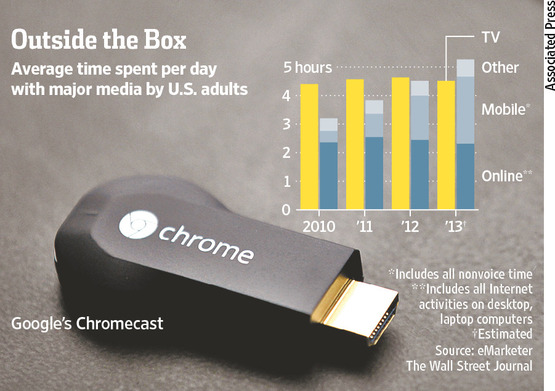
Shiny Chromecast Could Dim Cable TV; Chromecast offers a window into Google’s vision of making the Internet a platform for TV

August 4, 2013, 4:59 p.m. ET

Shiny Chromecast Could Dim Cable TV

Chromecast offers a window into Google’s vision of making the Internet a platform for TV.

MIRIAM GOTTFRIED

MI-BX631_CHROME_G_20130804173609

Even a simple innovation can sometimes help tip the scales toward revolution. Google, GOOG +0.26% along with technology peers like Intel, Apple and Microsoft, is vying to shape the future of TV. Its latest gambit: the introduction of Chromecast, a $35 device that plugs into a TV and allows users to view content from mobile devices or computers on the big screen. On its own, Chromecast won’t suddenly upend the bundled-TV business model. For now, only Internet content and video from YouTube, Netflix NFLX -1.18% and the Google Play store can be watched via the device. And it doesn’t include sports or live programming. Read more of this post

Future of Cable Might Not Include TV

August 4, 2013, 7:38 p.m. ET

Future of Cable Might Not Include TV

At Cablevision, Broadband Could Become Primary Offering Eventually

SHALINI RAMACHANDRAN And MARTIN PEERS

Predicting that transmission of TV will move to the Internet eventually, Cablevision Systems Corp. CVC +5.20% Chief Executive James Dolan says “there could come a day” when his company stops offering television service, making broadband its primary offering. His comments may be the first public acknowledgment by a cable CEO of the possibility of such a shift, long speculated about by analysts. It comes amid growing tensions between cable operators and channel owners over rising programming costs, highlighted Friday night when Time Warner Cable Inc. TWC -0.49% dropped CBS from its channel lineup in major markets such as New York and Los Angeles.

Read more of this post

China Mobile launches own-brand smartphones

China Mobile launches own-brand smartphones

English.news.cn   2013-08-03

By Shen Jingting

BEIJING, Aug. 3 (Xinhuanet) — China Mobile Ltd officially entered the booming mobile terminal market on Friday as it unveiled its own-brand smartphone models. The China Mobile M701, a 5-inch screen Android-based smartphone equipped with MediaTek Inc’s 1.2-gigahertz quad-core processor, is priced at 1,299 yuan ($212). The China Mobile M601 is a 4-inch screen, dual-core Android smartphone that targets lower-end users with a price of 499 yuan. The two smartphones are produced by original equipment manufacturers, Hisense Group and Shenzhen-based BYD Co Ltd, respectively. They will hit the Chinese market through China Mobile’s online and offline outlets this month. Read more of this post

Baby Formula Brands Admit Possible Price Violation; Mead Johnson is the largest baby formula company in China with a 14% market share; Beingmate ranked second with a 10% share, followed by Danone’s 9.2%

Baby Formula Brands Admit Possible Price Violation, Xinhua Says

By Bloomberg News – Aug 4, 2013

Infant-formula companies being probed in China have broadly admitted that their resale prices may have violated rules, the official Xinhua News Agency reported, citing an official in the National Development Reform Commission. The official, Xu Kunlin, head of the regulatory body’s pricing supervision department, didn’t name the dairy companies who admitted to price violations, according to the news report. Mead Johnson Nutrition Co. (MJN), Danone, Nestle SA (NESN), Abbott Laboratories (ABT), Royal FrieslandCampina NV and domestic manufacturer Biostime International Holdings Ltd (1112) were being probed on pricing, the official People’s Daily reported on July 2. The investigation offered a window into how government scrutiny in China can create obstacles for overseas companies expanding there. Read more of this post

Toyota’s $37 Billion Cash Pile Means Turning Point for Abenomics; Auto Maker pulled off the unlikely feat of nearly doubling profit while selling fewer cars

Toyota’s $37 Billion Cash Pile Means Turning Point for Abenomics

AM-AZ707_JAPANH_NS_20130804053005

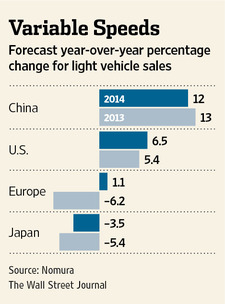
Prime Minister Shinzo Abe has been urging Japan’s companies to spend their growing piles of money to bolster the country’s economy. Toyota Motor Corp. (7203), with cash swelling to about $37 billion, is beginning to comply. The carmaker said on Aug. 2 that net income almost doubled to 562.2 billion yen ($5.7 billion) last quarter — more than General Motors Co. (GM) and Volkswagen AG (VOW) combined — as U.S. sales rose and the weaker yen boosted overseas profit. Cash and marketable securities rose 11 percent and totaled the most of any non-bank in Japan, according to data compiled by Bloomberg. Read more of this post

Is Japan’s Beer Market Set to Fizz on Abenomics?

August 5, 2013, 9:22 AM

Is Japan’s Beer Market Set to Fizz on Abenomics?

Top of Form

By Hiroyuki Kachi

Japan’s long-stagnant beer market may have finally started picking up in the wake of Prime Minister Shinzo Abe’s pro-growth economic policies, known as “Abenomics.” But it’s hard to be sure just yet, given that shipments actually fell in the first half of 2013. The first true test of whether Abenomics is putting a head of foam on the beer industry will be when figures for the peak beer-drinking month of July come out Aug. 12. From January to June, overall beer shipments for Japan’s five top brewers declined 0.9% from a year earlier. Shipments have languished more than 20% off their 1994 peak as the population ages and consumer demand has diversified. Still, the country’s two biggest brewers, Asahi Group Holdings 2502.TO -0.90% andKirin Holdings Co. 2503.TO -0.26%, last week reported solid operating profit gains for the first six months of the year. But most of the gains were attributable to the weaker yen, which lifted the value of their overseas operations. Weak beer sales at home failed to put any extra fizz in their bottom lines. Read more of this post

Meaning Is Healthier Than Happiness

Meaning Is Healthier Than Happiness

By Emily Esfahani Smith, AUG 1 2013, The Atlantic

happybuddahmain

For at least the last decade, the happiness craze has been building. In the last three months alone, over 1,000 books on happiness were released on Amazon, including Happy Money, Happy-People-Pills For All, and, for those just starting out, Happiness for Beginners. One of the consistent claims of books like these is that happiness is associated with all sorts of good life outcomes, including — most promisingly — good health. Many studies have noted the connectionbetween a happy mind and a healthy body — the happier you are, the better health outcomes we seem to have. In a meta-analysis (overview) of 150 studies on this topic, researchers put it like this: “Inductions of well-being lead to healthy functioning, and inductions of ill-being lead to compromised health.”

But a new study, just published in the Proceedings of the National Academy of Sciences (PNAS) challenges the rosy picture. Happiness may not be as good for the body as researchers thought. It might even be bad. Of course, it’s important to first define happiness. A few months ago, I wrote a piece called “There’s More to Life Than Being Happy” about a psychology study that dug into what happiness really means to people. It specifically explored the difference between a meaningful life and a happy life. Read more of this post

Apple’s ‘Mission Statement’ Is Making People Worry That The Company Has Gone To Hell

Apple’s ‘Mission Statement’ Is Making People Worry That The Company Has Gone To Hell

HENRY BLODGET AUG. 3, 2013, 11:41 AM 16,896 34

Where are we headed, Tim?

A tech-industry insider sent us the note below highlighting what Apple’s web site is describing as the company’s “mission statement.” The executive’s reaction to this mission statement was not positive. He took it as a sign that Apple has changed fundamentally — and for the worse — since Steve Jobs died. I don’t know what Apple’s official mission statement was when Steve Jobs was alive – but I’d be shocked if it was this pathetic piece of generic corporate mumbo jumbo drivel. It’s almost as if Tim Cook hated Jobs. The “mission statement” the executive was referring to is the paragraph below, which can be found on Apple’s investor relations site and at the bottom of Apple press releases: What is Apple’s mission statement?

Apple designs Macs, the best personal computers in the world, along with OS X, iLife, iWork and professional software. Apple leads the digital music revolution with its iPods and iTunes online store. Apple has reinvented the mobile phone with its revolutionary iPhone and App Store, and is defining the future of mobile media and computing devices with iPad.

If that really is Apple’s “mission statement,” it is indeed pretty lame. It’s not a mission statement so much as a list of product lines. And it would be hard to imagine a less-inspiring, more prosaic description of what Apple is (or used to be) all about. Read more of this post

The future of TV; Netflix, Google, Apple, and Intel think they can remake the industry, but there’s a lot of money and brain-power standing in their way

SATURDAY, AUGUST 3, 2013

Don’t Touch That Dial

By ALEXANDER EULE | MORE ARTICLES BY AUTHOR

Netflix, Google, Apple, and Intel think they can remake the industry, but there’s a lot of money and brain-power standing in their way.

BA-BC573I_futur_NS_20130803020905 ON-BB729_TV0805_G_20130803022940

Netflix is having a good summer. The Internet streaming service garnered 14 Emmy nominations last month, including a Best Actor nod for House of Cards star Kevin Spacey. Four days later, the company announced that U.S. subscribers to its video-streaming service hit 30 million.

Netflix shares (ticker: NFLX) are up 170% on the year, making them the best performer in the S&P 500. But it’s the future of TV that investors are really excited about, and Netflix is not shy about putting itself in the center, declaring on its Website, “Over the coming decades and across the world, Internet TV will replace linear TV….As Internet TV grows from millions to billions, Netflix is leading the way.” Read more of this post

Is It Possible to Recover from Autism? New research says yes, but how to spark recovery remains a mystery

Is It Possible to Recover from Autism?

New research says yes, but how to spark recovery remains a mystery

By Jennifer Richler  | Monday, July 29, 2013 | 11

When I was training to be a clinical psychologist, telling parents that their child had autism was a regular part of my job. Now that I’m a parent, I understand better the pained expression that came over their faces as they contemplated this news. Among the many questions taking shape in their minds, I can imagine the one looming largest: Could their child ever be like other children?

A recent study, published in February in the Journal of Child Psychology and Psychiatry, suggests that for some people, the answer is yes. The researchers found that some individuals who had been diagnosed with autism as young children no longer had symptoms—such as difficulty interacting and communicating with others, rigid adherence to rituals and routines, and repetitive movements of their bodies and objects—when they were older. Read more of this post

Billions are being spent to pack business-class seats with engineering innovations and fancy features.

August 3, 2013

The Race to Build a Better Business Class

By JAD MOUAWAD

IN a confidential test lab in a remote office park near the Frankfurt airport, a small Lufthansa team holed up for five years, refining one of the German airline’s most closely guarded secrets. They called it the V concept. Six feet six inches long and almost two feet wide, the V concept is the German carrier’s latest weapon in the fierce competition among global airlines. It is designed to withstand shocks 16 times the force of gravity and comes with a cozy padded footrest. It is a new business-class seat, and if you are traveling round trip from Frankfurt to New York, it can be yours for about $5,000. “Business class is where competition really is serious,” says Björn Bosler, the airline’s manager for passenger experience design, business and premium, who led Lufthansa’s team of dozens of seat designers and engineers. Bob Lange, senior vice president, head of market and product strategy at Airbus, the European plane maker, agrees: “There’s an arms race going on among carriers.” Billions are being spent on research and development, architects, industrial designers and even yacht designers to pack seats with engineering innovations and fancy features. Just fabricating a single business-class seat can cost up to $80,000; custom-made first-class models run $250,000 to $500,000. Read more of this post

China’s third-party payment market had total transactions reaching US$1.127tn in the first half of 2013; China UMS is the leader in the nation’s third-party payment industry, taking a market share of 46.3%, followed by Alipay with 17.8%

Third-party payment market in China worth RMB7tn so far this year

Liao Kuei-ju and Staff Reporter

2013-08-04

In the first half of 2013, China’s third-party payment market had total transactions reaching 6.91 trillion yuan (US$1.127tn), already achieving 66% of last year’s total, our sister paper Commercial Times reports, citing the China Electronic Information Industry Development Institute. The mainland is seeing slowing economic growth but its e-commerce industry has outperformed, with sales jumping more than 100% a year. To grab a slice of the pie, international credit card giant Visa in April began its certification program for third-party payment companies. On Aug. 1, Chinese third-party payment company Tenpay announced it will begin offering secure third-party payment services for international credit cards immediately. Read more of this post

Damned lies and statistics: Fraud generates RMB300bn (US$48.9 billion) a year in China

Damned lies and statistics: Fraud generates RMB300bn a year in China

Weng Lu-yi and Staff Reporter

2013-08-04

Which industry is the most profitable in China? The answer is neither the financial sector nor real estate, but the cheating industry. The money earned through fraudulent means exceeds 300 billion yuan (US$48.9 billion) a year. In 2008, police cracked down on two illegal pyramid schemes in Hebei who swindled funds in excess of 100 million yuan (US$16.3m). In the same year, authorities in Shandong province also busted an illegal pyramid scheme involving tens of thousands of people across 20 provinces. The company had ended up defrauding victims out of 890 million yuan (US$145m) in total. Read more of this post

What’s in your small-cap fund? Try Boeing or Pfizer

What’s in your small-cap fund? Try Boeing or Pfizer

8:01am EDT

By David Randall

NEW YORK (Reuters) – Investors in small-cap funds may be in for a big surprise. Many portfolio managers hold heavyweight stocks like Verizon Communications, Boeing and Pfizer in funds that claim to focus almost exclusively on shares of small-capitalization companies. Overall, 211 out of the 476 actively managed small-cap funds tracked by Lipper own companies with market capitalizations of $10 billion or more. That is more than twice the size of companies that Lipper defines as the focus of small-cap funds. Investors in these actively managed funds – which include those from such well-known firms as Gabelli, Charles Schwab and T. Rowe Price – have several reasons to worry, fund experts and financial advisers say. Read more of this post

Three Differences Between Managers and Leaders: Counting value vs Creating value; Leading people vs Managing work

Three Differences Between Managers and Leaders

by Vineet Nayar  |  10:01 AM August 2, 2013

A young manager accosted me the other day. “I’ve been reading all about leadership, have implemented several ideas, and think I’m doing a good job at leading my team. How will I know when I’ve crossed over from being a manager to a leader?” he wanted to know. I didn’t have a ready answer and it’s a complicated issue, so we decided to talk the next day. I thought long and hard, and came up with three tests that will help you decide if you’ve made the shift from managing people to leading them.

Counting value vs Creating value. You’re probably counting value, not adding it, if you’re managing people. Only managers count value; some even reduce value by disabling those who add value. If a diamond cutter is asked to report every 15 minutes how many stones he has cut, by distracting him, his boss is subtracting value. By contrast, leaders focuses on creating value, saying: “I’d like you to handle A while I deal with B.” He or she generates value over and above that which the team creates, and is as much a value-creator as his or her followers are. Leading by example and leading by enabling people are the hallmarks of action-based leadership. Read more of this post

China Policy Lender Reprimands Bankers for Playing Golf during work hours

China Policy Lender Reprimands Bankers for Playing Golf

China Development Bank Corp., the world’s largest policy lender, reprimanded bankers for playing golf during work hours as the Communist Party cracks down on extravagance by officials and state-owned company executives.

The lender investigated the issue after receiving tips from the public, according to an article by the Communist Party’s official People’s Daily newspaper that was posted to China Development Bank’s website. The bankers involved have been “solemnly criticized,” it said. Read more of this post

South Africa’s Post-Apartheid Failure in Shantytowns

South Africa’s Post-Apartheid Failure in Shantytowns

Cecily Ghall speaks with pride about the neat, whitewashed two-room shack she built in an acquaintance’s backyard using scrap wooden planks and asbestos plates. It’s warm and — important in the midst of a wet South African winter — dry, she says. But it isn’t hers. Ghall, 47, has waited for a government-provided home since 2008, when she and her daughter Deonie, then 13, moved to Kurland Village, a predominantly mixed-race settlement of about 2,000 residents. Less than 10 miles (16 kilometers) away is Plettenberg Bay, a seaside resort where homes selling for more than 15 million rand ($1.5 million) are common. “I don’t know how they decide who gets a house,” said Ghall, who works part-time as a domestic servant. “I’ve been on the waiting list all this time, but I never hear anything. In the meantime, I have to live in someone’s backyard and I can get kicked out at any time.” Read more of this post

South Korea’s students rank among the best in the world, and its top teachers can make a fortune. Can the U.S. learn from this academic superpower?

August 2, 2013, 7:05 p.m. ET

The $4 Million Teacher

South Korea’s students rank among the best in the world, and its top teachers can make a fortune. Can the U.S. learn from this academic superpower?

AMANDA RIPLEY

RV-AL211_TEACHE_DV_20130802162509

Kim Ki-Hoon, who teaches in a private after-school academy, earns most of his money from students who watch his lectures online. ‘The harder I work, the moreImake,’ he says. ‘I like that.’

Kim Ki-hoon earns $4 million a year in South Korea, where he is known as a rock-star teacher—a combination of words not typically heard in the rest of the world. Mr. Kim has been teaching for over 20 years, all of them in the country’s private, after-school tutoring academies, known as hagwons. Unlike most teachers across the globe, he is paid according to the demand for his skills—and he is in high demand. Mr. Kim works about 60 hours a week teaching English, although he spends only three of those hours giving lectures. His classes are recorded on video, and the Internet has turned them into commodities, available for purchase online at the rate of $4 an hour. He spends most of his week responding to students’ online requests for help, developing lesson plans and writing accompanying textbooks and workbooks (some 200 to date). “The harder I work, the more I make,” he says matter of factly. “I like that.” Read more of this post

Japan has not learnt the lessons of its lost decade

August 1, 2013 4:20 pm

Japan has not learnt the lessons of its lost decade

By Peter Tasker

Success is more likely if monetary and fiscal policy pull together, writes Peter Tasker

Debate is heating up in Tokyo about the advisability of increasing Japan’s consumption tax. Which should come first – economic growth or fiscal reconstruction? The prime minister must decide in a matter of weeks. I’m sitting in a Roppongi bar discussing the subject with a knowledgeable Japanese bureaucrat. “It’s essential to raise taxes,” he says, cradling a well-aged Islay malt. “If we don’t, investors will lose confidence and our bond market will collapse.” “Aren’t you risking a serious recession?” I asked. He replied: “A temporary blip, maybe. But the strengthening of public finances will be good for future growth.” The year was 1997. The Asian crisis was already in full swing. Japan’s own banking system was on the brink of collapse. Yet officials had convinced the prime minister of the day, the popular and dynamic Ryutaro Hashimoto, that raising taxes on consumers was a priority. Read more of this post

Indonesia’s consumer and natural resources boom falters

Last updated: August 2, 2013 12:53 pm

Indonesia’s consumer and natural resources boom falters

By Ben Bland in Jakarta

Mitra Adiperkasa, the retail group that operates Burger King, Zara and a host of other international food and fashion brands in Indonesia, has ridden the wave of middle-class consumption that transformed Southeast Asia’s biggest economy into one of the world’s hottest emerging markets. But the group is scaling back its expansion plans and capital expenditure next year, for the first time since 2009, as Indonesian companies contend with problems including rising inflation and slowing Chinese growth. “The main challenge for us is rising costs,” says Fetty Kwartati, head of investor relations at Mitra Adiperkasa, with salary and rental expenses increasing more quickly than sales. The company plans to open 60,000-70,000 square metres of new space next year, down from 90,000 square metres this year. Read more of this post

Unrated bond issues double in Europe

August 1, 2013 5:11 pm

Unrated bond issues double in Europe

By Christopher Thompson

The number of European companies without investment ratings tapping capital markets for funding has doubled as investors throw caution to the wind in their hunt for yield.

Bond issuance by unrated companies -–or those without investment ratings which measure credit quality – has totalled about €108bn since the beginning of 2010, driven by yield-hungry investors, low interest rates and a dearth of bank finance, according to research by Fitch. Read more of this post

With An Astounding $6 Billion Valuation, ServiceNow Has Become ‘The Next Salesforce.com’

With An Astounding $6 Billion Valuation, ServiceNow Has Become ‘The Next Salesforce.com’

JULIE BORT AUG. 2, 2013, 4:32 PM 2,648

It’s been over a year since ServiceNow’s IPO practically saved the post-Facebook IPO market single-handedly. In June 2012, with an opening share price of $18, the company had a jaw-dropping valuation of over $2 billion. (It was originally priced at $17 the night before the IPO.) And it and hadn’t even hit annual revenues of $100 million. Fast forward to this week: ServiceNow’s shares are trading at about $45, giving it a nearly $6 billion valuation. That makes it the fifth most valuable company in Bessemer Venture Partners new “Cloud Index” that tracks the 30 biggest software-as-a-service public cloud companies. At the time of its IPO, ServiceNow, which offers cloud apps that automate the help desk function for enterprises, was considered proof that the tech industry was in another bubble. But, it turns out, it was proof that ServiceNow is the next Salesforce.com, CEO Frank Slootman told Business Insider. Read more of this post

One Of The World’s Biggest Mobile Ad Companies Is In Huge Trouble And Has Stopped Paying Its Bills

One Of The World’s Biggest Mobile Ad Companies Is In Huge Trouble And Has Stopped Paying Its Bills

JIM EDWARDS AUG. 2, 2013, 10:46 AM 5,244 2

We first told you that Velti, the little-known but relatively massive mobile ad company, was in trouble back in June, when we demoted CEO Alex Moukas to 10th place on our annual ranking of the most important people in mobile advertising. The reason? The company cut about 300 of its 1,100+ jobs after Q1 2013 revenue collapsed 20% to $41 million. Velti is in the middle of a restructuring. Its stock, which once traded above $10, is now at $1.08. Its COO, Christos Kaskavelis, has been terminated. The company’s market cap is now less than its projected annual revenues. Read more of this post

The New York Times Company did the world of journalism a big favor today by finally disclosing the exact revenues of its digital business.

IT’S OFFICIAL: We Never Need To Worry About The Future Of Journalism Again!

HENRY BLODGET AUG. 1, 2013, 6:15 PM 10,620 24

The New York Times Company did the world of journalism a big favor today. The company finally disclosed the exact revenues of its digital business. The numbers were impressive. And they made clear that no one ever needs to fret about the future of journalism again. Specifically, the New York Times reported that the revenue of its digital business is now about $360 million a year. That’s composed of about $200 million of advertising revenue, which is basically flat, and another $150 million of digital subscription revenue, which is growing nicely. Assuming the digital subscription revenue continues to grow as the company rolls out new subscription products, which it will start to do next April, the New York Times Company should soon have a $400 million digital business. Why does that mean we never have to worry about the future of journalism again? Because a $400 million digital business is a healthy business, one that will support a large, talented newsroom. Even if the New York Times’ print paper, which still generates most of the company’s overall revenue of about $2 billion a year, were to shut down tomorrow, the company would still be able to fund an excellent newsroom. Read more of this post

Movie fans who were intrigued by director Peter Jackson’s use of high frame rates in “The Hobbit” are now getting a chance to see the superclear format online.

High frame rates debut online with special player

BY RYAN NAKASHIMA

AP

AUG 2, 2013

BURBANK, CALIFORNIA – Movie fans who were intrigued by director Peter Jackson’s use of high frame rates in “The Hobbit” are now getting a chance to see the superclear format online. The second season of the YouTube Web series “Video Game High School” is being released online at 48 frames per second (fps), double the 24 fps that has been standard in movie theaters for the past century. The season’s second episode debuted Thursday after the premiere episode attracted nearly 2 million viewers. Online video programming is growing fast as major networks and small upstarts go after young audiences who increasingly watch shows on laptops, tablet computers and mobile phones. Laying claim to the high-frame-rate niche could help “Video Game High School” stand out in a crowded field. By capturing moving objects on camera at higher frame rates, filmmakers are able to cut down on blurriness because the camera’s shutter opens and closes much faster. That reduces the amount of time that an object moves across an open lens and gives each image, or frame, more clarity. The experiment is partly a way to explore how to use high frame rates creatively while also pioneering a new business model online. Read more of this post

Why Chinese Stocks Perform Poorly? They had cooked books before IPO, often with the assistance of local governments

Why Chinese Stocks Perform Poorly?

08-02 17:56 Caijing

Companies’ engagement in bad business practices and high inflation levels are among the reasons.

Summary:
(1) They had cooked books before IPO, often with the assistance of local governments,
(2) They engaged in bad business practices,
(3) They sold too many new shares,
(4) They suffered cost explosion as inflation surged. Read more of this post

America’s Engineering Hubs: The Cities With The Greatest Capacity For Innovation

America’s Engineering Hubs: The Cities With The Greatest Capacity For Innovation

By Joel Kotkin

Created 07/31/2013 – 12:01

America has always been a nation of tinkerers. Our Founding Fathers, notes author Alec Foege, [1] were innovators in areas ranging from agriculture (George Washington, Thomas Jefferson) and electricity (Benjamin Franklin) to the swivel chair (Jefferson).

Engineering advances drove America’s quest for industrial supremacy in the 19th century, many of them borrowed (sometimes illegally) from the then very resourceful British Isles. By the early 19th century, the U.S. was producing its own major inventions, including the steamboat and cotton gin. By the end of that century, the U.S. was clearly on the way to industrial preeminence. The growth of engineering schools — MIT, the Case Institute, Stevens Institute of Technology, as well as departments at the great land grant universities — generated a steady supply of engineers. For much of the last 70 years, America, has been the world’s leading center of engineering excellence, dominating markets from steel and cars to energy and aerospace. Read more of this post