To avoid paying taxes, the rich are emptying their bank accounts in Switzerland and investing in art. This has spawned a new business of storing such works tax- and duty-free in warehouses across the world

07/24/2013 12:10 PM

(Sm)art Investing

Rich Move Assets from Banks to Warehouses

By Christoph Pauly

To avoid paying taxes, the rich are emptying their bank accounts in Switzerland and investing in art. This has spawned a new business of storing such works tax- and duty-free in warehouses across the world.

One of the world’s most valuable art treasures is being stored in an extremely ugly place, a six-story concrete building known as the Geneva free port. Instead of windows, much of the façade of this giant safe for the world’s wealthy is covered with gray panels. Anyone hoping to get into the walk-in lock boxes of this very special Swiss tax haven must first surmount a number of hurdles. At the first door, an employee has to type the right combination of numbers into a small screen. The next hurdle is a large steel barrier that has to be rotated counter-clockwise until it snaps into place, followed by a heavy steel door that resembles a submarine bulkhead. Behind it is a drab corridor with doors on both sides. Only the renters have keys to these doors. Read more of this post

Google Translate now supports handwriting input in 45 languages

Google Translate now supports handwriting input in 45 languages

By EMIL PROTALINSKIWednesday, 24 Jul ’13, 11:02pm

pngbase6442d71369feb6ecca-730x563

Google today launched handwriting input for Google Translate. The feature, which currently support 45 languages, lets you translate a written expression even if you don’t know how to type it out on a keyboard. If you’re getting a feeling of déjà vu, don’t worry: Google brought handwriting input to Google Translate for Android back in December 2012. Earlier this year, Google updated its Google Input Tools for the desktop by adding new virtual keyboards, input method editors, and transliteration input tools. Now it’s time to bring handwriting to the Web. Read more of this post

Chinese films gain box office edge with reality-based films

Chinese films gain box office edge with reality-based films

Xinhua

2013-07-25

Already topping US box office charts, action sequel Fast & Furious 6 and sci-fi flick Pacific Rim are also poised to cash in on the flourishing Chinese film market. These Hollywood blockbusters, which are scheduled to debut in Chinese theaters on July 26 and July 31, respectively, will face fierce competition from their Chinese counterparts, including a sequel to a popular coming-of-age drama Tiny Times that will hit screens early next month. Tiny Times, a film inspired by author-turned-director Guo Jingming’s novel of the same name, has raked in 475.6 million yuan (about US$77.5 million) in the Chinese mainland since its debut on June 27, according to figures released by China Film News on Tuesday. Read more of this post

Japan’s Temples, Universities, Hospitals Haunted By Yen Bets; Ryusho Soeda, 66, has taken on a job for which his career as a Buddhist priest never prepared him: forensic accounting

Japan’s Temples, Universities, Hospitals Haunted By Yen Bets

By Hideyuki Sano on 1:36 pm July 24, 2013.
Koya, Japan. Ryusho Soeda, 66, has taken on a job for which his career as a Buddhist priest never prepared him: forensic accounting.

Soeda’s temple is the 1,200-year-old Koyasan, a World Heritage site deep in the mountains of western Japan and long prized as a haven for quiet contemplation. But in recent months monks here have been debating a very worldly question: How did a complex bet on the yen go so horribly wrong?

Soeda, who was picked to head Koyasan in June after his predecessor was forced out, has promised a full accounting of the temple’s losses, which at one point last year threatened to wipe out half of its endowment. Read more of this post

As growing numbers of Indonesians become frustrated with the rising price of basic foods, such as chili, onion, chicken and eggs, the government faces scrutiny

Hot Seat on Chili Cost

By Yanto Soegiarto on 9:40 am July 24, 2013.
As growing numbers of Indonesians become frustrated with the rising price of basic foods, such as chili, onion, chicken and eggs, the government faces scrutiny.

Not only are citizens upset, but President Susilo Bambang Yudhoyono also recently expressed anger over the public outcry and incapability of his ministers to stabilize food prices.

Based on official statistics obtained from the Central Statistics Bureau (BPS) during the first week of July, the price of red chili (bird’s eye chili) went up to Rp 41,000 ($4) a kilogram — nearly 50 percent higher than the normal price. Read more of this post

Tide Turns Against Private Equity in India

Jul 24, 2013

Tide Turns Against Private Equity in India

By Kenan Machado

AM-AZ574_AMONEY_NS_20130724132404

The rupee’s slump to a record low is adding to the woes of foreign private-equity firms invested in India even as they deal with slowing economic growth and a big drop in initial public offerings this year. Those firms piled into the country in 2007 and 2008, when the economy was expanding at 8% to 9%. Since then, growth has fallen, sliding to a 10-year low of 5% in the fiscal year that ended in March. The rupee has fallen by around 52% since hitting a multiyear high in late 2007. It reached a record low of 61.20 to the dollar this month before strengthening to trade at around 59.40 on Wednesday. Read more of this post

No Menstrual Hygiene For Indian Women Holds Economy Back

No Menstrual Hygiene For Indian Women Holds Economy Back

Sushma Devi, a mother of three in Northern India, stores her “moon cup” on the window sill of the mud-brick veranda that shelters the family goats.

In a village where few have indoor toilets and the Hindi word for her genitals is a profanity, 30-year-old Sushma struggles to talk about how she manages her period and the changes brought by the bell-shaped device she inserts in her vagina to collect menstrual blood.

“It’s a thing from hell,” she says of the malleable, silicone cup, which she received from a Massachusetts Institute of Technology research group. “I have to keep it far from the house, from where I pray.” Read more of this post

China Wrings Price Cuts in Public Campaign on Graft-to-Collusion

China Wrings Price Cuts in Public Campaign on Graft-to-Collusion

When GlaxoSmithKline Plc (GSK) sent a top executive to Beijing this week to apologize in person for alleged corruption, he delivered a second pledge: cheaper drugs.

“We fully support the efforts of the Chinese authorities in their reforms of the medical sector,” Abbas Hussain, the London-based drugmaker’s president overseeing emerging markets, said in a statement on the website of the Ministry of Public Security, the country’s top law enforcer. Any savings in the way Glaxo operates, he said, will be passed to consumers, “ensuring our medicines are more affordable to Chinese patients.” Read more of this post

What about the workers … and their share of income?

What about the workers … and their share of income?

10:33am EDT

By Alan Wheatley, Global Economics Correspondent

LONDON (Reuters)- Nothing lasts forever but a global trend that set in 30 years ago shows no sign of ending: a steep rise in the share of income that goes to profits and a corresponding decline in labor’s slice of the economic pie.

The imbalance, which is driven by technical change, the waning clout of unions and the rise of financial markets, raises issues that are primarily political.

At what point will public opinion decide that the pendulum has swung too far towards the owners of capital? Should taxes and transfers be tweaked to redistribute income more fairly? Read more of this post

Australia’s CBA Seeks Property Withdrawal With Plan to Exit REITs Management

CBA Seeks Property Withdrawal With Plan to Exit REITs Management

Commonwealth Bank of Australia (CBA) is seeking to exit its property management business by proposing that its three listed property funds set up their own management teams.

CFS Retail Property Trust (CFX) and Commonwealth Property Office Fund (CPA), now managed by CBA’s funds management division, and Kiwi Income Property Trust in New Zealand have received a conditional proposal from the bank to internalize their management, the trusts said in separate regulatory filings. The bank is also proposing that CFS Retail acquire the wholesale property funds management and retail property and development business from CBA, the trust said. Read more of this post

Americans Gambling on Rates With Most ARMs Since 2008

Americans Gambling on Rates With Most ARMs Since 2008

Jung Lim plans to offset the cost of rising mortgage rates by using an adjustable-rate loan to buy a home for his expanding family. For the California endodontist, the money he’ll save makes up for the ARM’s risky reputation.

Lim, 38, whose wife is expecting a second child in December, is leaving a two-bedroom condo in Los Angeles’s Hancock Park to buy a four-bedroom house in the city’s Sherman Oaks neighborhood for $1.12 million. His lender offered him a rate for an adjustable mortgage that is about a percentage point cheaper than a fixed loan. Read more of this post

Angolan Capital Overtakes Tokyo as Most Costly City for Expats

Angolan Capital Overtakes Tokyo as Most Costly City for Expats

The Angolan capital Luanda has overtaken Tokyo to become the world’s most expensive city for expatriates in a survey of 214 cities by Mercer, which cited security for pushing up costs.

“Despite being one of Africa’s major oil producers, Angola is a relatively poor country yet expensive for expatriates since imported goods can be costly,” Barb Marder, a senior partner at Mercer, said in a statement with the company’s annual Worldwide Cost of Living Survey. “In addition, finding secure living accommodations that meet the standards of expatriates can be challenging and quite costly.” Read more of this post

Humans Beating Robots Most in Currency Trading Since ’08 as Trends Shift

Humans Beating Robots Most Since ’08 as Trends Shift: Currencies

By Ye Xie and Liz Capo McCormick – Jul 23, 2013

Humans are proving more adept than computers in reacting to the Federal Reserve’s mixed messages on when policy makers will reduce their unprecedented stimulus.

Currency funds that use computer models for trading decisions made 0.9 percent this year through May, compared with 2.5 percent for those that don’t, the biggest margin since 2008, according to the latest data from Parker Global Strategies LLC. Hong Kong-based Ortus Capital Management Ltd.’s $1.1 billion computer-model fund lost 13.8 percent in the first half, while the FX Concepts Global Currency Fund, which employs a similar strategy, fell 3.3 percent, Barclay Hedge Ltd. data show. Read more of this post

From Buffett’s Scott Fetzer to Asia, Are Oddballs Odious or Opportunities? Bamboo Innovator is featured in BeyondProxy.com, where value investing lives

Bamboo Innovator is featured in BeyondProxy.com, where value investing lives:

  • From Buffett’s Scott Fetzer to Asia, Are Oddballs Odious or Opportunities? July 24, 2013 (BeyondProxy)

Oddballs


Starbucks and Danone team up to take on growing $7 billion US yogurt market

Starbucks and Danone team up to take on growing US yogurt market

Wednesday, Jul 24, 2013

Reuters

Starbucks Corp and Danone SA said on Tuesday they will sell a co-branded yogurt through Starbucks cafes and in grocery stores as yogurt makers and food companies battle for market share in the US$7 billion (S$.8.8 billion) US market. The partnership comes as Starbucks pushes into the “health and wellness” category and as Danone, owner of the Dannon brand, and other yogurt makers seek to conquer the US market, where yogurt consumption per capita lags Europe. Financial terms were not disclosed. Their first product will be ready-to-eat Greek yogurt parfaits, to be sold in US Starbucks stores in spring 2014. Read more of this post

Charlie Munger Triples Publisher’s Value With Panic-Era Wager on Stocks

Munger Triples Publisher’s Value With Panic-Era Wager on Stocks

Warren Buffett, Charlie Munger

Daily Journal Corp. (DJCO), the California publisher that counts Charles Munger as its chairman, more than tripled in value since 2008 after the company jumped into stocks during the financial crisis.

Best known as Warren Buffett’s longtime business partner, Munger began accumulating equities in early 2009 at the Daily Journal. The portfolio was worth $112.3 million as of March 31, or about 65 percent of the Los Angeles-based publisher’s current market value. Investors who attend the company’s annual meetings said he signaled that Wells Fargo & Co. (WFC) was among the bets.

“Here’s a guy in his mid-80s at the time, sitting around with cash at the Daily Journal for a decade, and all of a sudden hits the bottom perfect,” said Steve Check, a Costa Mesa, California-based investment manager who has attended the publisher’s meetings since 2004. Read more of this post

Chinese Not Impressed by World’s Future Tallest Building

Chinese Not Impressed by World’s Future Tallest Building

As recently as July 1, cattle apparently grazed in the fields intended for the world’s tallest skyscraper in the rural outskirts of Changsha, in China’s Hunan province. That wasn’t the original plan: Sky City, as the concept is known, was scheduled for completion earlier this year after a mere 90 days of construction.

Understandably, few people inside or outside China believed such a deadline was possible. It wasn’t. Work never even started on the project, which was delayed in part by the government-approval process. Read more of this post

Watch revenue when parsing western vs emerging bonds

Watch revenue when parsing western vs emerging bonds

1:53am EDT

By Mike Dolan

LONDON (Reuters) – Watch governments’ revenues, and not just how much their economies produce, to see if they can support their debt piles. For investors choosing between bonds of heavily-indebted governments of recessionary European nations and those of the seemingly tidier national accounts in the fast-growing developing world, the point is increasingly poignant. For over three years at least, the decision was simple. But after months of shocks to emerging markets and their previously buoyant bond universe in particular, lots of that recently assumed wisdom has come into question. Read more of this post

The Most Counterintuitive Advice From Famous Entrepreneurs

The Most Counterintuitive Advice From Famous Entrepreneurs

BELLE BETH COOPER, BUFFER JUL. 23, 2013, 5:11 PM 1,476 1

We all love to take advice from people who’ve previously been through the same situations as us or who are further along a similar path to us. For entrepreneurs this is particularly useful, since it’s such a difficult, unknown path to tread sometimes. Funnily enough, some of the advice I’ve come across through reading interviews and articles from famous entrepreneurs is often counterintuitive to what I would expect them to say. I thought it would be interesting to gather some of this advice into one place, so here are ten of the most counterintuitive pieces of advice I’ve come across from famous entrepreneur. Read more of this post

Innovation Isn’t an Idea Problem

Innovation Isn’t an Idea Problem

by David Burkus  |   8:00 AM July 23, 2013

When most organizations try to increase their innovation efforts, they always seem to start from the same assumption: “we need more ideas.” They’ll start talking about the need to “think outside the box” or “blue sky” thinking in order to find a few ideas that can turn into viable new products or systems. However, in most organizations, innovation isn’t hampered by a lack of ideas, but rather a lack of noticing the good ideas already there.

It’s not an idea problem; it’s a recognition problem. Read more of this post

Grandma on Feeding Tube Without Consent Symbolizes Japan

Grandma on Feeding Tube Without Consent Symbolizes Japan

A quarter of a million bedbound elderly people are kept alive in Japan, often for years, by a feeding tube surgically inserted into their stomach. A few months ago, my 96-year-old grandmother became one of them.

Feeding tubes are so common in Japan that my family wasn’t initially consulted about the procedure, which is effectively irreversible. When my mother walked into Grandma’s room the next morning and saw a tube, she dropped to her knees by the bedside and stayed there for hours, crying. Read more of this post

How Story Platforms Help Global Brands Go Local

How Story Platforms Help Global Brands Go Local

by Kirk Cheyfitz  |  11:00 AM July 23, 2013

While the current turmoil in Cairo may obscure the post-revolutionary optimism that pervaded the city last winter, that mood was powerful at the time. Despite the chaos in the virtual absence of government, the metropolitan region of some 14 million was taken over in January by an Arabic pop music video urging people to “go crazy” by committing acts of kindness to spread happiness. The film, produced by Coca Cola, features street scenes of people being kind and happy in well-known Cairo locations. Locals say it perfectly reflected the hopefulness and optimism of Egypt’s people as they embarked on the difficult path of building a new democracy. Read more of this post

Antiori sisters to lead wine empire Super Tuscans

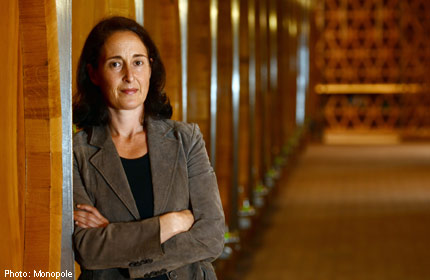
Sisters to lead wine empire

by Rebecca Lynne Tan, The Straits Times|24 July 2013

20130723.154922_20130723_albieraantinori_st

For the first time since the Antinori family began making wines more than 600 years ago, the world-renowned Italian wine company will continue into the future with an all-women team at its helm. The 26th generation is made up of three sisters – Albiera, 47; Allegra, 42; and Alessia, 38, daughters of famed winemaker Marchese Piero Antinori, 74. He is widely known as one of the founders of Super Tuscans, a category of thoroughbred Chianti wines that are commonly made with a blend of local grape varietals such as sangiovese and foreign grape varietals such as cabernet. Eldest daughter Albiera, the company’s vice-president, says: “When Dad saw that the third child was also a girl, he must have been a bit disappointed. But he’s over it, he couldn’t do much about it.” Read more of this post

Investing When Opportunities Are Limited; Ben Inker, an associate of famed investor Jeremy Grantham, argues that both stocks and bonds are overvalued. So what’s an investor to do?

TUESDAY, JULY 23, 2013

Investing When Opportunities Are Limited

By BEN INKER | MORE ARTICLES BY AUTHOR

Ben Inker, an associate of famed investor Jeremy Grantham, argues that both stocks and bonds are overvalued. So what’s an investor to do?

Editor’s Note: Jeremy Grantham has decided to take a break from his scheduled summer quarterly missive to investors. But we’re happy to share the latest commentary of Ben Inker, who works alongside Grantham at GMO, the Boston-based money management firm. A longer version of this commentary, along with charts, is available on the GMO Website.

To investors focused on U.S. equities, it may be easy to forget the investing excitement of this spring, but for others, particularly anyone running a portfolio predicated on asset class correlations being low, this has been a pretty shocking couple of months. From May 22 to June 24, the S&P 500 lost 5.6%, MSCI EAFE lost 10.1%, MSCI Emerging Markets fell 15.3%, the Dow Jones/UBS Commodity index fell 4.5%, the U.S. 10-year T-Note fell 4.4%, and the Barclays U.S. TIPS index fell 7.1%. For good measure, the J.P. Morgan Emerging Debt Global index fell 10.8%, the German 10-year Bund fell 5.2%, the UK 10-year Gilt fell 3.4%, and the Australian 10-year bond fell 6.5%. Equity markets have made a fairly sharp recovery since then, with the S&P 500 actually hitting new highs, but lots of other asset classes are still licking their wounds. In light of the generally negative correlations between stocks and bonds of the last decade, the universality of the declines looks pretty weird. For those schooled in thinking that the only “risks” that matter for investors are growth shocks and inflation shocks, it’s significantly more than just weird. To anyone of that mind, it’s a bit of a soul-searching moment, and it forces you to either treat the episode as a one-off event that will hopefully not happen again anytime soon or as a challenge that requires you to rethink your risk model. Not surprisingly, at GMO we believe it to be the latter, and that most investor risk models are missing an important piece of the puzzle. Read more of this post

Should Cities Specialize? When each city focuses on one industry, does that make the nation more productive, or hurt workers who can’t afford to relocate?

UPDATED JULY 23, 2013 9:21 PM

Should Cities Specialize?

DEBATERS

People Don’t Just Follow the Money

SPENCER CREW, AUTHOR, “FIELD TO FACTORY”

The New Yorkers who move South might be on to something: A low-paying job in Atlanta can buy a better life than a higher-paying one in New York.

Local Economies Are Only Part of the Story

ISABEL V. SAWHILL, BROOKINGS INSTITUTION

Educational resources and the stability of families have far more effect on how well young people do later in life.

Resources and Services Define a City

SUKKOO KIM, ECONOMIST, WASHINGTON UNIVERSITY

The loss of diversity caused by the convergence in local institutions and cultures may signal a move toward a more cohesive nation in time.

INTRODUCTION

The economies of American regions havebecome more alike, but economic mobility stillvaries widely among cities.

Is it fruitful for cities to specialize in one major industry – biotech in Boston, manufacturing in Detroit, media in New York? Or does that hurt workers who can’t afford to relocate, locking many out of the middle class? Read more of this post

Angry Birds Soda May Arrive In China Soon With Four Flavors

Angry Birds Soda May Arrive In China Soon

By Emma Lee on July 23, 2013

Roivo, developer of Angry Bird, reportedly plans to introduce Angry Birds soft drink to the Mainland China market in addition to its full product lineup ranging from t-shirts to posters (in Chinese). Angry Birds claims the soda, which currently comes in four flavors (see below), is already a hit in Finland, even outselling Coke and Pepsi. Rovio launched this product last year and then expanded it to several countries including Russia, Australia, New Zealand, Spain and the U.K. Angry Birds, which logged more than 1 billion downloads in 2012, targets to become an industry giant like Disney.

QQ截图20130723104151

Khaitan’s Radico Khaitan is now the largest local player in the spirits business. But he has to watch his patch as foreign competition looms

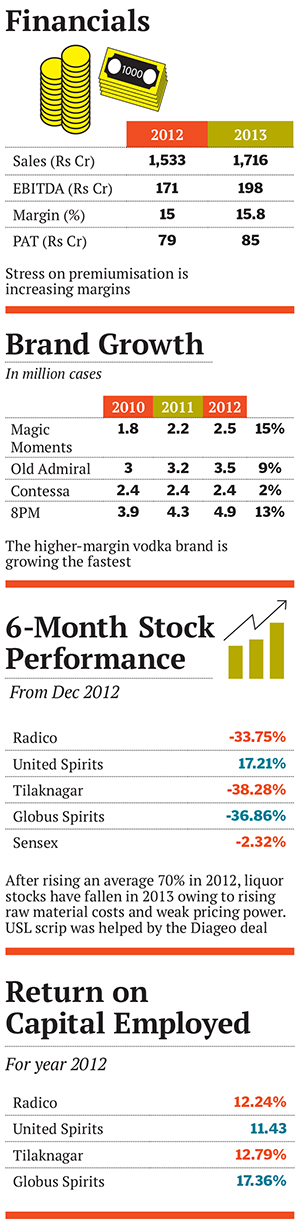
Radico Khaitan is on a High

by Prince Mathews Thomas | Jul 24, 2013

topimg_22097_lalit_khaitan_abhshek_khaitan_600x400 Radico.indd

Lalit Khaitan (L), chairman, with Abhishek Khaitan, MD of Radico Khaitan

Abhishek Khaitan’s Radico Khaitan is now the largest local player in the spirits business. But he has to watch his patch as foreign competition looms

In business, it helps to keep your ears to the ground. For Abhishek Khaitan, that meant doing the rounds of pubs. He had his first ‘eureka’ moment while pub-hopping in Bangalore. Even as he was studying for an engineering degree in the garden city, the family’s distilling and bottling business was at the back of his mind.
His discovery: “Indian drinkers were becoming more conscious of what they were consuming. Brands had become very important.” This insight led Abhishek and his father Lalit Khaitan, chairman of Radico Khaitan, to launch the company’s first whisky brand—8PM—some years later. It went on to sell a record one million cases in its very first year—a historic first in the Indian spirits industry. Read more of this post

Banyan Tree’s Ho Kwon Ping: “Asia is going to be a primary engine of growth, but that growth can come to a sputtering stop if our business models are not sustainable”

Experts call for Asia-based models

Achara Deboonme,
Annika Bhasavanich
The Nation July 24, 2013 1:00 am

Fresh approach needed for sustainability, added strength in view of long-lasting global uncertainties

Asian companies need to invent their own business models for long-term sustainability, models that address social and environmental costs, highlight brand building, and capitalise on the diversity of Asian culture, said panellists at an international conference. 
New models are a must as Asia has to strengthen its resilience to global uncertainties, which are not likely to end soon as long as most global trade is denominated in US dollars, agreed participants in a panel discussion on “Asia: Sustainable Business Models” at The Nation International Conference last Friday (July 19, 2013).
“Asia is going to be a primary engine of growth, but that growth can come to a sputtering stop if our business models are not sustainable,” said Ho Kwon Ping, executive chairman of Banyan Tree Holdings.  Read more of this post

Bribery serves as life-support for Chinese hospitals

Bribery serves as life-support for Chinese hospitals

5:14pm EDT

By Kazunori Takada

SHANGHAI (Reuters) – Bribery is the lubricant that helps keep China’s public hospitals running, and the health system would struggle to function without illegal payments to poorly paid doctors and administrators, say medical practitioners and industry experts.

They say government policies are partly to blame for a system in which doctors and other staff expect to be paid extra fees to perform operations and take kickbacks from pharmaceutical firms and medical-equipment suppliers. Read more of this post

Stratfor’s founder George Friedman: The End Of The Chinese Economic Miracle

7/23/2013 @ 8:24AM |1,543 views

The End Of The Chinese Economic Miracle

By George Friedman, Founder and Chairman of Stratfor, a geopolitical intelligence firm

Major shifts underway in the Chinese economy that Stratfor has forecast and discussed for years have now drawn the attention of the mainstream media. Many have asked when China would find itself in an economic crisis, to which we have answered that China has been there for awhile — something not widely recognized outside China, and particularly not in the United States. A crisis can exist before it is recognized. The admission that a crisis exists is a critical moment, because this is when most others start to change their behavior in reaction to the crisis. The question we had been asking was when the Chinese economic crisis would finally become an accepted fact, thus changing the global dynamic. Read more of this post