Early Calculator: The Sad Story of an Inventor at Buchenwald; A Viennese engineer worked meticulously in a concentration camp on the world’s first pocket calculator. After the war, others profited from his invention

07/03/2013 04:49 PM

Early Calculator: The Sad Story of an Inventor at Buchenwald

By Frank Thadeusz

A Viennese engineer worked meticulously in a concentration camp on the world’s first pocket calculator. After the war, others profited from his invention.

Herzstark

Curt Herzstark’s fate seemed to be sealed in 1943 when the Nazis sent him to Buchenwald concentration camp. But then Herzstark, the son of a Jewish industrialist, received the unexpected opportunity to become an Aryan. “Look, Herzstark,” one of the camp commandants said to him, “we know that you are working on a calculating machine. We will permit you to make drawings. If the thing is worth its salt, we’ll give it to the Führer after the final victory. He’ll certainly make you an Aryan for that.”

The engineer had made a pact with the devil. Night after night, after daily forced labor in the camp, Herzstark made detailed design plans for the world’s smallest mechanical calculating machine. He was given special rations as motivation, and he eventually survived the concentration camp. But there was no final victory, and Hitler was never able to enjoy the invention. Read more of this post

Darwin’s humbling lesson for business; The match between capabilities and environment is the key to success

July 2, 2013 4:49 pm

Darwin’s humbling lesson for business

By John Kay

The match between capabilities and environment is the key to success

Your correspondent is sitting below a large and ugly statue of Charles Darwin, overlooking the bay where the great scientist stepped ashore on Chatham, now San Cristobal, the most easterly of theGalápagos Islands. I am here to discuss the ways in which evolutionary theory can contribute to our understanding of social sciences.

It seems barely possible that careful observation of finches, mockingbirds andtortoises could fundamentally change the way we think about the world. But in the 19th century it did. The Galápagos, 700 miles from the mainland of Ecuador, contain flora and fauna that differ from those of the rest of the world and differ, but less, from island to island. The genius of Darwin was to apprehend the process by which this pattern came about. Read more of this post

How music festivals make money: From Coachella to Made In America, multi-act music festivals are big business. How do they rake in the cash?

How music festivals make money

July 3, 2013: 5:00 AM ET

From Coachella to Made In America, multi-act music festivals are big business. How do they rake in the cash?

By Melissa Locker, contributor

FORTUNE — Back in April, more than 150,000 music fans flocked to Indio, Calif., for the Coachella Valley Music and Arts festival. In mid-June, Bonnaroo drew over 100,000 people to Manchester, Tenn., to see Sir Paul McCartney and R. Kelly, among others. Sasquatch brought droves of people to a far-flung corner of Washington State for a long weekend. Every year, more and more festivals seem to pop up in addition to the dozens of music events that already exist. For every Lollapalooza, Austin City Limits or Riot Fest there’s a Governor’s Ball, which just held its third festival, or Catalpa Festival, which is in its second year. Read more of this post

The Immortal Life of the Enron E-mails; A decade after the Enron scandal, the company’s internal messages are still helping to advance data science and many other fields

The Immortal Life of the Enron E-mails

A decade after the Enron scandal, the company’s internal messages are still helping to advance data science and many other fields.

By Jessica Leber on July 2, 2013

Corporate corpus: Volumes of e-mails that were sent and received in Enron’s headquarters in Houston, seen here in 2002, are still parsed and dissected by computer scientists and other researchers. Former Enron executive Vincent Kaminski is a modest, semi-retired business school professor from Houston who recently wrote a 960-page bookexplaining the fundamentals of energy markets. His most lasting legacy, however, may involve thousands of e-mails he wrote more than a decade ago at the energy-services company. Read more of this post

Dividend Stocks Enter New Era of Caution

Updated July 2, 2013, 6:04 p.m. ET

Dividend Stocks Enter New Era of Caution

MATT JARZEMSKY

MI-BW964A_MKTLE_G_20130702182118

Jitters about Federal Reserve policy have made investors more cautious about stock sales by companies that pay high dividends, but the window is still open for new offerings. Investors may no longer be rushing to buy just about anything with a high yield at just about any price, as they seemed to be doing at times during the first five months of the year. Yet interest rates are expected to remain exceptionally low even if the Fed begins to scale back its stimulus efforts. That, many analysts and investors say, will continue to fuel a search for yield through dividend stocks, and provide an appetite for new offerings. At the same time, the kind of improved growth outlook that would lead the Fed to taper its easy-money policies could encourage stock sales by companies more sensitive to economic growth. Investors look to shares of these companies because they offer potential for price appreciation. Read more of this post

Investors buy into software-defined networks, will customers follow?

Investors buy into software-defined networks, will customers follow?

11:06am EDT

By Sayantani Ghosh

(Reuters) – As Superstorm Sandy bore down on the East coast last year, companies with data centers in its path needed another location fast. But moving computer servers is tricky, and usually planned over days or weeks. Enter a new technology: software-defined networking, or SDN. Such urgent data moves could now be done within a few hours. Investors, including some of the world’s biggest technology companies, are buying into the start-ups behind SDN, a technology that allows users to substitute some of the most complex hardware functions in server switches with software. SDN is still relatively small, generating around $300 million in annual business in a $30 billion networking industry. Customers are not yet sure how to make the most of its flexibility. Read more of this post

Painkiller Abuse Spurs Search for a Safer Opioid Therapy

Painkiller Abuse Spurs Search for a Safer Opioid Therapy

Backed by a U.S. campaign to slow abuse of prescription painkillers, drugmakers are devising new forms of the medicines that don’t lead to misuse and new products that treat dependency in a bid to change the face of a $9.4 billion market.

Orexo AB (ORX) is awaiting a July 6 U.S. ruling on a drug that blocks opiate receptors in the nervous system, potentially lessening addict dependence. Nektar Therapeutics (NKTR) on June 19 announced positive study results on an experimental medicine designed to enter the brain slowly, reducing the euphoria that can lead to addiction. And in April, the U.S. barred copies of the original form of OxyContin after Purdue Pharma LP proved its crush-resistant version made the therapy less valuable to addicts on the street. Read more of this post

This is a big deal. Hot money is now fleeing China “abruptly”

This is a big deal. Hot money is now fleeing China “abruptly”

By Matt Phillips @MatthewPhillips July 2, 2013

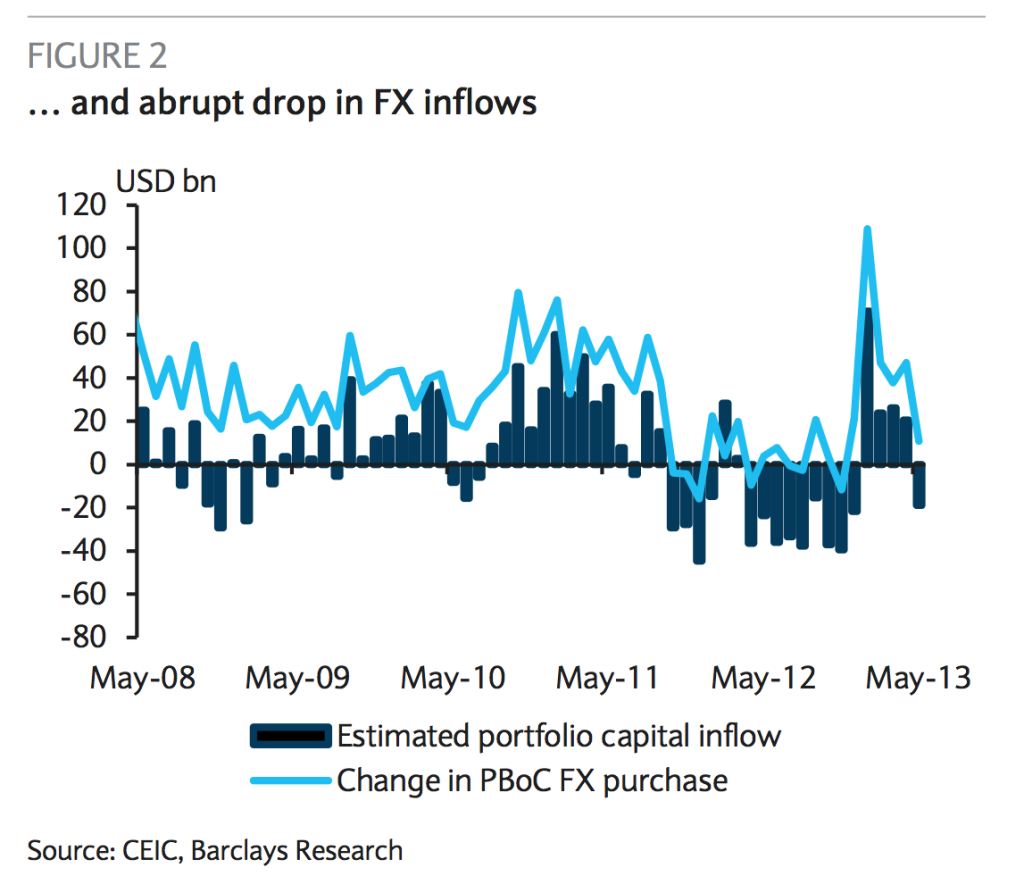
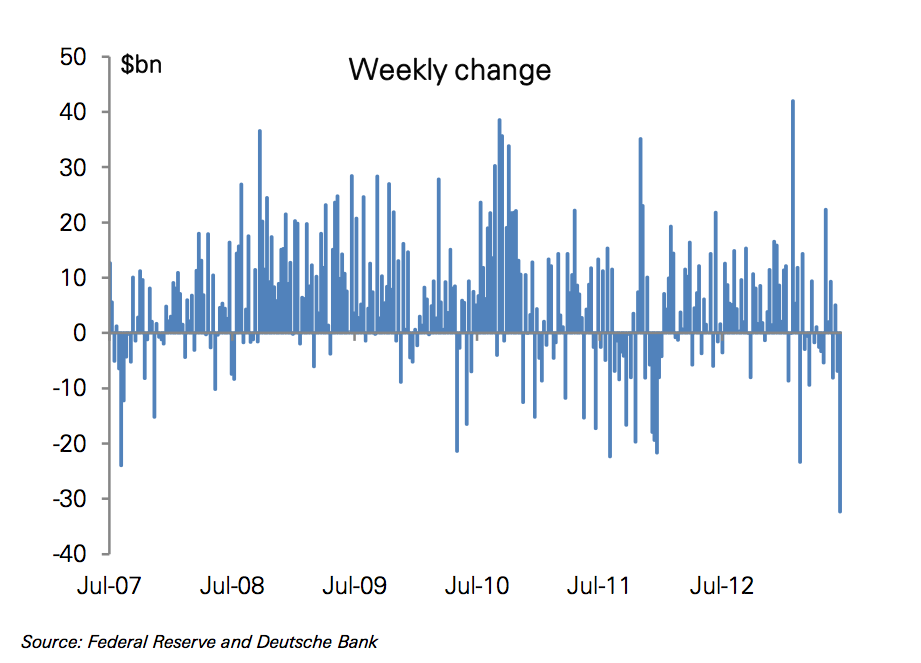
An important reason why countries like China have capital controls is to keep tidal flows of incoming foreign cash from creating destabilizing asset bubbles. But foreign capital has wormed its way into the mainland anyway. One creative method that got attention recently was phantom sales of “exports” to places like Hong Kong. Investors have salivated over opportunities—even if they are somewhat shadowy—to tap into Chinese growth. But the saliva glands seem to be drying up. Deutsche Bank FX analysts point out that flows of capital have started to change course in recent weeks, and they use so-called “over-invoiced” exports to Hong Kong as a proxy. Analyst at Barclays have also noticed the “abrupt” turn in financial flows into China. In the chart below, they’re looking at estimates of portfolio investment as well as central-bank purchases of foreign currencies. (The way China keeps capital flows in check is by forcing the private sector to convert foreign currencies in to Chinese yuan at the fixed government rate. So you can look at how much foreign currency the People’s Bank of China buys as a proxy for the amount of foreign currency that’s weaseled its way into the country.) We’re in the opening phase of this reversal. And whatever the causes of it might be—fears about the solidity of China’s financial system, slowing growth, the unwinding of the Fed’s easy-money policy—it could have wide-ranging implications. Domestically, the departure of foreign cash from China may have played a role in the recent credit crunch that sent a shiver through China’s banks. Government media minders have told the local press to tone down its coverage of financial worries (paywall), but that will only undermine confidence further. Internationally, if a decline of investment slows China’s economy, large trade partners such as Taiwan and Australia would feel it. Oh, and one other thing. Do you know where China happens to stow all that foreign cash it buy out of the markets? US government bonds. China is the largest foreign buyers of Uncle Sam’s IOUs, which helps finance the US’s persistently large current-account deficit. And coincidentally, last week saw the largest outflow on record from the Federal Reserve’s so-called “custody holdings” of Treasurys. Those are the Treasurys that the Fed holds in accounts for official entities, such as foreign central banks that use US government debt to store foreign exchange reserves. Here’s a look at a Deutsche Bank chart, which suggests that what happens in China will most definitely reverberate outward. Food for thought.

​screen-shot-2013-07-02-at-11-34-29-am screen-shot-2013-07-02-at-11-39-12-am screen-shot-2013-07-02-at-12-02-27-pm

China’s Leading Baby Formula Maker Cut Prices on Sweeping Probes

China’s Leading Baby Formula Maker Cut Prices on Sweeping Probes

07-03 11:09 Caijing

The investigation, however, targets more than the six, said a person familiar with the case, adding that dozens of brands could be involved.

Beingmate, a leading Chinese baby formula brand is trimming its products prices on the heel of a sweeping anti-trust investigation targeting both foreign and home brands, in what is believed to be the second shake-up in China’s milk industry following the food scandal in 2008. Read more of this post

Taiwan’s housing bubble is bigger than anyone admits

Taiwan’s housing bubble is bigger than anyone admits

Editorial 2013-07-03

Declining real income and surging housing prices in Taiwan continues to worsen, along with the stagnation in the country’s economy, even though the government has reiterated that it has taken stock and is trying to deal with the situation. Government data show that real income during first four months of this year dropped to a level comparable to 15 years ago, while the average unit price of new housing purchases in Taiwan’s six major metropolitan areas hit a record high of NT$245,000 (US$8,155) per ping (3.3 square meters) during the first quarter. Read more of this post

Gross Caught in TIPS Trap Gundlach Sidestepped in Tumble

Gross Caught in TIPS Trap Gundlach Sidestepped in Tumble

On April 19, three weeks before he called the end of the 30-year bull market in bonds, Bill Gross said he was buying inflation-linked Treasuries, a bet that money printing by the world’s central banks would push up consumer prices.

While Treasuries subsequently fell as he had predicted, so did inflation expectations, amplifying rather than limiting losses for Gross’s Pimco Total Return Fund (PTRAX), which had 12 percent of its $289 billion in Treasury Inflation-Protected Securities at the end of the first quarter. The world’s largest mutual fund fell 4.7 percent in May and June, prompting $9.9 billion in withdrawals last month, the most on record. Read more of this post

Shenzhen O-film Tech Co. Chairman Cai Rongjun has become a billionaire after shares in the Chinese touchscreen glass-panel maker soared nearly 178 percent this year on higher demand for tablet computers

Cai Emerges as Chinese Billionaire With Touchscreen Glass

Shenzhen O-film Tech Co. Chairman Cai Rongjun has become a billionaire after shares in the Chinese touchscreen glass-panel maker soared nearly 178 percent this year on higher demand for tablet computers.

Cai, 41, has a net worth of $1 billion after the stock advanced 10 percent yesterday, according to the Bloomberg Billionaires Index. He hasn’t appeared on any international wealth rankings. The bulk of his fortune consists of a 22 percent stake in the company, which supplies screens to Lenovo Group Ltd. (992), Samsung Electronics Co. and Sony Corp. Read more of this post

Bernanke Denies India to Mexico Rate Cuts as Currencies Sink

Bernanke Denies India to Mexico Rate Cuts as Currencies Sink

Traders who anticipated lower interest rates in developing nations are reversing course as prospects for reduced Federal Reserve economic stimulus sparks the worst rout in emerging-market currencies since 2001.

Just a month ago, central bankers in Mexico, India and South Korea were expected to pare borrowing costs at least once, according to interest-rate swaps data compiled by HSBC Holdings Plc. Now, the measures show no chance of cuts. Poland’s central bank said today that it has ended an easing cycle after lowering the benchmark rate to a record low 2.5 percent. Traders anticipate one more reduction in Hungary, instead of the two they expected a month ago. Read more of this post

Indian rupee record plunge is curbing demolition of obsolete merchant vessels, exacerbating a fleet surplus; “Indian scrap yards buy old tonnage from owners in dollars, but sell the scrap metal to steel mills in rupees”

India-Rupee Slump Seen by Broker ACM as Brake on Ship Demolition

A plunge in the Indian rupee to near a record is curbing demolition of obsolete merchant vessels, exacerbating a fleet surplus in the maritime industry, according to London-based shipbroker ACM Shipping Group Plc. “Indian scrap yards buy old tonnage from owners in dollars, but sell the scrap metal to steel mills in rupees,” ACM senior analyst Marc Pauchet said in a report sent by e-mail today. “Mills are finding it increasingly difficult to meet the prices demanded by recyclers.” The currency of the world’s largest vessel-scrapping nation fell 1 percent to 60.24 per dollar as of 3:12 p.m. in Mumbai today, according to prices compiled by Bloomberg. That’s 0.8 percent away from its record low of 60.765 per dollar on June 26. The shortfall in India’s current account, the broadest measure of trade, widened to a record 4.8 percent of gross domestic product in the year ended March 31, official data show. Ship owners are contending with a fleet surplus across the maritime industry that Clarkson Plc (CKN), largest shipbroker, estimated in March was the largest since the early-1980s. The Baltic Dry Index, an overall measure of commodity freight costs, averaged 847 points this year, its worst start on record, according to the Baltic Exchange in London.

To contact the reporter on this story: Alaric Nightingale in London at anightingal1@bloomberg.net

CJ Group has gone into emergency mode after Chairman Lee Jay-hyun was arrested Monday on charges of creating secret funds and evading taxes

2013-07-02 17:24

CJ put on emergency footing

By Kim Tae-jon

CJ Group has gone into emergency mode after Chairman Lee Jay-hyun was arrested Monday on charges of creating secret funds and evading taxes.  Read more of this post

Cash crunch has shown that financial policy in China is not reliable

July 2, 2013 3:17 pm

Pity the banks after Beijing’s blunt move

By Simon Rabinovitch in Shanghai

Cash crunch has shown that financial policy in China is not reliable

It is unfashionable these days to take the side of banks, especially institutions that are mollycoddled by the state. China’s government-owned banking behemoths are among the most unlikely candidates for compassion. But they deserve more than a little sympathy after the cash crunch of the past three weeks. Read more of this post

S. Korea’s household debts still face fragile structures

S. Korea’s household debts still face fragile structures

English.news.cn   2013-07-03

SEOUL, July 3 (Xinhua) — Growth of household debts in South Korea continued to slow amid efforts to contain further rise, but its debt structure remained fragile due to heavy dependence on high-rate loans, excessive debts compared with debt-servicing capabilities and growing multiple borrowers, data from related authorities showed Wednesday. The country’s household debts reduced 2.2 trillion won from three months earlier to 961.6 trillion won (843 billion U.S. dollars) as of end-March, the first decline in four years, according to reports submitted to lawmakers by the Ministry of Strategy and Finance, Bank of Korea (BOK), the Financial Services Commission (FSC) and the Financial Supervisory Service (FSS). Read more of this post

The Revolving Door of Chinese Politics: A look at how ambitious executives at China’s major state-owned enterprises hope to be transferred to government posts

The Revolving Door of Chinese Politics – Economic Observer Online

By Shen Nianzu (沈念祖)
Issue 626, July 1, 2013
This is an extended abstract of an article that appeared in this week’s edition of The Economic Observer, for more highlights from the EO print edition, click here.
It’s already been 100 days since a new generation of officials have taken up their posts in the country’s State Council. Many of the newly appointed politicians formerly served at executives at some of China’s major state-owned enterprises (SOE).
For example Guo Shengkun (郭声琨), who was recently appointed as Minister of Public Security and also as one of China’s five State Councilors, once served at the CEO and Chairman of Aluminum Corporation of China (Chinalco or 中国铝业公司). Read more of this post

Zong Qinghou built Hangzhou Wahaha Group into a beverage giant, and now he has his sights set on conquering the retail sector

07.03.2013 13:53

Time for a Transformation

Zong Qinghou built Hangzhou Wahaha Group into a beverage giant, and now he has his sights set on conquering the retail sector

By staff reporters Shen Hu, Zhou Qun and intern reporter Wu Yijing

(Hangzhou) — With nearly 70 billion yuan in personal assets, Zong Qinghou, founder and chairman of Hangzhou Wahaha Group Co., is China’s richest man and a talented salesman. Starting his business career by selling cold drinks and ice cream on a bicycle at age 42, Zong created Wahaha in 1989 and made the company the country’s largest beverage producer. Zong is well known for his toughness in business negotiations. In a dispute between Wahaha and its French partner, Groupe Danone, over branding issues several years ago, he mobilized resources in political, social, business and judicial arenas to win the argument. And yet he always says: “My wealth is accumulated by selling bottles of water.” Read more of this post

Listed Chinese firms invest in wealth management products

Listed Chinese firms invest in wealth management products

Staff Reporter

2013-07-03

Amid the credit crunch, many Chinese banks have rolled out wealth management products with high yields, which have attracted numerous investors, including listed firms with idle funds in hand.

According to Industrial Securities, in the third week of June the yield rate of one-month renminbi-denominated wealth management products issued by major banks has risen further to 5.06% per annum, while the rate of four and nine-month products issued by banks limited by shares hit 5.67% and 6.2%, respectively. Read more of this post

Seoul’s start-up generation; A group of ambitious young software entrepreneurs is striking out in South Korea

July 2, 2013 4:50 pm

Seoul’s start-up generation

By Simon Mundy

Led by example: technology entrepreneur Jimmy Kim co-founded Sparklabs, an incubator to provide would-be founders with advice and funding

Jay Mok’s family were shocked: 29 years old, recently married, a graduate from a top Seoul university with a good job at a global consulting firm, his career was a source of pride. Then he quit to pour his savings into developing a smartphone application.

“The older generation don’t understand as much about IT or the mobile business,” he says. “They think if I fail, the whole family will fail.” Read more of this post

A raft of A-share companies has made ambitious moves to acquire mobile gaming companies in the burgeoning nascent market; Ourpalm shares soared 275.77% YTD

Chinese Mobile Game Companies Come Under Spotlights

By Emma Lee on July 3, 2013

A raft of A-share companies has made ambitious moves to acquire mobile gaming companies in the burgeoning nascent market. Investors saw opportunities in the industry which boasted 286 million subscribers (source in Chinese) as of the end of 2012, boosting the performance of shares related to the sector.

Ourpalm (SZ:300315) announced recently that it would acquire a 100 percent stake in Dovo Technology Inc. , a game developer, with 810 million yuan (source in Chinese). Dovo Technologygenerated 57.08 million yuan of net profit in 2012. Ourpalm is seeking for another acquisition target to expand its gaming empire. Read more of this post

How RSS feeds lost the web

How RSS feeds lost the web

By Lydia DePillis, Updated: July 2, 2013

July 1 has come and gone: Welcome to the post-Google Reader world. For some of us, it is a poorer one, since we’ve had to re-wire our brains to consume words through a different filtering device. Others, like Ezra, have decided to dispense with RSS feeds entirely, figuring that they contributed to the narrowing of his media diet to a defined set of blogs. Many more people, though, never adopted RSS feeds in the first place; even Google’s numbers were on the decline. For all the moaning in the blogosphere, it’s fair to say the average Internet user hasn’t even heard of an RSS feed, let alone set up a web application to mainline content directly into their brains. Sure, services like Digg Reader and Feedly will make a go of the medium, but their eventual peak user base seems limited. Why did RSS never become universal in the way that Facebook has, and Twitter seems on track to do? A few reasons. Read more of this post

Risks of a hard landing for China; Beijing might need to do what its leaders neither want nor expect

July 2, 2013 7:12 pm

Risks of a hard landing for China

By Martin Wolf

Beijing might need to do what its leaders neither want nor expect

The new Chinese leadership is trying to manage one of the most difficult of economic manoeuvres: slowing down a flying economy. Recently, difficulties have become more apparent, with the attempt of the authorities to bring “shadow banking” under control. Yet this is part of a bigger picture: the risk that a slowing economy might even crash. Indeed, the expressed desire of China’s new government to rely on market mechanisms raises the risks. Read more of this post

For Pension Funds, Higher Fees Don’t Mean Higher Returns, Study Finds

July 2, 2013, 11:01 a.m. ET

For Pension Funds, Higher Fees Don’t Mean Higher Returns, Study Finds

Report on State Pension Funds Adds Fuel to Debate on Active Investment Managers

MICHAEL CORKERY

Public-employee pension plans paying the highest investment fees aren’t generating the highest returns, according to a new study by a pair of Maryland think tanks. In fact, just the opposite may be true, says the Maryland Public Policy Institute and Maryland Tax Education Foundation. On average, 10 states paying the most money-management fees had lower investment returns between June 30, 2007 and June 30, 2012 than 10 states paying the fewest fees.

Read more of this post

A Dizzying Condo Market: Toronto’s effort to create a livable city through densely populated neighborhoods is a roaring success, but to what end?

July 2, 2013

A Dizzying Condo Market

By IAN AUSTEN

TORONTO — Sandwiched between two rail lines in this city’s core, great factories once produced the finest Canada could offer the world: Magic baking powder, Brunswick bowling alley flooring and Massey Ferguson farm equipment.

Those factories and many others here have been long abandoned or demolished, but the area is bustling. It is now called Liberty Village and it is packed with high-rise condominiums, largely built over the last five years, with many more still under construction. Read more of this post

Worries of crash persist in Toronto’s condo alley

Worries of crash persist in Toronto’s condo alley

Ian Austen, The New York Times | 13/07/03 8:20 AM ET
Sandwiched between two rail lines in Toronto’s core, great factories once produced the finest Canada could offer the world: Magic baking powder, Brunswick bowling alley flooring and Massey Ferguson farm equipment.

What once was a no-brainer decision, locking in your mortgage rate for five years or even 10 years, now has a question mark attached to it. Read more

Those factories and many others here have been long abandoned or demolished, but the area is bustling. It is now called Liberty Village and it is packed with high-rise condominiums, largely built over the last five years, with many more still under construction. Read more of this post

Zhou Pulling China Punch Bowl Set to Shape Legacy as PBOC Chief

Zhou Pulling China Punch Bowl Set to Shape Legacy as PBOC Chief

Zhou Xiaochuan earned distinction as the G-20’s longest-serving central bank chief helping keep China out of a financial crisis the past decade. In the wake of June’s record liquidity squeeze, his legacy hangs in the balance.

Zhou and his colleagues at the People’s Bank of China left investors, bankers and market participants in the dark for four days after the overnight lending rate between banks hit a record 11.7 percent June 20 before releasing a week-old statement as the central bank’s first word on its objectives. Zhou himself kept mum until he reiterated a pledge to maintain market stability on June 28. Read more of this post

Tiger Moms Crave Diapers From Japan; Kao has a 30% market share in Japan compared with Unicharm’s 34%

July 3, 2013, 12:07 PM

Tiger Moms Crave Diapers From Japan

By Mayumi Negishi

Japan’s second-largest diaper maker is apparently struggling to meet surging demand from Tiger Moms.

Kao Corp.’s breathable Merries diapers have gained a reputation abroad for being good for a baby’s development, appealing to mothers who want to maximize the head start they give their children, Kao Chairman Motoki Ozaki said in a recent interview. Read more of this post

Dialysis stocks hit by proposed U.S. reimbursement cuts

Dialysis stocks hit by proposed U.S. reimbursement cuts

11:30am EDT

By Zeba Siddiqui and Ludwig Burger

(Reuters) – A proposal to slash reimbursements to kidney dialysis centers in the United States drove down shares of Fresenius Medical Care AG and Davita Healthcare Partners Inc, two of the world’s leading providers of dialysis services.

The proposed 9.4 percent cut in Medicare reimbursements to dialysis centers, announced by the Centers for Medicare & Medicaid Services (CMS) on Monday, was described by JP Morgan as “worse than even our most pessimistic scenario had envisioned”. Read more of this post