Hazards of the Buzzy Startup: Yahoo’s $1.1 billion deal for Tumblr is a fairy-tale ending for the blogging site, which fetched a rich price despite its meager revenue. Many other highflying Web startups may not be as lucky

May 20, 2013, 8:00 p.m. ET

Hazards of the Buzzy Startup

Yahoo’s Purchase of Tumblr Puts Spotlight on Highfliers Like Pinterest, Quora With Little Revenue

By AMIR EFRATI, SPENCER E. ANTE and EVELYN M. RUSLI

OB-XN856_Startu_G_20130520200007

Yahoo Inc.’s YHOO +0.23% $1.1 billion deal for Tumblr Inc. is a fairy-tale ending for the blogging site, which fetched a rich price despite its meager revenue. Many other highflying Web startups may not be as lucky.

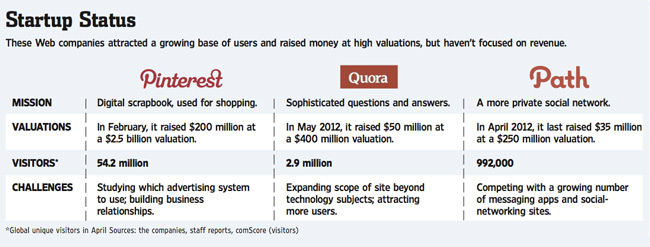
Monday’s deal for New York-based Tumblr throws the spotlight on a cadre of other Web startups that have similar characteristics. Many of them raised money at sky-high valuations based on their huge user growth, before a spate of troubled Internet initial public offerings in 2011 and 2012 for social networkFacebook Inc., FB -1.87% daily-deals site Groupon Inc. GRPN +0.14% and online-gaming service Zynga Inc.ZNGA +0.59%

Since then, a damper has been put on the Internet market. And as these startups have burned through cash to sustain their user growth, they have been dealing with difficult questions about exactly how much value they command and whether to remain independent or sell themselves off. Read more of this post

INFOGRAPHIC: Inside The Massive Mobile Video Ecosystem

INFOGRAPHIC: Inside The Massive Mobile Video Ecosystem

Business Insider | May 20, 2013, 3:37 PM | 13,495 | 7

Mobile video has begun to accumulate scale, and has also turned out to be one of the few types of mobile content — along with games — that monetizes reliably and drives premium ad rates. That’s reflected in the much higher prices that mobile publishers can command for mobile video ads, compared to standard mobile formats like banners. eMarketer estimates mobile video will account for $520 million in ad spending in the U.S. this year, or 13% of the digital video ad market. In a new report, BI Intelligence breaks down the mobile video ecosystem, analyzing the behavior and devices behind the growth in consumption, and examining the demographics and behavior of mobile video consumers. We specifically detail how mobile video monetization is booming, and look at the new video ecosystem that is taking shape, with mobile devices — rather than television — at the center. Thanks in large part to this growing ecosystem, brands and agencies are becoming more familiar with mobile video ad formats and in putting together mobile video ad campaigns. Thanks to technology and better know-how among ad platforms, mobile video ad units are easier to deploy across the mobile landscape than they were in the past. As we detail in our report, tablet-specific ad units are beginning to proliferate, as are non-ad videos that brands push out on their own digital platforms. So are anecdotes about increased mobile video ad transaction volume: YuMe, a provider of brand video advertising services, saw its mobile video advertising revenue in France and the U.K. grow over 500 percent in 2012. Mobile video ad specialist AdColony also reported U.S. revenue growth above 500 percent in 2012.  Michael Bayle, senior vice president of ESPN Mobile, says he sees the automotive industry diving quickly into mobile video as a complement to TV spending. “We see automotive highly skewing in favor of mobile,” he told Business Insider. ESPN benefits because its audience is 85 percent men, and auto advertisers are often chasing male eyeballs.

themobilevideoecosystem-1 (1)

Global Brands: Online retailer Amazon grabs top spot from bricks and mortar rival Wal-mart

May 20, 2013 11:59 pm

Global Brands: Online retailer grabs top spot from bricks and mortar rival

By Barney Jopson

Calling Amazon the “Walmart of the web”, a common moniker for the online giant, is one way to make people from Walmart bristle. The bricks-and-mortar behemoth tends to think that if any company is going to be the Walmart of the web, then it should be Walmart.

That is why, after several false starts, the 50-year-old retailer from Arkansas is in the throes of its latest – and most serious-looking – effort to build a substantial online business. The results will help shape the evolution of the Walmart brand for years to come (as will the progress of its international bricks-and-mortar business).

But the 2013 BrandZ Top 100 ranking shows that Amazon still has more momentum. For the first time since the ranking began, Amazon, founded in 1994, has leapfrogged Walmart to become the most valuable retailer in the rankings: a 34 per cent rise in its brand value to $45.7bn lifted it to position number 14 overall. Read more of this post

But Wait. Didn’t Yahoo Try a Deal Like This Before? Yahoo’s deal for Tumblr raises questions about its ability to make money by selling ads, among other thorny issues

MAY 20, 2013, 9:00 PM

But Wait. Didn’t Yahoo Try a Deal Like This Before?

By ANDREW ROSS SORKIN

When Yahoo announced its headline-grabbing acquisition, it boasted that the deal gave it access to an “unduplicated” audience of users and that its target was a “popular personal publishing” platform.

“Yahoo will be able to integrate and distribute a powerful set of state-of-the-art editing tools and content published through personal home pages in an array of services,” the company declared.

But Yahoo wasn’t talking about Tumblr. Those quotes came from a news release Yahoo issued in 1999 when it acquired GeoCities, which allowed users to create their own Web pages — not unlike Tumblr — for $3.6 billion in stock. The site was closed in 2009. Read more of this post

All Yahoo’s spending can’t make it cool again; It’s time for the Web 1.0 icon to put down its credit card and get back to work

All Yahoo’s spending can’t make it cool again

May 20, 2013: 12:15 PM ET

It’s time for the Web 1.0 icon to put down its credit card and get back to work.

By Cyrus Sanati

FORTUNE — Yahoo’s $1.1 billion acquisition of Tumblr looks like an expensive and misguided attempt by chief executive Marissa Mayer to somehow make the Web 1.0 company “cool” again. Instead of innovating her way out of the mediocre corner of the Internet in which Yahoo currently resides, the former Google executive has instead decided to take the company’s debit card and go on a shopping spree, snapping up 10 companies in less than a year on the job. Tumblr is by far the most expensive bauble she has picked up so far and could prove a dud over the long term given its questionable content, much of which is “NSFA” — Not Safe For Advertisers.

When Mayer took the helm at Yahoo (YHOO) last year, investors were ecstatic. The company had been on a listless voyage over the previous decade as it struggled to move from awkward adolescence into adulthood. Ms. Mayer’s appointment gave investors hope that Yahoo could somehow be pulled back from the brink of technological irrelevance. She was seen as a bright star equipped with the magic Google (GOOG) touch that would, hopefully, help restore Yahoo’s rusty search engine as well as the hodgepodge of companies it acquired over the years. Read more of this post

Viewers Start to Embrace Television on Demand

May 20, 2013

Viewers Start to Embrace Television on Demand

By BRIAN STELTER and AMY CHOZICK

While companies weigh bids for Hulu and industry heavyweights complain that TV Everywhere isn’t going much of anywhere, another way to watch time-shifted television is quietly gaining traction: video-on-demand, or VOD.

Glittery, those three letters are not. VOD rarely gets media attention, partly because of past missteps by cable and satellite providers.

But more and more TV episodes and movies are becoming available through the on-demand systems that cable subscribers can tune in with their set-top boxes. Some shows, like Fox’s “The Following” and ABC’s “Scandal,” now gain hundreds of thousands of viewers every week because of VOD, part of a decades-long shift from television on a linear schedule to television on viewers’ own terms.

“On-demand isn’t always the shiniest new technology. But we are seeing tremendous growth,” said Matthew Strauss, who oversees digital strategy for Comcast, the nation’s largest cable company. Read more of this post

Samsung swipes 95% of total industry profits earned from Android phones

HOW MUCH? SAMSUNG SWIPES 95 PERCENT OF TOTAL INDUSTRY PROFITS EARNED FROM ANDROID PHONES

By Andy Boxall — May 16, 2013

Google revealed its own fair share of big numbers associated with Android during its Google I/O keynote presentation, saying as of 2013, there have been 900 million activations of the mobile OS, making it the world’s most popular operating system. That must mean there are a lot of companies out there getting rich and fat from selling Android hardware, right?

Well, yes, but if the latest research from Strategy Analytics is accurate, it’s only one company doing so, despite Android being licensed by dozens of firms. As you have probably guessed, the one making the most profit from Android is market leader Samsung, but the actual figure may come as a surprise, as it’s said to have taken almost 95 percent of the global profits earned from the mobile OS during the first quarter of 2013. Read more of this post

Amazon wins key cloud security clearance from US Govt

Published: Tuesday May 21, 2013 MYT 1:55:00 PM

Amazon wins key cloud security clearance from US Govt

SAN FRANCISCO: Amazon.com Inc has been given a security clearance by the U.S. government that will make it easier for federal agencies to use its cloud computing services.

Amazon Web Services, known as AWS, was certified to operate as a cloud service provider for three years under the government’s new FedRAMP program. The accreditation covers all AWS data centers in the United States, the company said on Tuesday.

“This will cut the cost and time for agencies to deploy our systems,” saidTeresa Carlson, vice president of Worldwide Public Sector at AWS. “It cuts costs for AWS too.”

Amazon, the world’s largest online retailer, has moved aggressively into the business of renting remote computing, storage and other IT services in recent years through AWS. The business has been a hit with startups, but the company is now going after big corporations and government agencies, a much larger opportunity. However, these organizations are more demanding, especially on issues like security and regulatory compliance. Read more of this post

NYC Startup Scene Boosted by 50-Fold Return on Tumblr Deal: Tech

NYC Startup Scene Boosted by 50-Fold Return on Tumblr Deal: Tech

Tumblr Inc.’s $1.1 billion purchase by Yahoo! Inc. (YHOO) marks the biggest deal for a venture-backed New York startup, bringing a windfall for East Coast investors Union Square Ventures and Spark Capital while laying a foundation for further investing in the region’s entrepreneurs.

Union Square, founded in New York in 2003, and Boston-based Spark, which opened two years later, first led an investment of $775,000 in Tumblr in 2007, and then $4.5 million the following year. The firms owned a combined 47 percent of the company, giving them about a 50-fold return, according to PrivCo, which tracks private companies and venture capital.

While about 40 percent of venture funding happens in Silicon Valley, twice the amount in New York and New England combined, Union Square and Spark have spent about a decade investing in a revival of the East Coast technology industry. Though not all of the joint bets have panned out, their success proves there’s still growth in New York’s startup scene. Read more of this post

How cognitive science and user empathy powered Google’s design breakthrough

How cognitive science and user empathy powered Google’s design breakthrough

By Devindra Hardawar | VentureBeat.com, Published: May 20

Google has gone from a company that approached design through cold, hard data to one that’s employing gorgeous, user-centric interfaces.

Design was a big theme at this year’s Google I/O developer conference, with over a dozen sessions exploring design in some fashion. And you can see Google’s new aesthetic focus in plenty of its products — like Gmail’s slight redesign and the upcoming Google Maps refresh — but Android serves as the fastest example of Google’s design turnaround.

Perhaps it’s because design matters all the more on a small smartphone screen. With Android, Google also had to do something about Apple’s head start with iOS. To get Android to look as good at the iPhone, Google had to radically reshape how it thought of design, and fast. Android 4.0 “Ice Cream Sandwich,” released in 2011, was Google’s first attempt to emphasize design in its mobile OS. Its aesthetic has only become more refined since then. Read more of this post

GrubHub to Merge With Seamless as Food Orders Go Mobile

GrubHub to Merge With Seamless as Food Orders Go Mobile

GrubHub Inc. and Seamless North America LLC, two of the top food-delivery websites in the U.S., have agreed to combine their companies to take on rivals in the growing market for online meal orders.

GrubHub Chief Executive Officer Matt Maloney will become CEO of the merged group, and Seamless CEO Jonathan Zabusky will serve as president, the two said in an interview. Neither company is paying to acquire the other, Maloney said, declining to share financial details of the agreement. The deal now awaits the approval of U.S. regulators, he said.

Food-delivery sites and mobile applications are gaining in popularity as more people order their meals online, instead of calling or picking up orders at restaurants. That’s also driving consolidation, as startups join forces to head off competition from review sites such as Yelp Inc. (YELP) The merger will help the combined company accelerate the addition of users and restaurants, said Maloney, who co-founded GrubHub in 2004. Read more of this post

Expert Networks and Insider Trading: An Introduction and Recommendation

Expert Networks and Insider Trading: An Introduction and Recommendation

Daniel H. Jeng Boston University School of Law

May 7, 2013
Review of Banking and Financial Law, Forthcoming

Abstract: 
An expert network enabled the largest insider trading scheme ever discovered and charged by the Securities and Exchange Commission (“SEC”). As complex information webs circulating money for information, expert networks are significant and relevant to the financial system, generating over $400 million in revenue annually. In the past decade, regulatory revisions to disclosure requirements and reformations to investment banking research practices have fueled the rise of expert networks. Despite recent notoriety in connection with Raj Rajaratnam’s insider trading case and various insider trading convictions of expert network consultants, use of expert networks is legally permissible, as specifically acknowledged by the SEC. Nevertheless, expert network firms, expert consultants, and clients must guard against insider trading by ensuring that no information transferred is material, nonpublic, or acquired through a breach of duty. This article argues that strong compliance programs and well-written contracts protect expert networks against insider trading and regulatory investigations.

Testosterone and Financial Misreporting

Testosterone and Financial Misreporting

Yuping Jia Frankfurt School of Finance and Management

Laurence Van Lent Tilburg University – CentER for Economic Research and Dept. of Accounting

Yachang Zeng Tilburg University – Department of Accounting & Accountancy; Tilburg University – Center for Economic Research (CentER)

May 15, 2013

Abstract: 
We examine the relation between a measure of CEOs’ adolescent exposure to the hormone testosterone and financial misreporting. Testosterone is associated with a set of behaviors in males, including aggression, egocentrism, risk seeking, and a desire to maintain social status. Using a sample of CEOs from Standard and Poor’s 1500 firms during 1996–2010, we document a positive association between our measure of CEO testosterone exposure and financial misreporting. Our primary evidence is based on a sample of financial restatements due to intentional irregularities. Additional analyses are based on misreporting proxies derived from the misstatement-prediction model proposed by Dechow et al. [2011]. The positive association between CEO testosterone exposure and financial misreporting is robust to the various misreporting proxies. We show that our measure of testosterone exposure is different from overconfidence, which prior studies have shown to be associated with misreporting. Finally, we demonstrate that testosterone exposure not only correlates with financial reporting decisions but also predicts the incidence of option backdating in the sample.

Shaping Liquidity: On the Causal Effects of Voluntary Disclosure

Shaping Liquidity: On the Causal Effects of Voluntary Disclosure

Karthik Balakrishnan University of Pennsylvania – Accounting Department; University of Pennsylvania – The Wharton School

Mary Brooke Billings New York University; New York University (NYU) – Department of Accounting, Taxation & Business Law

Bryan T. Kelly University of Chicago – Booth School of Business; National Bureau of Economic Research (NBER)

Alexander Ljungqvist New York University (NYU) – Department of Finance; National Bureau of Economic Research (NBER); Centre for Economic Policy Research (CEPR); European Corporate Governance Institute (ECGI); Research Institute of Industrial Economics (IFN)

April 2013
NBER Working Paper No. w18984

Abstract: 
Can managers influence the liquidity of their firms’ shares? We use plausibly exogenous variation in the supply of public information to show that firms seek to actively shape their information environments by voluntarily disclosing more information than is mandated by market regulations and that such efforts have a sizeable and beneficial effect on liquidity. Firms respond to an exogenous loss of public information by providing more timely and informative earnings guidance. Responses appear motivated by a desire to reduce information asymmetries between retail and institutional investors. Liquidity improves as a result of voluntary disclosure and in turn increases firm value. This suggests that managers can causally influence their cost of capital via voluntary disclosure.

The only Fortune 500 company that’s grown faster than Apple; A big player in a low-profile business has outpaced the tech giant in both revenue growth (10-Yr) and stock return (5-Yr)

The only Fortune 500 company that’s grown faster than Apple

May 20, 2013: 10:38 AM ET

A big player in a low-profile business has outpaced the tech giant in both revenue growth and stock return.

World Fuel Services sells fuel to cargo ships and tankers globally.

By Brian O’Keefe, assistant managing editor

Fortune — The growth of Apple (AAPL) over the past decade is one of the most extraordinary stories in American business history. Ten years ago, the computer giant ranked No. 300 on the Fortune 500 with $5.7 billion in revenues. This year — millions of iPods, iPhones, and iPads later — Apple is ranked No. 6 on the 500 with $156.5 billion in revenues. And yet, Apple is not the fastest-growing company in the Fortune 500 over that span — at least on a percentage basis. That honor belongs to a company called World Fuel Services (INT), which ranks No. 74 on this year’s 500 list with $38.9 billion in revenues. Over the past decade, World Fuel grew its revenues at a blistering annual rate of 39.8%, or just good enough to edge out Apple’s average annual growth rate of 39.2%. Here’s another surprising fact about World Fuel Services: Its stock has easily trounced both Apple and the broader market over the past five years: In that span World Fuel shares have risen 230% vs. 131% for Apple and just 17% for the S&P 500. Read more of this post

China: E-commerce trumps retail; consumers in China’s lower tier cities actually spend as much online as higher tier cities even though their consumers have far less disposable income

China: E-commerce trumps retail

May 20, 2013: 11:12 AM ET

High-tech meets low-tech (bike messengers!) as new Chinese consumers embrace online shopping.

By Scott Cendrowski

FORTUNE — Just as cash-strapped consumers in the developing world bypassed so-called landline phones in favor of mobile devices, so China’s lower-income consumers are skipping physical stores in favor of e-commerce sites.

A recent report by McKinsey & Co. shows that e-commerce sales in China reached an estimated $190 billion last year, almost equaling the U.S. market as largest in the world. China’s online retail industry is expected to grow to at least $420 billion by 2020—which would total more than the U.S., Japanese, U.K., German, and French markets combined. China will overtake the U.S. for the top spot next year, if it hasn’t already. Read more of this post

Investors Turn Choosy on Chinese Debt after a deluge of offerings

Updated May 20, 2013, 12:22 p.m. ET

Investors Turn Choosy on Chinese Debt

By FIONA LAW

AM-AY597_CBOND_NS_20130520084504

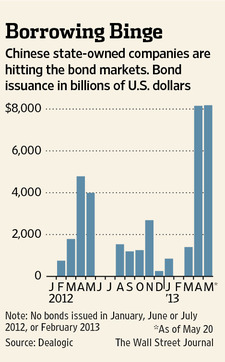
State-owned China International Marine Containers 000039.SZ +0.72% (Group) Co., the world’s largest producer of shipping containers, has postponed a bond sale after global fund managers balked at the interest rate, according to two people with direct knowledge of the matter. The delay may signal that investors are getting picky after a deluge of offerings. Investors had gorged on a record $18.6 billion in dollar-denominated bonds issued this year by Chinese state-owned companies, which typically offer higher returns than investment-grade companies in developed markets. “There’s been a lot of supply, and the beauty of that is, I can choose not to buy some of them,” said Bryan Collins, Hong Kong-based fixed-income portfolio manager at Fidelity Worldwide Investment, referring to the state-owned enterprises’ rising debt. He declined to comment on specific bonds.

Read more of this post

Rival inflation index created by Chinese e-commerce giant Alibaba that suggested China’s official inflation numbers might be too low prompts China’s National Bureau of Statistics into rebuttal action

May 20, 2013, 7:04 PM

Inflation Deflated? Evaluating the ‘Alibaba Index’

AI-CB077_CRT_bl_NS_20130520054205

How high is inflation in China? Some suspect it is higher than is captured in the official consumer price index. A new measure developed by e-commerce giant Alibaba Group Holding Ltd. seems to give that idea some credibility. The official CPI puts inflation at 2.4% year-on-year in April. Alibaba’s Internet Shopping Price Index – based on transactions on the firm’s Taobao and Tmall websites – puts it at 6.9%. After an article in The Wall Street Journal drew attention to the discrepancy, China’s National Bureau of Statistics went into action. They pored over the description of the Alibaba index (in Chinese), and dispatched researchers to Hangzhou to interview its creators. They came back with two key conclusions.

Read more of this post

Oil Out of Sync With Market Forces; Prices of many commodities are down this year, but U.S. oil futures have rallied. Skeptics say the mismatch is a sign of trouble.

Updated May 19, 2013, 5:58 p.m. ET

Oil Out of Sync With Market Forces

By CHRISTIAN BERTHELSEN

MI-BW041_Abreas_G_20130519173904

Prices of many commodities are down this year, but U.S. oil futures have rallied. Skeptics say the mismatch is a sign of trouble. U.S. benchmark crude-oil futures ended Friday at $96.02, up 4.6% since the start of 2013. Oil is a standout in a mostly dismal year for commodities, as the Dow Jones-UBS UBSN.VX +1.65% Commodity Index has fallen 5.6%. The decline has been even steeper for gold, copper and other former darlings. Oil isn’t a gusher compared with stocks, such as the Dow Jones Industrial Average, which is up 16% this year. But some analysts and investors say oil’s rise is remarkable because it came despite several factors that often push prices lower. For example, U.S. economic growth is tepid, domestic oil stockpiles are at their highest in more than three decades, the unemployment rate is at 7.5% in the U.S., and inflation is lower than the Federal Reserve’s target of 2%. Meanwhile, domestic oil production is soaring and U.S. fuel demand is soft.

Read more of this post

CEO Succession Practices: 2012 Edition

CEO Succession Practices: 2012 Edition

Jason D. Schloetzer Georgetown University – McDonough School of Business

Matteo Tonello  The Conference Board, Inc.

Melissa Aguilar The Conference Board, Inc.

April 13, 2013

The Conference Board Research Report R-1492-12-RR

Abstract: 
CEO Succession Practices: 2012 Edition documents and analyzes succession events of chief executive officers (CEOs) of S&P 500 companies. In addition to updates on historical trends, the study features discussions of the most notable cases of CEO succession that took place in 2011 (based on press announcements and other publicly available information) as well as the results of a survey of corporate secretaries and general counsel on the succession oversight practices of their boards (administered annually by The Conference Board). The study includes the following: Part I-CEO Succession Trends (2000–2011): Year-by-year succession rates; Part II-CEO Succession Practices (2011): Includes two sections, “Board Practices in CEO Succession Planning” and “Communication Practices in CEO Succession”; Part III-Notable Cases of CEO Succession (2011): Summaries of 10 episodes of CEO succession that made headlines in 2011 (Advanced Micro Devices; The AES Corporation; Apple; First Solar; Gannett Co.; Hewlett-Packard; H&R Block; Newell Rubbermaid; PG&E; and Yahoo); Part IV-Shareholder Activism on CEO Succession Planning (2011): Discusses a critical policy reversal by the U.S. Securities and Exchange Commission on the excludability of shareholder proposals in CEO succession policies (Hewlett-Packard; Kohl’s; News Corp; Red Robin Gourmet Burgers; United Natural Foods). Concluding the report is an appendix of The Conference Board Roadmap to CEO Succession Planning, which outlines a series of steps intended to help directors organize succession planning, integrate it with existing board responsibilities, make it transparent to all stakeholders, and ultimately define it as an ongoing element of business strategy.

India’s industrial dreams sputter

India’s industrial dreams sputter

There is an urgent need for manufacturing to expand to boost growth and create jobs. -ST
Krittivas Mukherjee
Sun, May 19, 2013
The Straits Times

NEW DELHI – A US$ 12 billion (S$15 billion) steel factory in eastern India was supposed to be the country’s biggest foreign investment, the symbol of a nation’s rush to become an industrial giant. Seven years on, the site is still a patch of sand with a few beat-up containers.

The steel mill that was to be built by South Korean giant Pos- co has been caught up in a drawn-out battle with villagers for land and for government environmental clearances. Thus it has become a symbol of all that needs to change if India is to become a global manufacturing hub.

India is expanding at its slowest in a decade. If it wants to revive lasting growth and absorb some 10 million Indians set to join the workforce annually over the next decade it must shift its economic engine towards manufacturing, industry and analysts say. Instead, factory output has steadily declined, underlining the challenge India faces in achieving its target of expanding manufacturing’s share of gross domestic product to a quarter by 2022 from about 15 per cent now. Read more of this post

China Development Bank Says $8.1 Trillion Needed for Urban Shift; China must urgently find special financing channels to support the urbanization process because local governments can’t afford the spending

China Development Bank Says $8.1 Trillion Needed for Urban Shift

China needs at least 50 trillion yuan ($8.1 trillion) in new investment by 2020 to accommodate a burgeoning population of city-dwellers, according to the president of China Development Bank.

China must urgently find special financing channels to support the urbanization process because local governments can’t afford the spending, Zheng Zhijie, the bank’s president, wrote in an article in the May 16 issue of China Finance, a journal run by the People’s Bank of China. Zheng didn’t elaborate on the estimate, which is about equal to the nation’s nominal gross domestic product in 2012.

The figure shows the extent to which China will need to come up with funds for roads and benefits as part of Premier Li Keqiang’s efforts to make urbanization a key engine of growth. China Development Bank, the world’s largest policy lender, created the the nation’s system of local financing for infrastructure projects. Read more of this post

Vietnam Says Economy at Great Risk of Macroeconomic Instability

Vietnam Says Economy at Great Risk of Macroeconomic Instability

Vietnam still faces “great risk” of macroeconomic instability, a deputy premier said, as credit growth trails behind targets while banks work to reduce elevated bad debt that has hampered growth. While Vietnam is targeting a 12 percent expansion in credit this year, local businesses are facing difficulties getting loans, Deputy Prime Minister Nguyen Xuan Phuc told the National Assembly in Hanoi today. Credit grew about 2 percent in the first four months of the year, the government said last week. The economy expanded 5.03 percent last year, the slowest pace since 1999, and the International Monetary Fund last month cut this year’s forecast to 5.2 percent from 5.8 percent. Lending grew last year by what the World Bank described as an “anemic” 9 percent, and while the central bank has cut policy rates, its attempts to spur growth have been countered by delays in forming a vehicle to address bad debt.

Read more of this post

‘Love Hormone’ Promises Safer Births After Pfizer Flop

‘Love Hormone’ Promises Safer Births After Pfizer Flop

A hormone treatment based on technology used in Pfizer Inc. (PFE)’s failed inhalable insulin shows promise in fighting the leading cause of maternal mortality.

Six years after Pfizer pulled Exubera from the market at a cost of more than $2.8 billion, scientists at Melbourne’s Monash University are revisiting the inhalable technology to deliver a life-saving medicine to stop post-delivery hemorrhage.

The Bill & Melinda Gates Foundation is backing the effort to produce a better way to give oxytocin, a brain chemical that helps the uterus contract after birth and is sometimes referred to as the “love hormone” because of its role in orgasm and bonding. The project is one of several testing inhalations to deliver medicines, salvaging the know-how of a product that was taken off the market after just 14 months of lackluster sales.

“Exubera was the first generation,” said John Patton, one of the original inventors of Pfizer’s inhaled insulin technology system. “When you’re first, you take a lot of bullets. With the developments in the industry, it’s just a matter of time before we will be inhaling lots of medicine.”

The lead scientist for the Monash project, Michelle McIntosh, says her group plans to start testing a dry-powdered form of oxytocin by early 2014. Patton’s company Dance Biopharm Inc., is working on an inhaled insulin, as is Mannkind Corp. (MNKD), the biotech company founded by billionaire investor Alfred Mann. Read more of this post

“Whiskey is for drinking, and water is for fighting.”: The fight for North Dakota’s fracking-water market

Insight: The fight for North Dakota’s fracking-water market

12:48am EDT

By Ernest Scheyder

WATFORD CITY, North Dakota (Reuters) – In towns across North Dakota, the wellhead of the North American energy boom, the locals have taken to quoting the adage: “Whiskey is for drinking, and water is for fighting.”

It’s not that they lack water, like Texas and California. They are swimming in it, and it is free for the taking. Yet as the state’s Bakken shale fields have grown, so has the fight over who has the right to tap into the multimillion-dollar market to supply water to the energy sector.

North Dakota now accounts for over 10 percent of U.S. energy output, and production could double over the next decade. The state draws water from the Missouri River and aquifers for its hydraulic fracturing, the process also known as fracking and the key that has unlocked America’s abundant shale deposits. The process is water-intensive and requires more than 2 million gallons of water per well, equal to baths for some 40,000 people. Read more of this post

Amid frenzy over map apps, new focus on 16th century world view

Amid frenzy over map apps, new focus on 16th century world view

Sat, May 18 2013

By Deborah Zabarenko

Conservators at the Library of Congress prepare a map for its encasement in Washington

WASHINGTON (Reuters) – As online titans compete to deliver instant maps to smartphones, the Library of Congress in Washington is focusing attention on an antique “cosmology” printed in 1507 that serves as America’s birth certificate.

The black-and-white map created by Martin Waldseemuller, a French cleric, was the first time the name America had appeared on any map.

Waldseemuller was prescient enough to show the Rocky Mountains and the Pacific Ocean at a time when no one else in Europe thought they were there.

The map, purchased a decade ago at a cost of $10 million, is the centerpiece of an exhibit at the Library of Congress running through June 22 that features a collection of artifacts from Waldseemuller and his colleagues. Read more of this post

NEA Notches 3,000 Percent Return on Tableau Software Investment as Digital Chart Valuation hit $950 Million on Nasdaq Debut

NEA Notches 3,000 Percent Return on Tableau Software Investment

For New Enterprise Associates Inc., its investment return on Tableau Software Inc. (DATA) was off the charts.

NEA’s $29.2 million investment in the digital-chart provider, which made its stock-market debut today, was valued at more than $950 million at the close in New York, making the venture-capital firm the top winner so far this year, Bloomberg.com reported on its Tech Deals blog.

As any Silicon Valley pundit knows, the vast majority of venture-capital bets fail. What makes the business work is the very rare gain of more than 3,000 percent on an investment, like the return NEA has thus far achieved on Tableau.

NEA first backed Seattle-based Tableau in 2004, a year after the company was founded, gaining two board seats and providing $5 million to “expand sales operations and invest in product development,” according to a statement at the time. NEA, with offices in Menlo Park, California, and Chevy Chase, Maryland, put in another $10 million in 2008 and $14.2 million in 2010.

More than 10,000 companies including Apple Inc. (AAPL) to Bank of America Corp. have used Tableau’s software to create easy-to-use charts out of complex data. Read more of this post

Bamboo Innovator Workshop for the Singapore Public: In Search of Compounding Stocks in Uncertain Times (Series #1 of 4)

http://valueinvesting-series1.eventbrite.sg/

From the Fund Management Jungles: Value Investing Exposed and Explored (Workshop Series)

In Search of Compounding Stocks in Uncertain Times (Series #1 of 4)

FE Asia Consultancy Pte Ltd

Saturday, 13 July 2013 from 09:00 to 17:00 (SGT)

Singapore, Singapore

Event Details

“In business, I look for economic castles protected by unbreachable ‘moats’.”

– Warren Buffett

With unresolved crises on the horizon, investors are often immobilized in making investment decision. “Wait for the clouds to clear” is the mantra. Value investing appears to provide a way out to see opportunities in cloudy weather by using the “cheap” price signal to identify “out-of-favor” neglected stocks and invest in them for “reversion back to mean”. Hence, pick stocks with “cheap” valuations based on conventional metrics and ratios – how much lower can they go anyway? – and they will bounce back up to their historical average levels. Or simply wait for a market dip, or a crash, before declaring some magical list of top ten stock tips to invest in. This is NOT value investing.

When Li Ning, the “Nike of China”, announced that its founder is going into industrial park and property development in September 2010, the stock has been a darling, having a competitive “moat” with brand recognition and it has recovered strongly since its bottom in March 2009 by climbing 140% to HK$24 per share. Oh, it is already expected that the market will react negatively to the property news, now it is down 20% to HK$19, value stock, be contrarian, BUY! Down another 20% to HK$15, getting cheaper and it’s out-of-favor, it will bounce back up, BUY! And the value investor catches the falling knife until below HK$5 now; while Nike hits an all-time high.

How do value investors distinguish whether “cheap” stocks are value traps or opportunity?Without an understanding of the underlying business model dynamics and analyzing the durability of the economic moat, an investment decision based on price and macro signals and historical valuation metrics can be misleading and costly. Without an understanding of business model, one would also have sold Wal-mart after it was listed in 1972 as the stock crashed over 60% in the next three years. Wal-mart went on to compound 1,200-fold since 1972 to over US$250 billion in market cap – a $100,000 investment in Wal-Mart becomes a $120 million treasure trove. So why is Wal-mart able to bounce back to scale new heights but the same cannot be said for the “Nike of China”?

Can resilient business models – Bamboo Innovators – outperform even in stormy periods? When Shanghai Composite Index crashed 70% from its peak of 6,000 in October 2007 to below 2,000 at the bottom in March 2009, Yunnan Baiyao was UP around 8%. As the index bounce to 2,200, still down 60% from its peak, Baiyao is up over 220% during the same period. Increasingly, such resilient business models are outperforming in Asia and globally; while the “cheap” stocks get cheaper and they become the fertile ground for “insiders” (庄家) who manipulate prices and volumes and inject “action” via exciting corporate news announcement of “sexy” projects or M&As, luring investors in and then offloading to them in a pump-and-dump cycle. Sophisticated value investors can overcome poor and uncertain macro conditions by investing in resilient compounders because they have their own internal rhythm to create value, like the bamboo, which bend, not break even in the wildest of storm that would have snapped the once-mighty oak tree.

Course Highlights:

– Mr Kee, one of the few Asian fund manager being invited to speak at a number of top banking & finance conferences around the world alongside with renowned speakers such as Praveen Kadle, Chief Executive Officer of Tata Capital & Lauren Templeton, President of Lauren Templeton Capital Management

– Learn from an experienced & qualified instructor who has taught in local Universities

Program Outline and Key Learning Points:

  • LEARN the R.E.S.-ilience factors in the business model and economic moat analysis of how Bamboo Innovators create extraordinary value, particularly the “E” factor which stands for “emptiness” in the business model.
  • GAIN the surprising insight of sophisticated institutional investors who understand why growth in sales, profit and tangible asset may not translate to market capitalization growth and sustainable share price gains.
  • ATTAIN the critical knowledge of 12 types of sophisticated institutional investors that climbing from $50 million to $1 billion in market cap takes an entirely different business model dynamics as compared to scaling up sustainably from $1 billion to $20 billion in market cap.
  • RECOGNIZE the 12 types of business models and their profit patterns and acquire the ability to scan through different businesses in various industries to understand the key levers for growth ahead of the investment curve.
  • UNDERSTAND why and how businesses hit a stall point in growth and without a transformation in business model, bigger can be riskier. Thus “Grow or Perish” become “Grow AND Perish”
  • DISSECT a wide range of real-world cases of Asian and global Bamboo Innovators in various industries and understand the intricacies of their business models, their critical success – and failure – factors.
  • UNIFY at the end of the day all the previously disparate loose-hanging concepts, descriptive facts and “checklists” you have learnt from various sources into the practical Bamboo Innovator mental model when it comes to real investment decision-making.

Understand more about the Instructor’s investment approach with the following published articles:

About the Instructor:

Koon Boon is the founder and managing director of the Singapore-based Bamboo Innovator Institute to establish the thought leadership of resilient value creators around the world. KB has been rooted in the principles of value investing for over a decade as a fund manager and analyst in the Asian capital markets. He was a fund manager and head of research/analyst at a Singapore-based investment management organization dedicated to the craft of value investing in Asia. He had been with the firm since 2002 and was also part of the core investment committee in significantly outperforming the index in the 10-year-plus flagship Asian fund. He was previously the portfolio manager for Asia-Pacific equities at Korea’s largest mutual fund company. He received his Masters in Finance (magna cum laude) and double degree in Accountancy and Business Management (both summa cum laude) from the Singapore Management University (SMU). He had taught accounting at his alma mater in SMU and lectures at SIM University for working professionals. He had published cutting-edge empirical research in the Special Issue of Istanbul Stock Exchange 25th Year Anniversary of the Boğaziçi Journal, Review of Social and Economic Studies, as well as wrote articles about value investing and corporate governance in the media. He had also presented in top banking and finance conferences in Sydney, Cape Town, HK, Beijing and in the recent Emerging Value Summit 2013. He is also an internationally-featured value investor in Greatinvestors.TV and BeyondProxy.com. He had trained CEOs, entrepreneurs, CFOs, management executives in business strategy, macroeconomic and industry trends in Singapore, HK and China.
The grandson of the Swedish brand’s H&M founder says price is not the only way to judge a company

May 19, 2013 6:00 pm

Karl-Johan Persson, chief executive, Hennes & Mauritz

By Richard Milne in Stockholm

Karl-Johan Persson pauses on his way out of the headquarters of Hennes & Mauritzin central Stockholm. The 38-year-old grandson of the founder has just spent an hour discussing the challenges of running the world’s second-largest fashion retailer – from sourcing clothes from Bangladesh to its rivalry with Spain’s Inditex. But on his way to one of the many H&M stores nearby for a photo shoot, he remembers another big test: modelling. At a fashion show for creative director Margareta van den Bosch’s 70th birthday last year, Mr Persson had to strut his stuff on a catwalk in a leather jacket and white jeans from H&M’s collaboration with Maison Martin Margiela. “This, this was my greatest challenge,” the photogenic Swede says, grinning. Mr Persson’s four years as H&M’s chief executive – following in the footsteps of both his father Stefan and grandfather Erling – have been filled with many tests. His starting point was hardly auspicious, taking the reins of the purveyor of cheap chic in 2009 just as the financial crisis hit consumers with full force. In 2011, H&M was overtaken as the world’s biggest fashion retailer by market capitalisation by Inditex, the owner of Zara. And last month’s factory collapse in Bangladesh, with the loss of more than 1,100 lives, has shone a spotlight on the country’s biggest buyer of clothes: H&M.

The paradox, however, is that even if H&M is focused on “fast fashion” and the shortest-term trends, Mr Persson runs the company with an almost stubbornly long-term approach. Some deride this as leaving H&M looking slow compared with the nimbleness of Inditex as the Swedish group takes its time developing new brands and launching online sales. But Mr Persson still views H&M – the largest listed company in Sweden with a market capitalisation of $58bn and annual sales of $21bn – as a family business with all the planning for future generations that this entails. Read more of this post

The Apathy Epidemic: Why your startup will suck you dry

The Apathy Epidemic: Why your startup will suck you dry

BY PETER SHALLARD 
ON MAY 17, 2013

With entrepreneurs, there’s rarely a lack of drive, at least in the beginning. After a while, though, as your idea matures into an actual startup, apathy can rears its ugly head. Almost every entrepreneur experiences this, though is usually loathe to admit it. It might present itself as a slow decline in motivation, with each day feeling a little less exhilarating than the one before, or a sudden slack of the wind in the sails.

Everyone, no matter how unconventional the business he’s in, is at risk. It happened, for example, to Andy Drish, founder of TheFoundation.com, a-software-as-a-service education platform that preaches a bootstrap philosophy. Last year’s product launch, though wildly successful, left Drish and his team in a slump.

“We were so focused on the launch that we made the mistake of not asking ourselves what the following hundred days of business looked liked,” Drish says. “The launch was so fun — immediately after that, it changed. Our customers felt the results of that too. It felt like depression.” Read more of this post