Google CEO Larry Page Shares His Philosophy At I/O: “We Should Be Building Great Things That Don’t Exist”

Google CEO Larry Page Shares His Philosophy At I/O: “We Should Be Building Great Things That Don’t Exist”

DREW OLANOFF posted yesterday
img_87131

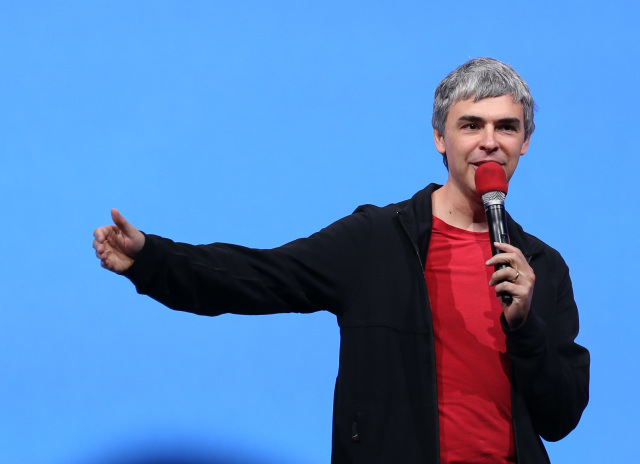
Today, a day after discussing his voice issues, Google CEO Larry Page took the stage at the I/O keynote. He skipped last year’s conference and a few earnings calls due to those same voice problems, which he has noted are improving. Page even did something a little new for I/O — taking questions at the end of his talk.

Page discussed how important it is for both the developers and Google to keep dedicating themselves to technology, to make sure that people everywhere can get access to it. He also discussed his relationship with his father, and how important that was in influencing him when it comes to innovation:

My dad was really interested in technology. He drove me and my family all across the country to go to a robotics company. Then we got there, he thought it was so important his son would go to the conference. Read more of this post

Death By A Thousand Cuts? Google Wallet’s Plan To Take On PayPal Leverages Chrome, Android, Google+, Gmail & More

Death By A Thousand Cuts? Google Wallet’s Plan To Take On PayPal Leverages Chrome, Android, Google+, Gmail & More

SARAH PEREZ posted yesterday

send_money-hero

Flying under the radar amid a flurry of announcements from today’s Google I/O developer conference is the bigger news of how Google is stepping up its efforts to compete with online payment giants, such as PayPal. It plans to do so with a revamped checkout process for the web, mobile web, within mobile applications running on Android, and more. It’s a proposed death to PayPal by a thousand cuts, leveraging everything from Chrome to Android and even Gmail. What Google hasn’t quite worked out yet is how all this will tie together in the long run, but you can see the plan beginning to form.

Read more of this post

Online apparel retailers are finding that showing their clothing on real people causes customers to engage more and buy more often

Updated May 15, 2013, 7:19 p.m. ET

More Brands Want You to Model Their Clothes

By CHRISTINA BINKLEY

Online apparel retailers are finding that showing their clothing on real people causes customers to engage more and buy more often. On Style columnist Christina Binkley joins Lunch Break.

After Katherine Lin put out a photo of herself with friends at the Coachella music festival on Twitter and Instagram this spring, she was thrilled to discover the photo posted on the website of Dannijo.com, the retailer whose necklace she was wearing.

“It shows how much they want to connect with us as consumers,” says the 21-year-old University of Southern California student. Read more of this post

Sony’s $100 Billion Lost Decade Supports Loeb Breakup

Sony’s $100 Billion Lost Decade Supports Loeb Breakup

By Angus Whitley, Brooke Sutherland and Naoko Fujimura – May 16, 2013

Sony Corp. (6758) has a $100 billion reason to consider Daniel Loeb’s breakup proposal.

Loeb, whose Third Point LLC hedge fund just took a $1.1 billion stake in Sony, is pushing the Tokyo-based company to sell as much as 20 percent of its entertainment business and focus on the “considerable and underappreciated value” of its electronics unit. After Loeb’s proposal sparked the biggest rally in Sony shares in more than four years, the $21 billion company still languishes at a cheaper valuation relative to profit than 90 percent of similar-sized consumer electronics makers, according to data compiled by Bloomberg yesterday.

Loeb is approaching Sony after shareholders lost more than $100 billion in market value since 2000. CLSA Asia-Pacific Markets said Sony would be worth 28 percent more in a separation. While estimates from Macquarie Group Ltd.’s Damian Thong fall short of Loeb’s targeted 60 percent stock gain, the analyst said the activist’s claim that spinning off the entertainment unit and boosting its profitability may raise the company’s market value by about 30 percent “seems reasonable.”

“Sony is a chronic underperformer,” Joshua Strauss, Chicago-based co-manager of the Appleseed Fund at Pekin Singer Strauss Asset Management Inc., which oversees about $1 billion, including investments in Japan and Korea, said in a telephone interview. “Should they spin off the entertainment division? Would it create shareholder value? Probably. When you do that sort of thing, the sum of the parts is greater than the whole.” Read more of this post

Chinese economy replaces EU debt crisis as investors’ top concern

Chinese economy replaces EU debt crisis as investors’ top concern

Staff Reporter 2013-05-16

Predictions that China’s economy will face a hard landing leading to a commodity collapse has replaced the European sovereign debt crisis as one of the main concerns of international and domestic investors, with many reducing their investments in emerging markets and commodities to invest in Japanese and European equities, reports our sister paper Want Daily.

A report released by the Bank of America Merrill Lynch earlier in the month showed that many investors are currently forecasting a weakening Chinese economy, with those feeling positive about the country’s economic outlook dropping by 8%. It is the first negative figure in fourteen months, while 25% of the fund managers surveyed considered a hard landing a possibility in China, a sharp increase from the 18% recorded last month.

Approximately 29% of the fund managers have already reduced their investments in China’s commodity market, while investments in Japanese equities have increased for the seventh consecutive month, surpassing the 31% recorded in May 2006. Read more of this post

Bentley Luxury-Car Sales in China Cool; Global luxury goods market to cool in 2013: Bain

May 15, 2013, 11:07 a.m. ET

Bentley Luxury-Car Sales in China Cool

By COLUM MURPHY

BEIJING—The maker of Bentley luxury cars is the latest high-end auto maker to warn that ebbing confidence among Chinese consumers and a government-led drive against conspicuous consumption has hurt demand for its expensive rides. Read more of this post

Cancer researchers are growing increasingly enthusiastic about harnessing the body’s own immune system to fight tumors

May 15, 2013

Melanoma Treatment Harnesses Immune System to Combat Cancer Cells

By ANDREW POLLACK

Cancer researchers are growing increasingly enthusiastic about harnessing the body’s own immune system to fight tumors. And new research shows that two drugs that use this approach may be even better than one. Researchers reported on Wednesday that a combination of two drugs from Bristol-Myers Squibb shrank tumors significantly in about 41 percent of patients with advanced melanoma in a small study. In few of the 52 patients in the study, tumors disappeared completely, at least as could be determined by imaging.

“I think it was really the rapidity and the magnitude of the responses that was impressive to us,” Dr. Jedd D. Wolchok of the Memorial Sloan-Kettering Cancer Center, said in a telephone news conference organized by the American Society of Clinical Oncology. Read more of this post

The Buffett Formula — How To Get Smarter

The Buffett Formula — How To Get Smarter

by SHANE PARRISH on MAY 15, 2013

“The best thing a human being can do is to help another human being know more.” — Charlie Munger

“Go to bed smarter than when you woke up.” — Charlie Munger

Most people go though life not really getting any smarter. Why? They simply won’t do the work required. It’s easy to come home, sit on the couch, watch TV and zone out until bed time rolls around. But that’s not really going to help you get smarter. Sure you can go into the office the next day and discuss the details of last night’s episode of Mad Men or Game of Thrones. Sure you know what happened on Survivor. But that’s not knowledge accumulation, it’s a mind-numbing sedative. You can acquire knowledge if you want it. In fact there is a simple formula, which if followed is almost certain to make you smarter over time. Simple but not easy. It involves a lot of hard work. We’ll call it the Buffett formula, named after Warren Buffett and his longtime business partner at Berkshire Hathaway, Charlie Munger. These two are an extraordinary combination of minds. They are also learning machines. Read more of this post

Why companies need inventors, not just their ideas

Why companies need inventors, not just their ideas

By Peter Gwynne May 13, 2013

Peter Gwynne is a former science editor of Newsweek and a freelance writer who covers science, technology and business.

According to an early and frequently quoted aerodynamic model, bumblebees cannot possibly fly. Of course, any entomologist or gardener knows that the fuzzy insects make it into the air with great success; the model simply had it wrong.

As with bees, so it is with business. Researchers have long held the conceit that innovative entrepreneurship is impossible. “They assert that ‘entrepreneurs can’t do anything new in the economy,’” says Daniel Spulber, a professor of management and strategy at the Kellogg School.

This is because established firms have several advantages when it comes to taking inventions to the market. “They have all kinds of assets that are complementary to innovation,” Spulber says, including established corporate structures, marketing channels, an existing customer base, and access to capital. To go it alone, on the other hand, the inventor must undertake the cumbersome effort of setting up a new firm and dealing with the uncertainty that any new invention faces in the market. Even Joseph Schumpeter, perhaps the greatest advocate of entrepreneurs, suggested in his classic book Capitalism, Socialism, and Democracy that only large companies have the resources and market power necessary for innovation. Read more of this post

What Is Organizational Culture? And Why Should We Care?

What Is Organizational Culture? And Why Should We Care?

by Michael Watkins  |   2:00 PM May 15, 2013

If you want to provoke a vigorous debate, start a conversation on organizational culture. While there is universal agreement that (1) it exists, and (2) that it plays a crucial role in shaping behavior in organizations, there is little consensus on what organizational culture actually is, never mind how it influences behavior and whether it is something leaders can change.

This is a problem, because without a reasonable definition (or definitions) of culture, we cannot hope to understand its connections to other key elements of the organization, such as structure and incentive systems. Nor can we develop good approaches to analyzing, preserving and transforming cultures. If we can define what organizational culture is, it gives us a handle on how to diagnose problems and even to design and develop better cultures.

Beginning May 1, 2013, I facilitated a discussion around this question on LinkedIn. The more than 300 responses included rich and varied perspectives and opinions on organizational culture, its meaning and importance. I include several distinctive views below, illustrated by direct quotes from the LinkedIn discussion thread — and then I offer my own synthesis of these views. (There often were multiple postings with similar themes, so these are simply early selections; unfortunately it was not possible to acknowledge everyone who made helpful contributions.) Read more of this post

Don’t Let Predictability Become the Enemy of Innovation

Don’t Let Predictability Become the Enemy of Innovation

by Michael Schrage  |   1:00 PM May 15, 2013

Unhappily shocked by Sputnik’s unexpected 1957 success, President Eisenhower quickly pushed the Pentagon to establish the Defense Advanced Research Projects Agency (DARPA). Its ostensible mission: “to prevent technological surprise to the U.S. military, and to create surprises of its own.”

Anticipating and enabling “technological surprise” has become even more challenging, DARPA director Arati Prabhakar recently told an MIT audience, because more people in more places have more access to more technology that ever before. Surprises can come from anywhere. In an era of greater global trade, knowledge transfer and transparency, Prabhakar unsurprisingly reports DARPA’s core value proposition demands disproportionately greater imagination and ingenuity. Predictability breeds complacency. Predictability is DARPA’s cultural, technical and organizational enemy. Read more of this post

Have we all been duped by the Myers-Briggs test? Despite its popularity, the personality test has been subject to sustained criticism by professional psychologists for over three decades

Have we all been duped by the Myers-Briggs test?

May 15, 2013: 11:13 AM ET

Despite its popularity, the personality test has been subject to sustained criticism by professional psychologists for over three decades.

By Roman Krznaric

FORTUNE — When Frank Parsons opened the world’s first career guidance center in Boston in 1908, he began by asking prospective clients 116 penetrating questions about their ambitions, strengths, and weaknesses (and how often they bathed). But then he did something more unusual: He measured their skulls.

Parsons was a committed believer in phrenology. If you had a large forehead, he might recommend you become a lawyer or engineer. But if your skull was more developed behind the ears, you were of the “animal type” and best suited to manual work. Read more of this post

The Leader’s Code: Mission, Character, Service and Getting the Job Done

May 15, 2013 4:25 pm

Management lessons from the frontline

Review by Morgen Witzel

The Leader’s Code: Mission, Character, Service and Getting the Job Done
By Donovan Campbell (Random House, $27)

That the experience of military leadership offers some useful lessons for leaders in other fields has long been understood. Sun Tzu’s The Art of War is still read by business leaders and sports coaches, and more recently Norman Dixon’s On the Psychology of Military Incompetence offers lessons from military failure.

The latest crossover book that draws from military experience is Donovan Campbell’s The Leader’s Code. As such efforts go, it is a pretty good one. Campbell, a former captain in the US Marine Corps who served in Iraq, writes fluently and persuasively, blendingabstract ideas and personal experience in a highly readable narrative. He begins by arguing that people no longer trust their leaders, whom they see as greedy and selfish. “The widespread destruction of trust has left a leadership vacuum that is slowly becoming filled with despair,” he says, pointing out that this is true of business and government alike. “We trust no single leader, or class of leaders, to fix what is broken.” Read more of this post

For Entrepreneurs, Failure Isn’t Always a Good Teacher

For Entrepreneurs, Failure Isn’t Always a Good Teacher

by Art Papas  |   8:00 AM May 15, 2013

Much has been said about the virtues of failure — it’s a learning opportunity, it happens to everyone, it’s character-building. Failure is becoming some romanticized rite of passage, invoking images of young entrepreneurs burning the midnight oil and yelling “Eureka!” I can say from experience that any entrepreneur who fails repeatedly before finding the golden ticket had better be ready to coat themselves in protective armor, because your stakeholders may not be as understanding of your failures.

I’ve often said that failure is a great teacher, but its lessons are too harsh. Entrepreneurs will fail all the time, yes, and there’s no alternative to failure. You can’t avoid it altogether. What you mustavoid, however, is letting it consume you and destroy your self-confidence. If you let yourself become afraid to innovate — to go for it — you haven’t just failed. You’ve become a failure.

Failure makes many of us less confident and less aggressive. We become gun shy. That’s not surprising. Unfortunately, the cold reality is that once you’ve failed as an entrepreneur, you need to have blind confidence and a healthy sense of aggression to prove to people that you actually cansucceed. You need to try again, and brace yourself to be criticized, lectured, doubted, and flat-out ignored by investors and sometimes even your own team. If at first you don’t succeed, you’re in for the fight of your life. Read more of this post

How to bridge a cultural ocean; Lessons on how to be brasher in business

Last updated: May 15, 2013 8:01 pm

How to bridge a cultural ocean

By Ian Sanders

On the 24th floor of a building on New York’s Avenue Of The Americas, a group of British entrepreneurs is attending a masterclass in how to do business in the US, listening to fellow Britons who have already set up in the city. The event has been organised by London-based media events company Chinwag as part of a trade mission in association with UK Trade and Investment, the government body that helps British businesses expand overseas. Amid the talk of tax arrangements and employment contracts, the entrepreneurs are learning about the cultural nuances in hiring, pitching and workplace culture. Read more of this post

Tiny Rowland’s maverick empire quietly vanishes; company has shrunk from a FTSE 100 component and symbol of buccaneering capitalism to a small Africa-focused infrastructure and agribusiness conglomerate

Last updated: May 15, 2013 7:12 pm

Tiny Rowland’s maverick empire quietly vanishes

By Kate Burgess and Anousha Sakoui

How the mighty are fallen. Lonrho, the global cars-to-crops empire built by maverick businessman Roland “Tiny” Rowland into one of the most prominent public companies of the last century, is about to vanish quietly from Britain’s stock markets. The company, which has shrunk from a FTSE 100 component and symbol of buccaneering capitalism to a small Africa-focused infrastructure and agribusiness conglomerate, has agreed to be taken private for £174.5m, about a tenth of its value in 1991. Two Swiss investors, Rainer-Marc Frey, a director of UBS and founder of hedge fund RMF, and Thomas Schmidheiny, the billionaire former chairman of Holcim, the cement maker, have offered Lonrho shareholders 10.25p a share in cash. The bid marks the end of a colourful chapter for the 100-year-old British company which was incorporated in London in 1909 as the London and Rhodesia Mining and Land Company and was to become synonymous with British capitalism in Africa.

Read more of this post

China in innovation challenge to Europe

May 16, 2013 12:03 am

China in innovation challenge to Europe

By Chris Bryant in Frankfurt

Europe’s business leaders fear its industry will fall behind China in technological innovation within a decade as the economic crisis undermines one of the continent’s competitive advantages.

More than two-thirds of business leaders surveyed by Accenture, the consultancy, on behalf of BusinessEurope, the business lobby group, said China would reach or pull ahead of Europe in innovation by 2023.

Weak demand caused by Europe’s economic crisis has sent industrial production into decline, while corporate reluctance to delve into cash reserves is holding back new investment, training and R&D. Read more of this post

Beijing signals concerns at rising unemployment

May 15, 2013 4:35 pm

Beijing signals concerns at rising unemployment

By Jamil Anderlini in Beijing

China’s newly installed leaders have signalled their concern about rising unemployment in the slowing Chinese economy with several carefully stage-managed public appearances this week.

On Tuesday, Chinese President Xi Jinping paid a surprise visit to a job fair in the eastern city of Tianjin while Premier Li Keqiang warned the country faces an unprecedented challenge in finding jobs for a record number of university graduates.

In a nationwide teleconference on Monday that was widely reported in state media on Wednesday, Mr Li said that nearly 7m tertiary students would enter the job market in July in China, the largest number in the country’s history.

He said it was an “important task” to find jobs for all these graduates, who make up a demographic considered potentially threatening to Communist Party rule if they become disaffected in large numbers. Read more of this post

China’s companies spurn directive to pay 30% dividend; Just 60 per cent of China’s biggest listed-companies met the dividend guidelines, a blow for attempts to build credibility in China’s equity markets

May 16, 2013 5:48 am

China’s companies spurn directive to pay 30% dividend

By Josh Noble in Hong Kong

Just 60 per cent of China’s biggest listed-companies met the dividend guidelines laid out by the Shanghai stock exchange earlier this year, a blow for attempts to build credibility in China’s equity markets.

Of the members of the FTSE A50 index, only 30 companies paid a dividend of over 30 per cent during the most recent earnings season, according to data compiled by Markit.

In January, the Shanghai bourse told listed companies to return at least 30 per cent of profits to shareholders“because of a definite gap between cash dividend ratios for Shanghai-listed companies and those in mature markets”. Read more of this post

China is addicted to debt and shows few signs of kicking the habit, says Francis Cheung

Thursday, May 16, 2013

China is addicted to debt and shows few signs of kicking the habit, says Francis Cheung

Credit can be like steroids for developing countries. Pump loans to businesses and governments, and they will be better able to tap into the latent opportunities of an undeveloped economy.

But as Francis Cheung, head of China and Hong Kong strategy at brokerage CLSA, points out, China has become addicted to debt to fuel growth. And like habitual steroid use, eventually growing debt will threaten the health of the overall system.

Cheung authored a report earlier this month sounding the alarm on how the levels of debt are piling up with no sign of slowing while bringing fewer benefits to the economy. More than half of China’s total debt was added in the past four years, the bulk of which came from shadow banking and bonds. The country’s debt level sits at roughly 205% of GDP as of 2012.

On the sidelines of the CLSA China Forum 2013 in Beijing earlier this week, Cheung spoke to CHINA ECONOMIC REVIEW about where the biggest risks lie and their possible solutions, even if it’s unlikely they’ll be enacted Read more of this post

Chairman of Sinovel has resigned as of one of the country’s largest makers of wind turbines struggles amid an industry downturn

05.15.2013 18:20

Head of Sinovel Resigns amid Company Struggles

Wei Chiyuan steps down as chairman after pursuing reforms that could not keep firm profitable during industry downturn

By staff reporter Pu Jun

(Beijing) – The chairman and acting president of Sinovel Wind Energy Group Co. has resigned as of one of the country’s largest makers of wind turbines struggles amid an industry downturn. Read more of this post

Hukou Age Limits Anger Graduates; A new policy prevents college graduates who are too old from getting Beijing residence

Hukou Age Limits Anger Graduates

By Liu Jinsong (刘金松) and Hu Dan (胡丹)
Issue 619, May 13, 2013
When Zhang Xin (a pseudonym) went online to find information about getting a Beijing hukou (household registration), he came across an agency saying that it would cost 220,000 yuan for people “within the age limit.” But for people over the “age limit,” it would cost an additional 40,000 yuan for them to work around “new rules.”

Zhang will finish his master’s degree at Peking University this June, and has already signed a contract with a well-known international company. Many people in his situation can obtain a Beijing hukou through their job so that they access certain social services within the city. Zhang Xin had counted on this.

However, the “age limits” mentioned by the online agency was the first mention he’d heard of any new rules. He thought it might be a scam, so he went to the company he was set to work for, as well as the employment office at his university. They all said they hadn’t heard of any age limits on obtaining a hukou. But after searching more online, Zhang found that the agency wasn’t a scam. Many others were facing the same problem. Read more of this post

Ping An’s investment in Chinese cosmetics company Jahwa turns sour; public is keen to know what went wrong with to the seemingly perfect investment

Ping An’s investment in Jahwa turns sour

Staff Reporter

2013-05-16

After Ge Wenyao stepped down as chairman of Shanghai Jahwa United, a listed Chinese cosmetics company, the public is keen to know what went wrong with to the seemingly perfect investment made by the Ping An Trust, a strategic investor that was introduced into the business by Ge himself. Read more of this post

China’s E-Tail Revolution: China’s e-tail market is the world’s second largest (after that of the United States), with an estimated $210 billion in revenue last year

China’s E-Tail Revolution

Richard Cooper, Richard Dobbs

14 May 2013

SHANGHAI – When you think about centers of technological innovation, Silicon Valley, Seattle, and Seoul are probably the first places that come to mind. After all, they are the homes of Amazon, Apple, Facebook, Google, Intel, Microsoft, and Samsung – companies whose innovations transform the way other sectors, from financial services to telecoms and media, do business.

Now, however, the rise of “e-tail” (consumer-facing e-commerce) in China is enabling Hangzhou – the base of Alibaba, China’s largest online retailer – to join their ranks. Indeed, on April 29, Alibaba signaled its ambitions by buying an 18% stake in Sina Weibo, China’s version of Twitter. And, as with technology hubs elsewhere, innovations born in Hangzhou are determining the development path of related industries.

China’s e-tail market is the world’s second largest (after that of the United States), with an estimated $210 billion in revenue last year. Since 2003, the market has posted a compound annual growth rate of over 110%. By 2020, China’s e-tail market could be as large as today’s markets in the US, Japan, the United Kingdom, Germany, and France combined. Read more of this post

Lessons from a rare $2 billion LA tech win: “I was competing with both hands tied behind my back”

Lessons from a rare $2 billion LA tech win: “I was competing with both hands tied behind my back”

BY SARAH LACY 
ON MAY 15, 2013

You hear it over and over again: What the LA ecosystem needs is a big, publicly-traded, home-grown, multi-billion dollar company. Well, there actually is one in LA that almost no one talks about: Cornerstone On Demand, an enterprise software company that focuses on HR software. And it’s a real enterprise software company, not a consumer company with a  freemium model that’s calling itself enterprise to get money and headlines these days. Why doesn’t Cornerstone — with its $2 billion market cap – get more love and attention? It’s partially that the company hasn’t focused on press and also the fact that enterprise software companies just aren’t as widely covered as consumer or ecommerce companies. But it’s also because the company was bootstrapped for much of its existence, growing up in a time in the LA ecosystem when there was little press or attention paid to tech. In an effort to raise the profile of LA entrepreneurs generally, Cornerstone is sponsoring our month-long look at the LA ecosystem. But as the multi-billion tech company that no one in LA talks about, it is also just the type of company we should be surfacing in this report. I hopped on the phone with Cornerstone’s founder and CEO Adam Miller to talk about the pros an cons of building one of the only billion-dollar-plus companies out of LA — and one that doesn’t rely on celebrity endorsements to boot.

Read more of this post

Challenging domination of oil’s powerful few

May 15, 2013 8:05 pm

Challenging domination of oil’s powerful few

By Ajay Makan in London

For decades the physical oil market has been the unregulated preserve of a few powerful companies. But in the wake of the Libor scandal, it is subject to intense scrutiny. Energy companies including BP, Royal Dutch Shell and Statoil, the majors raided by the European Commission on Tuesday in a probe into possible price rigging, have long dominated the trade. A handful of large commodity trading houses, hedge funds and investment banks are the other big participants. The market is not overseen by governments or exchanges, but by companies such as Platts, a price reporting agency (PRA) which publishes daily assessments that are gospel in the world of physical commodities. That gives Platts, a unit of the New York-listed McGraw Hill Financial, which was also raided on Tuesday, huge influence. According to Platts, its daily assessment of dated Brent, as the physical North Sea oil market is known, is the reference price for 60 per cent of crude traded worldwide. Dated Brent also underpins exchange-traded derivatives used by airlines to hedge prices and, along with taxes, Platts’ crude and product prices determine the price of petrol at the pump. The power of Platts has not gone unnoticed. Read more of this post

8 Tech Execs Whose Trash-Talking Blew Up In Their Faces

8 Tech Execs Whose Trash-Talking Blew Up In Their Faces

Kevin McLaughlin | May 15, 2013, 9:33 PM | 8,371 | 4

Tech execs just love mixing it up with their rivals. Maybe it has something to do with the lack of sleep they get, or the drudgery of spending large portions of their lives making and giving PowerPoint presentations. Whatever the reason, when tech execs trash-talk other companies’ products, sometimes it backfires. Some products that are belittled end up being hugely successful. Other times, the exec who’s doing the trash-talking ends up getting fired, or his or her company falls on rough times. In some cases, executive trash-talk ends up being factually inaccurate. Microsoft CEO Steve Ballmer laughed at the iPhone when Apple introduced it. He also predicted the iPad would not have much success. Obviously, neither prediction panned out. We’re not going to include Ballmer’s trash-talking about Apple, since it’s pretty much common knowledge at this point. But others have done the same or worse …

Ex-HP CEO Leo Apotheker Questions Wisdom Of iPad Usage

Leo Apotheker, whose 9-month reign as HP CEO was full of turmoil, was convinced that Apple’s iPad was just a passing fad that wouldn’t have a lasting impact in businesses. “I saw someone using an iPad with a keyboard. Why would you want to carry that when you could carry a laptop?” Apotheker said in an interview with AllThingsD’s Walt Mossberg at its D9 conference in June 2011.  Millions of people who’ve been lugging around iPads instead of notebooks since then would disagree. Apple sold 19.5 million iPads last quarter and sold 22.9 million the quarter before that. Almost every Fortune 500 company is using iPads in some capacity. Meanwhile, HP’s TouchPad had a brief six-week run in the market, and Apotheker was shown the door in September 2011.  Read more of this post

Nassim Taleb’s Six Rules For Succeeding In Life

Nassim Taleb’s Six Rules For Succeeding In Life

Matthew Boesler | May 15, 2013, 10:38 AM | 8,153 | 18

Black Swan and Antifragile author Nassim Taleb‘s six rules for success, just posted to his Facebook page:

Success in all endeavors is requires absence of specific qualities.

1) To succeed in crime requires absence of empathy,

2) To succeed in banking you need absense of shame at hiding risks,

3) To succeed in school requires absence of common sense,

4) To succeed in economics requires absence of understanding of probability, risk, or 2nd order effects and about anything,

5) To succeed in journalism requires inability to think about matters that have an infinitesimal small chance of being relevant next January,

…6) But to succeed in life requires a total inability to do anything that makes you uncomfortable when you look at yourself in the mirror.

As always, these are just heuristics. A brief explanation from earlier this month:

Nassim N. Taleb @nntaleb

Heuristics need to be convex, i.e. effect when wrong shoud be small, payoff from using it repeatedly should be broadly large.

3:09 AM – 3 May 2013

Vietnam must ditch state-sponsored crony capitalism

Last updated: May 15, 2013 8:03 pm

Vietnam must ditch state-sponsored crony capitalism

By David Pilling

For a country in its demographic sweetspot, the economy is not growing fast enough

The country has just emerged from a scandal that exposed virulent corruption at the heart of the Communist party. There is a pressing need to reform state-owned enterprises – behemoths of inefficiency, patronage and powerful vested interests. The internet is awash with stories about arbitrary land grabs, prisoners of conscience and the antics of the party’s privileged offspring. It sounds like China, but this is Vietnam, another one-party state where the economic and social aspirations of the people are bumping up noisily against a rigid and flawed political system. Read more of this post

India: Patents and precedents; Pharmaceutical companies fear that the battle raging in India over patents will inspire other countries to change their laws

May 15, 2013 8:12 pm

India: Patents and precedents

By Amy Kazmin

Pharmaceutical companies fear that the battle raging in India over patents will inspire other countries to change their laws

Meena, a 45-year-old New Delhi widow with a 10-year-old son, was diagnosed with potentially fatal blood cancer in 2010. To control it, her doctors prescribed an Indian*- made generic version of Novartis’ leukaemia drug. But her body stopped responding to it and Meena was advised to switch to a more expensive drug, Sprycel, a second-line cancer drug made by Bristol-Myers Squibb. Sprycel costs Rs160,000 ($2,900) per month, far out of reach for a woman living on her late husband’s Rs17,000 monthly pension. A solution appeared to be at hand last May when Natco, an Indian generic drugs company, started selling its own version of Sprycel for Rs9,000 a month. A charity helped Meena to buy it. But Meena’s ability to obtain potentially lifesaving medicine became tied up in a dispute pitting the interests of the world’s largest drugmakers – who spend $70bn annually developing drugs – and generic manufacturers in the developing world. Read more of this post