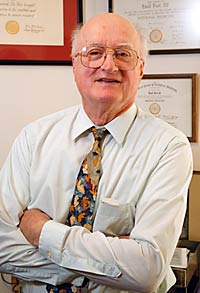
Munger Decries Wall Street Approach at Deposit-Taking Banks; Munger said that he was “a little less optimistic about the U.S. banking system” than Buffett is

Munger Decries Wall Street Approach at Deposit-Taking Banks

Berkshire Hathaway Inc. (BRK/A) Vice Chairman Charles Munger, whose firm owns stakes in some of the biggest U.S. lenders, said Wall Street trading risks should be curbed at deposit-taking institutions. “I do not see why massive derivative books should be mixed up with” government-insured deposits, Munger, 89, said yesterday during Omaha, Nebraska-based Berkshire’s annual meeting. “The more bankers want to be like investment bankers, instead of like bankers, the worse I like it.” Munger’s comments echo those of former financial executives and lawmakers who say the largest lenders still pose risks to the economy years after reforms and U.S. bailouts. Derivatives, which are used to hedge risks or for speculation, magnify the interconnectedness of firms including JPMorgan Chase & Co. (JPM) and Bank of America Corp. (BAC) Critics say that these so-called too-big- to-fail companies would get taxpayer help in a future crisis.

The Berkshire vice-chairman said his views about the industry differ with those of his longtime business partner, billionaire Chairman Warren Buffett. Responding to a question at the meeting about how too-big-to-fail affected Berkshire holdings, Buffett reiterated his support of U.S. lenders. In January, he said he guaranteed that banks no longer posed a threat to the economy because capital levels were higher. “I don’t worry about the banking system being the cause of the next bubble,” Buffett, 82, said yesterday. While lenders “won’t earn as high a return as they would’ve” previously, because of regulation, they still are “decent” investments, he said.

‘Less Optimistic’

Munger said that he was “a little less optimistic about the U.S. banking system” than Buffett is. Read more of this post

IT engineer becomes Weibo sensation after giving up career to become a fruit seller

IT engineer becomes Weibo sensation after giving up career to become a fruit seller

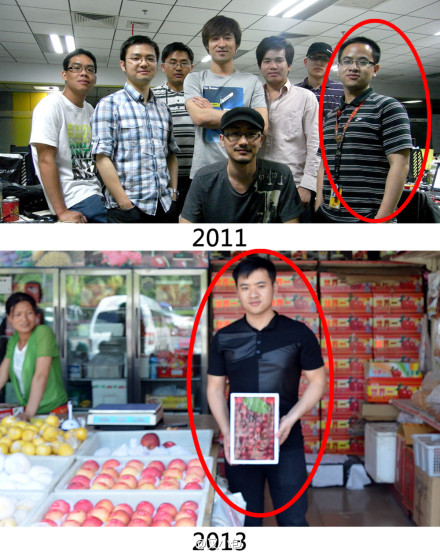
Xu Jia was a PHP engineer for Sina Weibo in 2011 and often worked late into the night. -China Daily
7427ea210acc12ed5abd14
Sat, May 04, 2013
China Daily/Asia News Network

A former IT engineer has become a sensation on China’s Twitter-like Sina Weibo after he gave up a promising career to successfully turn into a fruit vendor. Xu Jia was a PHP engineer for Sina Weibo in 2011 and often worked late into the night. In 2013, he was promoted to a title equivalent to an architect in one of China’s most popular social networking sites. “I was in tears to see my promotion. It was a dream for many years finally coming true. But I changed my mind and wanted to discover the other me,” Xu wrote on Weibo. Xu quit his job to sell fruit in 2013. What surprised Weibo users most is the combination photo showing sharp differences in his looks between the two working environments. In his high-end IT job, he looked exhausted, wore glasses and had scanty hair on his head. But in the fruit store, he appears vigorous, well-dressed, and in good shape. Read more of this post

Buffett maps out hopes for Berkshire without him

Buffett maps out hopes for Berkshire without him

8:19pm EDT

By Jonathan Stempel and Jennifer Ablan

OMAHA, Nebraska (Reuters) – Warren Buffett on Saturday gave the most extensive comments to date about the future of Berkshire Hathaway Inc after he is gone, saying he still expects the conglomerate to be a partner of choice for distressed companies.

Buffett, 82, also defended his plan to install his son, Howard, who has little investing experience, as nonexecutive chairman, saying the younger man’s role would be to ensure that Berkshire had the right CEO in place.

During the financial crisis and its immediate aftermath, Berkshire helped prop up a number of companies, among them blue-chips such as General Electric and Goldman Sachs. Buffett’s investments were viewed by many shareholders as a seal of approval from one of the world’s most respected businessmen.

Short-seller Doug Kass, invited by Buffett to Berkshire’s annual meeting on Saturday to offer contrarian points of view, asked whether a successor would have the same heft. Buffett said it would not matter.

“Berkshire is the 800 number when there is really some panic in the markets, and people really need significant capital,” Buffett said. Read more of this post

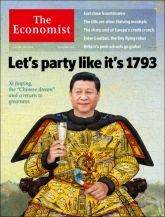
The Economist: Party Like It’s 1793? China’s New President Should Scare The Crap Out Of The Rest Of The World

China’s New President Should Scare The Crap Out Of The Rest Of The World

The Economist | May 4, 2013, 9:12 AM | 14,577 | 66

20130504_cna400

IN 1793 a British envoy, Lord Macartney, arrived at the court of the Chinese emperor, hoping to open an embassy. He brought with him a selection of gifts from his newly industrialising nation. The Qianlong emperor, whose country then accounted for about a third of global GDP, swatted him away: “Your sincere humility and obedience can clearly be seen,” he wrote to King George III, but we do not have “the slightest need for your country’s manufactures”. The British returned in the 1830s with gunboats to force trade open, and China’s attempts at reform ended in collapse, humiliation and, eventually, Maoism. China has made an extraordinary journey along the road back to greatness. Hundreds of millions have lifted themselves out of poverty, hundreds of millions more have joined the new middle class. It is on the verge of reclaiming what it sees as its rightful position in the world.

China’s global influence is expanding and within a decade its economy is expected to overtake America’s. In his first weeks in power, the new head of the ruling Communist Party, Xi Jinping, has evoked that rise with a new slogan which he is using, as belief in Marxism dies, to unite an increasingly diverse nation. He calls his new doctrine the “Chinese dream” evoking its American equivalent. Such slogans matter enormously in China (see “Xi Jinping’s vision: Chasing the Chinese dream”). News bulletins are full of his dream. Schools organise speaking competitions about it. A talent show on television is looking for “The Voice of the Chinese Dream”. Countries, like people, should dream. But what exactly is Mr Xi’s vision? It seems to include some American-style aspiration, which is welcome, but also a troubling whiff of nationalism and of repackaged authoritarianism. Read more of this post

As Best Buy’s ‘Five Star’ exits China, more foreign retailers jump in

As Best Buy’s ‘Five Star’ exits China, more foreign retailers jump in

Staff Reporter

2013-05-04

Foreign electronics retail giants such as Best Buy and Wonder City have repeatedly faced setbacks in China, but this hasn’t extinguished their enthusiasm as RadioShack approaches the mainland market, IT Times Weekly reports.

On March 18, consumer electronics retail giant Best Buy announced that Wang Jian, president of Five Star Appliance, its wholly owned subsidiary in China, will leave his post, though he will continue as a senior adviser for a smooth transition to help the new leadership until the end of June.

Wang’s departure means Best Buy’s “Five-Star era” has come to an end, as the subsidiary it bought in 2009 didn’t satisfy the parent company, insiders said. Best Buy will have to rethink its development strategy in China. Read more of this post

Steve Case: When Attackers Become Defenders, Innovation Is Lost

May 4, 2013

When Attackers Become Defenders, Innovation Is Lost

By ADAM BRYANT

This interview with Steve Case, chief executive of Revolution, an investment firm, was conducted and condensed by Adam Bryant. Mr. Case was also a founder of America Online.

Q. What were some early leadership lessons for you?

A. The earliest ones probably related to just understanding that everybody is wired a little bit differently. Just because you think a certain way or are inclined to react a certain way doesn’t mean everybody thinks and reacts the same way. I think people just naturally presume that they look at a problem in a certain way and frame the issue in a certain way and that everybody else would look at it the same way.

I learned in my 20s that there are a lot of different ways to look at things, a lot of different filters that people put on, partly based on how they analyze the circumstance but also based on their own history and perspectives and biases and instincts and so forth. You have to be open-minded about that and listen to what’s being said — but also to what’s not said sometimes. Those discussions can lead you to different places. Read more of this post

Emil Frei III, Who Put Cancer Cures in Reach, Dies at 89

May 4, 2013

Emil Frei III, Who Put Cancer Cures in Reach, Dies at 89

By MARGALIT FOX

Emil_FREI_26

Dr. Emil Frei III, an oncologist whose trailblazing use of combination chemotherapy — in which anticancer drugs are administered simultaneously rather than singly — helped make certain cancers curable for the first time, died on Tuesday at his home in Oak Park, Ill. He was 89.

His daughter Judy Frei confirmed the death.

Combination chemotherapy is now a standard treatment for a wide range of cancers, including breast, bone and testicular cancers, and has been credited with saving millions of lives worldwide. Read more of this post

To Fight Pandemics, Reward Research; An outbreak of avian flu in Asia raises questions about national preparedness for pandemics. A reward system for medical innovators would be a step in the right direction

May 4, 2013

To Fight Pandemics, Reward Research

By TYLER COWEN

THAT frightening word “pandemic” is back in the news. A strain of avian influenza has infected people in China, with a death toll of more than 25 as of late last week. The outbreak raises renewed questions about how to prepare for possible risks, should the strain become more easily communicable or should other deadly variations arise.

Our current health care policies are not optimal for dealing with pandemics. The central problem is that these policies neglect what economists call “public goods”: items and services that benefit many people and can’t easily be withheld from those who don’t pay for them directly.

Protection against communicable diseases is a core example of a public good, as is basic scientific research, which can yield new ideas that may be spread at very low additional cost. (In contrast, Medicare, which is publicly financed, has some elements of a public good, but any particular expenditure tends to benefit an individual receiving treatment, rather than being spread over a number of beneficiaries.)

One obvious step forward would be to exempt biomedical research from cuts of the current federal budget sequestration. Research and development grants are a way to pay potential innovators up front — an important move, as an innovator can’t always charge high-enough prices for the value of its remedies when they’re actually needed. Read more of this post

NYT: Malay majority are tired of the corruption and theft of public assets practiced in their name, greeted with enthusiasm the pledge to replace the corrupt ethnicity-based affirmative action program that has benefited cronies of PM Najib with a program that bases assistance on need

May 4, 2013

In Malaysia, a Historic Chance for Reform

By JOHN PANG

KUALA LUMPUR, Malaysia

MALAYSIANS are going to the polls Sunday for the most important election in our history. The opposition stands a real chance of winning, for the first time since independence from Britain in 1957. Recent polls show the People’s Alliance, the opposition coalition led by Anwar Ibrahim, running neck and neck with the governing National Front, led by Prime Minister Najib Razak. The National Front, the direct successor to the Alliance Party of the 1950s, has been one of the world’s longest-governing parties, outside of authoritarian regimes like China, North Korea and Cuba. For half a century, until 2008, it had a two-thirds parliamentary majority, which allowed it to amend Malaysia’s Constitution at will. Since the 1980s, the governing party has resorted to stoking fears among the country’s many ethnic communities — Malays, Chinese, Indians and many non-Malay indigenous peoples — to keep them beholden to its rule. It has abused affirmative action policies, intended to help impoverished ethnic Malays, in order to enrich its members and their cronies. Malaysia’s outdated model of governance — a system of racially exclusive parties that deliver patronage to captive racial voter blocs — is no longer sustainable. Read more of this post

The Smartest Thing Warren Buffett Ever Said

The Smartest Thing Warren Buffett Ever Said

By Matt Koppenheffer | More Articles | Save For Later
April 30, 2013 | Comments (1)

Berkshire Hathaway  (NYSE: BRK-A  ) (NYSE: BRK-B  ) CEO Warren Buffett is never shy about sharing wisdom. The brilliant investor is known for witty quips (“Rule No. 1: Never lose money. Rule No. 2: Never forget Rule No. 1.”) as well as longer parables (such as “The Superinvestors of Graham-and-Doddsville“). But could any one of Buffett’s gems of wisdom be the best? Could there be one Buffett-ism to rule them all? To find out, I grabbed five game Fools to weigh in.

Scott Phillips: In trying to distill Warren Buffett’s brilliance, many Buffett-watchers lean heavily on the Oracle of Omaha’s formative years at the metaphorical knee of his mentor, the famed value investor Ben Graham. Graham was notoriously mechanical in his investing; seeking to find companies with specific financial characteristics, then buy them in bulk. However, Buffett — particularly after he met his business partner and Berkshire Vice-Chairman Charlie Munger — is far from the myopically mechanical investor some would paint him to be. Indeed, in his 1982 Chairman’s letter to Berkshire Hathaway shareholders, Warren Buffett wrote: Managers and investors alike must understand that accounting numbers are the beginning, not the end, of business valuation. Yes, the reported numbers matter — a lot — but they are a guide to starting to understand the business, not neatly packaged answers. Buffett’s brilliance was in taking the fundamental lessons he’d learned from Graham and improving on them by understanding the factors that build and sustain great companies. Buffett has said he has one message for the managers of Berkshire’s subsidiaries — “widen the moat.” He wants them to focus on doing those things that make the business stronger and less vulnerable to the competition. Talking about Coca-Cola (NYSE: KO  ) , he said “Give me $10 billion and how much can I hurt Coca-Cola? I can’t do it.” That fact won’t show up in black and white on the financial statements, but is far more important than the numbers themselves.

Jason Moser: I had the great fortune of attending the Berkshire meeting last year, and while I’ve followed Buffett for a while now, something he said during the Q&A session last year resonated with me. Someone asked him his opinion on gold, to which he replied (and I’m paraphrasing): Let’s say you own an ounce of gold today. You hold it, love it and caress it. In 50 years you’ll still own an ounce of gold. Now say you own 100 acres of farmland today. In 50 years you’ll still own that same 100 acres of farmland. The difference is you’ll also have had the time to produce crops to grow more stuff to buy more farmland and whatever else you want. In other words, there’s a tremendous cycle of production there. Gold on the other hand is more or less an unproductive asset. This, to me, is key to why Buffett has been such a successful investor all these years. Not only is he able to focus on longer periods of time, but also the ever-so-valuable cycles of production that can occur during that time. It should therefore come as no surprise that if you gave me a bar of gold today, I would sell it and go buy stocks.

Tim Beyers: While Buffett is often thought of as the patron saint of value investing, I find him in many ways to be the quintessential Rule Breaker. Just listen to what he said at last year’s confab: I would never spend a lot of time valuing declining businesses. The same amount of energy and intelligence brought to other businesses is just going to work out better. I’d never have believed it had I not heard it myself. After all, what is value investing if not for figuring the worth of an oversold business that may, in fact, be in decline? Buffett’s lesson here, I think, is to be open to a broad range of stock ideas. Don’t merely look for a low price-to-earnings ratio. Look instead for businesses that are surprisingly strong defenders of the majority share of a profitable niche, such as Walt Disney  (NYSE: DIS  ) . The House of Mouse isn’t cheap at 20 times earnings, but can you name an enterprise with more big-name brands under its belt? Marvel, Star Wars, Pixar, and all those princesses that seven-year-old girls worship? Don’t be surprised if Berkshire takes a close-up tour of the Magic Kingdom.

Jacob Roche:

It takes 20 years to build a reputation and five minutes to ruin it. If you think about that, you’ll do things differently. This quote always stuck with me because it’s so applicable to both life and business. It takes a long history of coming through for people to build a reputation with your friends, family, and coworkers, but one big mistake can shatter that reputation and leave a lasting bitter taste in the mouths of people who know you. Whether you’re the normally responsible friend who had too a few too many drinks at a party, or the go-to guy at work who told off the wrong client, a person’s worst impression of you is usually their most lasting. This is even more true for the highest levels of management in a large company. It can take decades for a company to earn the trust of its customers, shareholders, and employees. And while a big accounting scandal may take years to fully percolate, it starts with one bad decision. Whether it was the massive accounting scandals at Enron, Worldcom, or evenWaste Management, an unethical decision that could have been avoided can, at best, result in massive fines, like WM’s half-billion dollar shareholder suit, or even jail time in the case of Enron and Worldcom executives. These unfortunate fates could have been avoided by managers at the top simply deciding to do things differently in that crucial moment.

Dan Dzombak:

Buffett: I tell college students, when you get to be my age, you will be successful if the people who you hope to have love you, do love you. Charlie and I know people who have buildings named after them, receive great honors, etc., and nobody loves them — not even the people who give them honors. Charlie and I talk about wouldn’t it be great if we could buy love for $1 million. But the only way to be loved is to be lovable. You always get back more than you give away. If you don’t give any, you won’t get any. Everybody loves Don. There’s nobody I know who commands the love of others who doesn’t feel like a success. And I can’t imagine people who aren’t loved feel very successful.

Munger: You don’t want to be like the motion picture exec who had so many people at his funeral, but they were there just make sure he was dead. Or how about the guy who, at his funeral, the priest said, “Won’t anyone stand up and say anything nice for the deceased?” and finally someone said, “Well, his brother was worse.”

Buffett: Most people in this room and most college students I talk to will have plenty of money, but some will have few friends.

— 2003 Berkshire Hathaway Annual Meeting

Coming from one of the richest people in the world, the quote is a good reminder that there’s a lot more to a successful life than just money. My definition of success is long-term sustainable happiness, and having friends who love you is a key part of that. A close network of friends has been shown to help fight illness and depression, speed recovery, slow aging, and prolong life. While it takes effort to be lovable, Buffett has shown that the benefits are massive and certainly worth the effort.
Van Gogh: “Today again from seven o’clock in the morning till six in the evening I worked without stirring except to take some food a step or two away”

What does nearly every genius have in common when it comes to work habits?

by eric barker

A very interesting new book, Daily Rituals: How Artists Work, examines the work habits of over 150 of the greatest writers, artists and scientists. What does nearly every genius have in common? Those interested in the 10,000 hour theory of deliberate practice won’t be surprised — the vast majority of them were complete and unapologetic workaholics.

Via Daily Rituals: How Artists Work:

William Faulkner:

During his most fertile years, from the late 1920s through the early ’40s, Faulkner worked at an astonishing pace, often completing three thousand words a day and occasionally twice that amount. (He once wrote to his mother that he had managed ten thousand words in one day, working between 10: 00 A.M. and midnight— a personal record.) “I write when the spirit moves me,” Faulkner said, “and the spirit moves me every day.”

Maya Angelou:

Sometimes the intensity of the work brings on strange physical reactions— her back goes out, her knees swell, and her eyelids once swelled completely shut. Still, she enjoys pushing herself to the limits of her ability. “I have always got to be the best,” she has said. “I’m absolutely compulsive, I admit it. I don’t see that’s a negative.”

H.L. Mencken:

His compulsiveness meant that he was astonishingly productive throughout his life— and yet, at age sixty-four, he could nevertheless write, “Looking back over a life of hard work  …   my only regret is that I didn’t work even harder.”

Musician Glenn Gould:

From the time he retired from public performances in 1961, when he was thirty-one years old, Gould devoted himself completely to his work, spending the vast majority of his time thinking about music at home or recording music in the studio. He had no hobbies and only a few close friends and collaborators, with whom he communicated mostly by telephone. “I don’t think that my life style is like most other people’s and I’m rather glad for that,” Gould told an interviewer in 1980. “[ T] he two things, life style and work, have become one. Now if that’s eccentricity, then I’m eccentric.”

Alexander Graham Bell:

As a young man, Bell tended to work around the clock, allowing himself only three or four hours of sleep a night… When in the throes of a new idea, he pleaded with his wife to let him be free of family obligations; sometimes, in these states, he would work for up to twenty-two hours straight without sleep.

Van Gogh:

“Today again from seven o’clock in the morning till six in the evening I worked without stirring except to take some food a step or two away,” van Gogh wrote in an 1888 letter to his brother, Theo, adding, “I have no thought of fatigue, I shall do another picture this very night, and I shall bring it off.”

Artist Chuck Close:

“Inspiration is for amateurs,” Close says. “The rest of us just show up and get to work.” Read more of this post

Charlie Munger: No tweets for me, Buffett’s second-in-command says

No tweets for me, Buffett’s second-in-command says

2:20pm EDT

By Jennifer Ablan and Jonathan Stempel

OMAHA, Nebraska (Reuters) – So they are not completely in sync after all. A day after Berkshire Hathaway Inc Chairman Warren Buffett set up his own account on Twitter, his second-in-command, Charlie Munger, said he has no plans to follow the legendary investor’s lead. Buffett, 82, launched his “@WarrenBuffett” account with the tweet “Warren is in the house,” and immediately started adding followers at the rate of 1,000 per minute. But the 89-year-old Munger – renowned for his forthright style of speaking – suggested fans should not look forward to seeing his trademark remarks in 140-character form any time soon.

“No, certainly not,” Munger said in an interview, after being asked whether he planned to join the social media network. “That’s not my milieu. I don’t like too many things going on at once.” It marks a rare point of departure between Buffett and Munger, who have worked together at Berkshire for decades. “We have practically no disagreements. That’s just the way the chemistry has worked,” Munger said, commenting on his working relationship with Buffett. “People who think we’re quite a diverse pair, and that one is helping the other – it’s more like two twins, and one of them is a little more able than the other.” Berkshire Hathaway will hold its annual shareholder meeting on Saturday in Omaha. Buffett calls the meeting and the weekend’s related events “Woodstock for Capitalists.”

Find the Customers Your Competitors Are Offending

Find the Customers Your Competitors Are Offending

by Sehreen NoorAli  |  10:00 AM May 3, 2013

In a targeted effort to appeal to Gen Y, Pizza Hut offered free pizzas for life to any attendee of last October’s presidential debate who dared ask President Obama or Governor Romney, “Sausage or Pepperoni?” Outraged by the mockery to the democratic process, millennials shamed the popular company across national outlets. The backlash against the campaign shocked Pizza Hut and forced it to backpedal.

Pizza Hut’s campaign unwittingly shut the door on thousands of customers who were either: 1) people within the target market that the ad alienated (ex: millennials who care about politics more than pizza); or 2) people excluded from the target market altogether (ex: non-Gen Yers).

This is a basic problem with target advertising: it frequently ignores the fact that people who share a common demographic do not necessarily share the same preferences or opinions. By extrapolating consumer behavior from fixed demographic information like gender, age, and ethnicity, companies indiscriminately make conclusions like “African-Americans love fried chicken,” “senior citizens only care about incontinence” and “single men aspire to be James Bond.” Using unrefined market segmentation to understand the preferences of potential target customers often backfires. Take Diet Pepsi’s “Skinny Can” controversy, or Groupon’s callous Tibet commercial. Read more of this post

Little Data Makes Big Data More Powerful

Little Data Makes Big Data More Powerful

by Mark Bonchek  |  11:00 AM May 3, 2013

You may not know this, but Big Data has a little brother. And together, Big and Little Data are far more powerful than Big Data alone.

Big Data is what organizations know about people — be they customers, citizens, employees, or voters. Data is aggregated from a large number of sources, assembled into a massive data store, and analyzed for patterns. The results are more accurate predictions, more targeted communications, and more personalized services. Big Data is what enables banks to predict credit card fraud by analyzing billions of transactions, marketers to understand customer sentiment by analyzing millions of interactions on social media, and retailers to target promotions and offers by analyzing millions of purchases.

In contrast, Little Data is what we know about ourselves. What we buy. Who we know. Where we go. How we spend our time. We’ve always had a sense for these things — after all, it’s our lives. But thanks to the combination of mobile, social, and cloud technologies, it’s easier than ever to gain insight into our own behavior. Read more of this post

Leadership Is More than Interpersonal Skills

Leadership Is More than Interpersonal Skills

by Terri Griffith  |  12:00 PM May 3, 2013

Most of the 89,000 leadership books offered on Amazon.com focus on traditional interpersonal leadership: the relationships between leaders and followers. Interpersonal leadership sets up an expectation that leaders must be in dialog or at least in view of their followers. Yet this style of interaction is less likely as work stretches across locations and company boundaries as we telecommute, crowdsource, and take on joint ventures. Modern leadership may be as much about facilitating strategy through hiring, training, technology, and focused tasks and goals, as it is about face-to-face interaction.

Clear and meaningful tasks, goals, and technology tools that support the organization’s direction can supplement interpersonal leadership. This is a classic topic in the management field. In the 70s, Steve Kerr and John Jermier offered that leaders do many things beyond their interpersonal relationships with their followers. Talking about the history of substitutes for leadership research, Jermier said in 1997, “[Substitutes for leadership] pointed to unobtrusive and impersonal forces such as technology and task characteristics, professional standards, and formal regulations (policies, rules and procedures).” One of their conclusions was that some people don’t even need leadership in the traditional sense, or find leadership substitutes through interactions with other workers. Hiring for employees who can model the vision of the organization through their work can substitute for interactions with formal leaders. Read more of this post

Scientists Develop Epilepsy Warning Device

Scientists Develop Epilepsy Warning Device

By Agence France-Presse on 6:57 pm May 2, 2013.
Paris. A tiny device implanted in the brain of epilepsy sufferers has for the fist time been able to predict the onset of seizures, scientists reported on Thursday.

The potentially life-saving device works with electrodes that monitor electrical activity on the brain surface, they wrote in The Lancet Neurology.

The electrodes were connected to a second device implanted under the skin of the chest, which transmitted the data wirelessly to a hand-held device that calculated the probability of a seizure.

The device lights up in red for a high risk, white for moderate, or blue for low seizure probability. Read more of this post

The Analogical Animal: The key to human cognition may well be the ability to compare one thing to another

May 3, 2013, 7:42 p.m. ET

The Analogical Animal: The key to human cognition may well be the ability to compare one thing to another

By DOUGLAS HOFSTADTER And EMMANUEL SANDER

At the White House Correspondents Dinner last week, President Barack Obama got some laughs when he said that his advisers had suggested he start his speech “with some jokes at my own expense, just take myself down a peg. I was like, ‘Guys, after 4½ years, how many pegs are there left?’ ”

In this remark, few of us would immediately think of “take myself down a peg” as an analogy, but that’s what it is: a comparison between two things, in this case, between the president’s standing and pegs on a board. Mr. Obama did it again later in his speech, complimenting journalists “who took the time to wade upstream through the torrent of digital rumors to chase down leads and verify facts.” “Wade upstream” and “torrent” qualify as analogies, too.

In fact, once you start to look for analogies, you find them everywhere, not just in the metaphors and other figures of speech used by politicians. It is by way of analogy that human beings negotiate and manage the world’s endless variety. We would make an even grander claim: that analogies lie at the very center of human cognition, from the humblest of everyday activities to the most exalted discoveries of science. Read more of this post

Don’t Pay High Fees for Index Funds

May 3, 2013, 6:05 p.m. ET

Don’t Pay High Fees for Index Funds

By JOE LIGHT

You might think that a plain-vanilla index mutual fund is synonymous with low fees. But some such funds are charging expenses that might make even a high-turnover momentum-fund manager blush.

The indexing revolution has been a boon for investors. Big fund companies have launched many nearly identical mutual funds and exchange-traded funds that track indexes such as the Standard & Poor’s 500. With nothing to compete on but price, that’s meant ever lower expenses for investors.

According to an April report from the Investment Company Institute, a trade group, stock-fund investors on average paid 0.77% in expenses in 2012, or $77 per $10,000 invested. That was down from 0.79% in 2011 and from 1% a decade ago. Read more of this post

Regulators Focus on ‘Nontraded’ REITs

May 3, 2013, 6:03 p.m. ET

Regulators Focus on ‘Nontraded’ REITs

By CAITLIN NISH

Wall Street’s leading self-regulator has been watching how brokerages market “nontraded” real-estate investment trusts to customers, and it doesn’t like what it sees.

Brokers too often offer misleading information about the potential benefits and incomplete explanations of the risks of nontraded REITs, the Financial Industry Regulatory Authority said in guidance it issued to firms Thursday. Sales materials often stress the income the investments generate in distributions but can fail to make sufficiently clear that these may actually tap the investor’s principal, the regulator said.

“The notice provides clear standards that can be applied consistently by firms,” said Thomas A. Pappas, Finra’s vice president for advertising regulation, in an email. When firms follow the guidance, “investors will have a better understanding of the products and their features.”

REITs give investors an equity interest in a pool of assets such as land, shopping centers or hotels, or in mortgages secured by real estate. REITs don’t pay income taxes if they distribute at least 90% of their earnings to investors, and they often attract investors seeking higher payouts than other investments offer. Read more of this post

Risky Business: The Quiz That Could Steer You Wrong

May 3, 2013, 6:13 p.m. ET

Risky Business: The Quiz That Could Steer You Wrong

By JASON ZWEIG

BF-AE903_INVEST_G_20130503172321

With the stock and bond markets butting up against record highs, and volatility not far from all-time lows, that little red devil on your shoulder is whispering in your ear that it’s safe to take more risk again. Can you count on your broker or financial adviser to tell you how much risk is right for you?

Read more of this post

Receiver Gains Control of Some Assets of China’s ZST; Case Is Test of Investors’ Ability to Recoup Losses in Wake of Accounting Questions

May 3, 2013, 1:25 p.m. ET

Receiver Gains Control of Some Assets of China’s ZST

Case Is Test of Investors’ Ability to Recoup Losses in Wake of Accounting Questions

By MICHAEL RAPOPORT

The court-appointed receiver empowered to seize the assets of a U.S.-traded Chinese company facing accounting questions has chalked up his first successes.

The receiver, Robert Seiden, says he has obtained control over subsidiaries of the Chinese company, ZST Digital Networks Inc., ZSTN +13.33% in the British Virgin Islands and Hong Kong. He also has gained control of a ZST Digital bank account in Hong Kong, and is in the process of doing the same with ZST Digital bank accounts in China.

Mr. Seiden has been tasked with seizing and selling ZST Digital assets as part of a court’s novel remedy for a U.S. investor locked in a legal dispute with the network-equipment maker. The high-profile case may test the extent to which U.S. investors can recover losses from Chinese companies whose shares drop in the wake of accounting or disclosure problems. Read more of this post

How the Brain Really Works: New techniques are letting researchers look at the activity of the whole brain at once

May 3, 2013, 5:16 p.m. ET

How the Brain Really Works

New techniques are letting researchers look at the activity of the whole brain at once

By ALISON GOPNIK

For the last 20 years neuroscientists have shown us compelling pictures of brain areas “lighting up” when we see or hear, love or hate, plan or act. These studies were an important first step. But they also suggested a misleadingly simple view of how the brain works. They associated specific mental abilities with specific brain areas, in much the same way that phrenology, in the 19th century, claimed to associate psychological characteristics with skull shapes.

Most people really want to understand the mind, not the brain. Why do we experience and act on the world as we do? Associating a piece of the mind with a piece of the brain does very little to answer that question. After all, for more than a century we have known that our minds are the result of the stuff between our necks and the tops of our heads. Just adding that vision is the result of stuff at the back and that planning is the result of stuff in the front, it doesn’t help us understand how vision or planning work.

But new techniques are letting researchers look at the activity of the whole brain at once. What emerges is very different from the phrenological view. In fact, most brain areas multitask; they are involved in many different kinds of experiences and actions. And the brain is dynamic. It can respond differently to the same events in different times and circumstances. Read more of this post

Great historical minds on the importance of being truthful, or not

Saturday May 4, 2013

Great historical minds on the importance of being truthful, or not

“ONE per cent of people will always be honest and never steal,” the locksmith said. “Another one per cent will always be dishonest and always try to pick your lock and steal your television. And the rest will be honest as long as the conditions are right but if they are tempted enough, they’ll be dishonest too. Locks won’t protect you from the thieves, who can get in your house if they really want to. They will only protect you from the mostly honest people who might be tempted to try your door if it had no lock.”

Dan Ariely, The Honest Truth About Dishonesty: How We Lie to Everyone Especially Ourselves

Time will inevitably uncover dishonesty and lies; history has no place for them.

The late King of Cambodia, Norodom Sihanouk

“We can easily forgive a child who is afraid of the dark; the real tragedy of life is when men are afraid of the light.”

Plato

“It is not only by dint of lying to others, but also of lying to ourselves, that we cease to notice that we are lying.”

Marcel Proust, Sodom and Gomorrah

“If you tell the truth, you don’t have to remember anything.”

Mark Twain

“I’m not upset that you lied to me, I’m upset that from now on I can’t believe you.”

Friedrich Nietzsche

“I’m the most terrific liar you ever saw in your life. It’s awful. If I’m on my way to the store to buy a magazine, even, and somebody asks me where I’m going, I’m liable to say I’m going to the opera. It’s terrible.”

J.D. Salinger, The Catcher In The Rye

“I always tell the truth. Even when I lie.”

Al Pacino

“I lie to myself all the time. But I never believe me.”

Susan Eloise, The Outsiders

Clay is moulded to make a vessel, but the utility of the vessel lies in the space where there is nothing. Thus, taking advantage of what is, we recognise the utility of what is not.

Lao Tzu

What compels us to lie; Dan Ariely’s “The (Honest) Truth About Dishonesty: How We Lie to Everyone Especially Ourselves”

Saturday May 4, 2013

What compels us to lie

Reviewed by NICK WALKER
balticmedia@ymail.com

The (Honest) Truth About Dishonesty: How We Lie to Everyone Especially Ourselves
Author: Dan Ariely
Publisher: Harper

HAVE you ever lied on your CV? Yeah, right. Sure you haven’t. How about fudging the truth a bit? Was that an affirmative you just mumbled?

Well, don’t beat yourself up about it. According to Dan Ariely, a behavioural economist and popular psychologist, and the bestselling author of The Upside of Irrationality and Predictably Irrational, we generally speaking all lie sometimes. And some of us lie all the time. What is worse, and no big surprise to any urban professional in Malaysia, is that the job-hunting game provides fertile ground for duplicity on both sides.

In his latest book, Ariely examines the contradictory forces that both compel us to be dishonest and restrain us from lying.

From cheating-by-smartphone in schools to political leaders who take liberties with the truth, to the commercial shenanigans that hurt the poorest in society, cheating, lying, and compromising the truth in other ways, are inescapable components of the human condition.

Drawing on his own empirical research, and penned in the breezy accessible style of Malcolm Gladwell’s What The Dog Saw andFreakonomics by Steven D. Levitt and Stephen J. Dubner, Ariely reveals, with remarkable candor, what knocks us off the true and straight road of honesty. Read more of this post

Finding that true north; When Tan Sri Lee Shin Cheng started his ice-cream business on a bicycle, nobody including himself expected him to become Malaysia’s fourth wealthiest man

Saturday May 4, 2013

Finding that true north

By CHOONG EN HAN
han@thestar.com.my

WE have all heard about the runaway success stories of entrepreneurs that made it big. Take Sara Blakely for example, the woman behind the success story of Spanx, in which she turned a US$5,000 investment into a billion dollar slimming bodywear empire.

The ones who made it always make the headlines but nobody knows how many entrepreneurs armed with game changing ideas that just fell flat.

That doesn’t stop people from going out on their own, but really, what does it take for one to take that leap of faith and delve into the unknown? Read more of this post

Studying the Dark Art of Leaking Deal Talks

APRIL 29, 2013, 8:59 PM

Studying the Dark Art of Leaking Deal Talks

By ANDREW ROSS SORKIN

Psst.

That’s how you might imagine a “leak” of a big merger or acquisition would start. A well-placed phone call. An off-handed comment over lunch. A confidential document accidentally left on an airplane.

It seems as if news of most big deals is invariably leaked ahead of the official announcement. Of the biggest deals of the year so far — the buyout of Dell, Warren Buffett’s acquisition of Heinz, American Airlines–US Airways, Liberty Global-Virgin Media — none made it to the finish line without the news media finding out about it first, sometimes with weeks of advance notice, some with just hours to go.

An intriguing academic study casts new light on the dark arts of the leak — or what used to be affectionately known in London as “the Friday night drop.” (It’s a bit of lore, but deal leaks used to be delivered by envelope on Friday night on Fleet Street to the gossipy Sunday broadsheets where the news could be placed as a trial balloon ahead of the markets’ reopening on Monday.) Read more of this post

Seth Klarman: “If The Economy Is So Fragile That Government Can’t Allow Failure Then We Are Indeed Close To Collapse”

Seth Klarman: “If The Economy Is So Fragile That Government Can’t Allow Failure Then We Are Indeed Close To Collapse”

Tyler Durden on 05/03/2013 15:43 -0400

Following today’s flashback to the most euphoric and irrationally exuberant days of market peaks (and bubbles) gone by, driven entirely by the now constant central-planner dilution of current and future wealth, these selected excerpts from Seth Klarman’s latest letter to investors is just the cold water of common sense everyone needs:

From Seth Klarman of Baupost:

Is it possible that the average citizen understands our country’s fiscal situation better than many of our politicians or prominent economists? Read more of this post

Gazprom shows what happens when giants push their weight around for too long

Gazprom shows what happens when giants push their weight around for too long

By Steve LeVine 11 hours ago

If you wrote up a list of the world’s most vilified people and things, it currently would be topped by the Tsarnaev Brothers. Mohammed Soel Rana would probably be next, along with a few other Bangladeshi garment factory owners. But just a few years ago—in the middle-late 2000s—the list might have been led by Gazprom, the Russian gas giant that preferred to cut off service to Ukraine and the rest of Europe in the dead of winter rather than settle utility disputes the normal way.

What a difference five years makes. This mighty spearhead of Vladimir Putin’s foreign policy, according to The Wall Street Journal, finds itself pushed around(paywall) and having to offer discounts to Poland, Bulgaria and other relative small fry.

One thing that has changed Gazprom’s world is the global natural gas boom, which has undermined its previously unassailable dominance in Europe, where it supplies 25% of the market. Last year, outside gas pushed down Gazprom shipments to Europe by 3.6%; Gazprom’s profit fell by 9.5%. Investors have pummeled the stock, sending down Gazprom’s share price by 24% since September. Read more of this post

China calls time on expensive watches in face of crackdown

May 3, 2013 5:30 pm

China calls time on expensive watches in face of crackdown

By James Shotter in Zurich

Before accompanying the Chinese premier, Li Keqiang, on a visit to a neighbourhood ravaged by the earthquake in Sichuan two weeks ago, Fan Jiyue, a county party chief, took an important precaution: he removed his wristwatch.

His concern was understandable. China’s new leadership is cracking down hard on ostentatious displays of wealth by party officials and corruption. As a result, expensive watches – a popular gift given by those seeking to win favour with Chinese businessmen and politicians – have become a source of unwanted attention.

Unfortunately for Mr Fan, unwanted attention is precisely what his move brought him: the watch-shaped tan lines on his wrist were spotted by China’s eagle-eyed netizens, and pictures of the local official’s unadorned arm went viral on the Chinese internet. With predictable alacrity, the country’s censors had soon blocked searches for Mr Fan.

This sudden hostility to extravagance, which set in last autumn after Xi Jinping took over as Chinese president, has led to a big slowdown in Swiss watch exports to China – which over the past 10 years has been the fastest growing market for the Alpine nation’s timepieces. Read more of this post

What Every Successful Leader Knows About The Chicken And The Egg

What Every Successful Leader Knows About The Chicken And The Egg

by Fortune Gamanya | May 3, 2013

Great organisations are those that do not waste time telling the world how they are better than the competition – they show them

The question of whether the chicken came first or the egg has occupied minds and spurred debate for generations. A similar paradox is being played out right now in organisations across the world: “Does a carefully conceived set of differentiators inform an organisation’s culture and performance, or should culture and performance give birth to differentiators?”.

All businesses know that customer service based on value and quality are critical for survival. Good companies realise that to retain and win new business, quality is not enough. Enter the differentiator; with companies spending time and money identifying what sets their service offering apart from that of their competitors. Once done, the marketers step in and communicate this set, top-down, to employees and customers.

But what becomes of this well-worn strategy when all good companies are using differentiators to stand out in the marketplace? And is it fair to say that trying to evolve a corporate culture or define a service offering by first thrashing out that set of differentiators, is a bit like trying to produce a chicken without an egg; or vice versa? Read more of this post