Billionaire Investor Leon Black’s Apollo Global Management ‘Selling Everything’ as Prices Have Risen

Black’s Apollo ‘Selling Everything’ as Prices Have Risen

Leon Black, chief executive officer of buyout firm Apollo Global Management LLC (APO), said prices for traditional buyouts have risen so much that it’s a good time to sell. “We think it’s a fabulous environment to be selling,” Black said today during a panel discussion at the Milken Institute conference in Los Angeles, adding that Apollo has sold about $13 billion in assets in the last 15 months. “We’re selling everything that’s not nailed down, and if we’re not selling, we’re refinancing.” U.S. equity markets have more than doubled from their 2009 lows, helping push up average prices for leveraged buyouts to nine times earnings, Black said. The Standard & Poor’s 500 Index rose to a record today as consumer confidence offset an unexpected drop in business activity and investors weighed earnings reports. Black’s comments were echoed by buyout executives including Scott Sperling, co-president of Thomas H. Lee Partners LP, and Jonathan Sokoloff, managing partner at Leonard Green & Partners LP. “It has become more difficult to find transactions priced at levels we’d like,” Sperling said on the same panel. “We’re having trouble deploying capital at these price levels,” Sokoloff said. It’s “time to take a pause.”

To contact the reporter on this story: David Carey in New York at dcarey13@bloomberg.net

New bird flu poses “serious threat”, scientists say; “This is a very, very serious disease in those who have been infected. So if this were to become more widespread it would be an extraordinarily devastating outbreak”

New bird flu poses “serious threat”, scientists say

Wed, May 1 2013

By Kate Kelland

LONDON (Reuters) – A new strain of bird flu that is causing a deadly outbreak among people in China is a threat to world health and should be taken seriously, scientists said on Wednesday. The H7N9 strain has killed 24 people and infected more than 125, according to the Geneva-based World Health Organization (WHO), which has described it as “one of the most lethal” flu viruses. The high mortality rate, together with relatively large numbers of cases in a short period and the possibility it might acquire the ability to transmit between people, make H7N9 a pandemic risk, experts said. “The WHO considers this a serious threat,” said John McCauley, director of the WHO Collaborating Centre for Influenza at Britain’s National Institute for Medical Research. Speaking at a briefing in London, experts in virology said initial studies suggest the virus has several worrisome characteristics, including two genetic mutations that make it more likely to eventually spread from person to person. “The longer the virus is unchecked in circulation, the higher the probability that this virus will start transmitting from person to person,” Colin Butte, an expert in avian viruses at Britain’s Pirbright Institute, said. Of the some 125 people infected with H7N9 so far, around 20 percent have died, approximately 20 percent have recovered and the remainder are still sick. The infection can lead to severe pneumonia, blood poisoning and organ failure. “This is a very, very serious disease in those who have been infected. So if this were to become more widespread it would be an extraordinarily devastating outbreak,” Peter Openshaw, director of the center for respiratory infection at Imperial College London, told the briefing. Read more of this post

Cancers Share Gene Patterns; Cancer will increasingly be seen as a disease defined by its genetic fingerprint rather than by the organ where it originated

May 1, 2013

Cancers Share Gene Patterns, Studies Affirm

By GINA KOLATA

Scientists have discovered that the most dangerous cancer of the uterine lining closely resembles the worst ovarian and breast cancers, providing the most telling evidence yet that cancer will increasingly be seen as a disease defined primarily by its genetic fingerprint rather than just by the organ where it originated.

The study of endometrial cancer — the cancer of the uterine lining — and another of acute myeloid leukemia, published simultaneously on Wednesday by Nature and The New England Journal of Medicine, are part of a sprawling, ambitious project by the National Institutes of Health to scrutinize DNA aberrations in common cancers.

Over the past year, as part of this project, researchers have reported striking genetic changes in breast, colon and lung cancers that link them to other cancers. One kind of breast cancer was closely related to ovarian cancer. Colon cancers often had a genetic change found in breast cancer. And about half of squamous cell lung cancers might be attacked by drugs being developed for other cancers. Read more of this post

Robot Aids in Therapy for Autistic Children

Updated May 1, 2013, 12:03 p.m. ET

Robot Aids in Therapy for Autistic Children

By SHIRLEY S. WANG

SAN SEBASTIÁN, Spain—A two-foot-tall robot therapist may help children with autism learn to be more social, according to intriguing findings from a study being presented this week at the annual conference of the International Society for Autism Research here.

Results from the new study of 19 children with autism—thought to be the largest trial to date of such technology—found that kids improved their conversation skills more when interacting with the robot, compared with sessions with a human therapist alone. Parents reported these children had greater improvement at home as well.

Researchers long have been interested in using technology to help treat autism, a developmental condition characterized by social deficits and repetitive behavior, because many of these children seem particularly interested in computers, iPads and other devices—often more so than they are interested in people. Read more of this post

Xero: A billion-dollar software company that had five years in stealth at the bottom of the planet – New Zealand

Xero: A billion-dollar software company that had five years in stealth at the bottom of the planet

BY HAMISH MCKENZIE 
ON MAY 1, 2013

Xero, a cloud-based accounting company that has so far raised $67 million in venture capital, had one hell of a stealth period. By spending its first five years operating only in New Zealand, the company was able to not only build up a strong product – “The Apple of accounting,” as its marketing line goes – but also test it on a sizable market of paying customers, all while evading the attention of legacy competitors. Now, as it is making a serious push in the US, Xero suddenly looks like a major threat to Intuit’s QuickBooks, the dominant player in accounting software, which is attempting to transform itself into an online business.

But that protracted “stealth” period in a quiet southern corner of the planet is not the only thing that’s unconventional about Xero. Because New Zealand’s venture capital sector is so undeveloped (read: barely existent), Xero’s founder and CEO Rod Drury had to think of creative options to raise money for the company. While the biggest venture deal possible in New Zealand at the time, 2007, was about $2 million, Drury had grand plans for Xero from day one. Fresh from selling his company AfterMail to Quest for $15 million in cash, he wanted to hire 50 people from the start and decided the company needed $15 million. He didn’t want to raise money from Silicon Valley VCs because he didn’t want to face the pressure of quickly selling the company to a large company, so he instead decided to list Xero on the New Zealand Stock Exchange. Read more of this post

The Value of Big Data Isn’t the Data. It’s the narrative.

The Value of Big Data Isn’t the Data

by Kristian J. Hammond  |  11:00 AM May 1, 2013

generatingnarrativesortsofdata

It is clear that a new age is upon us. Evidence-based decision-making (aka Big Data) is not just the latest fad, it’s the future of how we are going to guide and grow business. But let’s be very clear: There is a huge distinction to be made between “evidence” and “data.” The former is the end game for understanding where your business has been and where it needs to go. The latter is the instrument that lets us get to that end game. Data itself isn’t the solution. It’s just part of the path to that solution.

The confusion here is understandable. In an effort to move from the Wild West world of shoot-from-the-hip decision making to a more evidence-based model, companies realized that they would need data. As a result, organizations started metering and monitoring every aspect of their businesses. Sales, manufacturing, shipping, costs and whatever else could be captured were all tracked and turned into well-controlled (or not so well-controlled) data.

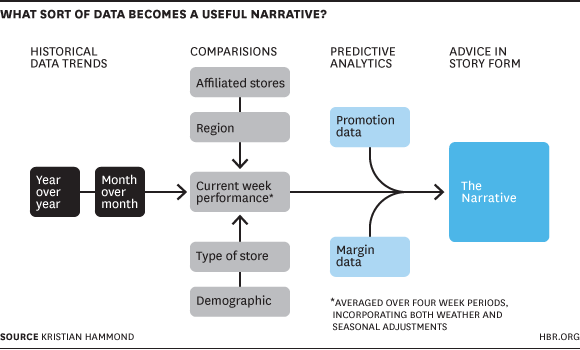
I would argue that what you want and what you need is to turn that data into a story. A story explains the data rather than just exposing it or displaying it. A narrative that gives you context to today’s numbers by exploring the trends and comparisons that you need in order to make sense of it all. The belief that Artificial Intelligence can support the generation of natural language reporting from data is what drove me to help found our company, Narrative Science. I fundamentally believe that a machine can tackle and succeed at freeing insight from data to provide the last mile in making big data useful, and this belief was the driver in building out a technology platform that makes it real. Read more of this post

Without explanation, the Shenzhen government has ended a seven-year incentive plan for the city’s much-hyped LED lighting sector

Shenzhen’s LED incentive plan comes to sudden end

Staff Reporter, 2013-05-02

Without explanation, the Shenzhen government has ended a seven-year incentive plan for the city’s much-hyped LED lighting sector, reports Guangzhou’s Southern Metropolis Daily. The original plan by the city government called for building a 130 billion yuan (US$21 billion) LED industry in Shenzhen from 2009 to 2015, according to Sui Shirong, head of Shenzhen Light Emitting Diode Industry. An official who wished to remain anonymous due to the sensitivity of the issue told the daily that the industry is facing falling prices amid oversupply. Read more of this post

The number of bond funds that own stocks has surged to its highest point in at least 18 years and could expose investors to unexpected losses

May 1, 2013, 8:09 p.m. ET

Bond Funds Running Low on…Bonds

By JOE LIGHT

MI-BV699_STOCKB_NS_20130501162411

The number of bond funds that own stocks has surged to its highest point in at least 18 years, another sign that typically conservative investors are taking bigger risks to boost returns. Regulators generally allow funds to hold a mix of assets, but the scale of bond funds’ shift into stocks is unusual, fund experts said, and could expose investors to unexpected losses. Read more of this post

“No more Martini lunches”; Mining Woes Snag Financial Firms; Far from any mine shaft, the legions of bankers, consultants and lawyers who benefited from a decadelong commodities boom are now preparing to retrench as the market weakens.

Updated May 1, 2013, 8:08 p.m. ET

Mining Woes Snag Financial Firms

By ALISTAIR MACDONALD

MI-BV698_MINETO_G_20130501162404

TORONTO—Far from any mine shaft, the legions of bankers, consultants and lawyers who benefited from a decadelong commodities boom are now preparing to retrench as the market weakens. Global mining capitals such as Toronto, Johannesburg and London all flourished amid lofty prices in recent years for everything from gold and copper to potash. Mining companies have tended to flock to a handful of cities to list their shares, set up headquarters and raise cash.

But over the past year, the sector has been hit by a triple whammy of falling prices, still-rising costs and waning investor interest. Most mined commodities have fallen sharply since their 2011 highs. Gold is 23% off its highs, and copper closed at an 18-month low Wednesday. Gold has fallen 14% since the start of this year to $1,446 a troy ounce. As a result, some of the world’s biggest miners are slashing outlays, shedding assets they bought at the top of the market just a few years ago, and shaking up management teams that spearheaded several years’ of frenetic deal making and fundraising. That is having a spillover effect on the industries servicing miners. Bankers and brokers involved in the sector are starting to see revenue dry up, and some are already shedding staff. Read more of this post

Retailers Wage War Against Long Lines; Infrared Vision Helps Kroger Reduce Wait Times to 26 Seconds; Wal-Mart Experiments With Bar-Code Apps

May 1, 2013, 9:33 p.m. ET

Retailers Wage War Against Long Lines

Infrared Vision Helps Kroger Reduce Wait Times to 26 Seconds; Wal-Mart Experiments With Bar-Code Apps

By JULIE JARGON

MK-CC911_KROGER_G_20130501222305

At this Cincinnati Kroger, supervisors monitor a system that says how many lanes need to be open and how many will be needed in 30 minutes.

Supermarket giant Kroger Co. KR -0.52% is winning the war against lengthy checkout lines with a powerful weapon: infrared cameras long used by the military and law-enforcement to track people. These cameras, which detect body heat, sit at the entrances and above cash registers at most of Kroger’s roughly 2,400 stores. Paired with in-house software that determines the number of lanes that need to be open, the technology has reduced the customer’s average wait time to 26 seconds. That compares with an average of four minutes before Kroger began installing the cameras in 2010. “The technology enabled us to execute at the front of the store without that additional (labor) expense,” said Marnette Perry, senior vice president of retail operations for Kroger.”It’s remarkable that we’ve been able to improve execution as much as we have without a big price tag.” Reducing wait times is becoming a top priority for retailers, from high-end department stores to hardware chains to fast-food outlets. Battling both online rivals that offer at-home convenience and intensifying competition among fellow brick-and-mortar outlets, many companies see enhancing the shopping experience as a way to build loyalty. “Since the checkout is the last experience in a store, if it’s a bad experience, you’ll probably see that financially,” says Kurt Kendall, retail strategist with Kurt Salmon, a management consulting firm. “Retailers could speed up their service if they fully staffed their lanes, but they are trying not to staff all their checkout locations. This is the dirty little secret of this.” Read more of this post

Apple to Samsung Develop Smartwatch as Sony’s Time Passes; “Sony was ahead of its rivals to release a watch, but it takes more than an idea to create a hit product”

Apple to Samsung Develop Smartwatch as Sony’s Time Passes: Tech

With growth slowing in the $358 billion handset market, Apple Inc. (AAPL) and Samsung Electronics Co. are developing digital watches that allow users to make calls, check map coordinates, or monitor their physical activity.

They might want to talk to Tokyo-based Sony Corp. (6758), whose feature-laden SmartWatch, on sale for more than a year, isn’t mesmerizing the masses.

Priced at $130, Sony’s 1.3-inch (3.3-centimeter) touchscreen watch wirelessly connects to Android smartphones using Bluetooth technology. The gadget alerts users to calls and allows them to reply to e-mails or texts with an array of pre­written messages. It even connects to Facebook Inc. and Twitter Inc. and controls a wearer’s phone-based music library.

The SmartWatch, about the size of an iPod Nano, is a slightly smaller successor to Sony’s LiveView watch. Introduced in 2010, it had more limited features and was hobbled by kinks. The newer model is more stylish, although users can’t enter messages and it sometimes requires daily recharging and a stable connection to tell time reliably.

“Sony was ahead of its rivals to release a watch, but it takes more than an idea to create a hit product,” said Keita Wakabayashi, a Mito Securities Co. analyst in Tokyo, who rates the shares neutral plus. “It’s about bringing a product that has functionalities that people would want and marketing the product in the right way.” Read more of this post

Japan’s Abenomics Haunted by Ghost of General MacArthur

Japan’s Abenomics Haunted by Ghost of General MacArthur

Prime Minister Shinzo Abe’s drive to revise Japan’s pacifist constitution for the first time risks alienating voters who support his economic agenda and dividing his coalition government before July elections.

Abe aims to make it easier to amend the constitution, a first step in plans to beef up the military at a time when Japan is mired in territorial disputes with China and South Korea. His Liberal Democratic Party is forecast to win the upper house race, potentially giving him the two-thirds majority in both chambers needed to alter the charter.

Overhauling a document imposed by U.S. General Douglas MacArthur’s occupation force after World War II has been a goal of LDP politicians, including Abe’s grandfather, since the party was founded in 1955. While polls show the public backs Abenomics, his strategy to resuscitate the world’s third-largest economy after more than a decade of deflation, a majority of voters don’t rate constitutional revision as a priority.

“The growth strategy can only be accomplished with sustained attention,” said Koichi Nakano, a political science professor at Sophia University in Tokyo. “It’s a monumental task in its own right. If he takes up more nationalistic causes and Abenomics is not looking good, this could lead to a loss of authority after the election.” Read more of this post

Energy Makes Up Half of Water Desalination Plant Costs: Study

Energy Makes Up Half of Desalination Plant Costs: Study

Energy is the largest single expense for desalination plants, accounting for as much as half of the costs to make drinking water from the sea, according to a report. Desalination plants on average use about 15,000 kilowatt- hours of power for every million gallons of fresh water that’s produced, the Pacific Institute said today in a report. In comparison, wastewater reuse draws as much as 8,300 kilowatt- hours of power for the same volume and importing a similar amount of water into Southern California requires as much as 14,000 kilowatt-hours of electricity, it said. There are 17 desalination plants proposed in California and two in Mexico to help supply area homes and businesses, according to Heather Cooley, co-director of the institute’s water program. While the projects may ease water strains for area utilities, they’ll increase suppliers’ exposure to variable energy prices, she said by phone. “While you may be improving your water reliability, you may be increasing your vulnerability to energy price changes over time,” Cooley said. A 25 percent increase in energy expenses would raise the cost of producing water by about 9 percent and 15 percent at reverse osmosis and thermal desalination plants respectively, according to the report. Electricity prices in California are projected to rise by about 27 percent from 2008 to 2020 in inflation-adjusted dollars as power grid infrastructure is maintained or replaced, capacity is added and more renewable energy is integrated.

Read more of this post

Qatar National Bank is No. 1 in Bloomberg Markets’ third annual ranking of the world’s strongest banks

Qatar Bank No. 1 Supplanting Singapore as Canada Slips

The tiny Persian Gulf nation of Qatar controls vast gas and oil deposits that feed billions of dollars annually into the state Treasury. Its petroleum riches make it the wealthiest nation per capita in the world, according to the International Monetary Fund. While other countries have been struggling to stay out of recession, Qatar averaged 13 percent annual growth during the five years through 2012, Bloomberg Markets will report in its June issue. The Qatar Investment Authority, a sovereign wealth fund, has big stakes in Agricultural Bank of China Ltd., Barclays Plc (BARC), Credit Suisse Group AG (CSGN) and Tiffany & Co (TIF). It owns London department store Harrods outright.

As Qatar’s government has spread its financial wings, the country’s biggest financial institution, Qatar National Bank SAQ (QNBK), has been at its side. Under Ali Shareef Al Emadi, its chief executive officer since 2005, QNB has become the largest lender in the Middle East and one of the most profitable. Even as the bank has expanded, Al Emadi has maintained QNB’S capital base and aversion to risk. As a result, based on its performance in fiscal year 2012, Qatar National Bank is No. 1 in Bloomberg Markets’ third annual ranking of the world’s strongest banks.

Read more of this post

Malaysia’s election provides a chance for long-overdue change; At stake in Sunday’s poll is governance based on race and patronage

May 1, 2013 6:15 pm

Malaysia’s election provides a chance for long-overdue change

By David Pilling

At stake in Sunday’s poll is governance based on race and patronage

Will it be 13th time lucky for Malaysia’s opposition? Malaysians vote this Sunday in the 13th general election since the country gained independence in 1957. This time, just for novelty value, there is actually some doubt about who will win.

Ever since independence, Malaysia has been run by a coalition dominated by the United Malays National Organisation, which represents the interests of ethnic Malays, who make up 60 per cent of the 29m population. (Ethnic Chinese form 24 per cent, Indians 8 per cent, and there are an estimated 3m migrant workers.) Until now, the arrangement has gone roughly like this. Chinese and Indian communities, who have historically been better off, have allowed the government to hand out preferential treatment to Malays. In return, they are left alone to prosper in a half-decently run economy. Umno administers the system through a policy of affirmative action known as bumiputra, which literally means “sons of the soil”. The system provides Malays with preferential access to everything from schools, universities and civil service jobs to lucrative government contracts and even car imports. Public companies must reserve part of their share allocation for indigenous Malays, who also get a discount on housing. Read more of this post

As Australia’s decadelong mining boom evaporates, the government is girding for what the finance minister calls a harsh “new reality.”

May 1, 2013, 6:22 a.m. ET

Australia’s ‘New Reality’ Sets In as Mining Boom Wanes

By ENDA CURRAN

SYDNEY—Australia faces a harsh “new reality” as a decadelong mining boom evaporates, forcing future governments to seek unpopular savings to avert steep deficits, Finance Minister Penny Wong said. “We have to deal with this new reality,” Ms. Wong said from her Sydney offices ahead of a budget in two weeks that the government already has warned will miss its revenue forecast by about 12 billion Australian dollars (US$12.4 billion). “The new norm is, certainly in the near term, a lower level of revenue growth,” she said. “This budget has to deal with that economic reality, and that is not a popular thing to go out and sell to the public.” And controlling deficits will become even harder in future, Ms. Wong said., as the mining boom fueled by Asia’s demand for Australian raw materials peaks this year and begins to cool.

Read more of this post

Tough times for hedge funds that bet on market tumult using complex trading strategies

Tough times for hedge funds that bet on market tumult

7:06am EDT

By Katya Wachtel

NEW YORK (Reuters) – Nelson Saiers, a trader and math whiz, runs the type of hedge fund that tends to perform best when markets are going haywire. The $600 million Saiers Capital fund and other so-called volatility funds use complex trading strategies to take advantage of pricing discrepancies caused by gyrations in global financial markets. These funds flourished in the years after the financial crisis, when volatility was running hot, but this year is a different story. Financial markets have been largely moving upwards with few wild swings along the way. The Standard & Poor’s 500 index is up about 11 percent and the closely watched CBOE Volatility Index hit a six-year low in March. Saiers Capital’s fund is down about 1.24 percent through April 26, according to an investor. Overall, volatility funds gained 1.16 percent in the first quarter, according to hedge fund tracking firm eVestment, underperforming the broader hedge fund industry’s 3.7 percent gain. Read more of this post

Wall Street to Best Buy – Now, get out of China

Wall Street to Best Buy – Now, get out of China

1:06am EDT

By Dhanya Skariachan

NEW YORK (Reuters) – Best Buy’s move to exit Europe has many on Wall Street hoping the big box retailer does the same in China.

The company sold its stake in a European joint venture to Carphone Warehouse Group this week for less than half of what it paid five years ago. Despite the loss, investors welcomed the news and sent shares up to their highest level in a year.

Many are betting that the next move for the world’s largest consumer electronics chain will be out of China, where it has struggled to fend off local rivals and failed to carve a niche in a cluttered market. That unit has also been without a leader for more than a month.

“They are really struggling in China, much more so than they were in Europe,” said BB&T Capital Markets analyst Anthony Chukumba, who predicted the company could divest its assets there later this year. “There are no strategic benefits to them being in China.” Read more of this post

China Past Due: Hukou ‘Economic Apartheid’

China Past Due: Hukou ‘Economic Apartheid’

APRIL 30, 2013 ⋅ POST A COMMENT

After school in her scruffy Shanghai migrant neighborhood, Yang Liping strolls over to a community center for migrant kids, sits down with an ancient Chinese stringed instrument, and loses herself in the music. “I started playing the guzheng here, three years ago, “ says Yang, an affable 16-year-old in a ponytail and a navy and white tracksuit. She moved to Shanghai from Sichuan in 2008, just after the earthquake, to join her migrant worker parents. And she’s impressed with Shanghai. “There’s a lot more going on here than in my hometown – a lot more ways I can improve myself.” Yang would like to stay in Shanghai for senior high school, so she’ll be likely to do better on the all-important college entrance exam. Not only are Shanghai schools better funded, with better facilities and teachers, but the better universities in Shanghai also require higher scores from those outside Shanghai than from those who go through the school system here. But staying in the city through senior high school and into college is not an option for Yang, or for millions of other migrant schoolchildren like her. That’s thanks to the household registration – or hukou – system, which requires students to take the college entrance exam in the place where their parents are registered. And very few migrant workers can move their hukous to the cities where they work. So some 260 million Chinese migrants – about 20 percent of China’s total population — live as second-class citizens in their adopted cities, in them, but not of them.

China has had a hukou system for at least a couple thousand years, mostly, to keep track of who was in what family. But it was only under Communist Party rule, starting in the late 1950s, that the hukou system started to be used to restrict movement and enforce a kind of economic apartheid. Read more of this post

It is indisputable that China is over-issuing currency. But the reasons behind China’s massive liquidity growth – and the most effective strategy for controlling it – are less obvious

Zhang Monan is a fellow of the China Information Center, a fellow of the China Foundation for International Studies, and a researcher at the China Macroeconomic Research Platform.

Controlling China’s Currency

01 May 2013

BEIJING – It is indisputable that China is over-issuing currency. But the reasons behind China’s massive liquidity growth – and the most effective strategy for controlling it – are less obvious.

The last decade has been a “golden age” of high growth and low inflation in China. From 2003 to 2012, China’s annual GDP growth averaged 10.5%, while prices rose by only 3% annually. But the unprecedented speed and scale of China’s monetary expansion remain a concern, given that it could still trigger high inflation and lead to asset-price bubbles, debt growth, and capital outflows.

Data from the People’s Bank of China (PBOC) show that, as of the end of last year, China’s M2 (broad money supply) stood at ¥97.4 trillion ($15.6 trillion), or 188% of GDP. To compare, M2 in the United States amounts to only roughly 63% of GDP. In fact, according to Standard Chartered Bank, China ranks first worldwide in terms of both overall M2 and newly issued currency. In 2011, China accounted for an estimated 52% of the world’s added liquidity. Read more of this post

Where the Chinese credit is going; there is plenty of evidence to suggest that financial distress is another reason why credit expansion has not worked well

Where the Chinese credit is going…

Kate Mackenzie | May 01 10:51 | 3 comments | Share

Part of the CHINA’S CREDIT CONUNDRUM SERIES
China-debt-comparisons-devt-countries-Asian-countries-UBS-Tao-Wang

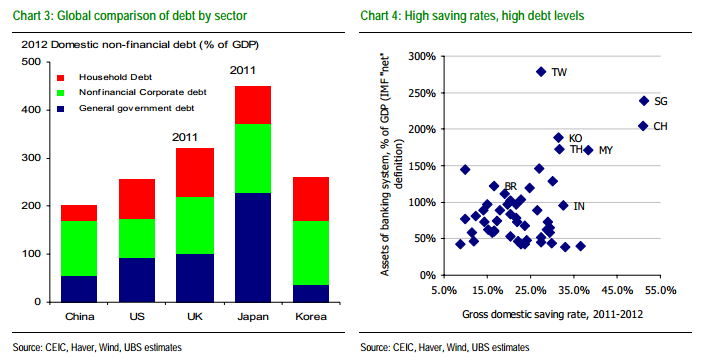
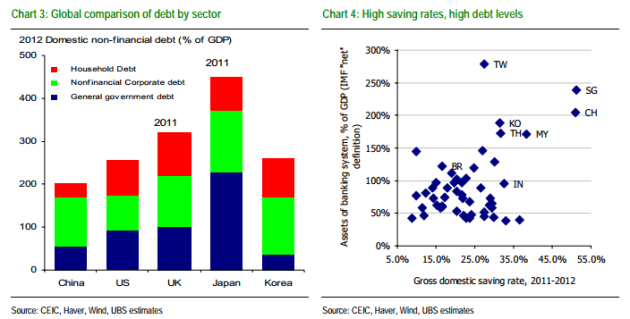
After Chinese first quarter GDP missed expectations, there was some hope that the relatively strong manufacturing PMIs in March would point to a better second quarter. Now that we know China’s April PMIs are definitely not supporting that notion, it is worth revisiting, again, the whole question of the country’s recent surging credit growth. The significance of the debt-to-GDP ratio can be argued over, and it’s impossible to say at what level it might become a big problem. But here are a couple of ideas to consider. First, UBS’ China economist Wang Tao has taken a look at the debt/GDP question. Her estimate is that government debt was about 55 per cent of GDP at the end of 2012, and total debt is about 210 per cent of GDP. (China’s official government debt to GDP ratio is only about 15 per cent, going purely on government bonds, but that ignores many government corporations, local debt, and the asset management companies that took on bad debt in the early 2000s financial crisis.) Anyway, 210 per cent is broadly in line with other credible estimates. Wang argues this absolute level in itself is not cause for dismay. In comparison to developed economies it may seem high, but it’s less dramatic measured against other emerging and Asian economies, which she points out typically have high savings rates which in turn provide some of that credit: There are a couple of other reasons not to worry. The growth might simply be lagging the credit surge, and some credit might have been double-counted: To be fair, we think credit growth has a delayed effect on economic growth, and expect construction an investment to pick up in Q2 and Q3 this year on the back of strong credit growth so far. Also, the TSF may overstate (or double count) the leverage increase in the real economy – corporates that engage in interest arbitrage by borrowing cheaply in the interbank credit market and lend to other corporate and/or local governments have both legs of their transaction included in TSF. While Wang doesn’t think a debt crisis is imminent, she does believe there are certainly reasons to worry. One is the recent rapid increase in the debt-to-GDP ratio. This is a very good point which we mentioned in February and forgot to point out in our ruminations of the past couple of weeks. To recap: Morgan Stanley’s Ruchir Sharma sums up some of these reasons in a WSJ op-ed, citing a BIS paper by Mathias Drehmann and Mikael Juselius which finds that if the private debt-to-GDP ratio increases by 6 per cent or more above its 15-year average, that is a “very strong indication that a crisis may be imminent”.

Wang believes there’s another reason for worry:

However, there is also plenty of evidence to suggest that financial distress is another reason why credit expansion has not worked well. Some local governments and companies do not have sufficient cash flow to pay interest on their existing debt, and have to borrow new debt to help service older debt. This is not hard to imagine for local governments – even if they have invested in sound projects in the last stimulus program, most of the projects do not yet have a cash return. In a downturn where local governments face weak tax revenue, dropping land sales, and more demand for pushing up investment and GDP from higher levels of government, the logical solution would be to incur more debt to keep the ball rolling. Read more of this post

China: Subprime for the masses

China: Subprime for the masses

May 1, 2013 11:54am by Simon Rabinovitch and Naomi Rovnick

With Chinese workers enjoying a break from their travails on May 1 for Labour Day, it is an opportune time to look at one gift recently bestowed on them by the country’s financiers. The gift is a new investment opportunity going by the name ‘fund of trusts’, which conjures up a sense of diversification and safety. But a more accurate name might be ‘subprime for the masses’. China’s funds of trusts are inspired by the funds of funds that are common in developed financial markets, allowing people to invest in a blend of other funds – whether mutual funds or hedge funds – to gain broader and more dispersed exposure. In China, the funds are invested in a cocktail of different trust products, which include some of the riskiest, high-yielding investments legally available in the country.

This innovation is notable for one major reason. Until now trust products have typically required minimum investments of Rmb1mn ($162,000) as a way of ensuring that only wealthy individuals put their money at risk. With funds of trusts, the entry barrier has been cut to as little as Rmb100,000 ($16,200). That puts trust investments within the reach of tens of millions of middle-class Chinese. Read more of this post

Chinese officials ‘taking lavish displays, banquets and secret sauna parties underground’

Chinese officials ‘taking lavish displays, banquets underground’

BEIJING — China’s top newspaper warned yesterday that some government officials were finding ways around President Xi Jinping’s graft-busting instructions to be frugal by taking banquets and other lavish displays underground, including hiding liquor in water bottles.

BY –

6 HOURS 35 MIN AGO

BEIJING — China’s top newspaper warned yesterday that some government officials were finding ways around President Xi Jinping’s graft-busting instructions to be frugal by taking banquets and other lavish displays underground, including hiding liquor in water bottles. Mr Xi has made battling pervasive corruption a top priority of his administration, warning the problem is so severe it could threaten the party’s survival. But despite his repeated admonitions for officials to practice frugality and stop wasting public funds, some people still have not got the message or are finding ways around it, the Communist Party’s official newspaper, People’s Daily, reported.

“In some places, the use of public money for eating and drinking has switched from high-end hotels to private venues and places of business … which has become known as ‘low-key luxury’,” the paper said. Cases had come to light of “saunas in farmhouses” and “maotai being put in mineral water bottles”, it said, in reference to the expensive spirit traditionally drunk at banquets. “These ways of pulling the wool over people’s eyes is typical of not following instructions and not stopping what is banned,” the commentary added. This phenomenon has reminded the party of the need to strictly enclose power “in the fence of supervision” and “the cage of regulation”, it said.  Read more of this post

Biofuel Pioneer Alan Shaw Forsakes Renewables to Make Gas-Fed Fuels; “Everybody but me is still in this nightmare. This model is broken.”

Biofuel Pioneer Forsakes Renewables to Make Gas-Fed Fuels

Alan Shaw, the chemist and executive who led a six-year effort to turn inedible crops into fuels to displace gasoline, has renounced the industry he helped pioneer and decided the future instead lies with natural gas.

Formerly chief executive officer of Codexis Inc. (CDXS), the first advanced biofuel technology company to trade on a U.S. exchange, Shaw now says it’s impossible to economically turn crop waste, wood and plants like switchgrass into fuel. He’s trying to do it instead with gas, in his new post as CEO of Calysta Energy LLC.

Shaw’s views put him at odds with the emerging segment of biofuels that’s invested about $3 billion since 2008 in the U.S. developing processes that turn biomass into new types of fuel. Amyris Inc. (AMRS) and Gevo Inc. (GEVO) are among producers that have yet to make fuel on commercial scales and slid since their initial public offerings.

“Everybody but me is still in this nightmare,” Shaw, 50, said in an interview in San Francisco. “This model is broken.” Read more of this post

Buffett Bear, Doug Kass, Adds Spice to Meeting as Rally Lulls Investors; Kass, 64, has shorted Berkshire stock in a bet the price will fall

Kass, Berkshire’s Bear, is ready to “surprise” Buffett

1:25am EDT

By Jennifer Ablan and Jonathan Stempel

Doug Kass, founder of hedge fund Seabreeze Partners Management Inc, sits at his desk at his home in Palm Beach

(Reuters) – Hedge fund trader Doug Kass had his first brush with fame at the age of 10, when he appeared on a television quiz show, Tic-Tac-Dough, and won every day for a week.

More than five decades later, Kass might find another sort of celebrity this Saturday when he will have the opportunity to quiz billionaire investor Warren Buffett at Berkshire Hathaway Inc’s annual meeting in Omaha, Nebraska. Buffett in March handpicked Kass, founder of hedge fund Seabreeze Partners Management Inc, to be Berkshire’s first “credentialed bear” to attend the meeting, and “spice things up. Kass, 64, has shorted Berkshire stock in a bet the price will fall. He is one of three members of an analyst panel that, along with shareholders and journalists, gets to question Buffett and Berkshire Vice Chairman Charlie Munger for five hours at the meeting, which draws more than 35,000 people to Omaha each year. “I had a lot of fun going to the Woodstock music festival on Max Yasgur’s farm in Bethel, New York in August 1969. I expect to have almost as much fun – and remember it – going to the Woodstock of Capitalism in Omaha,” Kass said in an interview. He declined to disclose the size of his Berkshire short, but called it an “average-sized position” that he initiated only a few days before Buffett’s invitation. Kass is known for his maverick positions, and his stock picks and pans have been followed widely by virtue of his prolific writings for TheStreet.com. He has a column – at one time called “The Contrarian” – to discuss neglected or undervalued stocks and sectors that he calls “purchase candidates,” as well as fully exploited or overvalued investments that he thinks are worth selling short. In April, Kass told clients and readers that he was bearish on economic growth and stocks.

Read more of this post

Buffett Further Trims Moody’s Stake as Shares Surge 21%; “What was once a bulletproof franchise may not be bulletproof”

Buffett Further Trims Moody’s Stake as Shares Surge 21%

Berkshire Hathaway Inc. (BRK/A), led by billionaire Chairman Warren Buffett, further trimmed its holdings of Moody’s Corp. (MCO) as the credit-ratings firm’s stock has surged this year. Berkshire sold about 1.75 million shares this week at prices ranging from $59.93 to $60.94 apiece, according to a filing issued yesterday. New York-based Moody’s has advanced 21 percent in 2013. Moody’s plunged in February when its larger competitor, Standard & Poor’s, said it could face a U.S. lawsuit over inflated mortgage-bond ratings. Buffett, 82, has pared his stake from 48 million shares in 2009. Buffett has said Moody’s didn’t anticipate a slide in housing prices.

“What was once a bulletproof franchise may not be bulletproof,” the billionaire said in a 2010 Bloomberg Television interview. “It’s still quite a franchise.” Read more of this post

Buffett Pays $2.05 Billion for Remaining 20% Stake in Iscar at $10B Valuation, Doubled from $5B Value in 2006 When Berkshire Bought 80% In Cutting Gear Firm

Buffett Pays $2.05 Billion for Remaining Stake in Iscar

Berkshire Hathaway Inc. (BRK/A) agreed to pay $2.05 billion for the 20 percent of IMC International Metalworking Cos. that it doesn’t already own as Chairman Warren Buffett expands his bet on the Israeli manufacturer.

IMC, known as Iscar, makes cutting gear for industries including aerospace and auto manufacturing. Jacob Harpaz will remain chief executive officer of Tefen, Israel-based IMC, the companies said today in a statement.

Buffett has structured deals to buy Marmon Holdings and IMC to allow the selling families to retain a stake in the companies they built. Omaha, Nebraska-based Berkshire can then increase its ownership with the price based on the results after the initial deal. He said in 2006 that he bought 80 percent of Iscar in a transaction that valued the company at $5 billion.

“As you can surmise from the price we’re paying for the remaining interest, IMC has enjoyed very significant growth over the last seven years,” Buffett, 82, said in the statement. Read more of this post

Feedback Loops And The Unsustainability Of China’s ‘Moderate’ Growth; the ‘rage’ among the Chinese at any suggestion of the sustainability of their growth model suggest a level of fragility in China’s social fabric

Feedback Loops And The Unsustainability Of China’s ‘Moderate’ Growth

Tyler Durden on 05/01/2013 19:11 -0400

With last night’s China PMI disappointing expectations and eking out a just-expansionary miasma of hope for the growth enthusiasts, the very real question of global growth sustainability (while not on US equity market participants’ minds) is coming to the fore. As Michael Pettis notes, Martin Wolf’s recent perspective that it may be useful to think about Japan as a model for understanding the adjustment process in China since the Japanese model shows how risky it is to shift to a slow-growth model.

Being in the significant non-consensus camp of “malevolent outsiders”, Pettis fears the ‘rage’ among the Chinese at any suggestion of the sustainability of their growth model suggest a level of fragility in China’s social fabric and its self-confidence that could make any slowdown more difficult to manage. The reason he is most-concerned is ‘feedback loops’; self-reinforcing mechanisms that are virtuous (with surprising growth expectations on the way up), but become vicious in an equally destructive manner. Read more of this post

Crude Inventories Surge To Record High As Energy Demand Collapses

Crude Inventories Surge To Record High As Energy Demand Collapses

Tyler Durden on 05/01/2013 11:38 -0400

20130501_DOE_0

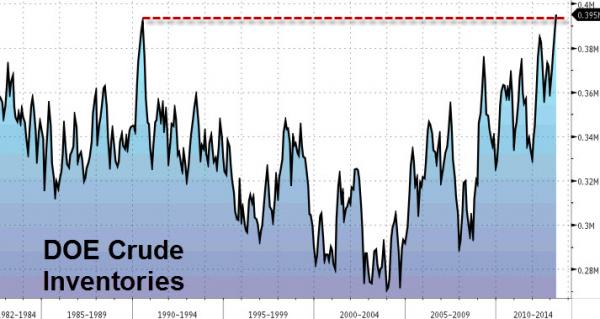
A month ago we highlighted the somewhat stunning reality of the real economy via the EIA’s detailed energy supply and demand data. The key takeaway was  that we hoped this did not represent the true state of the economy since the data was so dismal. Fast forward to today and the DOE just released a much higher than expected build in crude inventories that took the stuffed-channel of oil products to all-time highs.The 395.3 million barrels is higher than the previous record in July 1990. There appears to be a number of factors at play – none of which are positive. There is a surge in supply due to the incessant harvesting of shale oil (which could have its own problems as we noted here). Second, we suspect there is a degree of ‘channel-stuffing’ occurring – if we pump it, they will buy – as producers and transporters are desperate to keep active and show incremental business (despite fading railcar loadings). But perhaps most important, as EIA data has shown, there has been a collapse in end demand for crude products not seen since the 1990s. Today’s surge in inventories appears to confirm demand remains subdued at best.

Crude Declines for Second Day on Record Inventories

West Texas Intermediate oil fell for a second day as U.S. inventories reached a record high last week and on signs of economic slowdown in the U.S. and China.  Read more of this post

Bloomberg has calculated ratios of CEO compensation relative to average employees for the Top 250 companies in the S&P 500

How Much More Is Your CEO Making Than You?

Tyler Durden on 04/30/2013 13:32 -0400
Three years after Congress first told the SEC that it required public companies to uncloak the details of their CEO compensation relative to his lowly employees; the ever-ready SEC has yet to implement any rules. However, in an effort to ease the tough job that the SEC has, Bloomberg has calculated ratios for the Top 250 companies in the S&P 500, based on industry-specific averages for pay and benefits for the rank-and-file (since companies don’t disclose median worker pay). The table below, of the top 50 companies (meaning highest CEO pay relative to workers), suggests it remains good to be king (and Ron Johnson just made another #1 Spot earning an estimated 1,795x the average JCP employee – money well spent…).

20130430_CEO_0