Beyond Korean style: Shaping a new growth formula; Reduce housing payments + End the education “arms race.” + Create an entrepreneurial SME sector
April 27, 2013 Leave a comment
Beyond Korean style: Shaping a new growth formula
April 2013 | byWonsik Choi, Richard Dobbs, Dongrok Suh, Jan Mischke, Eunjo Chon, Hangjip Cho, Boyoung Kim, and Hyunmin Kim
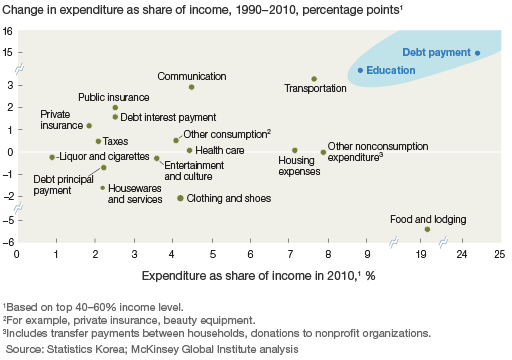
Beginning in the 1960s, South Korea has set economic-development records with a growth formula that focused on heavy-industry and manufactured exports. GDP has tripled in just the past 20 years, and South Korea became the first nation to go from being a recipient of aid from the Organisation for Economic Co-operation and Development to being a member of its donor committee. South Korea is the leading supplier of LCD screens, memory chips, and mobile phones and is the world’s number-five automaker. Yet the nation’s GDP growth is increasingly decoupled from the lives of its middle- income citizens. The number of middle-income households—earning 50 to 150 percent of median income—has fallen from 75.4 percent of the population to 67.5 percent since 1990, and more than half of middle-income households are cashflow constrained when the full costs of housing payments are counted. The squeeze contributes to trends that could affect future growth, including a plummeting personal-saving rate and one of the world’s lowest fertility rates. Beyond Korean style: Shaping a new growth formula, a new report from the McKinsey Global Institute (MGI), explores the causes of these economic challenges and makes specific recommendations for combatting them. Among the report’s findings: Read more of this post