In Japan, the Rising Cost of Elder Care—and Dying Alone

In Japan, the Rising Cost of Elder Care—and Dying Alone

By Kanoko Matsuyama on February 28, 2013

Itoko Uchida, 82, was counting on the nephew she raised to support her during old age. He refused, she says, forcing the Tokyo widow to pay 710,000 yen ($7,600) to a nonprofit, which will assist with her nursing home application and act in lieu of a close relative on health-care matters. Some 420,000 Japanese nationwide are waiting for a nursing home bed.

An erosion of traditional Confucian values, which stress the obligations children have to their parents, means fewer elderly are being cared for at home by relatives. By 2025, one in three citizens in Japan will be 65 or older, up from 12 percent of the population in 1990, the Organisation for Economic Co-operation and Development estimates. “The system is designed for the 1970s, when multiple generations lived together and family caregiving was thought to continue forever,” says Hiroshi Takahashi, a professor of health sciences at the International University of Health and Welfare in Otawara, north of Tokyo. “But that’s not the reality now.” Read more of this post

Expensive housing turning Australia into a nation of renters

Expensive housing turning Australia into a nation of renters

PUBLISHED: 01 MAR 2013 17:18:00 | UPDATED: 02 MAR 2013 02:42:28

ROBERT HARLEY

THE DREAM OF BUYING A HOME IS QUICKLY FADING FOR MANY AUSTRALIANS.THE RESIDENTIAL DEVELOPMENT COUNCIL’S CARYN KAKAS

Australians are headed to be a nation of renters, living increasingly in apartments, and, for the poor, crammed into more crowded homes.

On Friday the federal government’s independent adviser on housing, the National Housing Supply Council, released a major report warning of the long term consequences of constricted new supply and low affordability. Read more of this post

India’s Cycle of Recklessness and Reform; Unless Delhi holds itself accountable, it will periodically face crises

February 28, 2013, 12:21 p.m. ET

India’s Cycle of Recklessness and Reform

Unless Delhi holds itself accountable, it will periodically face crises.

By RUCHIR SHARMA

India’s cycle of crisis and reform is predictable as clockwork. Ever since it faced a balance of payments crisis in 1981, the country has found itself in some macroeconomic trouble at the start of every decade. This, in turn, has pushed its reactive policy makers into reform mode.

The same pattern has been at play over the past year, with the economy slowing sharply to 5%, inflation stubbornly high at 10% and the fiscal and current account deficits widening sharply. The threat last summer of India’s sovereign rating being downgraded to junk status finally galvanized policy makers into taking some corrective measures. They liberalized foreign investment in retail and airlines, and took aim at the subsidy system. Read more of this post

Institutional Holding Periods; Our results are consistent with the agency problem that arises when clients cannot distinguish when a manager is “actively doing nothing” versus “simply doing nothing” as well as managers having overconfidence in their own short-term trading ability

Institutional Holding Periods

Bidisha Chakrabarty 

Saint Louis University – John Cook School of Business

Pamela C. Moulton 

Cornell University

Charles Trzcinka 

Indiana University Bloomington – Department of Finance
February 20, 2013

Abstract: 
We find wide dispersion in trade holding periods for institutional money managers and pension funds, using a large database of fund-level transactions. All of the institutional funds execute round-trip trades lasting over a year; 96% of them also execute trades lasting less than one month, although short-duration trades have negative returns on average. We find only limited evidence that institutions choose trade holding periods based on portfolio optimization and no evidence that short-duration institutional trades are driven by the disposition effect. Our results are consistent with the agency problem that arises when clients cannot distinguish when a manager is “actively doing nothing” versus “simply doing nothing” as well as managers having overconfidence in their own short-term trading ability.

Can Any Mutual Fund Capture the Value Premium? Market-based value portfolios and passive value style indexes simply do not outperform growth portfolios and growth indexes over time. Therefore, we ask whether any managed fund can capture the elusive value premium that undoubtedly appears in the academic data

Can Any Mutual Fund Capture the Value Premium?

Kenneth E. Scislaw 

Drexel University Lebow College of Business

David G. McMillan 

University of Stirling
September 19, 2012

Abstract: 
If the value premium exists as a function of risk, then value investment portfolios should systematically outperform growth portfolios over time. A long lineage of research is very clear on the matter. Unfortunately, recent tests of managed portfolios and market indexes have failed to support the risk thesis. Market-based value portfolios and passive value style indexes simply do not outperform growth portfolios and growth indexes over time. Therefore, we ask whether any managed fund can capture the elusive value premium that undoubtedly appears in the academic data. Moreover, we do so by examining the returns of one particular fund that was specifically designed to capture it. In the end, we find the fund has indeed been successful. However, in decomposing the returns of this particular fund, in order to illuminate how others might replicate its success, we find substantial evidence that the value return premium is in fact partially a growth stock discount story. This finding goes a long way in explaining why managed growth fund returns have equalled managed value fund returns over time, despite predictions to the contrary from a long lineage of academic research.

Buffett to Update His Acquisition Hunt; Investors Are Curious if Berkshire CEO Is Still Looking for Big Deals After Heinz

Updated February 28, 2013, 5:23 p.m. ET

Buffett to Update His Acquisition Hunt

Investors Are Curious if Berkshire CEO Is Still Looking for Big Deals After Heinz

By ANUPREETA DAS And SERENA NG

Two years ago, Warren Buffett told Berkshire Hathaway Inc. BRKB +0.94%shareholders he was on the lookout for major acquisitions, as part of his unending effort to profitably employ the buckets of cash his company collects every month.

Since then, however, the billionaire investor has fired what he called his “elephant gun” just twice. Berkshire in February said it would join with a Brazilian investment firm to buy ketchup maker H.J. Heinz Co. HNZ -0.11% for $23.4 billion. In 2011, Berkshire bought engine lubricant-maker Lubrizol Corp. for $9 billion.

MI-BU438_BERKSH_G_20130228161413MI-BU435_BERKSH_NS_20130228160603

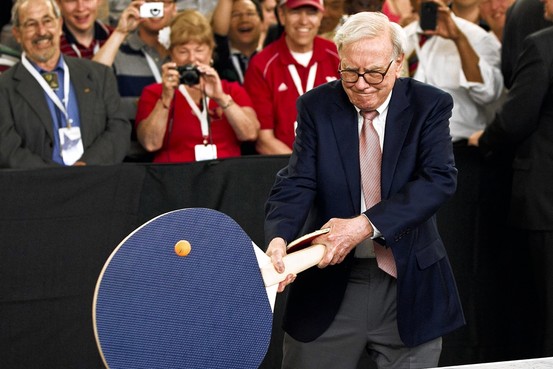
Shareholders watch as Warren Buffett, chairman and CEO of Berkshire Hathaway, deploys an oversize bat against table tennis prodigy Ariel Hsing in Omaha, Neb., in May.

The challenge of finding a big target at the right price will again be on investors’ minds when Berkshire files its annual report Friday afternoon. The report includes the shareholder letter penned by the 82-year-old Mr. Buffett, which over the years has been the source of many of the bon mots for which the Omaha, Neb., company’s chairman and chief executive is known. Read more of this post

From rags to riches to jail; Mexico’s top union leader; She was Mexico’s most powerful woman, feared by presidents and held the future of millions of school children in her hands; now facing charges of embezzling around $200 million from union coffers to fund a lavish, jet-set lifestyle

Published: Friday March 1, 2013 MYT 8:29:00 AM

From rags to riches to jail; Mexico’s top union leader

MEXICO CITY: She was Mexico’s most powerful woman, feared by presidents and held the future of millions of school children in her hands, but the head of one of Latin America’s biggest trade unions now languishes behind bars on corruption charges.

With a penchant for plastic surgery, designer purses and luxury villas, Elba Esther Gordillo, the 68-year-old leader of Mexico’s main teachers’ union, has come to embody the abuse of power by the country’s political class.

She now wears a prison uniform at Santa Martha Acatitla women’s prison on the edge of Mexico City, facing charges of embezzling around $200 million from union coffers to fund a lavish, jet-set lifestyle. Read more of this post

US companies in China: tougher times

US companies in China: tougher times

Feb 28, 2013 11:30am by Stefan Wagstyl

After a string of cautious statements on China from US companies ranging from Caterpillar to Yum!Foods, the American Chamber of Commerce in Shanghai has declared that the days of relentless sales and rising profits are over.

The “new normal” is one of slower economic growth, rising costs, skilled labour shortages and an increasingly competitive business environment. Tougher times “will be the rule rather than the exception in the years ahead,” AmCham says in a report. Read more of this post

Coca-Cola’s Chok! Chok! Chok! ad shakes up mobile marketing

Chok! Chok! Chok! ad shakes up mobile marketing

2:45pm EST

By Kate Holton and Leila Abboud

BARCELONA (Reuters) – A strange phenomenon hit Hong Kong in late 2011.

As the clock hit 10 pm each night a Coca Cola ad aired on television, prompting thousands of viewers to grab their phones and start shaking them frantically to virtually “catch” the falling bottle caps on the screen and win instant prizes.

Dubbed Chok! Chok! Chok! – meaning rapid motion in local slang – the interactive campaign by McCann Worldgroup became a hit, and sent viewers at home, in cinemas and in front of giant outdoor screens into a frenzy. (link.reuters.com/wux36t)

Nine million people saw the ad – 380,000 downloaded the Chok! Chok! Chok! app in the first month – and its success indicates that marketers may be finally figuring out how to direct ads at consumers via mobile phones. Read more of this post

Buffett’s Mentor Benjamin Graham’s Clever Idea for Averting Currency Wars

Benjamin Graham’s Clever Idea for Averting Currency Wars

Benjamin Graham is remembered primarily as the father of value investing, and as the former professor, employer, friend and investing mentor of Warren Buffett. Yet Graham did a lot more than dispense sound investment advice.

For one thing, he developed a subtle and clever idea for stabilizing currencies — and economies — that might bear closer examination today. He called it the commodity reserve currency.

Graham first formulated the idea in response to the recession of 1920-1921. During that crisis, Graham observed that the price of gold was remarkably stable while the prices of many other items, even basic commodities with far greater direct impact on the economy than precious metals, were dropping precipitously. From his perch on Wall Street, Graham saw these declining prices reflected in plummeting corporate earnings.

At the time, each U.S. dollar represented a fixed amount of gold. Graham noticed how that dynamic stabilized the price of gold (and, to a lesser extent, silver) while the price of other goods crashed. Gold producers were “exempt from the difficulties that bedeviled the rest of us,” he wrote.

So, with characteristic inventiveness, Graham wondered how much more stable the economy would be if, instead of precious metals alone, fixed quantities of more essential commodities would be pegged to the value of the dollar. He speculated that this would ensure that the prices of, say, petroleum or wheat would be as stable as that of gold. Read more of this post

Buffett Betrayed by Calls Shows Nobody Safe From Leaks

Buffett Betrayed by Calls Shows Nobody Safe From Leaks

The surge in H.J. Heinz Co. options before Berkshire Hathaway Inc. (BRK/A)’s $23 billion takeover bid shows that even the world’s most successful investor isn’t immune to leaks.

Federal authorities began a criminal probe after almost 2,600 Heinz June $65 call options changed hands on Feb. 13, compared with 14 the day before, according to data compiled by Bloomberg. It was the second instance in two years of well-timed trading before billionaire Warren Buffett’s company announced an acquisition. In March 2011, call volume in Lubrizol Corp. climbed to 12 times more than puts days before Berkshire offered to buy the world’s largest producer of lubricant additives.

While Buffett is under no suspicion, the government suit shows it’s getting harder to keep secrets in mergers and acquisitions, according to Robert Pavlik, chief market strategist at Banyan Partners LLC, which oversees $1.4 billion. Regulators have probed at least a dozen cases of options trading before events such as takeover announcements since 2007, including AstraZeneca Plc (AZN)’s purchase of MedImmune Inc. and BHP Billiton Ltd. (BHP)’s bid for Potash Corp. of Saskatchewan Inc., data compiled by Bloomberg show.

“People are looking for whatever edge they can get, which includes trying to game the system,” Pavlik said in a Feb. 22 phone interview from New York. “With these kinds of big deals there are a lot of participants, and anyone with access to information has friends and family who may engage in nefarious activity simply based on an off-the-cuff remark.” Read more of this post

Desigual’s Swiss Billionaire Meyer Forms Fortune With Kissing Party

Swiss Billionaire Meyer Forms Fortune With Kissing Party

Dressed in nothing but their lingerie and boxer shorts, more than 300 shoppers lined up outside the Desigual shop in the Soho neighborhood of New York City on Sept. 23, 2010, for a free outfit.

“I got out here at 1 a.m.,” said one customer in a video posted by the company on YouTube, her driver’s license stuffed into a pink bra as bypassers snapped pictures of the crowd, who were attending a marketing event Desigual called an Undie Party.

She emerged from the store hours later, posing in a black and green jacket. Other shoppers screamed with glee as they walked away in the color-splashed designs and prints the retailer is known for.

Such promotions — and others, like kissing festivals in London, Paris and Berlin — have helped make Thomas Meyer, the 50-year-old founder and owner of the Barcelona-based fashion chain, a billionaire.

Desigual, which is Spanish for “atypical,” has tripled its annual sales in the past five years to 700 million euros ($903 million), according to Orbis, a database of company information published by Bureau van Dijk. The company sold more than 22 million garments in 2012 through 330 of its own stores and 11,200 other points of sale in more than 100 countries.

Net Worth

Meyer has a net worth of at least $1.1 billion, according to the Bloomberg Billionaires Index. He has never appeared on an international wealth ranking.

“Desigual is a very unique, fast-growing brand that is doing well globally,” David Haigh, chief executive officer of Brand Finance Plc, a London-based consultancy, said by phone. Brand Finance releases an annual report on the most valuable publicly listed fashion companies in Spain. “They are very differentiated from other fashion brands. Their garments are edgy and complex.”

The company is valued at $1.6 billion, according to the Bloomberg ranking, based on the average enterprise value-to- earnings before interest and tax, and enterprise value-to-sales multiples of two publicly traded peers: Philadelphia-based Urban Outfitters Inc. (URBN) and Cheltenham, England-based Supergroup Plc. (SGP) Enterprise value is defined as market capitalization plus total debt minus cash. Read more of this post

Can’t sell the TV?…sell the office: Japan Inc fires up property market

Can’t sell the TV?…sell the office: Japan Inc fires up property market

4:44pm EST

By Junko Fujita

TOKYO (Reuters) – Japanese blue-chip firms, from electronics giants to brewers, are selling prime real estate to shore up battered balance sheets, stoking a resurgent property market. Some are moving into new offices to take advantage of relatively low rents.

Big downtown office buildings are coming up for sale as Tokyo’s property market regains growth momentum for the first time in almost five years, with plenty of interest among buyers, particularly Japan’s public real estate trusts, experts said. Read more of this post

China plans bond overhaul to fund $6 trillion urbanization

Exclusive: China plans bond overhaul to fund $6 trillion urbanization – sources

4:20pm EST

By Nick Edwards and Benjamin Kang Lim

BEIJING (Reuters) – China plans major bond market reform to raise the money the ruling Communist Party needs for a 40 trillion yuan ($6.4 trillion) urbanization program to buoy economic growth and close a chasm between the country’s urban rich and rural poor.

The Party aims to bring 400 million people to cities over the next decade as the new leadership of president-in-waiting Xi Jinping and premier-designate Li Keqiang seek to turn China into a wealthy world power with economic growth generated by an affluent consumer class.

The urban development would be funded by a major expansion of bond markets, sources with leadership ties, and a senior executive at one of China’s “Big Four” state banks, who was formerly at the central bank, told Reuters. Read more of this post

Yeltsin-Era Tycoons Sell Resources to Keep Distance From Kremlin

Yeltsin-Era Tycoons Sell Resources to Keep Distance From Kremlin

Russian billionaires who made their fortunes buying commodities assets in the 1990s are exiting natural resources to gain independence as Kremlin-backed oligarchs take their place.

Viktor Vekselberg, Russia’s third-richest man according to the Bloomberg Billionaire Index, said this year he will invest his share of the $28 billion sale of half of oil producer TNK-BP in technology, machinery and alternative energy, not resources.

Mikhail Prokhorov, Russia’s ninth-richest, sold his stake in Russia’s biggest gold producer, Polyus Gold International Ltd. (PGIL) for $3.6 billion last week, to diversify his investments. Sergey Popov, No. 27, sold his remaining stake in coal miner SUEK this year, the last of his resource assets.

“There is an evolution of interests among the wealthiest Russians and that evolution is in sync with the evolution of the Russian economy,” said James Beadle, an investment adviser at Societe Generale SA’s private banking unit in Monaco. “By saying that you are investing in areas other than commodities, you are both following the Kremlin’s nod and also following the economic logic of the situation.”

Russia’s government set targets to diversify the economy and cut its dependence on oil, gas and metals, which last year accounted for 81.3 percent of exports to countries excluding former Soviet republics, customs service data shows. Read more of this post

Michelle Obama: The Business Case for Healthier Food Options; In recent years, they have generated more than 70% of the growth in sales for packaged-goods companies

February 27, 2013, 7:29 p.m. ET

Michelle Obama: The Business Case for Healthier Food Options

In recent years, they have generated more than 70% of the growth in sales for packaged-goods companies.

By MICHELLE OBAMA

For years, America’s childhood obesity crisis was viewed as an insurmountable problem, one that was too complicated and too entrenched to ever really solve. According to the conventional wisdom, healthy food simply didn’t sell—the demand wasn’t there and higher profits were found elsewhere—so it just wasn’t worth the investment.

But thanks to businesses across the country, today we are proving the conventional wisdom wrong. Every day, great American companies are achieving greater and greater success by creating and selling healthy products. In doing so, they are showing that what’s good for kids and good for family budgets can also be good for business.

Take the example of Wal-Mart WMT -0.30% . In just the past two years, the company reports that it has cut the costs to its consumers of fruits and vegetables by $2.3 billion and reduced the amount of sugar in its products by 10%. Wal-Mart has also opened 86 new stores in underserved communities and launched a labeling program that helps customers spot healthy items on the shelf. And today, the company is not only seeing increased sales of fresh produce, but also building better relationships with its customers and stronger connections to the communities it serves. Read more of this post

Signatures Of Famous CEOs, And The Secrets They Reveal

Would be great if the signature analysis can be extended to outstanding CEOs and leaders who are not commonly featured in a high-profile way since preconceived notions and pre-“knowledge” about their “character” can be gathered..  KB

Signatures Of Famous CEOs, And The Secrets They Reveal

Jay Yarow | Feb. 27, 2013, 9:00 PM | 43,613 | 3

We asked a handwriting analyst to look at the signatures of some big-name technology executives and tell us what they say about their personalities.

Sheila Lowe, president of the American Handwriting Analysis Foundation, provided a blurb for us on Jeff Bezos, Steve Ballmer, and many more.

In researching this story, another handwriting analyst said Lowe is “great” at analysis. Lowe’s group, the AHAF, is trying to get cursive back in school curricula.

Lowe cautioned that it’s difficult to truly read a person’s character based just on their signature. You need some handwriting samples.

“A signature by itself gives only a limited amount of information (it’s like looking at a photo of someone’s nose and trying to describe their whole face),” Lowe told us over email. “The signature is like the cover on a book, and doesn’t always jibe with what’s inside. It’s what the person wants you to know about them.”

Since these people are in tech, we’re guessing it’s been years since any of them hand-wrote notes. As a result we have to use signatures we’ve found through various online sources.

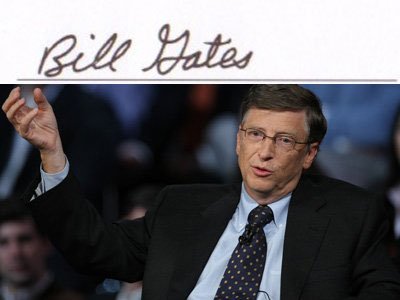
With Bill Gates, Microsoft’s chairman, what you see is what you get
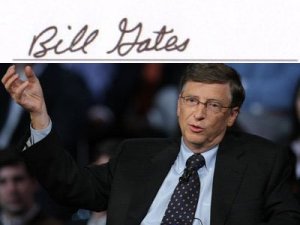
with-bill-gates-microsofts-chairman-what-you-see-is-what-you-get

Lowe: “Bill Gates takes the time to write a clear, clean, unpretentious signature that says, ‘What you see is what you get.’ There are signs of quick thinking, but the round dot over the ‘i’ says he’s patient with details. He’s willing to take the time to listen.”

Jack Dorsey, founder of Twitter and CEO of Square’s, “@” signature is about saying “who I am is what I do”

jack-dorsey-founder-of-twitter-and-ceo-of-squares--signature-is-about-saying-who-i-am-is-what-i-do

Jack Dorsey has two signatures we’ve seen online. This one plays on his Twitter founding.

Lowe’s take on this: “Jack Dorsey’s extremely simplified signature drops his last name and with the @ symbol, identifies him with what he does (‘who I am is what I do’). The k ends with a downward trail. If that’s how he normally signs, it may signify a desire to continually look back at the past and figure out how to benefit from his experiences, or to figure out how he got where he is now.”

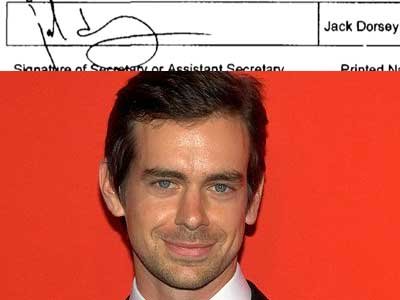
Jack Dorsey’s more formal signature shows he’s a bottom line kind of guy
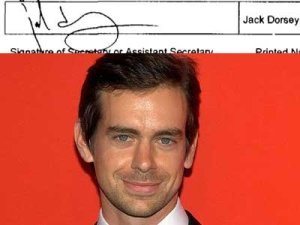
jack-dorseys-more-formal-signature-shows-hes-a-bottom-line-kind-of-guy

Here’s another Dorsey signature we found that’s more formal. Says Lowe, “This is more his public persona. This one is a logo-type signature, which happens to be easy to forge in its lack of complexity. It’s another case of illegibility that allows the writer to hide anything he doesn’t want the world to see. He’s a bottom line kind of guy, impatient and with that strong ending stroke, aggressive.”

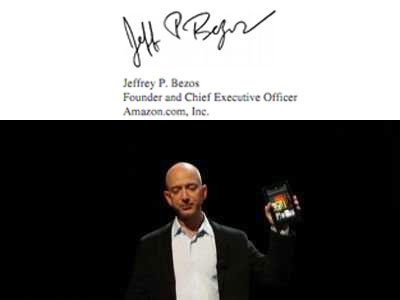
Amazon CEO Jeff Bezos is not as outgoing as he would have us believe
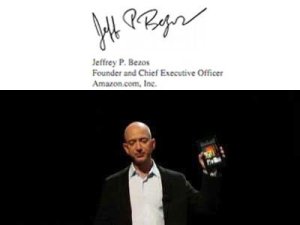
amazon-ceo-jeff-bezos-is-not-as-outgoing-as-he-would-have-us-believe

Lowe: “Jeff Bezos’ first name leans left before moving rightward with his last name, which is not completely legible and ends in a dynamic movement upward. Despite the fact that he might have a lot to say (notice the open “o” in his last name), he’s not as outgoing as he would like us to think he is, but we would need to see more handwriting to figure out why. That final stroke is somewhat aggressive and acts as a wall to keep others out.”

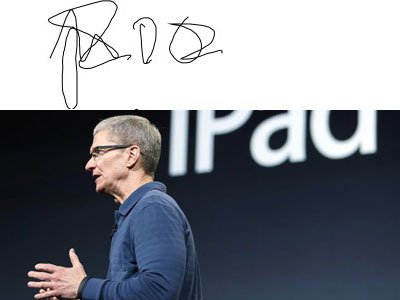
Apple CEO Tim Cook’s sloppy signature says he doesn’t want us to know much about him
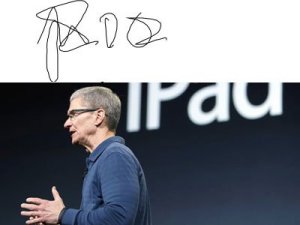
apple-ceo-tim-cooks-sloppy-signature-says-he-doesnt-want-us-to-know-much-about-him

Tim Cook also has two signatures online. This one is his sloppier signature. Says Lowe of this one, “Tim Cook has a signature that resembles some sort of alien hieroglyphic. Since a signature is written for the purpose of communicating who you are, we can assume that Tim doesn’t want us to know much about him. What we can see, however, is that his mind is moving faster than he can write. He gets to the bottom line at warp speed and isn’t interested in hearing all the mundane details. If you come to him with a plan, make sure you’ve done your homework.”

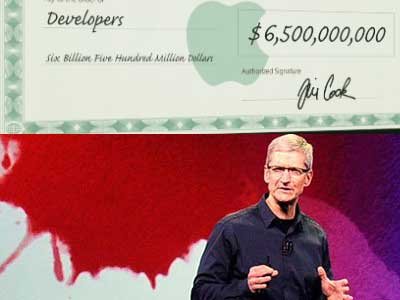
Tim Cook also has a cleaner signature, which indicates family pride
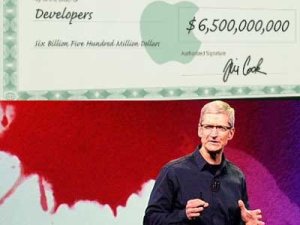
tim-cook-also-has-a-cleaner-signature-which-indicates-family-pride

We also found this Cook signature, which was on a check for developers. Says Lowe of this one, “He probably felt the need to be clearer, knowing his signature would be seen on this rather large check, so took more time with it. We don’t know which is his “normal” signature—probably the other one. This one has a very large ‘C’ in the last name—his father’s name—so there’s respect or regard for his family of origin.”

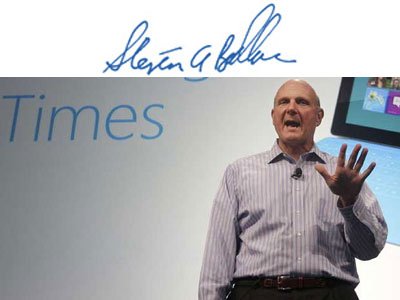
Microsoft CEO Steve Ballmer sets his own standards and doesn’t care what others think
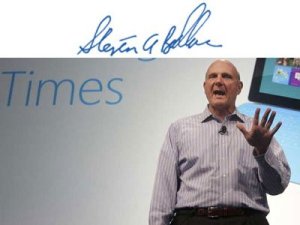
microsoft-ceo-steve-ballmer-sets-his-own-standards-and-doesnt-care-what-others-think

Lowe: “Steve Ballmer’s signature is interesting for a couple of reasons. First, he crosses the ‘t’ in Stephen far to the right, indicating forward-looking enthusiasm. Second, the ll in Ballmer has a rather strange shape that reaches into the stratosphere and make me wonder if he’s a pilot. We see this type of formation in people who have a great deal of pride in their accomplishments. He wants to be seen as an intellectual, which may lead him to make things sound a lot more complicated than they really are. He sets his own standards and has less interest in what others think.”

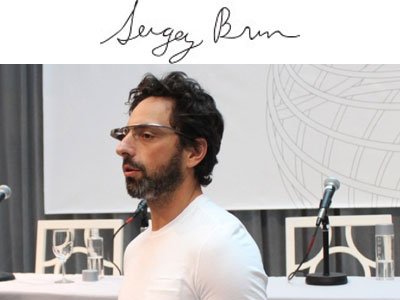
Google co-founder Sergey Brin’s signature suggests he wants to be known as Sergey, not Mr. Brin
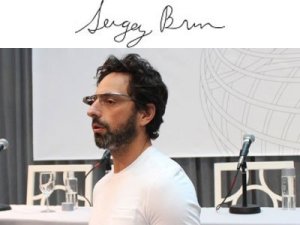
google-co-founder-sergey-brins-signature-suggests-he-wants-to-be-known-as-sergey-not-mr-brin

Lowe: “Sergey Brin’s somewhat sloppy signature is at least readable. He wrote it quickly, not paying much attention to the details—there’s no dot over his i. He has a sociable, casual approach, and with the capital S being taller than the capital B, he would rather be seen as ‘Sergey,’ than ‘Mr. Brin.'”

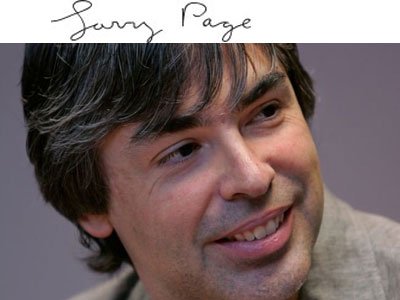
Google CEO Larry Page is a good listener
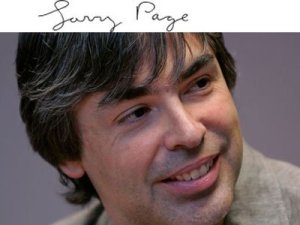
google-ceo-larry-page-is-a-good-listener

Lowe: “Larry Page just throws his clear signature down on the paper and doesn’t care what others think. The vowel letters are wide open, which suggests he is a good listener. However, the wide space between first and last name indicates the need for a wide berth of personal space. Don’t stand too close when you speak to him.”

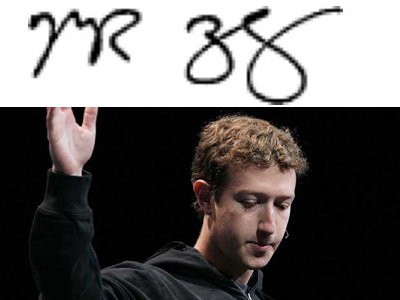
Facebook CEO and founder Mark Zuckerberg is pretty secretive
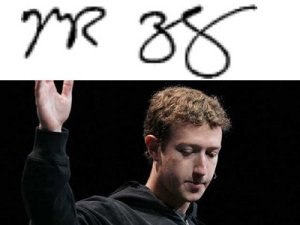
facebook-ceo-and-founder-mark-zuckerberg-is-pretty-secretive

Lowe: “Mark Zuckerberg apparently doesn’t feel the need to share more than just his initials. True, it’s a long name to write, but anyone not knowing what the name says, would find it impossible to guess. He is definitely the man behind the curtain, pulling the strings in the background.”

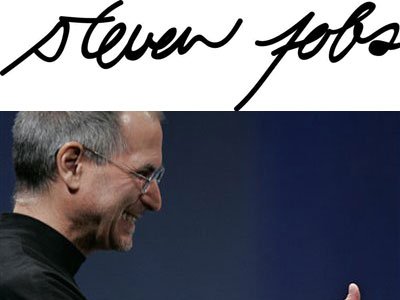
Once Apple’s co-founder Steve Jobs started going, there was no stopping him
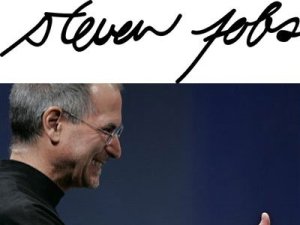
once-apples-co-founder-steve-jobs-started-going-there-was-no-stopping-him

Lowe: “Steve Jobs wrote with a thick marker pen (like his black turtlenecks) and didn’t capitalize his signature. This points to humility, at least in the way he felt about himself, if not his work. The low upper loop indicate someone down to earth, whose focus was on the here and now. The t cross stays mostly to the left of the downstroke, and apart from the capitals, there are no breaks between the letters. He might have needed a second cup of coffee to really get going, but once he did, he was a steamroller who never stopped until he had finished what he started.”
Why Innovation By Brainstorming Doesn’t Work

Why Innovation By Brainstorming Doesn’t Work

BY DEBRA KAYE

FEBRUARY 28, 2013

Anything–even doing laundry–will help you dream up new ideas better than sitting in a meeting, says Debra Kaye, author of “Red Thread Thinking.” A case study of the history of the single-use detergent pod. Eleven men and women file into a conference room and take their places around a large table. Coffee cups and pastries are assembled in front of them. George, the leader, steps up to a large whiteboard and scrawls across the top “SOAP STORM SESSION 9/18/12.” “Okay, let’s begin,” he tells the group. “Let’s just start free-associating. What do we think of when we think clean laundry?” he asks. “To get the ball rolling, I’ll write a few words down,” he says and dashes off chore, piles, whites and brights, and fresh on the board. “What else?” he asks. Several people add a few more words: time-consuming, fold, bright, uncontaminated, pretty, nice, old-fashioned, and pleasant. The meeting continues for about an hour, with more words and thoughts added. The plan was for the team to come up with a new idea for laundry detergent. When the meeting is over, the team members file back to their cubicles, word lists in hand, to ponder the outcome–but none of them ever produced any new insights into doing laundry that would lead to a new product. That’s because the group made the fatal error of trying to innovate by brainstorming around the idea of the central attribute of laundry–cleanliness. So while they came up with a pretty long list of words, none of the few concepts that came out of the meeting–“cleans in a shorter time,” “cleans without presoaking,” “brightens without fading”–was out-of-the-box spectacular. This scenario takes place every day in office suites around the world. That’s an important point to remember, because companies everywhere are brainstorming the same things about clean laundry as my imaginary team. Everything about clean laundry likely has been thought of before. It turns out that a brainstorming session is a great place to load up on baked goods and caffeine, but it’s not so great for generating ideas. In fact, the team in my imaginary example would have come up with more original associations and innovative thoughts had they stayed home and sorted a sock drawer, taken a hike, relaxed in a bathtub, or done just about anything else autonomously–including a load of laundry.

The conventional wisdom that innovation can be institutionalized or done in a formal group is simply wrong. Part of what we know about the brain makes it clear why the best new ideas don’t emerge from formal brainstorming. First, the brain doesn’t make connections in a rigid atmosphere. There is too much pressure and too much influence from others in the group. The “free association” done in brainstorming sessions is often shackled by peer pressure and as a result generates obvious responses. In fact, psychologists have documented the predictability of free association. Read more of this post

The World’s Most Admired Companies: Built for brilliance; Seven of those top 10 companies are one-man phenomena: Apple, Google, Amazon, Starbucks, Southwest Airlines, Berkshire Hathaway, FedEx

The World’s Most Admired Companies: Built for brilliance

By Geoff Colvin, senior editor-at-large @FortuneMagazine February 28, 2013: 7:55 AM ET

The most important trend in the World’s Most Admired Companies ranking isn’t the concentration of tech firms at the top, striking though that is. The list holds an even larger and more powerful pattern: Seven of those top 10 companies are one-man phenomena. Apple, Google, Amazon, Starbucks, Southwest Airlines, Berkshire Hathaway, FedEx — each is the reflection of a single individual (or two, at Google) who is still around, with the notable exception of Apple’s Steve Jobs, gone less than 18 months.

To see how unusual that is and what large questions it raises for any company’s future in today’s economy, one must consider the very first Most Admired list, which appeared 30 years ago, in 1983. Only one among the top 10 was a one-man phenomenon: Digital Equipment, run by founder Ken Olsen. The others were all long-established institutions, corporate aristocracy: IBM, Hewlett-Packard, Johnson & Johnson, Eastman Kodak, Merck, AT&T, General Electric, General Mills.

Why this massive shift? In an information-based economy, a company can rocket to industry dominance and a towering valuation in the space of a founder’s career, much faster than in an industrial economy. It can also fall right back down, as Yahoo, AOL, and MySpace prove. Read more of this post

Many women were appalled at the Yahoo news, noting that Mayer, with her penthouse atop the San Francisco Four Seasons, her Oscar de la Rentas and her $117 million five-year contract, seems oblivious to the fact that for many of her less-privileged sisters with young children, telecommuting is a lifeline to a manageable life.

February 26, 2013

Get Off of Your Cloud

By MAUREEN DOWD

When Marissa Mayer became queen of the Yahoos last summer, she was hailed as a role model for women. The 37-year-old supergeek with the supermodel looks was the youngest Fortune 500 chief executive. And she was in the third trimester of her first pregnancy. Many women were thrilled at the thought that biases against hiring women who were expecting, or planning to be, might be melting.

A couple months later, it gave her female fans pause when the Yahoo C.E.O. took a mere two-week maternity pause. She built a nursery next to her office at her own expense, to make working almost straight through easier. The fear that this might set an impossible standard for other women — especially women who had consigned “having it all” to unicorn status — reverberated. Even the German family minister, Kristina Schröder, chimed in: “I regard it with major concern when prominent women give the public impression that maternity leave is something that is not important.” Almost two months after her son, Macallister, was born, Mayer irritated some women again when she bubbled at a Fortune event that “the baby’s been way easier than everyone made it out to be.” “Putting ‘baby’ and ‘easy’ in the same sentence turns you into one of those mothers we don’t like very much,” Lisa Belkin chided in The Huffington Post. Now Mayer has caused another fem-quake with a decision that has a special significance to working mothers. She has banned Yahoos, as her employees are known, from working at home (which some of us call “working” at home). It flies in the face of tech companies’ success in creating a cloud office rather than a conventional one. Mayer’s friend Sheryl Sandberg of Facebook wrote in her new feminist manifesto, “Lean In: Women, Work, and the Will to Lead,” that technology could revolutionize women’s lives by “changing the emphasis on strict office hours since so much work can be conducted online.” She added that “the traditional practice of judging employees by face time rather than results unfortunately persists” when it would be more efficient to focus on results.

Many women were appalled at the Yahoo news, noting that Mayer, with her penthouse atop the San Francisco Four Seasons, her Oscar de la Rentas and her $117 million five-year contract, seems oblivious to the fact that for many of her less-privileged sisters with young children, telecommuting is a lifeline to a manageable life.

The dictatorial decree to work “side by side” had some dubbing Mayer not “the Steinem of Silicon Valley” but “the Stalin of Silicon Valley.”

Mayer and Sandberg are in an elite cocoon and in USA Today, Joanne Bamberger fretted that they are “setting back the cause of working mothers.” She wrote that Sandberg’s exhortation for “women to pull themselves up by the Louboutin straps” is damaging, as is “Mayer’s office-only work proclamation that sends us back to the pre-Internet era of power suits with floppy bow ties.”

Men accustomed to telecommuting were miffed, too. Richard Branson tweeted: “Give people the freedom of where to work & they will excel.” Read more of this post

Buffett once said that shunning dividends in his early years running Berkshire Hathaway allowed him to refocus the company on better businesses, much as a person would overcome “a misspent youth.”

Buffett Outlining Dividend Plan May Ease Successor’s Path

Warren Buffett once said that shunning dividends in his early years running Berkshire Hathaway Inc. (BRK/A) allowed him to refocus the company on better businesses, much as a person would overcome “a misspent youth.”

The 82-year-old billionaire is now focused on his legacy as he prepares the company he’s overseen for almost five decades for new management. Using his annual letter tomorrow to outline a dividend strategy could help explain to shareholders how the company’s next leaders should approach the challenge of allocating profits.

“It may ease the burden on the successors” if they are able to initiate a dividend, said Richard Cook, co-manager of the Cook & Bynum Fund (COBYX), which counts Berkshire among its largest holdings. Berkshire and its units “generate a lot of cash.”

Buffett has sought to teach shareholders about business, investing and corporate governance through the annual letters and meetings held in Omaha, Nebraska, where Berkshire is based. As the company grew with investment gains and acquisitions, so did its cash pile, which reached $47.8 billion at the end of September. That’s made the task of allocating the funds more difficult, because it’s hard to find worthwhile, large investments, Buffett has said. Read more of this post

God a Click Away as Web Courses Fuel Falwell’s College

God a Click Away as Web Courses Fuel Falwell’s College

Three times a week almost 13,000 students at Liberty University assemble for an hour of singing and speeches, evoking the spirit of a revival meeting that also attracts Republican politicians and Christian celebrities such as New York Jets quarterback Tim Tebow. The collegians make up just 14 percent of the student body. The Lynchburg, Virginia-based school founded by Baptist minister Jerry Falwell in 1971 has an additional 82,500 online students, more than twice as many as three years ago, making Liberty the largest, private nonprofit university in the U.S. “When I look at those numbers it still boggles my mind,” said Jerry Falwell Jr., a soft-spoken lawyer who took over the institution after his father died in 2007.

Nonprofit private and state schools alike are discovering what for-profit colleges such as Apollo Group Inc. (APOL)’s University of Phoenix and Washington Post Co. (WPO)’s Kaplan University figured out more than a decade ago. Faced with a swelling number of overleveraged student borrowers, cuts in public subsidies and paltry endowment investment returns, they are embracing the Internet as a viable alternative to educating students. Read more of this post

In a bid to make some major changes in Jakarta, a group of business tycoons has offered to lend a hand in seeking solutions to the city’s problems.

Indonesian tycoons lend city a hand

A group of business tycoons has offered to lend a hand in seeking solutions to the city?s problems. -Jakarta Post/ANN
Thu, Feb 28, 2013
The Jakarta Post/Asia News Network

In a bid to make some major changes in Jakarta, a group of business tycoons has offered to lend a hand in seeking solutions to the city’s problems.

Indonesian moguls with the President Executive Club met with Governor Joko “Jokowi” Widodo on Tuesday to discuss a number of urban issues the administration is trying to deal with.

During the discussion, Jokowi encouraged the billionaires to step out of their offices to see the capital’s issues first-hand and accompany him on a tour of some slums.

“After I visited numerous slum areas to better understand the problems here, I must admit everything seemed too complicated. For example, all the banks along Jakarta’s 13 rivers are occupied by squatters. I want to take all of you to visit these areas. There are acute socioeconomic disparities in this city,” Jokowi told the forum at the Batavia Tower in Central Jakarta.

The Ciputra Group’s owner, Ciputra; Lippo Group founder Mochtar Riady; and Jababeka president director SD Darmono were among the club’s members who attended the forum. Read more of this post

Singapore’s Canary Wharf-Topping Condos Damp Dollar: Currencies

Singapore’s Canary Wharf-Topping Condos Damp Dollar: Currencies

Currency strategists are abandoning their forecasts for a record-setting rally in the Singapore dollar as government measures to rein in property prices reduce pressure on the central bank to cool inflation.

The local dollar will likely rise 2.3 percent to S$1.21 versus its U.S. counterpart by Dec. 31, based on the median estimate of 26 analysts surveyed by Bloomberg. The forecast eased from an all-time high of S$1.19 at the end of last year, in the biggest outlook downgrade among Southeast Asian currencies. Singapore’s dollar won’t strengthen beyond the record of S$1.1992 until 2014, based on the polls.

Prime Minister Lee Hsien Loong is trying to curb property- market speculation with inflation almost double the 20-year average. A 1,636-square-foot (152-square-meter) condominium in the Marina Bay financial district sold for S$4.4 million ($3.6 million) in November, government figures show. A unit about the same size in London’s Canary Wharf was priced at 2.3 million pounds ($3.5 million), real-estate broker Foxtons Ltd said. Read more of this post

Google’s Brin Touting Glasses Says Smartphone Emasculate

Google’s Brin Touting Glasses Says Smartphone Emasculate

Sergey Brin has an unconventional view of the handheld devices that help generate billions of dollars in ad revenue for the company he co-founded.

Hunching over a smartphone while walking about is “emasculating,” Google Inc. (GOOG)’s Brin said yesterday at the Technology, Entertainment, Design conference in Long Beach, California, according to a blog post on the event’s website.

Brin was touting the benefits of Google Glass, his company’s wearable mobile-computing devices that resemble spectacles. His point: standing upright and summoning information to one’s eyes is a better use of the body than “rubbing a featureless piece of glass.”

“Is this the way you’re meant to interact with other people?” he said at the conference. “It’s kind of emasculating.” Read more of this post

North Dakota Fracking Boom Leaves Oil Hub a Bust: Muni Credit

North Dakota Fracking Boom Leaves Oil Hub a Bust: Muni Credit

Oil extracted from wells ringing Williston, North Dakota, helped push the state’s surplus to a record $1.6 billion and generate the nation’s lowest jobless rate. Drilling also left the city broke.

While the U.S. Census counts about 16,000 residents, Williston says it provides services to more than 38,000, including workers living in temporary camps, hotels, and even vehicles. Keeping up with the load is spurring budget gaps that will deplete rainy-day funds, according to Standard & Poor’s, which cut city debt to BBB+ in December, three steps above junk.

The $5.8 million of debt the city sold in December for water and sewer work is a fraction of the $625 million officials say they need for roads, the airport, water supplies and other facilities to handle the Bakken oil boom. The issue, which is exempt from state taxes, included debt due in May 2019 priced to yield 1.5 percent, about 0.75 percentage point above benchmark municipal securities, data compiled by Bloomberg show. Read more of this post

Gas Boom Projected to Grow for Decades

February 27, 2013, 8:50 p.m. ET

Gas Boom Projected to Grow for Decades

By RUSSELL GOLD

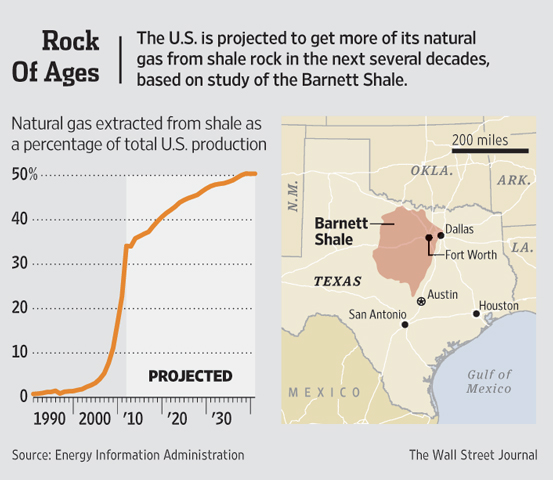
U.S. natural-gas production will accelerate over the next three decades, new research indicates, providing the strongest evidence yet that the energy boom remaking America will last for a generation.

OB-WM999_SHALE_G_20130227212402 Read more of this post

Smartphone app tests urine for medical conditions

Smartphone app tests urine for medical conditions

NEW YORK — A smartphone app that analyses urine samples for a range of medical conditions has been demonstrated at a science fair in the United States.

BY –

1 MIN 23 SEC AGO

NEW YORK — A smartphone app that analyses urine samples for a range of medical conditions has been demonstrated at a science fair in the United States.

The app can be used as an indicator of 25 different health issues including diabetes, urinary tract infections, cancers and liver problems.

Users who pay £13 (S$24.30) to download Uchek from Apple’s App Store from the end of this month will also be sent a mat and five dipsticks. Read more of this post

Nintendo Wii Games Boost Performance of Trainee Surgeons, Study Finds

Wii Games Boost Performance of Trainee Surgeons, Study Finds

Playing Nintendo Co.’s Wii console improved the performance of surgeons learning operations involving tiny cameras and instruments in a study that suggests the device could have a role to play in educating doctors.

In a trial among 42 post-graduate surgeons in Italy, those who were asked to play Wii games such as Tennis and a 3D battle game an hour a day, five days a week for four weeks did better at 13 out of 16 measures on a surgical simulator than those who didn’t play the games, researchers from Sapienza University of Rome wrote in the journal PLoS One today.

Trainee surgeons commonly hone their keyhole surgery skills on computer simulators such as those made by Cleveland-based Simbionix USA Corp. However, the expense of the machines, combined with the difficulty of a technique that involves maneuvering tiny operating tools through very small incisions, as well as increased risks of lawsuits, have raised the need for training outside the operating theater, researchers led by Gregorio Patrizi from the university’s department of surgical sciences wrote. Read more of this post

Wall Street Junk Kings Selling Debt Poised to Lose Value

Wall Street Junk Kings Selling Debt Poised to Lose Value

Wall Street junk-bond underwriters, selling debt at a record pace after the securities returned 19 percent last year, say it’s obvious that prices will drop when interest rates rise. So don’t blame the banks.

“Our job first and foremost is to properly structure deals for companies that can support their debt and perform well,” said Craig Packer, the New York-based head of Americas leveraged finance for Goldman Sachs Group Inc. (GS) “The interest-rate risk is just a law of nature.” Read more of this post