H.E.R.O.’s Journey in Tech (Weekend Reads 11-12 August 2018) – For Reliance Industries, consumer data is the ‘new oil’: Indian conglomerate’s transformation centers on telecom business + You See Less Than You Think: Our seemingly detailed view of the world is more of an ever-changing sketch than a rich portrait-our minds fill in the blanks

H.E.R.O.’s Journey in Tech (Weekend Reads 11-12 August 2018) – For Reliance Industries, consumer data is the ‘new oil’: Indian conglomerate’s transformation centers on telecom business + You See Less Than You Think: Our seemingly detailed view of the world is more of an ever-changing sketch than a rich portrait-our minds fill in the blanks

Companies

  • Tencent-backed news aggregation app Qu Toutiao (趣头条), or “Fun Headlines,” is said to list in September in the US (Technode)
  • Behind the fakes: Pinduoduo is leading the way for low-income consumption (Technode)
  • The liquidators tasked with unravelling the massive fraud behind the bankruptcy of China Medical Technologies Inc. are suing the company’s former senior vice-president of operations, Zhu Feng (Charles), seeking to freeze assets including a $2.9 million home. They claim Zhu was part of the management team at China Medical that perpetrated a US$521.8 million fraud against the company through sham purchases of technologies from a company called Supreme Well Investments Ltd. The company bought “fluorescent in situ hybridization technology” or “FISH technology” for $176.8 million in 2007 and “surface plasmon resonance technology” (SPR) for $345 million in 2008. “Former management touted the merits of the acquisitions and represented that Supreme Well was an arm’s-length company,” the claim states. “However, in reality, the FISH technology and SPR technology were of no, or no significant, value and Supreme Well was secretly controlled by former management. Zhu in particular touted the merits of the acquisitions to the board.” China Medical’s financial adviser, Credit Suisse, “made numerous unsuccessful requests for information about the shareholder and beneficial owners of Supreme Well, the operations of its board and shareholder, the chain of title of its shareholding and the FISH technology for the purposes of due diligence.” “Zhu was directly involved in the due diligence process,” the claim states. “Shortly after the acquisitions, Zhu received US$1.68 million directly and indirectly from Supreme Well for his role in facilitating the fraudulent transactions.” With China Medical now insolvent, creditors have claims of more than $400 million against the company and its assets “have only a nominal value.” (Richmond)
  • Mechanical motion control component and industrial robot maker Hiwin Technologies has reported strong profits for 1H18 (Digitimes)
  • PCB firm Zhen Ding July revenues hit 6-month high (Digitimes)
  • Which Stocks Will Benefit from Samsung’s 180 Trillion Won Investment? Wonik Holdings and LOT Vacuum are among the stocks that can expect to receive orders soon. Display equipment and material producers that can benefit from the resumption of investment are SFA, AP system, ICD, Wonik Tera Semicon, and Duksan Neolux (BK)
  • Investors sold off shares of Netmarble Games — Korea’s leading mobile game maker — after disappointing second quarter earnings combined with a rather glum outlook. (Investor)
  • For Reliance Industries, consumer data is the ‘new oil’: Indian conglomerate’s transformation centers on telecom business (Nikkei)

BATTSS – Baidu, Alibaba, Tencent, TSMC, Softbank, Samsung

  • Alibaba tweaks a controversial legal structure: Jack Ma’s role in the firm’s “variable interest entities” will be reduced (Economist)
  • Samsung’s new $1,000 power-user phone reflects slowdown in hardware innovation (Japan Times)
  • SoftBank’s Son says WeWork is his ‘next Alibaba’; Entrepreneur bets $1bn more on office sharer’s network-building vision (Nikkei)

FAANNMG – Facebook, Amazon, Apple, Nvidia, Netflix, Microsoft, Google

  • ‘Stories’ was Instagram’s smartest move yet: Can it become Facebook’s next big business? (Recode)
  • Microsoft’s AI can convert images into Chinese poetry (TNW)

Asia Tech & Innovation Trends

  • This edtech startup is using AI to help students with their entrance tests (TIA)
  • Singapore image recognition solutions firm Trax leverages new retail in China (KRA)

Global Tech & Innovation Trends

  • Jack Dorsey Is a Double-Duty CEO for Twitter and Square. Here’s How He Revived Them Both. (Barron’s); How Some CEOs Successfully Run More Than One Company (Barron’s)
  • Rising Dividends From Data-Center Giant Equinix. Founded in 1998, Equinix originally specialized in connecting various networks to one another to deliver email messages, for example. But the technology world has evolved exponentially since then, with massive amounts of data and software routinely exchanged around the clock. That has intensified the need for more speed, security, and high-quality data network connections, whether for a bank’s trading desk or a retailer tracking its inventory in real time. (Barron’s)
  • Dead robots raise questions on how far home technology has come Failed designs and undeveloped markets claim many projects before they switch on (FT)
  • Climbing The Wall Of Worry: Disruptive Innovation Could Add Fuel To This Bull Market (SA)
  • Stitch Fix: A Bull Says Digital Dresser Can ‘Continue to Outgrow Expectations’ (Barron’s)
  • RPA Provides a Lightweight, Agile Approach to Automation; It allows companies to automate processes at a fraction of the cost and time of classic software development (WSJ)
  • What MoviePass Can Teach Us About the Future of Subscription Businesses (HBR); Maybe MoviePass shouldn’t compare itself to uber (Wired)

Life

  • You See Less Than You Think: Our seemingly detailed view of the world is more of an ever-changing sketch than a rich portrait-our minds fill in the blanks (WSJ)
  • Eren Ozmen and her husband spent the last quarter of a century carefully building Sierra Nevada from a tiny, 20-person defence firm into a multibillion-dollar aerospace concern. Now she’s betting their fortunes on the billionaire space race (Forbes)
  • Earnings surprises are bigger, thanks to growing use of non-GAAP metrics; More S&P 500 companies are using non-standard numbers to report bigger earnings beats and boost share prices (MW, PDF)

Evidence of a Positive Trend in Positive Quarterly Earnings Surprise over the Past Two Decades

ABSTRACT

This paper confirms our prediction of a sustained positive trend in positive quarterly earnings surprise (ES) over the past two decades for reported and forecasted quarterly “Street” earnings. The timeseries distribution of Street ES has not shifted symmetrically to the right, however. Specifically, the shift is the result of fewer small ES in the bins at or just below zero and more and larger positive ES in the bins further away from zero. This descriptive evidence supports two explanations: of (i) increasingly upwardly biased Street earnings and/or increasingly downwardly biased forecasts of Street earnings and (ii) of greater use by analysts of adjustments to bias Street earnings to exceed GAAP earnings, especially in the fourth quarter. An analysis of ES based on the difference between GAAP earnings and time-series forecasts of GAAP earnings (GAAP ES) does not show the same trends, however, implying that the positive trend in Street ES would more likely stem from analysts’ efforts to bias ES rather than firms’ actions to manage GAAP earnings to achieve the same result. We also document that, whereas forecast accuracy improves for shorter forecast horizons, analysts’ Street ES bias increases for shorter forecast horizons. These results are robust to firm size and the earnings surprise shocks of the Sarbanes Oxley legislation and the 2007–2008 global financial crisis.

H.E.R.O.’s Journey in Tech (10 August 2018) – When the disruptor becomes the disrupted: Seek co-founder Andrew Bassat on what happens when you get complacent + Warren Buffett’s Biggest Wins & Fails

H.E.R.O.’s Journey in Tech (10 August 2018) – When the disruptor becomes the disrupted: Seek co-founder Andrew Bassat on what happens when you get complacent + Warren Buffett’s Biggest Wins & Fails

Companies

  • Flea market operator Mercari in search of new hit services; Former Japanese unicorn sinks deeper into the red on heavy US spending (Nikkei); After Mercari: Japanese asset managers see new era in venture capital investing (Reuters)
  • Chatty multilingual robot assists guests at hotels in Japan; AI-infused ‘Unibo’ set to guide foreign tourists as 2020 Tokyo Olympics nears; The robot has found a home at tour operator I.S’s Henn-na Hotels, where it has been a hit since being introduced in April (Nikkei)
  • Japan Triathlon Union is working with Weathernews ‘s Sports Weather Team to use meteorological data for sporting events, (Mainichi)
  • Apple supplier Pegatron mulls India facility amid trade tensions; Taiwan company considers expansion outside China, warns of market uncertainty (Nikkei)
  • When the disruptor becomes the disrupted: Seek co-founder Andrew Bassat on what happens when you get complacent (SmartCo)
  • LiveTiles signs Microsoft AI partnership as its growth rate soars (AFR)

BATTSS – Baidu, Alibaba, Tencent, TSMC, Softbank, Samsung

  • Alibaba scouting firms to feed apps; Thailand seen as strategic for supply (BP)
  • Tencent to merge Doctorwork with Trusted Doctors to build its online and offline medical network in China; Tencent Doctorwork has been developing its AI and big data capabilities in partnership with hospitals and clinics across the country (SCMP)
  • Tencent merges medtech investees to build an online-to-offline medical network (KRA)
  • Spotify shares turn up on Samsung partnership (FT)
  • WeWork gets another US$1 billion from SoftBank – this time in the form of convertible notes (SCMP)
  • Cyberattack on iPhone chipmaker exposes big tech’s vulnerability; TSMC and industry peers race to overhaul security to fend off WannaCry virus (Nikkei)

FAANNMG – Facebook, Amazon, Apple, Nvidia, Netflix, Microsoft, Google

  • Facebook adds quirky Messenger games to video chats (CNN)
  • The next stop on Amazon’s journey toward world domination is your car (qz)
  • Google’s New Facial Recognition Patent Wants To Stalk Your Social Media (CBI)

Asia Tech & Innovation Trends

  • Chinese mobile game-makers made more than $600 million in the US market in the first half of 2018 (Technode)
  • What China’s history of overseas tech IPOs says about the current wave; The number of Chinese tech IPOs is expected to rise in the near future in Hong Kong and the US (e27)
  • Japan’s ‘mad scientists’ pursue a cyborg-friendly future: An emerging scientific field seeks to combine living tissue with metals and plastics (FT)
  • Why Osaka Is Becoming The Hottest Spot For Startups In Asia (Forbes)
  • Musical.ly investor bets on internet radio with $17M deal for Korea’s Spoon Radio (Techcrunch)

Global Tech & Innovation Trends

  • Yelp Sees Boost in New Accounts, but Revenue Growth Is Uncertain (Barron’s)
  • Megamergers are not a silver bullet for success; The answer for incumbents in any industry is to embrace the model of the disrupter (FT)
  • Bots vs. Trolls: How AI Could Clean Up Social Media; Many tools exist that could help identify bad actors on social media. There’s just no consensus on how to use them. (WSJ)
  • The Battery Pioneer Who, at Age 96, Keeps Going and Going; John Goodenough strives to ‘transform the battery world’ with a second breakthrough in speed and capacity (WSJ)
  • Fraudsters using Shopify to scam people, and critics say the company isn’t doing enough to stop them; It’s dead simple for a criminal to set up a fake storefront using Shopify’s software; getting one up and running takes minutes (FP)
  • Naspers creates new video on demand unit as Netflix rivalry heats up (Reuters)

Life

  • Warren Buffett’s Biggest Wins & Fails (Visual)

  • The 5M’s: How Emergence Evaluates Series A Pitches: Learn why Management, Market, Metrics, Moat and the M-Factor are all that matters. (Emcap)
  • Natural Maniacs. There is a thin line between bold and reckless, and you only know which is which with hindsight. (Morgan Housel); Why Great Success Can Bring Out the Worst Parts of Our Personalities (HBR)

H.E.R.O.’s Journey in Tech (9 August 2018) – Koh Young Posts Record Q2 Revenue + Li Lu on Charlie Munger’s Greatest Influence: “Yet throughout all these blows, I’ve never seen him being pessimistic or desperate. He’s never complained about those terrible blows either. His attitude towards them is to take them as graceful and competent as he can.”

H.E.R.O.’s Journey in Tech (9 August 2018) – Koh Young Posts Record Q2 Revenue + Li Lu on Charlie Munger’s Greatest Influence: “Yet throughout all these blows, I’ve never seen him being pessimistic or desperate. He’s never complained about those terrible blows either. His attitude towards them is to take them as graceful and competent as he can.”

Companies

  • Weibo revenue surges as China tech groups lift advertising; Social media operator attracts big spenders like Alibaba (Nikkei)
  • China’s Dada-JD Daojia raises $500 million from Walmart, JD.com (Reuters)
  • Koh Young Posts Record Q2 Revenue; Coupled with powerful software, the Zenith handles an enormous amount of real data, which helps engineers gain insight into the reflow process and enables faster, better decision making. (iconnect)
  • Kakao’s net profit more than doubles in Q2; operating profit fell 38.2 percent to 27.5 billion won in the second quarter from 44.6 billion won a year ago, as the company spent more in marketing costs to promote new businesses (Investor)
  • IRESS has announced its new collaborative design initiative, IRESS Labs, would allow financial advisers to test and provide feedback on prototypes during a development phase before co-designed features are released. (MM, IFA)
  • 3D vision systems to drive growth for Vitrox (Star)

BATTSS – Baidu, Alibaba, Tencent, TSMC, Softbank, Samsung

  • The Amazing Ways Alibaba Uses Artificial Intelligence And Machine Learning (LinkedIn)
  • SoftBank is helping Alibaba create a formidable rival to Meituan; Ele.me looks forward to fresh capital to capture larger market share. (KRA)
  • Tencent-backed Q&A Platform Zhihu Reportedly Raises $270M Series E Round (CMN)
  • SoftBank in Talks to Invest Up to $750 Million in Zume, the Startup That Sells Robot-Made Pizza; Zume uses robots and software to deliver food. (Bloomberg)

FAANNMG – Facebook, Amazon, Apple, Nvidia, Netflix, Microsoft, Google

  • Amazon basically wants to turn Whole Foods into a drive-thru (FastCo)

Asia Tech & Innovation Trends

  • Hong Kong’s IPO Takeoff Is Running Out of Runway; Repeated flops are causing investor fatigue. (Bloomberg)

  • Chinese Truck-Hailing App On Course for $10 Billion Valuation; Manbang Group is speaking to U.S.-based mutual funds and late-stage investors as it looks to raise $1 billion (WSJ)
  • Meet the Shenzhen billionaire behind the world’s thinnest flexible display (SCMP)
  • How Tik Tok became China’s top short-video app in 500 days (TIA)
  • AI giant SenseTime leads $199M investment in Chinese video tech startup (Techcrunch)
  • Tech start-up funds plummet in China as easy money dries up, signalling big boom may be over (SCMP)
  • Fresh robot-baked bread hints at future of retail in China; Local juice company aims to turn errands into entertainment (Nikkei)
  • Japan plans 10 ‘AI hospitals’ to ease doctor shortages; Computers will fill in patient records and analyze blood tests (Nikkei)
  • Japan’s Spectee, news video aggregator for press, ready for North America expansion (Bridge)
  • South Korean social referral recruitment platform Wanted has a big plan for Southeast Asia; Can Wanted beat its competitors, which include traditional recruitment agencies, by offering cash rewards? (KRA)
  • Revolution Precrafted recently became the Philippines’ first “unicorn” by supplying limited-edition, luxury prefabricated homes to a global market primed for new modular dwelling options. Despite its high valuation, the company is yet to (SCMP)

Global Tech & Innovation Trends

  • These soft, tiny robot spiders might operate on you someday (TNW)
  • The ultra-pure, super-secret sand that makes your phone possible; Unimin’s North Carolina quartz operations supply most of the world’s high and ultra high purity quartz. (Wired)
  • Zillow Struggles to Find New Growth (Barron’s)
  • A quantum computing startup tries to live up to the hype (Japan Times)
  • DreamWorks Looks to Reanimate Business With Advanced Analytics; Approximately 600 terabytes of storage and 120 million core hours of rendering go into each animated feature-length film (WSJ)
  • com Adopts CEO Structure With Spotty Record; Salesforce.com’s elevation of Keith Block to co-chief executive creates a power-sharing structure that hasn’t always worked out for other companies (WSJ)
  • Match Group: Tinder, and the Shares, Stay Hot (Barron’s)
  • The World’s Most Peculiar Company; How does catalog-loving retailer Hammacher Schlemmer, famous for such eccentric and extravagant products as the Navigable Water Park, continue to survive in the age of Amazon? (CM)
  • Pinterest shapes up for anti-millennial IPO (Reuters)

Life

  • Li Lu on Charlie Munger’s Greatest Influence. The biggest blow during the past 15 years, was the passing away of his second wife Nancy, who had been with him for more than 50 years when she died in 2010. Less than a year later, he almost became completely blinded due to an accident. He’s already lost sight on one of his eyes previously due to a surgery operation. So I’ve witnessed him recovering from such hard blows one by one. Yet throughout all these blows, I’ve never seen him being pessimistic or desperate. He’s never complained about those terrible blows either. His attitude towards them is to take them as graceful and competent as he can. He’s objective and rational in everything. There is a Chinese saying that goes, “One should neither be pleased by external gains, nor be saddened by personal losses.” Charlie is one of those people who can achieve such a state of mind. At the same time, Charlie is also curious and enthusiastic about all issues, especially about how the business world works. This curiosity and enthusiasm has continued to this day. At age 95, he doesn’t work less every day than when I first met him 15 years ago. When he finds interesting books and materials, he will even read them until 4 a.m. in the morning until he finishes them, sometimes in one go. (GF)
  • Rare Charlie Munger and Li Lu Interview – Part I (GF)
  • Investing in an age of disruption (Todd Wenning)

H.E.R.O.’s Journey in Tech (8 August 2018) – Gree-owned firm launches app aimed at boosting Japan’s booming world of ‘virtual YouTubers’ + 100 Philosophy Quotes That Will Inspire and Challenge You

H.E.R.O.’s Journey in Tech (8 August 2018) – Gree-owned firm launches app aimed at boosting Japan’s booming world of ‘virtual YouTubers’ + 100 Philosophy Quotes That Will Inspire and Challenge You

Companies

  • Gree-owned firm launches app aimed at boosting Japan’s booming world of ‘virtual YouTubers’ (Japan Times)
  • Bandai Namco sees flat first quarter with little help from game sales; Gaming saw 5.4% decline year over year while all other segments saw slight increases (GI)

BATTSS – Baidu, Alibaba, Tencent, TSMC, Softbank, Samsung

  • Alipay adds Pinduoduo-like group buying feature (KRA)
  • Baidu’s Billionaire CEO Declares He Can Beat Google Again (Bloomberg)
  • SoftBank’s Ele.me Cash Will Act as Halon or Kerosene; This $3 billion-plus investment could fuel a Chinese online-to-offline war, or extinguish it. (Bloomberg)

FAANNMG – Facebook, Amazon, Apple, Nvidia, Netflix, Microsoft, Google

  • New FANG Notes Let Investors Bet on Tech Optimism or Skepticism (Bloomberg); FAANGs Are More Solo Acts Than a Tech Supergroup; They have a lot less in common than many investors think. (Bloomberg)
  • Apple is the epitome of an “asset light” company: It owns very few hard assets and therefore needs almost zero outside capital to run its business. As of mid-2018, Apple has $105 billion of operating assets and $120 billion of operating liabilities. What does that mean? Miraculously, its operations rely on no capital from outside financiers. How does one achieve this apotheosis of the asset-light strategy? First, create a supply chain in Asia run by companies willing to invest in low-return projects that create your products. Second, hold those suppliers under your thumb. Idolizing asset-light strategies, however, can also lead to underinvestment, an excessive reliance on outsourcing and the artificial division of companies to avoid hard assets. The accomplishments of Apple’s model are substantial. But the financial strategy that has worked so well for Apple is a risky one for less capable companies with weaker strategic positions. For them, aping Apple can just as easily result in too much debt on their balance sheets, precarious supply chains and deferred opportunities for investments. The financial archetype defined by Apple — asset-light strategy, leveraged share buybacks and cash flow above all — is a high-wire act. Boards should guard against the temptation to follow Apple’s path blindly. Many of Apple’s imitators are more likely to mortgage the future than create it. (NYT)
  • Meet the YouTube Stars Turning Viewers Into Readers (NYT)
  • Alphabet: How a $175 Billion Waymo Could Boost the Shares (Barron’s)

Asia Tech & Innovation Trends

  • Beijing Bytedance Technology Seeks to Raise $3 Billion Privately; Owner of China’s top news-aggregation app could be valued at $75 billion (WSJ)
  • Best Known For Portable Chargers, Shenzhen’s Anker Has Ambitious Expansion Plans (Forbes)
  • Chinese tech ‘wolf’ Huawei stalks Apple and Samsung (BT)
  • Hong Kong’s Fung Group injects US$35M into India’s B2B e-commerce startup ShopX; Currently, ShopX claims it covers 50,000 retailers across 300 towns and doing over US$72.7 million in annualised transaction volume (e27)
  • Chinese online lender delinquencies wipe out $4bn this year; Outrage mounts as government hastens to nip financial risks (Nikkei)
  • OnePlus Shows Apple How to Become India’s Top Smartphone Seller (Bloomberg)
  • Japan’s accounting software Freee raises $60M to grow its cloud accounting business (Techcrunch)
  • Taiwanese AI solutions provider Appier has purchased Bangalore-based content marketing startup Qgraph (TIA)

Global Tech & Innovation Trends

  • Etsy CEO: There’s a ‘Long Runway’ for Growth Ahead (Barron’s)
  • Snapchat Is Becoming Like the Internet It Disdains; It loses luster, though, as it discards the elements that set it apart. (Bloomberg); Snap’s strategy shifts win over advertisers more than users (Reuters)
  • Match boosts revenue forecast as Tinder lures more paying users (Reuters)

Life

  • 100 Philosophy Quotes That Will Inspire and Challenge You (Medium)
  • How to Master Your Fear Like a Navy SEAL (Medium)
  • Sequestered capital is capital that is hidden or unseen by the market. R&D is often sequestered capitaI. Sequestered capital is special because it doesn’t inform price signals (MR)
  • What Peter Thiel taught Stanford University students about startup success (TIA)
  • Strategy vs. Tactics: What’s the Difference and Why Does it Matter? (Farnam Street)
  • Six Business Lessons from ‘Star Wars’ (Medium)
  • Causing a disruption, by definition, means a minority opinion or idea must rise to the top. It can be a lonely journey to get there, though, so Chad and Stephanie have a story to inspire and celebrate all the incredible minorities of one changing the world. (TMD)

H.E.R.O.’s Journey in Tech (7 August 2018) – ‘Made in USA’ push is here to stay: Taiwan tech giant; Advantech, world’s biggest industrial IT company, ready to expand in America

H.E.R.O.’s Journey in Tech (7 August 2018) – ‘Made in USA’ push is here to stay: Taiwan tech giant; Advantech, world’s biggest industrial IT company, ready to expand in America

Companies

  • Billionaire Clothes Makers Trade Barbs Over How to Measure Customers (Bloomberg)
  • Tencent-backed Weimob files for Hong Kong IPO as marketing solutions provider joins rush to go public (SCMP)
  • Chinese tech group Bytedance plans IPO: Rising star behind Toutiao news feed and video app Douyin frustrated by crackdown; Chinese president Xi Jinping’s crackdown on online content had an impact on Bytedance’s fundraising (FT)
  • China’s Xiaomi says parts supplier Holitech Technology to invest $200 million in India (Reuters)
  • ‘Made in USA’ push is here to stay: Taiwan tech giant; Advantech, world’s biggest industrial IT company, ready to expand in America (Nikkei)
  • Delta Electronics showcases CPS application to smart manufacturing (Digitimes)
  • The man leading Seek’s push into high-risk, high-reward emerging markets has defended its focus on growth, after the online recruitment giant was forced to write down its operations in Latin America (Age)

BATTSS – Baidu, Alibaba, Tencent, TSMC, Softbank, Samsung

  • Tencent Leads $50M Pre-A Round In Chinese AI Chip Maker Suiyuan Technology (CMN)
  • SoftBank’s evolution to tech investor pays off; Vision Fund ranks as group’s top contributor to record earnings (Nikkei); SoftBank’s Operating Profit Jumps 49%, Boosted by Vision Fund; A one-time gain from the stake sale of Arm’s Chinese operations also contributed to the increase (WSJ)

FAANNMG – Facebook, Amazon, Apple, Nvidia, Netflix, Microsoft, Google

  • Facebook to Banks: Give Us Your Data, We’ll Give You Our Users; Facebook has asked large U.S. banks to share detailed financial information about customers as it seeks to boost user engagement (WSJ); Facebook shares recover on optimism its Messenger chat app can build closer banking relationships (SCMP)
  • How Apple’s Posse Fared on the Road to Trillionaire Status; The iPhone maker’s entourage of suppliers and partners has had mixed fortunes. (Bloomberg); Here’s Apple’s Plan to Keep From Losing the World’s Fastest-Growing Smartphone Market (Bloomberg)

Asia Tech & Innovation Trends

  • The only thing mythical about unicorns these days are their valuations (SCMP)
  • Didi to invest US$1 billion in one-stop car services business (SCMP)

Global Tech & Innovation Trends

  • Internet of Things Adoption to Rise Despite Security, Data Integration Challenges; Integrating IOT data into day-to-day operations among top challenges cited by decision makers (WSJ)
  • Spotify: The Crucial Change That Almost Came ‘Too Late’ (Barron’s)
  • Airbnb’s Great Wall of China competition upsets Chinese social media users (SCMP)
  • Can This Man Make His Video Gaming Team a $1 Billion Business? (Bloomberg)
  • Developers Add Smart-Lock Technology to Let the Dogs Out and the In-Laws In (Bloomberg)

Life

  • Morgan Housel discusses how the internet shapes consumer values, the power of shows like Chef’s Table, the sudden rise of Vanguard, under-reported insights from Warren Buffett and Howard Marks (Perell)
  • How Whole Foods Started an Organic Revolution and Became a $13 Billion Company (PH)

H.E.R.O.’s Journey in Tech (6 August 2018) – How Pinduoduo founder Colin Huang went from factory worker’s son to China’s youngest self-made billionaire + YCombinator’s Jessica Livingstone: Grow the Puzzle Around You

H.E.R.O.’s Journey in Tech (6 August 2018) – How Pinduoduo founder Colin Huang went from factory worker’s son to China’s youngest self-made billionaire + YCombinator’s Jessica Livingstone: Grow the Puzzle Around You

Companies

  • How Pinduoduo founder Colin Huang went from factory worker’s son to China’s youngest self-made billionaire. Pinduoduo has long been plagued with complaints that it trades quality for price, allowing merchants to offer inferior products at rock-bottom prices to capitalise on the platforms’ popularity (SCMP)
  • Eye on tech companies in Malaysia exposed to the Apple supply chain; Globetronics is involved in producing components operating within the Apple iPhone supply chain ecosystem. “We have also raised our gesture sensor volumes, incorporating capacity expansion undertaken by Globetronics as required by its key sensor client, ams AG”. Inari derived close to 50% of its revenue from the radio frequency (RF) division, which mainly serves the smartphone market. Meanwhile, MPI is estimated to derive 30% of its revenue from RF and Unisem 30%. These figures, however, do not only cater to Apple but also other South Korean and China-based smartphone manufacturers (Star)

BATTSS – Baidu, Alibaba, Tencent, TSMC, Softbank, Samsung

  • FANG Stocks Are Big, But Asia’s Tech Giants Carry Even More Sway; Tencent, Samsung dominate their markets, which recently has led to stock-index declines. (WSJ)
  • Google Is in Talks With Tencent and Inspur for China Cloud, Sources Say (Bloomberg)
  • From Amazon to Alibaba, Grocers’ Agony Is Endless; Tech advances from China’s internet giants should trouble food retailers across America and Europe. (Bloomberg)
  • Masayoshi Son in His Own Words. All 303,513 of Them (Bloomberg); SoftBank Is Starting to Look a Lot Like a Private Equity Firm (Bloomberg); SoftBank monetises investments as telco IPO looms (Reuters)

FAANNMG – Facebook, Amazon, Apple, Nvidia, Netflix, Microsoft, Google

  • How to fix Facebook: Mark Zuckerberg can do more to improve a social network that was meant to build communities but has helped to split societies (FT)
  • Time limits for Facebook and Instagram users: will they work? It’s doubtful social media giants really want us to use them less (SCMP)
  • Here’s Apple’s Plan to Keep From Losing the World’s Fastest-Growing Smartphone Market (Bloomberg)

Asia Tech & Innovation Trends

  • Shares of Chinese solar panel maker GCL expected to face selling pressure after asset-sale talks collapse (SCMP)
  • VipKid to expand to 100 countries as investment in China’s online education sector heats up; The country’s largest online education start-up currently has more than 500,000 students and a community of 60,000 teachers, located mostly in N America (SCMP)
  • China’s Didi to invest $1 billion in its auto services platform (Reuters)

Global Tech & Innovation Trends

  • Schaeffler buys drive-by-wire technology for autonomous vehicles (Reuters)
  • ‘The Beginning of a Wave’: A.I. Tiptoes Into the Workplace in an unglamorous place: the back office (NYT)
  • Academics created a periodic table of mind-blowing tech, and it’s a handy guide to how the world will change forever (BI)

Life

  • Q&A with Brian Portnoy, author of The Geometry of Wealth: How to Shape a Life of Money and Meaning (AR)
  • Grow the Puzzle Around You (Jessica Livingstone)

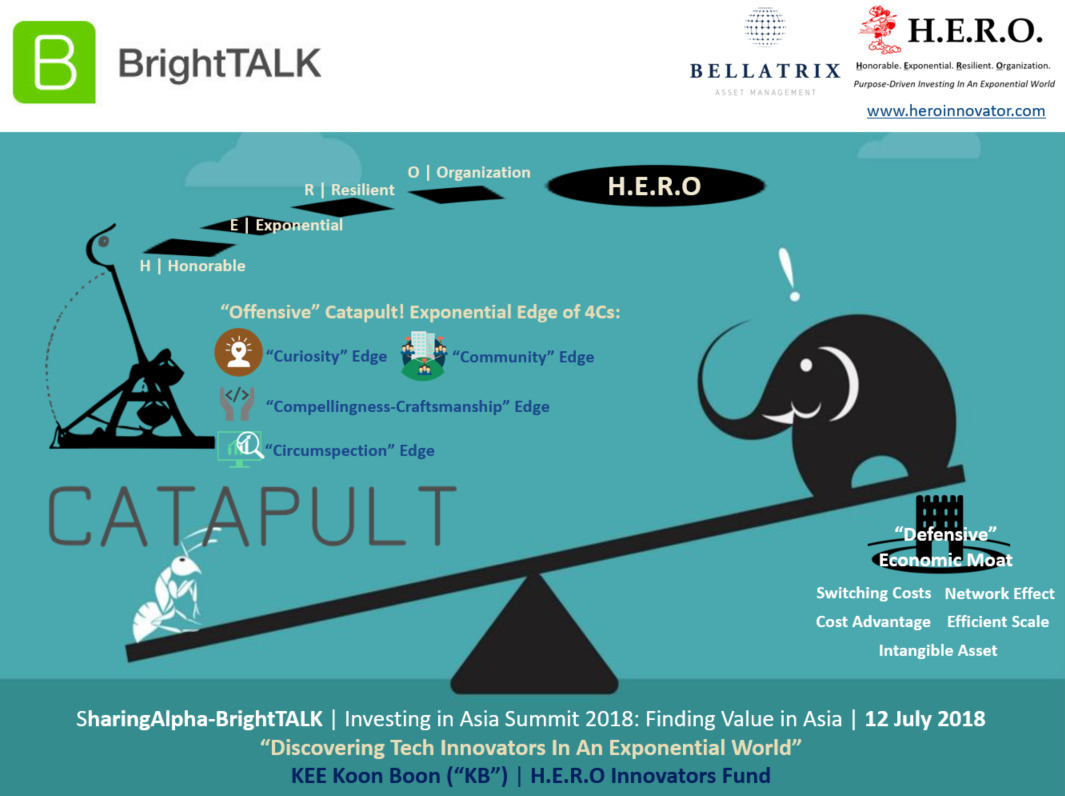
Finding Value in Asia: Discovering Tech Innovators in an Exponential World | Webinar Invite To BrightTALK Investing in Asia Summit 2018 (12 July 2018)

Finding Value in Asia: Discovering Tech Innovators in an Exponential World | Webinar Invite To BrightTALK Investing in Asia Summit 2018 (12 July 2018)

We like to invite lifelong learners in value investing and business model innovations to the BrightTALK webinar Investing in Asia Summit 2018 | Finding Value in Asia: Discovering Tech Innovators in an Exponential World on 12 July 2018 (Thursday) at 9am UK time (10am Swiss time or 4pm Singapore time). There will be a live Q&A session at the end of the webinar, please feel free to ask any tough questions which we will do our best to address them. We look forward to learn from your great questions and to open up a meaningful conversation with you to explore the journey together. We hope to build a warm community of resilience, learning and exponential growth where entrepreneurs and investors support and encourage one another to navigate and thrive in this challenging world and we are grateful to have your support. Thank you so much!

Abstract:
Can the megacap tech elephants still dance? Or is this the better question: Is there an alternative and better way to capture long-term investment returns created by disruptive forces and innovation without chasing the highly popular megacap tech stocks, or fall for the “Next-Big-Thing” trap in overpaying for “growth”, or invest in the fads, me-too imitators, or even in seemingly cutting-edge technologies without the ability to monetize and generate recurring revenue with a sustainable and scalable business model? How can we distinguish between the true innovators and the swarming imitators?

We see a distinct value opportunity in an exclusive group of under-the-radar Asian SMID-cap tech stocks who are exceptional market leaders in their respective fields with unique scalable business models run by high-integrity, honorable and far-sighted entrepreneurs with a higher purpose in solving high-value problems for their customers and society whom we call H.E.R.O. – “Honorable. Exponential. Resilient. Organization.”.

  • Investing in exponential innovators = The most relevant language in value investing?
  • Why are these exponential & exceptional innovators overlooked and mispriced winners and the most relevant multi-year investment trend and opportunity?
  • The analytical framework to identify under-the-radar winners, including rejuvenating the defensive economic “moat” analysis by complementing with the more offensive “catapult” analysis, using this new lens to view the value creation process afresh and continually discover innovators creating, enabling and capturing new demand with exponential non-linear growth potential.
  • Remaining skeptical and grounded in the Asian capital jungles and avoiding the investing pitfalls and traps of Asian-style accounting fraud and misgovernance which western-based fraud detection tools and techniques have not been adequately adapted to the Asian context.
  • Selected case studies.

Warm regards,
KB | kb@heroinnovator.com | WhatsApp +65 9695 1860
www.heroinnovator.com

Mini Workshop | 100X: Be Exponential, Be Exceptional Like a H.E.R.O.! Business Model Innovation & Investment Insights to Transform SMEs Into Exponential Enterprises from $10 Million to $1 Billion

Mini Workshop | 100X: Be Exponential, Be Exceptional Like a H.E.R.O.! Business Model Innovation & Investment Insights to Transform SMEs Into Exponential Enterprises from $10 Million to $1 Billion

We are planning mini-workshops in partnership with a quality audit & consultancy firm for their clientele base of SME business owners to share about H.E.R.O. – below is a brief synopsis. If there is available space, we will open up the workshop to interested qualified investors who are lifelong learners. More details on the dates and venue to be shared at a later date. If you are interested to find out more or reserve a seat, please contact KB, thank you.

Synopsis:

Disruptive innovation is accelerating exponentially across many industries, upending passive companies and benefiting selective innovators whom we call H.E.R.O., which stands for “Honorable. Exponential. Resilient. Organization.”

Always feel that the insights from the usual case studies of big giants from Apple to Alibaba may not be relevant and applicable to your SME? H.E.R.O. Innovators are not your usual SMEs – they are exceptional market leaders in their respective fields and are 10X exponential compounders in profits and market value. What does it take to be exponential and exceptional like a H.E.R.O. and scale a SME 10 times or even 100X from $10 million to $1 billion in market value?

What are the business model innovation and investment insights that business owners, CEOs, managers and investors can learn and discover from the real-world case studies of H.E.R.O. Innovators that can be transformed into growth and positive change for yourselves?

Are we willing to commit ourselves and our companies to a process of mobilization, learning and discovery that progressively unlocked more of the company’s and personal full potential?

Part 1: Be Exponential! 天时

  • Stay ahead of the curve and keep your head when all others are losing theirs in an exponential world by acquiring the ability to tap on the technological insights of H.E.R.O. Innovators as a source of endless innovation for you and your team.

Part 2: Be Exceptional! Business Model Innovation Insights 地利

  • Discover why Asian H.E.R.O. Innovators outperform to create value regardless of macroeconomic potholes and bumps and the innovations they introduce to make the bumps work for them – and how you can acquire the ability to adapt them to work for you and your team.
  • Learn why do two companies in similar industry with each earning the same absolute profit size differ vastly in their market value in the stock market.
  • Understand the surprising insight why sales, profit and tangible asset growth may not translate to market cap growth and the secrets to unlocking business valuation.

Part 3: Be a H.E.R.O.! CEO 2.0 人和

  • Master lessons in overcoming challenges, hardships and adversities from the leaders helming Asian H.E.R.O. Innovators who propelled some of today’s innovative next-generation companies to success. Avoid business mistakes of the decisions of H.E.R.O. Innovators.

Participants Profile:

JOIN US in this thriving community of serious entrepreneurs and value investors where we come together and profit from sharing ideas.

  • Business Owners, CEOsCFOs and company executives aspiring to scale new heights for their businesses and last the distance to lead a meaningful and successful life;
  • Finance professionalsaccountants, and non-financial professionals who are keen to enhance their understanding of business building and value investing principles for professional and personal use;
  • Scions of business owners who desire to sharpen their business and investment acumen, manage challenges in family business, wealth preservation and creation, and network with other entrepreneurs and senior managers.

Are You a “First-Class Noticer” of Wide-Moat Compounders? Business Model Innovation & Investment Insights from Japan’s M3 Inc (Archive April 2015)

“Are you free now?” N asked me in a pensive mood when our paths crossed in a chance encounter in the underground basement of the Singapore Management University (SMU).

“Sure, what’s on your mind?”

“I have read your email on ‘To what can I devote my life’ last night and I have been thinking. I like to show you something. It’s an app business that I am doing up with my friend Chris.”

A SMU accounting student taking my course Accounting Fraud in Asia, N and his friend Chris have started a mobile app company which had developed an Uber-like mobile app to assist us to beat the long queues in healthcare clinics.

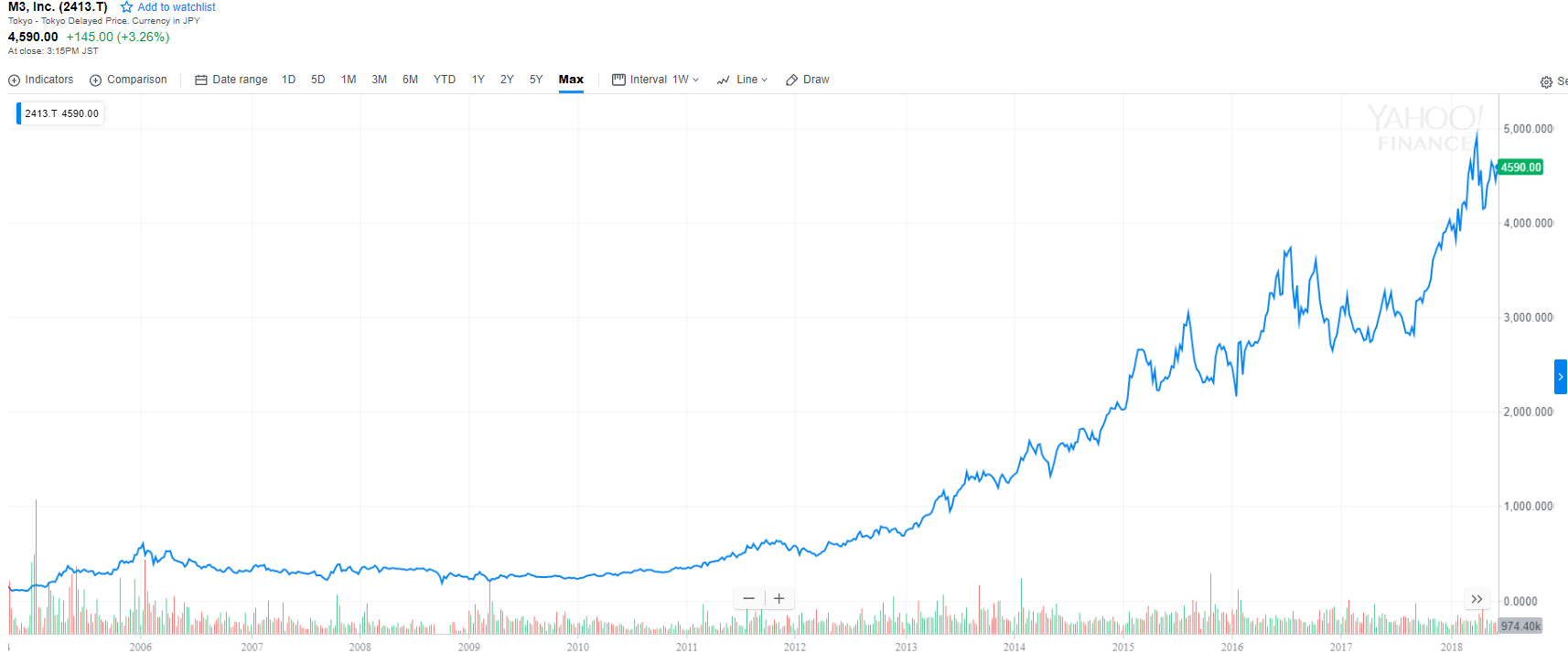
When I listened to N explaining his app, i immediately shared with him the Japanese innovator M3 Inc (2413 JP, MV $6.6bn). M3 is an overlooked wide-moat innovator I wrote about in 2012 and shared with the CEO and top management team of a listed tech company in a series of workshop “Uprising! Business Model Innovations and TMT Industry Trends” conducted in Singapore, HK and Beijing in 2012/13. M3 has since tripled to $6.6 billion. M3’s popular iTicket (www.iticket.co.jp) internet and mobile service used by more than 500,000 members to make reservations at clinics and beat the long queues might have some relevance for N to articulate the business model to seek funding – and clarity in their own execution and scalability. Both Chris and N have never heard of M3.

I explained briefly to them that M3 started out like a Google for medical professionals, with its core MR-kun service used as a marketing tool by pharmaceutical companies to provide consistent, repeated delivery of information on products and diseases. MR-kun also provides a channel for companies to receive questions and feedback from doctors, strengthening company/doctor relations.

With support by Sony Corp subsidiary So-Net which retains a 49.8% stake in M3, Itaru Tanimura established M3 in 2000 when he was 35. Essentially, M3 recognized that the demand for eDetails is quite high for busy physicians who require timely information at their convenience, without the limitations imposed by their off-line MRs. Doctors spend the most time collecting information via the Internet. Conversely, pharmaceutical firms spend the majority of their budget on MR related costs – and Japanese pharmaceutical firms’ huge marketing cost of ¥1.2-1.5tr ($10-12.5bn) is not sustainable.

Pharmaceutical companies signed up for MR-kun pay a basic annual fee of ¥70 to ¥100 million ($0.58 to 0.83 million) per electronic “e-detailing message,” which is the online equivalent of a sales visit by a MR (medical representative) to a physician’s clinic. In the pharmaceutical industry a sales visit by an MR to a doctor’s clinic is called a detail. M3 also charges fees for the production of promotional content and receives fees for other services such as facilitating the exchange of messages between pharma company MRs and their physician clients. The average of M3’s top five clients pays ¥860m ($7.2m) every year.

A dominant platform used by 80% of Japan’s physicians, MR-kun is rated by over 92% of its users who said its usage “deepened their knowledge of diseases”. With this intangible trust built up amongst the community of users, M3 is able to leverage this relationship with its members to develop new online tools. These include online tools in clinical trials to determine the feasibility of trials and help with patient recruitment, market research and survey panels, and online job search and career information site for member doctors and pharmacists. In China, M3’s membership for the healthcare professional portal site Medilive.cn topped one million members in August 2014 after just five years, covering roughly half of the physicians in China. M3 leveraged upon the media capacity of Medilive.cn to expand into “Messenger”, the Chinese version of MR-kun.

M3 even expanded from B2B to B2C by providing a range of services for consumers including AskDoctors.jp, a subscription service that gives patients a chance to ask doctors questions about their ailments, and iTicket.

M3’s Tanimura-san is what literary giant Saul Bellow would call a “first-class noticer”. Two entrepreneurs or value investors can study the same business model, watch the same video, or even take the same advice from a mentor, but the intensively-attentive and committed first-class noticer pick up critical details, opportunities and talents among noise that the other misses.

Building on Bellow’s term, Harvard’s business psychology expert Max Bazerman studied why some people notice and act on threats and opportunities while others do not. Bazerman identified three core challenges to being a first-class noticer: (1) Ambiguity, (2) Motivated blindness due to ego or vested self-interest, and (3) Conflict of interest with our desires influencing the way we interpret information, even when we are trying to be objective, and others that include the slippery slope and efforts of others to mislead us.

We develop noticing skills by acknowledging responsibility when things go wrong rather than blaming external forces beyond your control. Some character moves we can make to become first-class noticers:

·       Develop the introspection and capacity for observation to discover just how you learn and then to get out and do it.

·       Build in a process and attract people around you to challenge ambiguity, motivated blindness, and any conflict of interest to change you might have. Do it with intention. Intentionally establish a system to test your biases and comfortable assumptions.

·       Have a growth mindset that makes reinvention of yourself a regular way of life. Notice the signs. Find a way to embrace them rather than avoid them. Be self-accountable. Do it now.

Above all, the first-class noticer notices better because he or she cared more about their long-term journey than the shot-term paycheck. The intensive attentiveness is applied to a Purpose with an authentic Voice and the ability to engage others in shared meaning and to be truly aware of what’s going on in the world from wide-ranging and diverse sources of information. In the immortal words of leadership guru Warren Bennis, “the first-class noticer integrates a purpose with noble aims”. The first-class noticer devotes himself or herself to the Purpose and idea larger than themselves, being watchful and thankful. The word “watchful” is a legacy from the Old Testament – or a proactive sitting on a city wall and keeping watch. Watchmen were the first ones to see attacking armies or traveling traders. They saw things before others saw them.

One of the world’s greatest and most inspiring first-class noticer is Kazuo Inamori. Born into poverty, Kazuo Inamori lost his family home at age 13 and almost died that same year after contracting tuberculosis. A religious neighbour handed him several Buddhist religious tracts, urging him to meditate on the meaning of life. As he meditated, his TB subsided. His reprieve left Inamori with the idea that he should strive for the betterment of humanity.

Carrying this value in his heart, Dr. Inamori built two world-class companies from scratch in the course of a generation – global advanced ceramics company Kyocera (6971 JP, MV $20.6bn) (founded in 1959) and Japan’s second largest telecommunications firm KDDI(9433 JP, MV $62.8bn) (established in 1984), with a combined market capitalization of over $80 billion and employing over 80,000 kindred spirits. Through his commitment to society, which include the creation of the Nobel-class Kyoto Prize which honors contributors in technology, science, arts and philosophy by his Inamori Foundation, Inamori-san, 83, carries the voice of entrepreneurship on a global scale as the “Entrepreneur for the World”, an award he was presented with during the World Entrepreneurship Forum in 2009.

As president of Seiwajyuku, a business leadership association dedicated to nurturing business owners and entrepreneurs, Inamori-san, ordained as a Buddhist monk at 65, offered this advice to entrepreneurs:

“If your goal is to be a rich and beautiful celebrity, or if you are not willing to sacrifice yourself for the world and other people, do not try to be an entrepreneur. Entrepreneurs have heavy responsibilities and must share the fruits of their labor with employees and shareholders. We must always have criteria in our hearts that can help us answer the question, ‘What is the right thing to do as a human being?’ and guide us to do what is good for society and humanity in our daily work.”

After our chance encounter, N sent me an email that he aspires to build the “M3 of Southeast Asia”: “Uber became the one of the largest transport service company with no taxis. Alibaba became the world’s largest e-commerce company with no inventories. We hope our company can have a firm foothold in the medical industry without clinics”.

The medical industry needs high reliability because of its mission to care for the life of human beings. This is the reason why M3 succeeded with the trusted platform, the “emptiness” of the trust and support from the community of pharmaceutical firms, physicians, and patients to generate stable and continued income with the option value and potential to expand their business based on the trusted platform.

We wish N all the best in the pursuit of his aspiration – and to become a first-class noticer of business model innovations beyond the mere technical aspects of what makes a wide-moat compounder.

Warm regards,
KB

“Honor the Past, have Discipline and Hard Work for the Present, have Vision with Passion for the Future” – MoatReport.com Monthly Riddle

Dear Friends,

Can You Guess This Asian Wide-Moat Company?

“Honor the Past, have Discipline and Hard Work for the Present, have Vision with Passion for the Future”

“I believe in three things: Past, present and future. Honor the past, which means honor your parents, for the values they give to you, the experiences they pass down. For the present, you have discipline, hard work, using the talent you have been given. Last, the future, which is vision with passion.”

– Madam Y

Which Asian superbrand is so strong that Italian chocolate and confectionary giant Ferrero SpA and Unilever are compelled to bundle their products to better reach out to win the hearts and wallets of the local consumers? And these giants bear the cost of the superbrand’s product in the co-marketing campaign.

This month in December/January 2017, we investigate the owner behind this Asian superbrand who commands a dominant 90% of the domestic mass market share with its brand. Yet, there is a still a visible long runway to compound growth as the company operates in the segment which contributes to 20% market share of the overall highly fragmented industry with room for growth to consolidate the home/small producers making up 68% of the overall market and boutique producers accounting for 12% of the market. [Company’s name] operates 10 factories that is supported by a vast and efficient distribution network of 61,000 point of sales via modern trade channels and traditional trade channels. Established in 1996 by Madam Y and her father, together with two Japanese giants who later became strategic shareholders and technological and trade partners, [Company’s name] has become one of the country’s most recognizable household brands. [Company’s name] is also far-sighted in cultivating children as long-term consumers as they grow up, just like McDonald’s, by conducting factory visits for school children and opening their brand house at Kidzania, the edutainment centers allowing children to work in adult jobs and earn currency and receiving more than 31 million visitors since its opening, making it one of the fastest growing global edutainment brands in the world.

Due to its strong brand equity and efficient supply chain management, [Company’s name] generates a growing ROE of 34.3% and enjoys low to negative cash conversion cycle, a rare quality for manufacturers. This allows the company to repay its bank loans quickly using idle cash as it expands to grow. This efficiency is enabled by its adoption of the ERP system to integrate all systems and procedures starting from raw material purchase to product distribution. The program can also integrate the real-time conditions of the factories, which is a useful feature considering the different locations of the factories. In addition, [Company’s name] laid foundations for advanced distribution network and market penetration in 2012 with its own program which uses state of the art technology to monitor selling patterns, manage product and drop mix; remapping distribution areas built over the last 20 years and expanding its network of agents and distributors. The development of state-of-the-art tracking systems enabled the company to have a growing distribution network and deeper and wider market coverage. This technology allows the company to not only go to areas with potential demand but it enables them to support their distribution agents to increase sales of its branded products.

There are several listed iconic fast-moving consumer food brands in Asia and we think one of the closest comparables is Thailand’s Taokaenoi. Taokaenoi is Thailand’s market leader in processed seaweed snack products with dominant market share of around 62%. Noteworthy is that while [Company’s name] and Taokaenoi both enjoyed market dominance in their respective categories with comparable EBIT margin at 19-20%, [Company’s name] absolute level of sales and operating profit is around 40% higher than Taokaenoi’s US$127m and US$25.3m respectively and [Company’s name] enjoys a superior cash conversion cycle advantage of only 2 days as compared to Taokaenoi’s 30 days, yet [Company’s name] has a market value that is 44% smaller than Taokaenoi’s US$1bn market cap due to the huge disparity in valuations. [Company’s name] trades at EV/EBIT 17.6x and EV/EBITDA 14.1x, a 56-62% discount to Taokaenoi. We think the valuation gap between [Company’s name] and its comparables should closed over time as it continues to execute with performance. Since FY2012, [Company’s name] sales have grown 105% while operating profit grew faster at 133% and we believe the company can build on the momentum to generate over 50% growth in operating profits in the next 3-5 years, and spur an upward valuation re-rating towards a potential doubling in market cap.

We are impressed by [Company’s name] co-founder & CEO Madam Y for her tenacity in transforming the company to become Asia-ex-Japan’s manufacturer in its product category through making far-sighted and consistent continuous investments in production know-how, brand building, distribution network and IT system to scale up. We like the company’s strong management team and corporate culture to foster the win-together mindset and we think [Company’s name] deserves a valuation premium as it continues to consolidate the fragmented industry and expands its presence in a new market in which operations will commence in 3Q2017.

Below are excerpts of her unique insights on succession to the family business which reflected her strong desire and values to scale the business to greater heights by being grounded in discipline, hard work and a vision with passion:

Q: “You were designated at an early age as the successor to take over and lead the family business. What are your plans for your children in the family business?”

Madam Y: “Looking back, I would not do that to my children [Madam Y has three]. I don’t think bloodline qualifies—it’s got to be based on other things as well. To separate ownership and management is not easy for a parent, especially family companies, coming from the Asian families, because they always want it to be whole, it has to be “my son” or “my daughter” who continues the business. But it’s not necessarily good. My father always said, as an insider, you will guard your family assets, you will run the company very well. To me, both insiders and outsiders can ruin the company. As long as my children carry the vision and have the passion for what I do with the family business, they qualify to start the race, but I will not put them as a leader in that position. I will use professionals. I believe in three things: Past, present and future. Honor the past, which means honor your parents, for the values they give to you, the experiences they pass down. For the present, you have discipline, hard work, using the talent you have been given. Last, the future, which is vision with passion.”

Who is Madam Y and this Asian wide-moat innovator?

Warm regards,

KB

The Moat Report Asia

www.moatreport.com

A new monthly issue of The Moat Report Asia is now available!

Access the in-depth idea presentation:

http://www.moatreport.com/members/

“Bamboo Innovators bend, not break, even in the most terrifying storm that would snap the mighty resisting oak tree. It survives, therefore it conquers.”
BAMBOO LETTER UPDATE | Dec 19, 2016
Bamboo Innovator Insight (Issue 131)

  • The weekly insight is a teaser into the opportunities – and pitfalls! – in the Asian capital jungles.
  • Get The Moat Report Asia – a monthly in-depth presentation report of around 30-40 pages covering the business model of the company, why it has a wide moat and why the moat may continue to widen, a special section on “Inside the Leader’s Mind” to understand their thinking process in building up the business, the context – why now (certain corporate or industry events or groundbreaking news), valuations (why it can compound 2-3x in the next 5 years), potential risks and how it is part of the systematic process in the Bamboo Innovator Index of 200+ companies out of 15,000+ in the Asia ex-Japan universe.
  • Our paid Members from North America, Europe, the Oceania and Asia include professional value investors with over $20 billion in asset under management in equities, some of the world’s biggest secretive global hedge fund giants, and savvy private individual investors who are lifelong learners in the art of value investing.

The Five Principles of Success: ‘Romance’, “Vision’, “Motivation’, ‘Curiosity’, ‘Obsession’ – MoatReport.com Monthly Riddle

Dear Friends,

Can You Guess This Asian Wide-Moat Company?

The Five Principles of Success: ‘Romance’, “Vision’, “Motivation’, ‘Curiosity’, ‘Obsession’

MUNGER: I think Warren and I can match anybody’s failures in retail.

BUFFETT: Yeah, we have a really bad record, starting in 1966. We bought what we thought was a second-rate department store in Baltimore at a third-rate price, but we found out very quickly that we bought a fourth-rate department store at a third-rate price. And we failed at it, and we failed… 

MUNGER: Quickly.

BUFFETT: Yeah, quickly. That’s true. We failed other times in retailing. Retailing is a tough, tough business, partly because your competitors are always attempting and very frequently successfully attempting to copy anything you do that’s working. And so the world keeps moving. It’s hard to establish a permanent moat that your competitor can’t cross. And you’ve seen the giants of retail…a lot of giants have been toppled.

MUNGER: Most of the giants of yesteryear are done. 

What is the investment Achilles heel of Warren Buffett and Charlie Munger?

It appears to be in the “tough, tough” retail industry, from the above CNBC interview in 2014, given that it is “hard to establish a permanent moat that your competitors can’t cross”. Also, their biggest error of omission, as Buffett admitted during Berkshire Hathaway 2004 AGM, had been his “thumb-sucking” reluctance in investing more in Wal-Mart in the 1990s because of one-eighth of a point uptick in the stock price. One of the best investment deals that Warren Buffett considered he has made was ironically in a retailer, a furniture store called Nebraska Furniture Mart (NFM). NFM was founded in 1937 by the late Rose Blumkin, fondly known as “Mrs. B”, a Russian immigrant to America, with $500 she had saved for 16 years selling used clothes. NFM was set up in Omaha with no locational or product advantage and goes up against rich, long-entrenched competition – and grew to become one of the top furniture retailers in the country. Buffett had also tried to assemble a furniture empire since with the purchase of Utah-based RC Wiley in May 1995, Star Furniture in Jun 1997, Jordan’s Furniture in Oct 1999, and rental furniture provider CORT Business Services Corporation in Jan 2000. But none came close to matching NFM’s success. In Jun 2004, Berkshire also invested 9% In home furnishing retailer Pier 1 Imports (NYSE: PIR), an investment that did not work out. In Aug 2007, according to Bloomberg news, Buffett even mentioned about the Swedish-controlled flat-packed furniture retail innovator IKEA as a possible investment target, though the trust foundation setup at IKEA made the acquisition impossible.

Make no mistake: NFM and IKEA are the rare exceptions. Furniture retailers face critical economic hurdles and problems in building a wide moat and scaling up the business. Furniture is a category of product that is difficult for a retailer to handle, because (1) inventory turnover rates are low for durable goods, thus few furniture retailers manufacture their own products because of low purchase frequency and distribution efficiency, (2) unlike consumer electronics, it is rare for a furniture manufacturer to have a well-known brand, and it is hard to alter product features notably over a short period, making it difficult to promote replacement demand, (3) furniture sales usually require direct customer contact and explanations in-store, as well as delivery, which adds to the SG&A cost burden. Those rare few innovators who can overcome these formidable business dynamics like IKEA will enjoy increasing returns to scale and the business gets easier as it gets bigger.

In this month of September/October, we investigate another IKEA-like innovator who is the undisputed dominant specialty chain in furniture and home furnishing in its domestic market with rarity value as the only listed Asian company with a unique integrated manufacturing-logistics-retail business model in the industry with an 90% self-developed private label product ratio to sell low- to mid-priced high-quality functional merchandise to the masses. Whereas most furniture retailers simply sell furniture, [Company’s name] has put effort into offering a complete lineup of “home fashion” products which contribute to 60% of its sales. “Home fashion” products are purchased frequently, and by devoting effort to the development of such products, [Company’s name] has achieved the kind of customer-drawing power that other specialty furniture retailers lack. [Company’s name] develops these products itself for over 80% of its offerings.

[Company’s name] has achieved an astounding 29 consecutive years of growth in sales and profit, converting macroeconomic adversities ranging from consumption tax hike to currency volatility into opportunities to grow further. Despite [Company’s name] market leadership, it is still operating in a fragmented domestic market with around 10% market share in the home and garden market and has a long runway ahead to extend its market leadership, particularly in the urban areas. [Company’s name] has expanded its market share in the low-end category, but it has also been releasing mid-priced products that offer additional value in terms of quality and function since 2012, and this has led to the expansion of its customer base. [Company’s name] currently has a network of domestic stores and 37 overseas stores and targets 1,000 stores by 2022, 3,000 stores by 2032. [Company’s name] was established in in 1967 by founder Mr N.

Furniture and home furnishing business has low inventory turnover and loading efficiency is poor. As a result, controlling procurement and distribution costs is critical to achieving low-cost operations and to coordinate store openings and expansion. [Company’s name] manages the whole process of product planning, materials procurement, production, distribution and sales in order to reduce its intermediary costs, which enables it to offer highly functional quality products at low prices. This source of [Company’s name] wide-moat competitive strength is very much under-appreciated until the value investor understands the business economics of the furniture and home furnishing business. [Company’s name] “returns” benefits gained from lower COGS (on raw material changes, design revisions, and improved production yields at overseas plants) to customers through lower pricing. This policy has generated a virtuous circle of sales expansion from increasing economies of scale, and high customer loyalty is captured.

Powered by its unique integrated manufacturing-logistics-retail business model that is perhaps rivalled by only the unlisted giant IKEA, [Company’s name] is able to enjoy a lasting wide-moat competitive advantage that grows stronger with time with the virtuous cycle of customer returns that generate one of the highest ROE at 23.3% and profit margin relative to all its industry peers. Notably, [Company’s name] present operating profit margin at 16.3% is the highest in the industry, which is a steady structural progress over the years from 6% in 2001 to 13% to 2009, and looks set to improve further with a higher sales mix of higher-margin mid-priced quality functional products that expand its customer base. [Company’s name] has a healthy balance sheet with a 13.3% net cash-to-equity ratio to generate an impressive ROE of 23.3% and it currently trades at EV/EBIT 16.3x. [Company’s name] suffered a short-term 23% correction in share price from its recent high in July due to overall market uncertainty and without any major negative firm-specific news. We believe that once its upcoming earnings are announced on Sep 27, 2016 delivering another record-high results, the share price will rebound strongly.

From Wal-Mart to IKEA, companies with a greater sense of Purpose and insurgency in making available to the masses once expensive products and services that used to be affordable by only the rich, the “10X price disruptors”, are powerful super-compounders delivering superior shareholders’ returns for a long period of time. Motivated by this grand purpose to bring true life affluence to customers following his learning trip to US in 1972, Mr. N resolved to cut the middlemen and dedicated his life mission to building a unique integrated manufacturing-logistics-retail business model to offer quality merchandise at low affordable prices. [Company’s name] grew from 2 stores into a nationwide chain with dominant market leadership. We are highly impressed by the unique business model that gets stronger and easier over time and [Company’s name] still has a long runway to grow its store network in the fragmented furniture and home furnishing market in both domestic and overseas markets. [Company’s name] has also developed a powerful human capital strategy which has been a powerful enabler in supporting store expansion to achieve growth in sales and profit for 30 consecutive years. We think this is very rare for an Asian company and [Company’s name] deserves a valuation premium for its staying power and genuine potential to be one of the rare Asian company to reach the $100bn market cap milestone.

Below are some excerpts with the CEO Mr. N on his entrepreneurial journey to scale up his business into a formidable world-class innovator:

Q: “Chairman, [Company’s name] has achieved phenomenal success since it was established in 1967 to command domestic market share leadership in furniture and home fashion & furnishings. Can you share with us how the wonderful story of [Company’s name] started, including your own journey, especially the tipping point and challenges along the way? What is your personal driving force?”

Mr N: “It all began 49 years ago. The year was 1967 when I opened a small furniture store. My tiny 1,000 square foot store served the local community. Then I married and opened another store of about maybe three times that size. We finally managed to earn a decent living with the stores’ sales. However, a year later, another company opened a store of five times that size which made us go almost bankrupt. These were busy days and uncertain times but I continued to look forward and search for ways to grow my new venture.

In 1972, I was then 27, one study tour organized by an industry association to the United States was all it took to change the course of my struggling furniture store. During a week in California, I witnessed how differently Americans shopped and lived. Obviously, that I was deeply shocked. I was truly astonished, moved and struck. In the US there was no stand-alone furniture. Everything was built on the building, like walk-in closets. Compared to our country’s crowded living spaces, California homes were spacious with separate areas for entertaining and dining where guests would be welcomed, and the further back there would be a family-room. American consumers went to convenient retail stores to buy color-coordinated furniture and accessories to enhance their beautiful homes. In contrast, we had only mismatched offerings to choose from. They even had one bathroom on each floor! Most shocking to me was how inexpensive the high-quality merchandise in the US was compared to similar products back home. American furniture was designed to make life easier for consumers, not simply to pad manufacturers’ bottom lines. I recalled that I was so astonished by the difference in furniture and interior decor products in terms of price, selection, and quality.

It was like a dream world, I was so excited I could barely get any sleep. I wanted to bring the affluence of the US to my country. It was at this moment that I decided to bring back to my country what I had learned in the US. At first, I was pursuing my own sales and profit. Then I realized I was wrong. Ever since I visited the US, I changed my life philosophy, setting up an aim to enrich everyday life of people. I made my mind to develop and provide affordable and full-featured products for people. Furniture had occupied an important position in the lifestyle of the people. I would use my company to help people live as prosperously and comfortably as Americans. That wish and determination have never switched since [Company’s name] was founded, and remains there during every moment of its development. Setting and realizing this goal is our greatest pleasure.

Tracing back to the time when we advanced nationwide, we heard customers that they were surprised to see the numerous choices and the low prices in [Company’s name]. We can’t help but imagine the house we like and the room we desire, after what we saw in [Company’s name]. Not to mention it is the first time that we realize our imagination may come true. Every time we hear this, we are reminded once again, that our unremitting efforts have come to a result. We promise to keep an ear out for our customers as always, to step onto the arena of the whole world, to realize our dream deep inside, and to achieve so, we will do our utmost. We continue to chant the strong and simple words ‘to enrich the people’s life’ and to spread a dream to the customers, build a fire of motivation in the employees, stakeholders and business partners.

My personal driving force has been this ‘romance’ and purpose to help people around the world achieve the richness of living in the true sense by providing products with the appropriate quality and functionality for the customers at affordable price. Pursuing higher goals over a long period of time is critical because otherwise improvement will be superficial.

Looking back and our scale of our company is like a dream. [Company’s name] has been able to create value and grow successfully with tenacity and staying power because there was ‘romance’ and a long-term vision. That’s right, I have repeatedly told employees that to work at [Company’s name], it is important to have this five principles of success: ‘Romance’, “Vision’, “Motivation’, ‘Curiosity’, ‘Obsession’. ‘Romance’ is a feeling in one to contribute for the people and for the sake of the world over one’s life. Without such a Purpose, life is nothing. Humans were originally born for the people, for the sake of the world. Life is aspiring to become a person useful to the world. This is an ideal to get right from young, and even when one is 50 years old, 60 years old.”

Who is Mr. N and this Asian wide-moat innovator?

Warm regards,

KB


The Moat Report Asia

www.moatreport.com

A new monthly issue of The Moat Report Asia is now available!

Access the in-depth idea presentation:

http://www.moatreport.com/members/

“Bamboo Innovators bend, not break, even in the most terrifying storm that would snap the mighty resisting oak tree. It survives, therefore it conquers.”
BAMBOO LETTER UPDATE | Sep 26, 2016
Bamboo Innovator Insight (Issue 128)

  • The weekly insight is a teaser into the opportunities – and pitfalls! – in the Asian capital jungles.
  • Get The Moat Report Asia – a monthly in-depth presentation report of around 30-40 pages covering the business model of the company, why it has a wide moat and why the moat may continue to widen, a special section on “Inside the Leader’s Mind” to understand their thinking process in building up the business, the context – why now (certain corporate or industry events or groundbreaking news), valuations (why it can compound 2-3x in the next 5 years), potential risks and how it is part of the systematic process in the Bamboo Innovator Index of 200+ companies out of 15,000+ in the Asia ex-Japan universe.
  • Our paid Members from North America, Europe, the Oceania and Asia include professional value investors with over $20 billion in asset under management in equities, some of the world’s biggest secretive global hedge fund giants, and savvy private individual investors who are lifelong learners in the art of value investing.

Tooling Up the World With Mastery – Bamboo Innovator Monthly Riddle

“Bamboo Innovators bend, not break, even in the most terrifying storm that would snap the mighty resisting oak tree. It survives, therefore it conquers.”
BAMBOO LETTER UPDATE | Jaunary 5, 2016
Bamboo Innovator Insight (Issue 114)

  • The weekly insight is a teaser into the opportunities – and pitfalls! – in the Asian capital jungles.
  • Get The Moat Report Asia – a monthly in-depth presentation report of around 30-40 pages covering the business model of the company, why it has a wide moat and why the moat may continue to widen, a special section on “Inside the Leader’s Mind” to understand their thinking process in building up the business, the context – why now (certain corporate or industry events or groundbreaking news), valuations (why it can compound 2-3x in the next 5 years), potential risks and how it is part of the systematic process in the Bamboo Innovator Index of 200+ companies out of 15,000+ in the Asia ex-Japan universe.
  • Our paid Members from North America, Europe, the Oceania and Asia include professional value investors with over $20 billion in asset under management in equities, some of the world’s biggest secretive global hedge fund giants, and savvy private individual investors who are lifelong learners in the art of value investing.
Dear Friends,

Can You Guess This Asian Wide-Moat Company?

Tooling Up the World With Mastery

Do you have the right tools to succeed in your work?

The Scottish historian Thomas Carlyle, who coined the term “the dismal science” for economics, once said famously that “Man is a tool-using animal. Without tools he is nothing, with tools he is all.”

In this month of January 2016, we investigate an Asian-listed wide-moat innovator who is the world’s largest ODM producer of an important tool with multiple applications for automobiles, aerospace and homes with a global market share of 20-25%. Its 18.9% operating profit margin and 18.5% ROE is higher than that of its branded clients because of its negotiating and pricing power, technological prowess and vertically-integrated business model from upstream tooling design/ manufacturing to downstream final assembly. Yet this world-class innovator trades at PE 7.5x and EV/EBIT 10.8x.

Its deep vertical integration allows the company to achieve high precision standards in each part of the production process, and enhances its design ability to innovate lighter but stronger tool products. Technology ownership of key components raised quality and lower cost at a structural level, with production yield raised to 95% and costs reduced by 15%. Due to its mastery of critical end-to-end know-how, the company also utilize its magnesium alloy die casting technology in tools to produce aluminium-magnesium alloy bicycle frames for all top 7 global bicycle manufacturers. In 4Q15, the company also penetrated into the supply chain of possibly the most important American customer in a game-changing private label partnership that provides a long visible runway for the company. The company started shipping industrial-level tools to this American MNC in 4Q15. This private label order yields a higher gross margin of 50-60% as compared to the typical 10-40%.

The company was co-founded in 1983 by Mr. L after his retirement as Chief Judge in his local region and the L family controls 30-35% of the company.

Since the 2007/08 Global Financial Crisis, we like how the company has emerged stronger with major positive transformations to its business model resiliency: (1) Shifting to higher-margin industrial-level tools; (2) Successful new growth in auto tools which grew from 6% of total sales in 2006 to 37% in FY14; (3) Penetration into Europe, which contributed from 11% of total sales in 2006 to 33% in 1H15; (4) Client concentration risk reduced: its top 2 clients used to contribute 64% of revenue in 2006 and that proportion was down to <20% in 1H15.

This is possible because of the leadership by Mr. L and his brother who have demonstrated grit and foresight in a series of critical business decisions, ranging from (1) building  a vertically integrated ODM business model to invest in developing innovative new products, (2) insisting on 100% ownership of the ODM design and manufacturing know-how by continuously building up its capabilities in tool technology from die-casting, coasting, painting, firing pin heat treatment, mold production, and plastics injection; the know-how accumulated over the years is not easily replicated, thus giving rise to our long-term profitability and a win-win partnership with our customers who stayed loyal; (3) resisting the institutional imperative to focus on designing and producing higher-end products while its peers rushed into China, (4) expanding during the 2007-08 Global Financial Crisis to (5) grooming its own group of talents in design and operations who are able to point out from a systems perspective the detailed continuous improvements needed in each production process.

The company has been prudent and shareholder-friendly in its capital allocation decisions. In particular, the company announced a capital reduction plan in Aug 2015 and shares outstanding will decline 10% to return excess cash to shareholders and improve its ROE. As at Sep 2015, the company has a healthy balance sheet with net cash at 54% of book equity (21% of market cap), which could provide some short-term downside protection when coupled with its 5.3% dividend yield.

Sales has increased 32% in the past four years and EBIT and EBITDA growth is faster at 41-74% due to effective cost management in its vertically integrated strategy and higher weightage of higher-margin products in product mix. We believe the company can build on the momentum to at least double its profits in the next 4-5 years, pointing towards a potential doubling in market cap.

We like how the L brothers have cultivated a decentralized culture of mastery, empowerment and growth at the company to keep winning loyal customers and innovating new products. On its culture, below are some excerpts of the conversation shared by Mr. L:

Q: “What is the culture like at [Company’s name] and what is your management philosophy and style to guide your leadership?”

Mr. L: “Although [Company’s name] is globally number one in its field, I am the company’s driver. Whenever there are clients coming by to visit us, either my brother or myself will drive the company car to receive them. Our culture is such that everyone at [Company’s name] are familiar with my slogan of exceeding targets, challenge the limits, and stay grounded and pragmatic in executing. Our culture is that we treat our products as important as our lives. 

If the real estate industry has its maxim in ‘it’s all about the location, location, location’, our golden maxim to guide us is ‘it’s all about the product quality, product quality, product quality.’ This is why in our 32 years of establishment, we have not been afraid of losing customers and we have quality customers continuously coming in.

Our culture is aligned to our blue ocean strategy which is simple: to focus on innovation and quality in product and R&D. This strategy has been my unshakeable belief all these years. In order to pursue excellence in quality, as long as it can be changed and improved, I will constantly remind and demand my staff to seek breakthroughs and mastery. Do you know why the word ‘quality’ in the written Chinese is formed by three ‘kous’ ? The reason is because with two kous as the foundation, there is always a higher kou on top or mastery waiting to be reached.

Our management philosophy is ‘Integrity, responsibility, and steadiness in innovating. Constantly demand improvement in product quality, stay focused and loyal to the core business, and never stray and mal-invest.’

As shared, I was in the legal arena for 25 years. When I retired, I was the Chief Judge of…. I have gone past the age of striving for fame and fortune. The most important thing in the jump from the legal scene into entrepreneurship is to recognize oneself, to be self-aware of my role and responsibilities. To operate and manage a business is really tough work. Most of us who pressed on are using our hearts, our entire lives to operate.

Although I am [Company’s name]’s Chairman, I believe very much in empowerment and authorized decision rights to my team, in accordance to the Taoist philosophy of ‘managing with wuwei’ 无为而治 or governing by doing nothing that goes against nature.”

Who is Mr. L and this wide-moat Bamboo Innovator?

PS1: We like to share our Investor Day Presentation held on 1 December 2015 for our shareholders. The presentation material is available for download on the ASX website:

http://www.asx.com.au/asxpdf/20151102/pdf/432nk9r3hhw4nf.pdf (pg 10-14)

http://www.asx.com.au/asxpdf/20151201/pdf/433hdp24p2twyj.pdf

PS2: We will issue an additional Monthly Moat Report Asia in 1Q16.

Warm regards,

KB

The Moat Report Asia

www.moatreport.com

A new monthly issue of The Moat Report Asia is now available!

Access the in-depth idea presentation:

http://www.moatreport.com/members/

In a Pit with a Lion on a Snowy Day: Lessons for Value Investors – Bamboo Innovator Weekly Insight

“Bamboo Innovators bend, not break, even in the most terrifying storm that would snap the mighty resisting oak tree. It survives, therefore it conquers.”
BAMBOO LETTER UPDATE | December 21, 2015
Bamboo Innovator Insight (Issue 113)

  • The weekly insight is a teaser into the opportunities – and pitfalls! – in the Asian capital jungles.
  • Get The Moat Report Asia – a monthly in-depth presentation report of around 30-40 pages covering the business model of the company, why it has a wide moat and why the moat may continue to widen, a special section on “Inside the Leader’s Mind” to understand their thinking process in building up the business, the context – why now (certain corporate or industry events or groundbreaking news), valuations (why it can compound 2-3x in the next 5 years), potential risks and how it is part of the systematic process in the Bamboo Innovator Index of 200+ companies out of 15,000+ in the Asia ex-Japan universe.
  • Our paid Members from North America, Europe, the Oceania and Asia include professional value investors with over $20 billion in asset under management in equities, some of the world’s biggest secretive global hedge fund giants, and savvy private individual investors who are lifelong learners in the art of value investing.
Dear Friends,

In a Pit with a Lion on a Snowy Day: Lessons for Value Investors

As the year-end Christmas season approaches, we are reminded of of an obscure passage in the Old Testament book and its relevance to value investors in their search for wide-moat compounders in an increasingly uncertain environment following the supposedly “expected” symbolic decision to hike US interest rate for the first time in nearly a decade.

Buried in the Old Testament of 2 Samuel, the 23rd chapter and the 20-21 verses, is the story of Benaiah who chased a lion down into a pit on a snowy day. Encountering a lion in the wild is bad luck. Finding yourself in a pit with a lion on a snowy day qualifies as a horrible, terrible day. The instinct and the prudent thing to do is to run away. Most people would have seen the lion as a five-hundred-pound problem, but not Benaiah, who did not let fear dictate his choices. The Scripture doesn’t describe Benaiah as being prudent. It uses the adjective valiant. He chose to face and fight the lion, and killed it, defying the impossible odds. Fast forward two verses, Benaiah won a place in a bodyguard position in the administration of David, the King of Israel. Benaiah went on to have a brilliant military career, climbing all the way up the chain of command to become commander in chief of Israel’s army. His genealogy of success can be traced all the way back to a life-or-death encounter with a man-eating lion.

In a sense, Benaiah’s heroic acts of courage were unplanned. But don’t think that Benaiah was unprepared. He couldn’t predict when, how, or where the lion encounter would happen, but he had been preparing for it since he was a boy, wrestling with his poor pet cat that doubled as an imaginary lion, practicing his swordsmanship in front of a mirror until it became second nature, staging faux battles with his brothers. So when the lion crossed his path, he didn’t see it as bad luck. He saw it as an stewardship opportunity. Success equals stewardship. Stewardship of how we manage our time, talent, energy, including opportunity.

The story of Benaiah resembles that of companies facing disruptive changes and their response that would determine their destiny. Over the decade plus, we have encountered a number of entrepreneurs who faced disruptive changes and chose to chase the lions in building and deepening the wide moat in their business model.

Shanghai M&G Stationary (Shanghai: 603899) – Stock Price Performance, 2014-2015

MG

One of them include Shanghai M&G Stationary 晨光文具 (603899 CH), which was facing the disruptive digitization and smartphone threat to writing instruments and stationary. When M&G was established in the 1990s by the brothers Chen Huwen and Chen Huxiong and their sister Chen Xueling, they also faced a powerful and bigger incumbent lion TrueColor Stationery (真彩文具) who was the pioneer in introducing gel ink pen in China. In other words, M&G was in a pit with a lion on a snowy day, just like Benaiah.

MG2

The Chens responded with designing a unique and extensive win-win distribution partnership and launching a wide-range of high-quality, user-friendly, stylish, and value-for-money products. M&G is also the trend creator for the stationery industry with continuous new product and marketing innovations that include “Confucius Blesses Your Scholarly Success” writing pens designed for exams for the 200-million student population, also a popular gift set during this festive year-end season for school-going children before they start school in the New Year ahead.

M&G now corners the stationery market for students and it is said that three out of every ten stationery shops around the 600,000 schools in China belong to M&G. In addition to its own brand M&G, the company has also established partnerships with Auchan, Disney, Tesco and Walmart. M&G products are also available in over 40 countries and regions, with network covering Asia, Europe and Middle East, and it has sole agent in Malaysia, Singapore, Thailand and Vietnam. All three of the Chen siblings started working in the retail industry as teenagers and endured difficulties. Because they started from the bottom, they understand the difficulties and always will want to help sales people on the ground to do well. The brothers both own about 28% of M&G, now China’s largest stationary maker with a market cap of US$2.72 billion, generating $550m in sales and $64m in operating profits and 19.6% ROE.

The Chen siblings emphasized the need to focus on quality in order to win respect. Like Benaiah who had been preparing himself since young, Chen started running around as a 17 year-old salesman and encountered the stationery industry. Chen chose to focus his time and entrepreneurial energy in the stationery industry as they believe it relates to the child’s growth, learning, and thinking.

They also noticed the opportunity that comes from common misunderstanding that the business of pen has a very low threshold. Because people’s traditional impression stationery industry threshold is low, the industry manufacturing equipment and technology lags behind. Interestingly, China’s Premier Li Keqiang complained at a seminar with a question “Why can’t China make a good ballpoint pen?”, commenting that Chinese pens felt “rough” compared to pens made in Japan, Germany, and Switzerland. Li said China’s manufacturers at the lowest levels should focus on innovating their technology.

The business of pen is an advanced production industry requiring know-how in precision equipment that include precision lathes, the manufacturing equipment of the same level to manufacture luxury watches, with some requiring even higher precision than watch-making. Thus, the core technology of each pen — the stainless steel ball and its casing — is imported as China does not have a machine with the precision required to make the best ballpoint pens. Because the tip is hollow, the intrinsic quality of tolerance cannot be measured with a measuring tool, as compared to watch parts that are solid. A sophisticated infrared microscope is needed to monitor the quality. As Chen explains, “You are now writing with the nib, ball diameter 0.5 mm. If the writing length reaches 1,000 meters, the ball must withstand more than 200,000 times the rotational friction. Keeping the written precision has extremely high requirements as the ball must achieve micron-level precision. The key is the quality of the pen is demanding, but the unit price is very low, which means large-scale production is required to maintain product quality and stability.”

Better quality goods and services ultimately rely on quality and process management in both production and distribution- marketing. While M&G product quality standard is world-class reaching only 15 defects per million, Chen emphasized that this meant that their one-day output yield would mean 1,500 complaints from the customers and from the propagation angle, one negative defect would spread to 7 people and this meant that the problem might spread to 10,000 unhappy customers in one day. Thus, Chen emphasized that “Mass production while controlling a certain quality at the same time is very difficult. A lot of factories are cottage-style with no brand, no quality, and we are up against counterfeit and copycats. The pursuit of excellence, the pursuit of 100% quality, is always our goal, not just that simple goal of achieving few defects per millionth.” Chen added that their company name M&G “adds a layer of deeper meaning: exceed customer expectations to provide products and services to win customer respect and trust – a pursuit of excellence for quality”.

M&G has established a network of provincial distribution centers, with more than 3,000 channel partners, 100,000 retail outlets, and 100% coverage key account stores that include Carrefour , Wal-Mart , Tesco, Rosen, and all other major supermarkets, convenience stores. M&G’s deep and strong marketing network ensures its stationery products can arrive in 3 days in every city in China. M&G also built an informational analytics network to carry out product real-time monitoring to have an accurate understanding of market needs.

Its unique decentralized marketing system resembles Berkshire Hathaway, with the M&G’s HQ having only 50 people who focus on cultivating primary market dealers cultivate into single-brand dealers with dealer training guidance, planning and team building. The primary market dealers foster the secondary market dealers, who in turn build the rural market towns.

********

The goal of life is not the elimination of fear and risk; the goal is to muster the moral courage to chase lions, the opportunities which often look like insurmountable obstacles. The lion-chaser Benaiah devoted himself to being watchful and thankful. The word watchful is a throwback to the Old Testament watchmen whose job was to sit on the city wall, scan the horizon, and keep watch. They were the first ones to see an attacking army or traveling traders. They see further than others see. They see things before others see them. And they see things that people don’t see.

Chen is watchful of M&G’s progress: “Every year I took our team to study abroad from excellent high-level dealers to help them improve their respective areas and to explore new ideas. In Japan we learned a lot; they are meticulous in their management and in the manufacturing, which should be worth learning. Their cost control, quality assurance, and their pursuit of excellence is worthy of study.” Above all, Chen commented that “An enterprise should always maintain a sense of crisis, to be able to progress; an entrepreneur must maintain a sense of balance and not overestimate oneself and lose control. All the world’s successful brands are not accidental. They have decades, centuries of history. There is no shortcut.”

With the story of Benaiah and M&G, we like to wish our readers a Merry Christmas and a Blessed New Year 2016. Thank you for your support all this while.

Warm regards,

KB

The Moat Report Asia

www.moatreport.com

PS1: We like to share our Investor Day Presentation held on 1 December 2015 for our shareholders. The presentation material is available for download on the ASX website:

http://www.asx.com.au/asxpdf/20151201/pdf/433hdp24p2twyj.pdf

PS2: We will be back in the week of 4th January in the New Year 2016.

A new monthly issue of The Moat Report Asia is now available!

Access the in-depth idea presentation:

http://www.moatreport.com/members/

Our latest monthly Moat Report Asia for November/December 2015 investigates Asia’s leading solutions provider for transmitting signals and power for wide-ranging, value-added end-applications, such as Amazon’s warehouse robots and drones, medical equipment, automotive, green energy (wind power generator/turbine and solar power), industrial control, communications products to internet-of-things. Clients are very strict about product quality as this product is critical in transmitting signals and power and hence they have to be highly reliable; shock-resistant; and withstand high voltage, fire, water, bending/extension, UV rays, grease, chemical solvents, and low temperature; in order to operate for extended periods of time, resulting in long-term customer loyalty and representing high market entry barrier. Customers are mainly global MNC leaders. Top client is GE, contributing 5.1% of sales in FY14. 70% of GE’s medical equipment already uses its products and solutions. Top ten clients account for <30% of sales and a well-diversified quality MNC customer base reduces the operational risk from dependence from having a single key client. New high-growth products include robotics products used in automated warehouses which have seen an increase in construction due to the rise in online shopping and customers include Amazon and Alibaba.

For a 19.4% ROE business with visible long run-way in higher-margin applications and solutions, the company has a reasonable valuation: In terms of EV/Sales, it trades at 0.99x, a 180% discount on average to its peers. In terms of EV/EBIT and EV/EBITDA, it trades at 11.5x and 9.6x respectively, a 42% discount on average to its peers. There is short-term downside protection with over a healthy net-cash balance sheet (~10% of market value) and consistently high dividend yield (4.5%). With the continued improvement in operating profit margin due to the higher value-add products and solutions, it has the potential to double its operating profit in the next 3-5 years, pointing towards a doubling in share price.

The Swordless Samurai: Lessons for Value Investors from Japan’s Wide-Moat Innovator Cookpad – Bamboo Innovator Weekly Insight

“Bamboo Innovators bend, not break, even in the most terrifying storm that would snap the mighty resisting oak tree. It survives, therefore it conquers.”
BAMBOO LETTER UPDATE | December 14, 2015
Bamboo Innovator Insight (Issue 112)

  • The weekly insight is a teaser into the opportunities – and pitfalls! – in the Asian capital jungles.
  • Get The Moat Report Asia – a monthly in-depth presentation report of around 30-40 pages covering the business model of the company, why it has a wide moat and why the moat may continue to widen, a special section on “Inside the Leader’s Mind” to understand their thinking process in building up the business, the context – why now (certain corporate or industry events or groundbreaking news), valuations (why it can compound 2-3x in the next 5 years), potential risks and how it is part of the systematic process in the Bamboo Innovator Index of 200+ companies out of 15,000+ in the Asia ex-Japan universe.
  • Our paid Members from North America, Europe, the Oceania and Asia include professional value investors with over $20 billion in asset under management in equities, some of the world’s biggest secretive global hedge fund giants, and savvy private individual investors who are lifelong learners in the art of value investing.
Dear Friends,

The Swordless Samurai: Lessons for Value Investors from Japan’s Wide-Moat Innovator Cookpad

“Gratitude sparked in me a burning desire to better myself and help others. Contrary to what many think, the essence of leadership lies in serving, not in being served. Those who aspire to motivate followers need to learn the Secret of Gratitude: Leaders must be grateful.”

– From the book “The Swordless Samurai: Leadership Wisdom of Japan’s Sixteenth Century Legend Toyotomi Hideyoshi” by Kitami Masao

“Because I want a happy society. Happiness starts at the family table.”

– Cookpad’s founder Akimitsu Sano

How did a seemingly unknown company surpass illustrious giants such as Yahoo, Ajinomoto, Rakuten, Kikkoman to command an unheard of 90% domestic market share in a lucrative and growing service craved by over 56 million monthly users to generate over $30m in operating profit that is growing with new innovative services?

The rise of Cookpad (Tokyo: 2193), which has compounded 800% since 2009 to a market value of $2.26bn, and its newly-minted low-profile 42-year-old billionaire founder Akimitsu Sano who owns 44% in the company reminded me of the leadership story of Hideyoshi Toyotom (1536-1598), one of the most remarkable – and the most unlikely – leaders in Japan’s history.

Cookpad (Tokyo: 7956) – Stock Price Performance, 2009-2015

Cookpad

Despite his lack of strength and size, clumsiness at martial arts, and unglamorous peasant lineage, the “swordless samurai” Hideyohsi learned to outthink and outmanuever every pedigreed foe to become one of the greatest military and civc leaders Japan has every known, unifying a nation torn apart by more than a hundred years of civil strife, earning his position through hard work and innovation rather than birthright, becoming the ultimate underdog hero.

One of the most interesting and important leadership lessons Hideyoshi teaches us is that the essence of leadership lies in serving others, not in being served, an ethic that seemed increasingly rare these days. Hideyoshi goes on to explain that gratitude is the key esntiment that inspires true leaders to devote themselves to serving others.

Serving others to bring joy to the dinner table has been the philosophical foundation underlying Cookpad’s success. Cookpad was founded in the midst of the Asian Financial Crisis in Oct 1997 by Sano-san immediately after he graduated from Keio University. While at university, Sano worked as a produce retailer together with local farmers. Sano continued pursuing socially-involved entrepreneurship and joined an NGO. Participation in a UN meeting proved fateful. Touched by the smiles of delegates from some of the poorer Caribbean nations, Sano realized that economic prosperity was not necessarily a driver of genuine happiness. That nascent desire to pursue projects which might touch the hearts of those around him brought him to the idea of cooking for pleasure, a concept underpinned by his experience as a reseller of high-quality, appetizing fresh produce from the farm and the desire to bring joy to the dinner table.

It has not been an easy journey for Sano: “I tried to monetize Cookpad from day 1, but it took me 6 years. What did my wife and I eat during those 6 years? My wife’s family are farmers, so they gave us food and our living cost was so damn low.” Kitchen@coin, the predecessor of Cookpad, was launched in 1998 as a recipe site that allowed users to search and comment on recipe submissions. The name Cookpad was adopted in 1999, with the site allowing users to revel in pictures of their culinary creations and helpful feedback from other users about their experience with the recipe. Cookpad began accepting advertising in 2002, including accepting recipes specifically utilizing advertisers’ products as well as holding tie-up promotions like contests designed to feature a specific advertiser’s products. The success of these ads brought substantial benefits for advertisers with increased demand, re-evaluation of existing products, increased recognition of new products, which in turn supported the successful maturation of Cookpad’s business model.

Cookpad2

Every day at around 4 p.m., as schoolchildren make their way home, hordes of people across Japan — predominantly female, predominantly in their 30s — start furiously typing on their PCs and smartphones. They all have one burning question on their minds: “What should I cook for dinner?” Cookpad has penetrated into the daily lifestyle of Japanese housewives and other shoppers purchasing food and dinner ingredients who can often be found clutching smartphones accessing Cookpad as they peruse supermarket aisles. Today, more than 56 million users use Cookpad to share and find 2.1 million recipes to prepare at home. Cookpad has expanded its user base twelve fold in the past seven years, making it the 55th-most-viewed website in Japan; more than half of all Japanese women in their 20s and 30s visit it. Cookpad earns half of its revenue from premium services (1.6m subscription users in Japan), 34% from advertising, and 16% from ecommerce.

The “Tsukurepo” platform is perhaps the most underappreciated wide-moat competitive advantage and intangible asset of Cookpad, as this platform…

<ARTICLE SNIPPED>

Read more about the business model of Cookpad at the Moat Report Asia: http://www.moatreport.com/updates/

*******

Like Hideyoshi who has attracted talented leaders and created a brain trust dedicated to the mission such as warfare strategist Hanbei, former monk and organizational leader Mitsunari, etc, Sano has Yoshiteru Akita, the current CEO since May 2012. Akita was the former CEO of Kakaku.com from 2003-2010 during which share price jumped from ¥187 to ¥486 during his tenure. Akita owns 14.76% of Cookpad and is regarded as an internet management pioneer. Like Hideyoshi who looks for passionate and dedicated talents, Sano commented that “We look to see if the candidate codes at home or outside the work place. We look for someone who looks like they cannot help but code at any occasion.”

Above all, Hideyoshi’s clarity and power of the vision in reuniting Japan and ending the Age of Wars connected followers, allies and partners, inspiring them with the force of his vision to fight alongside the cause, empowering them to overcome seemingly impossible odds, sustaining his rise to ultimate leadership.

Sano has ambition to make Cookpad a household name around the world with various overseas acquisitions that include Cucumbertown, a U.S. food-blogging platform. Sano believes the way to increase visitor traffic is to offer more high-quality recipes that can make people happy and for the site to offer such attractive, useful services that all users are willing to pay for them. Sano’s clarity and power of vision that connects follower and allies is that he believes cooking helps keep families united and that happiness starts at the family table:

“Probably, the most important thing for an entrepreneur is to find a problem you’re passionate about. It’s not the size of capital that matter, but whether you’re really solving real customer problem or not. Create something! Create your own category! We wanted to offer free recipes as a contribution to the society. It’s essential to know what you are doing because the market is full of competitors. Do you think my vision is to create recipe site only? No, my vision is diversity in your food! Harmony in Japanese families begins in their table at home; by having diversity in your food, you’re not controlled by only one food resource, which means stability of price. Because I want a happy society. Happiness starts at the family table.”

The word “samurai” originally meant “one who serves”. Hideyoshi would have called Cookpad’s Sano-san the “Cooking Samurai”. Hideyoshi sums up the leadership precepts underlying his success:

“You may be surprised to learn that my successful quest to achieve the epitome of leadership was built on the commonplace notions of devotion, gratitude, hard work, and bold action. These principles appear so simple that you might not consider them “secrets”. But few people comprehend their true power, and still fewer understand that they form the cornerstone of the samurai code, an honoured protocol of conduct handed down for hundreds of years. The samurai code covers far more than the mere use of weapons, which is fortunate for me, since I have a reputation as the worst fighter in Japan’s history! But mu most formidable weapon has always been my mind: You might call me the swordless samurai.”

In essence, value investors could do well when they invest in leaders who focus on the values of devotion, gratitude, hard work, and bold action.

Warm regards,

KB

The Moat Report Asia

www.moatreport.com

PS: We like to share our Investor Day Presentation held on 1 December 2015 for our shareholders. The presentation material is available for download on the ASX website:

http://www.asx.com.au/asxpdf/20151201/pdf/433hdp24p2twyj.pdf

A new monthly issue of The Moat Report Asia is now available!

Access the in-depth idea presentation:

http://www.moatreport.com/members/

Our latest monthly Moat Report Asia for November/December 2015 investigates Asia’s leading solutions provider for transmitting signals and power for wide-ranging, value-added end-applications, such as Amazon’s warehouse robots and drones, medical equipment, automotive, green energy (wind power generator/turbine and solar power), industrial control, communications products to internet-of-things. Clients are very strict about product quality as this product is critical in transmitting signals and power and hence they have to be highly reliable; shock-resistant; and withstand high voltage, fire, water, bending/extension, UV rays, grease, chemical solvents, and low temperature; in order to operate for extended periods of time, resulting in long-term customer loyalty and representing high market entry barrier. Customers are mainly global MNC leaders. Top client is GE, contributing 5.1% of sales in FY14. 70% of GE’s medical equipment already uses its products and solutions. Top ten clients account for <30% of sales and a well-diversified quality MNC customer base reduces the operational risk from dependence from having a single key client. New high-growth products include robotics products used in automated warehouses which have seen an increase in construction due to the rise in online shopping and customers include Amazon and Alibaba.

For a 19.4% ROE business with visible long run-way in higher-margin applications and solutions, the company has a reasonable valuation: In terms of EV/Sales, it trades at 0.99x, a 180% discount on average to its peers. In terms of EV/EBIT and EV/EBITDA, it trades at 11.5x and 9.6x respectively, a 42% discount on average to its peers. There is short-term downside protection with over a healthy net-cash balance sheet (~10% of market value) and consistently high dividend yield (4.5%). With the continued improvement in operating profit margin due to the higher value-add products and solutions, it has the potential to double its operating profit in the next 3-5 years, pointing towards a doubling in share price.

The Essence of Pricing Power of Asian Wide-Moat Compounders – Bamboo Innovator Weekly Insight

“Bamboo Innovators bend, not break, even in the most terrifying storm that would snap the mighty resisting oak tree. It survives, therefore it conquers.”
BAMBOO LETTER UPDATE | December 7, 2015
Bamboo Innovator Insight (Issue 111)

  • The weekly insight is a teaser into the opportunities – and pitfalls! – in the Asian capital jungles.
  • Get The Moat Report Asia – a monthly in-depth presentation report of around 30-40 pages covering the business model of the company, why it has a wide moat and why the moat may continue to widen, a special section on “Inside the Leader’s Mind” to understand their thinking process in building up the business, the context – why now (certain corporate or industry events or groundbreaking news), valuations (why it can compound 2-3x in the next 5 years), potential risks and how it is part of the systematic process in the Bamboo Innovator Index of 200+ companies out of 15,000+ in the Asia ex-Japan universe.
  • Our paid Members from North America, Europe, the Oceania and Asia include professional value investors with over $20 billion in asset under management in equities, some of the world’s biggest secretive global hedge fund giants, and savvy private individual investors who are lifelong learners in the art of value investing.
Dear Friends,

The Essence of Pricing Power of Asian Wide-Moat Compounders

Having taught cost accounting at the university, I always find that the topic on “pricing” to create, communicate and retain value has been sorely neglected. Management tend to have fear of prices, especially when they need to increase them. The fear has one legitimate source: one can never know with absolute certainty how customers will react to a price change. If we raise prices, will customers remain loyal or will they run in droves to the competition? Will they really buy more, if we cut prices? As a result, managers invariably keep their hands off the pricing lever if they have doubt, turning their attention to something more tangible and more certain: cost management. But what is the underlying business model scalability, wide-moat competitive advantages, cost structure dynamics, and organizational system to support the pricing decision and pricing strategy?

The importance of pricing in investment fundamental analysis cannot be emphasized more. In fact, Warren Buffett once described “pricing power” as the most important factor in evaluating a business: “If you’ve got the power to raise prices without losing business to a competitor, you’ve got a very good business. If you’ve got the power to raise prices without losing business to a competitor, you’ve got a very good business. And if you have to have a prayer session before raising the price by 10%, then you’ve got a terrible business,” he said in 2011. In case of either inflation or deflation, value investors want to own companies that have pricing power — it will protect their earnings. Those companies will be able to pass higher costs to their customers during a time of inflation and maintain their prices during deflation without fear of volume decline or loss of market share.

Charlie Munger, the influential partner to Buffett’s success, also commented on the valuation effect of “untapped pricing power” for wide-moat compounders like Disney and See’s Candy:

“There are actually businesses, that you will find a few times in a lifetime, where any manager could raise the return enormously just by raising prices—and yet they haven’t done it. So they have huge untapped pricing power that they’re not using. That is the ultimate no-brainer. That existed in Disney. It’s such a unique experience to take your grandchild to Disneyland. You’re not doing it that often. And there are lots of people in the country. And Disney found that it could raise those prices a lot and the attendance stayed right up. So a lot of the great record of Eisner and Wells was utter brilliance but the rest came from just raising prices at Disneyland and Disneyworld and through video cassette sales of classic animated movies. At Berkshire Hathaway, Warren and I raised the prices of See’s Candy a little faster than others might have. You will get a few opportunities to profit from finding underpricing. There are actually people out there who don’t price everything as high as the market will easily stand. And once you figure that out, it’s like finding in the street—if you have the courage of your convictions.”

For instance, Disney’s Magic Kingdom actually saw an increase in attendance in all of the last five years except 2010 despite the fact that the price of admission also went up, even hiking to a 3 figure price tag of $105 for a one-day ticket to Magic Kingdom at Walt Disney World in Orlando. While tourism spending is a consumer discretionary item, consumers are increasingly more interested in spending money on unique and innovative “experiences” rather than on things.

At Costco, one of Munger’s favorite companies, member renewal and retention rates have not suffered much after membership fee increases, suggesting that Costco also wields meaningful pricing power over its customers. By selling several staples as loss leaders – fresh food and gas -Costco can preserve the market share it has already captured and fend off other discounters and online players like Amazon. Becoming “Amazon-proof” is an enviable position for any retailer, as the company’s online dominance has most major retailers such as Target and Walmart playing catchup.

The more conscientious students with intellectual curiosity in my accounting class find the various cases shared to be useful. Some of these cases include how JC Penney, once considered America’s most venerated department store chain, plunged over 80% in market value since Feb 2012 when then-CEO Ron Johnson radically altered its pricing strategy from frequent sales promotions at deep discounts off its higher list prices to an everyday low pricing model that eschewed sales and clearance discounting, dubbed “Fair and Square”. Launched without any consumer testing, the new pricing strategy failed dramatically. Customers voted with their feet, leaving the retailer in droves when they could not get products at the discounted price they had come to expect.

Parker Hannifin, the #1 motion & control company, rose 240% since 2001, outperforming the 55% rise in the S&P 500 index, when Donald Washkewicz introduced “winnovation” in integrating pricing into its innovation process, aiming to pinpoint and develop products that offer the most potential for price premiums. Parker Hannifin build upon basic “cost” information to think deeper about the pricing decision of its over 800,000 seemingly “homogenous” widgets, differentiating them and determining their prices by what its over 470,000 customers are willing to pay rather than what a product costs to make and using the straightforward cost-plus pricing.

Or the case of how Apple changed its pricing structure for songs sold through iTunes from a flat fee of $0.99 to a 3-tier price of $0.69, $0.99 and $1.29. The top 200 songs in any given week which make up more than one-sixth of digital music sales – songs by artists like Adele – are charged at the highest price of $1.29. Six months after Apple implemented the new pricing model, downloads of the top 200 tracks were down by 6%. However, because Apple’s iTunes costs – wholesale song costs, network and transaction fees and other operating costs – do not vary based on the price of each download, the profits from the 30% price increase more than made up for the losses from the 6% decrease in volume. Apple has also applied this new pricing structure to movies available through iTunes, which range from $14.99 for new releases to $9.99 for most other films.

A favorite Asian example is Japan’s Kyocera, the advanced ceramics company, working with the same material used to produce rice bowls.  If a company sells one truckload of rice bowls for ¥1.5m, the profit is about ¥0.1m. However, if that company sells one truckload of IC packs, which are made of the same ceramic material, it can charge ¥50bn, making a profit of ¥15bn. The products are based on the same material, but the difference in profit is obvious. The secret of Kyocera’s success was in its ongoing commitment to resolving any problems of customers while overcoming technical challenges. It also experienced constant price pressure, with customers in effect saying, “If you don’t lower your prices, we won’t place any more orders.” In that situation, the company made all-out efforts to reduce costs, opening up the market for a fierce cost-cutting struggle. The basic requirements for a technology-oriented company to exploit its uniqueness are: (1) Choose a core technology and then improve and then upgrade it; (2) Exchange technical information while positively fostering human relations; and (3) When an obstacle is encountered, start to adopt an attitude of making every attempt cause a positive splash in the market and with customers. The inventions of Kyocera’s founder Dr. Kazuo Inamori, who was the first person in Japan to synthesize Forsterite, a kind of ceramic that played a pivotal role in electronic circuitry for TV sets, helped supported Japan’s global revolution in TV manufacturing in 1950s after WWII. Kyocera’s advanced ceramic materials also fostered the development of the semiconductor industry.

Pigeon Corp (Tokyo: 7956) – Stock Price Performance, 1988-2015

Pigeon

For Japan’s Pigeon Corp

<ARTICLE SNIPPED>

Read more about the pricing power strategy of Pigeon Corp and 3 other Asian wide-moat companies at the Moat Report Asia: http://www.moatreport.com/updates/

*******

Pricing also intrigued the late managmenet guru Peter Druckerfrom an economics and also from an ethical perspective. He understood profit to be the “cost of survival” and sufficiently high prices to be a “means for survival”. Above all, he warned against the abuses of market power. He commented on price transparency and advocated fair behavior. The pricing abuse of pharmaceutical drug companies from Michael Person’s Valeant to Martin Shkreli’s Turing Pharmaceuticals has sparked public furore and threathened the going concern of their business. Pricing power to maximize profits become an inflmmatory phrase and lighting rod.

Hedge fund manager Bill Ackman compared “platform stock” Valeant to early-stage Berkshire Hathaway in early 2015; William Thorndike, author of The Outsiders, compared Valeant’s CEO Michael Person to Liberty’s cable billionaire John Malone. When Valeant’s share price collapsed in Oct 2015, many sophisticated institutional investors were hurt. Charlie Munger commented in March 2015 that companies like ITT Corp., made money back in the 1960s in an “evil way” by buying businesses with low-quality earnings then playing accounting games to push valuations higher. “Valeant, the pharmaceutical company, is ITT come back to life,” Munger said. “It wasn’t moral the first time. And the second time, it’s not better. And people are enthusiastic about it. I’m holding my nose.” Valeant relied on “gamesmanship” to run up its value and created a “phony growth record.” We noted various articles back in 2014 that shed insights about the corporate culture and accounting of Valeant: Valeant CEO Michael Pearson is known as an aggressive cost cutter. Valeant’s corporate culture is that it does not want to spend money on science and sees no wrong in substantially jacking up prices of drugs after acquiring them, violating the Drucker’s ethical principle on pricing power.

Value investors analysing the pricing power of business need to understand that a sustainable fair game between the seller and consumer in pricing lies in one word: value. Ultimately, the customer is only willing to pay for the value he or she gets. The challenge for any seller is to find out what this perceived value is and then price the product or service accordingly. It leaves the seller or manager/ entrepreneur three tasks which the value investor must know in order to understand the effect of pricing power on value creation: (1) Create value: The quality of materials, performance, and design all drive the perceived value of customers. This is also where innovation comes into play; (2) Communicate value: This is how you influence customers’ perception. It includes how you describe the product, your selling proposition, and the brand. Value communication also covers packaging, product performance, and shelf or online placement; (3) Retain value: What happens post-purchase is decisive in shaping a lasting, positive perception. Expectations about how the value lasts will have a decisive influence on a customers’ willingness to pay. The customer stays loyal only if the exchange with the seller cultivates a lasting sense of fairness. Customer satisfaction and loyalty is the only way to build and deepen wide-moats and compound long-term value.

An ancient Chinese business philosophy sums up best the essence of pricing power and sustainable value creation for value investors:

斯商,不以见利为利,以诚为利;

斯业,不以富贵为贵,以和为贵;

斯买,不以压价为价,以衡为价;

斯卖,不以赚赢为赢,以信为赢;

斯货,不以奇货为货,以需为货;

斯财,不以敛财为财,以均为财;

斯诺,不以应答为答,以真为答;

斯贷,不以牟取为贷,以义为贷;

斯典,不以值念为念,以正为念。

Warm regards,

KB

The Moat Report Asia

www.moatreport.com

PS: We like to share our Investor Day Presentation held on 1 December 2015 for our shareholders. The presentation material is available for download on the ASX website:

http://www.asx.com.au/asxpdf/20151201/pdf/433hdp24p2twyj.pdf

20151201081907

A new monthly issue of The Moat Report Asia is now available!

Access the in-depth idea presentation:

http://www.moatreport.com/members/

Our latest monthly Moat Report Asia for November/December 2015 investigates Asia’s leading solutions provider for transmitting signals and power for wide-ranging, value-added end-applications, such as Amazon’s warehouse robots and drones, medical equipment, automotive, green energy (wind power generator/turbine and solar power), industrial control, communications products to internet-of-things. Clients are very strict about product quality as this product is critical in transmitting signals and power and hence they have to be highly reliable; shock-resistant; and withstand high voltage, fire, water, bending/extension, UV rays, grease, chemical solvents, and low temperature; in order to operate for extended periods of time, resulting in long-term customer loyalty and representing high market entry barrier. Customers are mainly global MNC leaders. Top client is GE, contributing 5.1% of sales in FY14. 70% of GE’s medical equipment already uses its products and solutions. Top ten clients account for <30% of sales and a well-diversified quality MNC customer base reduces the operational risk from dependence from having a single key client. New high-growth products include robotics products used in automated warehouses which have seen an increase in construction due to the rise in online shopping and customers include Amazon and Alibaba.

For a 19.4% ROE business with visible long run-way in higher-margin applications and solutions, the company has a reasonable valuation: In terms of EV/Sales, it trades at 0.99x, a 180% discount on average to its peers. In terms of EV/EBIT and EV/EBITDA, it trades at 11.5x and 9.6x respectively, a 42% discount on average to its peers. There is short-term downside protection with over a healthy net-cash balance sheet (~10% of market value) and consistently high dividend yield (4.5%). With the continued improvement in operating profit margin due to the higher value-add products and solutions, it has the potential to double its operating profit in the next 3-5 years, pointing towards a doubling in share price.

Investor Day Presentation – Our Investment Strategy: Investing with Conviction to Outperform in Times of Volatility and Uncertainty – Bamboo Innovator Weekly Insight

“Bamboo Innovators bend, not break, even in the most terrifying storm that would snap the mighty resisting oak tree. It survives, therefore it conquers.”
BAMBOO LETTER UPDATE | December 1, 2015
Bamboo Innovator Insight (Issue 110)

  • The weekly insight is a teaser into the opportunities – and pitfalls! – in the Asian capital jungles.
  • Get The Moat Report Asia – a monthly in-depth presentation report of around 30-40 pages covering the business model of the company, why it has a wide moat and why the moat may continue to widen, a special section on “Inside the Leader’s Mind” to understand their thinking process in building up the business, the context – why now (certain corporate or industry events or groundbreaking news), valuations (why it can compound 2-3x in the next 5 years), potential risks and how it is part of the systematic process in the Bamboo Innovator Index of 200+ companies out of 15,000+ in the Asia ex-Japan universe.
  • Our paid Members from North America, Europe, the Oceania and Asia include professional value investors with over $20 billion in asset under management in equities, some of the world’s biggest secretive global hedge fund giants, and savvy private individual investors who are lifelong learners in the art of value investing.
Dear Friends,

Investor Day Presentation – Our Investment Strategy: Investing with Conviction to Outperform in Times of Volatility and Uncertainty

This week, we like to share our Investor Day Presentation held on 1 December 2015 for our shareholders. The presentation material is available for download on the ASX website:

http://www.asx.com.au/asxpdf/20151201/pdf/433hdp24p2twyj.pdf

2015120108522420151201081907

Warm regards,

KB

The Moat Report Asia

www.moatreport.com

A new monthly issue of The Moat Report Asia is now available!

Access the in-depth idea presentation:

http://www.moatreport.com/members/

Our latest monthly Moat Report Asia for November/December 2015 investigates Asia’s leading solutions provider for transmitting signals and power for wide-ranging, value-added end-applications, such as Amazon’s warehouse robots and drones, medical equipment, automotive, green energy (wind power generator/turbine and solar power), industrial control, communications products to internet-of-things. Clients are very strict about product quality as this product is critical in transmitting signals and power and hence they have to be highly reliable; shock-resistant; and withstand high voltage, fire, water, bending/extension, UV rays, grease, chemical solvents, and low temperature; in order to operate for extended periods of time, resulting in long-term customer loyalty and representing high market entry barrier. Customers are mainly global MNC leaders. Top client is GE, contributing 5.1% of sales in FY14. 70% of GE’s medical equipment already uses its products and solutions. Top ten clients account for <30% of sales and a well-diversified quality MNC customer base reduces the operational risk from dependence from having a single key client. New high-growth products include robotics products used in automated warehouses which have seen an increase in construction due to the rise in online shopping and customers include Amazon and Alibaba.

For a 19.4% ROE business with visible long run-way in higher-margin applications and solutions, the company has a reasonable valuation: In terms of EV/Sales, it trades at 0.99x, a 180% discount on average to its peers. In terms of EV/EBIT and EV/EBITDA, it trades at 11.5x and 9.6x respectively, a 42% discount on average to its peers. There is short-term downside protection with over a healthy net-cash balance sheet (~10% of market value) and consistently high dividend yield (4.5%). With the continued improvement in operating profit margin due to the higher value-add products and solutions, it has the potential to double its operating profit in the next 3-5 years, pointing towards a doubling in share price.

The Asian Innovator’s DNA Powering Robots, Drones, Automobiles, Medical Equipment, Smart Grid and Green Energy – Bamboo Innovator Monthly Riddle

“Bamboo Innovators bend, not break, even in the most terrifying storm that would snap the mighty resisting oak tree. It survives, therefore it conquers.”
BAMBOO LETTER UPDATE | November 23, 2015
Bamboo Innovator Insight (Issue 109)

  • The weekly insight is a teaser into the opportunities – and pitfalls! – in the Asian capital jungles.
  • Get The Moat Report Asia – a monthly in-depth presentation report of around 30-40 pages covering the business model of the company, why it has a wide moat and why the moat may continue to widen, a special section on “Inside the Leader’s Mind” to understand their thinking process in building up the business, the context – why now (certain corporate or industry events or groundbreaking news), valuations (why it can compound 2-3x in the next 5 years), potential risks and how it is part of the systematic process in the Bamboo Innovator Index of 200+ companies out of 15,000+ in the Asia ex-Japan universe.
  • Our paid Members from North America, Europe, the Oceania and Asia include professional value investors with over $20 billion in asset under management in equities, some of the world’s biggest secretive global hedge fund giants, and savvy private individual investors who are lifelong learners in the art of value investing.
Dear Friends,

Can You Guess This Asian Wide-Moat Company?

The Asian Innovator’s DNA Powering Robots, Drones, Automobiles, Medical Equipment, Smart Grid and Green Energy

Amazon’s mobile army of KIVA cargo-carrying robots cruising in the complex automated warehouses need this product inside them in order to function. So too for Amazon’s hordes of unmanned aerial vehicle (UAV) or drones to deliver packages – without this product, airplanes, spaceships cannot fly, the best electronic device cannot function.

This month of November/December, we investigate an Asian-listed wide-moat innovator who is the leading designer and maker of this product that is critical for Amazon’s robots and drones, and wide-range of high-value-add end-applications, from medical equipment, automotive, green energy (wind power generator/turbine and solar power), industrial control, communications products to internet-of-things, to function properly.

Clients are very strict about product quality as this product is critical in transmitting signals and power and hence they have to be highly reliable; shock-resistant; and withstand high voltage, fire, water, bending/extension, UV rays, grease, chemical solvents, and low temperature; in order to operate for extended periods of time, resulting in long-term customer loyalty and representing high market entry barrier.

Customers are mainly global MNC leaders. Top client is GE, contributing 5.1% of sales in FY14. 70% of GE’s medical equipment already uses its products and solutions. Top ten clients account for <30% of sales and a well-diversified quality MNC customer base reduces the operational risk from dependence from having a single key client. New high-growth products include robotics products used in automated warehouses which have seen an increase in construction due to the rise in online shopping and customers include Amazon and Alibaba. The company was founded in 1989 by Mr. W who was a former math teacher and had honed his skills as a sales manager for the American MNC who is the world’s largest maker of this product.

The company offers a one-stop solution for R&D, design, vertically-integrated manufacturing capabilities in molding, in-house tooling, component sourcing and assembly of finished goods, similar to giant Hon Hai’s famous eCMMS model. It is capable of taking orders for customized products, turnkey projects and a total solution from international brand-name clients and its flexible production facilities and know-how offer customers high-mix & low-volume services.

The company’s industrial business has received notable orders and long-term contracts from a major US client for FY2016-17 for power-saving equipment and will start shipping smart-grid monitoring module application orders in FY2016. [Company’s name]’s smart-grid devices enable distribution feeder voltage regulation control and power-saving mode, detecting user’s utilization of electronic energy, and help them save about 20% of electricity use per year, taking power from low-use clients and supplying more to higher users. The system saves on power waste for the end-users too; for example, in a shopping mall, the equipment detects where there are fewer people and can adjust air-conditioner temperatures automatically. Overall, the electronic power-saving system saves energy for both the power company and the end-user, and also provides electronic data for analysis, part of the Internet-of-Things (IoT) concept. As the systems will be installed outdoors, devices are deigned to prevent water and dust ingress and offering erosion protection, allowing operation in harsh environments.  This client has signed contracts with power companies in the US, India, Saudi Arabia, and the Philippines, and is looking for new companies to break into, boosting strong prospects for long-term business development due to the need for growing energy-efficiency.

The company plans to enter the supply chain of aerospace electronic components in the Asia-Pacific region with an joint investment in Aug 2015 with a European firm with Boeing, Airbus and GE Aviation being its major customers. It has received the AS 9100 certification for its manufacturing facilities in China for aerospace applications and the construction of the factory started in 2H15 and is scheduled for production in 2016.

For a 19.4% ROE business with visible long run-way in higher-margin applications and solutions, the company has a reasonable valuation: In terms of EV/Sales, it trades at 0.99x, a 180% discount on average to its peers. In terms of EV/EBIT and EV/EBITDA, it trades at 11.5x and 9.6x respectively, a 42% discount on average to its peers. There is short-term downside protection with over a healthy net-cash balance sheet (~10% of market value) and consistently high dividend yield (4.5%). With the continued improvement in operating profit margin due to the higher value-add products and solutions, it has the potential to double its operating profit in the next 3-5 years, pointing towards a doubling in share price.

Led by founder and chairman Mr. W and his team of 500 R&D talent out of around 5,000 employees, the company has transformed its business model three times successfully. Mr. W attributed the success of the company’s continued renewal and transformation to the “Innovator’s DNA” and his role as the “teacher, not the boss” in cultivating a corporate culture that fosters innovation. Below are some excerpts of the conversation with Mr. W:

Q: “Chairman W, you mention about that having an ‘Innovator’s DNA’ is the key factor that determine whether the business model transformation succeeds or fails. Can you elaborate more on how you cultivates and develops this ‘Innovator’s DNA’ and corporate culture in [Company’s name]? What personal role do you play in fostering the innovative corporate culture?”

Mr. W: “[Company’s name] has actively nurtured and cultivated organizational innovation, decentralizing the central HQ power and cascading the decision rights throughout the organization in groups. We are not stingy at all in putting down ‘power’, coordinating a performance-based way of approaching and doing things, giving every talent the platform to perform to their best potential.

Every business unit have the autonomy and power to pursue and choose their own customers, to possess the ultimate decision right to develop new markets or carry out R&D. Because [Company’s name] is willing to share, because [Company’s name] treasures talents, our small but closely-knitted team of talents are able to fully make good use of their decision rights, authority and power entrusted upon them, accelerating the speed of development in [Company’s name]’s ‘nervous system’ in intelligence to react and respond to market challenges and opportunities with speed. With the friendly internal competition, [Company’s name] is forever renewing itself and keeping itself dynamic, youthful, vibrant and energetic.

With the ‘Innovator’s DNA’ flowing through [Company’s name], we are able to make a third business model transformation in 2012 onwards, entering into the higher-margin, higher value-add product applications.. In this Industrial Age 4.0, our integrated design-manufacturing-integrated service business model ensures that we are able to innovate new products that include robotic applications for Amazon’s automatic warehouses and win the trust of our customers to foster long-term customer loyalty.

We know that our wide-moat competitive strength does not lie in mass production of standardized items. We need to be more sensitive, we need to be faster. Our focus in the higher value-add niche markets enable us to maintain and grow profit margins and growth. We believe that choosing and deepening our roots in the right niche markets and having the right strategy and risk management will result in [Company’s name] to grow steadily one-step at a time.

Tech business guru Geoffrey Moore commented: ‘The biggest trap that successful enterprises face is that they were kidnapped by their past success. Maturing companies face their stall point in growth from their core business.’

The ‘Innovator’s DNA’ enabled [Company’s name] to be courageous and meticulous in doing the right things right at the right time, to combine innovative strategy with product lifecycle management, rapidly locking in the market and ensuring customer stickiness, continuously and consistently improving the solution to ensure steady and resilient growth, making prudent capital allocation in R&D investments in new fields to seek a new trajectory growth path to strive for the best profitability and efficient use of capital resources.

Notably, by successfully transforming our business model three times over our lifecycle, this has created an intangible advantage and quality in our organizational culture and united our team towards a sense of purpose and common objective.

When our team is familiar with the footsteps of transformation, we can always keep a proactive mindset to coordinate with the market strategy, the IT system, and continuously renew our ‘Innovator’s DNA’ through the process, refine our operating model and adapt to the ever-changing environment.

Importantly, we have to change and innovate before crisis arrives, having the determination to open up new paths of growth. [Company’s name] is like a sponge, constantly sucking in various information from the external business environment, transforming them into new product innovation and new business model breakthrough, and the footsteps to our business renewal and transformation will never cease.

My personal role in [Company’s name] with regards to fostering an innovative corporate culture would be that of a teacher.

As shared, I was formerly a math teacher and the soul of a teacher never diminishes. I am the teacher at [Company’s name], not the boss. A good teacher has to teach according to the different aptitude of the student to unleash their greatest potential. It is the same principle when treating our employees. Everyone has different views on doing things. A leader has to keep an open mind and must listen to the views and feedback of our team and to encourage the team to develop their strengths and perform their best.

We [Company’s name]-ites are not afraid of setbacks and mistakes and also possess the courage to take responsibility and accountability in their work. Even during the difficult periods throughout our corporate history when we were having intense cost pressure, we never retrench any workers and we kept the M plant. We started off our business in M and we will never forsake our root and foundation.”

Who is Mr. W and this wide-moat Bamboo Innovator?

PS1: We will be doing a double issue of the Monthly Moat Report Asia in the week of 4th January. Thank you for your kind understanding and support. We will be back with the weekly on 1 December with presentation slides of our Investor Day – we will be sharing insights on our investment strategy of our listed Asian equities portfolio.

PS2: We also like to share with you an article “Scouring Accounting Footnotes to Prevent Tunneling” which we penned for our local newspaper Business Times Singapore that was published on 19 Aug 2015: PDF article link on SMU website. We are honoured to be able to have the opportunity to present to the top management of the Monetary Authority of Singapore (MAS) about implementing the fact-based forward-looking fraud detection framework in a world’s first for Singapore.

Warm regards,

KB

The Moat Report Asia

www.moatreport.com

A new monthly issue of The Moat Report Asia is now available!

Access the in-depth idea presentation:

http://www.moatreport.com/members/

The Opposable Mind: How Successful Leaders Win Through Integrative Thinking; John Dewey on How to Find Your Calling, the Key to a Fulfilling Vocation, and Why Diverse Interests Are Essential for Excellence in Any Field – Bamboo Innovator Daily: 20 Oct (Tues)

Life

  • John Dewey on How to Find Your Calling, the Key to a Fulfilling Vocation, and Why Diverse Interests Are Essential for Excellence in Any Field: BP
  • Manny Stul takes out Australian EY Entrepreneur Of The Year; Stul says the secret to Moose Enterprise’s success is “innovation with integrity”. TheAge
  • Dilbert creator Scott Adams presents his 10 favorite comics of all time: BI
  • Watch A Clip From Pixar’s Super Team of Hindu Deities: WSJ
  • The histories of Judaism and Christianity suggest that words alone won’t pacify Islam. Its transformation will be long and bloody. WSJ
  • Richard Branson explains his 10 rules for being a great leader: BI

Books

  • The Opposable Mind: How Successful Leaders Win Through Integrative Thinking: Amazon

Read more of this post

What the Best Do Better Than Everyone Else – Asian Wide-Moat Innovators Surpassing Stall Points in Scaling New Heights

“Bamboo Innovators bend, not break, even in the most terrifying storm that would snap the mighty resisting oak tree. It survives, therefore it conquers.”
BAMBOO LETTER UPDATE | October 19, 2015
Bamboo Innovator Insight (Issue 105)

  • The weekly insight is a teaser into the opportunities – and pitfalls! – in the Asian capital jungles.
  • Get The Moat Report Asia – a monthly in-depth presentation report of around 30-40 pages covering the business model of the company, why it has a wide moat and why the moat may continue to widen, a special section on “Inside the Leader’s Mind” to understand their thinking process in building up the business, the context – why now (certain corporate or industry events or groundbreaking news), valuations (why it can compound 2-3x in the next 5 years), potential risks and how it is part of the systematic process in the Bamboo Innovator Index of 200+ companies out of 15,000+ in the Asia ex-Japan universe.
  • Our paid Members from North America, Europe, the Oceania and Asia include professional value investors with over $20 billion in asset under management in equities, some of the world’s biggest secretive global hedge fund giants, and savvy private individual investors who are lifelong learners in the art of value investing.
Dear Friends,

What the Best Do Better Than Everyone Else – Asian Wide-Moat Innovators Surpassing Stall Points in Scaling New Heights

Training CampCan a small guy with a big heart succeed against all odds?

In the masterful book “Training Camp: What the Best Do Better Than Everyone Else” that was based on interviews with top professionals from a wide variety of fields, author Jon Gordon tells about the tale of Martin Jones, an undrafted rookie trying to make it in the NFL. After spraining his ankle in the preseason, Martin thinks his dream is lost, until he meets a very special coach who shares life-changing lessons that keep his dream alive as he strives for excellence and brings out the best in others every day.

The story of Martin bears some resemblance to the hidden fear and doubt that blighted many SME business owners whom we have interacted over the years. Despite attaining a certain level of success and personal wealth, their hearts are ever more unsettled as time passes, because they have hit a stall point in their core business model and they are unable to unlock the valuation potential of their business. In other words, they failed the acid test that value investors should employ to gain conviction in sizing up the investment bet to outperform in times of volatility and uncertainty, a seemingly simple but profound question: “Does the business get easier as it gets bigger?”

We like to share an article “Surpassing Stall Points in Scaling New Heights” below that we wrote in May 2011 in which we kicked ourselves and asked the tough question: “Is there a “natural limit” or “stall point” in the size of the business by industry and country as the entrepreneur attempts to scale up before he or she faces the challenge of their corporate lives to overcome the start of a secular reversal in fortune?” We had used the story of Ray Kroc to highlight how he and his team scaled McDonald’s with tenacity amidst the thicket of resource-rich incumbents, aggressive competitors under the wings of corporate giants, and copycats.

It has been four years since the article was written and we like to update the question for value investors to address the power of disruption lashing SME business owners and even giants who had hit the stall point in the growth of their core business model. Even seemingly stable wide-moat companies are not spared: McDonald’s is upended by fast casual disruptors such as Chipotle Mexican Grill; big beer firms are forced to merge with consumers switching to craft beer with innovative styles; Coca-Cola challenged by the secular decline of soda consumption as consumer taste change toward healthy and natural beverages. The decay in valuation once accorded to these incumbents and the narrowing of the economic moat had accelerated, posing an incredible dilemma for value investors:

“Should value investors hunt for what seemed to be “bargains” in disrupted business models hitting stall points? Or should they pivot and switch to buying the richly-valued disruptors instead?”

The icon of disruption is epitomized by Travis Kalanick, Uber’s co-founder, who entered and thrived in city after city, despite the opposition of giant taxi companies, lawsuits, strikes, consumer privacy woes, and other controversies from some of its drivers, who are private contractors rather than full-time employees. The question on the minds of value investors is undoubtedly: how do you value a company like Uber, as was asked and updated in Oct 2015 by NYU’s finance professor Aswath Damodaran. Uber was last valued at over $50bn from its last bond term sheet in Jun 2015 revealing $470m in operating losses on $415m in revenue. Even the disruptor Uber was not spared from being disrupted itself – by Google, who could end up undercutting Uber’s revenue by offering a service for free in a free app called “Free Ride” using its Google autonomous cars. Some venture capitalists have called the disruption risk of Google’s Free Ride to be overblown because Google was only trying a carpooling service internally for employees.

Asian Wide-Moat Innovator (Red) vs S&P 500 Index – Stock Price Performance, 1997-2015

WMI

The business of carpooling reminded us of an Asian wide-moat innovator in our Index who is the largest developer and operator of time-rental parking spaces. This innovator had updated the antiquated parking lot business and pioneered 24-hour automated time-rental parking services and became the most well-known brand of unmanned pay-by-the-hour parking lots, pulling itself ahead of its competitors who range from large real estate operators to sole proprietors. In terms of vehicle units managed, this innovator is over twice the size of rivals. The company disrupted itself by starting a car sharing business in June 2009, which was unprofitable for quite due to heavy up-front investment, but it turned profitable in FY14 and becomes an earnings driver to generate ROE of over 18% and this highly profitable world-class innovator is trading at EV/EBITDA 9x. Contrasting with Uber’s $470m in operating losses, this Asian innovator has created possibly the only profitable car-sharing business in the world, owning 60% of all vehicles used for car sharing services in its country.

The second generation leader of this family business has also introduced an innovative system that made it possible for the parking lot operator to…

<ARTICLE SNIPPED>

Read more at The Moat Report Asia

Importantly, as a result of striving for excellence every day, the low-profile family leaders are able to surpass its stall points in its business model to scale new heights. It is the task of value investors to dive through the rumpus and bustle of cabal in poignantly troubled times in a vigilant watch for Bamboo Innovators devoted in their intensive task of building a wide-moat business.

Surpassing Stall Points in Scaling New Heights

BY KEE Koon Boon, 9 May 2011

2011 marks the 50th “anniversary” since Ray Kroc, 59 years old then, bought out McDonald’s for US$2.7 million from the McDonald brothers who were the original pioneers of the fast food restaurant “system”– an expensive valuation then and with no secret recipe for hamburgers, no patents, and no technological breakthroughs. Since fully taking charge of McDonald’s destiny, Kroc, the visionary leader, enlisted the help of a team with Fred Turner as the execution extraordinaire, June Martino as the human resource specialist, and Harry Sonnenborne as the numbers guy who advised him that real estate was the key to a franchise’s financial success.

By 1965, the year when McDonald’s was listed – interestingly, at the same time as Singapore’s independence – the team had scaled the business nationwide with tenacity to more than 700 restaurants amidst the thicket of resource-rich incumbents, aggressive competitors under the wings of corporate giants, and copycats. McDonald’s now has more than 32,000 restaurants worldwide in 117 countries and two-thirds of its sales are now contributed from outside of America. More than 75 percent of McDonald’s restaurants worldwide are owned and operated by independent local men and women. McDonald’s is also one of the largest property companies with US$17.6 billion in self-owned “McProperty” real estate retail assets. The company’s market capitalization has since multiplied 140 times in 45 years to US$88 billion currently.

Why McDonald’s, easily one of the most recognizable brand name in the world, is not a core buy-and-hold stock in the portfolio of Warren Buffett, the world’s greatest value investor, is probably one of the greatest underexplored enigmas in value investing. The non-investment by Buffett’s Berkshire Hathaway is all the more ironic given that McDonald’s is the biggest buyer of Coke – and the Golden Arches was also listed in the same year as Berkshire. Having multiplied his returns by 10-folds after investing in Coca-Cola in a big way in 1988, the ubiquitous beverage brand is arguably the business model that most define Buffett’s philosophy in value investing.

When asked whether he would buy McDonald’s and go away for twenty years, Buffett gave an intriguing reply in a lecture at the Florida School of Business back in October 1998. “It is a tougher business over time“, Buffett said, “People don’t want to be eating – exception to the kids when they are giving away Beanie Babies or something – at McDonald’s every day. If people drink five Cokes a day, they probably will drink five of them tomorrow… I like the products that stand alone absent price promotions or appeals although you can build a very good business based on that.”

Buffett’s Berkshire Hathaway did purchase McDonald’s in 1995/6 when it was probably around US$17 to 20 billion, but he exited in 1997/8 at around US$26 to 30 billion. Although McDonald’s grew to US$50 billion around a year later, it started its precipitous trend to fall to US$13 billion by February 2002 as it posts its first ever quarterly loss. Singapore’s dynamic entrepreneur Robert Kwan, who had a small wholesale toy store, was earlier than Buffett, opening with sharp foresight the first McDonald’s in Singapore in 1979 at Liat Towers, although he sold off his share in the business in 2003. Mr. Kwan carried his experience and insights to rejuvenate the Singapore Zoo, Bird Park and Night Safari, bringing them back into the black in his role as the executive chairman of Wildlife Reserves Singapore in 2003, later stepping down in 2007.

“A tougher business over time”, an all-important axiom for entrepreneurs and value investors.

Coca-Cola itself hit its peak at around US$200 billion in market cap in Jul 1998 before dwindling to US$90 billion by 2005 and recovering to US$165 billion presently. Starbucks, in its 40th “anniversary” this year, poured its heart to scale one cup at a time after Howard Schultz bought over the six Starbucks shops for US$4 million in 1987 to reach US$28 billion in 2006 before hitting the roadblock to tumble to US$7 billion by end 2008 and is now back up again to US$38 billion.

Most businesses are not so fortunate to be able to recover. In 1962, the year IBM turned 50, Tom Watson Jr. – IBM’s chairman and the son of its founder – commented that of the top 25 industrial corporations in the United States in 1900, only two remained on that list by 1961. This year in 2011, as IBM celebrated its centennial, its current CEO Sam Palmisano carried on Watson’s insight and said that of the top 25 companies on the Fortune 500 at the time of Watson’s lecture, only four remained in 2010.

Is there a “natural limit” or “stall point” in the size of the business by industry and country as the entrepreneur attempts to scale up before he or she faces the challenge of their corporate lives to overcome the start of a secular reversal in fortune? After all, if an elephant were larger by a mere 15 percent, its body weight would require such bone and muscle strength in its legs that its weight would make it simply too heavy for the muscles to lift, and the beast, unable to move, would starve.

Yet, elephants can dance, as what Lou Gertsner said in describing how he led IBM to overcome a near-death experience in the early 1990s when he took over as CEO in April 1993. IBM then was at US$10 billion after falling from its 1987 peak at US$50 billion. By reducing the Big Blue’s dependency in mainframe manufacturing, which was supplanted by personal computers and servers, and building the global platform for services to provide higher value to customers, a core business which today accounts for over 40 percent of its overall profits, Lou had multiplied the market cap 10-folds to US$100 billion by the time he passed over the leadership baton in 2002 to Sam Palmisano. Palmisano quadrupled earnings and created another US$120 billion in shareholders’ value in 10 years as he positioned IBM in software and analytics, an area which now contribute more profits than services do.

Understanding the dynamics of this stall point can illuminate important lessons for both the Asian entrepreneur trying to scale his or her enterprise to a greater height and the diligent value investor wanting to generate sustainable compounding returns. In other words, value investing is about investing in the outstanding entrepreneur building the durable economic moat which means the business gets easier, not harder, as it gets bigger.

One key to McDonald’s success is what…

<ARTICLE SNIPPED>

Read more at The Moat Report Asia

Warm regards,

KB

The Moat Report Asia

www.moatreport.com

A new monthly issue of The Moat Report Asia is now available!

Access the in-depth idea presentation:

http://www.moatreport.com/members/

In the month of October, we investigate a listed Asian family business founded in 1975 that is now a leader in the foodservice industry with multiple brand format across several categories to capture a bigger chunk of the dining-out market where >12% of its local domestic population dine at one of their outlets every week, led by their flagship brand which dominates the market with a share of 57% which is 3x the value share of its next largest peer. The under-penetrated domestic market, where foodservice spending per capita is one of the lowest in Asia, paves the way for acceleration and long-term structural growth in outlet expansion, especially in the provincial areas where margins are potentially higher, as urbanization rise. Such market dominance and brand equity in generating consistent cashflow is underappreciated and deserves valuation premium.

We believe that the outstanding leadership provided by the inspiring visionary founder and his management esprit de corps team which has out-trumped the foreign and local rivals to dominate its domestic market, deserves a valuation premium. Most would have been contented to rest on their laurels but Mr. C has international ambitions, the “Maker’s” mentality to create value, by taking calculated risks to expand smartly with its own brands in selected countries and to acquire already-popular brands and work to improve their strength. The management has also fostered a powerful performance-based empowerment corporate culture and positive work environment where everyone has a sense of pride and emotional commitment in sustainably growing the company, which we believe is rare for an Asian company and is the underappreciated source of its wide-moat it enjoys in executing the scaling of the multi-brands, the product innovation, the support for franchise partners and identifying and integrating synergistic M&A targets. In essence, the company provides resilient growth with visible long run-way and upside surprise from outstanding execution track record in M&As.

What the most successful people understand about creative work; Best-selling author Elizabeth Gilbert shares her ideas about the importance of constantly moving between extremes for creative success – Bamboo Innovator Daily: 19 Oct (Mon)

Life

  • What the most successful people understand about creative work; Best-selling author Elizabeth Gilbert shares her ideas about the importance of constantly moving between extremes for creative success. FastCo
  • Physicist Lisa Randall on the Sublime, Our Human Quest for Meaning, and the Crucial Differences Between How Art, Science, and Religion Explain the Universe: BP
  • This Is The #1 Mistake Parents Make When Arguing With Kids: barker
  • How to train your brain by thinking like an expert: Wired
  • How to Work More Efficiently — The Eisenhower Matrix: Farnam
  • Marijn Dekkers, Bayer: From GE to Germany; Running a €90bn life sciences group without burning out: FT

Books

  • Avoiding Disaster: How to Keep Your Business Going When Catastrophe Strike: Amazon
  • 5 Gears: How to Be Present and Productive When There Is Never Enough Time: Amazon

Read more of this post

Why this VC who sold his last company for $3 billion asks this unusual interview question: “What did you learn from your mom?” “Basically I’m testing them to see, ‘How human are you ready to be with me?’ – Bamboo Innovator Daily: 18 Oct (Sun)

Life

  • Why this VC who sold his last company for $3 billion asks this unusual interview question: “What did you learn from your mom?” “Basically I’m testing them to see, ‘How human are you ready to be with me?’”: BI
  • Lars Dalgaard: Build Trust by Daring to Show That You’re Human: NYT
  • ‘What quality do you look for in a spouse? Do you look for beauty? Do you look for brains? Do you look for character? Do you look for honesty? Do you look for humor?’ No, no no,” added Buffett. “You want to marry the last-look for someone with low expectations”: Fortune
  • Why this CEO thinks a 6-figure salary isn’t always worth your time; If you only look at financial compensation, you might miss out on doing something you truly love: Fortune
  • Why What You Learned in Preschool Is Crucial at Work: NYT
  • Office Shows the Person: The assumption of authority brings out the leader’s inner world. It reveals whether the leader has undergone a process of honest self-discovery that allows for the productive application of power. Forbes
  • Girl, 3, takes care of bedridden mother in hospital: AsiaOne
  • Worry less, live more: Star
  • Why What You Learned in Preschool Is Crucial at Work: NYT

Books

  • Word Hero: A Fiendishly Clever Guide to Crafting the Lines that Get Laughs, Go Viral, and Live Forever : Amazon
  • Confessions of the Pricing Man: How Price Affects Everything : Amazon
  • Power Pricing: How Managing Price Transforms the Bottom Line : amazon
  • Manage for Profit, Not for Market Share: A Guide to Greater Profits in Highly Contested Markets: Amazon
  • Anxious: Using the Brain to Understand and Treat Fear and Anxiety: Amazon

Read more of this post

The Best Leaders Are Constant Learners; Hard Work Makes Children, and Families, Stronger; Think Like an Author, Not an Owner; Trailblazing Astronomer Vera Rubin on Obsessiveness, Minimizing Obstacles, and How the Thrill of Accidental Discovery Redeems the Terror of Uncertainty – Bamboo Innovator Daily: 15-17 Oct (Thurs-Sat)

Life

  • Hard Work Makes Children, and Families, Stronger: NYT
  • The Best Leaders Are Constant Learners: HBR
  • Think Like an Author, Not an Owner; Oswald’s story teaches us that what is most valuable in an economy is not what authors make, but their ability to make it. The executives at Universal tried to extort Disney and Iwerks by holding one of their creations hostage. But this was a naïve move. HBR
  • Trailblazing Astronomer Vera Rubin on Obsessiveness, Minimizing Obstacles, and How the Thrill of Accidental Discovery Redeems the Terror of Uncertainty; Why all creative endeavor is a matter of “getting hung up on little interesting things.” BP
  • Nietzsche on the Journey of Becoming and What It Means to Be a Free Spirit; “.become master over yourself, master of your own good qualities. acquire power over your aye and no and learn to hold and withhold them in accordance with your higher aims: BP
  • The Top Ten Resilient Animals on Earth: KM
  • What They Don’t Teach You in Business School: AWCS
  • Head to head: Michelangelo and Raphael; Leibniz and Newton; Constable and Turner. Does every creative genius need a bitter rival?: Aeon
  • The Innovative Mindset Your Company Can’t Afford to Lose: HBR
  • How to Turn a Bad Day Around: HBR
  • Be Your Own Best Advocate: HBR
  • The Best Data Scientists Know How to Tell Stories: HBR
  • A Simple Formula for Changing Our Behavior: HBR
  • The fascinating science behind your tastes and preferences: qz
  • Is necessity really the mother of invention? 14 speakers at TED@IBM challenge this adage: TED
  • You’re a Great Man, Charles Schulz: The soulful wit of Schulz’s writing is framed by his spare art—blanks left for the eye and brain to fill. WSJ
  • Success depends on succession: KH
  • The billionaire founder of Sam Adams shares his top 4 productivity tips: BI
  • A worthy journey to rethink how, what, where and when we learn: TODAY
  • Education ‘needs rethink to focus on individual’; “Kids want to grow into vocations, professions and careers that can allow them to protect the ones they love, to walk through fire to save others, to cure the sick, to build cars, to fly to the moon, to understand Mother Nature … the higher education system must help people uncover and pursue their passions, and chase their respective rainbows.”: TODAY
  • ‘This is what I was put on earth to do’: Elizabeth Holmes and the importance of passion: WaPo
  • How Injustice Affects Decision-making: K@W
  • The Social-Network Illusion That Tricks Your Mind; Network scientists have discovered how social networks can create the illusion that something is common when it is actually rare. TR
  • VW’s Problem Is Bad Management, Not Rogue Engineers: HBR
  • Professor Dr Robot QC: Once regarded as safe havens, the professions are now in the eye of the storm: Economist
  • Reality cheque: Angus Deaton wins the Nobel prize for bringing economics back to the real world: Economist
  • How The Apprentice Explains Donald Trump’s Campaign; His base is Apprentice viewers; and his Iowa coordinator is an Apprentice finalist who chooses delegates using Apprentice-style games.: Bloomberg
  • The Funny Thing About Adversity; It makes you more compassionate. Except when others are suffering just as you did. : NYT
  • Back to business: Michael Bloomberg; He ran New York for 12 years. Now the politician must fix the company he started 30 years ago: FT
  • A college entrance consultant with 19 years of experience describes the best essay she has ever read: BI
  • 9 tricks to motivate yourself to reach your goals: BI
  • Richard Branson, Tony Robbins, and 5 other successful people share their best productivity tricks: BI
  • Authors, Beware: Billionaire Subjects Don’t Make For Best-Selling Biographies: Forbes
  • The 10 funniest Dilbert comic strips about idiot bosses: BI
  • The riff: Mastered by ‘The Apprentice’; The TV show’s amorality has seeped into business culture: FT
  • How to unlock your secret productivity powers: FastCo
  • Help for Pantsers and Plotters: SP
  • Frontline Leadership: A New Source of Competitive Advantage: BCG
  • Demand-Centric Growth: How to Grow by Finding Out What Really Drives Consumer Choice: BCG
  • The Self-Tuning Enterprise: Wouldn’t it be nice if an algorithm could tell you when to develop a new business model or whether to enter a new market? BCG
  • Creating Exponential Growth at the Edge; An Interview with Entrepreneur and Author Salim Ismail: BCG
  • The Tim Ferriss Way: Life Is a Choose-Your-Own-Adventure Game: Success
  • You’re not as virtuous as you think: WaPo

Books

  • Rocket: Eight Lessons to Secure Infinite Growth: Amazon

Read more of this post

Reflections on Leadership from Gettysburg – Bamboo Innovator Daily: 13-14 Oct (Tues-Wed)

Life

  • Reflections on Leadership from Gettysburg: HBR
  • A Child Who Treats Their Parents With Respect Is An Employee Any Boss Would Be Thrilled To Hire: Forbes
  • Oprah Winfrey hates meetings so much she once persuaded Coretta Scott King not to visit her; “[I] really, really, really try to avoid meetings.” She prefers that her staff instead send her detailed emails. BI
  • Minimizing our problems can help us cope. Maximizing our strengths can help us flourish. Forbes
  • Louis I, King of the Sheep: An Illustrated Parable of How Power Changes Us; “Never be hard upon people who are in your power,”Charles Dickens counseled in a letter of advice to his young son: BP
  • The Gentle Giant: Oliver Sacks and the Art of Choosing Empathy Over Vengeance; An existential lesson gleaned from a brush with death and foolishness.: BP
  • The Four States of Mind: Farnam
  • Hunter S. Thompson on Living versus Existing: Farnam
  • The cofounder of Apple talks about how Steve Jobs viewed innovation and instilled it into the company’s products: BI
  • 13 tricks Steve Jobs, Jeff Bezos, and other famous execs have used to run effective meetings: BI
  • Why Angus Deaton Deserved the Economics Nobel Prize; Angus Deaton: A Skeptical Optimist Wins the Economics Nobel; Angus Deaton is a meticulous scholar who believes that reducing the world to simple theories is almost always dangerous; Nobel Economist Showed We’re Helping the Wrong People: NYT, NewYorker, Bloomberg
  • Former Indonesia investment banking head of UBS fined by Singapore regulator for insider trading; currently works for private equity firm Carlyle Group as the Indonesia head: Reuters
  • An email adding one letter to his domain name almost cost Centrify’s Tom Kemp $500,000. Here’s his 4 tips for avoiding ‘CEO fraud’. BRW
  • New Billionaire: Martin Selig Escaped Nazi Germany to Seattle, Where He Built Fortune In Real Estate: Forbes
  • Mental competency tests in the C-suite are more common than you think: Fortune
  • How Charles Koch made his billions; His new book Good Profit shows another side to the billionaire businessman: Fortune
  • The Innovative Mindset Your Company Can’t Afford to Lose: HBR
  • 4,000 Starbucks workers are going to college for free: CNN
  • Giant, ancient viruses are thawing out in Siberia – and they’re changing everything we thought we knew about them: BI
  • How Office ‘Bad Guys’ Handle the Role; Whether they are axing pet projects or firing underperformers, some managers learn how to be comfortable with being unpopular. WSJ
  • GE’s Jeff Immelt on evolving a corporate giantGE’s Jeff Immelt on evolving a corporate giant, what’s driving the company’s evolution, how he leads, and why he’s different from Jack Welch. McKinsey
  • What’s the Difference Between Data Science and Statistics?: PN
  • Chinese scientists are developing color-changing paint you can remotely control: BI
  • Famous last words of 18 famous people: BI
  • Woody Allen inspired billionaire Uber CEO Travis Kalanick to get back into startups: BI
  • Uber CEO Travis Kalanick knows a thing or two about when to call it quits if your company’s not finding success.: BI
  • Lunch with the FT: Jonathan Franzen; What is it about the great American novelist that provokes such strong reactions? FT
  • How Google’s head of marketing handles 20 meetings a day: FastCo
  • How Ads for Big Brands Could Benefit Rivals Instead: Strategy&
  • Freakonomics author Steven Levitt got a whole bunch of college kids to confess to cheating: BI

Books

  • 100 Baggers: Stocks That Return 100-to-1 and How To Find Them : Amazon

Read more of this post

Capital Allocation in Asian Wide-Moat Innovators: The Story of the Jin and Hui Merchants – Bamboo Innovator Weekly Insight

“Bamboo Innovators bend, not break, even in the most terrifying storm that would snap the mighty resisting oak tree. It survives, therefore it conquers.”
BAMBOO LETTER UPDATE | October 12, 2015
Bamboo Innovator Insight (Issue 104)

  • The weekly insight is a teaser into the opportunities – and pitfalls! – in the Asian capital jungles.
  • Get The Moat Report Asia – a monthly in-depth presentation report of around 30-40 pages covering the business model of the company, why it has a wide moat and why the moat may continue to widen, a special section on “Inside the Leader’s Mind” to understand their thinking process in building up the business, the context – why now (certain corporate or industry events or groundbreaking news), valuations (why it can compound 2-3x in the next 5 years), potential risks and how it is part of the systematic process in the Bamboo Innovator Index of 200+ companies out of 15,000+ in the Asia ex-Japan universe.
  • Our paid Members from North America, Europe, the Oceania and Asia include professional value investors with over $20 billion in asset under management in equities, some of the world’s biggest secretive global hedge fund giants, and savvy private individual investors who are lifelong learners in the art of value investing.
Dear Friends,

Capital Allocation in Asian Wide-Moat Innovators: The Story of the Jin and Hui Merchants

“…the heads of many companies are not skilled in capital allocation. Their inadequacy is not surprising. Most bosses rise to the top because they have excelled in an area such as marketing, production, engineering, administration or, sometimes, institutional politics. Once they become CEOs, they face new responsibilities. They now must make capital allocation decisions, a critical job that they may have never tackled and that is not easily mastered. To stretch the point, it’s as if the final step for a highly-talented musician was not to perform at Carnegie Hall but, instead, to be named Chairman of the Federal Reserve. The lack of skill that many CEOs have at capital allocation is no small matter: After ten years on the job, a CEO whose company annually retains earnings equal to 10% of net worth will have been responsible for the deployment of more than 60% of all the capital at work in the business.”

– Warren Buffett

Intelligent capital allocation is possibly the most important skill that entrepreneurs need to master to cross the chasm to “Stage 2” to become a true wide-moat compounder. It requires understanding the long-term value of an array of opportunities to reinvest back into widening the economic moat of the business; sourcing and using money prudently and sagaciously in capital expenditures, R&D, M&As; having a sharp analytical framework and independence of mind to avoid “institutional imperative” and the illusory comfort of equating “busyness” in embarking different projects and multiple activities as “productive”.

Having recently visited the facilities and interacted with the top management team of one of Singapore’s most beloved consumer brands last week, we are confident that with the right capital allocation capabilities, selected Asian entrepreneurial companies can build upon their strong foundation, brand heritage and brand equity to scale to greater heights and create and compound value in a sustainable way.

Michael Mauboussin and his colleagues have written a great guide to capital allocation for investors: Capital Allocation: Evidence, Analytical Methods, and Assessment Guidance. The authors shared a Checklist for Assessing Capital Allocation Skills, reproduced below:

Past Spending Patterns

  • Have you analyzed how companies have spent money in the past, separating operating uses from return of capital to claimholders?
  • How has the company funded its investments?
  • Identify the prime use of capital. Do you know if management thinks about that use of capital properly?
  • Have there been shifts in the pattern of spending?
  • If there is new management, has spending changed?
  • Who makes which capital allocation decision?
  • How does the company conduct its budgeting process?

 Calculate ROIC and ROIIC

  • Have you calculated ROIC over time and observed a trend?
  • Examine composition of ROIC through a DuPont analysis—does this suggest a consumer or production advantage?
  • Have you compared the company’s results to those of its peers?
  • Have you calculated ROIIC for one year and rolling three- and five-year periods?

Incentives and Governance

  • How is the company’s incentive compensation structured?
  • How much stock does senior management own?
  • Is total shareholder return calculated on a relative basis?
  • Have you examined the company’s incentive score?
  • Are the measures in place to encourage management to think for the long term?

 Five Principles of Capital Allocation

  • Does the company use zero-based capital allocation or is it dominated by spending inertia?
  • Is the company focused on funding strategies or projects?
  • Does the company have a “scarce but free” attitude about capital, or “abundant but costly?”
  • Does the company prune businesses with poor prospects for creating value?
  • Does the company know how to calculate the value of its assets and does it act accordingly?

We like to share a story that we had written back in February 2011 about Hengan (1044 HK) to illustrate thoughtful capital allocation during 2004-2009; Hengan invested heavily to move up the value chain in higher-end products and to distinguish itself from the hundreds of low-end producers, becoming the largest producer of personal hygiene products such as tissue paper, sanitary napkins, pantiliners and baby diapers and compounding its market cap from a billion to $12 billion in the process.

Importantly, to complement the checklist approach, we explore why the once-powerful Jin and Hui merchant groups in China did not manage to cross the chasm to “Stage 2” to become true wide-moat compounders and blew up because they did not understand thoughtful capital allocation; while the Ningbo entrepreneurs “were more far-sighted, reinvesting their profits into building sustainable industrial businesses rather than making speculative asset transactions that yield transient profits, making the successful transition to Stage 2.”

We hope the story of the eclipse of the Jin and Hui merchants will provide positive and uplifting lessons for entrepreneurs and value investors: the compounding power of capital allocation when mastered properly.

Eclipse of the Jin and Hui Merchants: Lessons for Entrepreneurs and Value Investors

By KEE Koon Boon, 20 Feb 2011

Pinnacle to pits. Such is the tragic and thought-provoking path of the powerful Shanxi-based “Jin Merchants” (晋商) and Anhui-based “Hui Merchants” (徽商) during China’s Ming Dynasty till their demise in the late-Qing Dynasty as they could not cross the chasm to “Stage 2”.

They were richer than the emperor and their business empires stretched as far as to Asia, Russia and Europe. The powerful Shanxi “banks” (piaohao 票号) offered a full array of financial services, establishing the remote inland Shanxi province’s Pingyao and the nearby Qixian and Taigu counties as the premier financial centers or China’s Wall Street then; the first and largest of them, Sunrise Provident (Rishengchang 日升昌), was the modern equivalent of JPMorgan.

They were extremely hardworking; the Hui Merchants were also called “Hui Camels” as camels symbolize their propensity to tolerate hardwork and overcome adversity in harsh conditions. They were highly educated and cultured; the Hui Merchants were also called “Confucius merchants” and one in five imperial scholars came from the Anhui province then. They worked in “teams”; family groups and clan members collaborate to dominate geographies and industries ranging from tea, timber to textile.

So why and how did these two powerful business empires went into oblivion?

Both the Jin and Hui Merchants, for all their vast accumulated wealth, did not invest for growth in building an economic moat, a unique durable business model.

Take the case of Dashengkui (大盛魁), one of the largest business empires established by three “Jin Merchants” then. It had 20,000 camels, dominating the logistics business in China, particularly in the transport of tea to Mongolia, Xinjiang and Russia. Its assets were said to be so vast that they can be converted into enough 50-liang tael to lay a road that stretches from Ulan Bator (the capital and largest city of Mongolia) to Beijing.

Despite the advent of steamship as a low-cost and efficient transportation means, Dashengkui failed to invest any of its profits or reserves in upgrading its logistics assets. Also, the Jin Merchants who dominated the tea trade and became very rich, used the profits and cashflow from the businesses to fund their lavish lifestyles and indulge in asset speculation, purchase land and rebuilt their houses.

In 1866, without the burden of tariffs, the Russians started to transport tea from China via the sea route and subsequently exported the tea to Europe and Middle-East. They established modern processing and manufacturing facilities in places such as Hankou, Jiujiang, Fuzhou, making use of coal-based steam turbine technology and machines rather than the manually-driven turbines and labor-intensive manufacturing methods used by the Chinese Jin Merchants.

The Russians produced high quality and low-cost tea bricks in huge quantities and had the added advantage of transporting via the cheaper sea route instead of the conventional land-based path dominated by Dashengkui. The fortunes of the Jin Merchants started to take a sharp deterioration. They were contented to rely on their core business of piaohao and pawnshops for the cashflow to speculate in property and to fund their lavish lifestyles. As a result, they missed the opportunity to convert their piaohao into banks, including declining the invitation to invest in the current HSBC.

Hu Xueyan胡雪岩 (1823-1885), dubbed the richest-ever Chinese entrepreneur and known as the “Red-Topped Merchant” (hongding shangren 红顶商人) after the scarlet tasselled hat which reflected his position as a first-grade imperial official and awarded the “yellow mandarin jacket”, was probably the most celebrated Hui Merchant.

Despite the realities of the Industrial Revolution exposing the weaknesses of the labor-intensive manufacturing methods employed by most of the Chinese merchants as compared with the modern machines which western companies invested heavily in, Hu, a veteran in the silk business, insisted on using labor to process raw silk. At that time, the western companies had the upper hand and deliberately depressed the price of raw silk in China.

In May 1882, Hu purchased raw silk in bulk, hoping to monopolize the supply in order to force the cartel of western companies to buy at higher prices. Hu was an accomplished opportunistic trader all his life and he was highly confident that his Fukang “Bank” was “rock-solid” in providing the financing to fight the battle with the western companies.

Unfortunately, after two consecutive years of drought in Europe prior to Hu’s purchase, Italy had a good silk crop harvest. Raw silk prices plummet and Hu’s unsold inventory depressed the silk market further. A French navy fleet also arrived at Shanghai, threatening to attack China.

With the prospects of a Sino-French war breaking out, cash became king and banks withdrew their short-term loans. Trade halted and there were massive property and asset disposals in Shanghai. Bank runs erupted, impacting Hu’s “rock-solid” Fukang Bank. By December 1883, Hu was bankrupt. Hu died in 1885 in the same year as did General Zuo Zongtang 左宗棠, who provided Hu protection and patronage, enabling Hu to get and stay rich.

Their neighbors, the Ningbo Entrepreneurs, were more far-sighted, reinvesting their profits into building sustainable industrial businesses rather than making speculative asset transactions that yield transient profits, making the successful transition to Stage 2.

While investing for growth is critical, it is important for value investors to note that making capital investments without allocating them to build a team and an economic moat is likely to be an inefficient and value-destroying exercise. They will fall into the general category of firms described by finance researchers Sheridan Titman, John Wei and Xie Feixue in their 2004 JFQA paper. These firms that increase capital investments substantially destroy future firm value in the long-run because investors consistently fail to appreciate managerial motivations to put the best possible spin on their new “growth opportunities” when raising capital to fund their “expenditures”.

In addition, value investors need to be discerning in understanding that investing to build an economic moat to build up the intangibles and core competencies for sustainable and scalable growth could depress short-term cashflow. Thus, the financial numbers may not look appealing from a historical snapshot perspective.

Established by Mr. Sze Man Bok and Mr. Hui Chit Lin in 1985, Hengan grew over 20-fold from US$480 million to US$11 billion since its HK listing in 1998 to become the largest producer of personal hygiene products such as tissue paper, sanitary napkins, pantiliners and baby diapers.

Interestingly, Hengan was below a billion market cap post listing until 2004. From 1998 to 2003, Hengan invested a total of around S$140 million in capital expenditures and conserved cash. The capex figure scaled six-folds to a total of S$830 million from 2004 to 2009 as Hengan invested heavily to move up the value chain in higher-end products and to distinguish itself from the hundreds of low-end producers. Annual profits grew six-folds from a size of S$57 million in 2003 to S$400 million in 2009, creating S$12 billion in firm value in the process.

Long-term entrepreneurs need to appreciate that generating profits via collecting transactions will not lead to sustained compounding returns. Hu Xueyan, the consummate trader in accruing multiple profitable transactions all his life, witnessed the horror of not building a durable economic moat when he opened his warehouses that were stockpiled with unsold silkworm pupae. The silkworms had metamorphosed into moths and Hu literally watched his fortunes flutter away.

Profits need to emanate from, housed and reinvested in an economic moat to be rejuvenated, propelling the enterprise to scale new heights and generate sustained compounding returns. Without doing so, they risk blowing up in Stage 1 like the Jin and Hui Merchants.

It is the task of value investors to dive through the rumpus and bustle of cabal in poignantly troubled times in a vigilant watch for outstanding entrepreneurs devoted in their intensive task of building an economic moat.

PS: We also like to share with you an article “Scouring Accounting Footnotes to Prevent Tunneling” which we penned for our local newspaper Business Times Singapore that was published on 19 Aug 2015: PDF article link on SMU website. We are honoured to be able to have the opportunity to present to the top management of the regulatory authorities in Singapore about implementing the fact-based forward-looking fraud detection framework in a world’s first for Singapore.

Warm regards,

KB

The Moat Report Asia

www.moatreport.com

A new monthly issue of The Moat Report Asia is now available!

Access the in-depth idea presentation:

http://www.moatreport.com/members/

In the month of October, we investigate a listed Asian family business founded in 1975 that is now a leader in the foodservice industry with multiple brand format across several categories to capture a bigger chunk of the dining-out market where >12% of its local domestic population dine at one of their outlets every week, led by their flagship brand which dominates the market with a share of 57% which is 3x the value share of its next largest peer. The under-penetrated domestic market, where foodservice spending per capita is one of the lowest in Asia, paves the way for acceleration and long-term structural growth in outlet expansion, especially in the provincial areas where margins are potentially higher, as urbanization rise. Such market dominance and brand equity in generating consistent cashflow is underappreciated and deserves valuation premium.

We believe that the outstanding leadership provided by the inspiring visionary founder and his management esprit de corps team which has out-trumped the foreign and local rivals to dominate its domestic market, deserves a valuation premium. Most would have been contented to rest on their laurels but Mr. C has international ambitions, the “Maker’s” mentality to create value, by taking calculated risks to expand smartly with its own brands in selected countries and to acquire already-popular brands and work to improve their strength. The management has also fostered a powerful performance-based empowerment corporate culture and positive work environment where everyone has a sense of pride and emotional commitment in sustainably growing the company, which we believe is rare for an Asian company and is the underappreciated source of its wide-moat it enjoys in executing the scaling of the multi-brands, the product innovation, the support for franchise partners and identifying and integrating synergistic M&A targets. In essence, the company provides resilient growth with visible long run-way and upside surprise from outstanding execution track record in M&As.

Living the Life That Is Upright and Executing Day By Day to Scale Asia’s Wide-Moat Foodservice Company – Bamboo Innovator Monthly Riddle

“Bamboo Innovators bend, not break, even in the most terrifying storm that would snap the mighty resisting oak tree. It survives, therefore it conquers.”
BAMBOO LETTER UPDATE | October 7, 2015
Bamboo Innovator Insight (Issue 103)

  • The weekly insight is a teaser into the opportunities – and pitfalls! – in the Asian capital jungles.
  • Get The Moat Report Asia – a monthly in-depth presentation report of around 30-40 pages covering the business model of the company, why it has a wide moat and why the moat may continue to widen, a special section on “Inside the Leader’s Mind” to understand their thinking process in building up the business, the context – why now (certain corporate or industry events or groundbreaking news), valuations (why it can compound 2-3x in the next 5 years), potential risks and how it is part of the systematic process in the Bamboo Innovator Index of 200+ companies out of 15,000+ in the Asia ex-Japan universe.
  • Our paid Members from North America, Europe, the Oceania and Asia include professional value investors with over $20 billion in asset under management in equities, some of the world’s biggest secretive global hedge fund giants, and savvy private individual investors who are lifelong learners in the art of value investing.
Dear Friends,

Living the Life That Is Upright and Executing Day By Day to Scale Asia’s Wide-Moat Foodservice Company 

Can You Guess This Asian Wide-Moat Company?

“Work hard. Deal with people honestly. Always look to improve yourself. Celebrate if we outdo ourselves, not when we outdo others. Enjoy what you are doing. This will help you to deliver the best products and services to your customers. It will also help you to strive to improve until you achieve excellence. Be ready to innovate. And never be afraid to dream big! The advice and motivation comes from one source – my mother. She is steadfast in counselling us, on how to live the life that is upright.”

This is the message that the inspiring Mr. C has for like-minded entrepreneurs and the next generation of leaders.

In the month of October, we investigate a listed Asian family business founded in 1975 by Mr. C and his wife that is now a leader in the foodservice industry with multiple brand format across several categories to capture a bigger chunk of the dining-out market where >12% of its local domestic population dine at one of their outlets every week, led by their flagship brand which dominates the market with a share of 57% which is 3x the value share of its next largest peer.

The under-penetrated domestic market, where foodservice spending per capita is one of the lowest in Asia, paves the way for acceleration and long-term structural growth in outlet expansion, especially in the provincial areas where margins are potentially higher, as urbanization rise. Such market dominance and brand equity in generating consistent cashflow is underappreciated and deserves valuation premium.

The company’s flagship brand, which contributed 52% of systemwide sales, has powerful store economics driven by high margin, low cash investment cost per outlet, resulting in cash-on-cash return of 43%, which is significantly higher than the 24% return for the average US peers. Its other domestic brands are leaders in their own categories with market share ranging from 35-91%.

Its international brands in China have broken even in 3Q14 after its initial entry more than 10 years ago; all along, the operations are profitable at the store level, but lack enough scale to cover the corporate and infrastructure overheads in which the management has committed to long-term investments in central kitchens to support the scaling up of the network expansion. In Jan 2015, management also inked a 60:40 JV and master franchise agreement with famous US snack chain in China and commented that they are exploring the opportunity to acquire a US brand with a $1bn market capitalization.

Being born into a poor family, Mr. C has demonstrated far-sightedness, discipline and values to build and scale the company into Asia’s leading foodservice company by “giving our fellow men more than they expect, whether they be customers, co-workers, suppliers, family and friends.” Below is an excerpt shedding more insights into the inspiring entrepreneurial story of Mr. C:

********

Q: “…Can you share with us the story of how the company started? What are the business and personal challenges that you face along the way? How did you overcome them and what are the lessons that you have learnt?”

Mr. C: “…That was the first lesson – and it is something that [Company’s name] espouses to this day. I believe that we should give our fellow men more than they expect, whether they be customers, co-workers, suppliers, family and friends. I think that comes from the view that we don’t have to be greedy in our daily lives or business. If we strike the right balance, we share the benefits with whomever we’re dealing…

Saving every dollar we could was our mindset during the early days of [Company’s name] when we had a lone store… We had to do everything by ourselves in the beginning.. My wife and I even cleaned the toilet. When there’s no cashier, you do the cashier.. if there’s no janitor, you clean the toilet. It’s like your neighborhood mom-and-pop store. We also served the customers as waiter and waitress, and then at night, we do the accounting by ourselves. As my wife said wisely, ‘There’s a Chinese saying that says it’s easier for you to save than to earn’. So if you have something and you can save it. Don’t waste it because to earn money, it takes a lot of hard work. We worked hands-on but as the business propels, we noticed they could not do it all so we started to set up an organization hired store managers, and trained people.

During those challenges I continued to have high hopes and optimism that anything is possible. I think I pick up this belief from my mom. Our role is to do what we can as best we can and don’t worry about the outcome. The outcome will take care of itself. This belief has allowed me to sleep well at night. It gives me new hope everyday.

The third lesson is that innovation starts in our minds. Our mindsets determine what we’re able to accomplish. The story of [Company’s name] is a story of finding opportunity amidst difficult times. The main thing is to dream, dream big and not be afraid of it. Dreams are free. Why limit what you are aspiring for? But dreaming is not enough. One must be willing to put in the needed action and hard work to make these dreams come true. If you dream big and put your dreams into action you will indefinitely make mistakes. But don’t be scared to make mistakes. Just be quick to recognize them and learn from them as fast as you can. Learn from each mistake and it will not be a waste of time. If we place no restrictions on ourselves, then we’re capable of doing anything. If we are not greedy, then more things will return to us. If we give more to our fellowmen and to our customers, more than what they expect, they’ll return over and over again…

…The food business is still very basic. It’s still about taste. It’s still about How did you serve me? Is your place nice? Am I treated well? Do I get value? If you think about it, if we’re going out to eat, these are the basic things we look out for, but the execution is the difficult part. It’s not like other businesses where it’s the concept or the knowledge that’s difficult. Here, there’s no secret; it’s very easy, but it’s the execution that’s hard. If you ask a lot of restaurant, they know all these things. Executing day by day is what’s hard.”

********

Historical precedents in Chipotle and Yum Brands show that EBITDA/store growth drives valuation multiple expansion; EBITDA/store and EV/store is not just a linear combination but an exponential one. Thus, companies that successfully increase store profitability in a sustainable manner will see valuation increase by an even greater degree. Market has rewarded the company in the past for productivity improvements but has punished the company lately for the weaker-than-expected FY2014 and 1H15 results. Enterprise Value/store for is now back to 2013 valuation multiple despite expanding store count by 8.6% and sales/store growth increasing 1.5% in the trailing 12 months. If EBITDA/store improves 5% back to 2013 level and the company is able to sustain the improvement as it expands the store count to the target level in the next 3 years, EV/store could rebound and EV could jump, indicating a 36-56% upside potential.

The company’s store economics and return metrics is more like “fast casual” that include Chipotle, Starbucks, Shake Shack, which have higher returns and tend to trade at higher valuation multiples. In terms of EV/EBITDA to the fast casual companies, the company trades at a 37% discount. The Price/Sales ratio of fast casual companies is >5x, as compared to the company’s 2.16x, indicating room for profitability improvement, especially with its China business breaking even in 3Q14, and therefore providing the foundation for further valuation gains. Thus, the company’s business model which is more fast-casual in its superior store economics, is underappreciated and undervalued by 37% to >100%.

We believe that the outstanding leadership provided by the inspiring visionary Mr. C, and his management esprit de corps team which has out-trumped the foreign and local rivals to dominate its domestic market, deserves a valuation premium. Most would have been contented to rest on their laurels but Mr. C has international ambitions, the “Maker’s” mentality to create value, by taking calculated risks to expand smartly with its own brands in selected countries and to acquire already-popular brands and work to improve their strength. The management has also fostered a powerful performance-based empowerment corporate culture and positive work environment where everyone has a sense of pride and emotional commitment in sustainably growing the company, which we believe is rare for an Asian company and is the underappreciated source of its wide-moat it enjoys in executing the scaling of the multi-brands, the product innovation, the support for franchise partners and identifying and integrating synergistic M&A targets. In essence, the company provides resilient growth with visible long run-way and upside surprise from outstanding execution track record in M&As.

Can you guess who is Mr. C and his wide-moat family business?

PS: We also like to share with you an article “Scouring Accounting Footnotes to Prevent Tunneling” which we penned for our local newspaper Business Times Singapore that was published on 19 Aug 2015: PDF article link on SMU website. We are honoured to be able to have the opportunity to present to the top management of the regulatory authorities in Singapore about implementing the fact-based forward-looking fraud detection framework in a world’s first for Singapore.

Warm regards,

KB

The Moat Report Asia

www.moatreport.com

A new monthly issue of The Moat Report Asia is now available!

Access the in-depth idea presentation:

http://www.moatreport.com/members/

In the month of September, we investigate a listed Asian family business that has persevered for over fifty years since 1962 in this high-electricity-rates emerging country to sell something that seems risky – air-conditioners and refrigerators to consumers and commercial clients. Led by the capable, down-to-earth third generation leader Mr. C who believe in making available to his countrymen products and services that used to be affordable by only the rich as his family and personal SWFF, [Company’s name] is now the #1 market leader in air-conditioner (36.7% market share) and refrigeration (25.6% market share) which are under-penetrated appliances in the country, with household penetration rates at 6% and 35% respectively, amongst the lowest in Asia where its neighbours have at least twice the penetration rate, representing significant untapped market potential.

Amongst the white good appliances that are disrupted by ecommerce, the sale of aircon and refrigerator remain resilient because they require installation and aftermarket service support. [Company’s name] provides unmatched end-to-end solutions from production to distribution to aftersales services network that spreads across the logistically-challenged country. [Company’s name] has over 90% appliance store coverage nationwide and its unrivalled aftersales service business is supported by over 170 accredited installer companies; over 130 accredited service centers; over 2,000 technicians; rapid sales facilitation and service turnaround from over 1,000 merchandisers deployed at the point of sale; and 8 dedicated parts stores; and a centralized in-house call center, distribution, parts availability/support as well as regional field personnel. Its robust logistics network ensure speedy delivery and fast service response.

In terms of business nature, margins and profitability, [Company’s name] is comparable to India’s Voltas (NSI: VOLTAS), India’s #1 aircon company who is an affiliate of the Tata Group with a 20% market share. [Company’s name] has a much higher and more stable market share than Voltas and generates higher ROE at 23.1% as compared to Voltas’ 18.1%. Yet, [Company’s name] trades at a 140% valuation discount in terms of EV/EBIT and EV/EBITDA at 9x as compared with 21x for Voltas. We think [Company’s name] deserves to command a higher valuation premium for its market leadership in an under-penetrated domestic market, its strong portfolio of synergistic businesses, and its visible long run way to reinvest its profits back into the core business to extend its market leadership and widen the moat. The company has a healthy balance sheet with net cash comprising 26% of book equity due to its integrated business model that has enabled the generation of steady, resilient and growing margins, profits and cashflow and the efficient employment of capital with a 23.1% ROE.

The key to Oprah Winfrey’s success: radical focus; After revamping her once-struggling TV channel, OWN, Oprah Winfrey has figured out how to make time for the projects she cares about most – Bamboo Innovator Daily: 12 Oct (Mon)

Life

  • The key to Oprah Winfrey’s success: radical focus; After revamping her once-struggling TV channel, OWN, Oprah Winfrey has figured out how to make time for the projects she cares about most. FastCo
  • Elise Andrew, the woman credited with making science sexy and interesting for millions around the world, says she was offered $40.1 million to sell her runaway success Facebook page and websites. TheAge
  • The Importance of Recreational Math: ‘Fun’ problems can lead to striking, unexpected discoveries.: NYT
  • Secrets from 11 of the most productive people from Oprah to Aziz Ansari: FastCo
  • Joining the family business: An emerging opportunity for investors: McKinsey
  • The Nobel prize in economics was awarded for showing the world as it is-not how it should be; Don’t let the Nobel prize fool you. Economics is not a science: qz
  • Making Caregiving Compatible with Work: HBR
  • The six lists you need to make every day productive: FastCo
  • Angus Deaton Awarded Nobel Prize in Economic Sciences; Professor of Economics and International Affairs at Princeton University wins for his analysis of consumption, poverty, and welfare: WSJ
  • They may be fighting like rats in a sack’ – how to survive a VW-style corporate crisis; From Enron to Kids Company, Northern Rock to the News of the World, former employees recall their feelings of excitement, isolation and despair  Guardian
  • Don’t let the Nobel : Guardian
  • Why It’s Important To Understand Cultural Difference In Business: Forbes
  • Ruby McGregor-Smith, Mitie CEO: Outsourcing’s prickly peer; Managing cleaners and carers has led her into the House of Lords – and a national debate over pay: FT
  • The problem with those who cheat; Insead professor of ethics analyses how the Volkswagen brand came to fail: FT
  • Maestro Guitarss found ways to improve its guitar quality expand the business: ST
  • Ageing: switching off genes could extend lifespan by 60 per cent, scientists say: TheAge
  • The Trouble With Economics: Bloomberg
  • Ageing: switching off genes could extend lifespan by 60 per cent, scientists say: TheAge
  •  The Trouble With Economics: Bloomberg
  • Ferrari Scion, Steered Away From Racing, Ends Up a Billionaire: Bloomberg

Books

  • Fortune’s Formula: The Untold Story of the Scientific Betting System That Beat the Casinos and Wall Street : Amazon

Read more of this post

Foolproof: Why Safety Can Be Dangerous and How Danger Makes Us Safe; You can learn to be creative, if you’re willing to embarrass yourself; Prepare yourself for the good, bad, and ugly moments of life; Steve Jobs used to ask Jony Ive the same question almost every day; Perfecting Pixar’s movies takes a crazy amount of research – Bamboo Innovator Daily: 7-11 Oct (Wed-Sun)

Life

  • You can learn to be creative, if you’re willing to embarrass yourself: qz
  • Prepare yourself for the good, bad, and ugly moments of life. TWS
  • Steve Jobs used to ask Jony Ive the same question almost every day: BI
  • Perfecting Pixar’s movies takes a crazy amount of research: Wired
  • Why an Open Mind Is Key to Making Better Predictions: K@W
  • The four critical traits of highly successful people; never give up on the dream, invest in experience – practice mastery, learn relentlessly…. persistent but also patient: LinkedIn
  • Read Tim Cook’s Note To Apple Employees On The Anniversary Of Jobs’ Death: Techcrunch
  • How To Never Get Angry: 3 New Secrets From Neuroscience: Barker
  • How Grok Learning uses fake Shakespeare sonnets and microwaved marshmallows to teach computers to kids: BRW
  • Mixed blessing for Tu’s Nobel honor; Nobel Winner’s Story Highlights Flaw in How China Picks Top Academicians: Standard, Caixin
  • Meet early Macintosh marketer Joanna Hoffman, who was not afraid to stand up to Steve Jobs: BI
  • For think tanks, it’s either innovate or die: WaPo
  • The science of organizational transformations; New survey results find that the most effective transformation initiatives draw upon four key actions to change mind-sets and behaviors. McKinsey
  • From rags to riches to jail: More details have emerged of the rags- to-riches Macau billionaire at the center of a bribery scandal that has rocked the United Nations. Standard
  • Why Businesses Back Innovation Centers: techcrunch
  • Why Free Markets Make Fools of Us: NYBooks
  • How Picasso the Sculptor Ruptured Art History: Vulture
  • “Just Googling it” is bad for your brain: qz
  • 9 Simple Statements That Will Make You Think Differently About the World: Fool
  • Why Are Black Action Stars So Old?: PE
  • Should You Ever Use a Pie Chart?: PE
  • Class 3 Notes From Reid Hoffman, John Lilly, Chris Yeh, and Allen Blue’s Technology-enabled Blitzscaling – CS183C Class At Stanford: LinkedIn
  • The Most Important Thing, and It’s Almost a Secret: NYT
  • The Big Decisions: NYT
  • The madness of Charlie Brown: Lancet
  • Poultry to property: how Australia’s richest families are making second fortunes: BRW
  • The Devil’s Dictionary: AB
  • Angela Merkel’s incredible rise from quantum chemist to the world’s most powerful woman: BI
  • The fascinating life of Nikola Tesla, the man who electrified our world and fell in love with a pigeon: BI
  • Here’s a young Steve Jobs giving the best advice on hiring, success and failure: BI
  • Treasures in our hearts: Star
  • Alice Walker on What Her Father Taught Her About Lying and the Love-Expanding Capacity of Telling the Truth: BP
  • Keeping it in the family: Asian tycoons lack confidence in their sons and heirs: SCMP
  • How to become CEO of a huge public company: Fortune
  • How the Star Wars producer went from secretary to studio boss: fortune
  • 6 fascinating ideas that are about to change our world: BI
  • Why elephants rarely get cancer – and what we can learn from them; CBS
  • There’s a fascinating reason why it feels like it keeps getting harder to sleep as you age: BI
  • These 3 simple words can help almost anyone earn their boss’s trust: BI
  • In Lotteries, Lucky Numbers Will Only Win You Less; Popular picks are no more likely to hit than others—and mean more potential winners when they do: WSJ
  • A Criminal Mind: For 40 years, Joel Dreyer was a respected psychiatrist who oversaw a clinic for troubled children, and doted on his four daughters and nine grandchildren. Then, suddenly, he became a major drug dealer. Why?: CS
  • The Importance of Empathy in Our Services-Centric, People-Oriented Economy: WSJ
  • Ken Jeong, From Medicine to Laughter; The doctor-turned-actor can’t quite leave his medical past behind: WSJ
  • Gil-li Vardi: Can Businesses Learn from Military Strategy?: Stanford
  • Dunkin’ and the Doughnut King: Ted Ngoy overcame poverty and escaped genocide, made a fortune off doughnuts and gambled it all away. Today, Ngoy is back on top — but America’s biggest doughnut chain could threaten the hundreds of California shops that are his legacy: CS
  • Rebirth of a Salesman: At 66, the founder of Men’s Wearhouse is starting over – with a startup.: CS
  • Why our demand for instant results hurts think tanks: WaPo
  • Successful and disastrous career of music legend: WaPo
  • Perfecting Pixar’s movies takes a crazy amount of research: Wired
  • The Meaning of History: Farnam
  • How to Disagree: Amin Maalouf on the Key to Intelligent Dissent and Effective Criticism: BP
  • Billionaire’s Dropout Grandson Wants to Kill Work E-mail: Bloomberg
  • Amazon Wants to Know How Its Employees Feel Every Day: Bloomberg
  •  How Two Guys Lost God and Found $40 Million: Bloomberg
  • How to Live and Invest Without Failure: SN
  • Driven to distraction by mounting multitasking; With evidence mounting against multitasking, bosses could do well to hit the pause button and spare staff from productivity-sapping overload: SCMP
  • From Langham To Xintiandi, Hong Kong’s Lo Clan Stays Together, Apart: Forbes
  • Near Misses: Clans Too ‘Poor’ For FORBES’ Inaugural List Of Asia’s Richest Families: Forbes
  • More Money, More Problems: Asia’s Richest Clans’ Most Notorious Feuds: Forbes
  • Galileo on Critical Thinking and the Folly of Believing Your Preconceptions: BP
  • Why We Choke: Farnam
  • Harvard, Goldman Sachs, Venture Capital.Fugitive; Iftikar Ahmed appeared to be an immigrant success story, but prosecutors and regulators allege he stole $65 million: WSJ
  • Pixar President Urges Companies to Tolerate Failure and ‘Mess’: WSJ
  • Pixar’s Ed Catmull: What Many Get Wrong About Steve Jobs: WSJ
  • Why We Fall for Bogus Research: Bloomberg
  • Take Giant Leaps (Because You’re Not Going to Win with Timid Steps): BCG
  • Excellence comes from saying no: Forbes
  • How Successful People Make Smart Decisions: Forbes
  • Stop teaching kids to add up — maths is more important; Business needs problem-solvers who use modern tools: FT

Books

  • Foolproof: Why Safety Can Be Dangerous and How Danger Makes Us Safe: Amazon, FT
  • Traction: How Any Startup Can Achieve Explosive Customer Growth : Amazon
  • Zen Pencils Volume Two: Dream the Impossible Dream : Amazon
  • Zen Pencils: Cartoon Quotes from Inspirational Folks : Amazon
  • The De-Textbook: The Stuff You Didn’t Know About the Stuff You Thought You Knew: Amazon
  • What If?: Serious Scientific Answers to Absurd Hypothetical Questions: Amazon
  • Everything Is Bullshit: The greatest scams on Earth revealed: Amazon
  • Hipster Business Models: How to make a living in the modern world: Amazon
  • Transformative Experience: Amazon
  • Startupland: How Three Guys Risked Everything to Turn an Idea into a Global Business : Amazon
  • Better Places, Better Lives: A Biography of James Rouse; A visionary developer and master planner, James Rouse was a key figure in the story of how and why the United States was built the way it was during the last half century.  Amazon
  • The Real Deal: The Autobiography of Britain’s Most Controversial Media Mogul: Amazon
  • The Liar’s Ball: The Extraordinary Saga of How One Building Broke the World’s Toughest Tycoons : Amazon
  • Zeckendorf: The autobiograpy of the man who played a real-life game of Monopoly and won the largest real estate empire in history.: Amazon
  • Black Box Thinking: Why Most People Never Learn from Their Mistakes–But Some Do: Amazon

Read more of this post

Not For Investors Only: Top 10 Nuggets Of Buffett Wisdom For Life Success; How Michelle Phan Built A $500 Million Company; The One Thing You Must Ignore To Boost Your Business and Elevate Your Craft – Bamboo Innovator Daily: 6 Oct (Tues)

Life

  • Not For Investors Only: Top 10 Nuggets Of Buffett Wisdom For Life Success: Forbes
  • How Michelle Phan Built A $500 Million Company: Forbes
  • The One Thing You Must Ignore To Boost Your Business and Elevate Your Craft: Forbes
  •  From Apple to Python: how everyone can tap teams’ creative juices; A leader’s talent lies in integrating other people’s work rather than trying to direct every aspect: FT
  • How the most successful people keep track of their best ideas; five leaders share how they record, organize, and manage their ideas.: FastCo
  • How Much Should Scientists Check Other Scientists’ Work? A debate is growing in the research world over the value of replicating older, peer-reviewed studies: WSJ
  • Is the Theory of Disruption Dead Wrong? The sexiest idea to come out of business schools in decades has major flaws, a new study says. Bloomberg
  • A Billionaire New York Landlord Who Doesn’t Trumpet His Wealth; New York real estate billionaire Larry Friedland got his start while he was studying to be a pharmacist in the late 1950s when he met a guy named Nathan Miller. Bloomberg
  • 15 inspirational quotes from Steve Jobs on the fourth anniversary of his death: BI
  • A former real estate agent reveals 7 broker tricks to look out for when searching for apartment rentals: BI
  • 20 things you should say at work if you want people to trust you: BI
  • The Network Man: LinkedIn’s Reid Hoffman’s big idea. NewYorker
  • Here’s how the cofounder of LinkedIn starts every dinner meeting: BI
  • Here’s the unglamorous job Hillary Clinton was fired from before she was famous: BI

Read more of this post

Listen Widely and Be Curious – Bamboo Innovator Daily: 5 Oct (Mon)

Life

  •  Weekend Listening: Listen Widely and Be Curious: CFA
  • Psychologist Barry Schwartz on What Motivates Us to Work, Why Incentives Fail, and How Our Ideas About Human Nature Shape Who We Become: BP
  • The 9 habits of insanely likable and charismatic people: GSK
  • How to Be a Speed Writer: HBR
  • Mystery of how fire ants survive floods solved: Insects hook their legs together to form LIFE RAFTS that help them float: Dailymail
  • How Uncertainty Teaches Us To Adapt For The Better: Forbes
  •  5 Easy Ways To Improve Difficult Relationships, Backed By Research: Barker
  • How Managers Can See the Future More Clearly: HBR
  • Inside The Epic Fantasy That’s Driven Donald Trump For 33 Years: Forbes
  • Michael O’Leary, Ryanair CEO: Growing up in public; A more adult approach has lifted the budget carrier’s profits: FT

Books

  • Why Greatness Cannot Be Planned: The Myth of the Objective: Amazon

Read more of this post

Life is like a jigsaw puzzle; We must learn to appreciate the different aspects that make our life complete, and not dwell on the imperfections – Bamboo Innovator Daily: 4 Oct (Sun)

Life

  • Life is like a jigsaw puzzle; We must learn to appreciate the different aspects that make our life complete, and not dwell on the imperfections. Star
  • The Mountain View of the Mind: Simone Weil on the Purest and Most Fertile Form of Thought; “Our thought should be empty, waiting, not seeking anything, but ready to receive in its naked truth the object that is to penetrate it.” BP
  • In 1975, this Kodak employee invented the digital camera. His bosses made him hide it.  BRW
  • Gary Smith of Ciena: Build a Culture on Trust and Respect: NYT

Books

  •  How to Build and Sustain a Championship Culture: Amazon
  • H3 Leadership: Be Humble. Stay Hungry. Always Hustle: Humble (Who am I?), Hungry (Where do I want to go?) and Hustle (How will I get there?).  Amazon

Read more of this post