In their New Year’s greetings, the chairmen of major Korean conglomerates stress innovation to tackle crisis and urged their employees to prepare for another tough year by enhancing their competitiveness
January 3, 2014 Leave a comment
2014-01-02 16:56
Chairmen stress innovation to tackle crisis
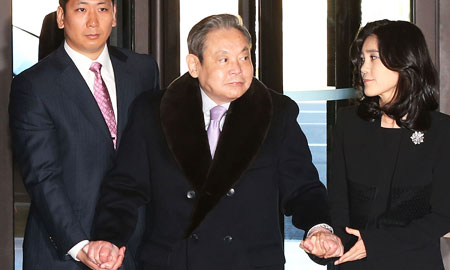
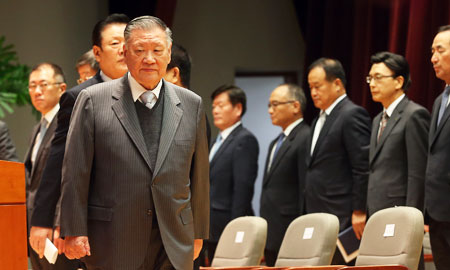
Samsung Electronics Chairman Lee Kun-hee walks into the Hotel Shilla in Seoul, Thursday, holding hands with the hotel’s CEO and his daughter Bu-jin, to attend a New Year’s greeting ceremony; Hyundai Motor Group Chairman Chung Mong-koo walks into a hall to attend a New Year’s greeting ceremony at the group’s headquarters in Yangje-dong, southern Seoul, Thursday.
Kim Tae-jong
In their New Year’s greetings Thursday, the chairmen of major conglomerates urged their employees to prepare for another tough year by enhancing their competitiveness.Samsung Electronics Chairman Lee Kun-hee stressed the need for change in order to stay competitive and maintain a leading position in the market.
“Our leading businesses are constantly being challenged by competitors, while time is running out for our less dynamic businesses,” he said in front of some 1,800 executives at the firm’s headquarters in Seoul. “It is therefore time to change once again.”
The message was delivered via a video that was televised in four languages ― Korean, English, Chinese and Japanese ― to all Samsung companies worldwide.
He also admonished the group to abandon its old business models and strategies, move beyond the hardware-oriented processes and corporate culture, and finally get rid of outdated ways of thinking, systems and business practices.
The remark came amid gloomy forecasts for the global and domestic economy. The group is expected to face a tough time, especially as the group’s key unit, Samsung Electronics, is currently engaged in legal battles against Apple over patents and is being chased by Chinese rivals.
“We must push ourselves to improve our business structure so that we can lead industry trends. We must innovate technologies that can help us compete in an uncertain future. And we must invest in systems to enhance our global management capabilities,” he said.
But he stressed that economic slowdowns can present opportunities, urging them to increase competitiveness beyond the reach of their competitors, while also focusing on the convergence and integration of industries and technologies to pioneer new businesses.
Another heavyweight figure, Hyundai Motor Group Chairman Chung Mong-koo, ambitiously set a new sales goal for this year, also asking for innovative approaches to tackle challenges.
He said the group aims to sell 7.86 million vehicles globally, up from 7.56 million last year, with Hyundai Motor to sell 682,000 vehicles domestically and 4.12 million globally, and Kia Motor to sell 480,000 at home and 2.48 million in other markets.
“We were able to have a satisfying result last year, despite challenging situations,” he said. “Looking back at what we have achieved in the past, let’s prepare for another success in the future.”
Last year, the automotive group produced 7.56 million vehicles at 31 plants in nine countries, up 2.0 percent from the previous year. Last year, the overseas production also surpassed the 4-million mark for the first time, with accumulated production topping 20 million.
But he said the situation will not be favorable this year as well, stressing the importance of innovation as a key to leap forward.
“The global economy has entered the era of low growth, which has led to a fiercer competition. Uncertainty has grown, due to technological conversions,” he said. “It is necessary to innovate the management system of global networks to obtain efficiency to cope with challenges.”
Other big names also called for efforts to tackle unfavorable economic situations.
LG Group Chairman Koo Bon-moo asked each employee to be ready for the challenge of difficult times ahead.
“We are in a crisis,” he said. “A leading firm could collapse due to a careless mistake.”
He encouraged everyone to aim at becoming a leader in new businesses without simply being satisfied with the current situation, and also making the best product in the market.
Hyundai Group Chairwoman Hyun Jeong-eun said 2014 will be a turning point for the group.
“We are in a time we can’t survive with old sales strategies, business models and management measures,” she said. “We should be reborn to carry out innovative strategies.”
The group has recently decided to sell its financial affiliates, as it may face a liquidity shortage.
GS Group Huh Chang-soo suggested that the group needs to improve its internal stability instead of focusing on external growth, especially as it celebrates the 10th anniversary of its founding this year.
Kim Chang-geun, chairman of the Supex Council, SK Group’s highest decision-making body, pledged to increase the group’s value to 300 trillion won.
“The group faced a crisis 10 years ago, when the group’s value stood at less than 20 trillion won. But a series of innovative measures, globalization and reform in management have led it to jump to 80 trillion won, four times higher than 10 years ago,” he said. “Let’s increase our current value to 300 trillion won, about four times higher than now.”
Tycoons call for innovation to get through 2014
‘We have to review every activity of ours to overcome such a crisis.’
Jan 03,2014
Samsung Chairman Lee Kun-hee stressed a shift in focus from hardware to software in his New Year message yesterday, as he ushered in another decade of his “new management initiative” of 1993.
Lee also encouraged a mind-set in which crises can be turned into opportunities, a message echoed by other leading conglomerates at a time of slow growth.
The fourth-largest economy in Asia has come up against another economic stumbling block: an overly strong currency. The nation’s leading bourse started the New Year yesterday by falling 2.2 percent to 1,967.19 points due in part to increased concern about the appreciation of the won against the yen. Samsung Electronics, the market’s bellwether, plunged 4.6 percent.
“Let us boldly throw away the business models and strategies of the past five and 10 years,” said the 71-year-old Lee in a message to Samsung Group’s 420,000 employees around the world. “Let us move beyond our hardware-oriented processes and corporate culture.”
Samsung, the world’s largest vendor of smartphones, had huge success in that business last year, but concerns over a narrow portfolio of products has deepened. The company, which also makes the most TVs and memory chips in the world, signaled a move last year to expand into the software arena, where it is not yet a match for American companies Apple and Google.
The tech giant is expected to unveil its first smartphone featuring the Tizen operating system next month, which is meant to lessen its dependence on Google and its Android operating system.
“We must push ourselves to improve our business structure so that we can lead industry trends,” Lee said. “We must innovate technologies that can help us compete in an uncertain future.”
Samsung posted a record-high operating profit of 10.16 trillion won ($9.67 billion) in the third quarter, more than 60 percent of which came from mobile devices. But foreign investors have dumped its stocks for five straight trading days since Dec. 23 on speculation of a disappointing earnings report next week.
BNP Paribas said in a report yesterday that Samsung Electronics’ operating profit in the fourth quarter will be 14 percent lower than the previous quarter. Mirae Asset Securities predicted Samsung will post around 9.21 trillion won worth of operating profit in the first quarter of this year, which is 1 percent lower than its fourth-quarter estimate for the conglomerate.
A series of costly patent disputes with Apple, which the chairman dubbed “do-or-die battles,” could plague the company again this year. A U.S. court has ordered Samsung to pay $930 million to Apple for infringing patents, which Samsung is appealing.
“Our leading businesses are constantly being challenged by competitors, while time is running out for our less dynamic businesses,” Lee said. “It is therefore time to change once again.”
The recovery of traditional economic powers such as the United States, Japan and Europe is expected to inject some momentum into the global economy this year, and Korea, the seventh-largest trader in the world, posted a record-high trade surplus, $44.2 billion, last year.
But the Ministry of Trade, Industry, and Energy said on Wednesday that the surplus will drop by 24.2 percent this year.
“Economic slowdowns can present opportunities too,” Lee said in his message.
“Let us see farther from a higher vantage point and create new technologies and markets.”
Other local conglomerates also signaled they will try to focus on qualitative growth and innovation this year, rather than aggressive expansion.
“The economic condition is still difficult, especially with the strengthening of the won and the dragging out of the economic recovery,” said Koo Bon-moo, chairman of LG Group, the country’s fourth-largest conglomerate, in a New Year message.
“All executives and employees should be clearly aware that this is a crisis for us .?.?. we have to review every business activity of ours in order to overcome such a crisis.”
In his New Year address, Hyundai Motor Group Chairman Chung Mong-koo said that the group should focus on strengthening the foundation of future growth by building up its capability.
Chung urged the group to bring innovation to its global management system so that each unit can quickly and flexibly react to business environment changes. The 75-year-old chairman also emphasized expanding investments in R&D for innovative technologies.
Similar themes were stressed by other conglomerate leaders yesterday, including GS Group Chairman Huh Chang-soo, who also heads the Federation of Korean Industries.
Hyundai Heavy Industries Chairman Lee Jae-sung emphasized uncertainties in the business environment. The world’s largest shipbuilder set a target of $29.6 billion in orders for 2014 and a sales target of 26.57 trillion won, up 9 percent from last year.
Hanjin Group Chairman Cho Yang-ho said his group should concentrate on the bottom line.
The troubled conglomerate, which owns the nation’s flag carrier, Korean Air Lines, last year announced a plan to raise 3.5 trillion won to address a cash shortage.
Hyundai Group, also hit by a fiscal crisis last year that forced it to pledge to raise 3.3 trillion won by selling subsidiaries, including its financial units, needs intensive innovation to build a foundation for long-term growth, according to Chairwoman Hyun Jeong-eun yesterday.
LS Group Chairman Koo Ja-yeol emphasized law-abiding management. The nation’s largest cablemaker last year was in trouble for supplying poor quality cables to the country’s nuclear power plants.
Financial groups put emphasis on strengthening internal fundamentals in their New Year rituals.
Lim Young-rok, chairman of KB Financial Group, the nation’s largest financial group, reacted to an embarrassing slush fund scandal involving an executive in its Tokyo branch. Lim pledged to make his group stronger in the local market.
“Last year was tough for us with decreased profitability and aggravated fiscal soundness,” Lim said. “KB will enhance its competitiveness in the retail financing business, traditional turf for us, in order to improve the overall management of the group.”
The chairman also unveiled plans to recover profitability through mergers and acquisitions of nonbanking businesses.
“We will establish solid internal growth by expanding into securities, life insurance and asset management businesses,” he added.
KB was selected as preferred bidder for Woori Financial late last year. KB also made a bid to acquire Woori Investment and Securities, but its rival NH Nonghyup Financial Group was selected as the preferred bidder instead.
KB’s aggressive move in the financial merger and acquisition market is based on its plan to diversify its businesses that are currently focused more in the banking sector as in the nonbanking sector.
Local banks suffered last year because low interest rates led to a drop in profits.
Hana Financial Group Chairman Kim Jung-tae said yesterday that financial companies need a new paradigm that makes them competitive, not only in the traditional banking business but also in the nonbanking sector.
Hana Financial Group is the owner of both Hana Bank and Korea Exchange Bank.
“A fundamental change is needed,” he said. “For example, the financial industry has been drawing a line between ordinary households and businesses, but that will no longer fit a changing market.
“Households and businesses are interconnected. We need to secure more consumers by utilizing Big Data and linking the two.”
Kim suggested utilizing the nation’s cutting-edge IT technologies to understand consumers’ needs better and bring greater profitability to various operations.
He said his group will compete not only with other financial groups but also with IT businesses by becoming as innovative as the IT sector in order to meet consumers’ demands in a more efficient way.
BY MOON GWANG-LIP, JOO KYUNG-DON AND SONG SU-HYUN [joe@joongang.co.kr]
 About bambooinnovator
 Bamboo Innovator