Turkish politics: No longer a shining example; Turkey’s government disappoints because of allegations of sleaze and its increasingly authoritarian rule
January 4, 2014 Leave a comment
Turkish politics: No longer a shining example; Turkey’s government disappoints because of allegations of sleaze and its increasingly authoritarian rule
Jan 4th 2014 | ISTANBUL | From the print edition
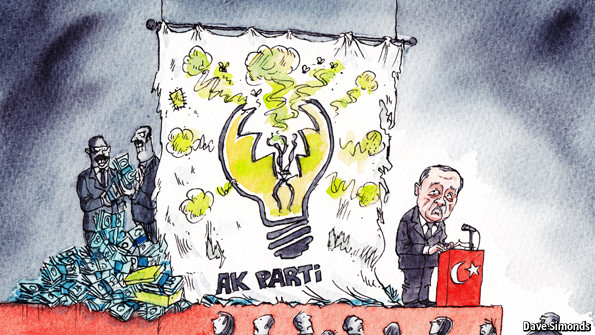
GOVERNMENTS fall in Turkey either because they are massively corrupt or because generals boot them out (or both). In 2002, fed up with the greed and ineptitude of the country’s secular parties, voters chose Recep Tayyip Erdogan as prime minister as they propelled his mildly Islamist Justice and Development (AK) Party into government. A decade on, AK, which means “white” or “pure” in Turkish, has proven not to be so exceptional after all and finds itself mired in one of the biggest graft scandals in recent history.On December 17th the police arrested around 50 people on suspicion of tender rigging, covert gold transfers to Iran and bribery. They included the sons of three cabinet ministers, an AK mayor, and the general manager of Turkey’s second biggest state lender, Halkbank, in whose home police found $4.5m crammed into shoeboxes. The probe drew closer to Mr Erdogan when prosecutors ordered a second raid that would have netted his son, who is alleged to have enriched himself through shady property deals. Mr Erdogan responded by reassigning hundreds of police chiefs, sacking a prosecutor involved in the investigation and rewriting laws in ways that would allow the government to stop corruption probes against its own. For a public already on the edge, thanks to Mr Erdogan’s increasingly authoritarian tendencies, none of this is reassuring.
A cabinet reshuffle that saw the dismissal of ministers whose sons are in jail, and of Egemen Bagis, the minister for European affairs who was also caught up in the scandal, has not muted the public outcry. Meanwhile the markets’ confidence (vital for Turkey, which depends on capital inflows) has been shaken. The Turkish lira tumbled by 5% against the dollar and Istanbul’s stockmarket shed 10% of its value.
On December 31st Hasan Harmi Yildirim, an AK MP, resigned in protest at what he called the insults made by Mr Erdogan against Fethullah Gulen, a hard-nosed imam who runs a global empire of schools, media outlets and charities from Pennsylvania. This increased the number of recent departures from AK, which is riven by internecine strife, to seven. Even so, a full-scale split does not seem likely.
Mr Erdogan’s renewed tirades against “foreign mischief-makers”, led by Israel and America, whom he blamed for anti-government protests in June, seem increasingly desperate. He now claims that the corruption charges were cooked up by these forces and their local collaborators from the powerful Muslim fraternity led by Mr Gulen. Few doubt that many of the prosecutors and policemen involved in the case are loyal to Mr Gulen and may be motivated by revenge. Calling them “a parallel state”, Mr Erdogan has been purging followers of Mr Gulen from state institutions. He has vowed to phase out thousands of crammers owned by Mr Gulen’s movement, known as Hizmet. These act as its prime recruiting ground and cash cow. “They have collected sex tapes to blackmail our party members,” claimed a senior AK official. Hizmet members angrily deny this. Yet videos purporting to show people close to Mr Erdogan engaged in extramarital bedroom romps have been making the rounds.
Ironically, Hizmet and AK were until recently allied in the fight to defang Turkey’s generals. Gulen-linked prosecutors and police are widely believed to have rigged evidence in the Ergenekon case that helped convict hundreds of generals and other senior officers for allegedly plotting a coup. Mr Erdogan didn’t seem to mind then, but now bitterly complains about the infiltration of the judiciary by Gulenists.
The crisis is not just about a power struggle between AK and the Gulenists. It highlights the chronic weaknesses of Turkey’s wobbly democracy: a shackled media; a politicised judiciary; a flawed, illiberal constitution; and a lack of independent scrutiny of public accounts. Re-elected in 2011, Mr Erdogan had a real chance to fix these shortcomings. His failure to do so has left his more liberal supporters feeling frustrated and betrayed. His increasingly authoritarian rule has prompted comparisons to Vladimir Putin, Russia’s president. It now seems that Mr Erdogan’s main goal is to plot his path to the presidency when it comes free in August.
The latest ructions make it less likely that he can fulfil his presidential dreams. Much depends on the outcome of the nationwide municipal polls that will be held in March. The main opposition, the pro-secular Republican People’s Party (CHP), believes it now has a real chance of taking Istanbul, the country’s largest city. And the Gulenists suggest they may back the CHP. Mr Erdogan’s safest bet, it seems, would be to call snap elections and run for a fourth term. He would need to change AK’s rule of a maximum of three terms to do so. But the way things are going, parliamentary immunity (from prosecution) may prove Mr Erdogan’s only way out.
Yet those now clamouring for AK’s demise should think long and hard. The CHP remains weak and divided. Nobody knows just what it stand for, least of all its leaders. The antediluvian far-right Nationalist Action Party is even worse. The country’s Kurds would surely want the AK to remain in charge, because, for all his faults, Mr Erdogan is the first Turkish leader to talk openly to Abdullah Ocalan, the imprisoned Kurdish rebel boss. A ceasefire struck in March is still holding.
When Turks next go to the polls they will probably have to choose the lesser evil. That is still likely to be the AK.
 About bambooinnovator
 Bamboo Innovator