Global Companies Rethink M&A Deals in China
January 12, 2014 Leave a comment
Global Companies Rethink M&A Deals in China
CYNTHIA KOONS
Jan. 8, 2014 8:11 a.m. ET
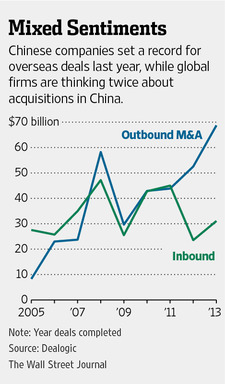
While Chinese acquisitions of overseas companies hit a record high in 2013, the value of inbound deals has stagnated in recent years. That’s because China’s regulatory regime has become tougher, while a just-ended moratorium on initial public offerings made it harder to determine exactly what Chinese companies were worth.“The difficulty and the effort it takes to clear regulatory approvals is more demanding than doing a comparable deal in the U.S. or elsewhere,” said Joseph Chan, a partner at global law firm Sidley Austin.
Some sectors in China are harder to crack than others. Acquisitions of companies in the Internet, media, telecommunications or financial-services sectors are subject to a tougher review. Clearing the antitrust regulatory hurdle takes two or three months, sometimes longer. After that, foreign buyers must apply for regulatory approval at the local level or national level, depending on the size of the deal.
Nestle SA ‘s 2011 acquisition of China’s Yinlu Foods Group, for example, took seven months to complete following the deal’s announcement.
By comparison, Shuanghui International Holdings Ltd.’s $4.7 billion acquisition of Smithfield Foods Inc., the biggest-ever purchase of a U.S. company by a Chinese firm, received U.S. regulatory approval within four months.
In the U.S. a foreign buyer that doesn’t present any national security concerns would most likely only have to submit a Hart-Scott-Rodino notification filing, and approval can usually be completed in 30 days or less if there are no antitrust issues, said Scott Jalowayski, a partner at Ropes & Gray.
“There’s only so much you can stuff through a small pipe and [in China] it’s a small pipe—relative to industrialized nations—because you still have the same approval-based foreign investment system, foreign-exchange controls, and a relatively primitive set of corporate laws,” Mr. Jalowayski said.
The numbers tell the story. While China’s outbound M&A hit a record $68.7 billion last year, an increase of 31%, inbound M&A totaled $31 billion, below the $33.6 billion averaged over the past five years, according to data provider Dealogic. The number of inbound deals has declined sharply in the past two years—from 831 to 540 last year.
Problems in the domestic equities market are also to blame. The Chinese government shut the door on initial public offerings in late 2012 after a spate of new listings performed poorly. That dented confidence and made it harder to value companies because there weren’t many newly listed companies to use as a benchmark. It also meant private-equity buyers didn’t have a natural route to exit investments, potentially damping enthusiasm for inbound investments.
“The shutdown of the IPO market has really caused the prolonged valuation gaps that have existed between buyers and sellers,” said Bob Partridge, Asia-Pacific private-equity leader at EY. “When you talk about outbound M&A, particularly in Europe, you don’t have the valuation gaps that you have here.”
The Chinese government officially ended the IPO freeze last month, which should help clear up that valuation disparity, Mr. Partridge said.
Memories of deals gone awry in recent years have also hurt sentiment. Caterpillar Inc., for example, said early last year that it was writing off $580 million of the roughly $700 million it paid for a Chinese maker of mine-safety equipment, citing “accounting misconduct.” Meanwhile, U.S.-listed Chinese stocks have been punished in recent few years following a rash of accounting scandals.
“The surprises that have surfaced post-acquisition have left a bad taste in people’s mouths and that, coupled with the scandals surrounding certain Chinese companies in the U.S., that has caused people to pause,” Mr. Chan said.
Regulatory reform would go a long way toward restoring foreign companies’ appetite for M&A deals in China, market participants say. China has introduced a number of new regulations in the past few years that have hindered inbound deal activity, including a new antitrust regime and national security review process, while eliminating preferential tax treatment for foreign buyers. The current government has paid lip service to streamlining the regulatory process but dealmakers say meaningful reform remains to be seen.
“There’s always been a lot of rhetoric around opening the country and increasing foreign investment and reform in the broad sense, but the dialogue never seems to extend to fundamentally altering the system that requires prior government approval for each foreign investment,” Mr. Jalowayski said. “Unless and until that system changes, I just don’t see how there’s going to be a significant uptick in cross-border M&A activity.”
Write to Cynthia Koons at cynthia.koons@wsj.com
 About bambooinnovator
 Bamboo Innovator