Hot air ballooning catching on in China
January 12, 2014 Leave a comment
Hot air ballooning catching on in China
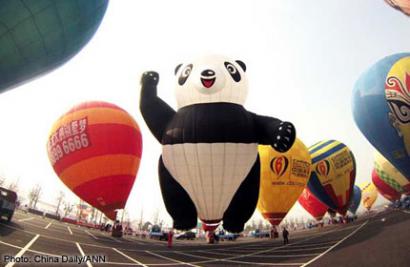
Sunday, January 12, 2014 – 10:30
Deng Zhangyu
China Daily/Asia News Network
Just a couple of years ago, Chen Chunyu could only imagine what it would be like to ascend 1,000 meters above the ground, to a place between the clouds and the sun. Now the hot air balloon pilot routinely takes “selfies” against a bird’s-eye view of a city, then drifts away for the pure joy of floating through the air. Since 2011, Chen has flown over mountains and rivers, volcanos, grasslands, terraced fields and other picturesque places around China.“It’s different from taking a flight by airplane,” he says of his special kind of aircraft that allows Google Earth-style sightseeing without a computer screen or cellphone. “It’s a dreamlike feeling when you fly above the carpet-like clouds.”
Chen runs a transportation company in Changzhou, Jiangsu province. He is one of the five pilots who have obtained a pilot certificate for hot-air balloons in the past two years there.
Across China, there are about 400 to 500 licensed balloonists, 90 per cent of whom are individuals who get certified and then buy balloons on their own. The number of pilots started to rise with the new millennium, although the sport was introduced to the Chinese mainland in 1983.
In the 1980s, only professional pilots from aviation schools were allowed to fly these craft, explains Wu Gongyu, director of the ballooning commission of the Aero Sports Federation of China. Now, he says, more individuals who have money and time are taking up ballooning to relax and enjoy themselves.
While most balloonists are entrepreneurs older than 30 – some of them billionaires – the joy of flying also attracts students.
Cheng Peng, general manager of a Hebei-based pilots club that provides balloon-piloting training classes, says he was asked to write a dozen recommendation letters for a 17-year-old member of his club.
The young member, still a student in his senior year, is learning to pilot a balloon in order to capture the attention of recruiters of universities overseas where he wants to apply.
Cheng adds there’s another 17-year-old member at his club taking pilot training just because he likes the sport.
A hot air balloon costs about 70,000 yuan (S$14,600). The training to become a licensed balloonist costs 35,000 yuan. The total expense including license fees and insurance, is no more than 200,000 yuan.
The growth of the balloonist group in China goes hand in hand with China’s economic rise, and many Chinese now can afford the cost.
“It’s not a matter of money now. I think what most Chinese people lack is the spirit of taking risks,” Cheng says.
However, he says the post-1980 generation is more willing to take risks compared to the older generation. They are likely to become the main group that takes up ballooning in the future.
Born in 1980, Cheng is already a veteran balloonist. He got his pilot certificate in 2003. He has piloted his balloon flying over the Great Wall, the Three Gorges and the Qiongzhou Strait.
To Cheng, each flight is a different experience due to the uncertainty. Pilots can only control the ups and downs of the balloon, so a balloonist needs to be good at predicting the wind direction.
“A single change of the wind direction can influence my route. That’s why it attracts me,” Cheng says.
Although Cheng is eager for the challenges of flying balloons through more complicated routes, he is very careful about safety. People involved in the group insist that hot air balloons are one of the safest aircrafts.
“If it’s not safe enough, I wouldn’t take my son with me almost every flight,” Fu Xueying says.
Fu is mother to a 9-year-old boy. She joined the first generation of China’s balloonists when she got her pilot certificate in 1995. But now she is a housewife, and piloting a balloon is an escape from housework.
As soon as her son’s holiday begins, Fu says, she will take him to fly.
“My son loves ballooning with me. It’s safe. If the weather is good, we can have a nice talk above the sky. Sometimes we even make a phone call to our friends from the air,” she says.
Safety is important for a mother like Fu and other entrepreneur pilots. But taking up challenges is the priority of Liu Xiang, who holds the record for the longest hot air balloon flights in China.
Liu has taken many risky flights to places that many travelers can’t reach. His dream is to fly over Mount Qomolangma, also known as Mount Everest in the West.
Half of the highest mountain in the world is in China. To fly over it as a Chinese pilot, Liu says, is his dream for the future.
“I love risks,” he says.
 About bambooinnovator
 Bamboo Innovator