IBM: The technology giant asks Watson to get it growing again
January 12, 2014 Leave a comment
IBM: The technology giant asks Watson to get it growing again
Jan 11th 2014 | NEW YORK | From the print edition
“IT’S a silly project to work on, it’s too gimmicky, it’s not a real computer-science test, and we probably can’t do it anyway.” These were reportedly the first reactions of the team of IBM researchers challenged to build a computer system capable of winning “Jeopardy!”, a television quiz show. Yet within five years they had created Watson (named after Thomas Watson, who built up the company), which used natural-language programming to understand questions the way a human would, and massive processing power to find the likeliest answer from vast amounts of data. In February 2011 it beat two human “Jeopardy!” champions in a public showdown. Now, less than three years later, Watson is being touted as a business opportunity potentially so lucrative it can get Big Blue out of what has started to look like a serious growth problem.On January 9th, with much fanfare, the computing giant announced plans to invest $1 billion in a new division, IBM Watson Group. By the end of the year, the division expects to have a staff of 2,000 plus an army of external app developers working within its “open Watson ecosystem”. It also unveiled a raft of new projects under development, on top of the handful already revealed in health care, financial services and retailing with firms such as WellPoint and the Cleveland Clinic. Mike Rhodin, who will run the new division, calls it “one of the most significant innovations in the history of our company.” Ginni Rometty, IBM’s boss since early 2012, has reportedly predicted that it will be a $10 billion a year business within a decade.
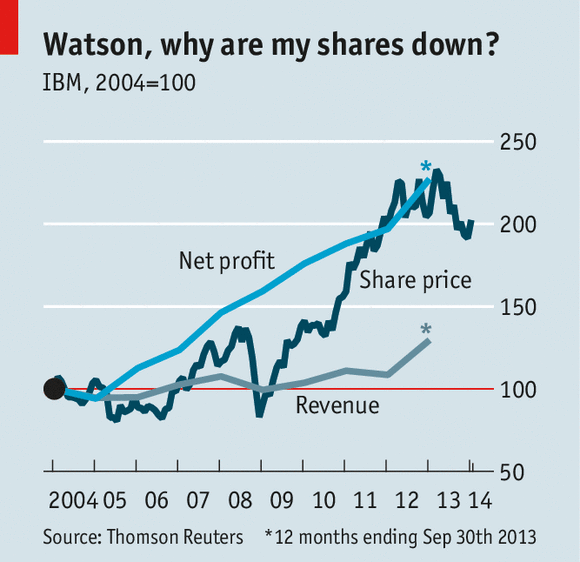
That is the sort of success Ms Rometty badly needs. Though IBM’s profits have kept rising, investors have become doubtful about where its future growth will come from, so its shares have fallen by almost 13% since their peak last March (see chart), even as tech stocks and the broader stockmarket have soared. Stanley Druckenmiller, a hedge-fund manager, said in November that his bet against the firm was “one of the more higher-probability shorts I have seen in years,” because “IBM is old technology being replaced by cloud technology.”
Since Ms Rometty took over, investors have put up with IBM falling short of analysts’ expectations for its revenues while it seemed to be making a shift to higher-margin businesses. Now, though, some are worried that the strategy has run out of steam and that Ms Rometty will not achieve the $20 of earnings per share she has promised them in 2015 (from $14.37 in 2012). Analysts at CSFB, an investment bank, recently said that IBM is making over half of its earnings gains from “lower-quality means” such as share buy-backs and cost cutting.
IBM insists it remains on target to reach $20 a share. But Ms Rometty has shuffled her team in an effort to boost performance. She has also moved IBM into the cloud. In June it bought Softlayer, a rising star of cloud computing, for an estimated $2 billion. That followed a painful loss to Amazon in a battle to win a contract to build a private cloud for the CIA.
The cloud is a key part of the Watson strategy, with $100m allocated to invest in building an “ecosystem” of independent Watson app developers. “This is the right strategy for getting rapid growth,” says Jamie Popkin of Gartner, a research firm. So too, he thinks, is IBM’s initial focus on applying Watson to industries such as health and finance, which rely on expensive human advisers. There are good prospects of training Watson to understand “best practice” in such things as cancer diagnosis and wealth management, and to produce sensible results, based on its ability to sift through a mass of data.
Watson is now smaller, more efficient and “24 times faster” than when it won “Jeopardy!”, says Mr Rhodin. Although competitors from Apple to Microsoft are also investing in some form of natural-language question-answering technology, “We are way out in front,” he boasts.
The computer is some way from making doctors and financial advisers redundant. However, IBM is “well-placed to provide them with expert advice” says Barney Pell, founder of Powerset, a natural-language search engine bought by Microsoft in 2008. Whether the firm can commercialise the opportunity fast enough to silence its doubters is a question that, for now, not even Watson can answer.
 About bambooinnovator
 Bamboo Innovator