India Manages to Free Itself of Polio; Against-Odds Achievement Remains Fragile but Brings Global Eradication Quest Tantalizingly Close
January 12, 2014 Leave a comment
India Manages to Free Itself of Polio
Against-Odds Achievement Remains Fragile but Brings Global Eradication Quest Tantalizingly Close
GAUTAM NAIK in London and NIKITA LALWANI in New Delhi
Jan. 10, 2014 7:30 p.m. ET
The World Health Organization is set to announce on Monday that India has officially eliminated polio. Gautam Naik explains how it has achieved this and how far until it is eradicated globally. Photo: Getty ImagesThe World Health Organization plans to announce on Monday that India has officially eliminated polio, one of the biggest public-health achievements of recent times, and one that could set the stage for stamping out the ancient scourge globally.
Public-health officials have been counting the days to the three-year anniversary of India’s last recorded case, which allows the WHO to certify it as polio free.
Many long doubted that India could pull it off, given the country’s size, poor sanitation and the enormous challenge of vaccinating millions of children, often in far-flung places and in the face of societal and religious resistance.
“India was by far the hardest place in the world to get rid of polio,” said Bill Gates, chairman of Microsoft Corp. MSFT +1.44% and co-chair of the Bill and Melinda Gates Foundation, a major financial donor in the global polio campaign. “It’s quite phenomenal they did it.”
The success with polio has also emboldened India to announce that it will now try to eliminate measles as well. At the same time, India faces significant public-health challenges such as malaria, HIV/AIDS and the spread of drug-resistant tuberculosis. In epidemiology, elimination of a disease means wiping it out regionally, while eradication gets rid of it globally.
Hamid Jafari, director of the WHO’s polio-eradication campaign, says the agency’s ambitious quest to stop all polio transmission by the end of 2014 is now within reach. If that is achieved, and no new cases crop up for three years, polio—like smallpox—will be officially banished from the planet.
“India was one of the most important sources” from where the virus spread to other countries, said Dr. Jafari.
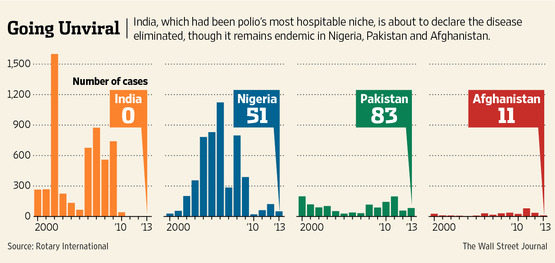
It won’t be easy. Polio remains endemic in three countries, Pakistan, Nigeria and Afghanistan. There also have been recent outbreaks in the Horn of Africa and Syria, although there are signs that those cases will soon be mopped up.
So, for now, India’s elimination of polio remains “a fragile achievement,” Mr. Gates said in an interview. “Global eradication is a very different thing.”
Polio was one of the most feared childhood diseases of the 20th century. Infected people often show no symptoms but continue to excrete the virus in their feces, which allows it to jump to others, typically via contaminated food and water. In a small proportion of cases, the virus causes paralysis that is often permanent. It can be prevented only by vaccination.
The polio virus has been around for thousands of years. Vaccines made much of the world polio free by the year 2000. But India—vast, dense and poor—continued to be its most hospitable niche. Just two decades ago, there were several hundred new cases every day.
“I could name 300 challenges, but the main one was fighting apathy and ignorance among political bigwigs and among beneficiaries themselves,” says Deepak Kapur, who heads the polio campaign in India for Rotary International, a major funder.
Another big hurdle, according to Mr. Kapur, was fear. There were rumors that the polio vaccine was designed to make children infertile, or that it contained substances banned by Islamic scripture. Such fears made it especially hard to vaccinate Muslim children.
The Indian government’s campaign to eliminate polio began in 1995, and has cost it nearly $1.6 billion so far; private sources have contributed millions more. It was a mammoth operation, involving health workers, local officials, religious leaders and some two million vaccinators who often went door to door. Over the past three years alone, 480 million vaccinations were given each year to about 174 million children under the age of 5.
Religious leaders were persuaded to join the effort. “The calls that went out to the Muslim faithful every Friday contained reminders to take children to the immunization booths,” said Mr. Kapur of Rotary International. “These were the people initially most skeptical of the vaccines but, once convinced, they became our biggest agents of change.”
By 2009, there were only 741 polio cases in India, and the figure dropped to 42 the following year. The last case—a girl called Rukhsar Khatoon who was paralyzed by polio—was reported Jan. 13, 2011. There is still the danger that a new polio case may get imported from neighboring Pakistan or Afghanistan; India plans to keep vaccinating children to ensure no new cases crop up.
Others have made progress, too, partly by adopting India’s techniques. In 2012, the three remaining endemic countries reported just 223 cases, the lowest figure recorded historically until then. Last year, the figure was 148.
According to the Gates Foundation, between 2012 and 2013, the number of cases fell 67% in Afghanistan and more than 50% in Nigeria.
Pakistan and Nigeria pose special challenges. In Nigeria, most of the polio cases are in the Muslim north, and there have been violent—and sometimes fatal—attacks against people believed to be working on polio-immunization drives. In Pakistan, meanwhile, more than 70% of the remaining polio cases are in inaccessible places.
As a result, the hope of stopping all transmission by year-end may slip a little. “There’s a chance we won’t get to zero cases in Nigeria and Pakistan—we’ll probably miss in one of those countries,” Mr. Gates said.
Still, the dream of global eradication is tantalizingly close—and it is backed by money. The Gates Foundation has contributed $1.2 billion toward polio eradication since 2009, and has committed a further $1.8 billion through 2018. In all, some $4 billion has been pledged by various groups to eradicate the disease.
The effort is led by the Global Polio Eradication Initiative, which includes various governments, the WHO, Rotary International, the U.S. Centers for Disease Control and Prevention and Unicef. The initiative estimates that polio eradication could deliver total net benefits of up to $50 billion by 2035 from reduced treatment costs and gains in productivity.
But stamping out an ancient and debilitating disease promises much more. “The benefits of eradication accrue for eternity,” said Dr. Jafari of WHO.
 About bambooinnovator
 Bamboo Innovator