Is Malaysia in middle-income trap?
January 12, 2014 Leave a comment
Updated: Saturday January 11, 2014 MYT 8:19:01 AM
Is Malaysia in middle-income trap?
BY CECILIA KOK

THE next six years will be a crucial period for Malaysia, as it strives to break out of the middle-income rank to become what World Bank would categorise as a “high-income nation”.Indeed, with a gross national income (GNI) per capita of US$9,820 (RM32,235) in 2012, Malaysia is already on the cusp of graduating from an upper-middle income to a high-income economy, which, according to World Bank’s definition in 2012, is one with a GNI per capita of more than US$12,615.
Yet, economists continue to propound that being a developed nation is not just about meeting the numbers set by the intergovernmental organisation, but it is also about achieving quality, equitable and sustainable growth for the long term.
As independent consultant and economist Dr Vijayakumari Kanapathy puts it, “reaching the target (as set by World Bank) does not really make one a high-income nation… for the country can always fall back (to its previous level) if its economic fundamentals are not strong”.
In the case of Malaysia, which aims to achieve the high-income status as defined byWorld Bank by 2020, Vijayakumari says how the country manages the process towards that goal is even more crucial than merely meeting the requirements to be in the club of high-income nation six years down the road.
“What we need is to achieve a ‘steady-state’ growth, which we have yet to do so,” Vijayakumari points out as she presents the findings of a case study on Malaysia’s economy over the week.
Identified challenges
Experts have long pointed out that beyond the headline numbers that continue to paint a somewhat rosy picture for Malaysia’s economy amid a weak global economic environment are risks that are hindering the country’s continued progress.
And according to a report by The Asia Foundation (TAF), an international non-profit organisation headquartered in the United States, Malaysia continues to struggle in addressing the identified challenges that are preventing or delaying the country’s shift to high-income status.
The recently launched report, entitled “Middle-Income Trap: Economic Myth, Political Reality”, is based on case studies from Malaysia and Thailand. The case studies adopt a political-economy approach to examine the underlying dynamics that are deterring meaningful structural reforms in both countries.
The section on Malaysia was co-authored by Vijayakumari and TAF’s deputy country representative Herizal Hazri.
Both the authors note that despite the numerous bold policy measures and long-term plans introduced by the Government over the years, Malaysia’s economic progress continues to be plagued by a lack of innovation and skills, low level of investments in technology, declining standards in education, relatively high labour cost and sluggish productivity growth.
To put it simply, Malaysia’s economy is displaying the symptoms of “middle-income trap”.
“Despite the policy focus and increased investment to address these weaknesses, progress has been, at best, modest,” TAF highlights in its report.
While the TAF report concedes that there have been some positive policy innovation in Malaysia in recent years, the stated reform measures have only focused on addressing the symptoms of “middle-income trap”, rather than the underlying causes of the country’s economic uncompetitiveness.
The TAF report also observes that even with the raft of measures to improve Malaysia’s economy, implementing meaningful reforms has not been an easy feat for policymakers given the existing political system of the country. It points to the fact that strong pressure groups, even from within the ruling coalition who can benefit from the status quo or business-as-usual arrangements, continue to contest vigorously the reform measures introduced by policymakers.
“The on-going economic and government transformation programmes may spike growth in the short term, but sustainable broad-based growth to escape the ‘middle-income trap’ requires parallel socio-political transformation,” the report emphasises.
In that sense, it says, there is a compelling need for Malaysia to shift from a race-based to a needs-based policy in order to address imbalances in society and improve the democratic process to ensure good governance and that the rule of law prevails.
“There must be adequate checks and balances to maintain the integrity of Malaysia’s key institutions,” the report argues, adding that corruption must be addressed and greater transparency and accountability is needed so that developmental outcomes are just.
Too much politics?
The middle-income trap is a dreaded situation as it depicts of a country that is unable to compete against advanced economies with high levels of innovation and value-adding activities, and at the same time, unable to compete with less developed economies that offer relatively cheaper labour.
TAF reckons that while Asia continues to be the world’s fastest-growing region, some middle-income countries in the region are already showing signs of economic fatigue and face stiff competition from low-cost economies. It argues that the threat of “middle-income trap” looms over several Asian middle-income countries, including Malaysia.
Leveraging on cheap labour, Malaysia has had its golden era in 1987 to 1997, when its economy was growing at around 10% a year. By 1992, the once-poor Malaysia was already categorised as a middle-income economy.
Malaysia’s golden dream, nevertheless, burst and its robust growth interrupted following the onslaught of the 1997/98 Asian Financial Crisis, which exposed the then weak fundamentals of the country’s economy. Growth of the country subsequently became more volatile and moderate over the years.
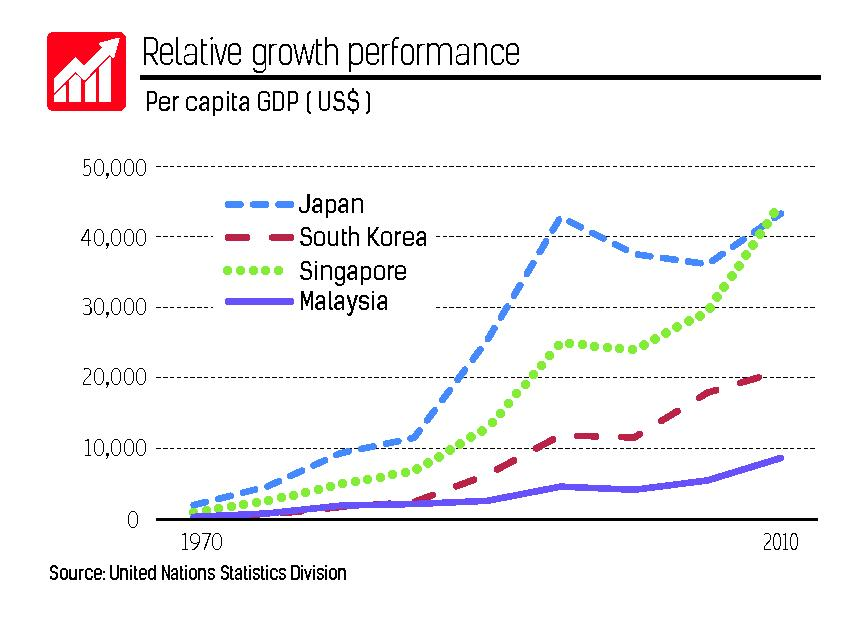
In retrospect, Malaysia started out with somewhat similar levels of gross domestic product (GDP) per capita as Japan, South Korea and Singapore in the 1970s. But the three countries have since gone on to become high-income economies, while Malaysia continues to lag over the years, and now, as TAF argues, risks falling into a “middle-income trap”.
According to TAF, one of the sore points is that Malaysia’s rapid economic progress, especially pre-1997, had not been accompanied by reforms in the country’s political system.
It explains that while Malaysian leaders have managed to ensure political stability for the country over the years, insufficient checks and balances continue to dog the country’s economy, thus leading to increasing concentration of power within the executive and persistence in rent-seeking behaviour, patronage politics, and opaque governance practices.
TAF, therefore, argues that the underlying dynamics that are slowing down Malaysia’s progress to the next level are more political in nature.
“Malaysia’s lacklustre economic performance is not due to insufficient policies… in fact, we already have too many of them,” Vijayakumari argues.
“What the country needs is to get its politics right in order to avoid the ‘middle-income trap’; not more economic policies,” she adds.
In dealing with the decline in the quality of the country’s education system, for instance, Vijayakumari says, having another “masterplan” or “blueprint” will not help.
“Just take politics out of our education system,” she says, adding that Malaysia’s existing education system has devastatingly failed the country’s labour force for not producing the skills and talent required to take the country’s economy to the next level.
Declining quality of life
Undeniably, Malaysia has been very successful in reducing absolute poverty, but income inequality remains an issue, especially in certain geographical areas.
TAF reports point out that a recent study found one-third of Malaysian workers to be earning below RM700 (US$214) per month, and that is a strikingly low figure for an upper middle-income economy.
TAF argues that Malaysia faces an increasingly fragile economic scenario, as traditional growth drivers, that is, exports and investment, have somewhat been losing momentum over the year. Public investment may have managed to offset the weakening private investment, but the situation has only led to growth in the Government’s debt, which currently stands just a hairline away from the self-imposed limit of 55% of the country’s GDP, and prolonged fiscal deficit at around 4% of GDP last year.
“Weakening private investment is a reflection of the limited capacity of Malaysian firms to diversify through innovation into areas which bring higher returns,” TAF argues.
“In Malaysia, enabling measures for small and medium enterprises are also stressed given that entrenched subsidies along with cronyistic relationships between large businesses and the state limit their operating space,” it says.
According to TAF, Malaysia also needs to take note of the worsening socio-political environment that has impinged on the quality of life of its people.
“The quality of life of the average Malaysians have declined with the rising cost of living and declining public safety and security,” Vijayakumari says, adding that wage rate increases in the country have not been able to keep pace with the country’s economic growth and rising costs of living.
“The next few years will be very challenging for Malaysia… how policymakers manage the risks going forward will be very crucial,” Vijayakumari says.
 About bambooinnovator
 Bamboo Innovator