Michelangelo’s Sistine Sketch: A centuries-old puzzle focusing on a drawing stored in Florence appears to have been solved
January 12, 2014 Leave a comment
Found? Michelangelo’s Sistine Sketch
KELLY CROW
Jan. 10, 2014 9:43 p.m. ET
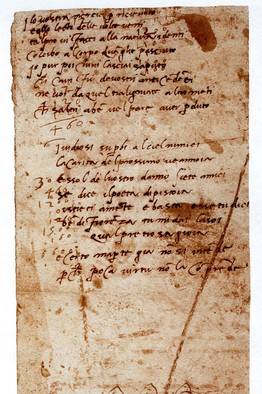

For centuries, art historians have puzzled over the meaning of a geometric drawing that Michelangelo sketched on a sheet of paper stored in the Buonarroti Archive in his hometown of Florence. The drawing doesn’t look like much at first glance, just a sienna-brown row of inky triangles and half-moon shapes.But since Michelangelo was arguably the greatest artist of the High Renaissance, the mystery nagged. Was it his diagram for an artist’s tool? Maybe a crenelation design for a fortress wall?
A new theory now gaining traction in art circles suggests that the drawing may actually be the artist’s first sketch of the Sistine Chapel—a significant find, if true, as it sheds fresh light on how the artist initially saw the Vatican chapel ceiling that would become his masterpiece. No other drawing survives that reveals what Michelangelo saw in the architecture of the 131-foot-long ceiling before his scaffolding or frescoes went up.
Michelangelo’s First Sketch of the Sistine Chapel?
Architectural historian Adriano Marinazzo believes a manuscript he found stored in Florence’s Buonarroti Archive is actually Michelangelo’s first sketch of the Sistine Chapel ceiling. The 1508 sketch, a longtime mystery to scholars, was found beneath of the artist’s poems. Compare the sketch to a view from below of the Sistine Chapel’s ceiling.
Michelangelo’s First Sketch of the Sistine Chapel?
Architectural historian Adriano Marinazzo believes a manuscript he found stored in Florence’s Buonarroti Archive is actually Michelangelo’s first sketch of the Sistine Chapel ceiling. The 1508 sketch, a longtime mystery to scholars, was found beneath of the artist’s poems. Compare the sketch to a view from below of the Sistine Chapel’s ceiling.
Adriano Marinazzo, an architectural historian at Virginia’s Muscarelle Museum of Art at The College of William & Mary, made the discovery while he was sifting through the artist’s archival papers two summers ago. Mr. Marinazzo said he noticed the sketch along the bottom of a long sheet of weathered parchment near a poem the artist had written satirizing the provincial limits of the Tuscan town of Pistoia. (Michelangelo often reused his sheets.)
Curious, Mr. Marinazzo turned the sheet sideways to see the sketch’s geometric shapes from a different angle, and that’s when it hit him. “I knew immediately that it looked like the outline of a vaulted ceiling,” Mr. Marinazzo said. “Michelangelo was trying to map something.”
Mr. Marinazzo soon after realized that the dimensions of these shapes corresponded exactly to the architectural elements fringing the Sistine Chapel at the time the artist took on the commission from Pope Julius II in 1508. A side-by-side comparison reveals noticeable overlaps.
Mr. Marinazzo published his hypothesis in the Italian art journal Commentari d’Arte last November, and since then Michelangelo scholars have been giving the sketch a closer look.
Cammy Brothers, an associate professor at the University of Virginia who specializes in Michelangelo and Italian Renaissance archicture, called his theory “very persuasive.” Ms. Brothers said Michelangelo was a voluminous draftsman, but he typically destroyed his early, rougher drawings and only kept the “perfect or pretty ones.”
“That’s what makes this sketch so rare, because very few drawings survive that show his first thoughts,” she added.
Michelangelo’s sketch Archivio Buonarroti, Florence
By all accounts, Michelangelo considered the job a beast from beginning to end. When he received the commission, he was 34 years old and already considered to be among his generation’s greatest sculptors, having carved the “Pietà” of St. Peter’s and the “David” a few years before. Painting was not his forte, he said repeatedly. He even accused his peers of recommending him for the chapel commission merely to watch him fail, Ms. Brothers said.
That attitude could help to explain why his plans for the chapel ceiling so far exceeded his papal marching orders: merely to paint the 12 apostles in the triangular shapes lining the outer edges of the barrel-vaulted ceiling. The center was already painted like a night sky, with gilt stars. Instead, Michelangelo took on all 5,000 square feet of the ceiling, ultimately painting more than 300 figures that tell the biblical story of man’s search for God and redemption.
The work was regarded as a masterpiece from the moment it was unveiled in 1512. Michelangelo’s biographer Giorgio Vasari, called it the “lamp of our art,” and Johann Wolfgang von Goethe, writing in 1787, said, “Without having seen the Sistine Chapel, one can form no appreciable idea of what one man is capable of achieving.”
Seeing the sketch that may have started it all could prove daunting, however. The Buonarroti Archive, named after his family, has no plans to exhibit it publicly, and only scholars are allowed to see it firsthand for now, according to Pina Ragionieri, the archive’s director.
 About bambooinnovator
 Bamboo Innovator