To Conserve Water, China Raises Prices for Top Users
January 12, 2014 Leave a comment
To Conserve Water, China Raises Prices for Top Users
BRIAN SPEGELE and WILLIAM KAZER
Updated Jan. 8, 2014 9:10 a.m. ET
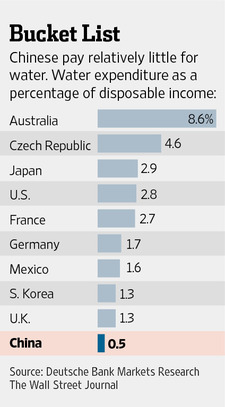
BEIJING—China will roll out wide-reaching reforms in how it prices water by the end of next year, the government said Friday, charging higher prices for the heaviest urban consumers to conserve diminishing resources and spur investment.The changes are part of a wider government reckoning that current state-controlled pricing structures for everything from water to electricity and natural gas are severely flawed. Underpriced resources help Beijing protect its citizens and industries from inflation, but experts say overuse as a result of the low costs is contributing to China’s environmental woes and long-term concerns about economic sustainability.
The announcement by the National Development and Reform Commission, China’s top economic planning body, marks the first stab at actual resource-sector reform after an economic-reform blueprint by top Chinese Communist Party leaders in November targeted the cheap use of resources, promising a greater role for markets in setting prices for power and other commodities.
The new system, which will be in place by the end of 2015 and will extend existing trials in some locales, will include a three-tiered pricing structure based on water use for households in all cities and some towns.
Under the plan, the heaviest consumers—or top 5% of households—will pay at least three times the base rate of water. The second tier will pay 1.5 times the base rate, while the lowest tier—roughly 80% of urban households—wouldn’t be affected by the changes, according to the NDRC.
Reforms to the pricing system are likely a precursor to new drinking-water standards, which could be in place by 2015. Such higher standards will require new investment in water treatment, say experts.
“Ultimately, quality standards can only be raised when tariffs are adjusted more comprehensively,” said Debra Tan, director of China Water Risk, an advocacy group based in Hong Kong.
The NDRC’s newly announced tiered structure is part of a multilayered approach to water-pricing reform in which local governments steadily raised water prices in recent years. Deutsche BankDBK.XE +1.77% said in a report last year that it expected a 30% increase in water tariffs nationwide within three years.
Prices for water in China remained relatively cheap nonetheless, according to analysts. The bank, citing a 2011 survey by Global Water Intelligence, said the average water price in 25 major Chinese cities was 46 cents per cubic meter, compared with a global average of $2.03 per cubic meter. Chinese consumers spent 0.5% of disposable income on water tariffs versus 2.8% in the U.S. Residential consumers in Beijing pay four yuan (66 U.S. cents) per cubic meter of water.
Social unrest stemming from higher prices ranks among leaders’ concerns in pressing ahead with resource-price reforms, from cabdrivers angry over higher pump prices to workers laid off as industry grapples with rising costs.
Economists see stable inflation rates as necessary for leaders to undertake wide pricing reforms. China’s consumer-price index rose 3% in November, down from 8.7% in February 2008.
Over the longer term, industrial water consumers will likely bear the largest burden from higher costs as industrial water prices and wastewater discharge tariffs rise, industry experts say. China’s economic growth has long been dependent on water-intensive industries, such as steelmaking.
Such strengthened measures would likely mean more efficient water usage and better waste treatment, said Ms. Tan, of China Water Risk. “Unfortunately for industry, it will mean rising costs,” she said.
Changes to the pricing system will also likely begin addressing long-standing profitability concerns among Chinese water producers, many of which operate at a loss. Dismal margins dissuade companies from undertaking badly needed upgrades to improve water quality.
“To improve the quality of treated water you need to invest,” said Zhou Min, executive director of Beijing Enterprises Water Group Ltd. 0371.HK -2.12% , a Hong Kong-listed company that supplies water and treats sewage. He added water-treatment facilities need to have a market for treated water—and one that better reflects the cost of treatment.
Water in China is unevenly distributed, with large swaths of its industrialized north facing shortages while parts of the south are powered by massive hydroelectric projects. Work continues on the south-north water transfer project, which will redirect water from Yangtze River reaches to the arid northern plains. To make way for the project, hundreds of thousands of people have been forced to move.
 About bambooinnovator
 Bamboo Innovator