Japanese Firms Look to Hong Kong Listings
January 16, 2014 Leave a comment
Japanese Firms Look to Hong Kong Listings
YVONNE LEE
Updated Jan. 13, 2014 12:24 p.m. ET
Japanese companies, led by the operator of Uniqlo, the clothing retailer, are heading to the Hong Kong Stock Exchange even as some foreign companies have shelved planned listings in the city in recent years.A few years ago, Italian luxury house Prada SpA and Russia’s United Co. Rusal Ltd. led a spate of listings in Hong Kong. But last year, there were just six foreign listings in the city, according to Dealogic data. Italy’s M&G Chemicals postponed an initial public offering meant to raise up to $592 million in December. M&G declined to comment.
While Hong Kong has long been a preferred listing venue for Chinese companies seeking to tap the international capital markets, it is home to just three Japanese companies.
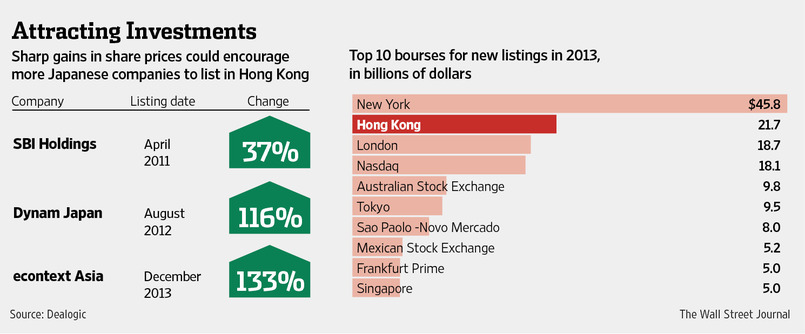
But with strong gains in past Japanese listings in the city and the chance to build up their brands in China via the publicity a Hong Kong listing would offer, more Japanese companies could head to the Hong Kong Stock Exchange. Last year, the Hong Kong exchange was second only to the New York Stock Exchange in terms of funds raised via stock offerings, according to Dealogic.
“Foreign companies looking at a Hong Kong IPO need to have a China consumption story,” said Jonathan Penkin, head of equity capital markets for Asia, excluding Japan, at Goldman Sachs Group Inc.
Fast Retailing Co., the operator of the Uniqlo casual-clothing store chain, is targeting asecondary listing
in the city in the first quarter, people with direct knowledge of the matter said, adding the company hired Morgan Stanley to handle the deal. Fast Retailing declined to comment.
If successful, the Tokyo-listed retailer would become the fourth Japanese company to list in Hong Kong in as many years. Financial-to-property conglomerate SBI Holdings Inc. raised $20 million in April 2011, Japanese pachinko-parlor operator Dynam Japan Holdings Co. raised $202 million in August 2012, and Japanese online payment and e-commerce services provider econtext Asia Ltd. raised $58 million in December.
Even though it isn’t clear whether Fast Retailing will be raising funds via it s Hong Kong IPO, a listing in the city would help boost the Japanese company’s profile in the region, especially China. Known for its simple and trendy clothes, Uniqlo had 251 stores in China, 19 in Hong Kong and 17 in the U.S. as of Nov. 30, according to its website.
Japanese companies have been seeking growth overseas because of an ageing population and a sluggish domestic economy. Those efforts have accelerated since the 2011 earthquake.
Last week, Fast Retailing posted a record-high profit for its first quarter; its China and U.S. operations contributed to stronger-than-expected results overseas. Fast Retailing Chief Executive Officer Tadashi Yanai has said that he aims to make the company the world’s biggest clothing retailer by 2020, with a focus on China, Southeast Asia and emerging markets. Fast Retailing competes internationally with Spain’s Inditex, Sweden’s H&M Hennes & Mauritz AB and U.S.-based Gap Inc.
“Japanese companies hope to list in Hong Kong as it can raise the brand eminence on the mainland and Asia,” said Edward Au, national co-leader of the public offerings group at Deloitte China. “Also, by listing in Hong Kong, Japan firms can raise funds in yuan through selling shares to hedge their currency risk if they plan to further business expansion in the China market.”
Investors in Hong Kong-listed Japanese stocks have profited handsomely, thanks to the companies’ aggressive overseas expansion plans. Shares of Dynam and econtext Asia have more than doubled from their IPO prices.
“The strong performance of the existing Japanese firms will encourage more Japanese companies to list in Hong Kong this year,” Mr. Au said.
Econtext Asia CEO Takashi Okita said the company plans to begin investing in China and India later this year. The company, a unit of Japan’s Digital Garage Inc., generates 99% of its revenue from its home market.
“We see overseas markets as an important part of our revenue in the next three to five years. That’s the reason why we are listed in Hong Kong,” Mr. Okita said.
Still, not all foreign companies have done well after listing in Hong Kong. Shares in United Co. Rusal, the Russian aluminum company, have fallen 78% since it listed in 2010. The key to success in Hong Kong appears to be either reporting strong earnings gains or playing into China’s consumer-growth story, bankers say.
Rusal recorded a net loss of $611 million in the three months ended in September, following a loss of $117 million a year earlier, due to a continued decline in aluminum prices.
The Hong Kong Stock Exchange raised $21.7 billion from new listings in 2013, more than double the Tokyo Stock Exchange’s $9.5 billion, according to Dealogic.
 About bambooinnovator
 Bamboo Innovator