Legend Holdings co-founder Liu Chuanzhi explains his company’s surprising decision to go into agriculture and controversial comments he made about businessmen and politics
January 16, 2014 Leave a comment
Breaking New Ground
Legend Holdings co-founder Liu Chuanzhi explains his company’s surprising decision to go into agriculture and controversial comments he made about businessmen and politics
By staff reporter Hu Shuli
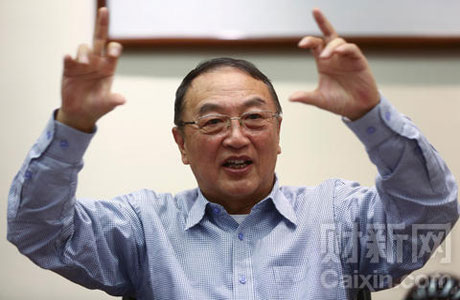
(Beijing) — Liu Chuanzhi, co-founded what is now Legend Holdings – owner of Lenovo, the world’s largest PC maker and seller – has dedicated his life to exploring new ground and pushing boundaries.The corporation that he leads has operations in more than a dozen fields, including computers, real estate, financial services and investment. Still, it was surprising when in 2009 he announced a foray into agriculture, which many thought was a far cry from the company’s image as a high-tech champion.
Liu, who turns 70 years old next year, says that before he retires he wants to take Legend public, which would happen before 2016. During his career, he had stepped down from key positions in the conglomerate to let younger colleagues take the reins – a strategy that he says ensures the business is left in the right hands.
Liu is considered by many to be socially responsible, but some of his remarks have aroused debate, such as recent comments on the role of entrepreneurs in politics, which Liu says were taken out of context.
Caixin editor-in-chief Hu Shuli recently interviewed Liu. Excerpts from their conversation follow.
Caixin: In the discussion of what political role and individual mission entrepreneurs should have, you’ve said that a businessman should mind only business, which has been controversial. Can you talk about how you see the role of the entrepreneur?
Liu Chuanzhi: When I said that businessman should mind only business, I wasn’t speaking on the record but internally because at the time I thought the government was still relatively strong on the ideology front. As an entrepreneur, I’m concerned with my business first. Of course I’m concerned about national affairs, but I’m not willing to speak haphazardly about things I don’t understand, nor do I dare to. Not only am I not willing to speak words I don’t meant to, but I’m also not willing to say words that would bring harm to myself. The best thing to do is to run your company well so that you can create more employment opportunities for society, pay more taxes, honestly engage in business and use actions to motivate those in the same profession. I think this is our duty.
People are fond of talking about the relationship between government and business, or the relationship between government and companies, or rather, between government officials and businessmen. How should an entrepreneur handle this appropriately?
When the government sets policy and everyone works accordingly, this relationship is easier to handle. When I was in Hong Kong, I didn’t feel the government’s presence. It was banks that I dealt with the most if I had to. You don’t feel the government coming after you or helping you. Everyone works according to rules.
So under normal circumstances, it’s best if the government leads policy in a direction that conforms more to the sustainable and healthy development of China’s economy rather than always intervening in specific actions. Ideally, it should streamline administrative procedures and delegate powers.
But before we arrive at this ideal state, entrepreneurs must still deal with the government and government workers. I think it is necessary to respect the government and respect government employees. I’ve told our employees that when facing government employees, at a minimum one thing should be clear: they undertake great responsibility and their work is hard, but their real income may be much lower than ours. Corrupt officials are one thing, but there are many officials who work responsibly, cleanly and honestly. The company needs to respect them and maintain a good relationship with them without pushing things too far. Going too far will cause problems. Take government procurement for example, there will be problems if companies have too close of a relationship with government officials.
Now that Legend has reached a certain size, we try to avoid these issues. But some small businesses can be squeezed and I know this. The feeling of helplessness and having nowhere to go is very painful.
The recent attack on Zong Qinghou (chairman of beverage giant Hangzhou Wahaha Group who was stabbed in the hand by a job-seeker in September) has had a major psychological impact on entrepreneurs. What is your take on that?
China has been reforming and opening up for so many years, but there is a serious problem, which is the rich-poor divide. This division needs further analysis. There are rich people who have profited by illegitimate means. I think these people deserve our hatred. But entrepreneurs themselves cannot be blamed for the rich-poor divide.
What happened to Zong was very unfortunate. It’s a manifestation of the impetuous societal atmosphere. Someone couldn’t find work and became agitated. He went to Zong and bluntly asked for a job. Zong said no, and he responded by taking a knife to him. People are stabbing even doctors, which makes no sense. It only shows how impetuous society has become. It should be said that entrepreneurs have been among the biggest beneficiaries of reform and opening up, so we have a responsibility to have more self-discipline and improve the social atmosphere.
Even under the laws of the market economy, polarization will continue. With good companies and more wealth, everyone’s income will increase, but the gap between rich and poor is still likely to widen. Then we might still need the government to transfer some of the wealth of the rich to vulnerable groups through redistribution.
But I think China’s tax rates are already quite high with double taxation in many places. The key is how the government can make good use of the tax revenue. I think this is something the government should dwell on.
The 30 years of reform and opening up have created many successful entrepreneurs. Now the first generation of them is facing handover issues. What experience does Legend have to share in terms of this?
We made a rule when the company was founded that no offspring are allowed in the company. That wasn’t decided today. And the children aren’t complaining.
I’ve long felt that younger colleagues should rise in ranks early. Thirty year olds can do many things, and this should be a very mature age. If people graduate at 22, assuming they have no plans for a Ph.D program, they would be 24 after two years of graduate school and would have six years of work experience. If they work hard enough in the six years, they would be able to shoulder a heavy responsibility. Yang Yuanqing (Chairman and CEO of Lenovo), for example, took on great responsibility at 29 years old. So it is important to make human resource arrangements early. If you have a person who can lead and work independently, you can open a new line of business.
Take me for an example. I started making arrangements when I was 60 years old and thought I was still capable of working on my own. That means stepping back and letting young colleagues take on the main duties while I watch from the sidelines. If they cooperate well, then I have nothing to worry about when I retire. If not, we can review and make adjustments in two or three years. In between, there won’t be any big problems because I can still work. If things really go wrong, I am still there to pick up the slack and we can still adjust.
If you must wait until you have no choice but to retire and then appoint successors, sticking them together and hoping they can cooperate before getting to know each other, I think there might be issues.
Legend has quite an extensive product line. Why go into agriculture?
Everyone thinks China needs safe food. There’s no doubt about that. And it’s not only food safety. Speaking with the pride of a Chinese, it is against an entrepreneur’s conscience to be unscrupulous if it concerns making food.
I was challenged by a European once. His bluntness made me uncomfortable. The minute I returned home I said we are going into agriculture. All of our executives, including several presidents and executive vice presidents, all take this matter very seriously, and we selected a very good leader. After doing some research, we found that if you do it well, there is profit to be made in agriculture. First, when the area of land reaches a certain scale and agricultural technologies can be used, both yields and produce quality can be improved significantly. Second, if you can create a credible brand, people will be willing to pay for it.
Our involvement in agriculture is also an attempt at contributing to the “three rurals” (i.e. agriculture, rural areas and farmers) strategy. We went in as a leading enterprise and deal with peasants according to market rules. We set up requirements, such as what type of seeds to use and what technical assistance would be provided. Peasants do the real farming work. This way it can be industrialized. It also conforms to the Chinese reality.
We’re serious about agriculture. Food safety has been a real problem. If someone can do a really good job, chances are everyone will follow suit. When we started with computers, we had only a 2 percent market share, and everyone else was a foreign brand. When we got to 27 percent, Founder and Tongfang were No. 2 and No. 3, ahead of the foreign brands. I have the same idea about agriculture. If we don’t shoot for No. 1, other Chinese agricultural companies might not be able to move up.
 About bambooinnovator
 Bamboo Innovator