How a PLA General Built a Web of Corruption to Amass a Fortune; Gu Junshan gave gifts to make sure he rose through the ranks and fabricated a personal history to give himself revolutionary credentials
January 17, 2014 Leave a comment
01.16.2014 18:30
How a PLA General Built a Web of Corruption to Amass a Fortune
Gu Junshan gave gifts to make sure he rose through the ranks and fabricated a personal history to give himself revolutionary credentials
By staff reporter Wang Heyan
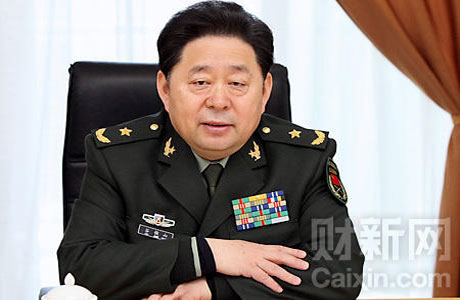
(Puyang, Henan Province) — More than 20 policemen lined up at the gate of a massive mansion in a village in the central province of Henan at midnight on January 12, 2013, loading heavy crates onto two military trucks.
Hours later – loaded with 20 crates of expensive liquor and a number of gold items, including a boat, wash basin and Mao Zedong statute – the trucks disappeared. Behind them was the now empty mansion owned by Gu Junshan, deputy head of the People’s Liberation Army General Logistics Department, who once held the rank of lieutenant general. He had been detained a year earlier.
The official confiscation of property from the families of Gu and his brother took two nights. Officers from the People’s Armed Police and members of the military prosecutor’s office did it at night to avoid attracting attention. It yielded four truckloads of items.
The raid of a property owned by another brother of Gu, who was the chief of the Dongbaicang Village, apparently came too late. It found only empty liquor crates. The younger Gu went into hiding and was arrested seven months later.
No official statement about the investigation into Gu has been released. In early 2012, Gu’s name disappeared from the PLA’s website. Despite media speculation that Gu was being investigated, there was no official confirmation until August 2013, when a PLA officer and military professor, Gong Fangbin, mentioned Gu’s case in an interview with the online forum of a state media outlet.
Gong said that “Gu and his predecessor’s cases made citizens unsatisfied.” The predecessor was Wang Shouye, a former military logistics official who later became a deputy commander in the PLA Navy. Wang received a suspended death sentence in 2006 for taking bribes worth 160 million yuan and keeping mistresses.
Despite the secrecy surrounding Gu’s case, details of his extravagance, the massive scope of corruption and his fast rise to power have emerged. Gu left behind a slew of properties from Henan to Beijing – and the story of a reckless grab for power and money.
A Networker
Puyang, a city in Henan, saw a large number of military investigators arrive from Beijing in early 2012. The team soon expanded to include members from the Communist Party’s Central Discipline Inspection Commission and the country’s top prosecutor’s office. The probe also grew to cover more than 10 charges.
Investigators found a massive web of businesses woven by Gu and his family, and a heavily edited family and personal history to add legitimacy to his rapid rise in military ranks. Gu’s rise from a humble beginning was dotted by many calculated moves.
Gu, born in 1956 to a rural family in Dongbaicang Village, in Puyang, has five brothers and sisters. He joined the military at age 17.
The short, stout Gu was sent to the northeastern city of Jilin, where he joined the ground team for the military airport. Many of his fellow military newcomers did not like him, thinking he tended to spend more time currying the favor of superiors than doing his job. In peer reviews, Gu was often rated “bad.”
But his attention was focused on higher-ups. A fellow soldier said that as soon as a military official was sent to be the political instructor of the regiment, Gu became a frequent visitor, often bringing gifts. The instructors later became a division commander and helped promote Gu, the source said.
Gu also spent time courting the daughter of Zhang Longhai, his regiment’s deputy political commissar. Despite strong opposition from Zhang, the daughter, Zhang Shuyan, married Gu. The father-in-law also rose in military ranks and became the deputy political commissar of a major military division.
In 1985, the central government decided to reduce the size of the military, and Zhang helped to move Gu, a soldier with lackluster skills, to the military-affiliated industry in his hometown of Puyang. The move was a blessing for Gu.
The Puyang military zone set up several factories and Gu served as deputy director for the zone’s business arm. The country was switching from central planning to a market economy, and sources said Gu managed to profit from moving between the controlled and free markets. He bought quota-controlled resources, such as steel, lumber and oil, from state-owned dealers and sold them for a high price. Backed by the windfall, Gu bought expensive gifts for local military leaders, sources said.
Jia Qingxian, then head of Zhongyuan Oil Service Ltd., a company that set up joint venture with the Puyang military zone, said Gu was hardworking and capable. In the joint venture, Zhongyuan provided land, personnel, capital and sales channels, while Gu was responsible for dealing with government agencies. “That was the whole purpose of having a joint venture with the military,” Jia said.
Gu’s work, much of it done at banquet tables, helped the JV thrive. Profits went to Zhongyuan, which sponsored events in the military zone and provided benefits to its employees.
In 1993, Gu was promoted, becoming deputy head of logistics in Puyang. A local military official said he worked day and night, and was very capable at building relations at dinner tables and home visits.
“Even he visited the home of a leader for the first time, he would come back knowing what they need,” the source said.
 About bambooinnovator
 Bamboo Innovator