Thai Farmers Begin Deserting Government Over Late Rice Payments
January 17, 2014 Leave a comment
Thai Farmers Begin Deserting Government Over Late Rice Payments
Thailand’s Flagship Rice Subsidy Is Running Out Of Cash
JAKE MAXWELL WATTS, ISABELLA STEGER and WILAWAN WATCHARASAKWET
Updated Jan. 15, 2014 1:10 p.m. ET
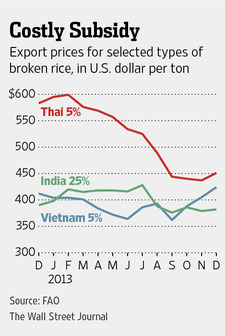
Thailand’s flagship rice subsidy is running out of cash and backfiring at a critical time for Prime Minister Yingluck Shinawatra, whose political future hinges on support from farmers and other rural voters as her rivals intensify their campaign to remove her from office.
The government has been buying up rice from farmers at about 50% above market prices to boost rural incomes since Ms. Yingluck’s Pheu Thai Party took office in 2011. Now, it can’t sell the rice fast enough to fund the subsidy. Rival exporters such as India and Vietnam have ramped up production, selling rice cheaper and knocking Thailand off its perch as the No. 1 exporter.
“Farmers are very angry,” said Nipon Poapongsakorn, a rural development specialist at Thailand Development Research Institute, a think tank. “It is the first time in our history that farmers didn’t get money for the rice that they already sold to the government,”
The state-owned bank tasked with funding the policy, the Bank of Agriculture and Agricultural Cooperatives, is seeking to raise 20 billion baht ($610 million) in a bond auction Thursday it hopes will make up the shortfall from a 75 billion baht auction in November, when only half of the issue was purchased.
The funds will go toward paying rice farmers, some of whom haven’t been paid in months. The government on Wednesday extend a deadline for the payment of October’s harvest, while local media said that in one northern province, only a small fraction of its nearly 50,000 rice farmers received money from the government.
Thailand’s rural population comprises the political base for Ms. Yingluck and her elder brother Thaksin Shinawatra, a polarizing former premier who was ousted in a military coup in 2006. The subsidy is one of a raft of policies aimed at benefiting rural voters that has annoyed the mostly middle-class protesters in Bangkok whose taxes pay for it.
Opponents of the Shinawatra political empire have turned out by the tens of thousands this week to demand Ms. Yingluck’s resignation. The protesters say Ms. Yingluck and her brother’s populist policies amount to vote-buying, while the government maintains its policy benefits farmers, who are among Thai society’s poorest citizens.
The expectations raised by the subsidy program have now become a liability for the government, which has also had to face down protests from rubber farmers and other groups demanding equal treatment.
The delay in payments highlights how the subsidy program has left the agriculture bank—and the government—in a financially precarious situation. Analysts at CIMB Securities said the Thai state incurs costs of about 300 billion baht ($9.2 billion) a year to support rice prices, amounting to about 2.5% of GDP.
Chookiat Ophaswongse, president of the Thai Rice Exporters Association, said approximately 10 million tons of paddy—unprocessed rice—haven’t been paid for by the government, worth about 170 billion baht.
The bond auction Thursday may go some way to alleviating the pressure. Chut Trakoolngam, a dealer at Kasikornbank, said he would take part in the auction and was fairly optimistic the bond will sell because it offers an attractive yield of about 3.2%, but added that the agriculture bank’s debt level is “not sustainable.”
The International Monetary Fund has warned that the debt has eroded the credibility of Thailand’s public finances and recommended in November that the subsidies be scrapped. Some farmers have even turned out in Bangkok to join in the antigovernment protests. Wasana Yingphon, a 45-year-old rice farmer, drove from the ancient capital of Ayutthaya, a stronghold of support for Ms. Yingluck, to the capital in December to complain about missing payments.
Ms. Wasana said many rice farmers are having to go to nonbank lenders and pay high interest rates so they can afford to plant new crops.
With such large outstanding payments, Mr. Chookiat of the rice exporters association said he worries how the government will settle its bills long-term.
“I suspect that the situation will get worse if the government delays their payments any further,” he said.
 About bambooinnovator
 Bamboo Innovator