Banks Sit Out Riskier Deals; Regulatory Pressures Push Some Lenders to Let Lucrative Deals Go
January 22, 2014 Leave a comment
Banks Sit Out Riskier Deals
Regulatory Pressures Push Some Lenders to Let Lucrative Deals Go
GILLIAN TAN
Updated Jan. 21, 2014 8:07 p.m. ET
Regulatory pressures are pushing many of the biggest banks to pass on financing lucrative deals, as Washington targets excessive borrowing. Bank of America Corp. BAC 0.00% , Citigroup Inc. C -0.80% and J.P. Morgan ChaseJPM +0.10% & Co. are among lenders that have in recent months decided against financing some corporate takeovers partly out of concern the deals will run afoul of new guidelines. Those guidelines are designed to keep banks away from deals regulators feel are too laden with debt.Starting late last summer, the Office of the Comptroller of the Currency and the Federal Reserve sent letters to about a dozen big banks saying they need to comply with the guidance—regulators’ latest effort to reduce risk in the banking industry following the financial crisis.
The new push could make deals more costly for private-equity firms, which rely on banks to lend much of the borrowed money that helps fuel their corporate takeovers. It could also create opportunity for other firms, such as some securities dealers, that aren’t regulated like banks and thus aren’t subject to the same strict regimen of regulation over lending. And it could crimp the fees banks generate from providing financing for private-equity deals in the U.S., which last year totaled $7.1 billion, according to Dealogic.
For banks, the pressure comes as Washington seeks to crack down on behavior seen as potentially harmful to the broader financial system. Regulators, who were criticized for lax oversight leading up to the financial crisis, are increasingly telling banks which lines of business they can operate in and cautioning them to steer clear of certain areas or face potential supervisory or enforcement action.
“The impact on private equity, a significant driver of what we see as risky practices, is an intended consequence of our actions,” Martin Pfinsgraff, the OCC’s senior deputy comptroller for large-bank supervision, said in an interview. “As regulators, we certainly hope to change bad practices and remove the extraordinary froth that’s experienced at the peak of a credit cycle. If we can mitigate that, it reduces the size of the valley to follow.”
In the letters, the Federal Reserve and the OCC demanded banks comply with guidance published in March 2013 saying they should avoid financing takeover deals that involve putting debt on a company of more than six times its earnings before interest, taxes, depreciation and amortization, or Ebitda, among other factors regulators consider risky, according to people who have seen the correspondence.
Earlier
Carlyle Agrees To Buy Johnson & Johnson’s Blood-Testing Unit (1/16/14)
KKR Buys Landscaper Brickman Group for $1.6 Billion (11/11/13)
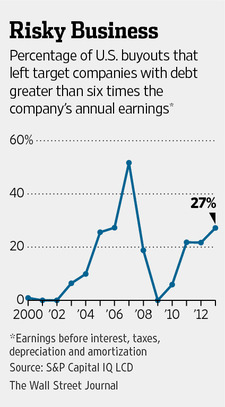
In 2013, the percentage of new U.S. leveraged buyouts with a debt-to-Ebitda ratio above six times was, at 27%, the highest it has been since 2007, when the percentage reached 52%, according to S&P Capital IQ LCD.
Buyouts aren’t seen as a big contributor to the financial crisis, and few banks suffered outsize losses from them. However, some companies laden with debt in these deals have struggled or collapsed, and many investors in their debt lost money.
If banks repeatedly participate in deals regulators consider unduly risky, they could be fined or face other sanctions, Mr. Pfinsgraff said.
Loans with debt ratios above the guidance may be permitted if, say, regulators view the industry the borrower operates in especially favorably, or if the bank convinces regulators the loan has strong odds of repayment. But Mr. Pfinsgraff said “exceptions will not be the norm.”
Regulators are far less concerned with bonds issued for these deals, which banks tend not to hold on to. That is leading some private-equity firms to structure deals with a bigger bond portion, bankers say. Since bonds are typically more expensive than loans, the revised structure can make the deals more costly.
Citigroup decided, partly because of the new guidance, not to finance buyout shop KKRKKR +2.02% & Co.’s $1.6 billion acquisition of commercial landscaper Brickman Group Ltd., according to people familiar with the deal, which was announced in November. Similarly, J.P. Morgan and Bank of America are sitting out Carlyle Group CG +1.90% LP’s planned $4.15 billion acquisition of Johnson & Johnson’s blood-testing unit, announced last week, partly because of the new guidance, according to people familiar with that deal.
Citigroup made its decision partly because of the debt load Brickman is expected to carry, the people said. Moody’s Investors Service said the deal was likely to carry 6.8 times debt-to-Ebitda as part of the acquisition. By sitting out, Citigroup missed out on a potential fee of roughly $10 million, some of the people said.
Carlyle’s acquisition of the blood-testing unit, inked this month, will put debt of about 6.9 times Ebitda on the business once it is separated from the health-care giant, according to people familiar with the deal. J.P. Morgan and Bank of America could have earned more than $20 million each for helping lead financing for it, according to people familiar with the matter.
A number of competitors of the three banks agreed to fund the two deals. Some did so based on different interpretations of the guidance, or because they had already signed contracts to participate in the takeovers before regulators sent their letters, or because they aren’t subject to the bank guidance, people familiar with the firms say.
Nonbank lenders who could gain market share because they aren’t subject to the guidance include broker-dealers like Jefferies Group LLC and the capital-markets and credit arms of buyout firms like KKR and Blackstone Group LP.
The Fed and the OCC’s focus includes loans, mostly related to new buyouts, that lenders sell to other banks and investors, according to the published guidance, as regulators want the banks to have responsibility for products they distribute.
One practice in particular the OCC is aiming to deter, says Mr. Pfinsgraff, is dividend recapitalizations, or deals in which private-equity firms put new debt on companies they already own to pay themselves dividends. The agencies may approve refinancing transactions they would otherwise look askance at if they improve a company’s overall financial health, he adds.
It isn’t clear how the new regime will play out for the private-equity business.
“We are waiting to see how lending institutions integrate the leveraged lending guidance into their operations and what the practical effect of the guidance will be,” said Jason Mulvihill, general counsel of the Private Equity Growth Capital Council, which represents private-equity firms on policy and other matters. He added that lenders “have flexibility to make decisions based on the particulars of each loan.”
Some investors are fretting over the guidelines.
“Micromanaging lending in this manner could potentially shake the fundamental tenets of the leveraged-loan markets and lead to unintended consequences, such as distorted pricing or limited supply,” said Alex Jackson, who invests in high-yield loans on behalf of Cutwater Asset Management, which oversees $26 billion. “It’s a little disturbing.”
 About bambooinnovator
 Bamboo Innovator