Indian Companies Sell Assets to Ease Debt; Rising Non-Performing Loans Prompt Banks to Pressure Borrowers
January 22, 2014 Leave a comment
Indian Companies Sell Assets to Ease Debt
Rising Non-Performing Loans Prompt Banks to Pressure Borrowers
KENAN MACHADO
Jan. 21, 2014 7:49 a.m. ET
Indian firms are selling their assets to raise cash, as banks are tightening the screws on loan repayments to help stem rising bad debt. Several companies sold pieces of their business last year, and bankers say more are likely to do so in the coming year, as the Indian economy continues to be sluggish and interest rates remain high.Indian companies had borrowed heavily in the late 2000s, when interest rates were low and India’s economy was growing between 8% and 9%. Companies used the money to fund ambitious expansion plans, which included diversifying into new businesses and global locations.
“People thought that the party would go on forever,” said Avinash Gupta, head of finance at consultancy firm Deloitte Touche Tohmatsu India Pvt. Ltd.
But India’s economic growth is now hovering around 5%, and some of these companies are struggling to repay debt because their businesses didn’t grow as fast as they had expected. Many large projects, especially in infrastructure, have stalled due to delays in regulatory approvals stemming from tougher government policies, while rising domestic interest rates have added to borrowers’ repayment woes.
India’s lending rate had risen to as high as 8.5% in 2012, increasing the stress on companies to service their debt obligations. The excess debt at large corporates is high and is a potential source of additional asset quality stress for banks, Credit SuisseCSGN.VX +0.41%
said in a report in August.
“Aggressive expansion by corporates during the boom phase with resultant excess capacities,” contributed to worsening loan quality at banks, the Reserve Bank of India said in December.
Indian banks’ nonperforming assets climbed to 4.2% of total loans at the end of September from 2.4% in 2009, according to the latest data from India’s central bank.
Worried about deteriorating loan quality, Indian banks have over the last year been pushing companies—especially those in the infrastructure and power sectors—to repay their debt. Last month, at least three companies sold their investments in other companies or their units to raise money to repay debt.
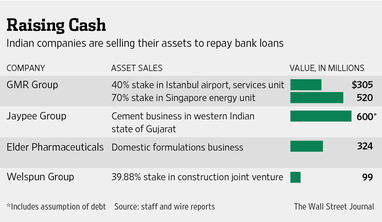
Infrastructure firm GMR Group, based in the southern Indian city of Hyderabad, agreed to sell its 40% stake in Istanbul’s international airport and another firm providing airline services for 225 million euros ($305 million) in December, just months after it sold a 70% stake in GMR Energy (Singapore) Pte. Ltd. for about $520 million in March.
The company had $6.2 billion in debt as of Sept. 30, according to company filings. A debt-to-equity ratio of one or lower would be comfortable for Indian companies, analysts say, but GMR’s ratio was sharply higher at 4.9 as of June, Credit Suisse said in a report.
Mumbai-based Welspun Corp. 532144.BY -0.15% , which has interests ranging from construction to textiles to steel, last month agreed to exit its Indian construction venture with Australia’s Leighton Group by selling its indirectly held 39.88% stake for $99 million. The money would be used mostly to reduce its excess debt, Welspun said in a statement issued at the time.
Also in December, Elder Pharmaceuticals Ltd. 532322.BY +1.43% said it would sell its branded formulations business in India and Nepal to Torrent Pharmaceuticals Ltd.500420.BY +0.21% for $323.8 million. The firm’s liabilities totaled $282 million at the end of June, eclipsing its annual income of $211.6 million and $17 million in cash, according to Factiva.
All three sellers didn’t respond to requests for comment.
Bankers say they expect more companies to sell some assets or businesses in the coming months. Many Indian companies that took loans to fund global acquisition sprees in the boom years are under stress because of the economic downturn world-wide.
“We are pitching for that business,” said Manisha Girotra, India head of U.S. investment bank Moelis & Co. in a recent interview. Ms. Girotra declined to name any companies.
But selling assets in the current downturn isn’t going to be easy, bankers say, since global and Indian banks are hesitant to back companies seeking to buy struggling businesses that need large amounts of cash to turn around.
Construction firm Jaypee Group, for instance, took more than a year to sell some of its cement operations in the western Indian state of Gujarat. Its unit, Jaypee Cement Corp., reached an agreement to sell the assets to UltraTech Cement Ltd. 532538.BY -0.73% for about $600 million in September. Jaypee Group had debt of about $10.4 billion and a debt-to-equity ratio of 4.8 as of as of June, according to a Credit Suisse report in August.
There “should possibly be a lot more of such deals” as Indian firms seek to cut debt, said Deloitte’s Mr. Gupta.
 About bambooinnovator
 Bamboo Innovator