The Calm Smile of the Bodhisattva
January 22, 2014 Leave a comment
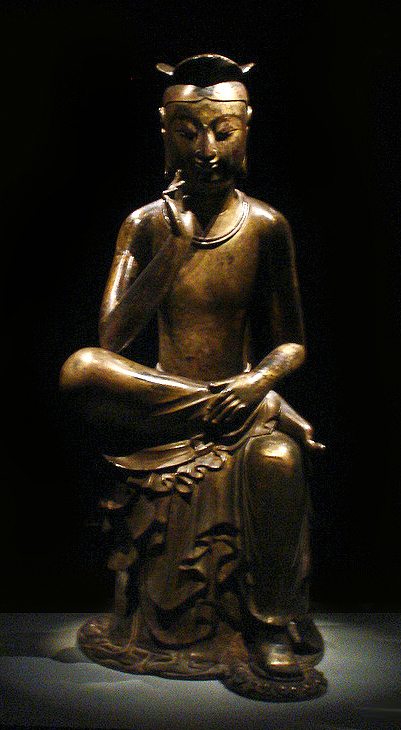
Korea’s Gilt Bronze Maitreya Bodhisattva Bangasayusang

Whenever I visit a Buddhist temple, I always pay respect to the main Buddha statue first because the holy image is a symbol that represents the virtues of mercy, compassion, wisdom, generosity, philanthropy and enlightenment.
Despite differences of religion, ideology and nationality, many people in the world admire the significance and profound aesthetic value of Buddhist art and give respect to the basic tenets of Buddhist philosophy. It is uncontestable that Buddhism has played a significant role in the spiritual development of modern civilization.
I am most inspired by the sublime tranquility of the Maitreya Bodhisattva in the Meditation statues in the Gyeongju National Museum and the National Museum of Korea.
It is encouraging that ancient Silla Dynasty artifacts have captivated the heart of many New Yorkers at the exhibition titled ”Silla: Korea’s Golden Kingdom” that is on display at the Metropolitan Museum of Art in New York through Feb. 23.
There are approximately 100 sophisticated ancient Silla cultural assets including Buddha statues, golden crowns and ornaments such as belts, rings and earrings on exhibit in New York. I surmise that the highlight of the display at the Metropolitan Museum of Art is Korea’s National Treasure No. 83, the precious ”Geumdong Mireuk Bosal Banga-sang,” the gilt-bronze Pensive Maitreya Bodhisattva in Meditation.
This statue is regarded as one of the greatest masterpieces of all Korean Buddhist sculpture. It was discovered in the 1920s in Gyeongju, the ancient capital of Silla. It measures 93.9 cm tall and was made in the 7th century.
The Bodhisattva image is in profound contemplation and its facial features are not very happy. It seems to depict human anguish. However, when I look more closely, I see a mysterious smile on his indescribably peaceful face. In a sense, the figure shows a holiness that cannot be easily described in words. The Pensive Maitreya Bodhisattva in Meditation statue reminds me of Rodin’s famous sculpture “The Thinker.”
Rodin’s “Thinker” is a solitary thinker, sitting all by himself. The nude figure sits in intense contemplation, twisting awkwardly, resting his right elbow on his left knee. Rodin’s statue is a powerful yet enigmatic figure in profound concentration. The pose of “The Thinker”, like the Pensive Buddha statue, leads us into thoughtful quiet and contemplation.
It is presumed that the Pensive Bodhisattva statue style originated in India because the statue suggests the way Shakyamuni is assumed to have lost himself in deep thought while reflecting on the evanescence of human life when he was the young Crown Prince “Siddhartha” prior to renouncing the world.
This gilt-bronze Maitreya Bodhisattva statue was almost excluded from the New York exhibit because of one administrator’s fear that the statue could be damaged in transit. However, after heated debates among cultural experts in Korea, the objection of the former head of the Cultural Heritage Administration of Korea was overridden.
I hope this revered statue will evoke peace, harmony, love, and good fortune for 2014 with its serious posture and graceful, calm smile. Our Korean Maitreya Bodhisattva looks vibrant and engaged in real life, almost like it is alive.
The smiling statue is the apex of historical, religious, artistic and aesthetic values. May 2014 be the year North and South Korea unite as one peaceful nation in the Maitreya’s (friendly) vision.
Choe Chong-dae is a guest columnist of The Korea Times and the president of Dae-kwang International Co., as well as a director of the Korean-Swedish Association. He can be reached at dkic98@chol.com
A Bodhisattva is the symbol of compassion who seeks enlightenment while also trying to save all sentient beings by spreading the Buddha’s teachings. The Maitreya Bodhisattva is also referred to as the Ilsaengpoch’ (一生補處; Eka-jati-prati-baddha) Bodhisattva, meaning that the Matireya Bodhisattva will be the next Buddha after the Shakyamuni Buddha. According to the Mirukhasaengkyong sutra(彌勒下生經) and the Kwanmirukposal Sangsaengtosolch’onkyong sutra(觀彌勒菩薩 上生兜率天經), the Maitreya Bodhisattva was born in Varanasi in southern India to a Brahman family. He received the teachings from the Shakyamuni Buddha who predicted that he would become the next Buddha. The Maitreya Bodhisattva then ascended to Tusita Heaven where he now teaches the Dharma to the Gods residing there. Tusita Heaven refers to a heaven of full knowledge and satisfaction, where no greed or worldly desires exist. The Gods there have perfect knowledge(吾唯知足)and do not need materials or external objects to be satisfied. According to tradition, the Matireya Bodhisattva will return to the Saba(secular) world 5 670 000 000 years after the death of the Shakyamuni Buddha. He will attain Buddhahood under the Naga-puspa(dragon-flower) tree in a lotus garden(華林園) and will save all sentient beings with 3 Dharma Talks. The Maitreya Bodhisattva is the epitomy of compassion in Mahayana Buddhism and was the one predicted to be the future Buddha by the Shakyamuni Buddha himself. The Maitreya Bodhisattva represents a very important figure in Buddhism. It is believed that if one dilligently cultivates one’s virtues in this lifetime, one will be reborn into Tusita Heaven where he/she will meet the Maitreya Bodhisattva. Furthermore he/she will also be present at the Maitreya Bodhisattva’s first Dharma Talk after his enlightenment and attain enlightenment himself. Hence the tradition of worshipping the Maitreya, Amitab ha and Avalokitesvara Bodhisattvas remains strong among the Buddhist populace even today.
 About bambooinnovator
 Bamboo Innovator