Big Bang Disruption: Business Survival in the Age of Constant Innovation
January 24, 2014 Leave a comment
January 22, 2014 4:15 pm
‘Big Bang Disruption’, by Larry Downes and Paul Nunes
Review by Jonathan Guthrie
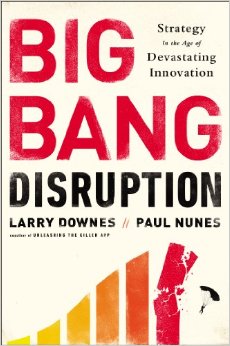
Big Bang Disruption: Business Survival in the Age of Constant Innovation, by Larry Downes and Paul Nunes, Portfolio Penguin, $29.95; £14.99
When asked how he went bankrupt, a character in Ernest Hemingway’s novel The Sun Also Rises, replies: “Two ways. Gradually and then suddenly.” This neat summation of how business failure creeps up on victims is quoted in Big Bang Disruption , a book with more than a whiff of apocalyptic prophecy about it.
The book plays to the belief that technology has made incumbent companies more prone to destruction by new entrants than ever before. Authors Larry Downes and Paul Nunes have encapsulated this in a buzzphrase – “Big Bang Disruption” – as anyone writing a popular business tome must do for marketing purposes. But any reader who is not a technology obsessive is likely to be no more than half convinced by their thesis.
Noting the rapid uptake and equally fast abandonment of new personal technology such as games consoles and smartphones by consumers, Downes and Nunes theorise that Everett Rogers’ classic bell curve of demand is redundant. Instead of anticipating smoothly rising and falling sales of new products, business must retool to cope with a “shark fin” pattern of purchasing. Here, demand is explosive and its collapse almost as precipitous.
A sceptic would argue that the shark fin is merely a bell curve with a telescoped time axis.
It is true that cycles of product development in personal technology and web-based business are punishingly short. But it is wrong to assert that the same pattern and the same threats apply to all other industries. Incumbents retain significant competitive advantage across a swath of sectors.
Another fallacy common within the tech industry is that we live in age of unprecedented innovation. The first shaggy warrior to have his stone weapon knocked from his hand by an early adopter with a bronze sword would have disagreed. The micro processor is just the latest in a long line of disruptive technologies. In the past few centuries alone we have had cast iron, canals, railways, penicillin, domestic electricity, internal combustion engines, aircraft and the telephone.
The authors correctly point out that barriers to entry have toppled in some parts of the software and internet industries as memory has become cheaper and open-source tools and cloud-based services more available. But as they rather uncomfortably admit, the opposite applies in pharmaceuticals, where breakthroughs are increasingly expensive. Perplexingly they blame this in part on regulation. Personally, I am glad that groovy young drug developers cannot randomly release new treatments dreamt up during coffee-fuelled “hackathons” in imitation of peers in the software business.
The criticisms above are a sign that Big Bang Disruption is, at the least, a stimulating read. It is carefully researched and accessibly written, if a tad breathless in style. The case studies on disruption alone are worth the cover price. These include the destruction of the pinball machine industry by computer games.
The book partly draws on research by the Accenture Institute for High Performance, of which Nunes is a managing director. Downes, meanwhile, is a consultant and co-author of the book Unleashing the Killer App.
The marketing pitch for Big Bang Destruction is partly that it will help incumbents avoid annihilation at the hands of disruptive entrepreneurs. The book is a bit light on such advice. There is a section on stalling tactics. The wisdom here boils down to “sue ’em”. The authors, one sometimes suspects, are secretly rooting for the disrupters.
Probably the best strategy for avoiding disrupters – which is not covered in the book – is to avoid vulnerable sectors such as entertainment or information retailing. Try banking, instead.
Big Bang Disruption: Strategy in the Age of Devastating Innovation Hardcover
by Larry Downes (Author) , Paul Nunes (Author)
It used to take years or even decades for disruptive innovations to dethrone dominant products and services. But now any business can be devastated virtually overnight by something better and cheaper. How can executives protect themselves and harness the power of Big Bang Disruption?
Just a few years ago, drivers happily spent more than $200 for a GPS unit. But as smartphones exploded in popularity, free navigation apps exceeded the performance of stand-alone devices. Eighteen months after the debut of the navigation apps, leading GPS manufacturers had lost 85 percent of their market value.
Consumer electronics and computer makers have long struggled in a world of exponential technology improvements and short product life spans. But until recently, hotels, taxi services, doctors, and energy companies had little to fear from the information revolution.
Those days are gone forever. Software-based products are replacing physical goods. And every service provider must compete with cloud-based tools that offer customers a better way to interact.
Today, start-ups with minimal experience and no capital can unravel your strategy before you even begin to grasp what’s happening. Never mind the “innovator’s dilemma”—this is the innovator’s disaster. And it’s happening in nearly every industry.
Worse, Big Bang Disruptors may not even see you as competition. They don’t share your approach to customer service, and they’re not sizing up your product line to offer better prices. You may simply be collateral damage in their efforts to win completely different markets.
The good news is that any business can master the strategy of the start-ups. Larry Downes and Paul Nunes analyze the origins, economics, and anatomy of Big Bang Disruption. They identify four key stages of the new innovation life cycle, helping you spot potential disruptors in time. And they offer twelve rules for defending your markets, launching disruptors of your own, and getting out while there’s still time.
Based on extensive research by the Accenture Institute for High Performance and in-depth interviews with entrepreneurs, investors, and executives from more than thirty industries, Big Bang Disruption will arm you with strategies and insights to thrive in this brave new world.
 About bambooinnovator
 Bamboo Innovator