Google Is Raking In Huge Sums Of Money From A New Type Of Online Shopping That Hurts Amazon
January 24, 2014 Leave a comment
Google Is Raking In Huge Sums Of Money From A New Type Of Online Shopping That Hurts Amazon
JIM EDWARDS
JAN. 22, 2014, 12:52 PM 14,440 9
Late in 2012, Google quietly introduced a new type of search ad. “Product Listing Ads” (PLAs) are those photo boxes that appear at the top of Google’s results pages when you search for stuff that is shopping related, like “Ugg boots” or “iPhone charger.”
Turns out the new format has been a huge success for Google, according to data from Marin Software, which buys PLA campaigns for its clients.
That’s likely bad news for Amazon.
PLAs push Amazon’s organic, non-paid search results farther down the page every time they appear. In search advertising, everyone knows that the top of the page is key. The bottom of the page is shopping Siberia — and that’s where Amazon’s pages are now frequently ranked on Google. Frequently, when you do a search that generates PLAs, the shopping ads will display ads for all Amazon’s competitors on that product line. But not Amazon.
Amazon is known to be highly sensitive regarding Google’s use of PLAs. The company has declined to buy any PLAs from Google to boost its search rankings. They must work, however, because several of Amazon’s subsidiary units — Zappos, Diapers.com, Wag.com Soap.com, and BeautyBar.com — have upped their PLA budgets during the course of the year, according to Jefferies Research. (Amazon did not immediately respond to a request for comment.)
Those increased budgets from all of Google’s online retailers have swelled the search giant’s coffers in 2013, Marin says.
Analyst Ben Schachter and his team at Macquarie Capital agrees. In a pre-earnings note to GOOG investors yesterday, he wrote, “We expect a strong quarter from Google, and believe that PLAs in particular will drive upside, as PLAs pricing/competition has been better than expected.” Google will deliver its Q4 2013 earnings on Jan. 30.
This chart from Marin shows how spending on PLAs has quadrupled:

Marin Software
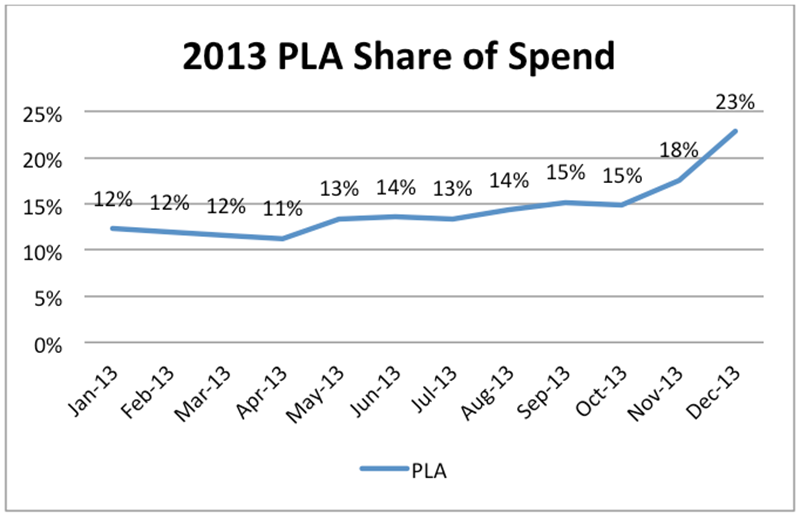
The data above are indexed, where 100 is the level in January 2013. Marin’s dataset looks at clients spending more than $100,000 a month on search ads. Nearly a quarter of retail paid search budgets during the Thanksgiving-Christmas season went on PLAs, Marin says.
“By December, retailers were allocating 23% of their paid search budget toward PLAs, a 92% increase over January,” the company said in a blog post:
Marin Software
The cost-per-click to advertisers went up as more advertisers spent money on them:

Marin Software
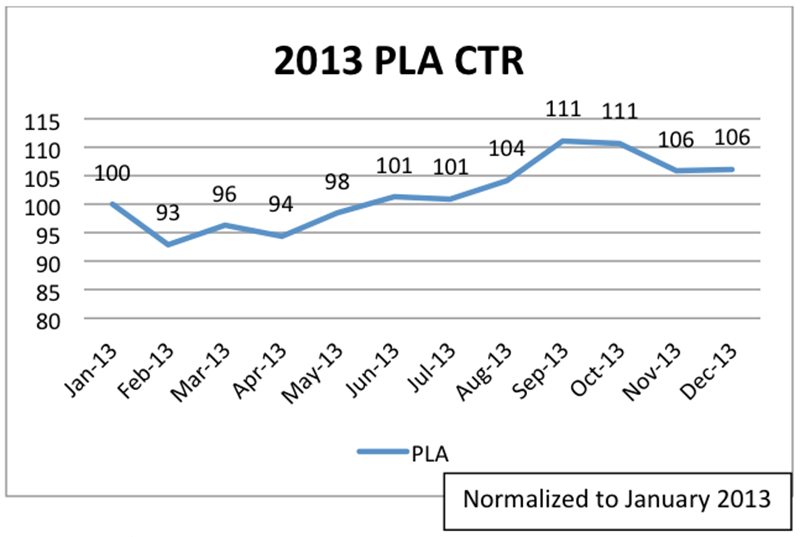
And the click-through rate was also higher than average:
Marin Software
“The image-based ad format resonates well with users – consumers can see what they’re looking for – and streamlines the shopping the experience. The large images and prominent placement help retailers lure shoppers to websites as well as stores,” said Matt Ackley, CMO of Marin Software. “We expect this percentage [of spending] to grow to 33% in 2014.”
 About bambooinnovator
 Bamboo Innovator