Aberdeen Cheers Crackdown as NSE Readies Fines: Corporate India

Aberdeen Cheers Crackdown as NSE Readies Fines: Corporate India

India’s stock exchanges are stepping up pressure on listed companies to improve shareholder disclosures as foreign institutional investors boost holdings in Asia’s fifth-largest equity market to an all-time high.

The National Stock Exchange of India Ltd. has asked at least 54 companies, including Reliance Industries Ltd. (RIL) and Bharti Airtel Ltd., to provide more information or explain unusual share-price swings since Nov. 18, when the securities regulator compelled bourses to tighten oversight and levy fines for lax disclosures. That compares with 42 requests in the previous 11 months, data compiled by Bloomberg show.

Overseas money managers who bought $45 billion of Indian shares in the past two years are seeking more information from companies, while local mutual funds cite a lack of transparency as one reason they pulled $3.42 billion from equities in 2013.

“Greater scrutiny of companies is generally a positive,” Hugh Young, a Singapore-based managing director at Aberdeen Asset Management Plc (ADN), which oversees about $319 billion worldwide, said in an e-mailed interview on Jan. 20. “India’s disclosure standards are not great compared with developed markets.”

The Securities and Exchange Board of India plans to announce new corporate governance rules next month as policy makers seek to prevent repeats of the payment default at the National Spot Exchange of India.

Penalties

Regulators globally are expanding scrutiny of markets from metals to currencies, tightening rules on capital buffers and cracking down on crimes from money laundering to interest-rate rigging. Global fines linked to the manipulation of the London Interbank Offered Rate, or Libor, have reached $6 billion.

India’s National Stock Exchange will soon start imposing penalties on non-compliant companies, Senior Vice President Ravi Varanasi said in an interview on Jan. 21. Rival BSE Ltd., the nation’s oldest bourse, has also increased scrutiny, according to V. Balasubramaniam, its chief business officer.

Fines can reach 10,000 rupees ($161) a day in case of delays in submitting financial results, according to Sebi’s website. An additional penalty of 0.1 percent of the equity capital or 10 million rupees, whichever is less, will be levied on companies that fail to comply for more than 15 days.

In a note dated Nov. 18, the Sebi cited an International Monetary Fund report saying Indian exchanges “have not acted as vigorously as necessary in enforcing compliance” by issuers with the reporting rules.

Corporate Governance

“Stock exchanges must own up responsibility for improving corporate governance,” U.K. Sinha, chairman of SEBI, said in an Jan. 21 interview.

The S&P BSE Sensex (SENSEX) rose 9 percent in 2013, its best annual performance among the four-largest emerging markets, boosted by $20 billion of equity purchases by global investors last year, the most in Asia after Japan. Net purchases in 2012 were $24.6 billion, data compiled by Bloomberg show. The Sensex fell from a record today, losing 0.1 percent at 9:32 a.m.

There is a proposal to grant more sweeping powers to the regulator in search and seizure procedures, consent orders and prevention of insider trading, Sinha said.

“The NSEL fiasco and the new corporate governance rules have prompted this change,” Sandeep Parekh, founder of Finsec Law Advisors Ltd. and a former Sebi executive director, said in a phone interview on Jan. 15.

Petronas Stake

Trading on NSEL was suspended in July after the country’s largest spot exchange failed to settle about 56 billion rupees ($905 million) in dues to investors. The payment crisis led to shares of Financial Technologies (India) Ltd. (FTECH), which owns the bourse, sinking 84 percent in 2013.

When the NSE sought clarification from billionaire Mukesh Ambani’s Reliance Industries regarding a newspaper report that the owner of the world’s largest refining complex was looking to buy a stake owned by Petroliam Nasional Bhd in a $20-billion Venezuela venture, the company said Jan. 15 “it continues to look for opportunities to grow its business internationally and cannot make any specific comment on the media report.”

Tushar Pania, Reliance’s spokesman in Mumbai, didn’t reply to an e-mail requesting comment.

The NSE asked Bharti Airtel Jan. 17 to verify a newspaper report that the country’s top mobile-phone carrier was buying a rival operator. Bharti said three days later that it frequently receives proposals for potential transaction and won’t comment on the “speculative news item.” The company added that it had not released any specific information. Ashutosh Sharma, a spokesman at Bharti, declined to comment.

In January 2013, Sebi called for comments on its proposed measures to limit the tenure of auditors and independent directors, establish whistle-blower policies and screen related-party trades. The regulator could delist errant companies, fine managements and bar founders from raising money for non-compliance. The feedback on the proposals is being examined by the regulator, Sinha said.

“Investors are seeking quality information from companies and failure to provide it may bring down investors’ trust,” Jagannadham Thunuguntla, chief strategist at New Delhi-based SMC Global Securities Ltd., said by phone yesterday.

To contact the reporters on this story: Bhuma Shrivastava in Mumbai at bshrivastav1@bloomberg.net; Santanu Chakraborty in Mumbai at schakrabor11@bloomberg.net

Billionaire Kotak Sees Balance-Sheet Challenges at Indian Banks

Billionaire Kotak Sees Balance-Sheet Challenges at Indian Banks

Billionaire Uday Kotak, the controlling shareholder of the Indian bank with the highest lending margins, said rising bad loans will pose challenges this year to lenders in Asia’s third-largest economy.

“Balance-sheet challenges for Indian banking will be a key issue for 2014,” Kotak, managing director of Mumbai-based Kotak Mahindra Bank Ltd. (KMB), said in a Bloomberg Television interview with Matthew Miller and Francine Lacqua from the World Economic Forum in Davos, Switzerland. “Indian banking, especially if some of the banks get under pressure, will require some amount of consolidation and strengthening.”

Slowing loan growth and a surge in soured debt is eroding profitability at Indian banks amid an economic slowdown. The central bank predicts the economy will expand 5 percent in the 12 months through March 31, the same pace as the last fiscal year, which was the weakest rate in a decade.

Indian lenders’ bad loans rose to 4.2 percent of total credit as of Sept. 30, the highest level in at least six years, according to a Dec. 30 report from the Reserve Bank of India. Profitability at the country’s banks, as measured by return on equity, fell to a six-year low of 10.2 percent in the year to Sept. 30, the report showed.

Kotak Mahindra, based in Mumbai, had a gross bad-loan ratio of 2 percent as of Dec. 31, up from 1.46 percent a year earlier, exchange filings showed. The bank avoided lending to sectors including airlines and the diamond industry to keep bad loans in check, Kotak said in the interview.

The lender had a net interest margin of 4.8 percent at the end of last year, the highest among 40 publicly traded banks in India, according to exchange filings.

Shares of Kotak Mahindra fell 0.7 percent to 705.30 rupees at the close in Mumbai. The stock gained 12 percent in 2013, making it the S&P BSE Bankex index’s best performer. The gauge of 12 lenders slumped 9.4 percent last year.

To contact the reporter on this story: Anto Antony in Mumbai at aantony1@bloomberg.net

Netafim to Build Largest India’s Drip-Irrigation Project

Jain Irrigation competes with Netafim.. A once-good company bogged down by over-indebtedness..
—-
Netafim to Build Largest India’s Drip-Irrigation Project

The Indian unit of Netafim Irrigation Inc., a smart-drip and micro-irrigation specialist for farmers, won a 3.81 billion-rupee ($62 million) water project contract in the southern state of Karnataka.

The company will build an automated water pipeline network to more efficiently drip-irrigate about 29,000 acres (11,800 hectares) of land in the Bagalkot area of Karnataka, its largest in India, Netafim Irrigation India Pvt. said.

The contract auctioned by state-owned Krishna Bhagya Jala Nigam Ltd. will help 6,000 farmers through a simultaneous release of water so growers even at the end of the network get the same amount of water as those closer to the supply source. Netafim said it will build the project with partner Megha Engineering and Infrastructure Ltd.

“This is our largest project in India,” Avinash Thakur, Netafim’s head of marketing, said today by phone from Vadodara. Netafim, present in seven Indian states, is an Israeli firm that started in the Negev desert in 1965.

The privately owned global seller of smart-drip and water-saving products originated in a kibbutz when members teamed with an engineer who discovered that a slow and balanced supply of water improved plant growth.

The Ramthal-Marol drip-irrigation project is India’s biggest such project. Only 32 percent of all farmland in the world’s second-most populous nation is irrigated, according to World Bank data.

To contact the reporter on this story: Archana Chaudhary in New Delhi at achaudhary2@bloomberg.net

David Brooks: The Art of Presence; Do be a builder

The Art of Presence
JAN. 20, 2014
David Brooks
Tragedy has twice visited the Woodiwiss family. In 2008, Anna Woodiwiss, then 27, was working for a service organization in Afghanistan. On April 1, she went horseback riding and was thrown, dying from her injuries. In 2013, her younger sister Catherine, then 26, was biking to work from her home in Washington. She was hit by a car and her face was severely smashed up. She has endured and will continue to endure a series of operations. For a time, she breathed and ate through a tube, unable to speak. The recovery is slow.
The victims of trauma, she writes in a remarkable blog post for Sojourners, experience days “when you feel like a quivering, cowardly shell of yourself, when despair yawns as a terrible chasm, when fear paralyzes any chance for pleasure. This is just a fight that has to be won, over and over and over again.”
Her mother, Mary, talks about the deep organic grief that a parent feels when they have lost one child and seen another badly injured, a pain felt in bones and fiber.
But suffering is a teacher. And, among other things, the Woodiwisses drew a few lessons, which at least apply to their own experience, about how those of us outside the zone of trauma might better communicate with those inside the zone. There are no uniformly right responses, but their collective wisdom, some of it contained in Catherine’s Sojourners piece, is quite useful:
Do be there. Some people think that those who experience trauma need space to sort things through. Assume the opposite. Most people need presence. The Woodiwisses say they were awed after each tragedy by the number of people, many of whom had been mere acquaintances, who showed up and offered love, from across the nation and the continents. They were also disoriented by a number of close friends who simply weren’t there, who were afraid or too busy.
Anna and Catherine’s father, Ashley, says he could detect no pattern to help predict who would step up and provide the ministry of presence and who would fumble. Neither age, experience nor personal belief correlated with sensitivity and love.
Don’t compare, ever. Don’t say, “I understand what it’s like to lose a child. My dog died, and that was hard, too.” Even if the comparison seems more germane, don’t make it. Each trauma should be respected in its uniqueness. Each story should be heard attentively as its own thing. “From the inside,” Catherine writes, comparisons “sting as clueless, careless, or just plain false.”
Do bring soup. The non-verbal expressions of love are as healing as eloquence. When Mary was living with Catherine during her recovery, some young friend noticed she didn’t have a bathmat. He went to Target and got a bathmat. Mary says she will never forget that.
Do not say “you’ll get over it.” “There is no such thing as ‘getting over it,’ ” Catherine writes, “A major disruption leaves a new normal in its wake. There is no ‘back to the old me.’ ”
Do be a builder. The Woodiwisses distinguish between firefighters and builders. Firefighters drop everything and arrive at the moment of crisis. Builders are there for years and years, walking alongside as the victims live out in the world. Very few people are capable of performing both roles.
Don’t say it’s all for the best or try to make sense out of what has happened.Catherine and her parents speak with astonishing gentleness and quiet thoughtfulness, but it’s pretty obvious that these tragedies have stripped away their tolerance for pretense and unrooted optimism.
Ashley also warned against those who would overinterpret, and try to make sense of the inexplicable. Even devout Christians, as the Woodiwisses are, should worry about taking theology beyond its limits. Theology is a grounding in ultimate hope, not a formula book to explain away each individual event.
I’d say that what these experiences call for is a sort of passive activism. We have a tendency, especially in an achievement-oriented culture, to want to solve problems and repair brokenness — to propose, plan, fix, interpret, explain and solve. But what seems to be needed here is the art of presence — to perform tasks without trying to control or alter the elemental situation. Allow nature to take its course. Grant the sufferers the dignity of their own process. Let them define meaning. Sit simply through moments of pain and uncomfortable darkness. Be practical, mundane, simple and direct.
Ashley and Mary went to Afghanistan a few months after Anna’s death. They remember that as a time out of time. They wept together with Afghan villagers and felt touched by grace. “That period changed me and opened my imagination,” Ashley recalls. “This thing called presence and love is more available than I had thought. It is more ready to be let loose than I ever imagined.”

Efraim Benmelech on Financial Contagion; The economist explains how financial crises spread and what companies can do to immunize themselves.

Published: January 20, 2014
Efraim Benmelech on Financial Contagion
The economist explains how financial crises spread and what companies can do to immunize themselves.
by Frieda Klotz
When the global economic crisis took hold in 2008, a central concern among economists and officials was contagion: the idea that the failure of one company (or one sector of the economy) would spread to others like an infectious disease. This type of risk is familiar to people who study financial events, but until recently little light had been shed on how to most effectively recognize and, thus, address it.
Such was the purpose behind groundbreaking research by Efraim Benmelech, an associate professor of finance at the Kellogg School of Management. Together with Nittai Bergman of the MIT Sloan School of Management, Benmelech has demonstrated that an effective response to a financial crisis begins by understanding its roots: Was it caused by a systemic shock that simultaneously hit everyone in the sector (be that defined by industry or geography), or did it originate with a single, company-specific malady—a contaminant?
EFRAIM BENMELECH ON FINANCIAL DISEASE
The associate professor of finance at the Kellogg School of Management discusses the life cycle of a financial crisis.
Focusing on the airline industry, Benmelech and Bergman devised a method for pinpointing the origins of major financial events and, thus, giving direction to the most effective remedy. Their work also informs how companies can shield themselves from the worst effects of a financial outbreak. Their research won theJournal of Finance’s annual Brattle Prize, given for the best paper in finance, in 2011.
Before his academic career, Benmelech served briefly as a junior economist at the Israeli Ministry of Finance, which sparked his interest in debt and credit markets. Since completing a Ph.D. at the University of Chicago’s Booth School of Business in 2005, he has studied bankruptcy, corporate finance, and financial distress, among other things. He has won numerous awards, including the 2004 Lehman Brothers Fellowship for Research Excellence in Finance and the Review of Corporate Finance Studies Best Paper award in 2012.
He talked to s+b about the genesis of financial contagion and how companies can best protect themselves.
S+B: What did your research add to what is already known about the risk of financial contagion?
BENMELECH: We were able to make a case for a causal effect.
Let me begin by talking about contagion and the empirical challenges that are involved in understanding it. Contagion begins with an entity facing some form of financial difficulty, even a bankruptcy. The effects are not isolated to the firm, but spread out and cause financial distress among other companies that are associated with it—they could be suppliers, customers, bankers. They are often competitors.
But not all financial disruptions are driven by contagion, and once a crisis has happened, the cause is not immediately obvious. This is the main difficulty we have whenever we deal with the empirical evaluation of contagion: How can we tell whether this is real contagion in which one country or one firm is causing the distress or it is just a reflection of a bad situation, a bad jolt that has affected everyone?
There is a huge difference between the two. Where there is contagion, we can—potentially—help one sick firm, and, by doing that, help heal other firms. In the second case, a broader remedy is required—for instance, a major policy intervention.
Let me be more specific about contagion by drawing on our research of the airline industry. Let’s say for the sake of argument that Airline One is flying only Boeing aircraft. Airline Two flies two types of aircraft, Boeing and Airbus. Airline Two has issued two bonds. One is secured by Boeing, and the other is secured by Airbus.
Now there is a disruption within the industry: Airline One files for bankruptcy. As it quickly attempts to restructure to a scaled-down enterprise, Airline One’s managers begin to sell off aircraft. When you sell a lot of assets on short notice, the prices are going to drop. Hence, this is going to affect Airline Two. For the bonds issued by Airline Two that were secured by Boeing and, thus, overlapped with the aircraft of Airline One, we will see the credit spreads grow. But we won’t see a change in the credit spreads of Airline Two’s other bonds, which were secured by Airbus, the aircraft not used by Airline One.
So how do we know that the effect on Airline Two is driven by Airline One and not by an industry-wide shock? Because only the bonds secured by the same aircraft as those being sold by Airline One have seen their credit spreads increasing.
In our analysis, we look at the two types of aircraft bonds that were issued by Airline Two. We differentiate between how much each bond overlaps with the fleet of Airline One. There we can identify contagion. If both types of Airline Two’s bonds were similarly affected, it would be an indication that larger forces were causing the industry disruption and that Airline One’s distress was not the cause of Airline Two’s.
S+B: Does the airline analogy map onto other kinds of contagion?
BENMELECH: We believe so. We used the airline industry because we wanted to have precise estimates and it’s such a clean test. We can classify individual aircraft and we can look at the overlap between different types of collateral, so this facilitates the study. But the methods of the study should not be confined to the airline industry. We can extend the argument to housing markets, which are incredibly important. We can extend the argument to sovereign debt, and we can extend the argument to other types of corporate debt.
S+B: Are there particular sectors in which we’re more likely to see contagion occur?
BENMELECH: Industries in which there are a lot of networks and industries that share the same types of assets are industries in which you might have contagion. The more connections—the more business that occurs within the industry, the more the firms depend on one another—the more potential for contagion you have.
S+B: The 2008 crisis is still very much on people’s minds.  Would you say that’s a clear example of contagion in the banking sector?
BENMELECH: The whole reason that people are concerned about banking is contagion. Banks make loans to one another, and if one bank collapses it could lead to the collapse of another bank and potentially the collapse of the sector. This is why people were so worried about the collapse of Lehman Brothers. Other financial institutions had made loans to Lehman Brothers or had securities insured with Lehman. Once the value declined, they had to sell them, and then the value of the collateral fell further and then more banks failed.
In the Great Depression, many banks failed, and they failed in a domino pattern. In 2008, banks were failing, but the domino effect was smaller because we had more regulation and more intervention in place. But it’s still a major concern.
S+B: If contagion spreads across industries like a disease in the body, can a company immunize itself against it?
BENMELECH: It’s not exactly that a company can immunize itself completely, but it can definitely take steps to avoid having a weak immune system. The strength of a company’s immune system is directly tied to the amount of debt it has.
When there is a lot of debt, the immune system is weak. And when there is less debt and more cash, the firm is more resilient. If you think about a contagious disease, the disease spreads most easily to people with weak immune systems.
S+B: It seems sort of obvious that a company (or a person) shouldn’t take on too much debt. Why have these situations occurred?
BENMELECH: In fact, it’s not clear that firms should not take on a lot of debt. Debt is not as negative as some people try to portray it; it is actually very useful. Why do firms have debt? Some firms need to invest in capital and may not see the profits until a few years later. If they have fantastic projects and good ideas, why shouldn’t they take on debt? That’s the only way in which one can grow and invest. We need debt.
All firms will have debt, but they need to get the balance right. What’s the optimal level of debt? No one knows. Economics is not only about giving numbers; it’s also about describing trade-offs. Companies must weigh the value of debt against the need for strong immune systems. Our research helps lay out the issues for consideration.

Text, Chat, Profit: Tencent Launches Investing on WeChat

Text, Chat, Profit: Tencent Launches Investing on WeChat

Jan 22, 2014

If imitation is the sincerest form of flattery, just about everyone in China’s Internet industry is kowtowing to Alibaba Group Holding Ltd.
On Wednesday, Tencent Holdings Ltd.TCEHY +2.35% followed Sina Corp.SINA +0.97%and Baidu Inc.BIDU +1.00% in rolling out an online financial-services product similar to Alibaba’s popular Yu’E Bao
. Users of Tencent’s WeChat app can put money directly in the fund, which is run by China’s largest mutual-fund manager, China Asset Management Co.600030.SH -1.24%
The new service is no doubt aimed at competing with Alibaba’s service, which was introduced last year. It’s also likely a ploy by Tencent to entice users to link their bank and WeChat accounts. The fund, called Licaitong, offers an impressive 7.3940% seven-day annualized yield, besting Yu’e Bao’s rate by almost 1%.
China’s financial sector has long been dominated by state-owned banks, but technology companies have begun to enter their turf by using online platforms to push innovations in the sector.
Though Alibaba was first to push into the sector, others have been hot on its heels. It isn’t known how many customers or how much investment Licaitong attracted on its first day, but a promotion giving away cash prizes to promote the new product attracted enough users to crash the system, according to Chinese magazine Caixin. Tencent’s official QQ customer service said the promotion has been postponed.
Tencent and Alibaba didn’t respond to requests for comment.
Even so, Tencent likely has its work cut out for it if it wants Licaitong to rival Alibaba’s Yu’e Bao in popularity. As of Jan. 15, Yu’e Bao had attracted more than 49 million customers with more than $40 billion in investment.
That made Tianhong Asset Management Co., which manages the fund Yu’e Bao is based on, rise from a no name in the industry to the second-largest mutual-fund manager, threatening the throne held by China Asset Management.
Yu’e Bao’s success is due in no small part to Alibaba’s two biggest strengths, its online e-commerce platform Taobao.com and its online-payment system Alipay, which many online shoppers have grown accustomed to depositing money in.
Taobao clients can transfer their Alipay funds to Yu’e Bao, which offers a higher yield than bank deposit or deposit-like wealth-management products. Like current deposits at banks, money invested in Yu’e Bao can be used to shop on Taobao and can be withdrawn at any time, up to 1 million yuan per day (about $165,000).
Though Tencent has more than 272 million users, it doesn’t have a mature e-commerce platform and users aren’t nearly as comfortable transferring funds in and out of WeChat. Even if they do put money into Licaitong, they must do so directly from their bank account, not through an intermediary like Alipay, which facilitates Yu’e Bao’s exchange.
“The yield offered by Tencent is quite appealing, but it’s not as convenient as Yu’e Bao, which can be easily used for online shopping. I will wait and see if Tencent will continue to offer such a high rate or provide better services than Alibaba,” said Song Chen, a Beijing resident who currently has money invested in Yu’e Bao.
Still Tencent seems determined to use investment products to win over users. In the future, the company said it plans to launch three other investment services, based on funds provided by China Universal Asset Management Co., E Fund Management Co., and  Guangfa Fund Management Co.

Reading Books Is Fundamental; “You think your pain and your heartbreak are unprecedented, but then you read. It was books that taught me that the things that tormented me the most were the very things that connected me with all the people

Reading Books Is Fundamental
JAN. 22, 2014
Charles M. Blow
The first thing I can remember buying for myself, aside from candy, of course, was not a toy. It was a book.
It was a religious picture book about Job from the Bible, bought at Kmart.
It was on one of the rare occasions when my mother had enough money to give my brothers and me each a few dollars so that we could buy whatever we wanted.
We all made a beeline for the toy aisle, but that path led through the section of greeting cards and books. As I raced past the children’s books, they stopped me. Books to me were things most special. Magical. Ideas eternalized.
Books were the things my brothers brought home from school before I was old enough to attend, the things that engrossed them late into the night as they did their homework. They were the things my mother brought home from her evening classes, which she attended after work, to earn her degree and teaching certificate.
Books, to me, were powerful and transformational.
So there, in the greeting card section of the store, I flipped through children’s books until I found the one that I wanted, the one about Job. I thought the book fascinating in part because it was a tale of hardship, to which I could closely relate, and in part because it contained the first drawing I’d even seen of God, who in those pages was a white man with a white beard and a long robe that looked like one of my mother’s nightgowns.
I picked up the book, held it close to my chest and walked proudly to the checkout. I never made it to the toy aisle.
That was the beginning of a lifelong journey in which books would shape and change me, making me who I was to become.
We couldn’t afford many books. We had a small collection. They were kept on a homemade, rough-hewn bookcase about three feet tall with three shelves. One shelf held the encyclopedia, a gift from our uncle, books that provided my brothers and me a chance to see the world without leaving home.
The other shelves held a hodgepodge of books, most of which were giveaways my mother picked when school librarians thinned their collections at the end of the year. I read what we had and cherished the days that our class at school was allowed to go to the library — a space I approached the way most people approach religious buildings — and the days when the bookmobile came to our school from the regional library.
It is no exaggeration to say that those books saved me: from a life of poverty, stress, depression and isolation.
James Baldwin, one of the authors who most spoke to my spirit, once put it this way:
“You think your pain and your heartbreak are unprecedented in the history of the world, but then you read. It was books that taught me that the things that tormented me the most were the very things that connected me with all the people who were alive, who had ever been alive.”
That is the inimitable power of literature, to give context and meaning to the trials and triumphs of living. That is why it was particularly distressing that The Atlantic’s Jordan Weissmann pointed out Tuesday that:
“The Pew Research Center reported last week that nearly a quarter of American adults had not read a single book in the past year. As in, they hadn’t cracked a paperback, fired up a Kindle, or even hit play on an audiobook while in the car. The number of non-book-readers has nearly tripled since 1978.”
The details of the Pew report are quite interesting and somewhat counterintuitive. Among American adults, women were more likely to have read at least one book in the last 12 months than men. Blacks were more likely to have read a book than whites or Hispanics. People aged 18-29 were more likely to have read a book than those in any other age group. And there was little difference in readership among urban, suburban and rural population.
I understand that we are now inundated with information, and people’s reading habits have become fragmented to some degree by bite-size nuggets of text messages and social media, and that takes up much of the time that could otherwise be devoted to long-form reading. I get it. And I don’t take a troglodytic view of social media. I participate and enjoy it.
But reading texts is not the same as reading a text.
There is no intellectual equivalent to allowing oneself the time and space to get lost in another person’s mind, because in so doing we find ourselves.
Take it from me, the little boy walking to the Kmart checkout with the picture book pressed to his chest.

Rima Regas
Mission Viejo, CA 5 hours ago
You’re so right, Charles! Those few hours we spend outside of ourselves and inside the mind and world of someone else enrich us. Those few hours of pleasure that we invest in ourselves teach us how to empathize with the world that is beyond our immediate reach. As good as the Disney version is, there is no substitute for reading Les Miserables and actually living the story, visualizing it in our minds, experiencing the emotions of the characters. The same was true for me when I first read Shogun. I spent a few days in ancient Japan. There have been many books I’ve read since that have left a deep impression.
I suspect the recession is a big factor in the decline. We lived in Los Angeles at the start of the recession. One of the first actions of then incoming Mayor Villaraigosa was closing 70 libraries, close all libraries on Mondays, and reduce the number of hours libraries are open.
The Pew study Charles links is packed with information. We should also read about states that closed libraries or severely limited visiting hours since the start of the Great Recession. Los Angeles is hardly the only city to have done both. For those whose budgets are tight and book-buying isn’t an option, libraries are an essential resource. Schools depend on them. Families depend on them. We need to support them.
http://www.ala.org/news/mediapresscenter/americaslibraries/soal2012/publ…
http://www.neontommy.com/news/2011/01/youths-impacted-los-angeles-public…

Fidelity Asset Management Head Ron O’Hanley to Leave; “Because it is a family company, the number two job at Fidelity is a challenging one”

Fidelity Asset Management Head Ron O’Hanley to Leave

Ronald P. O’Hanley, Fidelity Investments’ head of asset management, is stepping down after less than four years in the role, giving President Abigail Johnson an opportunity to consolidate control of the family-owned firm.

Fidelity, the second-largest mutual fund company, plans to replace O’Hanley with an internal successor, whom it didn’t name, according to a note to employees today from Johnson. O’Hanley, in a separate memo, said he plans to spend more time with his family and nonprofit organizations, before considering a new professional challenge.

O’Hanley, 56, was hired by Chairman Edward C. “Ned” Johnson III as Boston-based Fidelity struggled to recover from the 2008 financial crisis and investors fled actively managed stock funds, the firm’s traditional area of strength. Two years later, the elder Johnson promoted his daughter to be O’Hanley’s boss and positioning her to succeed him as chairman. O’Hanley is the second high-profile executive to quit at a top U.S. money manager in as many days, after the resignation of Pimco head Mohamed El-Erian yesterday.

“Because it is a family company, the number two job at Fidelity is a challenging one,” Russel Kinnel, director of mutual-fund research at Chicago-based Morningstar Inc., said in a telephone interview. “Historically it is a position in which people don’t stay very long.”

Losing Executives

O’Hanley joined from Bank of New York Mellon Corp., where he also oversaw money management. Upon his hiring, Fidelity split its investing and distribution businesses. Abigail Johnson took over all client-facing units the same day.

“Ron has effectively led the globalization of our investment team, driven solid investment performance across asset classes, built influential stakeholder relationships and launched innovative advancements to existing and new products,” Johnson said in the memo.

Fidelity lost executives in the past, such as Robert Reynolds, now chief executive officer of Putnam Investments LLC, when it became clear their path to the top job was blocked. That was not the case with O’Hanley, according to Donald Phillips, president of research at Morningstar who has followed Fidelity for more than 25 years.

“I’m shocked that he’s leaving, but it was always clear Ron was never going to run all of Fidelity,” Phillips said.

Trailing Vanguard

At the end of 2010 Fidelity managed $1.59 trillion, according to the company. While that amount rose to $1.7 trillion as of Oct. 31, Fidelity lost ground to faster-growing rivals including New York-based BlackRock Inc. and Vanguard Group Inc. in Valley Forge, Pennsylvania.

Fidelity’s mutual funds attracted $5 billion in 2013, compared with $74.6 billion for market leader Vanguard, according to data compiled by Morningstar.

“It has been a tough time for Fidelity,” Geoff Bobroff, a mutual-fund consultant based in East Greenwich, Rhode Island, said in a telephone interview. “They have lost market share and when that happens the guy on top usually gets blamed.”

O’Hanley arrived at Fidelity with the goals of improving asset management and helping Abigail Johnson take over the company from her father, according to John Bonnanzio, editor of Fidelity Monitor & Insight, a newsletter for investors, based in Wellesley, Massachusetts. He feels he accomplished both, said Bonnanzio, who spoke to O’Hanley today.

“On reflection, the time is right for me to move on,” O’Hanley said in his memo.

ETF Push

While O’Hanley struggled to attract assets, he pushed Fidelity into new product areas such as exchange-traded funds. The firm opened 10 equity ETFs in October, each focusing on a broad industry group. It also filed for permission from regulators to introduce actively managed ETFs.

The firm’s target-date retirement funds retained their top spot in the industry and grew by 49 percent to $188 billion.

O’Hanley leaves as the importance of Fidelity’s money-management business within the larger firm is waning. It was once the industry’s biggest player and the heart of the company founded in 1946 by Edward C. Johnson II, Abigail Johnson’s grandfather. It now produces less than half of Fidelity’s revenue. It’s outsized by the combined retirement, brokerage and advisory services units, which together oversee about $2.6 trillion in assets.

Given Abigail Johnson’s still young tenure as president of all of Fidelity’s main businesses, investors should watch closely who will replace O’Hanley, James Lowell, editor of Fidelity Investor, a newsletter based in Needham, Massachusetts, said in a telephone interview.

“It is imperative that Abigail has a trusted wingman going forward,” he said. “That is critical for running the company.”

To contact the reporters on this story: Christopher Condon in Boston at ccondon4@bloomberg.net; Charles Stein in Boston at cstein4@bloomberg.net

Fish Oil May Help Preserve Brain Cells, Study Suggests

Fish Oil May Help Preserve Brain Cells, Study Suggests

Women with high blood levels of fish oils have larger brain volumes then those with lower levels, suggesting the oils may delay the normal loss of brain cells due to aging, research found.

Those who raised their levels of two major omega-3 fatty acids by eating fish or taking supplements had larger total brain volume than those who didn’t, according to research posted online today by the journal Neurology.

As people age, their brains get smaller but the shrinkage is accelerated in those with dementia or Alzheimer’s disease, the authors said. While today’s findings suggest that larger brain volumes equal a one- to two-year delay in the normal loss of brain cells, more studies are needed to look at what that means for memory, said James Pottala, the lead study author.

“Omega-3s are building blocks for brain cell membranes” said Pottala, assistant professor of internal medicine at the University of South Dakota in Sioux Falls and principal biostatistician at Health Diagnostic Laboratory Inc. in Richmond, Virginia, in a Jan. 20 e-mail. If achieving certain omega-3 levels “can prevent or delay dementia, that would have huge mental health benefits, especially since levels can be safely and inexpensively raised through diet and supplementation.”

More than 5 million people in the U.S. have Alzheimer’s disease, a number projected to triple by 2050, according to the Alzheimer’s Association. There is no treatment for the mind-debilitating disease. The only drugs approved for the condition ease symptoms for a few months while the disease continues to worsen.

Study Data

Researchers looked at 1,111 post-menopausal women from the Women’s Health Initiative Memory Study. During that trial, women had their red blood cell levels tested for eicosapentaenoic acid, or EPA, and docosahexaenoic acid, or DHA, two major fish-derived omega-3 fatty acids, Pottala said. Eight years later, MRI scans were taken to measure their brain volume when they were an average age of 78 years.

They found that those whose omega-3 fatty acid levels were twice as high, 7.5 percent, had 0.7 percent larger brain volume. Those with the higher levels also had a 2.7 percent larger volume in the hippocampus area of the brain, which plays an important part in memory and can begin to atrophy in Alzheimer’s disease before symptoms even appear.

While the study didn’t measure how much fish or supplements the women consumed, previous research showed that healthy men and women eating non-fried oily fish like tuna, salmon or herring twice a week and taking fish oil supplements had a mean red blood cell level of EPA and DHA of 7.5 percent, Pottala said.

The brain uses DHA to make anti-inflammatory compounds that may help prevent cell death. Also the brain cell membranes are made up of DHA and insufficient amounts may cause the brain matter to decline over time, he said.

More studies are needed looking at men and women at risk for dementia and whether increasing their fish oil dose until their red blood cell levels were more than 8 percent benefited them, Pottala said.

To contact the reporter on this story: Nicole Ostrow in New York at nostrow1@bloomberg.net

What’s in Your Fish Oil Supplements? Millions of Americans take fish oil supplements to promote heart and vascular health. But a new analysis suggests that some consumers may not always get what they are paying for

JANUARY 22, 2014, 12:19 PM  25 Comments
What’s in Your Fish Oil Supplements?
By ANAHAD O’CONNOR
Millions of Americans take fish oil supplements to promote heart and vascular health. But a new analysis suggests that some consumers may not always get what they are paying for.
The new research, carried out by a testing company called LabDoor, analyzed 30 top-selling fish oil supplements for levels of omega-3 fatty acids, a group of compounds with anti-inflammatory effects. It found that six of those products contained levels of omega-3s that were, on average, 30 percent less than stated on their labels.
The research found more problems when it looked specifically at levels of two particular omega-3s that are promoted for brain and heart health: docosahexaenoic acid (DHA) and eicosapentaenoic acid (EPA). Tests showed that at least a dozen products contained DHA levels that were, on average, 14 percent less than listed on their packaging.
According to the Nutrition Business Journal, fish oil products generated about $1.2 billion in sales in the United States last year, making them among the most popular dietary supplements on the market. But like most supplements, they are largely unregulated. Companies do not have to register their products with the Food and Drug Administration or provide proof that the capsules and liquids they sell contain the ingredients on their labels and the doses advertised.
Researchers and health officials say that mislabeling is a frequent problem in the supplement industry.
A number of studies suggest that regular fish consumption is protective against heart disease, and some research suggests it may lower the risk of Alzheimer’s disease and other chronic conditions as well. The American Heart Association recommends that Americans eat two servings a week of fatty fish rich in omega-3 fatty acids, and it points to studies showing that fish oil supplements help reduce the rate of cardiac events in people with cardiovascular disease.
Omega-3s are also essential for brain and nervous system health, said Dr. Joseph C. Maroon, a neurosurgeon at the University of Pittsburgh Medical Center and the author of “Fish Oil: The Natural Anti-Inflammatory.” Eating fatty fish high in omega-3s and low in mercury and other contaminants, like sardines and wild salmon, is ideal, he said, but fish oil supplements can be an alternative.
“I think it’s one of the most important supplements people can take,” said Dr. Maroon, who is also chair of the medical advisory board for GNC, the nation’s largest specialty retailer of dietary supplements. “The omega-3 fatty acids are essential for so many functions in the body.”
But research on fish oil has not been conclusive. A large meta-analysis of high quality clinical trials published in 2012 found that purified fish oil supplements did not appear to help people with a history of heart disease, though some experts questioned whether the patients studied had been taking the pills long enough to see an effect. Other research has raised questions about whether high levels of omega-3s may raise the risk of prostate cancer.
In the current analysis, researchers carried out detailed tests to assess the supplements’ omega-3 content, their levels of mercury, and the extent to which they showed any signs of rancidity or deterioration. Samples of each product were either purchased online on sites like Amazon or bought off the shelves in stores and tested immediately.
Then they were ranked according to quality and value. Among the companies whose supplements ranked highly were Nordic Naturals, Axis Labs and Nature Made. LabDoor, which is funded in part by the investor Mark Cuban and by Rock Health, a nonprofit digital health incubator, posted its full list of rankings and results on its website.
The company found that several of the products it tested compared favorably to Lovaza, the prescription fish oil marketed by GlaxoSmithKline that can cost hundreds of dollars for a one-month supply. Lovaza is a prescription drug held to strict regulations, so it is subjected to regular quality control tests. But some of the products analyzed by LabDoor contained similar or greater levels of omega-3s at a fraction of the cost.
The analysis showed, however, that mislabeling was not uncommon, affecting at least a third of the supplements tested. One of the  products had only half the amount of DHA advertised, for example, and another contained only two thirds, said Neil Thanedar, the chief executive of LabDoor. There were also several products that did not mention DHA content on their labels at all.
As for heavy metals, the study found that all of the products tested contained only very low levels of mercury, ranging from one to six parts per billion per serving. That range is far below the upper safety limit of 100 parts per billion set by the Global Organization for EPA and DHA Omega-3s, or GOED, an industry trade group.
The data provide a good starting point for people considering taking a fish oil supplement, said Philip Gregory, the editor in chief of Natural Medicines Comprehensive Database, which evaluates evidence on dietary supplements. But much of the recent evidence on the supplements has been negative, he said, and it is not clear that most people gain anything from taking them.
“It may be that for people with heart disease who are already well treated with statins or high blood pressure medication, fish oil supplements may not offer any additional benefit,” he said. “Similarly, for those who already consume fish in their diet, adding a supplement probably doesn’t offer additional benefit.”
Another caveat applies to the testing itself. Dr. Gregory said that the new research provides “a snapshot in time,” which may not be a reliable indicator of the overall quality of a line of supplements. Dr. Gregory recommends that consumers check with the USP Dietary Supplement Verification program, a nonprofit group that does regular spot checks on certain supplements and provides a seal to the ones that meet its requirements. Products that carry the seal are widely considered high quality. But the program is voluntary, and as a result many supplement makers do not take part in it.

8 Scientific Reasons Self-Control Affects Your Success

8 Scientific Reasons Self-Control Affects Your Success
SIMON MOESGAARD-KJELDSEN, REFLECTD
JAN. 22, 2014, 4:27 PM 2,513
“Overcoming the self’s natural, impulsive nature requires self-control … Without this capacity, we would be slaves of our emotional impulses, temptations, and desires and thus unable to behave socially adequately” (Knoch & Fehr, 2007, pp. 128-132).
Self-control is delaying short-term gratification in favour of long-term outcomes. It is the investment of cognitive, emotional and behavioral resources to achieve a desired outcome. Self-control often involves resisting temptations and impulses, and habits often undermine self-control. Humans are relatively successful at exerting self-control to achieve long-term outcomes (Hagger et al., 2009).
However, people are better at exerting self-control when it comes to making decisions that are distant in time compared to near (Fujita, 2008). Eight facts about self-control are presented in this article.
1. Self-control is a limited resource.
According to the self-control strength model, exerting self-control at one time or over one set of behaviors may deplete the ability to exhibit subsequent self-control over another set of behaviours. A study by Shmueli & Prochaska (2009) supports this idea. In this study, smokers who resisted sweets were more likely to smoke a cigarette during a break compared to smokers who resisted raw vegetables. Participants, whose self-control strength was depleted (due to temptation resistance), were more likely to smoke compared to those who had not depleted their self-control strength.
A study by Vohs & Heatherton (2000) also supports the idea of a self-control strength model. The study draws three conclusions:
1. Perceived availability and proximity of tempting snacks undermined subsequent self-control among dieters.
2. Exerting self-control in one domain leads to subsequent reductions in self-control in another domain.
3. Asking dieters to suppress their emotional reactions to a movie depleted their self-control resources.
Hagger and colleagues (2009) found that breaks in exerting control (since it is a limited resource) and training in self-control makes people better at exerting self-control.
2. You can improve your self-control.
Research suggests that the following ways of thinking promote self-control (Fujita, 2008):
▪ Global construals: This means keeping in mind one’s goal. Actions are a part of a goal. For example, most dieters commit to healthier diets out of global concerns about health or physical appearance.
▪ Abstraction: This means paying attention to how one’s actions can fulfil one’s goal. For example, a dieter can have an emotional reaction to both the concrete taste of a chocolate cake and to the abstract implications of eating the cake (shame and disgust).
3. Lack of self-control leads to selfishness.
One way of illustrating the fact that lack of self-control leads to selfish behaviours is by playing the ultimatum game. This game demonstrates the tension between economic self-interest and fairness goals (i.e., self-control). The rationale behind this game is that, if people are driven by their economic self-interest instead of fairness, they accept even very low offers such as $1 because $1 is better than $0.
On the contrary, if people are driven by fairness (concerns for reciprocity and equity), they reject low offers because they are viewed as unfair. So self-control is believed to encourage people to reject low offers and behave socially adequately. Evidence suggests that most people (up to 80%) reject low offers in the ultimatum game (Knoch & Fehr, 2007), which indicates that people are relatively self-controlled in a setting like this.
4. Certain brain regions process self-control.
In a brain study by Knoch & Fehr (2007), the authors found that the right prefrontal cortex plays a crucial role with regard to self-control. The study showed that participants, whose right prefrontal cortices were stimulated (i.e., inhibited), exerted significantly less self-control in the ultimatum game (i.e., they were less able to resist economic temptation).
As a result, it was concluded that the capacity for restraint (self-control) depends on the activity of the right prefrontal cortex. These findings are congruent with other research findings (Knoch & Fehr, 2007). For example, patients with right prefrontal lesions are characterized by an inability to behave in normatively appropriate ways.
Moreover, patients with predominantly right front lesions show empathy deficits: self-control is necessary to tone down one’s self-perspective and to allow the perception of others’ perspectives. At last, patients with right-sided frontotemporal dementia show aggressive, antisocial and other socially undesirable behaviours. Taken together, much evidence suggests that the right prefrontal cortex is involved in the human capacity of self-control or behavioural inhibition.
5. Self-control is linked to successful outcomes.
A paper by Tangney and colleagues (2004) highlight the five following research findings that link self-control to successful outcomes.
1. People with high self-control have better grades. This is probably due to the fact that people with poor self-control are likely to procrastinate on tasks, which can lead to poorer performance and lower grades.
2. People with high self-control show fewer impulse control problems, such as binge eating and alcohol abuse.
3. They show better psychological adjustment, including somatization, obsessive-compulsive patterns, depression, anxiety, hostile anger, phobic anxiety, paranoid ideation, and psychoticism. These people also show greater self-acceptance or self-esteem.
4. High self-control is linked to better interpersonal relationships as well (better family cohesion and less family conflict). More specifically, it is linked to more secure attachment style, and better perspective-taking (empathy) and it is associated with less personal distress. In addition, people with high self-control report better emotional responses (less anger and better anger management).
5. People with high self-control report more guilt and less shame than others. Guilt has recently been associated with beneficial outcomes, whereas shame has been associated with more destructive, divisive outcomes, the authors note.
6. Training self-control promotes behaviour changes.
Unwanted eating behaviours can be inhibited by training self-control. A study by Houben & Jansen (2011) shows that training to inhibit food-related responses (i.e., self-control) can help people gain control over eating behaviour and decrease food intake (chocolate consumption).
Research has also shown that drinking behavior can be inhibited by training self-control. In a study by Houben and colleagues (2011), participants who repeatedly inhibited responding to alcohol cues (i.e., self-control) showed both increased negative automatic associations with alcohol-related stimuli and reduced alcohol intake. Withholding a response (self-control) to a positive stimulus may lead to a devaluation of this stimulus, research suggests (Veiling et al., 2008).
7. Self-control and overcontrol are not the same.
Theories about overcontrol stress the fact that high levels of self-control lead to psychopathologies such as obsessive-compulsive tendencies. However, Tangney and colleagues (2004) suggest that self-control might be better conceptualized as self-regulation — the ability to regulate the self strategically in response to goals, priorities, and environmental demands.
From this perspective, the authors state, “rigid ‘overcontrolled’ individuals suffer from problems regulating and directing their capacity for self-control. Such overcontrolled individuals might lack the ability to control their self-control. In contrast, individuals with a genuine high self-control have the ability to exert self-control when it is required and to suspend self-control when it is not” (p. 314).
8. People with self-control are happier.
A recent study by Hofmann and colleagues (2013) has linked self-control to life satisfaction. Self-control may not give instant gratification, instead it may bring contentment in the long run or long-term happiness. Postponing needs and achieving one’s goals is a measure of success and it provides satisfaction, which is likely to make us happy.
The study further shows that participants with a high self-control are not necessarily better at resisting temptations. In fact, they may just expose themselves to fewer craving-provoking situations. In this way, self-disciplined people can remain happy because they avoid desires and conflicts.

Big Bang Disruption: Business Survival in the Age of Constant Innovation

January 22, 2014 4:15 pm
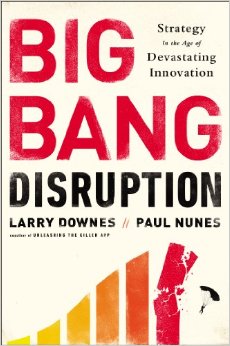
‘Big Bang Disruption’, by Larry Downes and Paul Nunes
Review by Jonathan Guthrie
Bigbang
Big Bang Disruption: Business Survival in the Age of Constant Innovation, by Larry Downes and Paul Nunes, Portfolio Penguin, $29.95; £14.99
When asked how he went bankrupt, a character in Ernest Hemingway’s novel The Sun Also Rises, replies: “Two ways. Gradually and then suddenly.” This neat summation of how business failure creeps up on victims is quoted in Big Bang Disruption , a book with more than a whiff of apocalyptic prophecy about it.
The book plays to the belief that technology has made incumbent companies more prone to destruction by new entrants than ever before. Authors Larry Downes and Paul Nunes have encapsulated this in a buzzphrase – “Big Bang Disruption” – as anyone writing a popular business tome must do for marketing purposes. But any reader who is not a technology obsessive is likely to be no more than half convinced by their thesis.
Noting the rapid uptake and equally fast abandonment of new personal technology such as games consoles and smartphones by consumers, Downes and Nunes theorise that Everett Rogers’ classic bell curve of demand is redundant. Instead of anticipating smoothly rising and falling sales of new products, business must retool to cope with a “shark fin” pattern of purchasing. Here, demand is explosive and its collapse almost as precipitous.
A sceptic would argue that the shark fin is merely a bell curve with a telescoped time axis.
It is true that cycles of product development in personal technology and web-based business are punishingly short. But it is wrong to assert that the same pattern and the same threats apply to all other industries. Incumbents retain significant competitive advantage across a swath of sectors.
Another fallacy common within the tech industry is that we live in age of unprecedented innovation. The first shaggy warrior to have his stone weapon knocked from his hand by an early adopter with a bronze sword would have disagreed. The micro processor is just the latest in a long line of disruptive technologies. In the past few centuries alone we have had cast iron, canals, railways, penicillin, domestic electricity, internal combustion engines, aircraft and the telephone.
The authors correctly point out that barriers to entry have toppled in some parts of the software and internet industries as memory has become cheaper and open-source tools and cloud-based services more available. But as they rather uncomfortably admit, the opposite applies in pharmaceuticals, where breakthroughs are increasingly expensive. Perplexingly they blame this in part on regulation. Personally, I am glad that groovy young drug developers cannot randomly release new treatments dreamt up during coffee-fuelled “hackathons” in imitation of peers in the software business.
The criticisms above are a sign that Big Bang Disruption is, at the least, a stimulating read. It is carefully researched and accessibly written, if a tad breathless in style. The case studies on disruption alone are worth the cover price. These include the destruction of the pinball machine industry by computer games.
The book partly draws on research by the Accenture Institute for High Performance, of which Nunes is a managing director. Downes, meanwhile, is a consultant and co-author of the book Unleashing the Killer App.
The marketing pitch for Big Bang Destruction is partly that it will help incumbents avoid annihilation at the hands of disruptive entrepreneurs. The book is a bit light on such advice. There is a section on stalling tactics. The wisdom here boils down to “sue ’em”. The authors, one sometimes suspects, are secretly rooting for the disrupters.
Probably the best strategy for avoiding disrupters – which is not covered in the book – is to avoid vulnerable sectors such as entertainment or information retailing. Try banking, instead.

Big Bang Disruption: Strategy in the Age of Devastating Innovation Hardcover
by Larry Downes  (Author) , Paul Nunes (Author)
It used to take years or even decades for disruptive innovations to dethrone dominant products and services. But now any business can be devastated virtually overnight by something better and cheaper. How can executives protect themselves and harness the power of Big Bang Disruption?
Just a few years ago, drivers happily spent more than $200 for a GPS unit. But as smartphones exploded in popularity, free navigation apps exceeded the performance of stand-alone devices. Eighteen months after the debut of the navigation apps, leading GPS manufacturers had lost 85 percent of their market value.
Consumer electronics and computer makers have long struggled in a world of exponential technology improvements and short product life spans. But until recently, hotels, taxi services, doctors, and energy companies had little to fear from the information revolution.
Those days are gone forever. Software-based products are replacing physical goods. And every service provider must compete with cloud-based tools that offer customers a better way to interact.
Today, start-ups with minimal experience and no capital can unravel your strategy before you even begin to grasp what’s happening. Never mind the “innovator’s dilemma”—this is the innovator’s disaster. And it’s happening in nearly every industry.
Worse, Big Bang Disruptors may not even see you as competition. They don’t share your approach to customer service, and they’re not sizing up your product line to offer better prices. You may simply be collateral damage in their efforts to win completely different markets.
The good news is that any business can master the strategy of the start-ups. Larry Downes and Paul Nunes analyze the origins, economics, and anatomy of Big Bang Disruption. They identify four key stages of the new innovation life cycle, helping you spot potential disruptors in time. And they offer twelve rules for defending your markets, launching disruptors of your own, and getting out while there’s still time.
Based on extensive research by the Accenture Institute for High Performance and in-depth interviews with entrepreneurs, investors, and executives from more than thirty industries, Big Bang Disruption will arm you with strategies and insights to thrive in this brave new world.

Gross Told El-Erian ‘Hell No’ Seeking to Stop Departure; El-Erian, 55, for years had been putting in long hours as the public face of Pimco next to Gross, appearing in the office as early as 5 a.m., speaking on national TV throughout the day

Gross Told El-Erian ‘Hell No’ Seeking to Stop Departure

When Mohamed El-Erian first told Bill Gross several weeks ago that he wanted to leave to “recharge the batteries,” the co-founder of Pacific Investment Management Co. was “shocked” and “discouraged.”

El-Erian, 55, for years had been putting in long hours as the public face of Pimco next to Gross, appearing in the office as early as 5 a.m., speaking on national television throughout the day, and responding to messages well past regular working hours. Gross, battling record redemptions from his biggest bond fund, tried to persuade El-Erian to stay.

“From our standpoint he was doing a great job,” Gross said in a phone interview from Newport Beach, California. “The answer we gave him was basically, ‘Hell no, you can’t go.’ ”

El-Erian, viewed as the successor to 69-year-old Gross in running the $237 billion Pimco Total Return Fund, stuck with his decision to step down as chief executive officer and co-chief investment officer of Pimco. The move took investors and analysts by surprise and forced Pimco to revisit its plans for a future after Gross, by naming two deputy CIOs. The firm is seeking to emphasize the depth of its investment talent by appointing several more in coming weeks, Gross said in the interview.

“I intend there to be a number of heirs apparent and for each of them to have assigned asset roles on a global basis with a global menu,” Gross said in the interview. “We’re not just bond people anymore.”

Deputy CIOs

Money managers Andrew Balls and Daniel Ivascyn will become deputy investment chiefs, helping Gross oversee the firm’s $1.97 trillion. Gross said that as Pimco continues to evolve from a bond-centric firm to a diversified money manager, he intends to appoint investment professionals specializing in equities, global fixed income and other asset classes to leadership roles.

Douglas Hodge, the firm’s operating chief, will succeed El-Erian as CEO, though with no history in managing money he’s not a candidate to replace Gross in managing the Total Return Fund.

Pimco Total Return had record withdrawals of $41 billion last year as investors fled traditional bond funds because of rising interest rates. Pimco as a whole had $30.4 billion in net redemptions during 2013, compared with net deposits of $62.7 billion in 2012, the biggest drop in organic growth among the 10 largest U.S. mutual-fund families, according to Morningstar Inc.

‘Sound Match’

The turbulence in the bond market over the past year isn’t the cause for El-Erian’s resignation, according to Gross. He cited other difficult times that El-Erian has weathered, such as turmoil in Brazil and Argentina when he invested in emerging-market debt.

“Total Return is more on my shoulders than his,” Gross said, referring to the firm’s biggest fund. “I didn’t notice any additional stress whatsoever. He’s a man that deals with stress and that’s part of his makeup.”

While the two occasionally disagreed, they’ve been “on the same page” in how they assessed the macroeconomic environment and the direction of the market, Gross said.

“He’s a classically trained economist, I’m sort of a seat-of-the-pants-economist. All of that in combination was just a sound match,” Gross said. “If there was a disagreement at all, it was his decision to leave.”

‘Open Question’

El-Erian plans to write a second book and spend more time with his family, Gross said. El-Erian’s “When Markets Collide: Investment Strategies for the Age of the Global Economy” was published in 2008. El-Erian didn’t respond to e-mails and phone calls seeking comment.

In an internal memo to employees, El-Erian said he has no plans as of now.

“What happens longer-term is an open question,” he wrote.

Gross brought El-Erian back to Pimco in 2007 following a stint running Harvard University’s endowment because he knew “Mohamed could fill an important part of the puzzle” in planning for succession, he said in a 2010 Bloomberg interview. El-Erian was responsible for transforming Pimco from a bond shop to a diversified fund manager, and led the firm’s push into equities in 2009.

Gross said growth in Pimco’s equity unit has been “disappointing” since then as the funds have been slow to gather assets and performance has been lackluster. Pimco’s four main U.S. equity mutual funds collectively manage less than $5 billion in assets.

Stocks, Alternatives

A separate family of funds, the StocksPlus lineup, attempts to beat the stock market by using a combination of bonds and derivatives. Pimco intends to emphasize the performance of its StocksPlus family, led by Gross since he started them in the 1980s, he said. The $840 million Pimco StocksPlus Fund has averaged annual returns of 24 percent in the past five years, beating 91 percent of peers, according to data compiled by Bloomberg.

“The world obviously in terms of flows isn’t a bond-friendly climate,” Gross said. “We anticipated this when Mohamed came back and have been building ever since. In some cases not too well like with equities, and others very well like alternatives.”

Gross said some of the new deputy CIOs would be given seats on Pimco’s investment committee, which sets strategy guidelines for fund managers. Gross has no intention of scaling back his role even as he elevates other executives.

‘Permanent Fixture’

“Think of me sort of as a permanent fixture,” he said. “I’d like to be here for a long time.”

Under El-Erian, who made a name for himself investing in emerging-market debt early on in his career at Pimco, the bond firm more than tripled its assets under management as investors flocked to fixed income after the 2008 financial crisis. Money in non-traditional funds rose to 66 percent of Pimco’s assets from 56 percent when El-Erian became CEO, according to the internal memo to employees.

El-Erian is listed as manager of eight mutual funds with $10.2 billion, according to data compiled by Bloomberg, including two U.S. mutual funds. The Pimco Global Advantage Strategy Bond fund, opened in 2009 and run by El-Erian, has advanced 3.2 percent annually in the past three years, behind 53 percent of rivals, according to data compiled by Bloomberg. El-Erian’s Global Multi-Asset Fund has gained an annual 6.5 percent over the past five years, trailing 82 percent of similarly managed funds.

El-Erian, the son of an Egyptian diplomat who’s fluent in English, French and Arabic, joined Pimco in 1999 as a senior member of the money management and investment strategy group. He left in 2006 to serve as CEO of Harvard Management Co. and revamp the university’s endowment before rejoining Pimco in 2007. He also worked at the International Monetary Fund for 15 years, and served as a deputy director at the IMF from 1995 to 1997. El-Erian received a bachelor’s and master’s degree in economics from Cambridge University as well as a Ph.D. from Oxford University.

To contact the reporters on this story: Sree Vidya Bhaktavatsalam in Boston at sbhaktavatsa@bloomberg.net; Alexis Leondis in New York at aleondis@bloomberg.net

Howard Lerman Shares the Secrets of Starting Up

Howard Lerman Shares the Secrets of Starting Up
by JJ Colao | Jan 23, 2014
Now in his fourth startup, Howard Lerman has an uncanny sense of timing. What’s his secret?
Dante had his Beatrice, and Keats, Fanny Brawne. Howard Lerman’s muse? It appeared after he stepped onto a treadmill at a Manhattan Upper West Side gym seven years ago. “So I’m looking at Al Sharpton’s Spandex butt, and I’m like, ‘I don’t want to look at that,’” recalls the 33-year-old CEO of Yext. “So I look out the window instead.” Outside he spotted a gym salesman spinning a ‘Wheel of Savings’ to lure pedestrians with free trials and discounts. “I walked out and said, ‘This is crazy. Why are you doing this?’” The rep told him nobody read the Yellow Pages anymore, so he had to find some way. Inspiration struck. Less than a year later Lerman’s GymTicket.com, a lead-generation service, had signed up 3,000 gyms around the country.
Epiphanies come in strange packages. The most successful entrepreneurs act on them— but also know when to let go. Lerman has been through that respiratory exercise three times. At his corner office near Madison Square Park, he’s now deep into his fourth company, the result of abrupt, decisive shifts in strategy—the sort that transformed GymTicket.com into Yext.
Investors, who have bet $66 million on two incarnations of the business since 2006, haven’t yet seen a dime. But with this latest iteration, Lerman is pretty sure he has it right.
Today his 250-person outfit sells cloud software that helps brick-and-mortar businesses manage online storefront data—addresses, phone numbers and business hours among them—to keep listings accurate while monitoring customer reviews and referral traffic from 46 websites, including Facebook, Yahoo and Yelp. They pay $500 per year for each location while massive enterprise customers like Citibank and FedEx get a discount. Just three years old, it should do $33 million in sales this year, with 70 percent gross margins, says Lerman. He’s confident sales will double again in 2014.
Growing up in Vienna, Lerman went to a magnet high school that had a $1 million supercomputer. He rigged a phone line to his PC to access an online network of local hackers. (Sean Parker grew up nearby and occasionally joined the chats.)
While at Duke University he studied history, the easiest major he could find, and teamed up as a sophomore in 2000 with high school classmates Tom Dixon and Sean MacIsaac, now Yext’s COO and CTO, to launch JustATip.com. Based on a whim—prank calls from high school days—the service let users send ‘tips’ anonymously, e-mailing friends about, say, their offensive body odour or lack of rhythm. An intern at the White House at the time, Lerman says he “may or may not have used government computers to build it”. The gag caught fire on college campuses. Jon Stewart used the website on The Daily Show in 2001 and usage rocketed to a million visitors per month. But token revenue from banner ads barely made a dent in server bills, and the founders searched for an acquirer. Two deals fell through before Traffix, a publicly traded online marketer, bought the site for $150,000.
After “a couple of roaring keg parties”, the trio launched Intwine, a consulting firm that specialised in Microsoft’s .NET programming language. Within three years it grew to 30 consultants and $5 million in sales. It sold to Datran Media, a digital marketer, for $7 million in 2005.
Next up, GymTicket.com. It worked like this: Web surfers on the hunt for a gym found the site through ads and search engines, entered their Zip codes, then viewed a list of local gyms. When they called to sign up for a trial membership, GymTicket pocketed a fee. Lerman enlisted Brent Metz, a high school friend and IBM speech scientist, and Brian Distelburger, a colleague at Traffix, as co-founders. Sales jumped to $1 million within a year, and soon they expanded to nine more categories, including LocalVets.com and TVRepairman.com.
With the sites rolled into Yext, they developed transcription technology that recorded customer phone calls and charged clients based on keywords in conversations. For vets, ‘spay’ might incur an $80 charge, ‘checkup’ just $5. By 2009 the company was nearly profitable and approaching $20 million in sales, yet few had heard of it. Lerman and company did the rounds on Sand Hill Road, emerging with $25 million from Institutional Venture Partners.
Yet after just a couple months Lerman saw he was on the wrong path. “We f—ed up,” he concedes. “We should have never raised that money.” The model turned into a “quagmire”, as clients disputed charges and tied up account managers. Growth slowed; managing 10 websites grew untenable. Instead of folding up or searching for a sucker to buy the operation, Lerman decided to start an entirely new company within Yext.
In the spring of 2010 he grabbed three employees, appointed Metz de facto CEO of the old operation and holed up in a separate room. For years his customers had told him how hard it was to keep tabs on different online listings. When the cloud software debuted in January 2011, it was an immediate hit. Sales were $2.7 million in 2011, $14.2 million last year. The old business, meanwhile, known as ‘Felix’, looked like deadweight.
At the suggestion of venture capitalist Ben Horowitz, who declined to invest in Yext, Lerman decided to spin out Felix, selling it to IAC’s CityGrid Media for $30 million in April 2012. The proceeds went directly to Yext’s balance sheet. Two months later Lerman raised a $27 million round, at a $270 million valuation, from existing investors, plus Marker and CrunchFund. (Lerman’s worth: An estimated $50 million.) Lerman is positioning Yext beyond local data. He talks of Starbucks managers using it to post pictures and specials on each location’s Facebook page. And when retailers start pinging in-store shoppers with geo-targeted ads, Yext might serve as the platform for managing such campaigns. Meantime, he can fish among the estimated 20 million storefronts in the US and 50 million globally.
His current muse is his wife, Wendy. Just months ago he sported shoulder-length curls and a beard that ran untrimmed down his neck. “One day my wife was like, ‘You’re starting to look like a homeless guy,’ ” he says.
Today, coiffed, he looks like tens of millions.

Marissa Mayer’s Remarkable Rise To The Top: In high school, Mayer was allowed 20-minute breaks during the day. “She would go to the library or the science lab to study. She wouldn’t be the one to stay and sit there and converse for 20 minutes.”

These Quotes Show Marissa Mayer’s Remarkable Rise To The Top At Yahoo
KYLE RUSSELL
JAN. 22, 2014, 8:53 PM 2,095 7
Yahoo CEO Marissa Mayer is one of the tech industry’s most exciting figures.
Publicly, she’s gone from being “the blonde woman in computer science classes” at Stanford to running one of the oldest names in consumer Internet history in less than two decades. She makes billion-dollar acquisition decisions and has made Yahoo — once an afterthought in the post dot-com boom era — a hot topic on tech blogs and mainstream news sites alike.
Behind the scenes, she’s earned something of a reputation for being a strong personality in the workplace — controlling discussions and always assuming that her view is right. Often she turns out to be just that.
Below, we’ve organized the quotes that chart both her rise and the life-long personality traits that enabled it.
Brian Jojade took Advanced Math with Mayer in eighth grade. One day, he called in to a local radio station to ask if they would announce that it was her birthday on-air. “She wasn’t amused at all. You could just tell it wasn’t fun for her,” he later recalled.
In high school, Mayer was allowed 20-minute breaks during the day. According to classmate Elize Bazter, “She would be the person to come down, get something to eat from the kitchen or the vending machines, and then she would go to the library or the science lab to study. She wouldn’t be the one to stay and sit there and converse for 20 minutes.”
Mayer was on Wausau West’s state championship winning debate team
Looking back on her time before college, Mayer herself notes: “It wasn’t until I was a professional woman mentoring other girls in math and science that I learned that openly liking math and science is unusual for girls. It’s actually considered far too nerdy and far too much for the boys. Wausau schools were so supportive that I never felt strange for a second about pursuing math and science and being good in them.”
Josh Elman, venture capitalist and a former member of one of Mayer’s study groups at Stanford, distinctly remembers their time working together: “It felt like she was the smartest student in the room — and the most serious. You always knew those two things about her. Very smart. Very serious.”
After grad school at Stanford, Mayer was presented with over a dozen job offers in the tech industry. “My quest to find, and be surrounded by, smart people is what brought me to Google,” she says.
Discussing her time at the company, Google co-founder Sergey Brin says: “Marissa makes the decisions she feels are right, and history proves that she probably calls it right.”
In 2009, Vogue Magazine ran a profile of Mayer, describing her as “the 34-year-old mega-millionaire, Oscar de la Renta-obsessed, computer-programming Google executive who lives in a penthouse atop the Four Seasons.”
“She doesn’t need any sleep. When you have four or five more hours in the day than most people do, you don’t learn to delegate because you don’t need to,” says Craig Silverstein, the Google engineer who originally hired Mayer. Many Googlers cite Mayer’s constant oversight as a frequent point of conflict when describing her time there.
When Yahoo’s board discussed the company’s future with Mayer at an informal dinner, she shocked everyone with a surprisingly detailed plan for the company going forward. “That’s the next CEO of Yahoo,” a member of the board stated after she left.
“The baby’s been way easier than everyone made it out to be,” Mayer joked during a conference on women in business, two months after giving birth.
Mayer started a weekly event called “FYI” at Yahoo, where they’d go over the company’s plans and she would take questions. Here’s how one executive described the meetings: “She is deified. The first 50 rows are packed with the engineering team and they’re cheering her on. There is no question that there’s a palpable level of energy and renewed enthusiasm and renewed pride.”
This is not one of Mayer’s “FYI” meetings.
“You have to give Marissa a lot of credit. Just because I don’t like what she’s done to me and I don’t like what she’s done to many other people, doesn’t mean I’m going to shy away from giving her credit. She brought life back to Yahoo. There’s no question about it,” says one person at Yahoo who has had clashed with Mayer.

Successful Chinese Hot Pot Chain Haidilao Stumbles In U.S. Expansion

Successful Chinese Hot Pot Chain Stumbles In U.S. Expansion

Christopher Marquis, Contributor
1/22/2014 @ 8:45AM |732 views

Last fall, the popular Sichuanese hot pot chain Haidilao opened its first outpost in America, to great anticipation, in the Southern Californian neighborhood of Arcadia. Aside from a few outposts in Singapore, the Arcadia location was the first Haidilao to open outside of China. Perhaps Zhang Yong, Haidilao’s personable founder and General Manager, counted on Arcadia’s large Chinese-American population to provide a soft landing, but the restaurant’s opening has been rocky.
Founded with 10,000 RMB in 1994 in the small city of Jianyang, Haidilao, whose name roughly translates to “scooping treasure from the bottom of the sea” has since become the dominant hot pot restaurant chain in a country obsessed with hot pot. From the beginning, the company’s culture was based on Zhang’s personal values of kindness, and personal empowerment. Employees are given remarkable decision-making capabilities under the latter while drilled on imbuing every element of customer service with the former. Some of the more famous services Haidilao has adopted over the years include free shoe shining and nail polishing for customers awaiting tables, protective baggies for cell phones, and impromptu employee song and dance performances.
While the reality is that the shoe shine and nail polish stations are too understaffed to serve more than, say, 1 in 30 customers, such flourishes work. The chain is legendary for its customer service in China, where good service is rarely found outside private dining rooms in formal banquet restaurants. Individual Haidilao locations dominate the 5-star echelons of Dianping.com, a review site similar to Yelp.com, in every city the company has a presence (which is most of them). Currently, the company remains privately owned and carefully managed, with all 80+ stores reporting directly to headquarters.
Zhang, who has stepped back from daily operations but still oversees Haidilao’s corporate strategy, is no doubt the driving force behind the US expansion. It seems that the man who once said of business, “Once you have positioned yourself, it’s clear what to do,” is still trying to find his US positioning. The Arcardia restaurant only has three out of five stars on Yelp.com. Reviewers complain that the restaurant is overpriced and overhyped, and worst of all, the service well intentioned but often inept. One customer notes, “the staff seemed utterly confused and ill trained to handle the crowd,” while another observes that prices should be relatively lower in America because diners are also expected to tip. There is even a salt-instead-of-sugar dessert disaster.
In truth, Haidilao’s troubles in America started before the restaurant had even opened. A local news outlet reported in July 2013 that a carpenter’s union was protesting the construction site with “Shame on Haidilao” signs for hiring a non-union company. For a brand well known for its decent treatment of employees, Haidilao has faced unexpected challenges translating its business principles to the US market.
As global ties become increasingly complex, recent examples of Chinese companies expanding overseas have shown that success in global markets requires nuanced localization.  With great service, quality food and strong employee relations, Haidilao seemed a natural fit for the US market.  The old narratives no longer hold: Haidilao’s stumbles were not caused by any “made in China” stigmas around quality, but rather the company’s own misjudgments.  On the flip side, foreign companies can no longer coast on simply being foreign: Apple and Fonterra’s troubles have shown that Chinese consumers no longer blindly buy imports.  Wherever they’re based, companies aiming to compete internationally today must demonstrate a sophisticated understanding of their target markets and engage many different sets of stakeholders accordingly.
Moreover, our research on CivilChina.org shows that US consumer sentiments about Chinese companies appear to be shifting.  For example, in our analysis of Twitter conversations about the Shineway-Smithfield deal, we found that American consumers had very little opinion on the acquisition of a venerable American company by a Chinese one, a far cry from the xenophobia traditional media on both sides like to emphasize.  We believe that this indicates increasing acceptance of Chinese companies by American consumers, which makes sophisticated localization strategies all the more important.
Consistency is requisite in any restaurant’s success, but Haidilao’s woes are not just the stumbles of a new restaurant trying to find its mark; some problems can be traced to differences in cultural style. The company has misjudged how the company’s selling points back home – freshness and service – should translate to a market where such qualities are taken for granted. Urban Chinese consumers may be increasingly willing to spend money on quality food, but in America, where Chinese food is still synonymous with cheap, many diners bristle at being charged for sauces and condiments. Certain ingredients that signal quality in China, such as the whole cloves and peppercorns dotting the spicy coup base, are unappetizing to American diners (one referred to their presence as “debris”). Moreover, good service in China borders on the obsequious, but some Haidilao Arcadia customers have found the constant attention intrusive. Flashy new elements like iPads for ordering come across as excessive when customers cite difficulties even communicating with the waitstaff in English.
One of the biggest drivers of Haidilao’s success in China is Zhang’s intuitive understanding that happy and loyal employees make happy and loyal customers. According to a Tsinghua University case study on the company, Haidilao offers a highly complex compensation package that rewards outstanding workers with wages comparable to white-collar jobs, free apartments, nannies, and even parental subsidies. In addition, there is a dedicated fund for helping employees with personal emergencies, a referral system to bring in friends and family that fit the company culture, and a strong tradition of promoting from within. Staff turnover rates in retail services are notoriously high even in the US, but China’s restaurant industry, which runs largely on migrant labor, is unstable even by those standards. Haidilao’s turnover rates are much lower than those of its competitors – almost zero at the management level.
Such a thorough vision for employee development shows Zhang’s nuanced understanding of stakeholder management, but the same incentive structures cannot be exported to the US. “Front of house” restaurant labor in the US is fundamentally different, more likely to be comprised of bored high school students looking to make quick cash rather than migrants seeking a steady income with the possibility of career advancement. Wages and benefits are negligible, and tips are capped by check sizes (Haidilao is “two dollar sign” restaurant on Yelp, meaning the average diner only spends between $11 and $30). Persisting service problems may be a sign that the company has not yet figured out how to train and motivate employees under the American system.
Zhang Yong has said of his American customers, “whatever they want is what I’ll give them.” No doubt Zhang and his team are doing their best to divine exactly that, and it will be interesting in the upcoming months to see if the company can communicate a more compelling value proposition to American diners. Haidilao’s American story is far from over, but it needs to dig deeper and develop a more targeted understanding of US consumers in order to find the treasure at the bottom.

Trying to deleverage China without blowing up the system

Trying to deleverage China without blowing up the system
By Ambrose Evans-Pritchard Economics Last updated: January 22nd, 2014
China is walking a tightrope without a net. There is an acute cash crunch. Credit at a viable cost is being fiercely rationed. Foreign buyers with money in hand can – and are – buying up nearly completed buildings from distressed developers for a song.
The shadow banking system has risen to 30pc of all lending from 20pc in barely more than a year. The growth generated by each extra yuan of credit has fallen by three quarters from 1.0 to 0.25 in five years, evidence of credit exhaustion.
That was the gist of a fascinating gathering on China at the World Economic Forum in Davos, including CITIC Chairman Zhang Yichen, the president of the Chinese Academy of Social Sciences Wang Weiguang, and Blackstone chairman Stephen Schwarzman, among others.
It was Chatham House rules so they cannot be quoted by name (except for one), but I pass on a few general thoughts to readers.
“They are trying to deleverage without blowing the whole thing up,” said CITIC’s Zhang Yichen.
“The M2 money supply is 120 trillion RMB but that is still not enough cash because velocity of money is very slow, and interest rates are going up.”
“My guess is that they will manage it. The US couldn’t contain Lehman contagion but in China all contracts can be renegotiated, so it is very hard to have a domino effect. We’ll see a slow deflating of the bubble,” he said.
“The stock market is not a true market. It is wholly controlled by the government. Even under the new reforms some of the rules are mind-boggling. They are trying so hard to contain speculation that they ended up causing more speculation. They are trying to control price of IPOs, to discourage the price going up. It is a perfect example why markets should be left alone.”
There was general agreement that there will be “no more stimulus” for now. President Xi Jinping is determined to tough it out.
The moment the Chinese authorities open up the capital account and make the RMB convertible there will be a rush of money abroad. That will unleash captive funds in property that have nowhere else to go, and could trigger a disorderly fall in real estate prices, and much else besides. So the government will not do it yet.
An ex-global regulator sitting next to me disputed the 30pc figure for the shadow banking sector, muttering out loud that it was really 50pc. Others agreed.
The authorities are alarmed at the mushrooming difficulties of the trust fund, especially the looming default of the China Credit Trust Co on $500m of debt. However, they will let some trusts go bust to teach a lesson in moral hazard. There will be haircuts, but not wipeouts.
US-China rivalry could become ugly. The West is in deep structural crisis, and will not face up to its own failures. It will blame China. Both Xi Jinping and Barack Obama are worried about this in the long-run. (To which I would say, why did China then impose an air identification control zone over a big chunk of the East China Sea, including the Senkaku Islands?)
Nothing said changes my mind that China is riding a $24 trillion credit tiger that it cannot really control. Loans have jumped from 120pc of GDP to around 220pc since the post-Lehman blitz (George Magnus from UBS says it may be 250pc by now).
As Fitch says, this is an unprecedented rise in the credit-GDP matrix in any large state in modern times. It will not end with a Western style banking crash because the financial system is an arm of the state. It will end in an entirely different way. Since Chinese credit now matches the entire US and Japanese banking systems combined in dollar worth, this is no longer a local Chinese story. It is part of our lives too now.
Now off to hear Shinzo Abe talk about Abenomics live and in person.

Zhou Risks Turmoil With Easing of China Rate Controls

Zhou Risks Turmoil With Easing of China Rate Controls

China central bank Governor Zhou Xiaochuan faces an obstacle in his efforts to tame financial market volatility: his own plans to free up interest rates.

The benchmark money-market rate remains above the average for January even after the People’s Bank of China this week injected more than $42 billion following the biggest jump since June. At the same time, Zhou’s planned removal of interest-rate controls may make volatility tougher to prevent, with Standard Chartered Plc economist Stephen Green saying that crisis is a “rule of financial liberalization.”

Zhou, reappointed last year to oversee China’s financial transformation, is working to free up rates to push the nation toward a more sustainable and market-driven model for economic growth. Moving too slowly raises dangers of a crisis from shadow banking outside of regulations, while mishandling liberalization risks sparking investment excesses and turmoil seen in nations from South Korea to Sweden and the U.S.

“China is facing a dilemma,” said Dong Tao, chief regional economist for Asia excluding Japan at Credit Suisse Group AG in Hong Kong. “If interest rates are not liberalized, shadow-banking activities spread like wildfire. If rates are freed up, it will worsen problems for existing debt.”

The seven-day repurchase rate dropped for a second day yesterday after the PBOC injected cash to relieve funding pressures ahead of the week-long Lunar New Year festival. The rate fell 19 basis points to 5.25 percent, according to a daily fixing compiled by the National Interbank Funding Center, compared with the month’s 4.61 percent average.

Markets’ Role

The decline has spurred market gains globally. The MSCI World Index of stocks has gained about 0.3 percent over the past two days, while the Standard & Poor’s 500 Index in the U.S. advanced 0.3 percent on Jan. 21.

Money-market rates in China typically rise before the week-long Lunar New Year break, which begins Jan. 31 this year and is a period in which cash gifts are made and families get together for celebratory feasts.

Allowing markets to set deposit and lending rates should be a top priority as part of efforts to generate new sources of growth and stop financial risks from building up, the International Monetary Fund said in its annual report on China in July.

Zhou, who turns 66 this month and has been PBOC chief for a record 11 years, wrote in a November article that China will “fully realize market-based interest rates” in the “medium term.” The Communist Party has pledged to give markets a “decisive” role in allocating resources as part of the broadest policy transformation since the 1990s.

Loosening Constraints

The PBOC in June 2012 let banks for the first time pay a premium over government-set deposit rates. Authorities in July 2013 scrapped a floor on borrowing costs while saying that further changes to deposit rules were the “most risky” part of liberalization. The PBOC’s next step, in December, was to authorize the trading of certificates of deposit on the interbank market.

Increasing competition for bank deposits may help curb shadow banking estimated by JPMorgan Chase & Co. at 69 percent of China’s 2012 gross domestic product. The industry encompasses entrusted loans, wealth-management products and other resources where borrowers can obtain funds unavailable through banks and depositors can get higher returns.

China’s rapid buildup of credit has evoked comparisons to Japan’s debt surge before its lost decade and to that in Thailand and Malaysia ahead of Asia’s financial crisis. China’s credit-to-GDP ratio rose to 187 percent in 2012 from 105 percent in 2000, compared with Japan’s increase to 176 percent in 1990 from 127 percent in 1980, JPMorgan said in a July report.

‘Fragile’ System

“The best sign of how fragile the system is, is what’s been happening in the interbank market,” said Charlene Chu, a former analyst at Fitch Ratings who warned that China’s debt could spark a crisis. Officials should “address the underlying fragility in the system” to minimize risks of turmoil from rate liberalization, Chu said in an interview yesterday.

Zhou and Chinese officials are trying to avoid repeating mistakes that fueled crises in other nations when rate controls were eased.

Finland, Norway and Sweden liberalized interest rates in the late 1970s and early 1980s without taking steps to regulate lending or tighten monetary policy, eventually resulting in a “full-blown banking crisis,” according to a 2009 paper by IMF researchers. The savings-and-loan crisis in the U.S. also stemmed from regulatory restraint after the government removed deposit-rate controls, the IMF study said.

South Korea

In South Korea, a partial loosening of limits on interest rates in the 1990s was followed by reckless investment by large companies and a financial crisis, according to the “China 2030” report published in 2012 by the World Bank and the State Council’s Development Research Center in China.

“The problem is deposit rates,” the economist Green said. “If you go up too quickly, everyone competes to justify the rising costs” and banks chase higher-yielding, and riskier loans, he said. While China is likely to need to re-capitalize its banks within the next five years, PBOC leaders are well aware of other countries’ experiences with interest-rate liberalization, he added.

One or two small Chinese banks may fail this year as they face pressure from their reliance on short-term borrowing, Fang Xinghai, a Communist Party economic official, said in November. Trusts and shadow banking will see defaults this year, which is a good thing, Zhang Ming, a researcher at the state-run Chinese Academy of Social Sciences, said this week.

“High and volatile interest rates and debt defaults are a sign of the stress that ails the financial system, but also a sign that the necessary medicine is being applied,” said David Loevinger, former U.S. Treasury Department senior coordinator for China affairs and now an analyst at TCW Group Inc. in Los Angeles. “Like a smoker trying to quit cigarettes, an economy addicted to cheap credit can’t avoid headaches as it deleverages.”

To contact Bloomberg News staff for this story: Kevin Hamlin in Beijing at khamlin@bloomberg.net

China crackdown on online video uploads

China crackdown on online video uploads
Updated 22 January 2014, 1:03 AEST
Chinese internet users will now be required to register their real names to upload content to Chinese online video sites, an official Communist Party body says.
It’s the latest move by the Chinese government to tighten control of the Internet and media, and suppress anti-government sentiment.
The new rule has been implemented to “prevent vulgar content, base art forms, exaggerated violence and sexual content in internet video having a negative effect on society,” China’s State Administration of Press, Publication, Radio, Film and Television (SARFT) said on its website.
The rule is “aimed at online dramas, micro-films and other online audio-visual programmes”, the statement said.
It gave no further explanation.
Online video sites are often hubs for comment and critique on social issues in China, with users uploading videos documenting corruption, injustice and abuse carried out by government officials and authorities.
Online video sites are extremely popular in China, with 428 million users.
Those allowing user uploads include sites operated by Youku Tudou Inc and Renren Inc.
Youku Tudou declined to comment, while officials at Renren were not available for immediate comment.
Last year, the Communist Party began a campaign to control online discourse, threatening legal action against people whose perceived rumours on microblogs such as Sina Weibo are reposted more than 500 times or seen by more than 5,000 people.
Rights groups and dissidents criticised the latest crackdown as another tool for the ruling Communist Party to limit criticism of it and to further control freedom of expression.
China has attempted to implement similar real-name registration rules, including when buying SIM cards for mobile phones and signing up for Tencent’s WeChat mobile messaging app and microblogs.
However, these have proven difficult to implement and easy to avoid for China’s tech-savvy internet population.
China’s internet regulation system is mired in bureaucracy and overseen by a number of government agencies, including SARFT, the State Council and the Ministry of Industry and Information Technology, which can lead to conflicts of interest between these bodies.
Reuters

Organic Food: Not Just for Kids

Organic Food: Not Just for Kids
Companies Try to Push Organic Foods for Every Stage of Life
SARAH NASSAUER
Jan. 22, 2014 7:23 p.m. ET

kids001
Organic food is increasingly found in shopping carts everywhere. But for the majority of shoppers, organic food is only an occasional habit. Sarah Nassauer explains how companies are trying to break out of that cycle and win shoppers over for good. Photo: Late July Organic.
What will make people pay $3 more for frozen pizza that says “organic” when they’ve been eating non-organic pizza for years?
Organic food is increasingly found in shopping carts everywhere from urban grocery stores to rural Wal-Marts. But for the majority of shoppers, buying pricey, sometimes hard to find, organic food is only an occasional habit.
Marketers are working to turn these organic dabblers into consistent customers. Brands known for organic baby and toddler food are pushing products to appeal to older kids and adults. Some are adding organic versions of mainstream hits like boxed mac and cheese and tortilla chips to entice skeptics.
View Graphics

Illustration by James Gulliver Hancock; (L-r) Organic Valley, Horizon; Annie’s; Late July Organic Snacks; Earthbound Farm; Honest Tea
Many consumers don’t see a difference between “organic,” “natural” or other health claims, making it tricky to charge a premium for products labeled organic.
To be certified organic, food must meet U.S. Department of Agriculture regulations regarding how the animals are fed and treated and produce is grown.
About 64% of U.S. shoppers are “dabblers” or “temperates,” says Maryellen Molyneaux, president and managing partner of the Natural Marketing Institute, a consumer research consultancy focused on health and wellness.
Dabblers buy organic food haphazardly, perhaps drawn in by the label. Temperates are price sensitive and buy for isolated reasons, like milk for a toddler. “Devoteds,” the top buyers of organic food, make up about 20% of shoppers, she says.
Pitching organic food is a high-stakes effort. Coca-Cola Co. KO -0.05% , Campbell SoupCPB +0.52%
Co, Danone SA BN.FR +1.67% and other large food companies are buying up smaller organic food makers (Honest Tea, Plum Organics and Happy Family, respectively), hoping they will be a growth engine as customers curtail purchases of products they had consistently bought for decades like cereal, soup and soda. For the last four years, sales of organic food have grown about 11% a year, but sales growth appears to be hitting a plateau.
Annie’s Inc., a Berkeley, Calif.-based company that makes boxed macaroni and cheese, cheddar crackers shaped like bunnies and gummy fruit snacks made with organic ingredients has “been working on aging up our brand,” and bringing new people in, says Sarah Bird, its chief marketing officer.
“For some kids, bunnies aren’t so cool as they get older,” so last year they added cheddar squares to their product line, says Ms. Bird. To target older kids and family meals, they also started selling frozen pizza and microwavable mac and cheese that a college student could easily heat in a dorm room.
Simply adding an organic label to tasty food doesn’t always work. Annie’s last year discontinued a line of 100% organic box skillet meals (think organic Hamburger Helper) and replaced them with a version made with some organic ingredients to improve the taste. Cutting back on pricey organic ingredients enabled the company to add other, more expensive ingredients—a creamier cheese sauce and whole grain pasta—while keeping the consumer price reasonable, says Ms. Bird.
About 21% of baby food sold is organic versus less than 5% of food overall, according to data from the Organic Trade Association, which represents the industry. Becoming pregnant or having a baby is a entry point into buying organic food, a moment when parents are most protective of family eating, say companies and consumer research firms. Having serious health problems or knowing someone who does is another common trigger.
But most food shoppers are focused on “where is the highest level of quality for the lowest price,” says Laurie Demeritt, chief executive of the Hartman Group, Inc., a consumer research firm.
Organic milk and meat can be twice as much as non-organic, while organic bagged salad is only slightly more expensive.
When Earth’s Best added frozen fish and chicken nuggets aimed at older kids to its line of organic baby cereal and formula, it didn’t make them organic. “To do organic is cost-prohibitive,” about twice as expensive, says Maureen Putman, president of the grocery business at Hain Celestial US, a unit of Hain Celestial Group
Inc. HAIN -1.19% which owns Earth’s Best and other brands. When buying meat, moms care most that it is antibiotic free and low fat, she says.
“We can’t afford to do 100% organic, so I am just going off of what I believe is most important,” says Amber Bull, a 37-year-old mother of two and hairstylist who lives in Loveland, Colo. To stick to a $600-a-month food budget, she often buys organically raised meat but serves her family less of it, she says.
Ms. Bull looks for organic produce on sale, like apples and leafy greens, as she believes they have the most pesticide residue when raised conventionally. Some studies indicate apples, spinach, kale and other leafy greens have more pesticide residue than other produce.
Certified organic food costs more to produce because it must follow U.S. Department of Agriculture regulations. Animals are required to spend some time grazing on pasture, fed pricey organic feed and not given antibiotics or most hormones. Produce is grown without most synthetic fertilizers and pesticides. Genetically modified organisms can’t be used in organic products or given to animals.
In a survey last year, about 60% of people said food labeled “natural” has most of the same qualities as organic food, like being grown without pesticides, says Ms. Molyneaux of the Natural Marketing Institute. In fact, the government doesn’t define what the term natural on food labels means.
Organic yogurt maker Stonyfield Farm in August added “no toxic pesticides used here” next to the certified organic seal on its products “to get at the confusion,” says Gary Hirshberg, chairman of Stonyfield Farm, which is owned by Danone SA. “If a consumer can convince herself, ‘This is almost the same thing’ and there is a 30 cent price difference,” she will buy the cheaper, natural yogurt, he says.
Some foods trigger interest. Organic milk sales spike when families have toddlers, the age many pediatricians recommend babies first try cow’s milk.
Natural Marketing Institute data shows organic milk sales taper off when kids turn about 7 years old. Consuming organic yogurt, cereal bars, meat and poultry also becomes less common in families with older children, according to the data.
To appeal to young adults, Organic Valley is considering selling “grab and go,” milk in small bottles, says George Siemon, chief executive of the company, the largest cooperative of organic farmers in the country.
Sales of organic snacks from Barnstable, Mass.-based Late July have tripled since the company added multigrain chips in grown-up flavors like Red Hot Mojo and Sea Salt by the Seashore to its line of crackers and sandwich cookies, says Nicole Bernard Dawes, chief executive of the company.
Now people discover the brand when “looking for a chip for a Super Bowl party,” not just shopping for kids, she says

Yu E Bao Deals with the Pressure of Being No. 1

Yu E Bao Deals with the Pressure of Being No. 1

01.22.2014 18:39
The fund company behind the WeChat investment service must handle a huge amount of money every day, but one manager says risk control remains the top concern
By staff reporters Zhang Bing and Cao Wenjiao
(Beijing) – It took less than seven months for the fund company that manages Yu E Bao to become the country’s largest public funds manager, a place that China Asset Management Co. held for seven years.
As of January 15, Yu E Bao has more than 250 billion yuan in investment from over 49 million users, says Tian Hong Asset Management Co., the company that manages Yu E Bao. That makes it the 14th-largest money market fund in the world, data from Bloomberg shows. Combined with other investment funds, the amount managed by Tian Hong has exceeded 260 billion yuan.
Meanwhile, China AMC’s public funds were worth about 244.7 billion yuan at the end of last year and reportedly have not changed much in January. It has formed a partnership with social networking company Tencent Holdings to challenge Yu E Bao through a similar wealth management service embedded in the voice and text messaging app WeChat.
Wang Dengfeng, a Tian Hong fund manager who oversees the money market fund connected with Yu E Bao, said in a recent interview that controlling risk is his company’s biggest priority.
Yu E Bao limits its investments to just 29 banks on a safe list, he says, and prudence demands that, “We don’t venture outside the list.”
An excerpt of the interview follows.
Caixin: How do you allocate funds from Yu E Bao?
Wang: About 80 to 90 percent of the money from Yu E Bao accounts will go to interbank deposits and the rest to safe bonds. Interbank deposits are banks’ wholesale businesses with each other. The demands are vibrant.
We allocate investments and match maturities based on data analysis. At different stages a bank’s ability to take deposits varies. On one hand, there are banks that can only take, say, 10 billion yuan, but we have 11 billion yuan that needs to be taken care of. That is when we hit the limit of their deposit-taking ability. We can deal with other banks or lower the interest rates we charge. On the other hand, a larger size brings greater negotiating power. We can ask for higher interest rates.
We pay the most attention to liquidity management. So far, we have seen a net increase in Yu E Bao investment. That means we face the pressure of finding investment opportunities for new funds every day.
Do you often get higher interest rates from small banks?
That is generally the case, but large banks may offer higher rates if they are caught short of cash. This is a matter of less concern to Yu E Bao because we limit our investments to only 29 banks that are on our white list. We don’t venture outside the list. Most of those banks are state-owned or large joint-stock banks. We think it is not worth the risk dealing with small banks. It is not that we think they would actually default on loans. But we would like to avoid the risk altogether to be prudent.
There are many wealth management services similar to Yu E Bao. What is the strength of Yu E Bao?
First, the core value of our team is prudent wealth management. We have placed risk control in the highest place. Second, Yu E Bao operates on Alipay (the third-party payment service run by e-commerce giant Alibaba Group). It is connected to more than 49 million ordinary people and retail investors. That makes it particularly deep-rooted in society. Third, it brings the function of money market fund investment and payment together. The user experience is good. There are, of course, other funds being developed with a payment function. But we have been at the frontier.
What is the impact of interest rate changes on Yu E Bao? Some people say Yu E Bao’s yield will stop rising. What is your view?
The yield of Yu E Bao goes with the cost of capital in the market. In December, there was a rebound in money rates, and the yield of Yu E Bao also increased. When money rates were low, the yield of Yu E Bao was low as well.
We will try to repay investors with moderate returns on investment. If the money market goes weak, it is normal for our yields to fall. But it would not happen all of a sudden. Neither do we promise to deliver any rate of returns. Yields are not our primary concern. We are most concerned with risk control.
The U.S. payment company PayPal introduced a money market fund service in its second year. It shut it down in 2011 as investment shrank. Do you worry that this may be where Yu E Bao is headed?
We have been thinking about this since the first day Yu E Bao was launched. Now that we have grown, whether we will become a second PayPal is more of an issue. The puzzle is not only ours. It is true for the entire money market fund industry.
A big question is: If China has a zero interest rate like the United States, is there still a reason for money market funds to exist? This may not happen very quickly, judging by current conditions. For China to have zero interest rates for a long term, it has to have gone through a very large economic cycle.

LifeWatch Shares Rise to 3-Year High on China Telecom Deal to provide medical smartphones and related services

LifeWatch Shares Advance Most Since 2008 on China Telecom Deal

LifeWatch AG (LIFE), a provider of remote cardiac and other patient monitoring systems, rose the most in almost six years after a preliminary agreement to provide China Telecom Corp. (728) with medical smartphones and related services.

LifeWatch shares climbed as much as 29 percent, the biggest advance since April 2008. The stock was up 23 percent at 9.47 Swiss francs as of 11:42 a.m. in Zurich, giving the company a market value of 125.4 million francs ($138 million).

The agreement with China Telecom, the nation’s third-largest wireless company, may generate more than $400 million of sales over five years, LifeWatch said in a statement today. The binding memorandum of understanding provides a minimum purchase volume and China Telecom was granted exclusivity for the China territory, LifeWatch said.

The agreement “is a significant positive for the company and the stock,” Tom Jones and other analysts at Berenberg Bank in London, wrote in a note to clients. “It’s a step toward diversifying away from its core wireless cardiac monitoring business.”

The minimum sale alone of its health-enabled smartphone, called LifeWatch V, and the accompanying services, may lead to turnover rising by a third and a “multiplication” of earnings before interest and taxes this year, LifeWatch said.

“This cooperation is a great achievement and the confirmation of the right product and marketing strategy adopted by our CEO, Yacov Geva,” LifeWatch Chairman Kenneth Melani said in the statement. “We are very proud of our research and development team in Israel.”

LifeWatch Prospects

The final agreement is scheduled to be signed in March, LifeWatch said. The Swiss company said it expects to get the required regulatory approval in April, with sales of the smartphones to begin in the second quarter.

“Given the relative sizes of the two companies, should they be unable to agree on the final terms it would, in our view, be relatively painless for China Telecom to extract itself and far more burdensome for LifeWatch to enforce whatever binding terms the memorandum of understanding includes,” the Berenberg Bank analysts wrote today. “The question for the longer term is whether LifeWatch will become and remain a market leader in this space.”

To contact the reporter on this story: Albertina Torsoli in Geneva at atorsoli@bloomberg.net

Judge Suspends Chinese Units of Big Four Auditors; Ruling Bars Firms From Audit Work for Six Months

Judge Suspends Chinese Units of Big Four Auditors
Ruling Bars Firms From Audit Work for Six Months
MICHAEL RAPOPORT
Updated Jan. 22, 2014 8:47 p.m. ET
The Chinese units of the Big Four accounting firms should be suspended from auditing U.S.-traded companies for six months, a judge ruled, a move that could complicate the audits of dozens of Chinese companies and some U.S.-based multinationals.
The audit firms, plus a fifth China-based accounting firm, broke U.S. law when they refused to turn over documents about some of their clients to the Securities and Exchange Commission to aid the commission in investigating those U.S.-traded Chinese companies for possible fraud, ruled Cameron Elliot, an SEC administrative law judge.
Judge Elliot’s ruling Wednesday doesn’t take effect immediately, and the firms can appeal the ruling, first to the commission itself, then to the federal courts. But if the ruling stands, it could temporarily leave more than 100 Chinese companies that trade on U.S. markets without an auditor. It also could throw a monkey wrench into the audits of U.S. multinational companies that have significant operations in China, because the Chinese affiliates of the Big Four—PricewaterhouseCoopers, Deloitte Touche Tohmatsu, KPMG and Ernst & Young—often help their U.S. sister firms complete those audits.
Without audited financial statements, a company can’t sell securities in the U.S. or stay listed on U.S. exchanges.
“This is a body blow to the Big Four,” said Paul Gillis, a Beijing-based professor at Peking University’s Guanghua School of Management. “It’s really quite a harsh ruling.”
The ruling will be inconvenient for the companies those Chinese firms audit, said Jacob S. Frenkel, a former SEC enforcement attorney now in private practice. It is a middle ground, he said. The judge could have gone further and permanently barred the Chinese firms from issuing audit reports on U.S.-traded companies, as the SEC had requested and as the accounting industry had feared.
In a joint statement, the Big Four firms in China called the judge’s decision “regrettable” and said they would appeal. “In the meantime the firms can and will continue to serve all their clients without interruption.”
The SEC said it was gratified by the ruling and that it upholds the commission’s authority to obtain records that are “critical to our ability to investigate potential securities law violations and protect investors.”
The fifth firm, Dahua CPA, was censured by Judge Elliot but not suspended. Dahua was an affiliate of another large accounting firm, BDO, until last April, but the two are no longer affiliated.
The SEC had sought audit work papers from the firms to assist its investigations of some of the 130-plus Chinese companies trading on U.S. markets that have encountered accounting and disclosure questions in the past few years. Many of those companies have their independent audits performed by the Chinese affiliates of the Big Four, and the SEC had wanted to know more about what the auditors had found about the companies. (All the major accounting firms are international networks made up of individual, free-standing firms in each country in which they do business.)
But the Chinese firms refused to turn over the documents. They said their hands were tied, as Chinese law treats the information in such audit documents as akin to “state secrets.” The firms said their auditors could be thrown in jail if they cooperated with the SEC without the Chinese government’s blessing.
That led the SEC to file an administrative proceeding against the five firms in December 2012, arguing that U.S. law compels the firms to cooperate with such requests.
The judge agreed, saying the firms “have failed to recognize the wrongful nature of their conduct” and showed “gall” in complaining that complying with the SEC’s demands would hurt them. The firms knew when they registered with U.S. regulators and built their businesses in China that they might ultimately be put between a rock and a hard place in providing documents, the judge said.
The judge wasn’t deterred by an agreement last year between the U.S. and Chinese governments that somewhat alleviated the stalemate over documents, by allowing some documents from the audit firms to come to the U.S. after they were funneled through Chinese regulators. Since July, documents the SEC had sought relating to at least six companies have either been provided to U.S. regulators or were “in the pipeline” to be provided, the audit firms said in filings in November and December.
The five Chinese firms involved in the case have a total of 103 U.S.-traded companies that they audit or in which they played a substantial role in the audit, according to their 2013 annual reports filed with U.S. regulators. The companies might have to make other arrangements for audits if their firm is suspended during the period when their yearly audit is being performed.
The potential effect on U.S. multinationals is less clear, because most multinationals don’t specify when a Chinese affiliate or other foreign audit firm contributed to their audit, though a pending proposal from U.S. regulators would require them to do so. KPMG Huazhen, KPMG’s Chinese affiliate, indicated in its annual report with U.S. regulators that it had participated in the audits of U.S.-based companies like Yum Brands Inc. and SanminaCorp. SANM +0.44% by auditing Chinese subsidiaries of the companies. Yum and Sanmina couldn’t immediately be reached for comment.

How Caterpillar got bulldozed in China

How Caterpillar got bulldozed in China
Thursday, Jan 23, 2014
Reuters

ZHENGZHOU, China – Asia’s top mergers and acquisitions bankers gathered two years ago at the swanky Island Shangri La in Hong Kong to celebrate the top deals of 2012. As the transactions were being toasted, one was unravelling.
Advisers on Caterpillar Inc’s $677 million purchase of ERA Mining Machinery Ltd picked up an award for cross-border deal of the year. The purchase was billed as a coup for Caterpillar, the world’s top maker of tractors and excavators. ERA was the holding company for Zhengzhou Siwei Mechanical & Electrical Equipment Manufacturing Co Ltd, one of China’s biggest makers of hydraulic coal-mine roof supports. Siwei would help Caterpillar gain traction in the world’s largest coal industry.
“Siwei was going to be our Chinese business card,” said a person with direct knowledge of Caterpillar’s strategy.
The night of the awards on November 16 three Caterpillar lawyers were wrapping up an eight-hour grilling of Wang Fu, Siwei’s chairman. Major accounting problems had been unearthed at Siwei headquarters in the gritty Chinese city of Zhengzhou. Two months later, on January 18, 2013, Caterpillar said it had discovered “deliberate, multi-year, coordinated accounting misconduct” at Siwei.
Wang was sacked. Caterpillar took a non-cash goodwill impairment charge of $580 million – 86 per cent of the value of the deal. The company says it was caught unaware by the problems at Siwei and only discovered them in November 2012, five months after the deal closed.
A Reuters review of hundreds of pages of public documents, as well as interviews with former employees, board members, bankers and advisers, reveals a more complex story. Accounting problems were rampant at Siwei before Caterpillar bought it. Yet at multiple junctures, Caterpillar chose to ignore existing or potential problems and push ahead with the deal.
A year and a half after directors of the Peoria, Illinois-based company signed off on the deal, it has become a case study in how a foreign company with decades of experience in China can still flounder in that market. It also shows how willing some multinationals are to accept risks they might otherwise avoid to establish themselves in the world’s second-largest economy.
The deal has triggered legal action against Caterpillar. In May, Caterpillar announced it had settled a dispute with Siwei’s controlling shareholder, owned by an heir to the Crown Worldwide logistics company fortune and the former head of the American Chamber of Commerce in Beijing. Four shareholder suits filed in the United States in Caterpillar’s home state of Illinois are continuing.
Meanwhile, Siwei has foundered. Former employees told Reuters that as of September, the company had no new orders in 2013, and it had fired or furloughed about half of its workforce.
Siwei’s former CEO, Wang, says his books were a mess but he committed no wrongdoing.
“We were a legend in the industry,” Wang, 52, told Reuters, in his first media interview since the announcement of the write-off. Wang is now pursuing a second act: He has launched a new company with a nearly identical name in the same business. He has yet to build a factory, but says he can take Siwei’s old customers when he does.
BECOMING A CHINESE MANUFACTURER
When it bought Siwei, Caterpillar had been doing business in China for more than 30 years. It had amassed 20,000 China employees, dozens of manufacturing, research, logistics and parts centers and a broad dealer network. It had nine new facilities under construction, and had just completed the $8.8 billion purchase of Bucyrus, a mining and earth-moving company with significant China operations.
When former Chinese president Hu Jintao dined with a group of American businessmen in 2011, Caterpillar Chief Executive Doug Oberhelman was included.
But the company was slow to ramp up production of construction machinery in China and lost out on market share as a result, says Anthony Farmer, a former executive at Caterpillar. It didn’t want to make the same mistake in coal mining equipment.
China’s coal industry is the largest in the world, but it also insular. Local companies, particularly state-owned enterprises, prefer locally made products, said Farmer, now at construction and mining consultancy Millton Group.
Siwei was attractive. It once was state-owned, but no longer. That, and the fact that it was listed in Hong Kong – under the name of ERA – made it much easier for a foreign company to buy.
Moreover, the roof supports it made – spatula-like hydraulic arms that keep underground coal mines from collapsing – were lucrative, since 80 per cent of China’s mines are underground.
Siwei retained close ties to the government. In 2012 alone, it was visited twice by the Communist Party leader of Zhengzhou.
AMERICAN CONNECTIONS
Adding to the appeal, Siwei also had three high-profile investors with American ties.
Li Rubo, an American-trained mining engineer and an early Siwei investor, had arranged mining deals in Russia and Mongolia – sensitive undertakings that would have required political connections.
Emory Williams, an American business associate of Li, was a major shareholder and chairman of Siwei’s parent. He had invested in a Beijing concrete business back in the mid-1990s. The son of a former senior Sears executive, Williams had also served as chairman of the American Chamber of Commerce in Beijing. And along with Li, he had founded another Chinese mining company recently sold to another American mining equipment maker.
The third investor was Jimmy Thompson. He was Li Rubo’s son-in-law – and the son of billionaire Jim Thompson, who founded Crown Worldwide, the transport, relocation and storage giant.
Li and Williams were part of the reason Caterpillar felt comfortable with the acquisition, several people with direct knowledge of the situation said.
“They provided loans, they helped finance the company,” one of those people said.
Beyond that, their influence was limited. “The show was run out of Zhengzhou on a day-to-day basis. Unfortunately, they were further away from the business than I had expected,” that person said. “Our reliance on them was the blind leading the blind.”
Li, Thompson and Williams declined to comment for this story.
PROJECT SEQUOIA
Steve Wunning, the Peoria-based president of Caterpillar’s mining equipment division, Resource Industries, and then-Chief Financial Officer, Ed Rapp, pitched the idea of buying Siwei to the company’s board of directors in October 2011. It was codenamed “Project Sequoia.” The board expressed support for the strategy, according to court documents filed in the United States.
The first sign of trouble surfaced quickly. On November 7, 2011, the board received a two-page memo explaining that Siwei would need an immediate $50 million loan for working capital. Excerpts of the memo were contained in the court documents.
The memo explained that Siwei’s customers weren’t paying what they owed. It also noted Siwei hadn’t made overtime payments to its workers and didn’t hold operating permits required by Chinese regulations. Fixing these and other issues, the memo said, would cost CAT as much as $30 million.
The board was unfazed. That same day, the directors voted for the acquisition, authorising the purchase of Siwei for up to $964 million. It would be the biggest foreign machinery acquisition in Hong Kong or China since the country opened up for business in 1978. The board also authorised the loan for working capital.
Four months later, in March 2012, the board received another memo signalling trouble at Siwei, court documents showed. The company had missed its 2011 financial targets, and its parent company, ERA, was going to report a $2 million loss rather than a $16 million profit. Wunning also told the board that Siwei’s average receivables had grown to an extraordinary 371 days, according to filings in connection to the court case.
Corporate filings show the amount owed to Siwei by customers had risen 58 per cent per year since 2008, overtaking total sales in 2011. Some 90 per cent of those debts were overdue when Caterpillar launched its bid.
Mining equipment companies typically finance at least part of their customers’ purchases. However, once accounts are more than 90 days old, they are almost always disqualified from being counted as collateral for loans. At six months, they are widely recognised as needing to be turned over to a collection agency, or they are written off or reserved in full, according to one of the four shareholder suits filed in the United States. The complaint says the receivables issue rendered Siwei’s revenues and assets “highly suspicious and most likely wholly illusory.”
Unsold goods were also a problem for Siwei. At the end of 2010, the average number of days Siwei’s products sat in storage was 414, double what it was during China’s economic slowdown in 2009.
NO ‘RED FLAGS’
Caterpillar spokesman Jim Dugan said the company would not comment directly on matters of “pending litigation.”
But he said Siwei’s accounting problems were unrelated to the profit warning and other issues the company found during its due diligence of the acquisition.
“The Siwei accounting issues that led to the goodwill impairment charge involved Siwei’s falsification of its books,” Dugan said in an email. “Therefore, Siwei’s profit warning and failure to meet its 2011 targets, the $50 million working capital loan to Siwei, and other issues that came up in the course of Caterpillar’s diligence were not ‘red flags’ as to the accounting fraud.”
The news release announcing Caterpillar’s tender offer went out on June 6, 2012.
Documents produced for one of the Illinois court cases show that Caterpillar’s board of directors did not ask for the results of the due diligence investigation, which ran from about September 2011 until June 2012. The board also did not look into whether Siwei’s financial problems had been resolved. And it did not adjust the offer price, the documents indicate.
Siwei had been focused almost entirely on gaining market share. Getting customers to actually pay their bills came to seem like an afterthought, former executives told Reuters.
“They would take orders without down payments, so they had to finance the whole thing,” said a person with direct involvement with Siwei. The point “was to try to get market share.” This person added: “These were all things we felt we could fix once we were on board.”
Caterpillar was so bullish on China, it may have been willing to overlook some of Siwei’s problems, former insiders say.
“There was also a lot of euphoria. We were really going to dominate. Not only in mining but also in China,” the person said, and old China hands Williams, Li and Thompson would help. “Obviously it was too much, and we got burned.”
LEGEND IN THE INDUSTRY
At first, Wang Fu was equally exuberant about the deal. Siwei’s former CEO is a native of the northeastern Chinese province of Liaoning with nearly 30 years experience in the machinery industry. His first job out of college in 1984 was with the state-owned company from which Siwei would eventually be spun out in 2003.
In Siwei’s first year of operation after the spinoff, sales were less than 20 million yuan. Growth came quickly amid China’s insatiable hunger for coal. By 2011, revenue approached 2 billion yuan ($500 million).
On June 8, 2012, two days after the acquisition was completed, Caterpillar executives addressed Siwei’s first post-merger board meeting in Zhengzhou. They pledged to preserve Siwei’s culture and way of doing business.
Wang says he was inspired. Siwei would retain independence, but be able to draw upon the experience and expertise of its new Fortune 500 parent.
The excitement faded quickly. Accounts of what went wrong, why and how, now diverge completely in Peoria and Zhengzhou.
In the interview, Wang said he knew Siwei’s accounting methodology was bad, and its finance team too inexperienced to make improvements. He said as CEO, his primary concern had been chasing market share. “Better to have market share than to solve every single problem and lose the market.” But his finance team, he said, couldn’t keep up as the firm grew and orders poured in.
Wang said he was proactive about the accounting problems. He raised it two or three times at Siwei board meetings, he said, hoping Caterpillar’s more experienced finance team could help. He said the board gave him half a year to resolve the issue.
Caterpillar denies that. Spokesman Dugan said Wang never brought the issue up and said Siwei’s accounting problems – including the existence of a second set of books – were only discovered in November 2012, after Caterpillar found inventory discrepancies.
Wang says there was no second set of accounting books.
THE GAME IS UP
Wang said he mobilized employees in finance, sales, manufacturing and technology to dig into the accounting issues following the acquisition. At the time, Wang said, nobody knew exactly how bad things were.
By October 2012, Wang found that costs were sometimes allocated to incorrect projects. Other times, the company had simply not capitalised costs, or had accounted for them improperly on Siwei’s balance sheet. Siwei had also double-booked some sales, which led to inventory discrepancies.
At the same time, however, by Wang’s estimates, the company’s income had been underreported by about 170 million yuan because it had under-valued equipment made in-house.
Caterpillar spokesman Dugan said this account was not accurate, but did not respond to specific questions about whether Caterpillar had written off too much. Requests to interview Caterpillar Chairman and CEO Oberhelman were declined.
In the months to follow, Wang’s relationship with Caterpillar soured. Every decision, it seemed to Wang, had to go through Caterpillar’s lawyers, and Wang said he rarely interacted with senior Caterpillar executives.
At the end of Wang’s marathon grilling by Caterpillar attorneys on November 16, the day of the awards ceremony in Hong Kong, the attorneys concluded there had been mismanagement but no fraud, Wang said.
Two months later, Wang says he was told to drop by Caterpillar’s China headquarters in Beijing at the tail end of a business trip. Company lawyers fired him, he says, and refused to answer his questions.
The written notice said: “Your misconduct and serious dereliction of duty have caused severe damage to the company. You have also seriously violated company rules.”
Since Caterpillar bought Siwei, it has had no new orders for hydraulic roof supports, two former employees with knowledge of customer accounts said.
The number of working employees fell to about 1,900 in September from about 4,300 at the start of the year, one former office employee said. Four other former employees corroborated the scope of the cuts.
Wang feels Caterpillar never had a “comprehensive understanding” of Siwei’s financial situation and believes he was the scapegoat.
“It looks like it is precisely to justify and cover up a dereliction of duty by their so-called elite teams that an easily discovered management issue is labelled as deliberate, intentional fraud,” he said.
Caterpillar stands by its allegation of fraud. And it is trying to open a new era at the company it acquired.
On November 8 it announced the company name had been changed to Caterpillar (Zhengzhou) Ltd. The Siwei brand, it said, would be phased out.

New Frugality Puts Strain on Chinese Firms; Anticorruption Campaign Dashes Peak Holiday Sales

New Frugality Puts Strain on Chinese Firms
Anticorruption Campaign Dashes Peak Holiday Sales
JAMES T. AREDDY
Updated Jan. 22, 2014 7:59 p.m. ET

chin1
In a campaign to stem wasteful spending and corruption by officials, China has banned government-run companies from spending public money to get calendars printed. The WSJ’s James Areddy reports.
SHANGHAI—As China prepares for the Year of the Horse, a crackdown on wasteful spending and corruption is weighing on calendar maker Li Zhen.
A growing list of new rules requires government officials to downshift their lifestyles by reducing public money spent on cigarettes, banquets, cars and travel, and fully eliminating perks like fireworks and private-jet travel. Tallying up edicts from the Communist Party’s internal corruption watchdog, more than a dozen broad categories of behavior, from entertainment to funerals, are being monitored for profligate spending.
The policy shift, announced in November, throttled the printing agency Mr. Li and his wife own, Shanghai Magnificent Star Calendar and Gift Ltd., by summarily forbidding thousands of government-owned banks and other companies from sending customers free calendars.
Mr. Li’s longtime business customers abruptly canceled orders. His warehouse now bulges with hundreds of thousands of increasingly unmarketable 2014 calendars worth over $170,000, including many embossed with corporate logos for companies that won’t pay.
“The impact is really huge,” says 42-year-old Mr. Li.
An unexpected peak-season rut for China’s calendar business illustrates how broadly a corruption crackdown has challenged business as usual. Private clubs are shutting down following official criticism they are extravagant; officials attend meetings without watches and belts to avoid suspicion they have ill-gotten wealth; military officers, once able to ride high in imported SUVs, were recently told to drive only domestically made vehicles.
The campaign may be beginning to drag on China’s economy by reducing demand, economists said after a report this week showed last year’s gross domestic product growth held steady at 7.7%.
President Xi Jinping sharpened anticorruption rhetoric that had become obligatory in speeches by Chinese leaders when he vowed a year ago to pursue “tigers” and “flies”—high-ranking officials and lowly bureaucrats—to restore trust in the Communist Party.

To reinforce new regulations reflecting his call for “honor to frugality and shame to extravagance,” government authorities stepped up enforcement, firing and detentions of bureaucrats. The party last year punished a record 182,000 officials nationwide, more than 13% above the rate a year earlier, according to its internal investigation agency, the Central Commission for Discipline Inspection.
Chilling officialdom and winning cheers from the public, the party punished cadres at various levels: public shaming for a county health official in Zhejiang province who allegedly accepted donations to cover his son’s wedding, and incarceration for Jiang Jiemin, the former head of oil giant China National Petroleum Corp., on unspecified corruption allegations.
President Xi earlier this month said the campaign has just begun.
“Every official should keep in mind that all dirty hands will be caught,” Mr. Xi said. Speaking with his back to a Communist hammer-and-sickle emblem as state television panned toward top cadres and uniformed military officials, Mr. Xi said: “Senior officials should hold party disciplines in awe and stop taking chances.”
Even critics of the campaign’s sometimes heavy-handed tactics credit Mr. Xi’s administration for effectively targeting ostentation and eliminating spending on dispensable items like calendars. Yet, there is less to suggest Mr. Xi is upending patronage structures that have repeatedly given rise to spectacular corruption cases, including in the railway, food and charity businesses.
“You need transparency. You need division of power,” said Thorsten Pattberg, a former researcher specializing in ethics at Peking University. “It looks they are punishing the black sheep. It’s not like they are reforming the system,” he said.
The man criticized about the wedding had to return the money but kept his job. He couldn’t be reached to comment.
Analysts say the former oil chief, who also couldn’t be reached, owes his fall mostly to his political links.
Bureaucrats are competing to dial back spending. Seven provinces targeted for extra scrutiny reduced 3.373 billion yuan, about $560 million, in spending for receptions, travel and vehicles during the latter half of 2013 compared with the year-earlier period, according to the official Xinhua news agency. Of the 30,000 caught violating regulations, Xinhua said, about a quarter got punished. “The regulations, publicity and all the punishment for all the officials who violated the rules” suggest the policy adjustment is permanent, said an official in the eastern city Wuxi.
Highlighting how compliance is fast replacing gross domestic product growth as a measure of success, the official said his government managed to cut the number of officials traveling overseas by 44% in 2013—twice the cut announced by his province, Jiangsu. The official, who traveled on city business three times in 2013, added that stipends were far lower than previous years, and “the hotels were not so flashy as before.”
New frugality extends beyond government budgets. China’s rich, according to Shanghai wealth-tracking service Hurun Report, cut gift-giving 25% last year, a rough indication they felt less pressure to funnel benefits toward officials responsible for granting contracts, business licenses and tax breaks.
Some unapproved activity is simply moving underground. While Hurun research found flashy watches are out, it said China’s wealthy are increasingly gifting discreet items like travel vouchers and health-care products. The kind of parties officials once hosted in gilded restaurants are sometimes now being catered clandestinely in suburban villas and behind simple doorways, according to people who have attended such events.
When a group of foreign bankers visited western China late last year, one of them said they inadvertently put local country officials in a bind: How to make the out-of-town guests feel welcome without appearing profligate? The officials decided on karaoke, according to the banker, though instead of partying in a club, the group retired to a government office where a disco ball was strung from the ceiling and hostesses served beer. “It was fairly awkward,” said the banker. “But they were just trying to be nice. You’d be surprised how sensitive they have become about perceptions.”
In announcing the free-calendar ban, Chinese authorities acknowledged that giving holiday greeting cards and calendars is a long-established and often innocent practice. Yet, explained Xinhua, “The printing is more and more luxurious and the waste is more and more severe.”
Calendar seller Mr. Li pointed to his stock and expressed frustration that he might only be able to salvage cardboard for recycling. But, he said he can’t completely disagree with the new policy: “In the long run, this is good because it’s a waste of money.”

SEC judge bars global auditors’ Chinese JVs

SEC judge bars global auditors’ Chinese JVs

January 23, 2014 4:14 am
By Josh Noble and Paul J Davies in Hong Kong
The Big Four global auditing firms have vowed to appeal a decision by a US Securities and Exchange Commission judge to ban their Chinese joint ventures from working for any US-listed Chinese companies.
SEC administrative trial judge Cameron Eliot ruled late on Wednesday that all four joint ventures – Ernst & Young Hua Ming, KPMG Huazhen, Deloitte Touche Tohmatsu, and PwC Zhong Tian – had violated the Sarbanes-Oxley Act, and said they should be barred from practising in the US for six months.
The SEC ruling is the latest twist in a long-running battle between US and Chinese regulators over access to company documents of Chinese companies listed in New York.
The four accountancy firms released a joint statement announcing their intention to appeal the judgment.
Accounting expert Professor Paul Gillis noted that parts of the judgment were redacted because they reported interactions between the SEC and China Securities Regulatory Commission “more candidly than is customary in diplomatic circles”.
The Big Four – EY, PwC, KPMG and Deloitte – have refused to turn over audit working papers requested by the SEC in several fraud investigations, as they say such a move would violate Chinese law.
The SEC has already banned some smaller US accounting firms for performing audit work for “botched” audits on a number of US-listed Chinese companies.
The ban for the Big Four does not come into effect immediately, but if finalised by the SEC all four joint ventures would be unable to audit the accounts of the Chinese companies listed in the US, of which there are more than 100.
These companies will be forced to hire new accounting firms in China, of which there are about 50 registered with US authorities.
Many Chinese companies that listed in the US did so through reverse mergers, buying a listed shell company. This method was seen as a short-cut to American stock markets and became notorious after several companies were targeted by short-sellers and a number proved to be frauds.
In their joint statement, the Big Four said: “It is regrettable that the SEC’s administrative law judge has recommended sanctions against the big four firms in China for failing to produce work papers to the SEC in circumstances where such production would have violated Chinese law and regulations. However, the firms note that the decision is neither final nor legally effective unless and until reviewed and approved by the full US SEC Commission. The firms intend to appeal and thereby initiate that review without delay.”
“This has significantly upped the ante in the regulatory battle between the US and China”, Professor Gillis wrote on his China accounting blog. “The SEC appears to be signalling to Chinese regulators that it is willing to deploy the ‘nuclear option’, for six months anyway.”
Observers had thought the spat between the US and China over accounting had been settled after the US Public Company Accounting Oversight Board PCAOB, China’s finance ministry, and the CSRC signed a memorandum of understanding last year.

President Xi’s son hides riches offshore: ICIJ probe

President Xi’s son hides riches offshore: ICIJ probe
Thursday, January 23, 2014 – 09:30
The China Post/Asia News Network
HONG KONG- Relatives of top Chinese leaders including President Xi Jinping and former Premier Wen Jiabao have used offshore tax havens to hide their wealth, according to a mammoth investigation released Wednesday.
The International Consortium of Investigative Journalists (ICIJ), citing information culled from 2.5 million leaked documents, said that Xi’s brother-in-law and Wen’s son and son-in-law were among those with offshore holdings.
It is the latest revelation to shine a light on the hidden wealth of family members of China’s top officials, a topic considered off-limits by Communist Party leaders.
Offshore entities can be legal and there was no evidence that the politicians were aware of their relatives’ actions.
The release came on the same day that China put leading activist Xu Zhiyong on trial for his part in protests calling for officials to disclose their assets.
It also came days after Wen reportedly penned a letter to a Hong Kong columnist proclaiming his “innocence” over previous claims that his family amassed huge wealth during his decade in power.
The ICIJ report cited nearly 22,000 offshore clients from mainland China and Hong Kong, including relatives of former president Hu Jintao, former premier Li Peng and late leader Deng Xiaoping, the man credited with opening up China’s economy in the 1980s.
Also included were members of China’s National People’s Congress, heads of state-owned enterprises and some of the country’s wealthiest men and women, including real estate mogul Zhang Xin; Pony Ma and Zhang Zhidong, co-founders of Chinese Internet giant Tencent; and Yang Huiyan, China’s richest woman.
ICIJ said it sent letters to the government officials, wealthy individuals and others named in its report.
“Their response in most cases was to not respond, a standard practice in China,” it said.
ICIJ said it collaborated with more than 50 partner organisations across the globe in sifting through the data, including The Guardian, Le Monde in France, El Pais in Spain and Hong Kong’s Ming Pao newspaper.
The websites of all four were not accessible within China on Wednesday, and nor was ICIJ’s.
Chinese foreign ministry spokesman Qin Gang told reporters at a regular briefing that “the logic of the article is unconvincing, which cannot but raise questions of ulterior motives.”
Asked if the government planned to follow up on the report, Qin responded: “What I want to point out is, the clean will be proved clean and the dirty will be proved dirty.”
The confidential files leaked to ICIJ also include the names of 16,000 clients from Taiwan.
Conflict of Interest
Ninety per cent of the mainland Chinese clients set up offshore entities in the British Virgin Islands, often with the help of Western firms such as UBS and PricewaterhouseCoopers, the investigation said. Seven per cent were established in Samoa and three per cent in other areas.
The British Virgin Islands was the destination of choice for Xi’s brother-in-law Deng Jiagui, a wealthy real estate developer and investor who married Xi’s older sister in 1996.
According to the report, Deng owns a 50-per cent stake in BVI-based company Excellence Effort Property Development.
While such offshore trusts and companies “may not be strictly illegal,” they are often linked to “conflict of interest and covert use of government power,” Minxin Pei, a political science professor at Claremont McKenna College in California, told the ICIJ.
In 2012 the New York Times and Bloomberg news agency published investigations into the vast wealth said to have been amassed by family members of Wen and Xi.
Both news organisations have since had their websites blocked in China, and authorities have denounced the reports as an effort to “smear” China’s leadership.
Last November the New York Times found that US bank JPMorgan hired Wen’s daughter as a consultant, part of a broader strategy that the newspaper said was aimed at accumulating influence in China by employing relatives of leaders.
According to the Times report, JPMorgan paid a total of US$1.8 million to Fullmark Consultants, a firm set up by Wen’s daughter Wen Ruchun, who also goes by the alias “Lily Chang.”
The files leaked to ICIJ purported to show Fullmark Consultants was set up in the British Virgin Islands in 2004 by her husband, who was its sole director and shareholder until 2006.
Hong Kong’s Ming Pao paper on Saturday quoted Wen as writing in a letter to a columnist: “I have never been involved and would not get involved in one single deal of abusing my power for personal gain.
“I want to walk the last journey in this world well. I came to this world with bare hands and I want to leave this world clean.”
It headlined its story on the ICIJ revelations about Wen but omitted any reference to Xi.

New rules have gone into place in China to prevent cinemas from manipulating viewing figures and other cinematic frauds

China’s new rules stop box office cheats
Liu Lu, Tao Yiping
BEIJING, Jan. 22 (Xinhua) — New rules have gone into place in China to prevent cinemas from manipulating viewing figures and other cinematic frauds.
The State General Administration of Press, Publication, Radio, Film and Television, China’s movie watchdog, confirmed on Wednesday that it has issued a circular with new rules to prevent box office fraud.
Earlier this month, the administrators defined a standard on the technicalities of managing cinema ticket sales to prevent tax avoidance through falsification of numbers of movie-goers and reporting of artificially reduced ticket sales.
According to the circular, film distributors should conduct routine inspections of cinemas and report those which break the rules whenever and wherever they are discovered. Persistent or severe offenders may have their licenses revoked.
These frauds are often facilitated through the use of illegal ticketing software offering double systems to cheat on box office sales. The circular said that all ticketing software must be upgraded before May 1 and disqualified software will not be allowed. An upgrade to the national digital ticketing platform will be completed by that date and all commercial cinemas must upgrade or face being banned from operations.
China has made rapid progress in the film industry in recent years.
In 2013, box office sales neared 21.8 billion yuan (3.6 billion U.S dollars), and domestic films raked in about 12.8 billion yuan, a year-on-year increase of 54.3 percent.
However, industry experts believe that real box office sales are at least 10 percent more and cheating by some cinemas has gravely affected tax revenue, as well as hitting the enthusiasm — and bottom line — of film makers.
Yin Hong, professor of Tsinghua University, said it is now common for cinemas in smaller cities to report fewer box office receipts to avoid paying taxes.
“Box office fraud will lead to disorder in the film market and to vicious competition which will ultimately affect Chinese people’s viewing pleasure,” said Yin.
Wang Changtian, president of film company Enlight Pictures, said that if film releasers did not make a profit, they would have no funds to make more movies; a vicious circle of film development.
Yin suggested harsher punishments for cheating cinemas and incentives for local departments to supervise cinema operations.
“The standard of ticket management can be further improved this year,” said Zhang Hongsen, head of the administration.
Departments at all levels should be positive in solving emerging film ticketing problems to keep the film industry on an even keel, Zhang added.

Remy Martin in low spirits as China’s crackdown drains brandy sales

Remy Martin in low spirits as China’s crackdown drains brandy sales
Wednesday, January 22, 2014 – 14:13
Lyu Chang
China Daily/Asia News Network
CHINA – France’s second-biggest distiller Remy Martin can no longer count on the Chinese New Year, usually the best time of the year for a sales boost, for a bonanza this Spring Festival because of the government’s crackdown on extravagant spending.
Sales of the Paris-based company were down in the first three quarters by more than 12 per cent to 845.7 million euros (S$1.47 billion) from 964.5 million euros over the same period in the previous year because of the “unfavorable situation” for spirits in China, the company said on Tuesday in a statement.
“The campaign to promote morality in China is expected to continue to adversely affect the consumption of ultra-premium products. No significant recovery can be expected because of the Chinese New Year,” the statement said. The Chinese New Year, known as the Spring Festival, is a key point for giving expensive gifts and high-end liquor. It begins on Jan 31 this year.
A further significant slowdown in sales over the previous two quarters was recorded in the third quarter, primarily in the Chinese market, while the brand continued to deliver good results in the United States, Russia, Japan and Africa.
From January to September, the company’s most profitable brand, Remy Martin brandy, declined 21 per cent at 465.9 million euros. But its liquors and spirits improved sales by 3.2 per cent to 188.5 million euros, a reflection of the healthy performance of the division’s brands.
Chief Executive Officer Frederic Pflanz said in November that annual earnings could fall 20 per cent or possibly more.
The liquor is not only the target of the government’s mounting campaign against corruption and extravagance: High-end wines and Chinese white liquor are also on the list.

China’s Interbank Squeeze: Understanding the 2013 Drama and Anticipating 2014

China’s Interbank Squeeze: Understanding the 2013 Drama and Anticipating 2014
Daniel H. Rosen and Beibei Bao | January 22, 2014
Share on printPrintShare on emailEmailMore Sharing ServicesShare

In mid-December 2013, as in June, China’s benchmark money market rates shot up as the People’s Bank of China (PBOC, or “the Bank”) declined to inject liquidity to satisfy business as usual growth in credit among banks. These two end-of-quarter incidents were dubbed “cash crunches” by most observers, but to us that term mischaracterizes what’s going on and glosses over the important differences between these two episodes.
The year 2014 has started off with additional drama over credit markets in China, and concerns that rising costs could lead to defaults for some risky financial products and end up spilling over to a broader financial crisis in China.  In this note we explore the current situation and the recent changes in money market structure. We also consider the common view that the central bank is not in control, and whether its intervention can steer reform for the coming year. As we held throughout 2013, we believe the Bank knows what it’s doing, is being as rational as it can be in the context of China’s unique political crosswinds, and will play a decisive role in shaping 2014 outcomes.
PBOC’s death is wholly exaggerated: Many pundits have been writing that the Bank has lost control of monetary conditions in China and is flailing about making policy mistakes. The opposite is true: in 2013, the Bank demonstrated that it is precipitating corrections, not reacting to them, and can apply differentiated tools in the face of different pressures.
Higher rates boost foreign opportunities:  Since the Bank is acting decisively, and not reacting to something it can’t manage, the higher borrowing costs it has engineered are likely to stick through 2014. At this elevated level, they will start to change business patterns in the real economy. Resulting stress for both Chinese financials and real economy firms will, in our view, widen opportunities for their foreign cousins.
High stakes, but no meltdown: Continued business-as-usual debt creation would lead to national insolvency in a few years at the current rate of growth, but the aggressive measures being taken to avoid that won’t seize-up the system in China, since government controls both sides of the ledger. In fact China has had far fewer defaults – which are a normal reality in a market economy where investors must take responsibility for their risk/return choices – than it should for its size, and this is part of growing up and getting stronger.
BREAKING DOWN THE MONETARY BASE
Ask any trader in China what the most critical dates in 2013 were and chances are they will say June 20 and December 23. On those two days interbank borrowing costs spiked severely, sending traders and banks scrambling for money to cover their positions until the last minute of market closing. Rumors of bank and wealth management product defaults cascaded, and the PBOC seemed to fuel panic by remaining on the sidelines and declining to supplement liquidity as was normally expected [Figure 1].
In late June 2013, as major media were flashing “cash crunch” headlines and seven-day interbank repo rates soared to 11.62% (almost triple current rates as of this writing), the PBOC issued a notice observing that “total liquidity isn’t in shortage”. Indeed, on June 21 financial institutions’ total excess reserves at the central bank were about 1.5 trillion RMB, more than twice necessary levels (according to the PBOC), in addition to about 18 trillion RMB of required reserves. During the December cash crunch, the PBOC used an unusual platform – the Twitter-like Weibo – to note that excess reserves remained around 1.5 trillion RMB, at a “relatively high historical level”. With so much excess reserves in central bank vaults, why were the banks still short of cash?
image25
The problem isn’t aggregate funds and obligations, but the structure of specific indebtedness and also the PBOC’s capacity to manage market expectations. Let’s first take a look at the three major sources of state influence over China’s monetary base: fiscal deposit injections, forex purchases, and PBOC open market operations (OMOs). These are the regular channels through which the Bank provides liquidity to the market, and then banks leverage this high-powered money up through various lending activities. To make sense of the battle being fought in Beijing, it’s necessary to look more closely at these three channels [Figure 2].

Fiscal deposit flows: Fiscal deposits are money placed with the PBOC by various levels of government through banks. Placement of fiscal deposits at the PBOC by government offices withdraws liquidity from the market, and injection of fiscal deposits means government expenditures occur, drawing money from PBOC accounts back to the banking system, increasing liquidity. Fiscal deposit flows are highly seasonal, often increasing liquidity at the end of the quarter as government spends money to meet budgetary objectives, and withdrawing liquidity over the rest of the quarter. For the last two months of the year traders can generally estimate the volume of fiscal deposit injections based on flows over the first ten months and the central government budget published at the beginning of the year, and execute trades accordingly. Fiscal deposit data is released monthly by the PBOC in its “Summary of Sources and Uses of Credit Funds of Financial Institutions (RMB)” (“Summary”) – financial institutions in the table include the PBOC, other banks, trust companies, financial lease companies and auto financing companies. A decrease in “fiscal deposits” means increased liquidity in the economy. In November 2013, the latest month data available, the injection of fiscal deposits was 43.5 billion RMB, and in June, it was 122 billion RMB.

Forex purchases: Foreign exchange (forex) purchases involve local currency (renminbi) injected into the economy in exchange for foreign currency-denominated assets bought by the banking system. The PBOC can only impact forex inflows partially because forex transactions are hard to track and voluminous nowadays, and include both legal trades and hot money inflows. When Beijing launched a crackdown on export over-invoicing and hot money inflows in the spring of 2013, forex purchases fell sharply from 294 billion RMB in April to 67 billion RMB in May, before turning negative in June. To smooth the volatility caused by forex inflows, the PBOC conducts offsetting operations; when it fails to do so the mismatch of market expectations creates problems. In the Summary, increasing forex purchases mean more liquidity in the market (which can be countered by sterilization operations). In November 2013, total purchases of forex added 398 billion RMB to liquidity, while in June they withdrew 41 billion RMB. PBOC sterilization operations were conducted with reserve requirements, OMOS (see below) such as bill issuance (which are transparent but haven’t been employed lately) and other liquidity tools which are non-transparent (see below), leaving the net effect on liquidity somewhat unclear. Some analysts use the monthly increase of excess reserves at the central bank and other public data such as fiscal deposits and currency in circulation to estimate the net sterilization effect, but PBOC doesn’t provide an exact number.

Open market operations: OMOs are another monetary policy option the Bank can deploy to influence market liquidity. Regular OMOs include central bank bill issuance, repurchase agreements, and reverse repurchase agreements. These instruments carry a maturity period ranging from a few days to three years, and when they mature they impact market liquidity in the opposite way to their initial effect. Data on OMOs is released by the PBOC as they are carried out, with publication on the Bank’s website, and at the CEIC, Bloomberg and Wind databases.

In January 2013 the PBOC introduced two new tools to adjust liquidity more swiftly and accurately. One is Short-term Liquidity Operations (SLO), in which the PBOC provides credit to designated large banks for no more than seven days, with details not published until one month later. The other is a Standing Lending Facility (SLF). Compared to SLO, SLF has a different maturity period –previously one to three months but in January 2014 for just a few weeks to get past Chinese New Year – and it is also different in that announcements on the PBOC website don’t follow a regular schedule. The next release, of Q4 operations, will probably be in PBOC’s Q42013 monetary policy report in the coming month.
In addition to these interventions, several other factors affect the monetary base from the supply side, including central treasury cash auctions, forex flows not purchased by the banks, changes in the required reserve ratio (RRR), and unpublished and irregular injections and withdrawals of credit by the central bank such as by forcing the big banks’ hands in holding forex privately. However, unlike the three formal channels defined above, these are not considered regular PBOC interventions and data on some of them is lacking.
image26
THE CRUNCHES: MISMATCHED EXPECTATIONS AND PBOC STERILIZATION
Many assumed the November-December 2013 liquidity squeeze was a repeat of June, but details were different in important ways. Starting in May, a Beijing crackdown on hot money inflows – partly out of determination to arrest the shadow banking sector getting out of control – choked down on forex inflows. The central bank not only refused to provide extra liquidity to offset the crunch, it kept conducting repurchases until June 9, thus continuing to withdraw renminbi from the market as well. PBOC also issued 92 billion RMB of central bank bill in May and 22 billion RMB more in June to further tighten credit. The Bank’s stance, and the evident lack of opposition to it from the nation’s paramount leaders Xi Jinping and Premier Li Keqiang, was a stark reversal from 1Q13, when total social financing (TSF, the broadest measure of new credit in China) rose to levels not seen since the financial crisis stimulus program in 2009 [Figure 3].
The Bank’s abrupt switch in stance caught the large state banks off guard. They had (dangerously) refused to believe that the Xi-Li Administration meant to break with business as usual up to this point; nor had they bet on American tapering so early – Bernanke signaled the end of QE on June 19 – given their poor read on US fundamentals (they had little presence in the US and senior leaders were preoccupied with Chinese conditions). The market began speculating that an unusual meeting of the Politburo Standing Committee at the end of April 2013 might have made a 180-degree turn in monetary policy.  The large banks flipped to cash hoarding mode in the first weeks of June, and though they had roughly 1.5 trillion RMB of excess reserves with the PBOC they refused to deploy this cash to help midsized counterparts make up for the PBOC’s absence from the interbank market.
With the end of the 2Q13 looming, smaller shareholding banks were at risk of disaster within days. Their predicament dated to the second half of 2010, when Beijing faced up to the need to discipline the liquidity explosion echoing from the 4 trillion RMB 2008-2009 stimulus program. With trillions tied up in long-term infrastructure and property projects years from generating cash flow, but with mismatched short-term debt repayment obligations and reported liquidity growth that had to be staunched, the smaller banks used to finance the local stimulus projects were told to go to these interbank markets (which are generally off balance sheet and not subject to lending/deposit ratio regulations) to stay solvent and avoid disorderly defaults. As a result, by 2013 the scale of the credit created by the interbank market was second only to proper RMB loans, as the PBOC’s 3Q2013 monetary policy report makes clear.
The big question in June was whether the PBOC anticipated these consequences of clamping down on interbank credit creation and higher borrowing costs, and whether they were in control both before and after US Fed tapering signals poured gasoline on the fire. To our minds, the addition of a new, special column introducing the SLO and SLF tools in the Bank’s Q1 monetary policy report published May 9 (just after the April 26 Politburo Standing Committee meeting), to be used “when multiple liquidity determinants reinforce each other or when market expectations change, [and  when we are] likely to see short-term liquidity shortages that cannot be timely eased by money market financing”, makes clear this was an anticipated war of choice.  This short sentence closely described what happened six weeks later.  Why didn’t the Bank advertise its intentions more broadly then?  Our belief is that doing so would have invited a maelstrom of preemptive criticism of the Bank from still powerful vested interests wanting growth at all costs. Remember, the vast majority of elite Chinese and foreign economists and political scientists still believed Xi Jinping would be a compromised, compromising leader at this juncture. The PBOC was doing its best to steer between preventing a systemic collapse and imposing capital discipline to deliver Xi’s reform commitment, and doing a pretty good job of it. And then on June 19 Ben Bernanke signaled (prematurely it turned out) the end of quantitative easing and the beginning of a taper, and that turned a managed squeeze of forex hot money out of Chinese markets into a more alarming rush. These external impacts, combined with murky expectations between regulators and banks, leavened by the end of the Bernanke put (guarantee of copious quantitative easing of liquidity), sent interbank rates to a dizzying June 20 peak.

image27

To get the saddle back on market expectations the Bank published a special note on June 25 with three messages. First, the PBOC could see 1.5 trillion RMB in excess reserves — more than enough to meet settlement needs – through the crunch, so they knew the liquidity shortage was not aggregate. And they had the ability to compel those in surplus to lend, which they did (picking up the phone and telling them to get to it). Second, to deleverage and reduce off-balance sheet lending risks, the central government would henceforth remain tighter, while actively using shorter-term tools such as re-discounting, SLO and SLF to manage (not eliminate) tensions (eliminating risk for some borrowers was precisely the problem that got China into its current debt mess!). And third, while large banks could ultimately count on the PBOC to provide liquidity, they were expected to be market stabilizers, channeling money to smaller banks when necessary. The implicit message was that these squeezes would happen again, and big banks should prepare, and smaller banks should adjust their balance sheet and asset structures. While Beijing leaned toward more accommodation to offset downside anxieties in a fiscal and liquidity injection from late July 2013, this was tactical, and not an alteration in the overall level of seriousness about draining the shadow banking swamps.
After the June 25 note was released, confusion over the central bank’s stance was largely resolved – or should have been. Anxiety in November and December was therefore not a repeat of June, but rather a different story. As Figure 2 makes clear, the financial system’s forex purchases (injecting RMB into the market) resumed in August and continued through November, and are likely to have continued in end of year data. Probably 75% of this was sterilized.  Washing most of the remaining forex purchase liquidity out was the lack of a year-end ramp up in fiscal deposit injection in November. Compared to an average of 234 billion RMB in government budget funds released to check-writing bureaucracies in the previous three Novembers, the 2013 figure was only 43.5 billion RMB, a reflection of the central anti-corruption campaign and seriousness about ending wasteful infrastructure and overcapacity industry projects. For instance the new 2014 railway fixed investment target was just publicly set to shrink from 2013, a surprise to market expectations. This is the reality: if you are serious about rebalancing and big bang economic reforms, then you have to put your money where your mouth is and reduce investment growth. December is the biggest month for fiscal injections, and it will be much bigger than November, but the trend seems to be much smaller than expected.
So much for fiscal behavior at year-end; on the monetary side the PBOC again took no action to offset the shortfall – instead amplifying them by suspending reverse repos entirely for two weeks, further draining capital. In its 3Q2013 monetary policy report the Bank once more spelled out its intention to address interbank off-balance sheet lending and credit product maturity mismatches. In addition, if leading market traders are to be believed there was additional unannounced capital withdrawal in the first half of November caused by SLF maturity; as noted above, SLF interventions and their reversal are not always reported by the Bank. If this was the case, it may be discernable in the Bank’s 4Q2013 report released in late January or early February (before or after Chinese New Year). Taken together, the evidence is clear that the PBOC worked to drain cash from the banking system over the past three quarters since April 2013, driving up money market rates and reducing the rewards of risky lending and credit product creation. This is not just the flavor of the moment, but serves the Standing Committee’s top level priority of reducing systematic risks and forcing banks to strengthen liquidity controls and reduce funding to overheated sectors through under-regulated channels that circumvent controls.
THE NEW NORMAL?
By our estimate average 2013 money market rates were 150% of the previous ten years’ average. For 2014 the Bank has pledged a prudent monetary policy stance, and in light of interest rate liberalization signals such as the restart of certificate of deposits, markets are expecting interbank rates to float in the current range (currently just over 4% for seven-day repos, down from the December 23 high of 8.94% but still four times January 2009 levels). So what implications does this have for the money market and the real economy in 2014? We have two working conclusions.
First, shareholding banks and other financial institutions that were fed on off-balance sheet lending in the past three years will go through painful restructuring in 2014. They need to adjust their asset structures and bring their gray-area banking activity back to the balance sheet. During this process we believe there will be recurring trust product defaults, though without any real risk of a banking system collapse. The PBOC foresees these problems and has an actively adjusted opinion about the degree of resilience in the system – a much clearer view of that than anyone outside the Bank in fact, by an order of magnitude.  That is not hubris on the Bank’s part.  This is not Soros against the Bank of England; Beijing has sacrificed the benefits of open financial markets prone to speculation in exchange for retaining control over the institutions with access to its credit system: the PBOC is not independent, but it has asymmetric dominance in terms of systemic liquidity information.
When “cash crunches” like last June happen, or when the Bank makes them happen, the Bank has tools with which to manage short-term liquidity without abandoning the goal of long-term deleveraging – the political system of China is finally backing them up and moving institutions, incentives and expectations in the right direction. In January 2014 they demonstrated this again, lest anyone think 2014 would be more placid: the usual pre-Chinese New Year cash demands and the unusual appetite for cash to fund stock buying accounts for newly relaunched IPO markets sent interbank markets right back up for short-term funds.  The Bank let them rise, even while rumors of high-return but risky wealth management product (WMPs) defaults swirled, before injecting the cash the market needed, at high rates, for short durations. The risk is not from the Bank’s gaming the market to impose a new, more conservative set of credit expectations; rather, it is that leverage continues to build up too quickly, and in non-transparent ways, and due to undisciplined political fiat such as ruled the Ministry of Railways in recent years. That is an acute medium-term risk, though for the moment Xi is making progress convincing skeptics that he really is going to shift the patterns of investment.
Second, in 2014 rising borrowing costs will mean repercussions for the real economy: industries that used to rely on cheap capital, especially those in overcapacity, such as steel, cement, glass, and even rail, face strong headwinds in financing. As mentioned above, the just -concluded national railway network conference (a senior-level central affair for this “strategic” sector) announced that the fixed asset investment goal for rail in 2014 was 630 billion RMB, 30 billion RMB less than what was spent last year. Targeting lower growth in 2014 was well beneath market expectations, given how important rail investment was in anchoring Chinese growth targets over the past five years. With falling rail FAI and steel sector consolidation, rising export surpluses thanks to a strong US will not be enough to get China to the rumored 2014 7.5% growth target (we still bet that high a target will not be announced). In response to the financial crisis huge industrial and property investment kept China sailing relatively smoothly, underwritten by largely unregulated shadow bank lending. Off-balance sheet activity and over-investment in China are two sides of the same coin, and if Beijing is determined to tackle either of them then the either side will be affected too. The most productive real economy firms in China – the ones that have to pay the bills and create the sustainable jobs going forward – are completely tangled up in this legacy. Cutting through this in 2014 is going to be messy. Ultimately, this year, we see no alternative for Beijing other than letting capable, productive private businesses off their leash so they can help pull the economy out of the ditch.