NYSE Euronext Files to Allow ‘Nontransparent’ ETFs to List, Trade; Mutual funds look to gain ETF foothold
January 26, 2014 1 Comment
NYSE Euronext Files to Allow ‘Nontransparent’ ETFs to List, Trade
ETFs Would Be Listed on NYSE Euronext’s Arca Trading Platform
MURRAY COLEMAN
Updated Jan. 23, 2014 6:07 p.m. ET
Exchange-traded fund managers got a boost to their efforts to capture a bigger part of the $7 trillion market for stock mutual funds.
The operator of the New York Stock Exchange filed a request with the Securities and Exchange Commission on Thursday to adopt a new rule that would permit “nontransparent” ETFs to list and trade on its platform.
The ETFs would be listed on the Arca trading platform of the NYSE Euronext, a unit ofIntercontinentalExchange Group Inc. ICE -1.22%
ETF sponsors currently must report securities held in each portfolio on a daily basis. Officials at NYSE Euronext, the exchange’s parent, are now asking for permission to trade ETFs that only have to report quarterly, much like traditional mutual funds, according to a copy of the filing on the exchange’s website. An NYSE official confirmed to The Wall Street Journal that the request was sent to the SEC.
“We’re finally seeing some real momentum in the move to gain regulatory approval for nontransparent ETFs,” said Kathleen Moriarty, an ETF pioneer who is now an attorney at Katten Muchin Rosenman LLP in New York. She was on the team that developed theSPDR S&P 500 ETF, SPY5.LN -1.56% the first exchange-traded fund, which launched in 1993.
Developers of nontransparent ETFs say they are getting more feedback lately from regulators after seeing their proposals sit on the SEC’s shelf for years. But Ms. Moriarty said that shouldn’t be taken as a signal of a warming by the SEC to such proposals.
“What it really shows is that they’re finally getting around to considering these proposals, not that they’re leaning in any particular direction,” she said. More rounds of comments between regulators and ETF sponsors could stretch out for more than a year, she predicted. Also, advancement of any proposal would need to go before the public. Processing of such comments could take even more time, she noted.
“Nontransparent ETFs still face an uphill battle,” she said.
Regulators have been busy dealing with ETFs that use derivatives and leverage, said Dave Nadig, chief investment officer at San Francisco-based market researcher IndexUniverse. “They’re fearful of products that investors can’t see what’s inside, especially if they trade throughout the day,” he said.
But that hasn’t been the big holdup for the SEC addressing nontransparent ETFs, according to Mr. Nadig. “Developers of these new proposals are fighting more of a culture of risk aversion,” he said. “The SEC hasn’t been open to much in the way of ETF innovation for years. We’re finally starting to see a thawing in that type of an attitude.”
Much of any debate over relaxation of current reporting guidelines will probably focus on “window dressing” of portfolios, according to Mr. Nadig. The practice involves managers who are trying to boost their performance numbers at quarter’s end by unloading underperformers beforehand. “It’s the oldest game in town, and although nobody knows how widespread it is, the SEC is going to have to be concerned about potentially opening the ETF marketplace to that type of influence,” he said.
The NYSE’s request comes a day after Precidian Investments, of Bedminster, N.J., filed the first proposed prospectus detailing how such ETFs might work. The document lays out guidelines for three proposed U.S. stock portfolios—one covering large caps, another investing in domestic mid caps and the last taking a multi-cap approach. The funds would use a custodian and a blind trust to help shield key information about holdings until the end of each quarter.
The NYSE filing describes ETFs much in the same manner as Precidian’s system. Rival exchange operator Nasdaq OMX Group Inc. NDAQ -2.84% has also been working with other fund sponsors interested in bringing to market nontransparent ETFs, those familiar with the situation have told The Wall Street Journal. They expect a request laying out trading rules for a different set of nontransparent ETFs to be filed sometime in the first quarter, perhaps in coming weeks.
Other industry leaders have also filed with the SEC to move in the same direction, although those plans haven’t reached the stages of submitting a formal prospectus or definite trading rules, according to analysts. Those include BlackRock Inc., BLK -3.95%State Street Corp. STT -4.45% , Eaton Vance EV -3.25% and T. Rowe Price.TROW -3.18%
Separately on Thursday, a unit of Eaton Vance Corp. updated an earlier request to launch its version of a nontransparent ETF. The proposal seeks to come to market with a hybrid it is calling exchange-traded managed funds. Managers of such ETMFs wouldn’t be required to publicize positions being initiated or increased until the trades had settled. Since larger funds typically make such moves in stages, an investor might not see those positions for weeks.
Last updated: December 9, 2013 6:26 pm
Mutual funds look to gain ETF foothold
By Arash Massoudi and Tracy Alloway in New York
“To know your enemy, you must become your enemy” is an oft-quoted dictum for military and corporate strategists.
Mutual funds providers trying to grab a slice of the fast-expanding market for exchange-traded products are taking the tactic to heart.
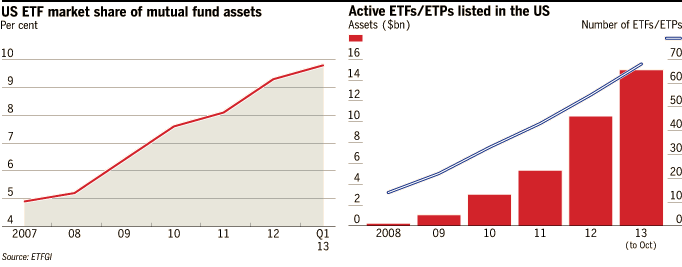
Exchange traded funds (ETFs) have challenged the mutual funds industry and grown into a $2tn asset class by offering investors cheaper products that trade like stocks but passively track indices or other baskets of securities.
Initially sceptical that ETFs would gain traction with investors, asset managers are now working to gain a foothold in the market by creating their own specialised version of the products.
So-called “actively managed ETFs” do not track an index, allowing the basket of securities underlying the funds to change in real time and give investment managers control over the portfolio’s trading strategy, just like a mutual fund.
To date some 68 of the products exist, holding more than $14bn worth of assets, but many believe the market for actively managed ETFs could grow to be worth more than $100bn over the next five years – if regulators agree to one crucial tweak.
“For the most part, the traditional mutual fund industry has watched from the sidelines and they can’t afford to miss this next wave in the ETF market,” says Stuart Thomas, principal at Precidian Investments, which creates ETFs.
The challenge is creating actively managed ETFs that protect a mutual fund provider from having its “secret sauce”, or daily trading strategies, exploited by other traders who now know what assets its managers are buying or selling.
While mutual funds are required to disclose their holdings every quarter, ETFs publish their holdings daily because they need a variety of banks and brokers to make markets in the underlying stocks and create the ETF shares.
At the same time, the ETFs will need to function like traditional versions of the product by closely tracking the value of the underlying basket of goods in real time.
“Compared to mutual fund sales there’s a bigger ecosystem supporting the sales of ETFs,” says Deborah Fuhr, founding partner at consultancy ETFGI. “A lot more people are talking about them and monitoring what’s happening in the space.”
Guggenheim Partners, Eaton Vance, T Rowe Price and Precidian have put forward proposals in recent years to create so-called “non-transparent actively managed ETFs”, which would preserve the anonymity of their trading strategies.
If successful, the effort will allow mutual fund providers to challenge large asset managers such as BlackRock, State Street and Vanguard who have carved out dominant positions in ETFs and also submitted proposals to regulators for non-transparent, actively managed ETFs.
Asset managers have made their case for non-transparent, actively managed ETFs in recent phone calls with the US Securities and Exchange Commission, according to people familiar with the matter.
For would-be issuers who have been trying for more than five years to convince regulators to approve the new products, the detailed discussions are being viewed as a potential turning point in their long-running battle to win the SEC’s blessing.
Kathleen Moriarty, a partner and ETF specialist at law firm Katten Muchin Rosenman, says: “The regulators want to know, if you are not going to tell the arbitrageurs what is in the portfolio, what you are going to give them to let them perform the hedging function.”
Arbitrageurs, known as “authorised participants”, or APs, are essential to building the funds since they create and redeem the ETF shares, usually in exchange for baskets of the underlying securities from the ETF sponsor. APs typically sign on to support ETFs because they believe they can profit by arbitraging small differences between the price of the fund’s shares and the underlying securities being tracked.
In most of these non-transparent active ETFs, proxy portfolios are designed to replicate the performance of the real holdings while disguising the ETF’s actual holdings.
Mr Thomas, at Precidian, says he believes regulators will ultimately approve some of these new ETFs despite the potential murkiness of the proxy portfolios: “The industry realises that an ETF structure brings technological and structural efficiencies, which bring advantages to the manager and the investor.”
But even if mutual fund sponsors are able to convince regulators, there are still questions over whether the products will work properly and simultaneously be embraced by investors.
Says Ms Fuhr: “Until it really happens and is out there and is really being used, that’s when we’ll see whether there are any potential issues that might come to light.”
 About bambooinnovator
 Bamboo Innovator
Pingback: kasina - innovating distribution in the financial services industry