Value is created by doing; Make mistakes of ambition and not mistakes of sloth. Develop the strength to do bold things, not the strength to suffer

Value is created by doing

Sam Altman

Jan 17, 2014

Value is created by doing.

It’s easy to forget this.  A lot of stuff feels like work—commenting on HN, tweeting, reading about other companies’ funding rounds, grabbing coffee, etc [1]—is not actually work.  (If you count that as work, think really hard about the value you’re creating in your job.)  These activities can be worthwhile in small doses—it’s important to network and meet interesting people to stay in the flow of ideas—but they are not by themselves how new wealth gets created.

Value gets created when a company does things like build widgets and sell them to customers.  As a rough guideline, it’s good to stay in roles where you’re close to the doing.

Of course you have to do the right things.  Writing software no one wants does not create value—that’s called a class project.  So it’s critical to figure out the right thing to work on, and strategy is far more valuable than a lot of pivot-happy companies would have you believe.  But strategy alone has no value—value gets captured by execution.

It’s easier to sit around and talk about building a startup than it is to actually start a startup.  And it’s fun to talk about.  But over time, the difference between fun and fulfilling becomes clear.  Doing things is really hard—it’s why, for example, you can generally tell people what you’re working on without NDAs, and most patents never matter.  The value, and the difficulty, comes from execution.

There are good tricks for keeping yourself honest here.  When I was running a company, I used to make a list of everything I got done at the end of the day.  It was remarkable how I could feel like I had a really busy day and realize that night I got nothing done.  Similarly, I could have a day that felt only somewhat busy, but accomplish 3 or 4 major things.

Err on the side of doing too much of the sort of work that matters and blowing off all the rest, or as Machiavelli said:

Make mistakes of ambition and not mistakes of sloth.  Develop the strength to do bold things, not the strength to suffer.

You build what you measure—if you measure your productivity by the number of meetings you have in a day, you will have a lot of meetings.  If you measure yourself by revenue growth or number of investments closed or something like that, you will probably have fewer meetings.

Another example of not-quite-work is every night in San Francisco, there are dinner parties where people get together and talk about the future.  It’s always fun and usually not very contentious—most people agree we need to go to space, for example.  But at the end of it, everyone goes home and works on something else.

If you believe that going to space is the most important project for humanity, then work on it.  If you can’t figure out how to raise hundreds of millions of dollars, go work for SpaceX (joining a great company is a much better plan than starting a mediocre one).  If enterprise software is what you really love, then work on that. [2]

If you’re reading this and feeling unproductive, there’s a silver lining.  You can just close the browser window.  The good news is that it’s easy to course-correct, and it feels great. [1] I count blogging as a marginal use of time, but the reason I started is because I realized it was important to be good at writing, I was bad at it, and the only way I was going to improve was with lots of practice.  And sometimes I meet really interesting founders because of something I wrote.

[2] This isn’t meant as any sort of relative value judgment; if what you want to do is build an enterprise software company, then you should do that.  The problem comes when what you really want to do is build rockets.  A lot of people feel like they first should do something to make money and then do what they care about (or first work at a company for awhile before starting a company they really want to start).  While you of course should take care of your family before anything else, you should try to work on what you really care about.  You can usually find a way.  The danger is that life is short and you only get to work on a small number of companies over the course of a career—it’s worth trying to make them count.


The Cult of Overwork

THE CULT OF OVERWORK

by James SurowieckiJANUARY 27, 2014

image001

For decades, junior bankers and Wall Street firms had an unspoken pact: in exchange for reasonably high-paying jobs and a shot at obscene wealth, young analysts agreed to work fifteen hours a day, and forgo anything resembling a normal life. But things may be changing. Last October, Goldman Sachs told its junior investment-banking analysts not to work on Saturdays, and it has said that all analysts, on average, should be working no more than seventy to seventy-five hours a week. A couple of weeks ago, Bank of America Merrill Lynch said that analysts are expected to have four weekend days off a month. And, last week, Credit Suisse told its analysts that they should not be in the office on Saturdays.

These changes may sound small, but, in the context of the Street, they’re positively radical. Alexandra Michel, a former Goldman associate who is now on the faculty at the University of Pennsylvania, published a nine-year study of two big investment banks and found that people spent up to a hundred and twenty hours a week on the job. In the pre-cell-phone, pre-e-mail days, it was possible for people to find respite when they left the office. But, as David Solomon, the global co-head of investment banking at Goldman, told me, “Today, technology means that we’re all available 24/7. And, because everyone demands instant gratification and instant connectivity, there are no boundaries, no breaks.”

Cry me a river, you might say. But what happened on Wall Street is just an extreme version of what’s happened to so-called knowledge workers in general. Thirty years ago, the best-paid workers in the U.S. were much less likely to work long days than low-paid workers were. By 2006, the best paid were twice as likely to work long hours as the poorly paid, and the trend seems to be accelerating. A 2008 Harvard Business School survey of a thousand professionals found that ninety-four per cent worked fifty hours or more a week, and almost half worked in excess of sixty-five hours a week. Overwork has become a credential of prosperity.

The perplexing thing about the cult of overwork is that, as we’ve known for a while, long hours diminish both productivity and quality. Among industrial workers, overtime raises the rate of mistakes and safety mishaps; likewise, for knowledge workers fatigue and sleep-deprivation make it hard to perform at a high cognitive level. As Solomon put it, past a certain point overworked people become “less efficient and less effective.” And the effects are cumulative. The bankers Michel studied started to break down in their fourth year on the job. They suffered from depression, anxiety, and immune-system problems, and performance reviews showed that their creativity and judgment declined.

If the benefits of working fewer hours are this clear, why has it been so hard for businesses to embrace the idea? Simple economics certainly plays a role: in some cases, such as law firms that bill by the hour, the system can reward you for working longer, not smarter. And even if a person pulling all-nighters is less productive than a well-rested substitute would be, it’s still cheaper to pay one person to work a hundred hours a week than two people to work fifty hours apiece. (In the case of medicine, residents work long hours not just because it’s good training but also because they’re a cheap source of labor.) On top of this, the productivity of most knowledge workers is much harder to quantify than that of, say, an assembly-line worker. So, as Bob Pozen, a former president of Fidelity Management and the author of “Extreme Productivity,” a book on slashing work hours, told me, “Time becomes an easy metric to measure how productive someone is, even though it doesn’t have any necessary connection to what they achieve.”

Habit, too, is powerful: things are done a certain way because that’s how they’ve been done before, and because that’s the way the people in charge were trained. When new regulations limited medical residents’ working hours to eighty a week, many doctors complained of declining standards and mollycoddling, and said that it would have a disastrous effect on training, even though residents in Europe work many fewer hours, without harming the quality of medical care. “I went through it, so you should” is a difficult impulse to resist.

To make these new policies stick, then, banks have to change not just rules but expectations. Indeed, as Michel told me, “it isn’t really external rules that force bankers to work the way they do. It’s an entire cultural system.” She cites the example of a consulting firm that mandated that people stay out of the office on weekends, only to discover that they were working secretly from home. In a culture that venerates overwork, people internalize crazy hours as the norm. As the anthropologist Karen Ho writes in her book “Liquidated,” “On Wall Street, hard work is always overwork.” Grinding out hundred-hour weeks for years helps bankers think of themselves as tougher and more dedicated than everyone else. And working fifteen hours a day doesn’t just demonstrate your commitment to a company; it also reinforces that commitment. Over time, the simple fact that you work so much becomes proof that the job is worthwhile, and being in the office day and night becomes a kind of permanent initiation ritual. The challenge for Wall Street is: can it still get bankers to run with the pack if it stops treating them like dogs? ♦

Read more: http://www.newyorker.com/talk/financial/2014/01/27/140127ta_talk_surowiecki?printable=true&currentPage=all#ixzz2rQSrI44K

Magnum, a Hong Kong nightclub launching its IPO, explains how a nightclub works, the popularity of the Jagerbomb and that, sometimes, people drink while dancing

With This Initial Public Offering, There’s a Lot to Drink In

Hong Kong Stock Pitch Explains Scene: Jagerbombs Sell Big; Club Hopping Poses a Risk

ISABELLA STEGER

Updated Jan. 21, 2014 10:58 p.m. ET

image001

Gold toilet at Magnum Club in Hong Kong Isabella Steger/The Wall Street Journal

When a company is going public, it is important that prospective investors understand its business.

Magnum, a Hong Kong nightclub, is launching an initial public offering on Thursday, and its prospectus explains the following: how a nightclub works, the popularity of the Jagerbomb and that, sometimes, people drink while dancing.

“Clubbing is a popular night time activity which has evolved from the discotheques of the 1970s into a modern form of social gathering with lively music, elaborate lighting and a dance floor, supplemented by both alcoholic and non-alcoholic beverages,” the IPO-prospectus overview begins.

And it describes the scene: “The aura and atmosphere of the modern clubbing scene is filled with images of people moving in unison to the beat of synthesised remixed dance and electronic music spun out by a DJ perched upon an elevated stage.”

Late on a Saturday night, the line to get into the Magnum Club can sometimes stretch down the block. As busy as Magnum gets, far more people want to buy into the company’s IPO than to dance amid its flashing walls and use its diamanté-encrusted toilets.

Investors placed orders for over 3,000 times the number of shares available in the HK$126 million ($16 million) IPO, making it one of the hottest stock offerings in the city’s history. The prospective buyers are betting that the stock of the nightclub chain will skyrocket when it starts trading on Thursday.

As with any coveted IPO, brokers give their best customers the first crack at the shares so they can earn quick profits if the stock pops when trading starts. In Hong Kong, that would include an army of mom and pop stock traders, many of whom spend their days hanging around brokerage offices and some who have likely gone to bed before Magnum gets hopping.

“Lots of my clients want to get their hands on Magnum’s shares,” said Arthur Lui, senior sales manager at Prudential Brokerage.

Peter Wong, 38 years old, works at a brokerage and visits the Magnum club twice a week. “I would actually be interested in the IPO, but it’s very hard to get into,” he said as he poured from a HK$5000 ($645) bottle of Belvedere vodka Saturday night at Magnum.

But he wouldn’t stay for the long haul. “I would dump the shares quickly,” Mr. Wong said. One reason: “People are fickle and will just move on to whatever the hottest new club is.”

The prospectus acknowledges that patrons might not hang around all night. “There has been a trend of ‘club-hopping’ developing in Hong Kong in recent years which means customers have the tendency to visit multiple clubs in one night,” the document continues. “Customers may choose a Club based on their mood on a particular evening.”

The IPO is tiny by most standards. The club’s owner, Magnum Entertainment Group Holdings Ltd., runs three nightclubs within blocks of one another in Lan Kwai Fong, a densely packed, occasionally rowdy neighborhood of bars and restaurants just up the hill from Central, Hong Kong’s main business district.

Magnum tries to differentiate its three clubs: Magnum, Beijing Club and Billion Club. The Billion Club boasts life-size bronze bulls on its outdoor terrace and Magnum has a crystal-studded DJ booth. Billion and Magnum have diamanté-decorated toilets. Proceeds raised from the IPO will go to opening another club, Zentral, this year.

The nightclub company and its bankers and lawyers wouldn’t talk ahead of the IPO.

Magnum topped the record set by Milan Station Holdings Ltd. 1150.HK +2.17% ‘s IPO in 2011, when investors placed orders for more than 2,000 times the number of shares available. Milan Station occupies a unique niche in brand-obsessed Hong Kong, selling secondhand designer handbags for prices ranging from a few hundred to a few thousand dollars. Hong Kong’s individual investors typically flock to small IPOs like these, looking to make a quick buck by selling the shares once the company starts trading.

Magnum makes most of its money selling drinks, “generally known as alcoholic beverage served by glass and prepared by bartenders mixing different alcohol and ingredients,” according to the prospectus.

The drinking habits of Magnum’s patrons have changed recently. According to the IPO prospectus, Magnum’s clients have widely divergent and rapidly changing tastes. The club’s highest-grossing drink is Moët & Chandon Magnum Champagne.

But the most popular is the Jagerbomb, typically defined as a shot of Jagermeister—a German liqueur made from 56 herbs, roots and spices that tastes heavily of anise—dropped into a glass of beer or energy drink. The Jagerbomb overtook a Smirnoff vodka that was the most popular drink for the previous three fiscal years, according to the prospectus.

Magnum’s IPO is getting an unlikely boost. While Hong Kong residents aren’t known to be big drinkers, the prospectus gives credit for the company’s growth to a 50% surge in expatriate professionals in Hong Kong after the financial crisis.

“It is believed that this leads the Hong Kong alcohol consumption and night entertainment scene closer to the consumption patterns observed in western countries,” the document says.


Craig Winkler’s Xero shares now worth $745m as stock breaks $40 barrier

Caitlin Fitzsimmons Online editor

Craig Winkler’s Xero shares now worth $745m as stock breaks $40 barrier

Published 16 January 2014 12:33, Updated 16 January 2014 12:35

image001

Craig Winkler returned to the BRW Rich 200 in 2013 thanks to his Xero investment. James Davies

The extraordinary rise of shares in accounting software start-up Xero has already made hundreds of millions of dollars for early investor Craig Winkler and it shows no signs of slowing down.

The New Zealand-based company opened on the Australian Securities Exchange at $40.30 on Thursday morning, after rising nearly 8 per cent the previous day.

This is an 18 per cent rise since 6 November last year when it closed at $34.20. The stock listed on the ASX just a year before, on 8 November 2012, at an opening price of $4.50. It was already listed on the New Zealand Stock Exchange and maintains a dual listing.

The share price gives it a market capitalisation greater than many other businesses, including SEEK and Qantas, and is despite the fact that the company is not yet profitable.

Xero reported a net loss of $16 million for the six months ended 30 September but revenue is growing strongly and is now more than $30 million. The company, described by Credit Suisse as the “Apple of accounting”, offers a cloud-based accounting solution to the small business market and its customer base is global.

Winkler paid $15 million for his initial stake in Xero in 2009 after selling out of rival accounting software company MYOB, which he founded.

He sold some shares early on but remains the second largest shareholder in Xero behind the Kiwi chief executive Rod Drury.

Winkler returned to the BRWRich 200 in 2013 in 178th place, with a fortune estimated at $275 million, $200 million of that from the value of Xero shares.

Based on the Thursday opening price of $40.30, his stake is now worth a staggering $745 million.

On Wednesday Xero appointed Victoria Crone, who previously worked at Telecom New Zealand and Chorus, as managing director in New Zealand, effective April.

The statement to the ASX also revealed the company had recruited 90 staff in the past three months and now had headcount over 600 but is still looking to hire more software developers.

Smiggle kids stationery retailer expands to UK; large shopping centre landlords are keen to have Smiggle as a tenant because there is little risk of sales leaking away to the internet

Smiggle kids stationery retailer expands to UK

Published 22 January 2014 12:00, Updated 23 January 2014 11:48

Simon Evans

The Smiggle chain’s bright colours and cheap and cheerful stationery have proven a hit with Australia’s nine-year-old girls and boys. Now Mark McInnes is hoping youngsters in Britain will have the same appetite for Smiggle’s rucksacks, pencil cases, lunch boxes, drink bottles and erasers.

The former boss of department store chain David Jones, who has been chief executive for almost three years at ­Premier Retail (the retail business owned by billionaire and BRW rich lister Solomon Lew’s listed Premier Investments ­vehicle), believes Smiggle can be a ­global champion.

He’s about to find out if Smiggle, which has 124 stores in Australia, can become a serious player in the $2.4 billion British market. The first Smiggle store is set to open on February 20 in Britain in Westfield Stratford City, the giant shopping centre which opened in 2011 and is adjacent to London’s Olympic Village.

McInnes, Smiggle group general manager John Cheston and the Premier Investments board are aiming to have 200 Smiggle stores operating in Britain within five years. This will make the British Smiggle business much larger than the Australian operations, which are rapidly approaching saturation point with 124 stores.

Smiggle also has 17 stores in Singapore after first entering that market two and a half years ago, and that business is tracking solidly. Mr McInnes thinks Smiggle has the right stuff to become a highly pro­fitable global brand as it attempts to muscle in on Britain.

“We’re not competing with the Zaras of the world. There aren’t many global companies that can talk about their ­target market being nine-year-old girls and boys.”

Smiggle’s biggest competitor is the private equity-owned Paperchase, which has about 100 stores in Britain and much larger store footprints of about 200 to 250 square metres. Paperchase has 70 per cent of its range focused on adult stationery. Another competitor is WH Smith, a newsagent, bookseller and stationery group.

Cheston says large shopping centre landlords are keen to have Smiggle as a tenant because there is little risk of sales leaking away to the internet. The average transaction size of Smiggle customers is about $20 each visit, as children shop with a parent and younger teenagers make purchases of fashionable stationery with their pocket money. Smiggle has a small internet presence but makes most of its sales in stores.

The former Just Group paid $29 million for Smiggle in 2008 when it was just 20 stores and sales revenue has risen from $19 million to more than $90 million. Premier Investments bought Just Group for $800 million in late 2008.


Will the 2nd Great Machine Age be a frightening jobless dystopia?

Will the 2nd Great Machine Age be a frightening jobless dystopia?

Machines have been displacing jobs for years and the rate is accelerating

By Ambrose Evans-Pritchard

12:11PM GMT 25 Jan 2014

Thanks to lightning-speed advances in hi-tech, humanity (or part of it) is close to achieving its dream of prosperity without toil. We are already starting glimpse the awful consequences. As Voltaire said, work is the triple tonic for needs, vice, and boredom.

A Davos vote split 51:49 on whether “technological innovation” will keep displacing jobs – and at an accelerating rate – leaving us with a deformed world where hundreds of millions are left on the unemployment scrap-heap (205m so far).

The waters have been so muddied by the global financial crisis – and the 1930s response to it in some quarters – that it is hard to separate the chronic job wastage caused by “robots” (to use a metaphor) from the temporary effects of scarce global demand.

Phillip Jennings, head of the UNI global labour federation, said it would be a “miscarriage of justice” to blame the 32 million job losses since the Lehman-EMU crisis on the iPad or the driverless car.

“You can’t put technology in the dock for 50pc youth unemployment in Greece or Spain. I blame the EU Troika. It was the economic and political decisions taken that have led to the collapse of jobs. In Greece it has gone beyond depression into a humanitarian crisis,” he said at theWorld Economic Forum.

He said some $2 trillion of corporate cash is on the sidelines in the US, $700bn in the UK, and another $2 trillion in the rest of the world. “There is an investors strike. This is a problem of demand in our economies, they are comatose,” he said.

This has a kernel of truth. The current policy settings are pushing the global savings rate to a record 25.5pc of GDP, creating a chronic surfeit of capital over labour. It is a Marxian world.

You can blame this on the “savings glut” in Asia and Northern Europe, or Chinese industrial policy, or regressive tax systems, or labour arbitrage that lets multinationals play off cheap labour in the East against the West, or growing inequality on the GINI index (all linked). As Mr Jennings says, “the social contract has been ruptured.” I would go further. We risk losing social/liberal democracy altogether.

And yet, there is a deeper story. Larry Summers, the former US Treasury Secretary, told the same panel that the post-Lehman jobless spike is of course due to a failure to take “economics seriously” – though he mercifully spared us the names of his “avatars of austerity”, the guilty men. We know who they are. It is a crisis caused by lack of global aggregate demand.

But he also said machines have been displacing jobs for almost half a century. The proportion of those aged 25-54 (the relevant cohort) that is not working in the US has tripled since 1965. This cannot be blamed on globalisation alone. “It predates meaningful trade with China. It is a long-term trend and it is accelerating.”

For those tempted by cry Luddism, hold your thought. This is nothing like the switch from agricultural revolution to the first machine age. The new displaced cannot migrate into textiles mills and great manufacturing hubs on the 19th Century. Labour-saving technology is now sweeping all sectors, including services. “The challenge is that much more immense now,” he said.

A single professor can teach 150,000 students the same academic course through digital lessons. While it still takes the irreplaceable creativity of human beings to play a Haydn Quartet, the same disc can be sold to millions, he said.

This is not a counsel of utter despair. Governments can rewrite the rule book, though that is a tall order in our global race to the bottom, with footloose capital. As Mr Summers says, the abuses did not self-correct even in the late 19th Century and early 20th Century. “It required a Gladstone, a Bismarck, a Roosevelt to make it work,” he said.

Prof Erik Brynjolfsson, a tech guru at MIT, said tax policies can change the game. Some 80pc of US taxation is now on labour. But how do you shift this burden to wealth taxes in a world of open capital flows and competing national tax jurisdictions? (Protectionism perhaps, but I wash my mouth out with soap for even muttering it)

Nor will the emerging economies escape this curse. Indeed, they are in the “bulls eye”, said Prof Brynjolfsson.

Apple’s new Mac Pro will be made in Austin, Texas. Robots have rendered the labour cost irrelevant. The BRICS and mini-BRICS can longer under cut on price.

“Wages don’t matter any longer. Off-shoring was just a way station.” We are back to reshoring, but without jobs. Welcome to our brave new world


If You’re Not Helping People Develop, You’re Not Management Material

If You’re Not Helping People Develop, You’re Not Management Material

by Monique Valcour  |   10:00 AM January 23, 2014

Skilled managers have never been more critical to the success of firms than they are today.  Not because employees can’t function without direction, but because managers play a vital role in talent management. Gone are the comprehensive career management systems and expectations of long-term employment that once functioned as the glue in the employer-employee contract.  In their place, the manager-employee dyad is the new building block of learning and development in firms.

Good managers attract candidates, drive performance, engagement and retention, and play a key role in maximizing employees’ contribution to the firm. Poor managers, by contrast, are a drag on all of the above.  They cost your firm a ton of money in turnover costs and missed opportunities for employee contribution, and they do more damage than you realize.

Job seekers from entry-level to executive are more concerned with opportunities for learning and development than any other aspect of a prospective job.  This makes perfect sense, since continuous learning is a key strategy for crafting a sustainable career.  The vast majority (some sources say as much as 90%) of learning and development takes place not in formal training programs, but rather on the job—through new challenges and developmental assignments, developmental feedback, conversations and mentoring.  Thus, employees’ direct managers are often their most important developers.  Consequently, job candidates’ top criterion is to work with people they respect and can learn from. From the candidate’s viewpoint, his or her prospective boss is the single most important individual in the firm.

Managers also have a big impact on turnover and retention. The number one reason employees quit their jobs is because of a poor quality relationship with their direct manager.  No one wants to work for a boss who doesn’t take an interest in their development, doesn’t help them deepen their skills and learn new ones, and doesn’t validate their contributions. This isn’t what departing employees tell HR during their exit interviews, of course.  After all, who wants to burn a bridge to a previous employer? Instead, they say they’re leaving because of a better opportunity elsewhere.  And so what happens is that organizations remain in the dark regarding how much damage their inept managers are doing.

Regardless of what else you expect from your managers, facilitating employee learning and development should be a non-negotiable competency.  Google’s famous people analytics team examined data from thousands of employee surveys and performance reviews to find out which behaviors characterize its most effective managers.  Coaching topped a list that also included helping with career development.  Research by Gallup has yielded similar results.  Work groups in which employees report that their supervisor (or someone else at work) cares about them as a person, talks to them about their career progress, encourages their development, and provides opportunities to learn and grow have lower turnover, higher sales growth, better productivity, and better customer loyalty than work groups in which employees report that these developmental elements are scarce.

Remember the Peter Principle?  The phrase refers to a process in which employees receive promotions as a reward for being competent in their current jobs, and they continue to rise through an organization’s ranks until they reach a level at which they are incompetent.  The predictable consequence of this pattern is that over time, an organization becomes heavily staffed by managers who are bad at their jobs.  Your organization cannot afford to let this happen.

Becoming a great developer of employees requires managers to expand their focus from “How can I get excellent performance out of my team members?” to “How can I get excellent performance out of my team members while helping them grow?”  Savvy managers know that doing well on the second part of the last question helps to answer the first.

The best managers ask, “How can we harness employee strengths, interests and passions to create greater value for the firm?”  Systematically linking organizational performance and individual development goals in the search for learning opportunities and better ways to work is a hallmark of organizations where sustainable careers flourish. And this is not a question managers try to answer by themselves; instead, they discuss it regularly with their team members.

Here are several steps you can take to stimulate learning and development:

Share detailed information with your team about current operations across the firm.  Be transparent about the firm’s challenges and direction, including such things as changing customer expectations, new vendor relationships, early-stage strategic plans, and top leaders’ thinking regarding the potential impact of industry trends and economic conditions. Invite their questions, thinking and suggestions on these issues as well.

Support the development of internal social networks that span functions and divisions in order to give employees broader understanding of the organization and help them spot opportunities to learn and to add value.

Instead of a once-annual conversation about career goals at the time of the annual performance review, have frequent short conversations throughout the year regarding employees’ career goals and interests, which may not be self-evident. Regular career conversations help employees to refine their goals. With better understanding of their learning goals, you and your employees are in a better position to spot developmental opportunities.

When planning your team’s work, ask employees to identify both how they can contribute and what they would like to learn. This gives employees the primary responsibility for clarifying what they want to learn and for proposing ways to incorporate on-the-job learning. It also helps to avoid having employees volunteer to perform only the tasks that they are already highly skilled at.

Ask employees to report back periodically to you and fellow team members on what they have been learning and how they are using new skills and knowledge.

Keep in mind that in addition to helping employees develop and pursue meaningful learning goals, regular career conversations also help to mark progress in development. And they serve as a reminder of the organization’s commitment to employee learning, which in turn strengthens employee commitment.


The Secret to Lean Innovation Is Making Learning a Priority

The Secret to Lean Innovation Is Making Learning a Priority

by Tom Agan  |   12:00 PM January 23, 2014

Lean innovation is being embraced by everyone — from the smallest start-ups to the largest global organizations. But in most cases, it’s still falling well short of its full potential because it either lacks or fails to tightly integrate with the mechanisms needed to systematically capture lessons learned and share them outside the team. And that’s where the money is in innovation.

Lean innovation embraces a philosophy of not letting perfection get in the way of progress. It leverages the Pareto principle that 20% of a product’s features (what’s distilled down into the minimal viable product) will most likely deliver 80% of the benefits sought by customers.

As an approach, lean innovation lends itself especially well to corporate cultures, often engineering ones and others strongly focused on process-improvement programs such as Six Sigma. Its straightforward, step-by-step methodology makes it relatively easy to explain and to implement:

Identify the minimal viable product.

Develop a version rapidly and test it with customers, ideally in a real-world competitive situation.

Repeat the process until the core product is competitive or pivot to explore a new approach.

Lean innovation stands in stark contrast to conventional approaches to product development in which teams expend enormous effort trying to create a perfected, many-featured product over an extended period without sufficient in-market customer feedback. The resulting new products are often too expensive, too complicated, too different from what customers want, and too late to market.

But an exclusively process-driven view of lean innovation obscures the underlying reason for its power. And without a deeper understanding, we limit our ability to fully benefit from its potential.

When I worked at Nielsen, I led a study of innovation best practices in the consumer-packaged-goods (CPG) industry with companies like Procter & Gamble and Kraft that revealed why top-performing companies average 600 times more revenue from their new products than the lowest performers. The research tied variations in new product revenue at almost 30 global companies to differences in processes, culture, organizational structure, senior executive leadership roles, and investment.

One of the key findings was that learning has far and away the single greatest impact on revenue from new products. And creating a better environment for learning is what lean innovation does so well. Its focus on the most important product attributes and rapid cycling of trial and error — ideally in the real-life competitive environment — accumulates critical knowledge at a rapid clip.

In other words, lean innovation is not a better innovation process; rather it’s a more efficient learning process. And by combining the lean perspective with innovation research from CPG companies, we can vastly improve the effectiveness of the lean innovation approach. Here is what the research tells us:

Companies with mandatory formal debriefs of both success and failure following new product launches average about 100% more revenue from new products in comparison to companies that don’t formally debrief.

When debriefs are led by an outside third party, the revenue increases substantially more.

And when the learnings are captured in a knowledge management system, revenue jumps again.

Companies that apply these learnings to creating, continuously improving, and strictly following decision-making criteria for the evaluation of potential new products average about 130% more revenue from new products.

Success can skyrocket by simply adding the above steps to a lean innovation process.

But this research also points to a cautionary note regarding lean innovation. Given that lean innovation teams move so quickly, the learnings are less likely to be captured than in traditional, slower approaches to product development. Secondly, given that lean innovation teams often exist in parallel with conventional product development teams, valuable learnings from lean teams are not always transferred to the development side.

We need to think of lean innovation as a process that drives more efficient learning. But to maximize success, lean innovation must be married to practices that effectively capture these rich lessons and make them readily available to everyone within the organization.


Five Questions Every Leader Should Ask About Organizational Design

Five Questions Every Leader Should Ask About Organizational Design

by John Beeson  |   11:00 AM January 23, 2014

A few years ago Dave Ulrich, a management thought leader from the University of Michigan, made a comment I found both insightful and profound: “Every leader needs to have a model of organization design.” Typically a graphic depiction of the organizational components to be addressed in a redesign (for example, McKinsey’s 7S model, which includes strategy, structure, systems, staff, skills, and so on), every consultant and his brother flogs an organization design model. Dave didn’t advocate any particular design model, just one the leader knows how to employ and one flexible enough to be applied to the range of organizational situations a leader faces in the course of a career.

Once upon a time, “organization design” meant bringing in a slew of consultants to oversee a large-scale organizational restructuring, most often intended to take out big chunks of cost during an economic downturn. Although that kind of redesign is still required periodically, leaders today are more typically confronted with the challenge of how to find cost efficiencies in certain parts of their organization to invest in other parts of the organization that drive growth. As a result, organization design is no longer just a big bang event. Rather it’s an on-going nipping and tucking of organizational resources to achieve both growth and efficiency at multiple levels: the company overall, the operating group level, and even within functional groups like human resources and information technology. So leaders at many different levels need to get in on the act.

If, as Dave suggests, there isn’t any ideal design model, then how does one choose an approach to designing an organization that is robust enough to address the dual goals of achieving efficiency and investing in growth at multiple levels of the organization?

The fundamental task of organization design is, as it always has been, helping a leader move from defining strategy to putting in place an organization that enables the strategy to be executed predictably. An effective organization design model guides a manager in answering five fundamental questions in a thoughtful and well-integrated way.

What is the business’s value proposition and it sources of competitive advantage? Business strategies are lofty, typically long-term oriented, and often aspirational. By contrast a compelling value proposition describes succinctly how the company will compete successfully against its competition—and implies the critical activities around which the organization should be designed. Are you competing on the basis of on-going product or technological innovation? Through low-cost sourcing and manufacturing?  By creating highly customized solutions for target customers? A clear, straightforward answer to this question provides a foundation on which you can design an organization.

Which organizational activities directly deliver on that value proposition—and, by contrast, which activities can the company afford to perform in a way equivalent to competition? When faced with an organization design challenge, many managers rush to grab a cocktail napkin—long the instrument of choice for reorganizing—and sketch out a high-level diagram of boxes and reporting relationships. In doing so, they implicitly accept the way organizational resources and costs are currently deployed and miss opportunities for more creative, effective design. A better course is devoting time to considering what organizational functions truly bring the value proposition to life. As Kreig Smith, founder of design consultancy AlignOrg Solutions, has pointed out, not all work is created equal. Certain activities are crucial to delivering on the value proposition. As a result, they should be owned by the company and given the greatest possible resources.

Conversely, there are functions and activities where an extra dollar of investment doesn’t help the company win in the marketplace. What’s important is to realize that both sets of activities vary with a company’s business strategy. For example, new product development may be the lifeblood of a consumer products company—and thus need to be cultivated and resourced carefully—while in a low-cost producer, or fast follower company, product development may be only a nice-to-have activity. “Get the wash out the door” activities, that is, those where being at par with competition is sufficient, are candidates for cost reduction whether by centralization, automation, outsourcing, or a shared service approach.

Which organization structure should we choose, and how do we overcome its inherent downsides? Many leaders fall in love with the organization structure they’re most familiar with, whether it’s organized according to function, geographic location, customer segment, or through a matrix. In the process they neglect to appreciate the pros and inherent cons of the structure and thus fail to take steps to mitigate the downsides. While a structure organized around customer groups is great for getting close to them and catering to their needs, for instance, it can be costly, and over time interest in product innovation may wane. What’s more, organization structures by definition create boundaries between one part of the organization and others. A successful organization design therefore, as Jay Galbraith of the Center for Effective Organizations pointed out years ago, includes linking or integrating mechanisms, such as an account management function to coordinate activities—creative, design, brand management, and so forth—on behalf of the client within an advertising agency.

What type of leadership and culture are required to achieve the value proposition? For all the table pounding that managers do about culture change, few fully consider the type of leadership and culture required to put a new organization design into gear. Clearly, a low-cost producer strategy demands a ruthless focus on controlling costs while a customer-focused organization needs to encourage deep customer knowledge and internal coordination aimed at creating customer-specific products and services. When a company adopts a significantly different organization design, a critical part of the implementation process needs to include putting in place leaders who lead in a way consistent with the new value proposition and who will take steps to strengthen corresponding cultural norms. For example, when a company moves from an efficiency-based strategy to a customer-focused one, members of the leadership team need to introduce a new reward system to promote a do-whatever-it-takes mentality in responding to customer needs throughout the organization.

Which organizational practices are required to reinforce the organizational intent? Many managers introduce a new strategy and organization structure and declare victory—often at their peril. The reason that cultures are so difficult to change is that cultural values are deeply woven into the policies and practices that govern how people work. As a result, when leaders launch a significantly new organization design, it’s imperative that they revise such practices — how performance objectives are set, the metrics and scorecards that signal success or failure, the type of people to be recruited, and how they are trained. Otherwise, they’ll put in place a shiny new organization structure — but find that people are behaving exactly as they did under the old regime.

As organization structures have become more fluid and organic, organization design is no longer the purview of a handful of senior executives supported by high-priced consultants. Leaders at many levels of the organization are increasingly called on to reallocate organizational resources and redesign their organizations to support more frequent shifts in company strategy. As a result, they need to have a trusty organization design model in their wallets—and know how to use it.


Does Your Company Make You a Better Person?

Does Your Company Make You a Better Person?

by Robert Kegan, Lisa Lahey and Andy Fleming  |   8:00 AM January 22, 2014

When we hear people talk about struggling to maintain work-life balance, our hearts sink a little. As one executive in a high-performing company we have studied explained, “If work and life are separate things—if work is what keeps you from living—then we’ve got a serious problem.” In our research on what we call Deliberately Developmental Organizations—or “DDOs” for short—we have identified successful organizations that regard this trade-off as a false one. What if we saw work as an essential context for personal growth? And what if employees’ continuous development were assumed to be the critical ingredient for a company’s success?

The companies we call DDOs are, in fact, built around the simple but radical conviction that the organization can prosper only if its culture is designed from the ground up to enable ongoing development for all of its people. That is, a company can’t meet ever-greater business aspirations unless its people are constantly growing through doing their work.

What’s it like to work inside such a company? Imagine showing up to work each day knowing that in addition to working on projects, problems, and products, you are constantly working on yourself.  Any meeting may be a context in which you are asked to keep making progress on overcoming your own blindspots—ways you are prone to get in your own way and unwittingly limit your own effectiveness at work.

Whether you are someone who avoids confrontation, hides your inadequacies to avoid being found out, often acts before thinking things through, gets overly aggressive when your ideas are criticized, or are prone to any number of other forms of counterproductive thinking and behavior, you and your colleagues can expect to be working on identifying and overcoming these patterns as part of doing your job well. Together, in meetings, one-on-one sessions, and just during the course of your everyday work, you will also be seeking to get to the root causes of these patterns and continually devising different ways of doing things and seeing what happens as a result.

In a DDO, the root causes almost always are about people’s interior lives—about unwarranted and unexamined assumptions and habitual ways of behaving. And no executive or leader (no matter how senior) is immune from the same analytic process. When it comes to ongoing development, rankdoesn’t have its usual privileges.

In the ordinary organization, every person is doing a second job no one is paying them to perform—covering their weaknesses and inadequacies, managing others’ good impression of them, and preserving a position that would feel more precarious if people didn’t always see them at their best. In a DDO, this is considered the single biggest waste of resources in organizational life.

Imagine if you worked in a place where your inadequacies were presumed not to be shameful but were instead potential assets for continuing growth, where business challenges were new opportunities to test out whether you could take a more effective approach to solving a problem, where no matter how effective you were at your job, you could keep stretching yourself to even greater levels of capability.

Imagine if you worked in a place where the definition of a “good fit” between the person and the job is “she does not yet have all the necessary capabilities to perform the role at a high level, but we will help her to develop them, and when she does she will have outgrown this job, and we will need to find her another.”

An implication of our work for companies that aspire to be high-performing cultures is summed up in this question:  Would you continue to consign the development of your people (and, inevitably, onlya fraction of your people) to one-off training programs, executive coaches, high-potential programs, and the like if you could make your organization’s very operations the curriculum and your company the most compelling possible classroom in your sector?

Being part of such an organization is not always easy, but the environment created by a focus on development in the workplace that is universal (across all ranks and functions in the organization) and continuous (and therefore habitual) unleashes some surprising qualities: compassion alongside tough-minded introspection and organizational solidarity that comes from collective work at self-improvement.  This creates a different kind of vitality at work: a work and life integrated rather than balanced against each other.

With thanks to our research team members, Matt Miller and Inna Markus, who contributed to this piece and to the forthcoming HBR article, “Making Business Personal” (April 2014).  


NYSE Euronext Files to Allow ‘Nontransparent’ ETFs to List, Trade; Mutual funds look to gain ETF foothold

NYSE Euronext Files to Allow ‘Nontransparent’ ETFs to List, Trade

ETFs Would Be Listed on NYSE Euronext’s Arca Trading Platform

MURRAY COLEMAN

Updated Jan. 23, 2014 6:07 p.m. ET

Exchange-traded fund managers got a boost to their efforts to capture a bigger part of the $7 trillion market for stock mutual funds.

The operator of the New York Stock Exchange filed a request with the Securities and Exchange Commission on Thursday to adopt a new rule that would permit “nontransparent” ETFs to list and trade on its platform.

The ETFs would be listed on the Arca trading platform of the NYSE Euronext, a unit ofIntercontinentalExchange Group Inc. ICE -1.22%

ETF sponsors currently must report securities held in each portfolio on a daily basis. Officials at NYSE Euronext, the exchange’s parent, are now asking for permission to trade ETFs that only have to report quarterly, much like traditional mutual funds, according to a copy of the filing on the exchange’s website. An NYSE official confirmed to The Wall Street Journal that the request was sent to the SEC.

“We’re finally seeing some real momentum in the move to gain regulatory approval for nontransparent ETFs,” said Kathleen Moriarty, an ETF pioneer who is now an attorney at Katten Muchin Rosenman LLP in New York. She was on the team that developed theSPDR S&P 500 ETFSPY5.LN -1.56% the first exchange-traded fund, which launched in 1993.

Developers of nontransparent ETFs say they are getting more feedback lately from regulators after seeing their proposals sit on the SEC’s shelf for years. But Ms. Moriarty said that shouldn’t be taken as a signal of a warming by the SEC to such proposals.

“What it really shows is that they’re finally getting around to considering these proposals, not that they’re leaning in any particular direction,” she said. More rounds of comments between regulators and ETF sponsors could stretch out for more than a year, she predicted. Also, advancement of any proposal would need to go before the public. Processing of such comments could take even more time, she noted.

“Nontransparent ETFs still face an uphill battle,” she said.

Regulators have been busy dealing with ETFs that use derivatives and leverage, said Dave Nadig, chief investment officer at San Francisco-based market researcher IndexUniverse. “They’re fearful of products that investors can’t see what’s inside, especially if they trade throughout the day,” he said.

But that hasn’t been the big holdup for the SEC addressing nontransparent ETFs, according to Mr. Nadig. “Developers of these new proposals are fighting more of a culture of risk aversion,” he said. “The SEC hasn’t been open to much in the way of ETF innovation for years. We’re finally starting to see a thawing in that type of an attitude.”

Much of any debate over relaxation of current reporting guidelines will probably focus on “window dressing” of portfolios, according to Mr. Nadig. The practice involves managers who are trying to boost their performance numbers at quarter’s end by unloading underperformers beforehand. “It’s the oldest game in town, and although nobody knows how widespread it is, the SEC is going to have to be concerned about potentially opening the ETF marketplace to that type of influence,” he said.

The NYSE’s request comes a day after Precidian Investments, of Bedminster, N.J., filed the first proposed prospectus detailing how such ETFs might work. The document lays out guidelines for three proposed U.S. stock portfolios—one covering large caps, another investing in domestic mid caps and the last taking a multi-cap approach. The funds would use a custodian and a blind trust to help shield key information about holdings until the end of each quarter.

The NYSE filing describes ETFs much in the same manner as Precidian’s system. Rival exchange operator Nasdaq OMX Group Inc. NDAQ -2.84% has also been working with other fund sponsors interested in bringing to market nontransparent ETFs, those familiar with the situation have told The Wall Street Journal. They expect a request laying out trading rules for a different set of nontransparent ETFs to be filed sometime in the first quarter, perhaps in coming weeks.

Other industry leaders have also filed with the SEC to move in the same direction, although those plans haven’t reached the stages of submitting a formal prospectus or definite trading rules, according to analysts. Those include BlackRock Inc., BLK -3.95%State Street Corp. STT -4.45% , Eaton Vance EV -3.25% and T. Rowe Price.TROW -3.18%

Separately on Thursday, a unit of Eaton Vance Corp. updated an earlier request to launch its version of a nontransparent ETF. The proposal seeks to come to market with a hybrid it is calling exchange-traded managed funds. Managers of such ETMFs wouldn’t be required to publicize positions being initiated or increased until the trades had settled. Since larger funds typically make such moves in stages, an investor might not see those positions for weeks.


Last updated: December 9, 2013 6:26 pm

Mutual funds look to gain ETF foothold

By Arash Massoudi and Tracy Alloway in New York

“To know your enemy, you must become your enemy” is an oft-quoted dictum for military and corporate strategists.

Mutual funds providers trying to grab a slice of the fast-expanding market for exchange-traded products are taking the tactic to heart.

image001

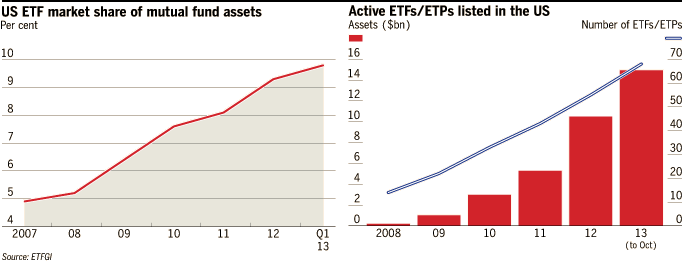
Exchange traded funds (ETFs) have challenged the mutual funds industry and grown into a $2tn asset class by offering investors cheaper products that trade like stocks but passively track indices or other baskets of securities.

Initially sceptical that ETFs would gain traction with investors, asset managers are now working to gain a foothold in the market by creating their own specialised version of the products.

So-called “actively managed ETFs” do not track an index, allowing the basket of securities underlying the funds to change in real time and give investment managers control over the portfolio’s trading strategy, just like a mutual fund.

To date some 68 of the products exist, holding more than $14bn worth of assets, but many believe the market for actively managed ETFs could grow to be worth more than $100bn over the next five years – if regulators agree to one crucial tweak.

“For the most part, the traditional mutual fund industry has watched from the sidelines and they can’t afford to miss this next wave in the ETF market,” says Stuart Thomas, principal at Precidian Investments, which creates ETFs.

The challenge is creating actively managed ETFs that protect a mutual fund provider from having its “secret sauce”, or daily trading strategies, exploited by other traders who now know what assets its managers are buying or selling.

While mutual funds are required to disclose their holdings every quarter, ETFs publish their holdings daily because they need a variety of banks and brokers to make markets in the underlying stocks and create the ETF shares.

At the same time, the ETFs will need to function like traditional versions of the product by closely tracking the value of the underlying basket of goods in real time.

“Compared to mutual fund sales there’s a bigger ecosystem supporting the sales of ETFs,” says Deborah Fuhr, founding partner at consultancy ETFGI. “A lot more people are talking about them and monitoring what’s happening in the space.”

Guggenheim Partners, Eaton Vance, T Rowe Price and Precidian have put forward proposals in recent years to create so-called “non-transparent actively managed ETFs”, which would preserve the anonymity of their trading strategies.

If successful, the effort will allow mutual fund providers to challenge large asset managers such as BlackRock, State Street and Vanguard who have carved out dominant positions in ETFs and also submitted proposals to regulators for non-transparent, actively managed ETFs.

Asset managers have made their case for non-transparent, actively managed ETFs in recent phone calls with the US Securities and Exchange Commission, according to people familiar with the matter.

For would-be issuers who have been trying for more than five years to convince regulators to approve the new products, the detailed discussions are being viewed as a potential turning point in their long-running battle to win the SEC’s blessing.

Kathleen Moriarty, a partner and ETF specialist at law firm Katten Muchin Rosenman, says: “The regulators want to know, if you are not going to tell the arbitrageurs what is in the portfolio, what you are going to give them to let them perform the hedging function.”

Arbitrageurs, known as “authorised participants”, or APs, are essential to building the funds since they create and redeem the ETF shares, usually in exchange for baskets of the underlying securities from the ETF sponsor. APs typically sign on to support ETFs because they believe they can profit by arbitraging small differences between the price of the fund’s shares and the underlying securities being tracked.

In most of these non-transparent active ETFs, proxy portfolios are designed to replicate the performance of the real holdings while disguising the ETF’s actual holdings.

Mr Thomas, at Precidian, says he believes regulators will ultimately approve some of these new ETFs despite the potential murkiness of the proxy portfolios: “The industry realises that an ETF structure brings technological and structural efficiencies, which bring advantages to the manager and the investor.”

But even if mutual fund sponsors are able to convince regulators, there are still questions over whether the products will work properly and simultaneously be embraced by investors.

Says Ms Fuhr: “Until it really happens and is out there and is really being used, that’s when we’ll see whether there are any potential issues that might come to light.”


Meet the Cabal That Wants to Terminate Your Cable Box

Meet the Cabal That Wants to Terminate Your Cable Box

By Victor Luckerson @VLuckJan. 24, 20142 Comments

Intel’s grand aspirations to launch a disruptive pay-TV service are dead, but the dream of a modern, more competitive television experience lives on. A cadre of big-name tech companies (and at least one startup) are quietly trying to broker deals with television networks in order to launch cable-like TV subscription packages that are delivered via the Internet. Such services could upend the $100 billion industry with improved user interfaces, tighter integration with digital services like Netflix and increased competition in local markets. Though all these companies have had their pay-TV plans reported on in the past, 2014 could finally be the year a newcomer breaks through. Here’s a breakdown of the primary contenders:

Aereo

The Plan: With Aereo customers can live-stream broadcast networks to their televisions, phones or tablets via the Internet and utilize a cloud-based DVR  to save at least 20 hours of content for later viewing. The $8-per-month service works by storing a farm of dime-sized antennas that are each assigned to individual customers, who can then tune them to the appropriate channel and stream content. The service is mostly for channels that send over-the-air broadcast signals that the antennae can pick up, but Aereo also carries Bloomberg TV and could make deals with other cable channels in the future.

Will it Work? That’s for the Supreme Court to decide. The court will hear an appeal brought by CBS, NBC and other major broadcast networks against Aereo that claims that the startup is essentially stealing their content by selling it to consumers without paying them retransmission fees. The lower courts have sided with Aereo, and a definite victory for the startup in the Supreme Court case would fundamentally change the relationship between broadcast networks and pay-TV operators.

Sony

The Plan: At this year’s Consumer Electronics Show Sony announced that it was launching a cloud-based TV service that would include live programming, on-demand viewing and DVR capabilities. Individual user profiles and a recommendation engine are also planned. Last year Sony reportedly reached a deal with Viacom to carry popular channels like MTV and Comedy Central on the service.

Will It Work? Sony hopes to appeal to its built-in fanbase by selling the service to people who own PlayStation game consoles and other Sony devices. Negotiating a deal with a huge player like Viacom also bodes well. However, the company just posted its first annual profit in five years in 2013, so it’s not exactly flush with cash to cut aggressive deals with TV networks. If a Sony service does launch, its channel bundles may look very similar to those currently offered by cable and satellite operators.

Verizon

The Plan: This week Verizon announced plans to purchase OnCue, the Intel-developed pay-TV service that the chipmaker abandoned after a new CEO threw cold water on the project. OnCue automatically saves three days’ worth of live content for easy viewing later, and utilizes a camera to recognize who’s watching television and serve them up personalized content. Verizon, which already has a small pay-TV service called FiOS, will likely use OnCue to more seamlessly stream content to mobile devices and expand FiOS’s footprint into more markets.

Will It Work? Verizon reportedly paid about $200 million for OnCue, so they’re definitely looking to put the technology to good use. The company also has more than 100 million wireless subscribers to whom they can offer bundles of television and cell service. And they already have relationships with the TV networks thanks to FiOS. But as an already active player in the pay-TV space, they’re unlikely to have the same disruptive tendencies as a startup like Aereo.

Amazon

The Plan: The online retail giant is reportedly in talks with television studios to license their content for a new pay-TV service that would stream live content, according to The Wall Street Journal. The service would be an extension of the Netflix-like streaming service and digital video rental store that Amazon already operates. It would likely integrate with the set-top-box that Amazon is reportedly prepping also.

Will it Work? Amazon has denied that they are planning a pay-TV service. But the company has shown itself willing to lose large amounts of money to elbow its way into other sectors (it spent an estimated $1 billion on its streaming service alone in 2013). The company might offer cheaper TV packages in hopes of enticing customers to buy more products from Amazon’s retail store.

Apple

The Plan: Apple has been trying to finagle its way into the TV industry since Steve Jobs was the CEO but hasn’t yet hit upon a winning formula. Reports last year indicated that the company was in talks with television studios to license content, but with a unique twist: Apple Apple would allow viewers to skip commercials, then compensate media companies for the lost ad revenue.

Will it Work? Apple has never commented much directly on its TV plans (beyond the Roku-like Apple TV device). However, the company is facing increasing pressure from Wall Street to launch another disruptive device like the iPhone or the iPad, despite continuing to rake in massive profits each quarter. A bold push into television might be just the thing to jumpstart the company’s stock price.

Google

The PlanGoogle has reportedly been mulling a pay-TV service for years. The company has plenty of experience broadcasting video content through YouTube, where it is currently experimenting with premium channels and live streams of sporting events.

Will It Work? Google has deep pockets, and the company is already edging its way into the living with Chromecast, a $35 device that allows users to stream content from computers and mobile devices to television screens. If the company couples Chromecast with a pay-TV service that people can easily control with their smartphones or tablets, they may hit on a formula that entices people to switch from clunky set-top-boxes and remote controls.

The Choreography of Design, Treasure Hunts, and Hot Dogs That Have Made Costco So Successful; The Designer of Over 500 Costco Warehouses on What Makes the Brand Such a Trustworthy Business

THE CHOREOGRAPHY OF DESIGN, TREASURE HUNTS, AND HOT DOGS THAT HAVE MADE COSTCO SO SUCCESSFUL

THE DESIGNER OF OVER 500 COSTCO WAREHOUSES ON WHAT MAKES THE BRAND SUCH A TRUSTWORTHY BUSINESS.

BY STAN LAEGREID

Costco, the sixth largest retailer in the world, succeeds because of its adeptness in breaking the rules of retail common sense. Costco has no advertising for non-members, though contained in a vacuous space, they offer no signage, then when you check out they do not bag your purchase. On top of that, the Costco store contains a mere 3,600 SKUs. Supermarkets offer around 25,000 and a typical Walmart can tally 142,000 SKUs under its roof. At Costco, if you want ketchup, you get just one choice, not 12. And all this comes with a membership fee; the shopper has to pay to even enter the store. But it works, and here’s why:

PANORAMIC STORE PLANNING

After transcending those barriers to entry, once you walk through Costco’s doors, the store is clearly set before you. It’s a carefully choreographed movement. The store–a three-acre, 148,000 square foot warehouse–at first glance appears overwhelming. The store layout however, offers a panoramic view of each of its shopping districts.

In comparison, Ikea stores create a circuitous but forcefully maneuvered “yellow brick road.” You survey each Ikea district only at your point of arrival there, whereas at Costco, the consumer can visually survey the entire store at its entrance, taking in the racetrack retail plan that will lead them past each of the Costco shopping districts they have already visually anticipated.

Upon entry, the Costco visitor is met by the “luxe” offerings of televisions, computers, and electronics. Add the unexpected but exotic offerings: a Cartier watch or a Prada handbag, or, on at least one occasion, an original Picasso. They may be for sale at a much reduced price, but likely for only a fleeting moment.

As the customer continues along, the racetrack infield features home, seasonal, and lifestyle selections on low-profile racks that allow for open sight lines across any point of the store. Beyond, floor-to-ceiling racks of hard goods ring the outside of the racetrack while fresh food is found at the racetrack’s far end. The very outside of the track is home to practical staples, including toilet paper, whose location requires consumers to pass many impulse buys.

PERISHABILITY TRIGGERS THE HUNT

Another element of Costco’s magic is the constant, storewide rotation of target staples–such as light bulbs, detergent, and paper towels–referred to as “triggers.” The shopper must search storewide for triggers, which, again, exposes them to a greater number of products. This is a “treasure hunt” in Costco’s parlance.

THE ENSUING SENSE OF URGENCY TO IMPULSE BUY IS STEMMED BY THE FEAR THAT THE ITEM MIGHT BE GONE IF YOU WAIT TO RECONSIDER.

Costco rotates upward of 25% of its hard-goods and its products inside the racetrack as triggers. The result is that, of the 3,600 items for sale, a full 1,000 may be offered only for that particular moment and may not be available upon a future shopping visit. In fashion retail, Zara has mastered this version of perishability, which creates a high turnover of unique and current offerings that, when sold out, are replaced by a new set of fashion looks or unique new offerings. The ensuing sense of urgency to impulse buy is stemmed by the fear that the item might be gone if you wait to reconsider.

A DANCE THAT DEFIES CRITICS

This choreography has resulted in astounding, perennial success: Last June, the Seattle Times ranked Costco as the 10th best company in the Northwest, placing it ahead of Amazon.com, Microsoft, Nordstrom, and Nike. The Times acknowledged that this kind of ranking is relative, but the recognition is still impressive. To qualify the retailer’s success further, we can look at rankings by specific factors, which offer more concrete comparisons.

In this case, it actually produces an even more staggering result: Costco is the fourth largest retailer in the country, and this year it’s No. 22 in the Fortune 500. The Costco private label, Kirkland Signature, is one of the most successful brands in the industry. Jim Sinegal, Costco cofounder and former CEO, just won the National Retail Federation’s Gold Medal Award for 2014, that organization’s highest honor. Since its inception, the company has never posted a negative same-store sales result, and Costco averages among the highest sales figures per sale in the industry.

Despite this success, greed has not overtaken its operation. Costco engenders loyalty among both its employees and members with a strategy that looks out for both. For its members, Costco religiously limits its mark-ups to a maximum of 15%, straining its profit margin compared to the average mark-up of 25% for supermarkets and in excess of 50% for department stores.

For its employees, a full-time hourly Costco worker with customary raises can make upward of $40,000 annually after three to four years. With an average pay approaching twice the minimum wage, Costco also offers health care for upward of 90% of its employees. That results in one of the lowest turnover rates in the industry.

image001A Costco store, located in Chicago.Photo courtesy of Brian Fritz

FRUGALITY BEGETS SUSTAINABILITY

Costco thrives on a sense of simplicity and sustainability. The store recycles packaging boxes for customers to use instead of bags, and displays are often just stacks of pallets from the loading dock. Costco also recycles tires and grease, and each warehouse uses around 150 individual skylights to provide a majority of the store’s illumination through natural lighting. Customers are unaware of many sustainable strategies, such as advanced heat recovery from the refrigeration system, or the increased introduction of solar panels. These efforts to maximize efficiency, from operations to store design and production, help Costco scale worldwide and still offer the benefits to its customers and employees.

CURATE MY KETCHUP

Costco also serves as a commodity editor that we can trust. There is a sentiment in shopping psychology that we as consumers suffer from a burden of choice and resultant overload anxiety. More than ever, we rely on social editors–people in whom we have faith or institutions whose values we identify with–to make simple decisions for us. Shoppers can freeze at the sight of an entire corridor of breakfast cereals, but Costco pre-selects and makes only one or two offerings. While Costco’s motivation may be efficiency, it ends up offering the customer simplicity and less stress, increasingly valued commodities.

INNOCENCE BELIES STRATEGY

After the checkout, the food court offers–in this case very similar to Ikea–a hot dog at $1.50, the same price since 1985. It’s again indicative of the company’s concerted effort, if not culture, to provide ever more value for its members while holding prices steady–or reducing them. It creates a situation where even the most determined single-item hunter shopper will be persuaded into many additional purchases. This carefully orchestrated layout of temptation and choreography results in an unexpected shopping spree that makes Costco a genius at seducing and catering to its customers at the same time. All this contained in a seemingly innocent warehouse.

Stan Laegreid, AIA, is senior principal of MulvannyG2 Architecture, Bellevue, WA, which has designed nearly every of Costco’s 648 warehouses and counting, worldwide, since the retailer opened for business in 1983.


Asian demand fuels Triotech’s growth in amusement park, attractions business

Asian demand fuels Triotech’s growth in amusement park, attractions business

Quentin Casey | January 8, 2014 | Last Updated: Jan 20 1:06 PM ET
image001

Ernest Yale’s story is familiar. In his youth, he spent hours tinkering with the computers at his school and reprogramming Atari games. So founding a business that made arcade games in 1999 was a natural progression. Montreal-based Triotech, soon found it was unable to compete on price with giants such as Sega, so it pivoted to creating original technology. Today, the company makes “interactive attractions” using large screens, 3D animation, moving seats, lasers, and wind machines, to make traditional amusement park attractions more interactive. Triotech is producing a major attraction for Canada’s Wonderland called Wonder Mountain’s Guardian, which features a digital dragon and lasers that visitors will fire at animated characters. Growth has been happening quickly, particularly in Asia where a growing middle class is clamouring for entertainment. As well, the 100-person company is using revenue-sharing partnerships with its clients to expand faster. Mr. Yale, chief executive of Triotech, recently discussed his company’s growth strategy with Quentin Casey. The following is an edited transcript of their conversation.

Q You’re headed off to Asia. Is the trip business-related?

A I travel about six months a year. On this trip I’m technically on vacation, but we’re in the attraction business so we always visit amusement parks. Even when I’m on vacation I go to every amusement park and I try the rides. There’s a thin line between work and play in my line of business. Actually, most people I know think I don’t work.

Q You have installations in more than 40 countries. Can you give me a sense of your recent growth?

A In the past four years, we’ve grown by an average 20% to 25%. We’ve been doing very well because we offer a new type of attraction — something interactive. When times are hard, people are looking for something that’s new and different to attract customers. We’re also in new markets like China.

Q You’ve opened a small office in Beijing. Does Asia represent the biggest market for further growth?

A Yes. It’s a bit of an expensive product for the Chinese market, but we’re seeing a lot of triple-A theme parks being built in China. They want to replicate the Disneys and Universal Studios of the world, so they’re buying foreign rides, including ours.

Q You’re trying to push your technology into bigger amusement parks. How will your project at Canada’s Wonderland aid that effort?

A Canada’s Wonderland is owned by Cedar Fair, a U.S. company. They own 11 amusement parks in North America. We’re targeting all their parks. Same thing in China. We’ve been working with theme park companies including the OCT Group and Happy Valley. If you do one ride, and it’s successful, then the park operators want to replicate that ride in a lot of their parks. That is our strategy.

Q You’ve also started partnering on revenue-sharing deals. Why?

A Our customers have been very successful with our attractions. A lot of them had a return on investment in less than a year. We’re partners in about 20 attractions, including one in the West Edmonton Mall. One of our goals is to establish these attractions all over the world, and have local partners manage them. It’s an important focus for the future.

Q Why is that important?

A It ensures long-term, steady revenue every month. And it’s actually much more profitable than manufacturing a product. Our operations division accounts for less than 10% of revenue. Eventually, it could drive the majority of our revenue. Just imagine you have 50 or 100 locations and they generate revenue every month. Every time someone steps on a ride we get a portion of that revenue. And some countries have 12-month seasons. In Singapore, for example, there’s no winter. Imagine the revenue.

Q Have you made any mistakes in growing the company?

A We’ve made a lot. For instance, we wanted to become a co-owner at some venues but we lacked expertise in operations. We initially placed some of our locations in far away places. We learned that we have to partner with someone who is local. In the U.S. we have local partners now. They know the market, and they know how to advertise there. We made a few mistakes. But we’re a small company so we’re able to turn it around quickly.

Q What’s your prediction for future growth?

A Last year was a record year. It was our best so far — by far. This year will be even bigger based on the contracts we have already. I see an acceleration of our growth in 2015 and 2016 — more than 25% a year. A lot of amusement parks are looking for something new. That’s where interactive attractions come in. It’s a virgin market.

New ETF Of ‘Old’ Firms An Odd Bird; NYCC ETF fund holds U.S.-listed companies with at least 100 years of operating history

New ETF Of ‘Old’ Firms An Odd Bird

By Scott Burley

January 23, 2014

There’s something to be said for tradition. The latest hot IPO might be exciting, but you could be buying into a fad that won’t last. Facebook, less than a decade old, might already be past its prime, and Twitter has yet to turn a profit.

Better to buy stable companies with long histories of proven performance.

That’s the pitch for the PowerShares NYSE Century Portfolio (NYCC), which launched Jan. 15. The fund holds U.S.-listed companies with at least 100 years of operating history. The holdings list is full of names your great-grandparents might have recognized: Coca-Cola (founded 1886), Ford Motor (1903), US Steel (1901), Campbell Soup (1869) and AT&T (1885).

NYCC’s premise makes intuitive sense. If a company has survived the ravages and pitfalls of the last century—the Great Depression, wars, stagflation, bubbles, crises and vast economic, technological and social change—then surely one can count on it to stick around for another 100 years.

Or maybe it’s a dinosaur that’s seen better days. Is Sears (1893) a safe bet for the next decade, let alone the next century? What about the New York Times (1851)? J.C. Penney (1902)?

In fact, the fund uses a rather loose set of criteria in determining the age of a company, one that safety-seeking investors might not be comfortable with. The holdings list is littered with firms that have declared bankruptcy at some point in the past 100 years. That’s right, a Chapter 11 reorganization doesn’t automatically disqualify a company from membership in the fund’s index.

To take a recent example: Auto parts supplier Dana Corp. (founded 1904) declared Chapter 11 in 2006, canceling its stock and wiping out equity holders in the process. The company emerged from bankruptcy in 2008 and is held by NYCC today. Dana survives—but pre-2006 shareholders lost their entire investments.

There are other concerns. NYCC doesn’t add new holdings based on any measure of fundamental or technical strength. Rather, it picks up new constituents whenever they cross that arbitrary 100-year mark.

In the recent past, this would have led to some unfortunate timing. Both General Motors and lender CIT Group were founded in 1908, meaning that they would have been added to the fund (had it existed) at its annual rebalance at the end of 2008. Both went bankrupt just months later. Both companies, now reorganized and trading newly issued shares, are held by NYCC today.

But wait, it gets weirder. The fund holds Berkshire Hathaway. No problem there—Berkshire is a conglomerate of boring, stable businesses. Berkshire has a long track record of success under the leadership of Warren Buffett. It’s a stock-picker’s stock. But Buffett isn’t a centenarian, so what qualifies the company for membership in a century portfolio?

Buffett has controlled Berkshire since 1964, when it was a New England-based textile manufacturer. The company was created by the 1955 merger of Berkshire Fine Spinning Associates and Hathaway Manufacturing Co.

But NYCC’s methodology looks back further than that, taking into account the history of all predecessor firms. Hathaway Manufacturing traces its lineage back to 1888, meaning Berkshire easily meets the requirements for membership.

But does any of this matter? Berkshire sold off or shut down the last pieces of its textile business almost 30 years ago.

Investors buy the company today to get a stake in Warren Buffett’s investing empire, not Horatio Hathaway’s cotton mill. (Coincidentally, Hathaway’s old mill was demolished on Jan. 14, 2014, the day before NYCC launched. There’s a metaphor in this somewhere.)

Berkshire Hathaway isn’t the only company to make it into NYCC’s portfolio on a technicality.

The new fund holds a stake in private equity firm KKR, of 1980s leveraged buyout fame. Compared with some of the other companies in the fund, KKR is quite young indeed—it was founded as a private partnership in 1976, and only went public in 2009. Private equity as an industry, strictly speaking, didn’t exist until the 1940s. So what’s it doing in the PowerShares NYSE Century Portfolio?

In 2013, KKR acquired industrial machinery producer Gardner Denver, descendent of the Gardner Governor Co., founded 1859.

But here’s the catch: Buying KKR won’t get you equity in Gardner Denver; that belongs to the pension funds and other institutional investors that have contributed to KKR’s private equity capital. KKR makes its money on management fees, and might turn a profit on the deal—or not—regardless of Gardner Denver’s performance.

It’s hard to imagine a more tenuous connection to the past.

NYCC’s strategy is odd, no doubt. But is it bad?

Not necessarily. The fund is well diversified, with almost 400 names. Effectively, it’s a U.S. total market portfolio with a distinct value tilt, as there aren’t too many companies still in a growth phase after 100 years.

Technology and health care are underrepresented, for obvious reasons, with most of the balance going to industrials, utilities, materials and financials.

Also, equal weighting of the constituents tilts the fund toward mid- and small-caps.

There are worse choices out there. But there are better, cheaper ones too.

With a 0.50 percent expense ratio—$50 for each $10,000 invested—NYCC would have been a bargain among mutual funds not too long ago. But with the advent of efficient, index-based ETFs with single-digit price tags and broad exposure, it may simply be out of date.


Does the Small-Cap Premium Exist? It is unreliable at best.

Does the Small-Cap Premium Exist?

It is unreliable at best.

By Alex Bryan | 01-22-14 | 06:00 AM | Email Article

It is intuitive to presume that small-cap stocks should outperform their large-cap counterparts over the long run. After all, small caps do tend to have more limited financial resources, weaker competitive advantages (if any), and lower profitability than large caps. They also tend to be more volatile and have less analyst coverage–which may increase the risk of mispricing. An efficient market should compensate investors for accepting greater non-diversifiable risk with higher expected returns. Consistent with this view, United States small-cap stocks historically have outpaced their large-cap counterparts over the long term. Rolf Banz from the University of Chicago first published this finding in 1981, and it served as the foundation for Dimensional Fund Advisors’ first equity fund when the firm was founded later that year. However, since the early 1980s, the small-cap premium has diminished despite outperformance during the past decade. Even if the premium still exists, it is unreliable at best. Investors should not count on a small-cap tilt as a way to boost long-term performance.

From 1927 through 1981, U.S. small-cap stocks outperformed large caps by 3.1% annualized, according to the Fama-French “Small Minus Big” factor. But this performance was uneven. In fact, much of this premium was concentrated in the month of January (Keim, Horowitz, and Easterday). This uneven performance suggests that the market is not offering a consistent risk premium for small-cap stocks. It’s also hard to argue that small caps are riskier at the beginning of the year. As an alternative explanation, some researchers have suggested that small caps may experience greater tax-loss selling in December because they include a disproportionate number of stocks that have declined in value (Crain). In January, when this selling pressure subsides, small caps are poised for greater gains, or so the argument goes. However, arbitrage should eliminate this effect, at least in the more liquid stocks. Small caps’ inconsistent performance edge over time further undermines the view that they offer a reliable risk premium. As the chart below illustrates, they have underperformed their large-cap counterparts for decade-long spans, such as during the 1950s and 1980s. That’s a long time to wait.

image001-7
Source: French Data Library.

In the periods when small caps did outperform large caps, the illiquid micro-cap stocks included in the group drove a significant portion of the performance gap (Horowitz, Fama, and French). This suggests that the small-cap premium may actually be compensation for liquidity risk. A few studies have presented direct evidence that liquidity risk helped explain the small-cap premium (Amihud and Liu). But small-cap stocks are more liquid than they used to be, partially because the proliferation of small-cap funds has made these securities more accessible. That may explain why the U.S. small-cap premium declined to 1.02% annualized from 1982 through November 2013. During that time period, this premium was not statistically significant, meaning that it may not really exist. Investors may have a tough time capturing what’s left of the small-cap premium because most small-cap stock funds invest in fairly liquid securities. For instance, from its inception in December 1978 through 2013, the Russell 2000 Index generated a nearly identical annualized return (12.1%) as the Russell 1000 and S&P 500 Indexes (12%).

There is also no evidence of a small-cap premium in many foreign markets during the past two decades. Small-cap stocks actually underperformed their large-cap counterparts in Europe, Japan, and Asia ex-Japan, from July 1990 through November 2013, based on the Fama-French “Small Minus Big” factor. This illustrates that small market capitalization is not a reliable source of higher expected returns, even over long horizons.

Valuation Matters
Valuations ultimately determine the long-term performance of small caps relative to larger stocks. In January 2004, the stocks in the Russell 2000 Index were trading at a lower price/forward earnings multiple (16.9) than those in the Russell 1000 Index (18.6). They subsequently generated higher returns over the next decade. However, these stocks are now trading at a premium (19.7 times forward earnings) to those in the Russell 1000 Index (16.2). Consequently, they are less likely to outperform going forward. Differences in expected growth rates can influence the valuation gap between large- and small-cap stocks.

In some cases, lofty growth expectations can work against small-cap stocks. Small-cap growth stocks have actually underperformed their large-cap counterparts over the long term, as illustrated in the table below. These stocks resemble lottery tickets. Some will offer big payoffs, but most won’t. On average, investors overpay for these stocks, leading to mediocre returns. However, small-value stocks have a better record relative to their large-cap counterparts. The value premium historically has been greatest among small-cap stocks. Consequently, a small-cap value fund may offer investors a better chance of boosting returns over the long run than a broad small-cap fund. Within this category, Gold-rated  DFA US Small Cap Value(DFSVX) (0.52% expense ratio) and  Vanguard Small-Cap Value ETF (VBR) (0.10% expense ratio) might be worth considering.

image003-6

But All Is Not Lost
Even if a broad portfolio of small-cap stocks won’t reliably outperform large-cap stocks, it still can offer good diversification benefits, particularly in the international arena. Small-cap stocks tend to be more highly leveraged to the domestic economy than large-cap stocks. As a result, foreign small-cap stocks tend to have lower correlations with U.S. stocks than their large-cap counterparts. For example, during the past decade, the MSCI ACWI ex USA Index was 0.89 correlated with the Russell 1000 Index, while the corresponding figure for the MSCI ACWI ex USA Small Cap Index was slightly lower at 0.85.  Vanguard FTSE All-World ex-US Small-Cap ETF(VSS) (0.25% expense ratio) offers low-cost exposure to foreign small-cap stocks from 46 developed and emerging markets.

Investors still may be able to capture an illiquidity premium from micro-cap stocks. However, index funds are poor vehicles to get exposure to these stocks because they usually screen out the most illiquid securities, which may offer higher expected returns than more-liquid stocks. Index funds may also incur high market-impact costs of trading when they rebalance, because they often have to pay a premium to obtain the necessary liquidity to quickly execute trades. (Samuel Lee’s article “Micro-Cap ETFs: Still Bad” in the March 2013 Morningstar ETFInvestor newsletter explains these challenges in more depth.)

 DFA US Micro Cap (DFSCX) (0.52% expense ratio) offers a better model. It provides broad exposure to U.S. micro-cap stocks, which DFA defines as the smallest 5% of the market by market capitalization. Yet, because it does not track an index, the fund is not forced to trade when doing so would not be cost-effective. The fund’s traders often act as liquidity providers in thinly traded stocks–buying when the herd is selling or selling to satisfy demand–which allows them to obtain better transaction prices. Consequently, this fund offers investors a cost-efficient way to harness an illiquidity premium.

1) Amihud, Yakov. 2002. “Illiquidity and Stock Returns: Cross-Section and Time-Series Effects.” Journal of Financial Markets, vol. 5, no.1 (January): 31-56.

2) Banz, Rolf W. 1981. “The Relationship Between Return and Market Value of Common Stocks.” Journal of Financial Economics, vol. 9, no. 1 (March): 3-18.

3) Crain, Michael A. 2011. “A Literature Review of the Size Effect.” SSRN Working Papershttp://papers.ssrn.com/sol3/papers.cfm?abstract_id=1710076

4) Easterday, Kathryn E., Sen, Pradyot K. and Stephan, Jens A. 2009. “The Persistence of the small Firm/January Effect: Is It Consistent With Investors’ Learning and Arbitrage Efforts?” The Quarterly Review of Economics and Finance, vol. 49, no. 3 (August): 1172-1193.

5) Fama, Eugene F. and French, Kenneth R. 2008. “Dissecting Anomalies.” The Journal of Finance, vol. 63, no. 4: 1653-1678.

6) Horowitz, Joel L., Loughran, Tim and Savin, N. E. 2000. “The Disappearing Size Effect.” Research in Economics, vol. 54, no. 1: 83-100.

7) Keim, Donald B. 1983. “Size-Related Anomalies and Stock Return Seasonality: Further Empirical Evidence.” Journal of Financial Economics, vol. 12, no. 1 (June): 13-32.

8) Liu, Weimin. 2006. “A Liquidity-Augmented Capital Asset Pricing Model.” Journal of Financial Economics, vol. 82, no. 3 (December): 631-671.


About That Morningstar Cover Jinx

About That Morningstar Cover Jinx

By John Rekenthaler | 01-23-14 | 08:45 AM | Email Article

Black Cats and Broken Mirrors
All right, I confess: I cheated with the headline. There’s no longer the sense among industry watchers that Morningstar’s Fund Manager of the Year Award serves as a jinx. This year, I’ve only seen one such article–a blog in U.S. News & World Reportcalled “The Curse of the Morningstar Top Fund Manager”–and even that was a head fake, as the article ended up being more about investor behavior than about the performance of FMOY funds.

But it’s a good excuse to run the numbers.

For all funds with managers who won an FMOY Award since the honor was first given in 1998, I compared the fund’s future Morningstar Risk-Adjusted Return against that of the category average.* The time periods were the following: one year, three years, five years, and 10 years.

 * If the manager ran more than one fund, I chose the largest, most visible fund, rather than double count that manager’s award. 

Below are the following one-year results, sorted into five buckets: 1) the fund’s MRAR was at least 4 percentage points per year higher than the category average; 2) the fund’s MRAR was between 1 and 4 percentage points higher; 3) the fund’s MRAR was between 1 percentage point lower and 1 percentage point higher; 4) the fund’s MRAR was between 4 percentage points lower and 1 percentage point lower; and 5) the fund’s MRAR was more than 4 percentage points lower.

(The cutoffs for the buckets are entirely arbitrary, but choosing different cutoffs does not change the analysis. As always, this analysis is from the perspective of the ongoing investor, so it does not include front-end sales charges but it does include all components of annual expenses.)

image001-4
  – source: Morningstar Analysts

In the year after the managers won, the FMOY Award funds regressed toward the mean, as one would expect. Overall, though, their performance remained modestly above average, as they were 34 funds making the top two quintiles and 24 funds landing in the bottom two quintiles. At the extremes, four funds out of the 57 in the sample had MRARs of greater than 8%, and five had MRARs of less than negative 8%.

While risk-adjusted performance is the best way to score success, per standard academic theory, it’s worth checking to see if total returns tell a different story. They do not, as shown by the chart below:

image002-4
  – source: Morningstar Analysts

Extending past one year, the numbers sharply improve. Winners (that is, funds landing in the top two quintiles) outnumber losers (funds in the bottom two quintiles) by an almost 2:1 margin for three years and by 3:1 for the five- and 10-year periods.

image003-3
  – source: Morningstar Analysts

image004-3

  – source: Morningstar Analysts


image005-3

  – source: Morningstar Analysts

This looks to be a straightforward tale. There’s little short-term information in an FMOY Award. Winners perform slightly better than randomly over the next 12 months. Over longer time periods, however, there is a good deal of information. This makes sense as, despite its name, the FMOY Award is something of a career achievement, given to a successful manager who happens to have had a particularly good year.

The effect holds for all three asset classes that receive the award–Domestic Stock, International Stock, and Fixed Income. (Yes, the Domestic Stock group is responsible for the modest one-year success. But I suspect that is luck; I see no reason why Morningstar’s Fund Research team has the ability to identify one-year winners with U.S. stock funds but not elsewhere.)

For example, the five-year results by asset class:

image006-3
  – source: Morningstar Analysts

image007-1
  – source: Morningstar Analysts

image008-1
  – source: Morningstar Analysts

I suspect that whispers of the curse will persist, as by chance three or four FMOY winners each decade figure to post a bottom-decile return the following year, thereby giving periodic opportunity for new anecdotes. There’s nothing to the general claim of a jinx, though, not as far as I can see.

Note: Morningstar’s Kailin Liu and I have each previously written on this topic, using a similar approach and arriving at broadly similar conclusions. Those articles are hereand here.

John Rekenthaler has been researching the fund industry since 1988. He is now a columnist for Morningstar.com and a member of Morningstar’s investment research department. John is quick to point out that while Morningstar typically agrees with the views of the Rekenthaler Report, his views are his own.

John Rekenthaler is Vice President of Research for Morningstar.


Novartis CEO Joseph Jimenez: Rethinking Pharmaceutical Business Models

JOSEPH JIMENEZ

Joseph Jimenez is CEO of Novartis.

JAN 23, 2014

Rethinking Pharmaceutical Business Models

ZURICH – The world’s health needs are changing dramatically. Demographic trends, shifting patterns of disease, and strained public funding are placing new burdens on health-care systems. For developed and developing countries alike, the new demands cannot be met if health care continues to operate in the same way. What is required are new business models that spread risks, take a broader view of health, and address the needs of the world’s poorest people.

Demographic changes will present significant challenges for countries’ long-term health planning. By 2050, the number of people worldwide who are 60 or older will exceed the number of children under 15. Moreover, an additional three billion people will join the global middle class over the next two decades, altering the types of health issues that countries will face, and the way health care is financed.

At the same time, non-communicable diseases, such as cancer, heart disease, and diabetes, are rising, while previously deadly conditions, such as HIV/AIDS, are now more treatable and have been deemed chronic diseases.

Keeping up with these changes would be difficult in the best of times. But a stagnant global economy is straining health-care budgets to the breaking point. Governments, insurers, and other health-care payers are becoming ever more concerned about getting value for money. In response, pharmaceutical companies and policymakers are looking for innovative ways to reduce these pressures, not just by developing new drugs, but also by rethinking how the industry operates.

My company, for one, has tested three business models that have shown encouraging results. One involves risk sharing, in which the user pays for the drug only if his treatment turns out to be successful. If it is not, the pharmaceutical company refunds the cost. We have used risk-sharing programs in Germany, where we cooperate with two major payers on the pricing for Aclasta, an osteoporosis treatment. If a patient suffers a bone fracture after treatment (signifying that the drug has not worked), Novartis repays the cost.

The payer benefits from this system, because risk sharing minimizes the cost of failure. The pharmaceutical firm gains as well, because the effective guarantee underpins public confidence in its products.

The risk-sharing model has limitations, though. Some payers find that the system is too complex, especially when trying to define a successful outcome, and that they must wait too long for refunds. Nevertheless, risk sharing is a good starting point from which to develop a fairer and more efficient business model – and one that can be refined or simplified over time.

A second business model brings patients, payers, and health-care professionals together to provide an integrated program to complement treatment for a specific illness. In Brazil, for example, our Vale Mais Saúde program uses this approach to treat chronic obstructive pulmonary disease (COPD), a potentially fatal lung condition forecast to be the world’s third biggest killer by 2030.

In addition to providing Onbrez Breezhaler, a daily treatment to improve lung function in COPD patients, the program provides a comprehensive treatment package covering all symptoms. Patients can receive discounted flu vaccines, nicotine replacement therapies, help in enrolling in pulmonary rehabilitation sessions, and health information sent to their homes. These interventions alleviate symptoms, prevent other illnesses from exacerbating them, and help patients continue their normal daily activities.

But it is in the poorest countries with the least developed health-care systems and weakest infrastructure that new business models are needed the most. In the past, corporate philanthropy has gone some way to help, but such an approach is neither sustainable nor scalable. If companies are to make a significant difference, they must find ways to work with existing health-care systems over the long term.

One way to do this is through social ventures. For example, our Arogya Parivar (or “Healthy Family”) program reaches millions of India’s poorest citizens. It is organized around four principles: awareness, acceptability, availability, and adaptability.

Arogya Parivar raises general public awareness of health issues by training educators to teach disease prevention and treatment in villages, helping some 2.5 million rural inhabitants in 2012 alone. The program reaches more than 45,000 local doctors through a network of 90 medical distributors, ensuring that medicines are available in 28,000 of India’s remotest pharmacies. To ensure affordability, especially to those on a daily wage, we sell smaller, over-the-counter doses. The program is also flexible, adapting medicines, packaging, and training according to the different health and cultural needs of India’s diverse communities.

These three examples demonstrate that, with innovative thinking, we can meet the world’s changing health needs. Pharmaceutical companies are doing what they can – but they need help. Most important, governments, payers, and physicians must come together to test, support, and roll out the best and most cost-effective ideas. Only then can we improve the health of all people, rich and poor alike, regardless of where they live.

The Elders of Organic Farming; two dozen pioneers of sustainable agriculture from the United States and Canada shared decades’ worth of stories, secrets and anxieties

The Elders of Organic Farming

By CAROL POGASHJAN. 24, 2014

BIG SUR, Calif. — Among the sleek guests who meditate and do Downward Facing Dog here at the Esalen Institute, the farmers appeared to be out of place. They wore baggy jeans, suspenders and work boots and had long ago let their hair go gray.

For nearly a week, two dozen organic farmers from the United States and Canada shared decades’ worth of stories, secrets and anxieties, and during breaks they shared the clothing-optional baths.

The agrarian elders, as they were called, were invited to Esalen because the organizers of the event wanted to document what these rock stars of the sustainable food movement knew and to discuss an overriding concern: How will they be able to retire and how will they pass their knowledge to the next generation?

Michael Ableman, a farmer and one of the event’s organizers, said the concerns were part of a much larger issue, a “national emergency,” in his words. Farmers are aging. The average age of the American farmer is 57, and the fastest-growing age group for farmers is 65 and over, according to the Census Bureau.

During their meetings, some of the farmers worried that their children would not want to continue their businesses and that they might have to sell their homes and land to retire.

Esalen is the birthplace of the human potential movement and a stunningly beautiful spiritual retreat overlooking the Pacific Ocean. When they were not in conference, the farmers wandered among floating monarch butterflies through Esalen’s farm and garden, rich with Calypso cilantro, tatsoi and flamboyant orange marigolds.

But the institute also holds conferences on major world and national issues. Mr. Ableman and Eliot Coleman, a Maine farmer, organized the intimate conference. Mr. Ableman, the author of “Fields of Plenty,” is writing a book about the gathering. Deborah Garcia, the widow of Jerry Garcia of the Grateful Dead and a filmmaker whose previous films include “The Future of Food” and “The Symphony of the Soil,” is making a documentary.

While the farmers here were proud of their anti-establishment beginnings, their movement has since gone mainstream, and organic farming has grown tremendously. Sales of organic food in the United States reached $31.5 billion in 2012, compared with $1 billion in 1990, according to the Organic Trade Association.

So the grandfathers and grandmothers of organic farming should be joyous, but they are not. Their principles of local, seasonal fruits and vegetables have been replaced in many cases by year-round clamshelled tomatoes for Walmart, Target and other stores. Some of today’s organic farmers have thousands of acres of single crops, which are flown to supermarket shelves, where they are sold at lower prices than many small organic farmers can afford to sell their produce.

Generally, the farmers at Esalen have less acreage and sell dozens or hundreds of varieties of fruits and vegetables at local farmers’ markets, to upscale restaurants and through so-called community-supported agriculture. C.S.A.’s, as these arrangements are known, consist of consumers who pay before the harvest for weekly deliveries of seasonal fruits and vegetables.

The sustainable agriculture these farmers practice goes beyond farming without synthetic fertilizer and pesticides. They adhere to a broader political and ecological ethos that includes attention to wildlife, soil, education and community. For most of them, the bottom line has never been their bottom line.

Many have done well, though not all organic farms succeed in the same way.

Some farmers operate a “debit card” C.S.A.; members make annual payments and buy at a discount only what they want. Jake Guest, who farms 70 acres in Norwich, Vt., said customers told him, “It’s like we’re getting free food.”

Stephen and Gloria Decater of Live Power Community Farm in Mendocino County, Calif., whose six Belgian draft horses help till the soil, operate “a participatory C.S.A.” with 200 households whose members split operating costs for the season and share the harvest with weekly baskets of organic food.

The proliferation of farmers’ markets has been a boon. Betsy Hitt sells her cut flowers, fruits and vegetables at one of 12 Saturday markets within 70 miles of her farm in Graham, N.C. Nash Huber, who farms in Washington State, sells his produce at seven farmers’ markets.

Some farmers have farm stands, some of which bring in $1 million or more annually. Another has a farmer’s cafe.

Farming an acre and a half of land in Harborside, Me., Mr. Coleman grosses $150,000, netting $30,000 annually. Tom Willey, with his wife, Denesse, grosses $2.8 million in direct food sales in the San Joaquin Valley. A few have had rough patches. But even they wax romantic about their love affair with the land.

“We went out of our way to give everything to the earth, and the earth gives back to us,” said Jack Lazor, who started his organic dairy farm in the 1970s. The earth doesn’t always give cash, though. He dropped his health insurance in 2008, because, he said, “We couldn’t afford it.”

All of the farmers were rebels. “We were told it was impossible to grow food without chemicals and pesticides,” said Mr. Coleman, who farms year-round, aided by his invention, a greenhouse on wheels.

They had few mentors or books to guide them. They went to schools like Tufts, Dartmouth, Cornell and the University of California. Some dropped out, protested the Vietnam War, occupied buildings or went to jail. They smoked marijuana and started communes.

“Every one of us broke the law,” said Frank Morton, 57, an Oregon seed farmer, with perverse pride.

When he was younger, Bob Cannard, 61, sprayed DDT and malathion, he said, and he passed out “many times” while working for his nurseryman father. Now Mr. Cannard lets weeds grow in harmony with his crops and is the main herb and vegetable grower for Chez Panisse in Berkeley, a temple of organic cuisine.

Mr. Ableman climbed out the window of his parents’ house when he was 16 and ran away. He was soon managing a 100-acre orchard, and then a 12-acre farm in Southern California, which grossed close to a million dollars. He now farms on Salt Spring Island, British Columbia, and travels to Vancouver to oversee urban farms he developed for people coping with addiction and mental illness. They are paid to work the land, and they sell their food to 30 restaurants and at six farmers’ markets.

Amigo Bob Cantisano’s dreadlocks dangle below his knees; he is tie-dyed down to his socks. Mr. Cantisano, 63, is the only one of the group at Esalen who has regular contact with industrial organic farmers. Some of them are Republicans in cowboy hats, he said, but they overlook his nonconformist appearance. He consults with companies like Sun-Maid, Sunkist and Earthbound Farm on how to improve yields and practice better sustainable agriculture.

Mr. Morton, who sells seeds through his Wild Garden Seed catalog, discovered at age 6 that food could be free but digging was hard. As a teenager, he said he “came to the realization that seed was the key to wealth and independence.”

Some related their marketing tips. Mr. Coleman, who sells his produce to 10 restaurants, said the endive variety called Bianca Riccia da Taglio would not sell until he renamed it. “Within two weeks, every lobster salad was sitting on a bed of golden frisée,” he said.

When farmers changed the name of Mandarin Cross tomatoes to tangerine tomatoes, sales soared. A farmer who had trouble selling her misshapen potatoes labeled them “Ugly Potatoes” and cut the price. They sold.

And many came looking for answers to the conundrum of retirement. Some have put their farms in land trusts; others said they tried to negotiate similar deals but failed. Like other family farmers around the country, some are finding that their children do not want to carry on their work.

Dru Rivers of Full Belly Farms in the Capay Valley in California was one of the few farmers whose children had returned to the farm, with their own ideas. A son is doing farm weddings and dinners. A daughter is operating a summer camp and running farm tours. In true hippie style, Ms. Rivers said: “I don’t want to die with one thing to my name. I want to give it all away. We have to do that to regenerate.” So she will give the farm to her children.

Norbert Kungl, 58, who farms in Nova Scotia, is concerned about the future of his land, which he says produces enough income for only one family. “I can’t find a cushion,” he said. “What options do I have other than selling to the highest bidder, which I do not want to do? These are questions that I have no answer for.”

Mr. Willey, 65, said he called a family meeting with his three children. “We made clear to them we have a very profitable business,” he said, but none were interested in carrying it on.

He understands why. “Farmers often work seven days a week and as many hours a day as the sun is up,” he said. “Young people looking into agriculture are not willing to make that drastic a sacrifice.”

Mr. Huber, who owns 25 acres and farms more than 600 acres on the north Olympic Peninsula in Washington State, said, “I think we’re looking at models that don’t work anymore.”

“I’m 72. I love what I do,” he said. “Obviously, I can’t keep doing it.” But young people “don’t have the financial resources to make it happen,” he said, with land in his area going for $26,000 an acre. “And they don’t have the knowledge, yet.”


The accuracy of equity research: Consistently wrong; Bear market or bull, analysts give bad advice

The accuracy of equity research: Consistently wrong; Bear market or bull, analysts give bad advice

Jan 18th 2014 | From the print edition

IT IS no secret that equity analysts at banks do not always give the best investment advice. In 2001 Eliot Spitzer, the attorney-general of New York state, exposed their habit of heaping praise on undeserving firms with which their colleagues hoped to do business. Some had advised clients to buy stocks they had referred to in private as “junk”, “crap” and “shit”.

But it is hard to talk up dud firms when markets are falling, and anyway, there is little business to be won at such times. So it might have been reasonable to assume that analysts’ recommendations are better in bearish markets than bullish ones. New research, alas, suggests this is not so: the advice analysts give in bad times seems to be even worse than the boosterism they peddle in good.*

Roger Loh of Singapore Management University and René Stulz of Ohio State University looked at analysts’ forecasts of profits and the buy or sell recommendations they issued for the period 1983-2011. Their predictions, it turned out, were less reliable in falling markets than in rising ones, even after making allowances for increased volatility in such times. Analysts’ forecasts of profits for the next quarter were out by 46% more during periods of financial crisis than at other times, for instance.

The drop in accuracy may be linked to cuts in research budgets. During downturns banks spend less on research. For instance, in the most recent crisis budgets were cut by around 40%, according to Neil Scarth at Frost Consulting, largely by replacing more experienced (and more expensive) analysts with younger, greener ones. The fear of being fired may also befuddle rather than focus minds.

Ironically enough, Messrs Loh and Stulz also found that investors pay more attention to analysts’ opinions when times are tough. Normally only one change in ten in analysts’ stock recommendations moves the price of the share in question. But the proportion increases to one in seven in falling markets, even though there are more changes during market routs. Just as drivers value maps more when it is foggy, investors pay more heed to research during periods of increased uncertainty, reckons Mr Stulz. Unfortunately for them, that is also when their maps are most likely to be wrong.

*Roger Loh and René Stulz, “Is sell-side research more valuable in bad times?”


Buy-in barons: Buy-out firms like selling to each other, much to their investors’ annoyance

Buy-in barons: Buy-out firms like selling to each other, much to their investors’ annoyance

Jan 18th 2014 | From the print edition

IN THE popular imagination, private-equity moguls unearth their targets by scouring obscure corners of the business world for corporate diamonds-in-the-rough. They buff such firms up and sell them for a fortune a few years later. The truth is rather more prosaic: often the buy-out barons merely take over companies owned by their private-equity rivals. Once a rarity, these “pass-the-parcel” deals have become common. In 2013 they represented nearly half the deals in Europe by value, according to Preqin, a data provider. Investors are grumbling that this defeats the point of private equity.

Reasons abound for the rise of “secondaries”, as the industry prefers to call such deals. For one thing, finding fresh corporate meat is hard. Taking listed companies private is tricky, since shareholders have enjoyed bumper returns of late and valuations are high. Conglomerates, which used to hive off unloved divisions to private equity, are flush with cash, which they started to stockpile as soon as the economy soured in 2008. At least in Europe, they remain wary of big mergers and acquisitions, which typically involve selling off expendable appendages to the likes of Blackstone or Carlyle. At the same time, private-equity groups have plenty of companies to sell, notably the firms they bought in the run-up to 2008, the industry’s apogee. Five years on, investors are clamouring for a payout, leaving private-equity funds eager to offload their stock.

Private-equity firms are not just forced sellers, they are also forced buyers. Funds globally have nearly $400 billion of cash on hand, about a third of it in Europe. Not spending the full amount is tantamount to failure: better to do a so-so second-hand deal than none at all. Some buy-out firms were left with slimmed-down teams in the aftermath of the crisis, meaning they are hesitant to commit scarce staff to take on a complex corporate spin-off. Secondary deals are easier: many of the due-diligence papers can be dusted off from the previous sale. The bankers who supplied the financing for the deal the first time round are often on hand for a repeat. Whereas a primary deal can take months or years of preparatory work, a secondary one can be set up in weeks if needed. Tertiaries are easier still.

Investors who back private-equity firms—typically pension funds, endowments and the like—are less than happy with the rise of secondaries. They offer much less scope for operational improvements, the main way in which private-equity firms purport to create value. Worse, the same institutions have sometimes invested in both the fund doing the buying and the one doing the selling. Strip away the financial montages, and they are in essence buying firms from themselves, with hefty transaction costs, including a 20% cut of the profit (if any) to the managers of the divesting fund.

Buy-out executives point to a host of profitable secondaries, as well as to studies that show that such deals are no less lucrative than other takeovers. Pets at Home, a purveyor of dog toys which three private-equity funds have chewed over in a decade, will deliver a handsome return for KKR if a proposed flotation goes ahead this year, for instance.

Many private-equiteers worry, however, about earning a reputation as repeat buyers, particularly in Europe. Joe Baratta, head of private equity at Blackstone, a buy-out titan, recently said it was “not a sign of health” that three-quarters of big deals in the region were secondaries. Things might change as the economy recovers, says Dwight Poler of Bain Capital, a rival buy-out firm: multinationals might regain an appetite for divestments, selling out of mature markets to focus on growth in emerging economies, say. Until then, more investors will discover the dubious pleasures of back-to-back buy-outs.


Which country gets the most out of international commerce?

Which country gets the most out of international commerce?

Jan 18th 2014 | WASHINGTON, DC | From the print edition

image001

“CHINA is now No 1 in trade”, proclaimed the front-page headline of China Daily USA, the American edition of an official Chinese newspaper, which is showcased in vending machines across America’s capital. The paper, published around the world, is one of the $2.21 trillion-worth of Chinese exports that helped make the headline true—or mostly true.

China’s international trade in goods did indeed lead the world in 2013. Its combined imports and exports amounted to almost $4.2 trillion, exceeding America’s for the first time (the exact size of its lead will not be known until America reports its full-year figures next month).

But goods are not the only things that countries trade. Alongside China Daily’s triumphant front-page story was an article about “PANDA!”, a Las Vegas show performed by the China National Acrobatic Troupe, which chronicles the quest of a heroic panda to liberate a peacock princess from a demon vulture. Such cultural exports are part of the international trade in services, which is of growing significance to global commerce. If trade in services is added to trade in physical goods, China remains number two (see chart).

China’s exports and imports are voluminous partly because its economy is so big. Relative to the size of its GDP, China’s trade is below the world average. Its exports and imports were equivalent to almost 53% of GDP in 2012, whereas the ratio of global trade to world GDP was over 63%.

Relative to the size of its population, China’s trade is also modest. It amounted to just $3,200 per inhabitant in 2012, ranking only 99th in the world. But China has over 1.34 billion people. Any economic magnitude, when divided by a number that size, looks rather less impressive. Populous, spacious economies are often quite closed: America’s ratio of trade to GDP is, for example, only a little above 30%. Brazil’s is about 26%. Indeed, Arvind Subramanian of the Peterson Institute reckons that China’s trade is almost 70% greater than one would expect given the modesty of its income and the vastness of its territory and population.

By the same token, measures of trade per person flatter small countries, like Luxembourg or Singapore. Some of the countries that rank highest by this measure are tiny emirates blessed with oil or gas. Their exports are lucrative, but not terribly sophisticated.

Ricardo Hausmann of Harvard University and his colleagues have devised an alternative measure of the sophistication of a country’s exports. To score highly, a country’s exports have to be both varied and esoteric (meaning sold by only a few countries). Using Mr Hausmann’s method, Saurabh Mishra and Nikola Spatafora of the World Bank have ranked countries according to the sophistication of their exports in 2012. Out of 181 countries, China ranks 39th. But that is a higher ranking than one would expect given its modest level of development. Controlling for its income per person, China ranks 10th.

Some sceptics of China’s trade point out that many of its seemingly sophisticated exports include valuable imported components. According to the World Trade Organisation and the OECD, China itself adds only 67% of the value of its exports; America adds 89%. Indeed, if you count only the value that a country adds to its exports, then America’s export figures are about the same as China’s.

But such a calculation would miss the point. Measures of international trade are not trying to capture the value a country adds to its economy through its international dealings. They are instead trying to capture a country’s integration with the rest of the world. The benefits of this integration mostly lie not with exports, but with imports. Countries export what they must to import what they want.

Which economy gets the most out of its imports? The biggest importer is America; the biggest per person, Hong Kong. But the country that gets the most bang for its import buck is possibly Norway. According to the IMF’s calculations, its currency, the krone, is now 83% overvalued—more than any other currency. As a consequence Norway’s money has far more purchasing power when spent on internationally traded goods, selling at world prices, than it does when spent on its own goods at home. Contrary to what China Daily declared this week, it is arguable that Norway is “now No 1 in trade”.


Archimedes would blush: Regulators go easy on Europe’s overstretched banks

Regulators go easy on Europe’s overstretched banks

Jan 18th 2014 | From the print edition

image001

“IT WAS always the French and the Germans,” grumbles a senior financial regulator, blaming counterparts from those two countries for undermining international efforts to increase capital ratios for banks. Every time the Basel committee, a grouping of the world’s bank supervisors, neared agreement on a higher standard, he says, a phone call from the Chancellery in Berlin or the Trésor in Paris would send everyone back to the table.

Similar phone calls almost certainly inspired the committee’s decision on January 12th to water down a proposed new “leverage ratio” for banks. It had originally suggested obliging banks to hold equity (the loss-absorbing capital put up by investors) of at least 3% of assets. In theory, that standard will still apply. But the committee came up with various revisions to how the ratio is to be calculated, in effect making it less exacting.

The new rule will allow banks to offset some derivatives against one another and to exclude some assets from the calculation altogether, thus making their exposure seem smaller. Analysts at Barclays characterised it as a “substantial loosening”. Citibank called it “significant regulatory forbearance”. Shares in big European banks such as Barclays and Deutsche Bank surged to their highest level in nearly three years on the news.

Leverage ratios have their critics—even outside overleveraged banks. They contend that leverage is a crude and antiquated measure of risk compared with the practice of weighting assets by the likelihood of making losses on them, and calculating the required cushion of equity accordingly. The chances of losing money on a German government bond, the argument runs, are much smaller than they are on a car loan; but a simple leverage ratio makes no distinction between the two. As a result, leverage ratios might actually encourage banks to buy riskier assets, in the hope of increasing returns to shareholders. Officials at Germany’s central bank, for instance, have argued that a binding leverage ratio “punishes low-risk business models, and it favours high-risk businesses.”

Bankers also claim that tough leverage requirements risk stemming the flow of credit to the economy, as banks shrink their balance-sheets to comply. BNP Paribas, a French bank, says this would particularly disadvantage European banks because they do not tend to sell on as many of their home loans as American ones.

The full extent of the new change is difficult to gauge, partly because there is still some uncertainty surrounding the rules. Yet a rough calculation suggests that they have been loosened just enough to allow most big European banks to pass the 3% test. Without the committee’s help as many as three-quarters of Europe’s big banks might have failed the test (see chart).

A detailed analysis by Kian Abouhossein of J.P. Morgan Cazenove, an investment bank, suggests that under the old rules big European banks may have had to raise as much as €70 billion ($95 billion) to get their leverage ratios to 3.5%, which is far enough above the minimum for comfort. Yet the new rules alone may improve big European banks’ leverage ratios by 0.2-0.5 percentage points compared with the previous ones, he reckons—enough for most to avoid raising new capital.

That does not mean banks will be able to shrug off the new leverage ratio entirely. Simon Samuels, an analyst at Barclays, expects it will prompt some European investment banks to reconsider their strategies. Some may have to cut lines of business and reduce their assets. That hints at the potency the measure could have had, if the regulators had allowed it.


The weather report: Economists are getting to grips with the impact of climate change

The weather report: Economists are getting to grips with the impact of climate change

Jan 18th 2014 | From the print edition

THE “polar vortex” that brought freezing weather to North America chipped roughly $3 billion off American output in a week. It was a reminder that extreme weather has economic consequences even in the richest countries and that climate change—which may usher in even wilder fluctuations—is likely to have a big economic impact. A recent burst of studies look at how large it may be, adding useful detail to the initial efforts, such as the Stern review of 2010. The results suggest that climate change may be having an effect already; that the weather influences economies through a surprisingly wide range of channels; but that calculating the long-run effects of climate change is harder than estimating the short-run impact of weather.

The link between more heat and more poverty is robust. Tropical countries are poorer. In a review of the literature, Melissa Dell of Harvard University, Benjamin Jones of Northwestern University and Benjamin Olken of the Massachusetts Institute of Technology find that, for each 1°C rise in the average temperature of a country, its GDP per head is 8.5% lower. Another study of poor countries alone showed that being 1°C warmer in any given year reduces income per head by 1.4%. These findings would not have surprised Montesquieu, who in 1748 argued that hot climates were inimical to the material conditions of the good life.

But it does not follow that if global temperatures were to rise by 1°C because of climate change, then world output would be 8.5% lower than it would otherwise have been. Perhaps the correlation between heat and poverty might exist because of some third factor (for example, the presence of malaria). If it were possible to change that factor (ie, eradicate the disease), temperature might cease to matter. Recently, tropical regions from southern China to Rwanda have been among the world’s most economically successful.

However, a correlation also exists between heat and growth, suggesting a longer-run effect. Despite some successes, tropical countries grew by 0.9 percentage points a year more slowly than the global average in 1965-90. In a sample of 28 Caribbean countries national output fell by 2.5% for each 1°C of warming. Again, this does not prove that high temperatures were to blame. But the correlation is strong enough to make it worth investigating whether the weather itself might be dragging down countries’ growth rates directly. The new literature suggests several ways in which it might do that.

First, natural disasters still wreak a lot of damage. One study reckons cyclones pushed down the world’s annual GDP growth by 1.3 points in 1970-2008. (Poor countries suffer disproportionately because they are more vulnerable to such disasters.) So if global warming were associated with more extreme weather, it would lower growth.

Next, higher temperatures and worse droughts tend to reduce farm yields. This hurts poor and middle-income countries most because agriculture has a bigger share in their GDP. To take one case, a decline in rainfall of one standard deviation cuts Brazilian farm incomes by 4%. But the agricultural effect of changing weather varies a lot. There seems to be a threshold of 29°-32°C below which rising temperatures can be beneficial; above it they are sharply harmful. With some crops, rising night-time temperatures do more damage than rising noontime ones. Farmers also adapt to higher temperatures by planting new crops or by emigrating to cities. So the impact of rising temperatures on farming is heterogeneous and hard to measure.

It is often assumed that the economic effects of climate change will be confined mainly to poor countries. That may be wrong. A study of time-use surveys and temperatures in the United States found that when temperatures reach 100°F (38°C), the labour supply in farming, forestry, construction and utilities falls by an hour a day, compared with what happens at 76-80°F. These are outdoor activities, which may explain why workers fail to show up. But a study of call centres also showed that each 1°C rise between 22°C and 29°C cut labour productivity by 1.8%. And in car factories in America, a week of outside temperatures above 90°F reduced output by 8%. Perhaps the heat disrupts the supply chain—or perhaps air conditioners fail to work properly.

Lastly, the weather influences basic conditions of life and hence factors of production. In America each additional day above 32°C raises the annual age-adjusted mortality rate by 0.1% relative to a temperate day (10-15°C). In India the rate increases by almost 0.8%. Heatwaves cause early deaths (especially of mothers and infants) and, by affecting the harvest, damage nutrition. This in turn has long-lasting effects on the economy.

Uncertain, with a chance of sub-optimal equilibrium

Almost all these correlations derive from weather data from the past five or ten years. But drawing conclusions about climate change—which takes place over hundreds of years—is perilous. Even more than with farming, the impact of climate change will be “non-linear”: changes may be modest up to a point, then turn dramatic. Meanwhile, people can adapt in important ways to changing conditions. This makes simple extrapolation nonsense.

But the new literature is a start. It shows how information in models of climate impact—recently described as “completely made up”—can be improved. It shows the multiple channels that economists of the climate must heed. It suggests that climate change is not something that will affect only poor countries, or hit rich ones only in the distant future. And—who knows—it may one day show how public policy, now so ineffective, might stem the emissions that are causing the mess in the first place.

Sources

“What do we learn from the weather?”, by Melissa Dell, Benjamin Jones and Benjamin Olken. Journal of Economic Literature, forthcoming.

Informing climate adaptation”, by Carolyn Kousky. Energy Economics   

Quantifying the influence of climate on human conflict”, by Solomon Hsiang, Marshall Burke and Edward Miguel

Envirodevonomics” by Michael Greenstone and Kelsey Jack. MIT Working Paper series   


Value of countries’ listed firms matched to companies with equivalent market cap

image001

Investors love the promise of high returns from emerging-market equities, but there are not many of them to buy. Especially if you exclude stakes held by governments, the market capitalisation of bourses beyond the rich world is tiny. Just how tiny is apparent from the map below: in many emerging markets, the value of all the freely traded shares of firms that feature in the local MSCI share index (which typically tracks 85% of local listings) is equivalent to a single Western firm. Thus all the shares available in India are worth roughly the same as Nestlé; Egypt’s are equal to Burger King. This suggests that emerging economies need deeper, more liquid markets-and investors need more perspective.

How Wall Street can make a good investment bad

How Wall Street can make a good investment bad

John Waggoner, USA TODAY7 a.m. EST January 18, 2014

Can Wall Street make index funds, a good investment, into a bad one? Sure.

Index funds are a low-cost way to get exposure to stocks

Their main advantage: Low cost

Don’t buy high-cost, highly specialized, or ultra-risky index funds

If you try really hard, you can make any good thing bad, and that’s exactly what Wall Street has done to some index funds. How bad? Very bad. Let’s take a look at the worst index funds.

First: Index funds really are good things. They give you a slice of a diversified portfolio of stocks at an exceptionally low price — as little as $5 per $10,000 invested, in the case of the Admiral shares of the Vanguard 500 Index fund. The average stock fund, in contrast, will charge you $120 year, according to Lipper, which tracks the funds.

How do you make a good thing bad? Three ways:

Charge a lot for it. The overriding advantage of an index fund is its low cost. It’s hard enough for a fund manager to beat the Standard & Poor’s 500 stock index. Beating the S&P 500 by more than 1.2% year after year makes Sisyphus’ job look easy.

The most expensive S&P 500 index fund: Rydex S&P 500 H shares, which charges 1.57% in annual fees. Not surprisingly, it is also the worst-performing S&P 500 index fund the past five years. While the average S&P 500 index fund turned $10,000 into $22,494 the past five years, Rydex S&P 500 H shares turned $10,000 into $21,137 — a $1,357 difference.

Specialize it. When you invest in a broad-based index, you get the volatility of the stock market. But when you invest in a specialized index, you more volatility. In general, the specialization you get, the greater the volatility. For example, the worst 12 months for the S&P 500 the past two decades has been a 44.8% loss the 12 months ended February 2009. The financial sector clocked a 70.7% loss the same period.

The more specialized you get, the greater your chance of loss. It should be no wonder, then, that one of the worst-performing funds the past five years has been an index fund: The United States Natural Gas fund, down 88.94% the past five years.

Leverage it, specialize it, and charge a lot for it. Leverage, in the financial world, means using futures and options to supercharge returns — both up and down. Direxion Financial Bear 3X shares takes an index of financial services stocks and leverages it by 300%. Unfortunately, it bets against the index, which has risen smartly the past three years. The fund has lost 99.7% of its value the past five years. Put more graphically, it has turned $10,000 into $30. The charge for that service? About 0.95% a year.

Why do bad index funds happen to good people? Sometimes, as in the case of Rydex S&P 500 H shares, it’s because they’re sold the fund by an adviser. Other times, it’s because they are lured by the prospect of huge returns. Had you invested in the PowerShares NASDAQ Internet Portfolio five years ago, for example, you would have gained 408.6%.

But your best bet is to avoid temptation and look for the lowest-cost, most broadly diversified index fund you can find for a core holding. Three suggestions:

• Vanguard Total Stock Market, which tracks the performance of the entire stock market. The investor class shares charge 0.17% a year in expenses; the Admiral shares charge just 0.05% a year. The fund has gained 57% the past three years.

• Fidelity Spartan International Index Fund, which tracks the performance of large-company foreign stocks. The fund charges just 0.27% a year in expenses, and has gained 27% the past three years.

• Vanguard Total World Stock, which invests in an index that tracks both U.S. and foreign stock performance. The fund charges 0.35% a year and has gained 33% the past three years.


The Sad Truth About Hedge Funds

The Sad Truth About Hedge Funds

By Larry Swedroe

January 22, 2014

No matter how you slice it, hedge funds seem like a rip-off, Swedroe says.

There are many well-documented problems with investing in hedge funds, and it’s hard to know where to start in pointing them out.

Among them are: lack of liquidity; lack of transparency; loss of control over the asset allocation and thus risk of the portfolio; non-normal distribution of returns (they exhibit excess kurtosis and negative skewness); and they have a high risk of dying (12.3 percent per year from 1994 through 2008).

Also, many invest in highly risky assets—creating problems when comparing with appropriate benchmarks—and returns have not been commensurate with the risks. They also tend to be highly tax inefficient, and their risks tend not to combine well with the risks of equities.

Not least, there’s no evidence of persistence in performance beyond the randomly expected, and their compensation structure creates agency risk, which is to say the incentives between the managers and investors are not aligned, which can lead to excessive risk taking.

And there are well-known biases in the data. Each of the following contributes significantly to a overstating of the actual returns earned by investors.

Self-reporting bias occurs because poorly performing funds are less likely to report.

Backfill bias occurs when funds with good performance during their incubation periods are added to databases.

Liquidation, or delisting, bias occurs when funds that become defunct fail to report their last returns.

Survivorship bias occurs when poorly performing funds disappear from the database of “live” funds.

Philippe Jorion and Christopher Schwarz, authors of the study “The Delisting Bias in Hedge Fund Databases,” which appears in the winter 2014 edition of the Journal of Alternative Investments, used information from three hedge fund databases with about 10,000 pairs of hedge funds to provide direct estimates of the amount of delisting bias.

The most famous example of a hedge fund that terminated its reporting because of serious negative performance is Long Term Capital Management. The managers of that fund managed to lose 92 percent of the invested capital from October 1997 through October 1998, and did not report that loss to public databases.

The authors note that while the delisting bias is impossible to assess from the information in one database only—they found funds delisted in one database often continue to report returns to another—they were able to build an estimate of the delisting bias. Following is a summary of their conclusions:

12.3 percent of funds delist per year, on average.

The delisting bias is greater for smaller funds solely due to their higher death rate, which goes from 20.2 percent for small funds to 5.5 percent for large funds.

The average omitted delisting loss is approximately 3.5 percent per fund, and 5 percent of omitted delisting losses are greater than 35 percent.

By tracking the typical performance of a fund that disappears in one database in others, they estimated a lower bound for the delisting bias of 0.35 percent per year across all funds, live and dead.

0.35 percent is only a lower bound because it ignores situations where the fund manager decides to stop reporting to all databases.

They inferred an upper bound for this delisting bias of approximately 1 percent a year.

The performance of hedge fund indices should be adjusted downward by about 0.5 percent a year to account for the delisting bias. This is still an estimate because it relies on self-reporting.Jorion and Schwarz note that the bias can help explain the systematic differences between the performance of the average hedge fund and that implied by funds of funds—once the extra fees of funds of funds are accounted for. Funds of funds cannot backfill the performance of their underlying funds, nor can they hide the performance of funds that perform poorly or fail. Avoiding the bias makes the funds-of-funds data more reliable.

With this information in mind, let’s take a look at the performance of hedge funds. In 2013, the HFRX Global Hedge Fund Index earned 6.7 percent. The table below shows the returns for various equity and fixed-income indices.

Benchmark Index 2013 Return (%)
Domestic Indexes
S&P 500 32.4
MSCI US Small Cap 1750 (gross dividends) 39.1
MSCI US Prime Market Value (gross dividends) 31.9
MSCI US Small Cap Value (gross dividends) 33.7
Dow Jones Select REIT 1.2
International Indexes
MSCI EAFE (net dividends) 22.8
MSCI EAFE Small Cap (net dividends) 29.3
MSCI EAFE Small Value (net dividends) 31.6
MSCI EAFE Value (net dividends) 23.0
MSCI Emerging Markets (net dividends) -2.6
Fixed Income
Merrill Lynch One-Year Treasury Note 0.3
Five-Year Treasury Notes -1.1
20-Year Treasury Bonds -1.14


The HFRX Global Hedge Fund Indexunderperformed all but two (U.S. REITs and Emerging Markets) of the major equity asset classes. An all-equity portfolio with 50 percent international/50 percent domestic, equally weighted within those broad categories, would have returned 24.2 percent. Also, a 60 percent equity/40 percent bond portfolio with those weights for the equity allocation would have returned 14.6 percent using one-year Treasurys, 14.1 percent using five-year Treasurys and 10.0 percent using long-term Treasurys.

Given the freedom to move across asset classes that hedge funds tout as their big advantage, one would think “advantage” would show up.

Over the long term, the evidence is even worse. For the 10-year period from 2004-2013, the HFRX Index returned 1.0 percent per year, underperforming every single equity and bond asset class. The table below shows the returns of the various indexes:

Annualized Returns 2004-2013

Domestic Indexes Return (%)
S&P 500 7.4
MSCI US Small Cap 1750 (gross dividends) 10.4
MSCI US Prime Market Value (gross dividends) 7.4
MSCI US Small Cap Value (gross dividends) 9.4
Dow Jones Select REIT 8.2
International Indexes
MSCI EAFE (net dividends) 6.9
MSCI EAFE Small Cap (net dividends) 9.5
MSCI EAFE Small Value (net dividends) 10.1
MSCI EAFE Value (net dividends) 6.8
MSCI Emerging Markets (net dividends) 11.2
Fixed Income
Merrill Lynch One-Year Treasury Note 2.1
Five-Year Treasury Notes 4.3
20-Year Treasury Bonds 6.1


Perhaps even more shocking is that over this period, the only year that the HFRX index outperformed the S&P 500 was 2008. Even worse, compared with a balanced portfolio of 60 percent S&P 500 Index/40 percent Barclay’s Government/Credit Bond Index, it underperformed every single year.

For the 10-year period, an all-equity portfolio with 50 percent international/50 percent domestic, equally weighted within those broad categories, would have returned 9.2 percent per year. And a 60 percent equity/40 percent bond portfolio with those weights for the equity allocation would have returned 7.1 percent per year using one-year Treasurys, 8.2 percent per year using five-year Treasurys, and 9.4 percent per year using long-term Treasurys.

The poor performance of the industry raises the question, Why is so much capital invested in hedge funds? One explanation is that it’s the triumph of hope, hype and marketing over wisdom and experience.

I also believe that the behavioral explanation of the desire to be a member of a special club explains the large amount of capital investment in hedge funds. Meir Statman, a leader in the field of behavioral finance, explains: “Investments are like jobs, and their benefits extend beyond money. Investments express parts of our identity, whether that of a trader, a gold accumulator, or a fan of hedge funds… We may not admit it, and we many not even know it, but our actions show that we are willing to pay money for the investment game. This is money we pay in trading commissions, mutual fund fees, and software that promises to tell us where the stock market is headed.”

Statman goes on to explain that some invest in hedge funds for the same reasons they buy a Rolex or carry a Gucci bag with an oversized logo—they are expressions of status, being available only to the wealthy.

He also explains that hedge funds offer what he called the expressive benefits of status and sophistication, and the emotional benefits of pride and respect. He cites the cases of investors who complain when hedge funds lower their minimums.

Those expressive benefits explain both why Bernard Madoff was so successful and why high net worth individuals continue to invest in hedge funds despite their lousy performance—they are ego-driven investments, with demand fueled by the desire to be a “member of the club.”

With that in mind, investors in hedge funds would be well served to consider the following from another leader in the field of human behavior, Groucho Marx: “I don’t care to belong to any club that will have me as a member.”


Larry Swedroe is director of Research for the BAM Alliance, which is part of St. Louis-based Buckingham Asset Management.

How to Read A Book

How to Read A Book

“Marking a book is literally an experience of your differences or agreements
with the author. It is the highest respect you can pay him.”
— Edgar Allen Poe

You already know how to read. I bet you were taught how in elementary school.

But do you know how to read well?

If you’re like most people, you probably haven’t given much thought to how you read.

Are you reading for information or understanding?

While great for exercising your memory, the regurgitation of facts without understanding gains you nothing. A lot of people, however, confuse insightful understanding with the ability to regurgitate information. They think that knowledge of something means understanding.

A good heuristic: Anything easily digested is reading for information.

Consider the newspaper, are you truly learning anything new? Do you consider the writer your superior when it comes to knowledge in the subject? Odds are probably not. That means you’re reading for information.

There’s nothing wrong with that; it’s how most people read. But you’re not really learning anything new. It’s not going to give you an edge or make you better at your job.

Learning something insightful is harder, you have to read something clearly above your current level. You need to find writers who are more knowledgeable on a particular subject than yourself. It’s also how you get smarter.

Reading for understanding means narrowing the gap between reader and writer.

The four levels of reading

Mortimer Adler literally wrote the the book on reading.

His book, How to Read a Book, identifies four levels of reading:

Elementary

Inspectional

Analytical

Syntopical

The goal of reading determines how you read.

Reading the latest Danielle Steel novel is not the same as reading Plato. If you’re reading for entertainment or information, you’re going to read a lot differently (and likely different material) than reading to increase understanding. While many people are proficient in reading for information and entertainment, few improve their ability to read for knowledge.

Before we can improve our reading skills, we need to understand the differences in the reading levels. They are thought of as levels because you can’t move to a higher level without a firm understanding of the previous one — they are cumulative.

1. Elementary Reading
This is the level of reading taught in our elementary schools.

2. Inspectional Reading
We’ve been taught that skimming and superficial reading are bad for understanding. That is not necessarily the case. Using these tools effectively can increase understanding. Inspectional reading allows us to look at the authors blueprint and evaluate the merits of a deeper reading experience.

There are two types of inspectional reading:

Systematic skimming
This is meant to be a quick check of the book by (1) reading the preface; (2) studying the table of contents; (3) checking the index; and (4) reading the inside jacket. This should give you sufficient knowledge to understand the chapters in the book pivotal to the authors argument. Dip in here and there, but never with more than a paragraph or two. Skimming helps you reach to a decision point: Does this book deserve more of my time and attention? If not you put it down.

Superficial reading
This is when you just read. Don’t ponder the argument, don’t look things up, don’t write in the margins. If you don’t understand something, move on. What you gain from this quick read will help you later when you go back and put more effort into reading. You now come to another decision point. Now that you have a better understanding of the books contents and its structure, do you want to understand it?

Inspectional reading gives you the gist of things. Sometimes that’s all we want or need. Too often however people stop here.

3. Analytical Reading

Francis Bacon once remarked “some books are to be tasted, others to be swallowed, and some few to be chewed and digested.” Think of analytical reading as chewing and digesting.

Analytical reading is a thorough reading. If inspectional reading is the best you can do quickly, this is the best reading you can do given unlimited time. At this point you start to engage your mind and dig into the work required to understand what’s being said.

There are rules to analytical reading

Classify the book according to kind and subject matter.

State what the whole book is about with the utmost brevity.

Enumerate its major parts in their order and relation, and outline these parts as you have outlined the whole.

Define the problem or problems the author is trying to solve.

You’ll probably notice that while those sound pretty easy, they involve a lot of work. Luckily the inspectional reading you’ve already done has primed you for this.

When you’ve done this you will understand the book but you might not understand the broader subject. To do that you need to use comparative reading to synthesize knowledge from several books on the same subject.

4. Syntopical Reading

This is also known as comparative reading and it represents the most demanding and difficult reading of all. Syntopical Reading involves reading many books on the same subject and comparing and contrasting the ideas.

This task is undertaken by identifying relevant passages, translating the terminology, framing and ordering questions we need answered, defining the issues and having a conversation with the responses.

The goal is not to achieve an overall understanding of any particular book, but rather to determine how to make the books useful to you.

This is all about you and filling in your gaps.

There are five steps to syntopical reading:

Finding the Relevant Passages
You need to find the right books and then the passages that are most relevant to filling your needs. So the first step is an inspectional reading of all the works that you have identified as relevant.

Bringing the Author to Terms
In analytical reading you must identify the key words and how they are used by the author. This is fairly straightforward.

The process becomes more complicated now as each author has probably used different terms and concepts to frame their argument. Now the onus is on you to establish the terms. Rather than using the authors language, you must use your own.

In short this is an exercise in translation and synthesis.

Getting the Questions Clear
Rather than focus on the problems the author is trying to solve, you need to focus on the questions you want answered. Just as we must establish our own terminology, so too must we establish our own propositions by shedding light on our problems to which the authors provide answers.

It’s important to frame the questions in such a way that all or most of the authors can be interpreted as providing answers. Sometimes we might not get an answer to our questions because they might not have been seen as questions by the authors.

Defining the Issues
If you’ve asked a clear question to which there is multiple answers then an issue has been defined. Opposing answers, now translated into your terms, must be ordered in relation to one another. Understanding multiple perspectives within an issue helps you form an intelligent opinion.

Analyzing the Discussion
It’s presumptions to expect we’ll find a single unchallenged truth to any of our questions. Our answer is the conflict of opposing answers. The value is within the discussion you have with these authors. You can now have an informed opinion.

Become a Demanding Reader

Reading is all about asking the right questions in the right order and seeking answers.

There are four main questions you need to ask of every book:

What is this book about?

What is being said in detail and how?

Is this book true in whole or in part?

What of it?

If all of this sounds like hard work, you’re right. Most people won’t do it. That’s what sets you apart.


Hesitate! Quick decision-making might seem bold, but the agony of indecision is your brain’s way of making a better choice

Hesitate! Quick decision-making might seem bold, but the agony of indecision is your brain’s way of making a better choice

by Steve Fleming 2,500 words

Steve Fleming is a cognitive neuroscientist. He is a postdoctoral fellow at New York University and a blogger at The Elusive Self.

In the autumn of 2007, the then prime minister of the UK, Gordon Brown, was riding on a wave of popularity. He had just taken the reins from Tony Blair, adroitly dealt with a series of national crises (terrorist plots, foot and mouth disease, floods) and was preparing to go to the country for a new mandate for his government. But then a decision to postpone the election tarred him with a reputation for dithering and his authority began to crumble. The lasting impression was not one of astute politicking — it was of a man plagued by indecision.

Whether lingering too long over the menu at a restaurant, or abrupt U-turns by politicians, flip-flopping does not have a good reputation. By contrast, quick, decisive responses are associated with competency: they command respect. Acting on gut feelings without agonising over alternative courses of action has been given scientific credibility by popular books such as Malcolm Gladwell’s Blink (2005), in which the author tries to convince us of ‘a simple fact: decisions made very quickly can be every bit as good as decisions made cautiously and deliberately’. But what if the allure of decisiveness were leading us astray? What if flip-flopping were adaptive and useful in certain scenarios, shepherding us away from decisions that the devotees ofBlink might end up regretting? Might a little indecision actually be a useful thing?

Let’s begin by casting a critical eye over our need for decision-making speed. It has been known for many years that the subjective ease with which we process information — termed ‘fluency’ by psychologists — affects how much we like or value things. For example, people judge fluent statements as more truthful, and easy-to-see objects as more attractive. This effect has consequences that extend beyond the lab: the psychologists Adam Alter and Daniel Oppenheimer, of the Stern School of Business in New York and the Anderson School of Management in Los Angeles respectively, found that if it a company name is easy to pronounce, it tends to have a higher stock price, all else being equal. The interpretation is that fluent processing of information leads people implicitly to attach more value to the company.

Fluency not only affects our perceptions of value; it also changes how we feel about our decisions. For example, if stimuli are made brighter during a memory test people feel more confident in their answers despite them being no more likely to be correct. In a study I conducted in 2009 with the psychologists Dorit Wenke and Patrick Haggard at University College London, we asked whether making actions more fluent also altered people’s sense of control over their decisions. We didn’t want to obviously signal that we were manipulating fluency, so we inserted a very briefly flashed arrow before the target appeared. In a separate experiment we confirmed that participants were not able to detect this arrow consciously. However, it still biased their decisions, slowing them down if the arrow was opposite in direction to their eventual choice, and speeding them up if it was in the same direction. We found that people felt more control over these faster, fluent decisions, even though they were unaware of the inserted arrow.

Fluent decisions, therefore, are associated with feelings of confidence, control, being in the zone. Mihaly Csikszentmihalyi, professor of psychology and management at Claremont GraduateUniversity in California, has termed this the feeling of ‘flow’. For highly practised tasks, fluency and accuracy go hand in hand: a pianist might report feelings of flow when performing a piece that has been internalised after years of practice. But in novel situations, might our fondness for fluency actually hurt us?

To answer this question we need to digress a little. At the end of the Second World War, engineers were working to improve the sensitivity of radar detectors. The team drafted a working paper combining some new maths and statistics about the scattering of the target, the power of the pulse, and so on. They had no way of knowing at the time, but the theory they were sketching — signal detection theory, or SDT — would have a huge impact on modern psychology. By the 1960s, psychologists had become interested in applying the engineers’ theory to understand human detection — in effect, treating each person like a mini radar detector, and applying exactly the same equations to understand their performance.

Despite the grand name, SDT is deceptively simple. When applied to psychology, it tells us that decisions are noisy. Take the task of choosing the brighter of two patches on a screen. If the task is made difficult enough, then sometimes you will say patch ‘A’ when in fact the correct answer is ‘B’. On each ‘trial’ of our experiment, the brightness of each patch leads to firing of neurons in your visual cortex, a region of the brain dedicated to seeing. Because the eye and the brain form a noisy system — the firing is not exactly the same for each repetition of the stimulus — different levels of activity are probabilistic. When a stimulus is brighter, the cortex tends to fire more than when it is dimmer. But on some trials a dim patch will give rise to a high firing rate, due to random noise in the system. The crucial point is this: you have access to the outside world only via the firing of your visual cortical neurons. If the signal in cortex is high, it will seem as though that stimulus has higher contrast, even if this decision turns out to be incorrect. Your brain has no way of knowing otherwise.

But it turns out the brain has a trick up its sleeve when dealing with noisy samples of information, a trick foreshadowed by the British mathematician Alan Turing while in charge of wartime code-breaking efforts at the secret Bletchley Park complex. Each morning, the code-breakers would try new settings of the German Enigma machine in attempts to decode intercepted messages. The problem was how long to keep trying a particular pair of ciphers before discarding it and trying another. Turing showed that by accumulating multiple samples of information over time, the code-breakers could increase their confidence in a particular setting being correct.

Remarkably, the brain appears to use a similar scheme of evidence accumulation to deal with difficult decisions. We now know that, instead of relying on a one-off signal from the visual cortex, other areas of the brain, such as the parietal cortex, integrate several samples of information over hundreds of milliseconds before reaching a decision. Furthermore, this family of evidence accumulation models does a very good job at predicting the complex relationships between people’s response times, error rates and confidence in simple tasks such as the A/B decision above.

Putting these findings together, we learn that there is a benefit from being slow. When faced with a novel scenario, one that hasn’t been encountered before, Turing’s equations tell us that slower decisions are more accurate and less susceptible to noise. In psychology, this is known as the ‘speed-accuracy trade-off’ and is one of the most robust findings in the past 100 years or so of decision research. Recent research has begun to uncover a specific neural basis for setting this trade-off. Connections between the cortex and a region of the brain known as the subthalamic nucleus control the extent to which an individual will slow down his or her decisions when faced with a difficult choice. The implication is that this circuit acts like a temporary brake, extending decision time to allow more evidence to accumulate, and better decisions to be made.

We don’t yet know whether these insights apply to the weighing of more abstract information, such as decisions about restaurants or holiday destinations. But there are hints that a signal detection-like model might explain these choices too. Daniel McFadden, a Nobel Prize-winning economist at the University of California, Berkeley, proposed an influential theory of choice in the 1970s directly inspired by signal detection theory. The core idea is that the values we assign to choice options are themselves subject to random fluctuations. These fluctuations then lead to different choices from moment to moment.

The agonising feeling of conflict between two options is not necessarily a bad thing: it is the brain’s way of slowing things down

In a recent study, researchers at the California Institute of Technology (CalTech) looked for signs of this accumulation of value while undergraduates chose between snack items, such as chips or cookies. During each decision, two items were presented on either side of a computer screen, and the students’ eye movements were recorded. Despite decisions being made within a couple of seconds, the pattern of eye movements belied subtle aspects of the decision process. When the decision was difficult — when the items were equally appealing — the eyes switched back and forth between the items more often than when the decision was easy. How much we flip between decision items, therefore, reveals the accumulation of evidence for decision-making.

In the evidence accumulation framework, indecision has a surprisingly simple interpretation. ‘Activity’ vacillates between two options over a particular time period — milliseconds for sensory A/B decisions, but perhaps minutes or even days for important decisions such as buying a car. Crucially, however, this neural flip-flopping is not something to be avoided. Instead, flip-flopping is an overt behavioural sign of the brain’s weighing of evidence for and against a decision. Anecdotal evidence suggests we are not alone in showing overt signs of indecisiveness. In a pioneering experiment, J David Smith, professor of psychology at the University of Buffalo in New York, trained a dolphin named Natua to press one of two levers depending on whether a sound was low- or high-pitched. After Natua could perform the task on cue, Smith introduced ambiguous tones. Natua vacillated between the two levers, swimming towards one and then the other, as if he was uncertain which one to press.

Some researchers have interpreted these signs of indecision as indicating that the dolphin has awareness of its own uncertainty during the decision. This could be the case, but it does not have to be — it could be that swimming from one option to the other is the dolphin equivalent of humans moving their eyes between options in the CalTech study. Either way, evidence accumulation models tell us that indecision is not a bad thing — the brain is slowing things down for a reason.

The speed-accuracy trade-off indicates that there can be negative consequences from being too decisive. Quicker decisions are often associated with more errors and greater potential for regret further down the line. If we are forced to make a decision quickly, evidence accumulation might not have finished before the decision is executed. By the time our muscles are contracting and we are pressing the ‘send’ button on a rash email, we might have accumulated additional evidence to suggest that this is not a good idea. Such gradual realisation of regret is writ large in Ian McEwan’s novel Atonement (2001) in which one of the characters, Robbie, is ‘seized by horror and absolute certainty’ that the letter he has just sent to his sweetheart is not the one he intended, with consequences that ripple through the rest of his story.

The implication is that sometimes our actions decouple from our intentions, revealing an intimate connection between evidence accumulation, indecision and error correction. Experiments support our intuitions about this: in a simple A/B decision, within only tens of milliseconds after the wrong button is pressed, the muscles controlling the correct response begin to contract in order to rectify the error. For rash emailers, this response even has a modern corrective: Gmail users are now able to set up a 30-second grace period in which to ‘undo’ a previously sent message. In other words, a response can be made, or an email sent, before our decision circuitry has appropriately weighed up all the evidence. Yet only a short time later, when enough evidence has been accumulated, we might become aware of something we should have said or done, the l’esprit de l’escalier of the neurosciences.

Consistent with this idea, a recent study by the neuroscientists Lucie Charles and Stanislas Dehaene at the Neurospin Centre in Paris showed that when subjects make errors under time pressure, a neural signature of the response that was intended but not actually executedcan be identified. Part of your brain seems to know what you should have done, even if the decision was executed too quickly, and too imperfectly, for the right action to have been made. In contrast, when given enough time to operate, intention and action work together in reasonable harmony, minimising the chances of a subsequent change of mind or regret.

Indecision is an inevitable feature of the neural mechanisms that underpin decision-making. With the right experimental set-up, we can observe the vacillations produced by this system in people’s behaviour. Cortico-basal ganglia circuits set the trade-off between speed and accuracy, and exquisitely sensitive mechanisms detect and correct errors even after decisions have been made. Yet decisiveness holds a subjective allure, perhaps because of the illusion of fluency, control and confidence it creates.

How should we reconcile the benefits of accumulating evidence with the costs of feeling disfluent? For simple decisions that take only a few seconds to make — from whether to reply to an email now or later, or which salad to have for lunch — there are some clear guidelines. First, decision-making tends to become more accurate if given a little extra time to operate. We should allow some indecision into our lives. Second, the agonising feeling of conflict between two options is not necessarily a bad thing: it is the brain’s way of slowing things down to allow a good decision to be made. Third, we should not ignore or suppress a change of mind after the fact — it is our brain’s way of using all the available information to correct inevitable errors in a time-limited process.

For important real-world decisions, however, the picture is certainly more complicated. The neuroscience of decision-making is in its infancy. Humans are endowed with the ability to simulate the future, and to use language to weigh up pros and cons — we can argue with ourselves and bounce ideas off others — all of which make such decisions very complex. But consider that important decisions are often the most difficult because they induce a state of indecision. (Charles Darwin even made a list of the pros and cons when deciding whether to marry, eventually deciding the pros outweighed the cons.) In these cases, our current understanding of the delicate balance of decision circuitry suggests we shouldn’t just blink and go with our gut instinct. In Habit (1890), the American philosopher William James said: ‘There is no more miserable human being than one in whom nothing is habitual but indecision.’ Yet enduring a little bracing indecision might be just what we need to navigate a busy, confusing world of choices.


What 16 Successful People Read In The Morning

What 16 Successful People Read In The Morning

ALISON GRISWOLD AND MAX NISEN JAN. 24, 2014, 8:00 AM 116,214 5

Staying informed is a constant struggle for most of us, let alone people with high-profile, high-pressure jobs. There’s usually not time to leisurely read a favorite paper over coffee.

Yet catching up on news is an important part of what’s often a very early morning for many of the world’s most successful people.

Now we would like everyone to read Business Insider in the morning (or the afternoon), but it turns out some very important people have their own favorite sources of news.

Warren Buffett starts his days with an assortment of national and local news.

The billionaire investor tells CNBC he reads the Wall Street Journal, the Financial Times, the New York Times, USA Today, the Omaha World-Herald, and the American Banker in the mornings. That’s a hefty list to get through.

David Cush reads five newspapers and listens to sports radio on a bike at the gym.

The Virgin America CEO told the AP that he wakes up at 4:15 a.m. on the West Coast to send emails and call people on the East Coast. Then he heads to the gym, hops on an exercise bike, listens to Dallas sports radio, and reads his daily papers, which include the New York Times, Wall Street Journal, USA Today, San Francisco Chronicle, and Financial Times.

Bill Gates reads the national papers and gets a daily news digest.

Bill Gates

The Microsoft co-founder gets a daily news digest with a wide array of topics, and he gets alerts for stories on Berkshire Hathaway, where he sits on the board of directors. Gates also reads the Wall Street Journal, the New York Times, and the Economist cover-to-cover, according to an interview with Fox Business.

Dave Girouard reads the New York Times and Wall Street Journal on his Nexus 7, and mixes in some Winston Churchill.

Girouard, CEO of Upstart and former president of Google Enterprise, told Business Insider that he’s a big fan of Winston Churchill’s speeches. He’s currently reading “Never Give In! The Best of Winston Churchill’s Speeches.” For news, he scrolls through the New York Times and Wall Street Journal.

David Heinemeier Hansson flicks through tech blogs.

The Danish programmer and creator of the programming language Ruby on Rails consumes a tech-filled fare each morning. He tells Business Insider that his daily round consists of Reddit, Hacker News, Engadget, the Economist, Boing Boing, and Twitter.

Jeffrey Immelt reads his papers in a very particular fashion.

“I typically read the Wall Street Journal, from the center section out,” the General Electric CEO told Fast Company. “Then I’ll go to the Financial Times and scan the FTIndex and the second section. I’ll read the New York Times business page and throw the rest away. I look at USA Today, the sports section first, business page second, and life third. I’ll turn to Page Six of the New York Post and then a little bit on business.”

Charlie Munger is devoted to the Economist.

When Fox Business asked the Berkshire Hathaway vice-chairman and right-hand man to Warren Buffett what he likes to read in the morning, Munger kept it simple. “The Economist,” he said.

Gavin Newsom starts with Politico’s Playbook email, and then reads each of California’s major papers.

The California Lieutenant Governor told The Wire that he starts by rotating through the morning shows at 7 a.m., then moves to his iPad to read Playbook, the Sacramento Bee, the San Francisco Chronicle, and the Los Angeles Times. Finally, he moves on to the news app Flipboard, through which he checks sites like Mashable and AllThingsD.

Barack Obama reads the national papers, a blog or two, and some magazines.

The President of the United States told Rolling Stone he begins his day with the New York Times, the Wall Street Journal, and the Washington Post. He’s a devoted reader of the Times’ columnists, and also likes Andrew Sullivan, the New Yorker, and The Atlantic.

Jonah Peretti pulls out the business or sports section from the New York Times for the subway ride; his wife keeps the rest.

The Buzzfeed founder and CEO wakes up around 8:30 a.m. and heads into the office with the sports or business section of the New York Times, he tells The Wire. He also takes New York magazine; subscriptions to the New Yorker and Economist fell by the wayside after he had twins.

Still, like many younger leaders, the principle way he discovers information is through Twitter and Facebook.

Steve Reinemund reads the Dallas Morning News and several national dailies.

The former PepsiCo CEO gets up promptly at 5:30 a.m. and heads downstairs with a stack of newspapers, Starwinar.com reports. He goes through the New York Times, the Wall Street Journal, and the Financial Times, as well as the Dallas Morning News.

Howard Schultz has kept his morning reading routine intact for 25 years.

In 2006, the Starbucks CEO told CNNMoney that he gets up between 5 and 5:30 a.m., makes coffee, and then picks up three newspapers: the Seattle Times, the Wall Street Journal, and the New York Times. The habit must work, because he’s stuck with it for more than two decades.

Nate Silver checks Twitter, Memeorandum, and Real Clear Politics pre-coffee in election years.

The FiveThirtyEight editor-in-chief shared his election-year reading habits with The Wire.

He starts with Twitter, Memeorandum, and Real Clear Politics before his coffee. He might hit the snooze button if nothing is breaking. Later come blogs like The Atlantic, Marginal Revolution, and Andrew Sullivan.

Shepard Smith works on TV, but relies on the websites of the New York Post and New York Times.

The Fox News host tells AdWeek that he starts his day with the websites of The New York Post or New York Times. After that comes The Daily Beast, SportsGrid, and sometimes Buzzfeed. Then comes sites relevant to whatever is being covered that day, including lots of local newspapers.

It’s a constant struggle to keep from being overwhelmed, he says. “If media were food, I would be obese,” Smith says.

Chuck Todd catches up with at least one major newspaper from each state on Twitter.

Todd, NBC’s Chief White House Correspondent, is up between 4:30 and 5 every morning, he tells AdWeek, and after catching up with dispatches and email updates, goes on Twitter to catch major news stories from local newspapers.

Twitter is the 21st century wire,” Todd says. “I remember the first time I got access to the [Associated Press] 50-state wire in 1992, and at that time, there was nothing like it. Now Twitter is the same way. I’ve made my own powerful, worldwide newswire on politics and international affairs.”

He also reads the New York Times, Washington Post, USA Today, Wall Street Journal, and Financial Times on his iPad.

Gary Whitehill supplements the Wall Street Journal with dozens of RSS feeds.

Sixty-three, to be precise. The Huffington Post reports that Whitehill, the founder of Entrepreneur Week, spends the first part of his day reading 40 pages in whatever his current book is, scanning through 63 RSS feeds, and perusing the Wall Street Journal.